Quick summary
The L264 Sultan Pleco is a striking but moderately demanding fish best suited to aquarists with some experience, needing a 200+ litre tank, strong filtration, clean warm water, and a protein-rich carnivorous diet rather than algae. It is not a beginner fish or an algae cleaner, but a hardy and rewarding choice once its water quality and territorial cave needs are properly met.
🐠 Build a tank around this species
In this guide:
- Introduction
- Quick Stats
- Appearance
- Natural Habitat
- Tank Size and Setup
- Water Parameters
- Filtration and Equipment
- Diet and Feeding
- Behaviour and Temperament
- Tank Mates
- Breeding
- Common Diseases
- FAQs
Introduction
The L264 Sultan Pleco (Leporacanthicus joselimai) is one of the most visually striking members of the Loricariidae family, commanding attention with its bold pattern of bright yellow or cream spots scattered across a jet-black body. First described by Isbrucker and Nijssen in 1989, this species hails from the fast-flowing, rocky tributaries of the Rio Tocantins and Rio Araguaia basins in Brazil. It belongs to the genus Leporacanthicus, a small group of plecos sometimes collectively referred to as “vampire plecos” owing to the distinctive elongated teeth visible in the upper jaw – a feature that hints at their carnivorous dietary preferences.
Among hobbyists, the L264 has earned a devoted following. Its manageable adult size, relatively hardy constitution once established, and spectacular colouration make it a highly desirable addition to medium-to-large community aquaria. It is closely related to the L091 Three Beacon Pleco (Leporacanthicus triactis), sharing a similar body plan and dietary requirements, though the two species are readily distinguished by their colour patterns. Whereas the L091 displays three prominent pale spots on its dorsal region, the L264 is adorned with numerous smaller spots distributed across the entire body and fins.
Despite its popularity, the Sultan Pleco is not a beginner’s fish. It requires clean, well-oxygenated water, a protein-rich diet, and carefully considered tank mates. Wild-caught specimens can be sensitive during acclimatisation, and breeding in captivity, while achievable, demands specific conditions and patience. This guide covers everything you need to know to keep Leporacanthicus joselimai thriving in your home aquarium.
Quick Stats
| Scientific name | Leporacanthicus joselimai |
|---|---|
| Common names | L264 Sultan Pleco, Sultan Pleco, L264, Vampire Pleco |
| Family | Loricariidae |
| Origin | Rio Tocantins and Rio Araguaia basins, Brazil |
| Adult size | 15 cm |
| Lifespan | 8–12 years |
| Difficulty | Intermediate |
| Breeding difficulty | Advanced |
| Temperature | 25–30 °C |
| pH | 5.5–7.5 |
| GH | 2–15 dGH |
| KH | 1–10 dKH |
| Minimum tank size | 200 L |
| Conservation status | Vulnerable (IUCN, assessed 2018) |
Appearance
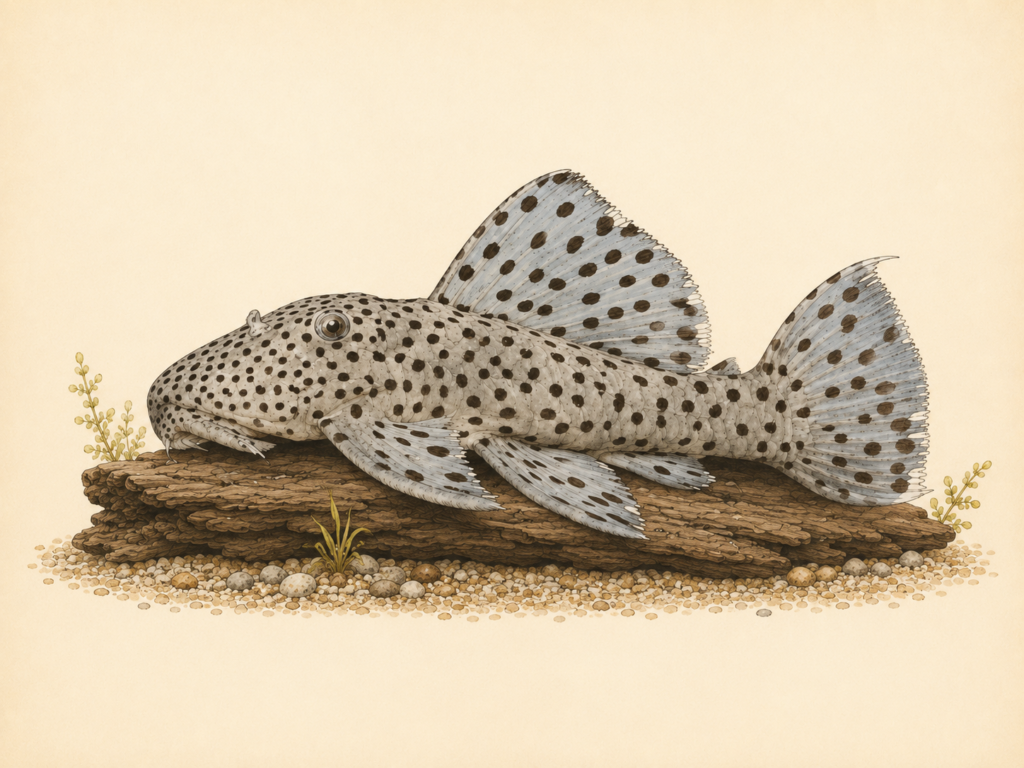
The L264 Sultan Pleco is an undeniably handsome fish. Its base body colour is a deep, velvety black that can range from pure jet-black in well-maintained specimens to a slightly brownish-black in stressed or poorly conditioned individuals. Scattered across this dark canvas are numerous bright yellow to cream-coloured spots, varying in size from pinpricks to roughly 3-4 mm in diameter. These spots cover the head, body, and all fins, including the caudal fin, creating a striking contrast that makes this species instantly recognisable.
The body shape is typical of the Leporacanthicus genus – somewhat elongated and dorsoventrally flattened, with a broad, slightly depressed head. The mouth is positioned ventrally (underslung), as is characteristic of suckermouth catfish, but unlike many other pleco species, the L264 possesses prominent, forward-pointing teeth in the upper jaw. These teeth are not used for rasping algae from surfaces; rather, they serve as tools for prying invertebrates from crevices and scraping protein-rich food from rocky substrates. This dental arrangement is a key identifier of the genus and gives rise to the “vampire pleco” nickname shared across Leporacanthicus species.
The dorsal fin is tall and sail-like, particularly in males, and features the same yellow spotting as the body. The pectoral and pelvic fins are broad and well-developed, equipped with stiff spines that allow the fish to wedge itself securely into crevices – a natural defence mechanism. The caudal fin is forked, with extended filaments on the upper and lower lobes in mature specimens, adding an element of elegance to an already impressive profile.
Sexual dimorphism is subtle but present. Males tend to develop more pronounced odontodes (small hook-like growths) along the pectoral fin spines and on the cheeks, particularly as they mature. Males may also appear slightly broader across the head when viewed from above, while females tend to be a touch rounder in the belly region when in breeding condition. Juveniles display the same spotted pattern as adults, though the spots may be proportionally larger relative to body size, and the contrast between spots and base colour can be even more vivid in young fish.
Natural Habitat
Leporacanthicus joselimai is endemic to Brazil, specifically the Rio Tocantins and Rio Araguaia drainage systems in the states of Goias, Tocantins, and Para. These are large, dynamic river systems that flow northward through the Brazilian Shield before joining to form the lower Tocantins, which eventually empties into the Amazon estuary near Belem. The species has also been associated with collection localities in the Rio Xingu region, though its precise distribution across this vast area continues to be refined as taxonomic surveys advance.
In the wild, the Sultan Pleco inhabits areas of moderate to strong current, typically in rocky stretches of river where the substrate is composed of boulders, cobbles, and bedrock rather than sand or mud. These environments are characterised by clear to slightly turbid water, high dissolved oxygen levels, and relatively warm temperatures year-round. During the dry season, water levels drop significantly, concentrating fish in deeper pools and channels where rocky structures provide both shelter and feeding grounds. During the wet season, flooding expands the available habitat and triggers breeding activity in many species, including Leporacanthicus.
The water chemistry in these habitats is generally soft and slightly acidic to neutral, with pH values typically ranging from 5.5 to 7.0 and very low mineral content. The substrate is largely devoid of rooted plants, though biofilm, algae, and aufwuchs (the complex community of micro-organisms, algae, and detritus that coats submerged surfaces) are present on rock surfaces. Invertebrates such as insect larvae, small crustaceans, and snails are abundant among the rocks, forming a significant component of the Sultan Pleco’s natural diet.
Understanding this habitat is crucial for replicating appropriate conditions in captivity. The key takeaways are strong water movement, high oxygenation, warm temperatures, soft to moderately hard water, and an abundance of rocky hiding places. Aquarists who recreate these conditions will find that their Sultan Plecos display bolder behaviour, better colouration, and improved overall health.
Tank Size and Setup
A minimum tank size of 200 litres is recommended for a single L264 Sultan Pleco. If you intend to keep a pair or a small group, or if the fish will share the tank with other bottom-dwelling species, a volume of 300 litres or more is strongly advisable. While the Sultan Pleco is not an excessively large fish, it is territorial, particularly towards conspecifics and other similarly shaped plecos. Providing ample space reduces the intensity of territorial disputes and allows each individual to establish its own domain.
The aquascape should prioritise rocky structures above all else. Use a combination of smooth river stones, slate pieces, and purpose-built pleco caves to create a landscape with numerous hiding spots, crevices, and tunnels. Each pleco in the tank should have access to at least two or three potential hiding places so that it can choose its preferred territory without being forced into direct competition with tank mates. Caves made from ceramic, PVC pipe, or stacked slate are all suitable. For breeding attempts, dedicated pleco breeding caves with a single entrance and an appropriate internal diameter (slightly larger than the male’s body width) are essential.
Substrate choice is relatively flexible. Fine gravel or sand both work well, though sand is often preferred as it is gentler on the fish’s ventral surface and more closely mimics the natural habitat. Avoid sharp-edged substrates that could damage the pleco’s delicate belly skin.
Live plants are not strictly necessary and, given the somewhat boisterous nature of this species, may be uprooted or damaged. Hardy, low-light species such as Anubias, Java Fern (Microsorum pteropus), or Bolbitis heudelotii can be attached to rocks or driftwood to provide additional cover and contribute to water quality without being at risk of uprooting. Floating plants can be used to diffuse lighting, which the Sultan Pleco, being primarily nocturnal, will appreciate.
Driftwood can be included for aesthetic purposes and as supplementary grazing surfaces, though this species does not consume wood in the way that Panaque or Hypostomus species do. The tannins released by driftwood can also help to soften the water and lower pH slightly, which is beneficial.
Lighting should be subdued. The L264 is most active during twilight and nighttime hours. Bright, uninterrupted lighting will cause the fish to remain hidden for extended periods. A timer-controlled light cycle with a gradual dimming phase, or the use of moonlight LEDs during evening hours, will encourage the pleco to emerge and forage openly, allowing you to observe its natural behaviour.
Water Parameters
| Temperature | 25-30 °C |
| pH | 5.5-7.5 |
| General hardness (GH) | 2-15 dGH |
| Carbonate hardness (KH) | 1-10 dKH |
| Ammonia | 0 ppm |
| Nitrite | 0 ppm |
| Nitrate | Below 20 ppm |
The Sultan Pleco is a warm-water species that thrives at temperatures between 26 and 29 °C. While it can tolerate a slightly broader range, prolonged exposure to temperatures below 24 °C or above 31 °C should be avoided. Higher temperatures increase metabolic rate and oxygen demand, so if you maintain the tank at the warmer end of the range, ensure that oxygenation and filtration are correspondingly robust.
Water chemistry should be soft to moderately hard, with a slightly acidic to neutral pH being ideal. Wild specimens originate from very soft, acidic waters, and while captive-bred individuals may tolerate harder, more alkaline conditions, the best colouration and long-term health are typically achieved when parameters lean towards the softer, slightly acidic end of the spectrum. Consistency is more important than hitting a specific number – avoid sudden swings in pH or hardness, as these cause stress and can trigger disease.
Ammonia and nitrite must always be at zero. The Sultan Pleco is sensitive to poor water quality, and even brief exposure to elevated ammonia or nitrite levels can cause gill damage, loss of appetite, and secondary infections. Nitrate should be kept below 20 ppm through regular partial water changes – weekly changes of 25-30% are a sensible baseline for most setups. In heavily stocked tanks, more frequent or larger changes may be necessary.
Filtration and Equipment
Given the Sultan Pleco’s natural habitat in fast-flowing, well-oxygenated rivers, robust filtration and water movement are non-negotiable. An external canister filter rated for at least 1.5 to 2 times the tank volume is recommended. For a 200-litre tank, aim for a filter with a turnover rate of 300-400 litres per hour or more. This provides both mechanical and biological filtration capacity sufficient to handle the bioload, while also generating meaningful water movement within the tank.
Supplementary powerheads or wavemakers can be used to increase flow in specific areas of the tank, mimicking the riverine conditions the species encounters in the wild. Positioning a powerhead so that it directs flow across a rocky area creates a “rapids zone” that the pleco will often choose to inhabit, anchoring itself to rocks with its powerful suckermouth while enjoying the oxygenated current.
An air pump with an airstone or sponge filter provides additional oxygenation and serves as a useful backup in case the main filter fails. Surface agitation is important – still, stagnant water at the surface inhibits gas exchange and can lead to dangerously low oxygen levels, particularly at higher temperatures.
A reliable heater with a built-in thermostat is essential to maintain stable temperatures within the 25-30 °C range. In larger tanks, two smaller heaters positioned at opposite ends of the aquarium provide more even heat distribution than a single unit. Use an independent thermometer to verify the heater’s accuracy, as thermostat drift is not uncommon in aquarium heaters.
UV sterilisers are not essential but can be beneficial in reducing the incidence of free-floating pathogens, particularly in tanks housing wild-caught specimens or during the quarantine period. They should not be relied upon as a substitute for good husbandry, however.
Diet and Feeding
The L264 Sultan Pleco is primarily a carnivore. This is one of the most common areas of misunderstanding among new keepers, many of whom assume that all plecos are algae eaters. While the Sultan Pleco may occasionally graze on biofilm, it does not consume algae in any meaningful quantity and should not be purchased with the expectation that it will clean algae from your tank. Its specialised dentition is designed for consuming animal protein, and its diet in captivity should reflect this.
A well-balanced diet for the Sultan Pleco includes high-quality sinking carnivore pellets or wafers as a staple. These should be supplemented regularly with frozen or live foods such as bloodworm, brine shrimp, mysis shrimp, daphnia, and chopped earthworms. Blanched shellfish such as mussel or prawn can also be offered and are eagerly accepted. Some keepers report success with offering small snails (such as pest snails from other tanks), which the pleco will crush and consume using its powerful jaws.
Vegetable matter should not be entirely excluded. Occasional offerings of blanched courgette, cucumber, or sweet potato provide dietary fibre and micronutrients. However, these should be considered supplements rather than dietary staples. The ratio of protein-based foods to vegetable matter should sit at roughly 70:30 or higher in favour of protein.
Feed once daily, preferably in the evening or just after lights-out, when the fish is most active. Remove any uneaten food within 12 hours to prevent water quality deterioration. Overfeeding is a common problem with plecos because their nocturnal habits make it difficult to observe how much food is actually being consumed. Monitor the fish’s body condition – a well-fed Sultan Pleco should have a gently rounded belly without appearing bloated, and the area just behind the head should not appear sunken or pinched.
Behaviour and Temperament
The Sultan Pleco is a territorial species, particularly towards conspecifics and other bottom-dwelling catfish that compete for the same cave-dwelling niches. Males are the more aggressive sex and will vigorously defend their chosen cave or crevice against intruders, flaring their gill covers and pectoral fin spines, and in some cases engaging in physical combat that can result in damaged fins or odontodes. This territorial behaviour intensifies during breeding periods.
Despite this intraspecific aggression, the L264 is generally indifferent to mid-water and upper-water species. It is primarily nocturnal, spending the daylight hours tucked away inside its cave or wedged beneath a rock, emerging after dark to forage across the substrate and rock surfaces. This crepuscular to nocturnal activity pattern means that many keepers rarely see their Sultan Pleco during normal viewing hours unless the tank is dimly lit or the fish has become exceptionally well-settled.
Providing adequate hiding spaces is the single most effective way to reduce stress-related aggression. When each individual has its own territory and retreat, confrontations become brief and ritualised rather than escalating into damaging fights. In tanks with insufficient cover, dominant individuals may relentlessly harass subordinates, leading to chronic stress, poor colouration, and susceptibility to disease in the weaker fish.
The Sultan Pleco is not a schooling species and does not require the company of its own kind to thrive. A single specimen will do perfectly well in a community setting. If you wish to keep multiple individuals, provide at least two caves per fish and ensure the tank is large enough (300 litres or more for two or three specimens) to support distinct territories.
Tank Mates
The L264 Sultan Pleco is compatible with a wide range of peaceful to moderately boisterous community fish, provided that direct competition for bottom-dwelling cave space is minimised. The best tank mates are species that occupy different zones of the water column – mid-water schooling fish, surface dwellers, or open-water swimmers that will not intrude upon the pleco’s territory. Avoid housing the Sultan Pleco with other large, territorial plecos unless the tank is very spacious and generously decorated with multiple cave systems.
Good tank mates
- Cardinal Tetra – A peaceful, mid-water schooling fish that shares a preference for soft, acidic water and will not compete with the pleco for territory.
- Rummy Nose Tetra – Another excellent schooling companion that thrives in warm, well-oxygenated water and occupies the mid-water column.
- German Blue Ram – A small, warm-water cichlid that generally ignores bottom-dwelling catfish and appreciates similar water parameters.
- Corydoras sterbai – A heat-tolerant Corydoras species that forages on open substrate areas rather than competing for cave space.
- Bristlenose Pleco – A smaller, algae-eating pleco that typically occupies different microhabitats and rarely comes into territorial conflict with Leporacanthicus species.
- Pearl Gourami – A peaceful, mid-to-upper-water gourami that is unlikely to interact with a bottom-dwelling pleco.
- Harlequin Rasbora – A gentle, undemanding schooling fish that adds colour and movement to the mid-water zone.
- Kuhli Loach – A slender, peaceful loach that occupies sandy substrate areas and is generally too small and non-confrontational to provoke territorial behaviour.
Fish to avoid
- Common Pleco – Grows far too large and will dominate cave space, potentially stressing or injuring the smaller Sultan Pleco.
- Royal Pleco – A large, territorial pleco that will compete directly for hiding spots and may bully the L264.
- Red Tail Catfish – A massive predatory catfish that will eventually consume any fish small enough to fit in its mouth, including the Sultan Pleco.
- Oscar – A large, aggressive cichlid that may harass or attempt to eat smaller tank mates, especially bottom dwellers.
- Jaguar Cichlid – A highly aggressive predator that poses a serious threat to any pleco it can overpower.
- Tiger Barb – A notorious fin nipper that may target the Sultan Pleco’s extended fin filaments, causing stress and damage.
- Green Terror – A territorial cichlid with a tendency to attack bottom-dwelling species, particularly during breeding.
- African Cichlids (Mbuna) – Require hard, alkaline water incompatible with the Sultan Pleco’s needs, and their aggressive nature creates constant stress.
Breeding
Breeding the L264 Sultan Pleco in captivity is achievable but requires deliberate preparation and patience. This species is a cave spawner, with the male selecting and defending a suitable cave, enticing a female to deposit her eggs inside, and then assuming sole responsibility for guarding and fanning the clutch until the fry emerge.
To condition a breeding pair, gradually raise the temperature to the upper end of the acceptable range (28-30 °C) and increase the proportion of high-protein foods in the diet. Frequent, slightly cooler water changes can simulate the onset of the rainy season and help trigger spawning behaviour. Reducing the water level slightly before performing a large, cooler water change is a technique employed by many successful Leporacanthicus breeders.
The breeding cave is critical. It should be just wide enough for the male to enter comfortably and turn around, with a single entrance. Commercially available pleco breeding caves in sizes ranging from 40-60 mm internal diameter are generally appropriate, depending on the size of your fish. The male will clean the cave interior thoroughly before attempting to attract a female. Courtship involves the male blocking the cave entrance and vibrating his body to create water currents that signal his readiness to the female.
Once the female enters the cave, she deposits a clutch of typically 15-50 large, adhesive, orange-yellow eggs on the cave ceiling or walls. After spawning, the female departs, and the male takes over. He will fan the eggs with his pectoral fins to ensure adequate oxygenation and will aggressively defend the cave entrance against any intruders. Do not disturb the male during this period – excessive interference can cause him to abandon or consume the clutch.
Eggs typically hatch within 5-7 days at 28-30 °C. The fry are relatively large and will absorb their yolk sacs over the following 3-5 days before beginning to feed independently. First foods should include crushed high-protein pellets, baby brine shrimp (Artemia nauplii), and microworms. The fry grow steadily and will begin to display their characteristic spotted pattern within the first few weeks of life. Rearing tanks should be well-filtered but with gentle flow to prevent the tiny fry from being swept into filter intakes – a sponge filter is ideal for this purpose.
Common Diseases
The L264 Sultan Pleco is reasonably hardy once established in a well-maintained aquarium, but it is susceptible to several common freshwater fish diseases, particularly when water quality is suboptimal or during the stress of acclimatisation after purchase.
Ich (white spot disease), caused by the protozoan parasite Ichthyophthirius multifiliis, is one of the most frequently encountered ailments. It presents as small white cysts on the skin and fins. Treatment involves raising the temperature to 30 °C (if the fish can tolerate it) and adding aquarium salt at a rate of 1-2 grams per litre, or using a proprietary ich medication. Be cautious with copper-based medications, as scaleless and armoured catfish can be more sensitive to copper than other fish. Always use medications at half the recommended dose initially when treating plecos, and monitor the fish closely for signs of distress.
Bacterial infections, including fin rot and body sores, can occur when fish are stressed or injured. These are typically secondary infections that take hold after damage from territorial fights, poor water quality, or transport stress. Treatment involves improving water quality (the most important step), and if necessary, using antibacterial medications such as those containing phenoxyethanol or antibiotics prescribed by a veterinary professional.
Fungal infections may appear as cottony white growths on the skin, fins, or around wounds. These are again often secondary to physical damage or chronically poor conditions. Antifungal treatments containing methylene blue or malachite green (used at reduced doses for catfish) are effective.
Internal parasites can be a concern with wild-caught specimens. Symptoms include weight loss despite normal feeding, white or stringy faeces, and a generally emaciated appearance. Antiparasitic medications containing praziquantel or levamisole are commonly used to treat internal worms and flukes. Quarantining all new arrivals for a minimum of four weeks before introducing them to an established community is strongly recommended.
Maintaining excellent water quality through regular water changes, avoiding overcrowding, and providing a nutritionally complete diet are the best preventative measures against all of these conditions. A healthy, well-fed Sultan Pleco with access to clean water and adequate hiding spaces is far less likely to succumb to disease than one kept in suboptimal conditions.
FAQs
Is the L264 Sultan Pleco a good algae eater?
No. Despite being a pleco, the L264 is primarily carnivorous and will not consume algae in any significant quantity. Its specialised teeth are designed for gripping and tearing animal protein rather than rasping algae from surfaces. If you need an algae-eating pleco, consider a Bristlenose Pleco or an Otocinclus instead. The Sultan Pleco should be valued for its beauty and behaviour, not purchased as a utilitarian algae-control solution.
Can I keep more than one L264 Sultan Pleco in the same tank?
Yes, but with careful planning. Multiple specimens can coexist in a sufficiently large aquarium (300 litres or more) with abundant caves and hiding places. Provide at least two to three caves per individual to minimise territorial disputes. Males are more aggressive towards one another than females, so keeping a single male with one or two females is often the most harmonious arrangement. Monitor interactions closely, particularly in the first few weeks after introduction, and be prepared to separate individuals if aggression becomes excessive.
How can I tell the difference between a male and female L264?
Sexual dimorphism in the Sultan Pleco is subtle. Males typically develop longer and more prominent odontodes (small bristle-like growths) on the pectoral fin spines and along the cheeks as they mature. Males may also have a slightly broader, more angular head shape when viewed from above. Females tend to be slightly rounder in the abdomen, particularly when carrying eggs. These differences become more apparent as the fish reach sexual maturity, which typically occurs at around 2-3 years of age or roughly 8-10 cm in length.
What is the difference between the L264 and the L091?
Both the L264 (Leporacanthicus joselimai) and the L091 (Leporacanthicus triactis) belong to the same genus and share similar body shapes, sizes, and dietary requirements. The primary difference is in their colour patterns. The L264 features numerous small yellow or cream spots distributed across the entire body and fins. The L091, by contrast, displays three large, distinctive pale or yellowish spots – one on the head and two on the body – earning it the common name “Three Beacon Pleco.” Both species require similar care, and their husbandry is largely interchangeable.
Does the L264 Sultan Pleco need driftwood in its tank?
Driftwood is not essential for the Sultan Pleco. Unlike wood-eating pleco genera such as Panaque, the L264 does not require wood as a dietary component or for digestive purposes. However, driftwood can be a beneficial addition to the aquascape, providing additional surfaces for biofilm growth, releasing tannins that soften the water and lower pH, and creating visual barriers that help define territories. It is a welcome but optional element of the tank setup.
Related Guides
- L091 Three Beacon Pleco – A closely related Leporacanthicus species with similar care requirements and a distinctive three-spot colour pattern.
- L007 Galaxy Pleco – Another spotted South American pleco that thrives in similar warm, well-oxygenated conditions.
- Bristlenose Pleco – A popular, hardy pleco species often kept alongside L-number plecos in community setups.
- L046 Zebra Pleco – A highly sought-after Brazilian pleco from the Rio Xingu with similar water parameter requirements and breeding challenges.
- Corydoras sterbai – A heat-tolerant bottom-dwelling catfish that makes an excellent companion for warm-water pleco setups.