Quick summary
The L091 Three Beacon Pleco is a striking but moderately challenging carnivorous catfish best suited to intermediate to experienced fishkeepers who can provide a spacious, well-filtered, rock-filled 200+ litre tank with strong water flow. It is not an algae eater and needs a protein-rich diet, so it’s not a good fit for beginners looking for a low-maintenance cleanup fish.
🐠 Build a tank around this species
In this guide:
- Introduction
- Quick Stats
- Appearance
- Natural Habitat
- Tank Size and Setup
- Water Parameters
- Filtration and Equipment
- Diet and Feeding
- Behaviour and Temperament
- Tank Mates
- Breeding
- Common Diseases
- FAQs
Introduction
The L091 Three Beacon Pleco (Leporacanthicus triactis) is a striking and somewhat uncommon South American catfish that has earned a loyal following among pleco enthusiasts and collectors. Named for the three conspicuous pale spots – or “beacons” – that adorn its dorsal fin, this species stands out in any aquarium thanks to its bold patterning and assertive personality. It belongs to the genus Leporacanthicus, a small group of loricariid catfish sometimes referred to as “vampire plecos” on account of their distinctive elongated teeth, which are adapted for a more carnivorous diet than many of their algae-grazing relatives.
First described scientifically by Isbrucker and Nijssen in 1989, Leporacanthicus triactis hails from the fast-flowing tributaries of the Orinoco River basin in Venezuela and Colombia. In the wild, it inhabits rocky, well-oxygenated stretches of river where it forages among crevices for invertebrates and organic matter. This natural history informs much of its captive care requirements – it thrives in aquaria that replicate the oxygen-rich, moderately warm conditions of its native habitat.
The L091 is closely related to several other popular Leporacanthicus species, including the L264 Sultan Pleco (Leporacanthicus joselimai) and the L007 Galaxy Vampire Pleco (Leporacanthicus galaxias). While all members of the genus share similar care requirements and dietary preferences, L091 is distinguished by its three-spot dorsal pattern, darker base coloration, and slightly more robust build. It is not as frequently available in the hobby as some of its congeners, which adds to its appeal among dedicated collectors.
This guide covers everything you need to know to keep the L091 Three Beacon Pleco healthy and thriving in a home aquarium. From tank setup and water chemistry to feeding strategies and breeding tips, the information below is designed to help both intermediate and experienced fishkeepers provide optimal care for this rewarding species.
Quick Stats
| Scientific name | Leporacanthicus triactis |
|---|---|
| Common names | L091 Three Beacon Pleco, Three Beacon Pleco, L091, Vampire Pleco |
| Family | Loricariidae |
| Origin | Orinoco River basin, Venezuela and Colombia |
| Adult size | 25 cm |
| Lifespan | 10–15 years |
| Difficulty | Intermediate |
| Breeding difficulty | Advanced |
| Temperature | 25–30 °C |
| pH | 5.5–7.5 |
| GH | 2–15 dGH |
| KH | 1–10 dKH |
| Minimum tank size | 200 L |
| Conservation status | Least Concern (IUCN, assessed 2020) |
Appearance
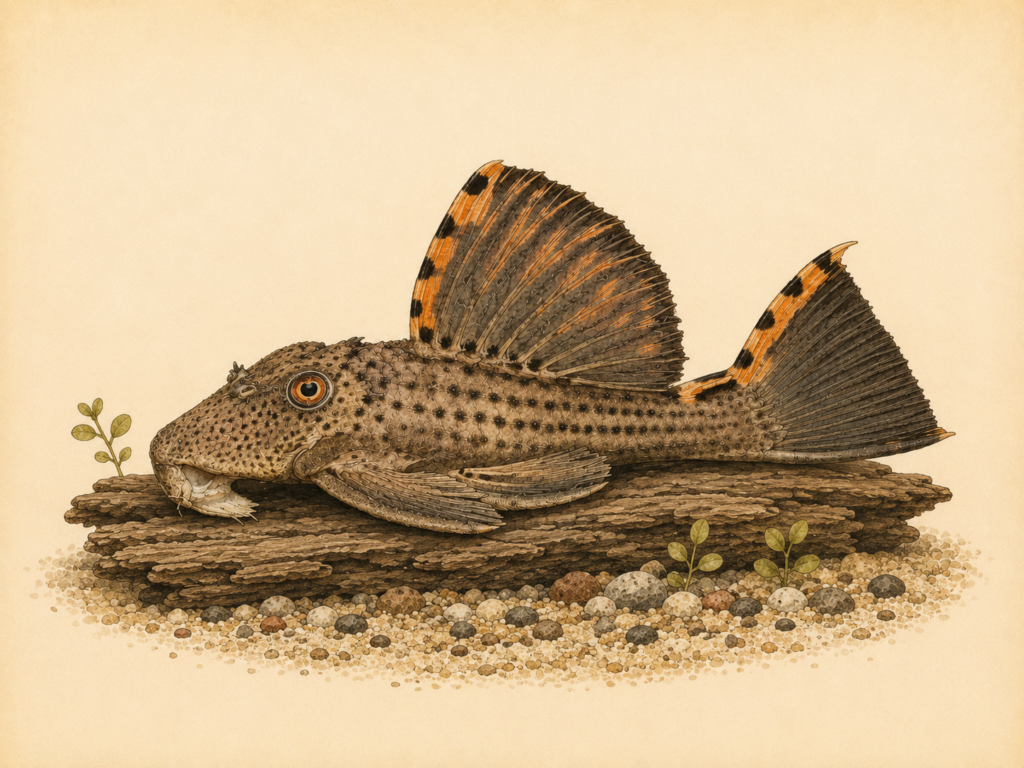
The L091 Three Beacon Pleco is a handsome, medium-sized loricariid with a powerful, somewhat flattened body profile typical of its genus. The base coloration is a deep charcoal grey to jet black, which provides a dramatic backdrop for the fish’s most defining feature: three bright, creamy-white to pale yellow spots arranged along the leading edge and membrane of the dorsal fin. These “beacons” are the origin of the species’ common name and are usually visible even when the dorsal fin is folded, though they are most impressive when the fin is fully erect during territorial displays or moments of activity.
In addition to the dorsal spots, many individuals display a scattering of smaller pale spots or speckles across the body, head, and other fins, though this secondary spotting is variable and tends to be more pronounced in juveniles. As the fish matures, the body coloration often darkens and the contrast between the base colour and the dorsal beacons becomes more striking. The ventral surface is typically lighter, ranging from dark grey to a mottled pale grey.
One of the most notable anatomical features of Leporacanthicus triactis, shared with its congeners, is the presence of elongated, curved teeth in both the upper and lower jaws. These teeth are visibly different from the rasping, comb-like dentition found in many other pleco genera and reflect the species’ carnivorous feeding habits. The interopercular odontodes – small spines on the gill covers – are also well-developed and can be flared outward during confrontations, serving both as a defensive mechanism and a visual warning to rivals.
The body is covered in bony plates (scutes) that provide a degree of armour, and the pectoral and pelvic fins are broad and strong, helping the fish anchor itself to rocks and driftwood in fast-flowing water. The caudal fin is forked, with the lower lobe often slightly longer than the upper, giving the fish a distinctive tail silhouette. Males tend to develop more prominent odontodes on the pectoral fin spines and along the sides of the head as they mature, which can be helpful for sexing adult specimens.
Overall, the L091 Three Beacon Pleco is an impressive and visually appealing fish that combines a sleek, darkly pigmented body with bold fin markings. Its appearance, coupled with its relatively manageable adult size, makes it a prized addition to any pleco-focused or South American biotope aquarium.
Natural Habitat
Leporacanthicus triactis is native to the Orinoco River drainage in South America, with recorded populations in both Venezuela and Colombia. Within this vast river system, the species is most commonly found in moderate to fast-flowing tributaries and side channels rather than the main stem of the Orinoco itself. These habitats are characterised by rocky substrates, often featuring large boulders, gravel beds, and an abundance of submerged rock formations that provide ample hiding places and territorial boundaries.
The water in these environments is typically warm, well-oxygenated, and ranges from clear to slightly tannin-stained depending on the specific tributary and the time of year. During the wet season, water levels rise dramatically and the current intensifies, while the dry season concentrates fish populations in smaller pools and channels where competition for shelter can become fierce. This seasonal fluctuation plays a role in the species’ breeding cycle and its territorial behaviour, both of which are important considerations for captive care.
The riverbed in the L091’s natural range is predominantly composed of rocks, gravel, and sand, with relatively little aquatic vegetation. Instead, the biological community is structured around the rocky substrate itself, with biofilms, aufwuchs (the complex community of algae, microorganisms, and invertebrates that colonise submerged surfaces), and small crustaceans forming the base of the food web. Fallen wood and leaf litter may be present but are not the dominant habitat feature, distinguishing these environments from the blackwater habitats favoured by some other loricariid species.
Understanding this natural habitat is key to providing appropriate captive conditions. The L091 Three Beacon Pleco evolved in an environment with strong water flow, high oxygen levels, warm temperatures, and an abundance of rocky hiding spots. Replicating these conditions in the aquarium will go a long way toward keeping this species healthy, reducing stress, and encouraging natural behaviours including territorial displays and, potentially, breeding.
Tank Size and Setup
A single adult L091 Three Beacon Pleco requires a minimum tank size of 200 litres. If you plan to keep more than one specimen, or if you intend to house this species alongside other bottom-dwelling fish, a larger aquarium of 300 litres or more is strongly recommended. Leporacanthicus triactis is a territorial species, and insufficient space is one of the most common causes of aggression and stress in captivity.
The aquascape should prioritise rockwork above all else. Use a combination of large river rocks, slate pieces, and stacked stones to create a network of caves, overhangs, and crevices. Each pleco in the tank should have access to at least one cave or shelter that it can claim as its own territory. Purpose-built ceramic pleco caves are excellent for this purpose and can also serve as potential breeding sites. Position caves so that their entrances face slightly into the current, mimicking the flow-oriented shelters found in the species’ natural habitat.
Driftwood can be included as a secondary decorative element, but it is not as essential for this species as it is for wood-eating genera such as Panaque. If you do add wood, choose dense hardwoods that will not break down quickly and will provide additional surfaces for biofilm growth. Bogwood and Malaysian driftwood are both suitable options.
The substrate should be smooth gravel or sand. Avoid sharp or rough substrates that could damage the fish’s ventral surface or barbels. A dark-coloured substrate will complement the species’ appearance and may help reduce stress by providing a more natural-looking environment.
Live plants are not strictly necessary, as the L091’s natural habitat is relatively devoid of vegetation. However, if you wish to include plants, choose robust species that can tolerate moderate to strong water flow, such as Anubias, Java Fern, or Bolbitis. These can be attached to rocks or driftwood rather than planted in the substrate, which keeps the tank floor clear for the plecos to forage and patrol.
Lighting should be subdued or at least include shaded areas within the tank. Like most plecos, the L091 is primarily nocturnal or crepuscular and will be more active and less stressed if it has access to dimly lit retreats during the day. Floating plants can be used to diffuse overhead lighting if desired.
Water Parameters
Maintaining stable, clean water is essential for the long-term health of the L091 Three Beacon Pleco. This species originates from warm, well-oxygenated rivers and is sensitive to poor water quality, particularly elevated levels of nitrogenous waste. Regular water changes of 25-30% per week are recommended, and more frequent changes may be necessary in heavily stocked tanks.
| Temperature | 25-30 °C |
| pH | 5.5-7.5 |
| General hardness (GH) | 2-15 dGH |
| Carbonate hardness (KH) | 1-10 dKH |
| Ammonia | 0 ppm |
| Nitrite | 0 ppm |
| Nitrate | Below 20 ppm |
The ideal temperature range sits between 26 and 28 °C for general maintenance. Slightly warmer conditions of 28-30 °C can be used to stimulate breeding behaviour. The pH should be kept on the slightly acidic to neutral side, with a target range of 6.0-7.0 being optimal for most specimens. While the species can tolerate mildly alkaline conditions, prolonged exposure to pH values above 7.5 is not advisable.
Water hardness is relatively flexible, but soft to moderately hard water is preferred. If your tap water is very hard, consider using a blend of reverse osmosis (RO) water and tap water to bring the GH and KH into the recommended ranges. Consistency is more important than hitting an exact number – sudden swings in pH or hardness are far more dangerous than a reading slightly outside the ideal range.
Ammonia and nitrite must always be maintained at 0 ppm. Even brief spikes can cause gill damage, stress, and secondary infections in this species. Nitrate should be kept below 20 ppm at all times, and ideally below 10 ppm. High nitrate levels over extended periods can lead to a condition sometimes called “hole in the head” or lateral line erosion, which is difficult to reverse once established.
Filtration and Equipment
Given the L091 Three Beacon Pleco’s preference for well-oxygenated, fast-flowing water, filtration is one of the most important aspects of the aquarium setup. A high-quality canister filter rated for at least 1.5 times the volume of your tank is the recommended starting point. For a 200-litre tank, this means a filter with a turnover rate of at least 300 litres per hour, though higher is generally better for this species.
Supplementary powerheads or wavemakers can be used to increase water circulation within the tank, particularly if the main filter outlet alone does not generate sufficient flow across the entire bottom of the aquarium. Position the flow so that it sweeps across the rocky decor and cave entrances, simulating the river current that the fish experiences in the wild. However, ensure there are also areas of calmer water where the fish can rest without constantly battling the current.
An air pump with one or more airstones is a worthwhile addition, especially during warmer months or if you maintain the tank at the upper end of the temperature range. Warmer water holds less dissolved oxygen, and the L091 is particularly sensitive to low oxygen levels. Surface agitation from the filter outlet and airstones will help maintain adequate gas exchange.
A reliable heater with a thermostat is essential. Choose a heater rated for your tank volume and position it near the filter outlet or a powerhead to ensure even heat distribution. If you keep a large tank, consider using two smaller heaters rather than one large unit – this provides redundancy in case one fails and reduces the risk of localised hot spots.
Lighting requirements are modest. A standard LED aquarium light on a timer set for 8-10 hours per day is sufficient. If the tank is heavily lit for the benefit of plants, ensure that the pleco has access to shaded caves and overhangs where it can retreat during the day. Moonlight or low-intensity blue LEDs can be used during the evening hours to observe the fish’s nocturnal activity without causing stress.
Diet and Feeding
The L091 Three Beacon Pleco is primarily carnivorous, which sets it apart from many other commonly kept pleco species that are predominantly herbivorous or omnivorous. In the wild, Leporacanthicus triactis uses its specialised teeth to prise snails and other invertebrates from rock surfaces, and its diet consists largely of aquatic invertebrates, insect larvae, small crustaceans, and carrion. This carnivorous tendency must be reflected in captive feeding to maintain the fish’s health and condition.
A varied diet is the key to success with this species. High-quality sinking carnivore pellets or wafers should form the staple, supplemented with regular offerings of frozen or live foods. Bloodworm, blackworm, brine shrimp, mysis shrimp, and chopped prawns are all eagerly accepted. Whole or crushed snails – such as small pond snails or Malaysian trumpet snails – are an excellent and natural food source that allows the fish to exercise its feeding instincts.
While the L091 is not primarily an algae eater, it will occasionally graze on biofilm and aufwuchs that develop on rocks and driftwood. Some keepers report that their specimens accept blanched courgette, sweet potato, or other vegetables, but plant matter should be considered an occasional supplement rather than a dietary mainstay. Spirulina-based wafers or tablets can be offered from time to time for variety.
Feed once daily, preferably in the evening or just after lights-out when the fish is most active. Remove any uneaten food within a few hours to prevent water quality deterioration. The L091 is not a particularly messy eater compared to some larger pleco species, but a protein-rich diet can produce more waste, making efficient filtration and regular water changes all the more important.
Avoid feeding mammalian or avian proteins such as beef heart on a regular basis. While some fishkeepers use these foods as occasional treats, they contain fats that tropical fish cannot metabolise efficiently and may contribute to fatty deposits on internal organs over time. Stick to aquatic protein sources wherever possible.
Behaviour and Temperament
The L091 Three Beacon Pleco is a territorial and somewhat pugnacious fish, particularly toward other bottom-dwelling species and especially toward conspecifics. Males are the more aggressive sex, and two males housed in close proximity without adequate space and hiding spots can engage in vigorous fights that result in torn fins, scraped flanks, and significant stress. This territorial behaviour is most intense around cave entrances and preferred resting spots.
Despite its assertive nature toward tank-floor rivals, the L091 is generally indifferent to mid-water and surface-dwelling fish. It spends the majority of the daylight hours hidden within caves or wedged under rocks, emerging at dusk to patrol its territory and forage. Keepers who observe their tanks under dim evening lighting or moonlight LEDs will be rewarded with a much more active and interesting display of natural behaviour.
When threatened or startled, the L091 will flare its interopercular odontodes and lock itself into position within a cave or crevice using its pectoral fin spines. This defensive posture makes the fish extremely difficult to dislodge and serves as an effective deterrent against predators. It also means that catching this fish with a net can be challenging – use a trap or gently guide the fish into a container rather than trying to pull it from its hiding place.
In a sufficiently large tank with ample caves and line-of-sight breaks, multiple L091 specimens can coexist, though some level of chasing and posturing is to be expected, especially during the settling-in period. A ratio of one male to one or two females tends to produce the least conflict, but this is only feasible in tanks of 300 litres or more. Solitary specimens do perfectly well on their own and will display confident, engaging behaviour once they have established a territory.
The L091 is not a schooling fish and does not require the company of conspecifics for well-being. It is, however, an intelligent and curious animal that benefits from environmental enrichment in the form of complex rockwork, varied food offerings, and a well-maintained tank environment.
Tank Mates
Selecting appropriate tank mates for the L091 Three Beacon Pleco requires an understanding of its territorial nature and its preference for warm, well-oxygenated water. The best companions are peaceful to semi-aggressive mid-water and surface-dwelling species that will not compete for cave space or bottom territory. Avoid pairing the L091 with other large, territorial bottom-dwellers unless the tank is very spacious and heavily decorated with multiple caves and hiding spots. Fast-moving characins, medium-sized cichlids, and other South American species that occupy different water column levels tend to work well.
Good tank mates
- Cardinal Tetra – A peaceful, small schooling fish that occupies the mid-water column and poses no territorial conflict with bottom-dwelling plecos.
- Rummy Nose Tetra – Another excellent schooling tetra that thrives in the same warm, slightly acidic water conditions favoured by the L091.
- Congo Tetra – A robust, mid-sized tetra that adds colour to the upper water column without bothering bottom dwellers.
- German Blue Ram – A small, relatively peaceful dwarf cichlid that shares similar water parameter requirements and rarely competes with plecos for territory.
- Angelfish – A classic South American cichlid that occupies mid to upper water levels and coexists well with Leporacanthicus species in sufficiently large tanks.
- Corydoras sterbai – A heat-tolerant Corydoras species that forages on open substrate and is generally ignored by territorial plecos that focus on defending caves.
- Severum – A moderate-sized, relatively peaceful cichlid that makes a good community companion in larger setups with adequate space.
- Bristlenose Pleco – A smaller, herbivorous pleco that can coexist with the L091 provided each fish has its own cave territory in a spacious tank.
Fish to avoid
- Common Pleco – Grows extremely large and will compete aggressively for cave space, leading to territorial disputes and potential injury.
- Red Tail Catfish – A massive predatory catfish that will outgrow virtually any home aquarium and may attempt to consume smaller tank mates.
- Oscar – A large, messy, and often aggressive cichlid that can bully or injure medium-sized plecos, especially in tanks under 500 litres.
- Jaguar Cichlid – A highly aggressive predator that poses a direct threat to the L091 and most other tank mates.
- Tiger Shovelnose Catfish – A large predatory catfish entirely unsuitable for community tanks and capable of swallowing fish up to a surprising size.
- Flowerhorn – An extremely territorial and aggressive hybrid cichlid that will dominate the entire tank and attack bottom-dwelling species.
- Royal Pleco – While not aggressive per se, this large pleco occupies similar cave territories and can provoke prolonged standoffs with the L091 in confined spaces.
- Green Terror – A moderately large cichlid with a well-earned reputation for aggression, especially during breeding, posing a risk to bottom dwellers.
Breeding
Breeding the L091 Three Beacon Pleco in captivity is achievable but requires patience, careful preparation, and a degree of experience. Like other Leporacanthicus species, L. triactis is a cave spawner. The male selects and defends a suitable cave, entices a receptive female to enter and deposit her eggs, and then guards the clutch until the fry hatch and absorb their yolk sacs.
To encourage breeding, start by ensuring you have a confirmed male-female pair or a small group with at least one of each sex. Sexing adult specimens can be done with reasonable accuracy by examining the pectoral fin spines and head odontodes – males typically develop thicker, more prominent odontodes and broader heads as they mature. Females tend to be slightly rounder in the body when viewed from above, particularly when carrying eggs.
Provide multiple caves of appropriate size. The cave entrance should be just large enough for the fish to enter, and the interior should be snug – males prefer tight-fitting caves where they can brace themselves against the walls while guarding eggs. Ceramic or PVC pleco caves with a single entrance and a closed rear end are ideal. Position caves with their openings facing into moderate water flow.
Conditioning the pair with high-quality, protein-rich foods is important. Increase the frequency and variety of live and frozen foods in the weeks leading up to a breeding attempt. Slight adjustments to water parameters can also help trigger spawning – a large, cool water change of 30-40% that drops the temperature by 2-3 °C can simulate the onset of the rainy season and encourage reproductive behaviour.
Once spawning occurs, the female deposits a cluster of large, orange to amber-coloured eggs inside the cave. The male then fertilises the eggs and assumes sole responsibility for their care, fanning them with his fins to maintain water circulation and removing any unfertilised or fungused eggs. The incubation period is typically 5-7 days at 27-28 °C, after which the fry hatch with large yolk sacs attached.
The fry remain in or near the cave for several days while they absorb the yolk sac. Once free-swimming, they can be fed newly hatched brine shrimp (Artemia nauplii), microworms, and finely crushed high-protein pellets. Growth is steady but not rapid, and the fry will begin to develop their characteristic colouration within the first few weeks. Maintaining pristine water quality during the fry-rearing stage is absolutely critical – even small spikes in ammonia or nitrite can be fatal to young fish.
It is advisable to separate the fry into a dedicated grow-out tank if possible, as this allows for more precise control over feeding and water quality. A bare-bottomed tank with a sponge filter, a few small caves or sections of PVC pipe for shelter, and gentle water flow provides an ideal rearing environment.
Common Diseases
The L091 Three Beacon Pleco is a reasonably hardy species when kept in appropriate conditions, but like all freshwater fish, it is susceptible to a range of health problems, particularly when water quality is compromised or the fish is subjected to chronic stress.
White spot disease (Ichthyophthirius multifiliis) is one of the most common ailments encountered in aquarium fish, and plecos are no exception. Affected fish display small white cysts on the body and fins, along with flashing (rubbing against surfaces) and increased respiration. Treatment should be undertaken with care, as Leporacanthicus and other loricariids are sensitive to many common medications. Use ich treatments at half the recommended dose, or opt for a heat-based treatment by gradually raising the temperature to 30 °C over 24-48 hours and maintaining it for 7-10 days.
Bacterial infections, including fin rot and skin ulcers, can occur in fish that have been injured during territorial disputes or are kept in suboptimal water conditions. Symptoms include frayed or reddened fins, open sores, and lethargy. Improving water quality through increased water changes is the first line of treatment. In more severe cases, a broad-spectrum antibacterial treatment may be necessary.
Fungal infections typically present as white, cotton-like growths on the body or fins and often develop secondary to wounds or in tanks with poor water quality. Antifungal medications are widely available and generally well-tolerated by loricariids when used as directed.
Internal parasites can be a concern, particularly in wild-caught specimens. Symptoms may include weight loss despite a healthy appetite, white or stringy faeces, and a gradual decline in condition. A course of anti-parasitic medication, often containing praziquantel or levamisole, is usually effective. Quarantining new arrivals for a minimum of two to four weeks before adding them to an established community is a sensible precaution.
Lateral line erosion, sometimes referred to as “hole in the head” disease, can affect Leporacanthicus species kept in tanks with chronically elevated nitrate levels or nutritional deficiencies. This condition manifests as small, pitted lesions along the lateral line and head. Prevention is far easier than cure – maintain nitrate below 20 ppm, provide a varied diet rich in vitamins and minerals, and ensure the tank environment is clean and well-maintained.
Finally, stress-related issues such as loss of appetite, colour fading, and increased hiding can occur when the L091 is kept in an inappropriate environment – too small a tank, insufficient hiding places, overly aggressive tank mates, or unstable water parameters. Addressing the root cause of stress is essential for recovery, as prolonged stress suppresses the immune system and predisposes the fish to opportunistic infections.
FAQs
Is the L091 Three Beacon Pleco a good algae eater?
No, the L091 is primarily a carnivorous species and should not be purchased with the expectation that it will control algae growth in your tank. While it may graze occasionally on biofilm, its diet in captivity should focus on high-protein foods such as frozen bloodworm, prawns, snails, and sinking carnivore pellets. If you need an algae-eating pleco, consider a bristlenose pleco or a similar herbivorous species instead.
Can I keep more than one L091 in the same tank?
Yes, but only in a sufficiently large aquarium with abundant caves and hiding spots. A tank of at least 300 litres is recommended for a pair, and each fish must have access to its own cave territory. Males are particularly territorial toward one another, so keeping a single male with one or two females tends to produce the least conflict. In smaller tanks, a solitary specimen is the safest option.
How can I tell the difference between male and female L091 plecos?
Sexing juveniles is very difficult, but adult males can usually be distinguished by their broader heads, thicker pectoral fin spines with more prominent odontodes (small bristle-like projections), and a generally more robust appearance around the head and gill area. Females tend to have a rounder body profile when viewed from above, especially when gravid with eggs. These differences become more apparent as the fish reach sexual maturity at around 12-15 cm in length.
What is the difference between L091 and L264?
Both the L091 (Leporacanthicus triactis) and the L264 Sultan Pleco (Leporacanthicus joselimai) belong to the same genus and share similar care requirements, body shape, and carnivorous feeding habits. The primary differences are in colouration and patterning. The L091 is characterised by its dark body with three distinct pale spots on the dorsal fin, while the L264 typically displays a more uniform dark body with bright white to yellow spots on the dorsal and caudal fins. The L264 also tends to remain slightly smaller on average.
Does the L091 Three Beacon Pleco need driftwood in its tank?
Unlike wood-eating pleco genera such as Panaque, the L091 does not require driftwood as a dietary supplement and does not rasp wood as part of its feeding behaviour. Driftwood can be included as decoration and will develop biofilm that the fish may occasionally graze on, but rockwork and caves are far more important elements of the tank setup. Prioritise providing multiple caves and rocky hiding spots over driftwood when designing the aquascape for this species.
Related Guides
- L264 Sultan Pleco – A closely related Leporacanthicus species with similar care requirements, making it a natural companion guide for L091 keepers.
- L007 Galaxy Vampire Pleco – Another member of the Leporacanthicus genus with a distinctive spotted pattern, sharing the same carnivorous diet and territorial behaviour.
- Bristlenose Pleco – One of the most popular beginner-friendly pleco species, useful for comparison and as a potential tank mate for the L091.
- Corydoras sterbai – A heat-tolerant bottom-dwelling catfish that makes an excellent companion species in warm South American community setups.
- German Blue Ram – A dwarf cichlid that thrives in similar warm, soft-water conditions and complements the L091 in a well-planned community tank.