Quick summary
The Sparkling Gourami is a tiny, peaceful, sound-making fish best suited to aquarists with some experience who can provide a densely planted nano tank with soft, acidic, stable water. It’s a great choice if you want a calm community species with genuine character, but it’s not ideal for beginners or setups lacking cover, cleanliness, and consistent warmth.
🐠 Build a tank around this species
In this guide:
- Introduction
- Quick Stats
- Appearance
- Natural Habitat
- Tank Size and Setup
- Water Parameters
- Filtration and Equipment
- Diet and Feeding
- Behaviour and Temperament
- Tank Mates
- Breeding
- Common Diseases
- FAQs
Introduction
The Sparkling Gourami (Trichopsis pumila) is one of the most enchanting small freshwater fish available in the aquarium hobby, yet it remains surprisingly underappreciated compared to its larger gourami relatives. Measuring barely four centimetres at full maturity, this diminutive labyrinth fish captivates keepers with its iridescent scales that shimmer in shades of blue, green, and red under aquarium lighting, an effect that earns it the “sparkling” moniker. Perhaps even more remarkable is its ability to produce audible croaking sounds, a behaviour that sets it apart from nearly every other small tropical fish and never fails to delight aquarists who encounter it for the first time.
Native to the slow-moving, heavily vegetated waters of Southeast Asia, the Sparkling Gourami is well suited to planted nano aquariums and peaceful community setups. Its modest size, relatively straightforward care requirements, and fascinating behavioural repertoire make it an excellent choice for aquarists who have moved beyond absolute beginner level and are seeking something with genuine character. Unlike many micro fish that serve primarily as schooling ornaments, the Sparkling Gourami displays complex social interactions, territory establishment, and breeding behaviours that reward patient observation. This guide covers everything you need to know to keep and breed Trichopsis pumila successfully in a home aquarium.
Quick Stats
| Scientific name | Trichopsis pumila |
|---|---|
| Common names | Pygmy Gourami, Dwarf Croaking Gourami |
| Family | Osphronemidae |
| Origin | Southeast Asia (Thailand, Laos, Cambodia, Vietnam, Malaysia, Indonesia) |
| Adult size | 4 cm |
| Lifespan | 3–5 years |
| Difficulty | Intermediate |
| Breeding difficulty | Moderate |
| Temperature | 22–28 °C |
| pH | 5–7.5 |
| GH | 2–12 dGH |
| KH | 1–8 dKH |
| Minimum tank size | 40 L |
| Conservation status | Least Concern (IUCN) |
Appearance
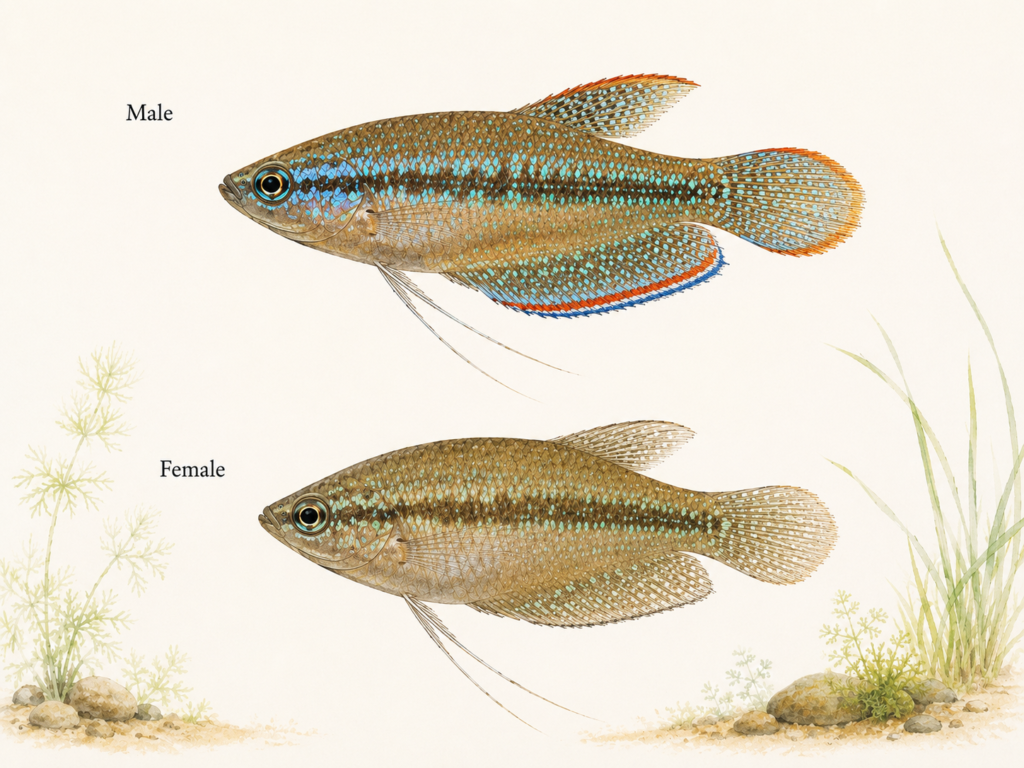
At first glance, the Sparkling Gourami might appear unremarkable, a small, somewhat elongated fish with muted brownish tones. However, closer inspection under decent lighting reveals an astonishingly beautiful animal. The body is slender and laterally compressed, with a pointed snout and relatively large eyes that give the fish an alert, expressive look. The base colouration ranges from pale olive-brown to warm beige, overlaid with rows of iridescent spots and flecks that flash brilliant blues, greens, and reds as the fish moves through the water. These sparkling scales are most vivid along the flanks and gill plates.
A dark horizontal stripe runs from the snout through the eye and along the body to the base of the caudal fin, often flanked by secondary stripes or rows of dark blotches. The fins are particularly attractive: the dorsal, anal, and caudal fins are largely translucent but adorned with fine iridescent blue-green edging and delicate red or russet spotting. The pelvic fins are modified into elongated filaments, a characteristic feature of gouramis, and these are typically tipped in bright white or pale blue. The eye itself often shows a striking blue-green iridescence.
Sexual dimorphism is subtle but discernible with practice. Males tend to be slightly more intensely coloured, particularly when in breeding condition, and their dorsal and anal fins are marginally more pointed at the tips compared to the more rounded fin profiles of females. Males may also appear slimmer when viewed from above, whilst gravid females display a noticeably rounder belly. Under strong side-lighting or with a dark substrate, the iridescent qualities of both sexes are shown to their full, spectacular effect.
Natural Habitat
Trichopsis pumila inhabits a broad range across mainland and insular Southeast Asia, occurring in Thailand, Laos, Cambodia, Vietnam, peninsular Malaysia, Sumatra, and Borneo. Within this extensive range, the species consistently favours shallow, slow-moving or still bodies of water. It is most commonly found in rice paddies, swamps, marshes, peat bogs, roadside ditches, and the heavily vegetated margins of streams and ponds. These are typically lowland environments at relatively modest elevations.
The waters in which Sparkling Gouramis are found are characterised by dense aquatic and emergent vegetation, which provides shelter, foraging opportunities, and breeding sites. In many localities, the water is stained dark brown with tannins from decomposing leaf litter and organic matter, resulting in soft, acidic conditions with a pH that can drop as low as 4.0 in some peat swamp habitats. Dissolved mineral content is generally very low. The substrate is usually composed of mud, silt, and fallen leaves rather than sand or gravel.
As a labyrinth fish, the Sparkling Gourami possesses a specialised accessory breathing organ that allows it to take atmospheric air from the surface. This adaptation is vital in its natural habitat, where oxygen levels in the water can be extremely low, particularly during the dry season when water bodies shrink and temperatures rise. Understanding this natural environment, warm, soft, acidic, densely planted, and low in water flow, is the key to replicating ideal conditions in captivity.
Tank Size and Setup
A single pair or small group of Sparkling Gouramis can be comfortably housed in an aquarium of 40 litres or more. For a group of six to eight individuals, which allows for more natural social dynamics and is generally recommended, a tank of 60 to 80 litres is preferable. Longer, shallower tanks are better suited to this species than tall, narrow designs, as the fish inhabit the middle and upper water layers and need easy access to the surface for air-breathing.
The aquascape should prioritise dense planting. Stem plants such as Rotala, Limnophila, and Hygrophila provide excellent mid-ground and background cover, whilst floating plants like Salvinia, Amazon Frogbit, or Red Root Floaters are particularly valuable. Floating vegetation diffuses overhead light, reduces surface agitation, and creates the shaded, secure environment that encourages Sparkling Gouramis to display their best colours and most natural behaviours. The fish will also use floating plants as anchoring points for bubble nests during breeding.
Leaf litter is another highly beneficial addition. Dried Indian Almond leaves (Catappa), oak leaves, or similar botanicals placed on the substrate will slowly release tannins that soften and acidify the water, mimicking the natural blackwater conditions these fish experience in the wild. The decomposing leaves also encourage the growth of biofilm and microfauna, which the fish will graze on between meals. Driftwood, particularly pieces with intricate branching, provides additional cover and visual barriers. The substrate itself is best kept natural, fine dark sand or soil-based substrates work well and help display the fish’s iridescence effectively.
Avoid overly bright, open aquascapes with minimal cover. Sparkling Gouramis are naturally shy fish that will spend most of their time hiding and appear washed-out and stressed in stark, barren environments. With proper cover and dim lighting, they become far bolder, frequently venturing into open areas and displaying to one another.
Water Parameters
| Temperature | 22–28 °C |
| pH | 5.0–7.5 |
| General hardness (GH) | 2–12 dGH |
| Carbonate hardness (KH) | 1–8 dKH |
| Ammonia | 0 ppm |
| Nitrite | 0 ppm |
| Nitrate | Below 20 ppm |
Sparkling Gouramis are adaptable within a reasonable range, but they thrive best in soft, slightly acidic water. A pH of 6.0 to 7.0 and a general hardness below 8 dGH represent the sweet spot for long-term health, vibrant colouration, and successful breeding. Fish kept in harder, more alkaline water often survive but may appear less colourful and prove reluctant to breed.
Temperature stability is more important than hitting a precise number. A steady 24–26 °C is ideal for general maintenance, whilst a slight increase to 27–28 °C can be used to condition fish for breeding. Ensure the tank has a well-fitting lid or minimal gap between the water surface and any cover glass. Because Sparkling Gouramis breathe atmospheric air regularly, cold draughts across the water surface can cause them to inhale cold air, potentially damaging the labyrinth organ and leading to respiratory illness. A covered tank maintains a warm, humid air layer above the water, which is essential for the long-term health of any labyrinth fish.
Regular partial water changes of 15 to 25 per cent weekly are sufficient to maintain water quality. When performing water changes, ensure the replacement water is closely matched in temperature and chemistry. Sudden shifts in pH or hardness can stress these small fish considerably.
Filtration and Equipment
Given the Sparkling Gourami’s preference for still or gently moving water, filtration should be effective but produce minimal current. Sponge filters powered by a small air pump are arguably the ideal choice for a Sparkling Gourami tank. They provide excellent biological filtration, create very little water movement, and pose no risk of trapping small fish or fry. A single sponge filter rated for the tank’s volume is usually sufficient.
If you prefer a hang-on-back or small internal canister filter, reduce the outflow by fitting a spray bar, directing the output against the glass, or baffling it with filter sponge. The key is to avoid strong surface agitation, which disrupts bubble nests and discourages the fish from using the upper water column. Internal filters with adjustable flow rates also work well in nano setups.
A reliable heater with an accurate thermostat is essential unless you live in a consistently warm climate. A heater guard is advisable for very small tanks to prevent the fish from resting against the element and burning themselves. Lighting should be moderate rather than intense, heavily planted tanks may benefit from a quality LED unit to support plant growth, but the floating plants will naturally shade much of the tank. If the aquarium lacks floating vegetation, consider dimming the light or using a timer to provide no more than eight to ten hours of illumination per day.
A tight-fitting lid is, as mentioned above, a non-negotiable requirement. It maintains the warm, humid air cushion above the water surface that labyrinth fish depend on when taking surface breaths.
Diet and Feeding
In the wild, Sparkling Gouramis are micro-predators that feed on tiny invertebrates, insect larvae, zooplankton, and other small organisms found amongst dense vegetation. In captivity, they accept a reasonably wide diet, but they do have a strong preference for small live and frozen foods over dry preparations.
The staple diet should ideally consist of high-quality micro-pellets or crushed flake food designed for small tropical fish. However, to maintain optimal health, colour, and condition, this should be supplemented regularly, ideally daily, with small frozen or live foods. Baby brine shrimp (Artemia nauplii), micro worms, grindal worms, Daphnia, Moina, and frozen cyclops are all excellent choices. Frozen bloodworm can be offered occasionally but should be chopped or selected in small sizes, as adult Sparkling Gouramis have tiny mouths relative to their body size.
Feed small amounts two to three times daily rather than one large meal. These fish have small stomachs and benefit from frequent, modest portions. Observe feeding carefully, especially in community tanks, as Sparkling Gouramis are not aggressive feeders and can easily be outcompeted by faster or bolder species. In a densely planted tank with established biofilm and microfauna, the fish will also graze naturally between scheduled feedings, which contributes positively to their overall nutrition.
Behaviour and Temperament
The Sparkling Gourami is a peaceful but socially complex species. Within a group, individuals establish a loose hierarchy, and males in particular will engage in frequent displays and minor territorial disputes. These interactions typically involve the fish flaring their fins, intensifying their colours, and, most characteristically, producing their distinctive croaking sounds. The croaking is generated by modified pectoral fin tendons vibrating against the swim bladder, and it can be surprisingly audible, even from across a quiet room. It is used in courtship, territorial assertion, and general communication between individuals.
Despite these intraspecific displays, aggression rarely escalates to the point of physical harm. Males may chase rivals briefly, but serious injuries are virtually unheard of in well-planted tanks with adequate space and visual barriers. Keeping the fish in groups of six or more helps to diffuse any tension, preventing a dominant male from fixating on a single subordinate.
Sparkling Gouramis are naturally shy and retiring, particularly when first introduced to a new aquarium. They tend to hover amongst plants, emerging cautiously to feed or explore. Over time, and especially in a well-planted tank with subdued lighting and calm tank mates, they become considerably bolder. Owners who invest patience in settling these fish in are rewarded with a species that will display openly, interact with one another in fascinating ways, and even learn to recognise the keeper at feeding time.
The fish are not strongly schooling in the traditional sense but are gregarious and clearly benefit from the company of their own kind. A solitary Sparkling Gourami tends to remain hidden and stressed, whilst a group displays far more natural, engaging behaviour.
Tank Mates
The Sparkling Gourami’s small size and gentle disposition require careful consideration when selecting companions. Tank mates should be similarly peaceful, small, and not prone to fin-nipping or boisterous behaviour that could stress or outcompete the gouramis.
Good tank mates
- Ember Tetra (Hyphessobrycon amandae), a tiny, peaceful tetra that occupies similar water conditions and will not compete aggressively for food.
- Chili Rasbora (Boraras brigittae), another diminutive Southeast Asian species that thrives in soft, acidic water and matches the gourami’s calm temperament perfectly.
- Celestial Pearl Danio (Danio margaritatus), a similarly sized, peaceful nano fish that occupies the middle to lower water column, reducing competition for space.
- Pygmy Corydoras (Corydoras pygmaeus), a gentle bottom-dwelling catfish that stays small and will not bother the gouramis, whilst adding activity to lower tank levels.
- Harlequin Rasbora (Trigonostigma heteromorpha), a classic community fish from overlapping natural ranges, peaceful and well suited to the same soft, acidic water parameters.
- Otocinclus (Otocinclus spp.), a small, inoffensive algae-eating catfish that stays out of the gourami’s way and helps maintain a clean tank.
- Kuhli Loach (Pangio kuhlii), a peaceful, nocturnal bottom-dweller from Southeast Asia that coexists harmoniously in planted setups.
- Amano Shrimp (Caridina multidentata), too large for the gouramis to eat and entirely non-aggressive, making them safe and useful algae-controlling companions.
- Lambchop Rasbora (Trigonostigma espei), a small, tranquil rasbora from similar habitats that adds colour without causing conflict.
Fish to avoid
- Betta Fish (Betta splendens), Males are territorial towards other surface-dwelling labyrinth fish and are very likely to harass or attack Sparkling Gouramis.
- Tiger Barb (Puntigrus tetrazona), a notorious fin-nipper whose boisterous nature will stress and likely injure the slow-moving gouramis.
- Convict Cichlid (Amatitlania nigrofasciata), far too aggressive and territorial for any tank containing small, peaceful species like Sparkling Gouramis.
- Angelfish (Pterophyllum scalare), Large enough to view Sparkling Gouramis as potential prey, and generally too assertive for a nano community.
- Paradise Fish (Macropodus opercularis), another labyrinth fish that is significantly larger and far more aggressive, posing a serious threat.
- Chinese Algae Eater (Gyrinocheilus aymonieri), Becomes increasingly aggressive and territorial with maturity and may harass or physically damage small tank mates.
- Giant Gourami (Osphronemus goramy), Grows enormous and would treat Sparkling Gouramis as food items.
- Red-Tail Shark (Epalzeorhynchos bicolor), highly territorial, especially near the substrate and mid-water, and will relentlessly chase small fish.
Breeding
Breeding Sparkling Gouramis in captivity is an achievable and highly rewarding endeavour. Like most gouramis, the male is a bubble nest builder, and the spawning and parental care behaviours are fascinating to observe. Success is most likely when the fish are well-conditioned, housed in appropriate water parameters, and provided with a calm, densely planted environment.
Begin by conditioning a group of Sparkling Gouramis on a rich diet of live and frozen foods for one to two weeks. Frequent small feeds of baby brine shrimp, Daphnia, and micro worms will bring females into spawning condition, evidenced by a noticeably rounded belly when viewed from above. Males in breeding mood will intensify their colours and begin croaking more frequently.
Spawning can occur in the main tank, but a dedicated breeding tank of 20 to 30 litres offers far higher fry survival rates. Set up the breeding tank with soft, acidic water (pH 5.5–6.5, GH below 5 dGH), a temperature of 26–28 °C, and very gentle filtration, an air-driven sponge filter on its lowest setting is ideal. Include floating plants such as Salvinia or Amazon Frogbit, as well as broad-leaved plants near the surface. The male will construct his bubble nest amongst the floating vegetation or beneath a broad leaf, incorporating small air bubbles bound with saliva into a raft that may be several centimetres across, though it is often relatively small and inconspicuous compared to the nests of larger gourami species.
When the nest is ready, the male will court the female with intensified displays and croaking. Spawning itself follows the classic gourami embrace: the pair spiral beneath the nest, the male wrapping his body around the female in a nuptial clasp. During each embrace, the female releases a small batch of eggs, which the male fertilises and then carefully collects in his mouth, depositing them into the bubble nest. This process is repeated multiple times over several hours, with a typical spawn producing 40 to 100 eggs in total.
After spawning, the female should ideally be removed, as the male assumes sole responsibility for guarding and maintaining the nest. He will patrol the area diligently, repairing the nest, retrieving any fallen eggs, and aggressively driving away any fish that approach. The eggs hatch in approximately 24 to 48 hours depending on temperature, and the tiny fry become free-swimming two to three days later.
Once the fry are free-swimming, the male can be removed. The fry are extremely small and require infusoria, paramecium, or commercially available liquid fry food as their first meals. After a week to ten days, they are generally large enough to accept freshly hatched baby brine shrimp, at which point growth accelerates noticeably. Maintain excellent water quality with very gentle filtration and perform small, frequent water changes using water matched precisely to the breeding tank’s parameters. The fry are delicate in the early weeks but become hardier as they grow, typically reaching sellable size at around three to four months of age.
Common Diseases
Sparkling Gouramis are reasonably hardy when maintained in appropriate conditions, but their small size and sensitivity to water quality fluctuations make them susceptible to several common freshwater ailments. Prevention through stable, clean conditions and a nutritious diet is far more effective than treatment.
Ich (white spot disease), caused by the parasite Ichthyophthirius multifiliis, is one of the most frequently encountered problems. It presents as small white cysts on the body and fins, accompanied by flashing (rubbing against surfaces) and lethargy. Raising the temperature gradually to 28–30 °C and treating with a half-dose of a proprietary white spot remedy, labyrinth fish can be sensitive to some medications at full strength, is generally effective. Ensure thorough aeration during treatment, as higher temperatures reduce dissolved oxygen levels.
Velvet disease (Piscinoodinium) is another parasitic infection to which labyrinth fish seem particularly prone. It manifests as a fine, gold or rust-coloured dusting on the body, often most visible on the gill plates. Affected fish may clamp their fins, breathe rapidly, and lose appetite. Treatment involves dimming the lights (the parasite is partially photosynthetic), raising the temperature slightly, and using a copper-based medication at a dose appropriate for small, sensitive fish.
Fin rot, typically caused by bacterial infection secondary to poor water quality or physical injury, can affect Sparkling Gouramis if conditions deteriorate. Frayed, discoloured, or receding fin edges are the hallmark signs. Improving water quality through increased water changes often resolves mild cases without medication. More advanced infections may require treatment with an antibacterial remedy.
Labyrinth organ damage, whilst not a disease per se, can occur if the air above the water surface is significantly colder than the water itself. This is most common in uncovered tanks or those kept in cold rooms. Affected fish may gasp at the surface or display laboured breathing. Prevention, maintaining a tightly fitted lid, is the only reliable approach, as damage to the labyrinth organ can be difficult to reverse.
Internal parasites, including intestinal worms and protozoan infections, can occasionally affect wild-caught specimens or fish from less reputable sources. Symptoms include weight loss despite normal feeding, white or stringy faeces, and a generally emaciated appearance. Appropriate anti-parasitic treatments are available from specialist aquatic retailers.
FAQs
Can Sparkling Gouramis really make sounds you can hear?
Yes, they genuinely can. The croaking sound produced by Sparkling Gouramis is audible to the human ear, particularly in a quiet room. The noise is generated by a mechanism involving the pectoral fin tendons and the swim bladder. Males croak most frequently during courtship and territorial interactions, but females also produce the sound. It is a distinctive, rapid clicking or buzzing sound that is one of the most endearing features of the species.
How many Sparkling Gouramis should I keep together?
A group of six or more is recommended. Whilst pairs can be kept successfully, a larger group distributes social interactions more evenly and results in more natural, less stressful behaviour. In a group, you will witness a wider range of displays, vocalisations, and social dynamics. Ensure the tank is adequately sized and well planted to provide visual barriers and personal space for each individual.
Are Sparkling Gouramis safe with shrimp?
Adult Sparkling Gouramis will generally coexist peacefully with adult dwarf shrimp such as Cherry Shrimp or Amano Shrimp. However, they are micro-predators by nature and will readily consume very small shrimplets. If you are trying to maintain a breeding colony of Neocaridina or Caridina shrimp alongside Sparkling Gouramis, expect some predation on the youngest shrimp. Dense moss and plant cover can provide refuges that allow at least some shrimplets to survive.
Do Sparkling Gouramis need a heater?
In most temperate climates, yes. Sparkling Gouramis are tropical fish that require consistently warm water between 22 and 28 °C. Unless your home maintains a stable temperature within this range year-round, a reliable aquarium heater with an accurate thermostat is essential. Temperature fluctuations, particularly sudden drops, are stressful and can trigger disease outbreaks.
Can I keep Sparkling Gouramis with Betta fish?
This combination is generally not recommended. Male Bettas in particular may view Sparkling Gouramis as rival labyrinth fish and display aggression towards them. Both species occupy the upper water column and surface area, increasing the likelihood of confrontation. Whilst some aquarists have managed this pairing in very large, heavily planted tanks, the risk of stress and injury to the smaller Sparkling Gouramis is significant, and they are better housed with other peaceful nano species.
Related Guides
- Croaking Gourami (Trichopsis vittata) Care Guide, the Sparkling Gourami’s larger relative, sharing the distinctive croaking behaviour and similar care requirements.
- Honey Gourami (Trichogaster chuna) Care Guide, another peaceful, small gourami species well suited to planted community tanks.
- Chili Rasbora (Boraras brigittae) Care Guide, an ideal nano tank companion for Sparkling Gouramis, sharing a preference for soft, acidic water.
- Planted Nano Tank Setup Guide, Essential reading for creating the densely planted, small-scale environments in which Sparkling Gouramis thrive.
- Pygmy Corydoras (Corydoras pygmaeus) Care Guide, a popular bottom-dwelling companion for nano community setups featuring Sparkling Gouramis.
- Blackwater Aquarium Setup Guide, a guide to recreating the tannin-rich, soft-water habitats that closely match the Sparkling Gourami’s natural environment.