Quick Summary
The Reed Tetra is a tiny, peaceful shoaling species ideal for planted nano tanks and blackwater setups, but it does require soft, acidic water and the company of at least eight of its own kind to truly thrive – making it a rewarding choice for aquarists willing to tailor their water chemistry accordingly.
🐠 Build a tank around this species
In this guide:
- Introduction
- Quick Stats
- Appearance
- Natural Habitat
- Tank Size and Setup
- Water Parameters
- Diet and Feeding
- Behaviour and Temperament
- Tank Mates
- Breeding
Introduction
The Reed Tetra (Hyphessobrycon elachys) is one of the smallest and most elegant members of the Hyphessobrycon genus, earning the alternative trade name “Veilfin Tetra” thanks to its gracefully elongated dorsal and anal fins. Despite its diminutive adult size of around 2 cm, this micro-predator packs a surprising amount of visual interest and behavioural nuance into a very small package. It hails from slow-moving, tannin-stained waterways in South America, and it brings a subtle, wild beauty to aquaria that can be difficult to replicate with larger, showier species.
Reed Tetras remain relatively uncommon in the mainstream aquarium trade, though they have gained a devoted following among nano-tank enthusiasts and blackwater biotope keepers. Their care is not especially difficult once their core requirements – soft, acidic water and a suitably sized group – are met, but they are not the most forgiving species for a complete beginner who has yet to master water chemistry. For anyone with a little experience and a genuine interest in South American micro fish, the Reed Tetra is an absolute gem.
This guide covers everything you need to know to keep Hyphessobrycon elachys healthy and happy in a home aquarium, from tank setup and water parameters to diet, behaviour, compatible tank mates, and breeding. Whether you are planning a dedicated nano biotope or looking for a peaceful addition to an existing soft-water community, the information below will help you provide the best possible care.
Quick Stats
| Scientific name | Hyphessobrycon elachys |
|---|---|
| Common names | Reed Tetra, Veilfin Tetra |
| Family | Acestrorhamphidae (formerly Characidae) |
| Origin | Upper Paraguay River basin, Mato Grosso, Brazil |
| Adult size | 2 cm |
| Lifespan | 3–5 years |
| Difficulty | Intermediate |
| Breeding difficulty | Advanced |
| Temperature | 24–27 °C |
| pH | 6–7.2 |
| GH | 3–10 dGH |
| KH | 1–4 dKH |
| Minimum tank size | 40 L |
| Conservation status | Least Concern (IUCN, assessed 2021) |
Appearance
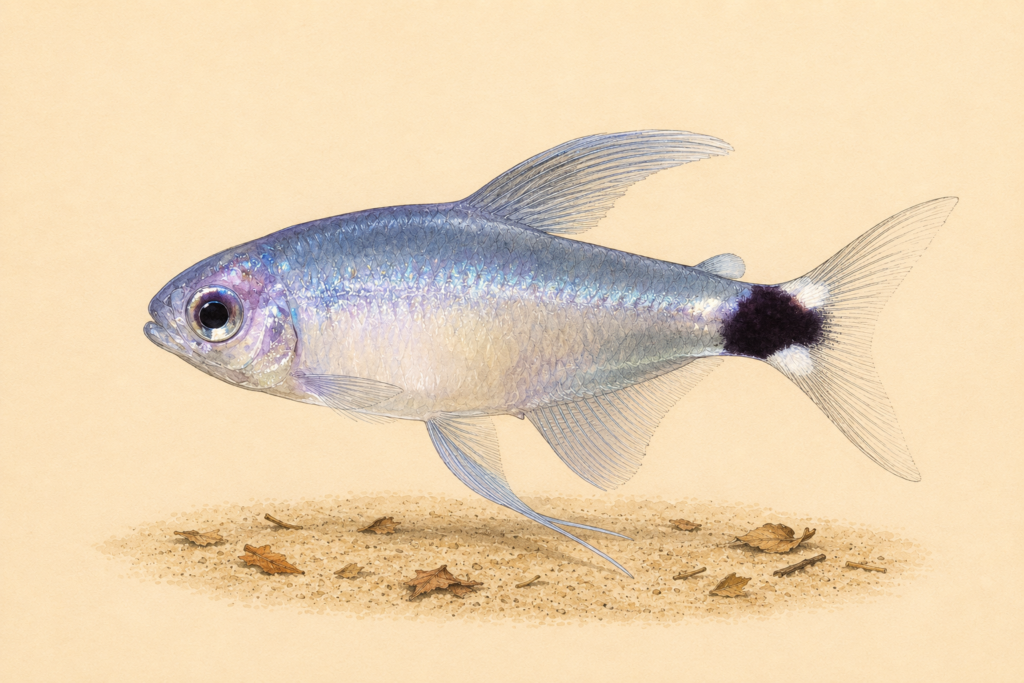
At first glance the Reed Tetra might appear unremarkable – a tiny, somewhat translucent fish with a silvery body. Look more closely, however, and its quiet charm becomes apparent. The body is slender and laterally compressed, typical of small characins, with a faint iridescent sheen that catches the light under low-angle aquarium illumination. A thin, dark lateral stripe runs from behind the gill cover to the base of the caudal fin, sometimes appearing more pronounced when the fish is relaxed and in optimal water conditions. The overall colouration is a subtle blend of pale silver, soft grey, and hints of warm amber, with the belly being slightly lighter than the flanks.
The feature that truly sets Hyphessobrycon elachys apart from many similarly sized tetras is its finnage. The dorsal fin is noticeably elongated, particularly in mature males, where it can develop a trailing, veil-like extension that gives the species its “Veilfin Tetra” trade name. The anal fin is likewise extended and gently tapered. These elongated fins lend the Reed Tetra an almost ethereal quality as it drifts through densely planted or tannin-rich water, looking far more refined than its tiny size might suggest.
Sexual dimorphism is present but subtle. Males tend to be slightly smaller and more slender than females, and they display the more pronounced fin extensions. Mature females are a touch deeper-bodied, especially when carrying eggs, and their fins, while still attractive, are shorter and more rounded. Both sexes share the same baseline colouration, making sexing most reliable in a well-conditioned group where direct comparison is possible.
Reed Tetras show their best colour and finnage when kept in soft, acidic water with subdued lighting and a dark substrate – conditions that mimic their natural blackwater habitat. Under harsh, bright lighting or in hard, alkaline water, they can appear washed out and stressed, with clamped fins that obscure their most appealing physical traits.
Natural Habitat
Hyphessobrycon elachys is native to the upper Paraguay River basin in the Mato Grosso state of Brazil. It inhabits slow-moving streams, backwaters, and marshy areas where the water is shallow and heavily influenced by surrounding vegetation. These habitats are characterised by dense stands of aquatic and emergent plants – including reeds, from which the common name derives – and a thick layer of leaf litter on the substrate.
The water in these environments is typically soft, acidic, and stained a deep amber or brown by humic acids and tannins released from decomposing leaves and wood. Conductivity is very low, general hardness is minimal, and the pH can drop well below 6.0 in the dry season. Light penetration is reduced by the tannin staining and the overhanging vegetation, creating a dim, sheltered environment.
The substrate in these areas is usually composed of fine sand, mud, and a deep carpet of fallen leaves and plant debris. Submerged root tangles, fallen branches, and dense marginal vegetation provide abundant cover from predators. Reed Tetras are found among these structures in loose shoals, picking tiny invertebrates and micro-organisms from the water column and the surfaces of plants and leaf litter.
Understanding this natural habitat is key to providing appropriate aquarium conditions. The species has evolved in water that is very soft and acidic, with minimal mineral content and plenty of organic structure. While they can tolerate a somewhat broader range of parameters in captivity, replicating the general character of their wild environment – soft water, gentle flow, plenty of plant cover, and subdued lighting – will result in healthier, more colourful, and more behaviourally natural fish.
Tank Size and Setup
A group of eight to twelve Reed Tetras can be comfortably housed in a tank of 40 litres or more. Given their tiny adult size, a larger group – which always looks more impressive and encourages more natural behaviour – can be kept in tanks of 60 to 80 litres without overcrowding. If you plan to keep them in a community with other small species, a tank of at least 60 litres is advisable to provide adequate swimming space and territory for all inhabitants.
The aquascape should aim to recreate the sheltered, plant-rich environment of their natural habitat. A dark, fine-grained substrate such as dark sand or a specialist planted-tank soil works well, both aesthetically and functionally. A generous layer of dried leaf litter – Indian almond leaves (Terminalia catappa) or oak leaves are popular choices – serves multiple purposes: it releases beneficial tannins that soften and acidify the water, provides foraging surfaces for micro-organisms that the tetras will graze on, and creates a natural-looking carpet that enhances the fish’s colouration against its dark tones.
Dense planting is strongly recommended. Fine-leaved species such as Java moss, Vesicularia dubyana, various Cryptocoryne species, Microsorum pteropus (Java fern), and floating plants like Salvinia or Amazon frogbit all work well. The floating plants are particularly useful because they dim the light reaching the water column, replicating the shaded conditions the Reed Tetra prefers. Driftwood and small branches can be used to create additional structure and contribute tannins to the water.
Ensure there is a secure, tight-fitting lid or a sufficient gap between the water surface and the top of the tank. Like many small characins, Reed Tetras can be surprisingly good jumpers, especially when startled. A cover of floating plants also helps discourage jumping by making the surface feel more enclosed.
Aim for gentle water movement. A sponge filter or a small internal filter with an adjustable flow rate is ideal. Reed Tetras are not strong swimmers and will struggle in tanks with powerful currents, spending energy fighting the flow rather than engaging in natural behaviour. Position the filter outlet so that it creates only a mild circulation, and consider baffling it if necessary.
Water Parameters
Providing the right water chemistry is arguably the single most important aspect of Reed Tetra care. Hyphessobrycon elachys is a soft-water species, and while it can tolerate a moderate range, it will not thrive in hard, alkaline conditions. If your tap water is very hard (above 10 dGH) or has a pH above 7.5, you will need to use reverse osmosis (RO) water or a blend of RO and tap water to bring the parameters into the suitable range.
| Temperature | 24 – 27 C |
| pH | 6.0 – 7.2 |
| General hardness (GH) | 3 – 10 dGH |
| Carbonate hardness (KH) | 1 – 4 dKH |
| Ammonia | 0 ppm |
| Nitrite | 0 ppm |
| Nitrate | Below 20 ppm |
The ideal sweet spot for most keepers is a pH of around 5.5 to 6.5, a GH of 2 to 5 dGH, and a temperature of 24 to 26 C. These conditions closely mirror the species’ natural habitat and will encourage the best colouration, finnage development, and overall health. Stability is as important as hitting an exact number – avoid sudden swings in pH or temperature, as these are far more stressful to small fish than a parameter that is slightly outside the textbook ideal but remains consistent.
The addition of Indian almond leaves, alder cones, or peat filtration media can help lower and buffer the pH naturally while also releasing tannins that condition the water. These botanicals create a mild antimicrobial effect that can reduce the incidence of bacterial and fungal infections – an additional benefit for these delicate little fish.
Regular water changes of around 15 to 20 per cent weekly are recommended to keep nitrate levels low and maintain water quality. When performing water changes, always match the temperature and chemistry of the replacement water as closely as possible to the tank water. This is especially important in very soft-water setups, where even small differences in mineral content or pH can produce a noticeable shock.
Filtration and Equipment
A gentle, reliable filtration system is essential for Reed Tetra care. Sponge filters are an excellent choice for nano and small tanks housing this species, as they provide effective biological and mechanical filtration without generating excessive current. Air-driven sponge filters also have the advantage of being safe for tiny fish and fry – there is no intake that could trap or injure them.
If you prefer a hang-on-back or small internal canister filter, choose one with an adjustable flow rate and set it to the lowest effective setting. You can also baffle the outflow with a piece of filter sponge or redirect it against the glass to dissipate the current. The goal is to maintain adequate circulation for even heat and oxygen distribution without creating a strong directional flow.
Heating requirements depend on your ambient room temperature. In most homes, a small adjustable heater rated for the tank’s volume will be needed to maintain a stable temperature within the 22 to 28 C range. Position the heater near the filter outflow so that warmed water is distributed evenly throughout the tank. A reliable thermometer – either a digital probe or a standard glass type – should be used to monitor temperature daily.
Lighting should be subdued to moderate. If you are growing live plants, a low to medium intensity LED light on a timer (approximately 8 hours per day) will usually suffice, especially if the plant choices lean towards low-light species. Floating plants are a natural and effective way to diffuse the light, creating the dappled, shaded conditions that Reed Tetras prefer. Avoid intense, direct lighting, which can stress the fish and wash out their colouration.
An air pump is not strictly necessary if you are using an air-driven sponge filter, as the filter itself will provide surface agitation for gas exchange. If using a different filter type, ensure there is some gentle surface movement to maintain adequate oxygenation.
Diet and Feeding
Reed Tetras are micro-predators in the wild, feeding on tiny invertebrates, insect larvae, zooplankton, and other minute organisms found among vegetation and leaf litter. In the aquarium, they accept a variety of foods, but their very small mouth size must be taken into account. Standard-sized flakes and pellets are far too large for them and will need to be crushed or replaced with micro-sized alternatives.
A good staple diet consists of high-quality micro pellets or finely crushed flake food designed for small tropical fish. Supplement this with regular offerings of live or frozen foods such as baby brine shrimp (Artemia nauplii), micro worms, grindal worms, daphnia, and cyclops. These protein-rich foods are not only nutritionally valuable but also stimulate natural foraging behaviour and can help condition the fish for breeding.
Feed small amounts two to three times per day rather than one large feeding. Reed Tetras have small stomachs relative to their body size, and multiple small meals mimic their natural continuous grazing pattern while reducing the risk of uneaten food fouling the water. Each feeding should be consumed within a couple of minutes; if food is still drifting around the tank after this time, you are offering too much.
In a well-established tank with a mature leaf litter layer and plenty of plant surfaces, Reed Tetras will also graze on biofilm and micro-fauna between feedings. This supplemental natural food source is one of the many benefits of a botanically rich setup and can contribute meaningfully to the fish’s overall nutrition and wellbeing.
Variety is important. A monotonous diet of dry food alone will not bring out the best colour or condition in these fish. Aim to include live or frozen foods at least three to four times per week, and rotate between different types to ensure a broad spectrum of nutrients.
Behaviour and Temperament
The Reed Tetra is a peaceful, somewhat timid species that does best in a calm, well-planted environment with the company of its own kind. A group of at least eight individuals is essential; in smaller numbers, these fish become visibly stressed, spending most of their time hiding and displaying washed-out colouration. In a suitably sized shoal of ten or more, they are far more confident, spending more time in open water and exhibiting their full range of natural behaviours.
Within the group, males will engage in gentle fin-flaring displays, positioning themselves alongside rivals and spreading their elongated dorsal and anal fins to impressive effect. These displays are entirely harmless – there is no physical aggression or fin-nipping involved – and they are one of the most attractive aspects of keeping this species. The displays are most frequent and intense when the fish are in good condition and the water parameters are within the ideal range.
Reed Tetras tend to occupy the middle to upper levels of the water column, drifting among plant stems and beneath floating vegetation. They are not fast, active swimmers in the manner of some larger tetras; their movement is more measured and deliberate, with bursts of speed reserved for feeding or fleeing perceived threats. This relatively sedentary demeanour makes them well suited to smaller tanks where more boisterous species might feel cramped.
They are not territorial in any meaningful sense, though males may loosely space themselves out within the group when displaying. They show no aggression towards other species and will generally ignore tank mates that are not large enough to threaten them. Conversely, they can be easily intimidated by larger or more assertive fish, which is an important consideration when planning a community setup.
Reed Tetras are most active during periods of subdued lighting – early morning, late evening, or in dimly lit tanks. Under very bright lights they tend to retreat into cover and remain largely inactive. This crepuscular tendency is another reason why diffuse, moderate lighting (or the use of floating plants to create shade) is so strongly recommended.
Tank Mates
Choosing appropriate tank mates for Reed Tetras requires careful consideration of their small size, peaceful nature, and preference for soft, acidic water. Any companion species should share similar water chemistry requirements, be small enough not to view the Reed Tetra as food, and be calm enough not to outcompete them for food or stress them through boisterous activity. Ideally, tank mates should also occupy slightly different areas of the tank to reduce competition for space.
Good tank mates
- Ember Tetra – A similarly tiny, peaceful tetra that thrives in the same soft, acidic conditions and makes an excellent companion in a nano community.
- Green Neon Tetra – Another small, soft-water tetra with a calm temperament and overlapping parameter requirements.
- Pygmy Corydoras – A diminutive bottom-dweller that poses no threat and helps keep the substrate clean without disturbing midwater species.
- Otocinclus – A gentle algae grazer that occupies different tank zones and shares the preference for stable, soft water.
- Celestial Pearl Danio – A small, peaceful species that coexists well in planted nano setups, provided water parameters are adjusted to suit both species.
- Chocolate Gourami – A quiet, soft-water species that inhabits the upper levels and makes a compatible, albeit somewhat demanding, companion.
- Sparkling Gourami – A tiny gourami with a gentle temperament that thrives in the same dimly lit, densely planted environments.
- Amano Shrimp – Large enough to avoid predation, peaceful, and useful for algae control in planted setups.
- Nerite Snail – A completely harmless and helpful algae eater that adds no bioload competition and tolerates a range of conditions.
Fish to avoid
- Angelfish – Far too large and predatory; adult angelfish will readily eat Reed Tetras.
- Tiger Barb – An active, nippy species that will harass and stress the Reed Tetra and may damage its elongated fins.
- Convict Cichlid – Aggressive and territorial, with vastly different water chemistry preferences.
- Betta – The Reed Tetra’s trailing fins may provoke aggression from male bettas, and bettas prefer calmer, solitary setups.
- African Cichlids – Require hard, alkaline water and are generally too aggressive and large for any community with Reed Tetras.
- Buenos Aires Tetra – Much larger and boisterous; will outcompete Reed Tetras for food and may bully them.
- Rainbow Shark – Territorial and far too large for a nano community; will dominate and stress smaller inhabitants.
Breeding
Breeding Reed Tetras in captivity is achievable but requires some dedication and attention to detail. Like many small characins, they are egg scatterers with no parental care, and the adults will readily consume their own eggs and fry if given the opportunity. A separate breeding setup is therefore strongly recommended.
Condition a group of healthy adults with frequent feedings of live and frozen foods – baby brine shrimp, micro worms, and daphnia are all excellent – for at least two weeks before attempting to breed them. This high-protein diet encourages egg development in females and increases spawning readiness in males. Select the plumpest females and the most vibrantly finned males for the breeding tank.
The breeding tank need not be large; a 10 to 20 litre tank is sufficient. Fill it with very soft, acidic water – a pH of 5.0 to 6.0 and a GH of 1 to 2 dGH is ideal. Use aged water conditioned with Indian almond leaves or peat extract to achieve a light amber tint. The temperature should be at the warmer end of the species’ range, around 26 to 28 C. Provide a spawning medium such as a clump of Java moss, fine-leaved plants, or a commercial spawning mop placed on the bottom of the tank. Some breeders use a mesh or grid over the base to allow eggs to fall through, out of reach of the adults.
Lighting should be very dim; spawning often occurs in the early morning hours. Introduce a pair or a small group (two males and three females works well) to the breeding tank in the evening. If conditions are right, spawning should occur within a day or two. The female will scatter small, semi-adhesive eggs among the plants or spawning medium, and the male will fertilise them as they are released.
Remove the adults immediately after spawning to prevent egg predation. The eggs are tiny and somewhat light-sensitive; keeping the breeding tank in near-darkness for the first 24 to 48 hours can improve hatch rates. The eggs typically hatch within 24 to 36 hours, and the fry become free-swimming after a further two to three days once they have absorbed their yolk sacs.
First foods for the fry should be infusoria or commercially available liquid fry food, as even baby brine shrimp are too large for the newly hatched fry. After a week or so, they will have grown enough to accept freshly hatched brine shrimp nauplii. Growth is slow, reflecting the species’ tiny adult size, and the fry are extremely delicate for the first few weeks. Maintain impeccable water quality with gentle sponge filtration and very small, frequent water changes using water matched precisely to the breeding tank’s parameters.
Common Diseases
Reed Tetras are not especially prone to species-specific diseases, but their small size and preference for soft, acidic water can make them vulnerable to common freshwater ailments if conditions deteriorate. Prevention through good husbandry is always the best approach.
Ich (white spot disease) is perhaps the most commonly encountered illness in freshwater aquaria, and Reed Tetras are susceptible. It presents as small white cysts on the body and fins and is usually triggered by sudden temperature drops or stress. Treatment involves gradually raising the temperature to 28 to 30 C over 24 to 48 hours and, if necessary, using a half-dose of a malachite green or formalin-based medication, as small fish can be sensitive to full-strength treatments.
Fin rot can occur if water quality is poor or if the fish have sustained fin damage from aggressive tank mates. The elongated fins of the Reed Tetra make it somewhat more vulnerable to this condition than short-finned species. Symptoms include ragged, discoloured, or receding fin edges. Improving water quality is the primary treatment; in severe cases, an antibacterial medication may be needed.
Bacterial infections and fungal infections can also arise, typically as secondary infections following injury, stress, or poor water quality. Maintaining stable, clean water with appropriate parameters and avoiding overcrowding are the most effective preventive measures.
Avoid using copper-based medications in tanks containing Reed Tetras or any invertebrate tank mates, as copper is toxic to both small fish at high doses and to shrimp and snails at any dose. Always research medication compatibility before treating, and consider quarantining new fish for at least two weeks before adding them to an established tank to reduce the risk of introducing pathogens.
Stress is perhaps the most significant underlying factor in disease susceptibility for this species. Ensuring a large enough group, providing adequate cover and dim lighting, maintaining stable water chemistry, and choosing calm tank mates will go a long way towards keeping your Reed Tetras healthy and disease-free.
FAQs
How many Reed Tetras should I keep together?
A minimum group of eight is recommended, though ten to twelve or more is preferable. Reed Tetras are obligate shoaling fish that rely on the security of numbers. In smaller groups, they become chronically stressed, which leads to poor colouration, suppressed immune function, and a reduced lifespan. A larger group also produces more impressive and natural-looking behaviour, including the gentle fin-flaring displays between males.
Can Reed Tetras live in hard water?
Reed Tetras can survive in moderately hard water for a time, but they will not thrive in it long-term. Their natural habitat is extremely soft and acidic, and they are physiologically adapted to those conditions. Water with a GH above 10 dGH or a pH consistently above 7.5 is likely to cause chronic stress, reduced lifespan, and difficulty breeding. If your tap water is hard, blending it with reverse osmosis water is the most practical solution.
Are Reed Tetras suitable for a nano tank?
Yes, Reed Tetras are excellent nano tank candidates due to their tiny adult size and relatively low activity level. A well-planted tank of 40 litres or more can comfortably house a group of eight to twelve individuals. The key requirements for a successful nano setup are soft, acidic water, gentle filtration, plenty of plant cover, and a secure lid to prevent jumping.
What is the best food for Reed Tetras?
A varied diet of micro pellets or finely crushed high-quality flake food supplemented with live or frozen baby brine shrimp, micro worms, daphnia, and cyclops is ideal. Their mouths are very small, so all food items must be appropriately sized. Live and frozen foods should be offered at least three to four times per week for optimal colour and condition.
Do Reed Tetras nip fins?
No, Reed Tetras are not fin nippers. They are an exceptionally peaceful species that shows no aggression towards other fish. However, the reverse can be a concern – their own elongated dorsal and anal fins may attract the attention of nippy species such as tiger barbs or serpae tetras. For this reason, it is important to choose tank mates that are equally peaceful and unlikely to target trailing fins.
Related Guides
- Ember Tetra Care Guide – Another tiny, peaceful tetra with overlapping care requirements that makes an ideal companion or alternative species for nano setups.
- Green Neon Tetra Care Guide – A fellow soft-water micro tetra from South America with similar needs and temperament.
- Pygmy Corydoras Care Guide – One of the best bottom-dwelling companions for Reed Tetras, sharing their preference for calm, planted tanks.
- Sparkling Gourami Care Guide – A small, blackwater-compatible species that pairs well with Reed Tetras in dimly lit community setups.
- Celestial Pearl Danio Care Guide – A popular nano fish with complementary care needs and a similarly peaceful disposition.