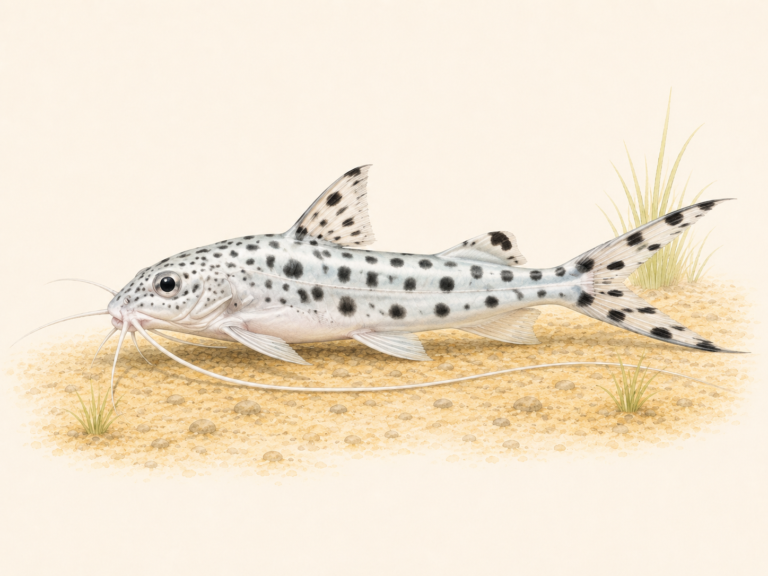
Spoonface Whiptail Catfish Care Guide – Tank Setup, Feeding and Breeding
Quick summary
The Spoonface Whiptail Catfish is a difficult, rarely available species best suited to experienced aquarists, requiring a spacious sandy-bottomed tank, pristine water quality, and a varied carnivorous diet. It is not recommended for beginners, who would do better starting with hardier whiptail or pleco species first.
🐠 Build a tank around this fish
In this guide:
- Introduction
- Quick Stats
- Appearance
- Natural Habitat
- Tank Size and Setup
- Water Parameters
- Filtration and Equipment
- Diet and Feeding
- Behaviour and Temperament
- Tank Mates
- Breeding
- Common Diseases
- FAQs
Introduction
The Spoonface Whiptail Catfish (Planiloricaria cryptodon) is one of the most unusual and visually striking members of the vast Loricariidae family. Native to South American river systems, this bottom-dwelling catfish is immediately recognisable thanks to its remarkably flattened, spoon-shaped snout and elongated, whip-like tail filament. It is a species that captivates experienced aquarists who enjoy keeping unusual and rarely seen fish, though its specific husbandry requirements place it firmly outside beginner territory.
Unlike many of the more commonly kept pleco and whiptail species, Planiloricaria cryptodon is a sand specialist. In the wild, it spends much of its time partially buried in sandy substrates on river bottoms, where its extraordinarily flat body profile serves as both camouflage and a hydrodynamic adaptation for life in moderate to strong currents. This lifestyle makes it a fascinating species to observe in captivity, but it also means that keepers must replicate these conditions carefully to ensure the fish thrives.
The Spoonface Whiptail Catfish remains relatively uncommon in the aquarium trade. It appears sporadically in specialist imports, often under various L-number or trade designations. When it does become available, it tends to attract considerable interest from catfish enthusiasts and dedicated loricariid collectors. Despite its rarity, those who have successfully maintained this species report it to be a rewarding and endlessly interesting aquarium inhabitant, provided its environmental needs are met.
This care guide covers everything you need to know about keeping Planiloricaria cryptodon in the home aquarium, from tank setup and water parameters to diet, behaviour, breeding, and compatible tank mates. Whether you are considering acquiring one of these remarkable fish or have recently added one to your collection, the information here will help you provide the best possible care.
Quick Stats
| Scientific name | Planiloricaria cryptodon |
| Common names | Spoonface Whiptail Catfish, Spoon-nosed Whiptail, Flatface Whiptail |
| Family | Loricariidae |
| Origin | South America – Amazon and Orinoco river basins |
| Adult size | 20-25 cm (including tail filament) |
| Lifespan | 8-12 years |
| Difficulty | Difficult |
| Breeding difficulty | Advanced |
| Temperature | 24-28 °C |
| pH range | 5.5-7.5 |
| General hardness (GH) | 2-12 dGH |
| Carbonate hardness (KH) | 1-8 dKH |
| Minimum tank size | 200 litres |
| Conservation status | Not Evaluated |
Appearance
Planiloricaria cryptodon is among the most dorsoventrally flattened of all loricariid catfish, and its body plan is adapted to an existence spent pressed against sandy river bottoms. The head is broad, extremely flat, and terminates in a distinctive spoon-shaped or spatulate snout that gives the species its common name. When viewed from above, the outline of the head is almost perfectly rounded and paddle-like, with the eyes positioned on top rather than on the sides, allowing the fish to remain watchful while largely buried in substrate.
The body tapers gradually from the wide head into a slender, elongated form that is typical of the whiptail group (subfamily Loricariinae). The caudal peduncle is very thin and can extend into a long, thread-like tail filament, particularly in mature males. This filament may be fragile and is sometimes damaged in transit or through poor handling, though it typically regenerates over time in good conditions.
The colouration of the Spoonface Whiptail Catfish is generally subdued but beautifully patterned. The base colour ranges from sandy brown to olive-grey, overlaid with a series of darker mottled markings, spots, and irregular bands that provide excellent camouflage against sandy and gravelly substrates. The ventral surface is typically paler, ranging from off-white to light cream. The fins are largely transparent to lightly pigmented, often with faint banding or spotting that echoes the body pattern.
The body is covered in bony plates (scutes), as is characteristic of the Loricariidae, giving the fish a somewhat armoured appearance. These plates are relatively smooth compared to some other loricariids and contribute to the streamlined profile. The mouth is positioned on the underside of the head and features a suckermouth disc, though it is somewhat reduced compared to more herbivorous plecos. Small odontodes (tiny tooth-like projections) may be present on the head and pectoral fins, particularly in breeding males.
Sexual dimorphism is subtle but present in mature specimens. Males tend to develop slightly broader heads and more pronounced odontode growth on the leading rays of the pectoral fins and on the cheeks. The tail filament may also be longer in males, though this is not always a reliable indicator. Females are generally slightly plumper when viewed from above, particularly when gravid.
Natural Habitat
Planiloricaria cryptodon is found in the major river systems of tropical South America, primarily within the Amazon and Orinoco basins. It inhabits the main channels and larger tributaries of these systems, where it is associated with sandy and fine-gravel substrates in areas of moderate to strong current flow. The species is not typically found in still or heavily vegetated blackwater environments, preferring instead the open, well-oxygenated stretches of larger rivers.
In its natural habitat, the Spoonface Whiptail Catfish lives in close association with the riverbed. It spends much of the day partially or fully buried in sand, with only its eyes and the tip of its snout visible above the substrate. This behaviour serves a dual purpose: it provides effective camouflage from predators and positions the fish to ambush small invertebrates and organic particles carried along the river bottom by the current.
The water in its native range is typically warm, soft to moderately hard, and slightly acidic to neutral. Seasonal flooding can alter water chemistry significantly, and the species appears to tolerate a reasonable range of conditions, though consistently clean, well-oxygenated water is a constant requirement. The substrate in these habitats is predominantly fine sand, sometimes mixed with silt and small pebbles, and the riverbed may be largely devoid of dense plant growth, with scattered driftwood and leaf litter providing the main structural features.
Understanding this natural habitat is essential for successful captive care. The key elements to replicate are the sandy substrate, moderate water flow, high dissolved oxygen levels, and an open bottom area that allows the fish to exhibit its natural burying and foraging behaviours. Aquarists who attempt to keep this species in setups designed for typical community fish or densely planted tanks often find that the fish fails to settle and may decline in condition.
Tank Size and Setup
A minimum tank size of 200 litres is recommended for a single Spoonface Whiptail Catfish or a small group. Given the species’ preference for open floor space rather than vertical swimming room, a tank with a large footprint is far more important than height. A standard 120 cm x 45 cm aquarium provides a good starting point, and larger tanks of 300 litres or more are preferable if you intend to keep multiple specimens or house them alongside other bottom-dwelling species.
The substrate is the single most critical element of the setup for this species. Fine, smooth sand is essential. Planiloricaria cryptodon buries itself in the substrate as a core part of its natural behaviour, and sharp or coarse substrates can damage the fish’s delicate ventral surface, mouth, and barbels. Play sand, pool filter sand, or purpose-made aquarium sand in natural tones are all suitable choices. A substrate depth of at least 3-5 cm allows the fish to bury comfortably.
The aquascape should prioritise open sandy areas while providing some cover in the form of driftwood, smooth stones, and perhaps a few robust plants. Avoid cluttering the bottom of the tank excessively – the fish needs clear expanses of sand to rest and forage. Pieces of bogwood or mopani wood positioned around the edges of the tank create visual barriers and offer the fish a sense of security without encroaching on its preferred open sand zones.
Lighting should be moderate rather than intense. In the wild, this species occupies deeper, dimmer areas of river channels, and overly bright lighting may cause it to remain hidden and inactive. Subdued lighting, or the dappled shade created by floating plants such as Amazon frogbit or water lettuce, helps the fish feel comfortable enough to emerge and exhibit natural behaviour during viewing hours.
A secure, well-fitting lid or cover is advisable. While the Spoonface Whiptail is not generally regarded as a jumper in the same way as some other catfish, startled individuals can bolt unexpectedly, and a covered tank prevents accidents. Ensure that any gaps around filter inlets and outlets are minimised.
Water Parameters
| Temperature | 24-28 °C |
| pH | 5.5-7.5 |
| General hardness (GH) | 2-12 dGH |
| Carbonate hardness (KH) | 1-8 dKH |
| Ammonia | 0 ppm |
| Nitrite | 0 ppm |
| Nitrate | Below 20 ppm |
Planiloricaria cryptodon is relatively adaptable regarding general water chemistry, tolerating a range from soft and acidic to moderately hard and neutral. However, water quality must be consistently high. This species is sensitive to elevated ammonia, nitrite, and nitrate levels, and deteriorating water conditions are a common cause of health problems. Regular partial water changes of 25-30% weekly are strongly recommended, and more frequent changes may be beneficial in heavily stocked tanks.
Temperature stability is important. Aim for a consistent range of 24-28 °C, avoiding rapid fluctuations. A reliable aquarium heater with an accurate thermostat is essential. If your ambient room temperature drops significantly at night or during cooler months, ensure the heater is rated appropriately for the tank volume.
Dissolved oxygen levels should be kept high. This is a riverine species accustomed to well-oxygenated water, and low oxygen levels will cause stress and can contribute to disease susceptibility. Good surface agitation from the filter outlet, supplementary airstones, or powerheads all help maintain adequate oxygenation. This is particularly important during warmer weather, when dissolved oxygen levels naturally decrease as water temperature rises.
Filtration and Equipment
Effective filtration is paramount for the Spoonface Whiptail Catfish. A high-quality external canister filter is the preferred choice for most setups, as these units provide excellent mechanical, biological, and chemical filtration while allowing the aquarist to direct the outlet flow in a way that creates moderate current across the tank floor. The filter should be rated for at least 1.5 to 2 times the tank volume per hour to ensure adequate turnover and oxygenation.
Supplementary flow can be provided by a small powerhead or wavemaker positioned to generate a gentle to moderate current across the sand bed. This mimics the river current the species experiences in the wild and encourages natural behaviour. However, avoid creating excessively turbulent conditions – a steady, laminar flow is preferable to chaotic, high-powered jets.
Pre-filter sponges fitted over canister filter intakes serve a dual purpose: they prevent fine sand from being drawn into the filter impeller and protect the fish from accidental entrapment. Given that Planiloricaria cryptodon frequently rests on the substrate near the bottom of the tank, intake guards are an important safety measure.
An appropriately sized aquarium heater, ideally with a guard to prevent the fish from resting against it and sustaining burns, is essential. Submersible heaters with reliable thermostats are preferred. An external inline heater connected to the canister filter outlet is an even better option, as it removes the risk of thermal burns entirely and keeps the tank interior uncluttered.
A reliable thermometer – either a digital probe type or an adhesive LCD strip – should be used to monitor temperature independently of the heater’s built-in thermostat. An air pump with an airstone or sponge filter provides supplementary oxygenation and serves as a backup in case the main filter fails temporarily.
Diet and Feeding
In the wild, Planiloricaria cryptodon is primarily a carnivorous or omnivorous benthic feeder. Its diet consists largely of small invertebrates, insect larvae, worms, and other organic matter found in and on the sandy substrate. Unlike many other loricariids that are primarily herbivorous or detritivorous, this species requires a diet with a significant animal protein component.
In captivity, the Spoonface Whiptail Catfish should be offered a varied diet that reflects its natural feeding habits. High-quality sinking pellets or wafers formulated for carnivorous catfish provide a good staple. These should be supplemented regularly with live or frozen foods such as bloodworm, tubifex, daphnia, brine shrimp, and mosquito larvae. Live foods are particularly valuable for encouraging natural foraging behaviour and for conditioning fish for breeding.
Feeding should be done in the evening or after lights-out, as this species is primarily nocturnal or crepuscular in its feeding habits. Scatter food directly onto the sand bed rather than relying on it to drift down from the surface. This allows the fish to forage naturally and ensures that food reaches the bottom before being intercepted by mid-water tank mates.
While the species may occasionally rasp at biofilm or algae-covered surfaces, it should not be relied upon as an algae eater. Its dentition and feeding apparatus are adapted for capturing small prey items from soft substrates rather than for scraping hard surfaces. Vegetable matter such as blanched courgette or spinach can be offered occasionally but should not form the bulk of the diet.
Observe the fish carefully to ensure it is feeding adequately. Newly imported specimens can be reluctant to accept prepared foods and may need to be tempted with live or frozen offerings initially. A slightly sunken belly is a cause for concern and may indicate that the fish is not competing effectively for food, particularly in a community setting.
Behaviour and Temperament
The Spoonface Whiptail Catfish is a peaceful, retiring species that spends the majority of its time on or partially buried in the substrate. It is largely nocturnal, becoming most active during the evening and overnight hours when it emerges to forage across the sand bed. During the day, it typically remains motionless, relying on its superb camouflage to avoid detection. In a well-set-up tank with subdued lighting and a secure environment, it may become somewhat bolder over time and begin to emerge during daylight hours, particularly at feeding time.
This is not an aggressive species by any measure. It rarely interacts with other fish in a hostile manner and is far more likely to be the victim of aggression than the perpetrator. It is generally tolerant of conspecifics, and small groups of three to five individuals can be maintained together in suitably sized tanks without significant conflict. Minor territorial disputes over preferred resting spots may occur, but these are typically resolved through subtle body language and displacement rather than physical confrontation.
One of the most captivating aspects of keeping Planiloricaria cryptodon is watching its burying behaviour. The fish uses rapid undulations of its pectoral fins and body to displace sand, gradually sinking into the substrate until it is almost completely hidden. Only the eyes and the tip of the snout remain visible, creating a remarkable and somewhat eerie sight. This behaviour is entirely natural and should be encouraged by providing an adequate depth of fine sand.
The species can be somewhat sensitive to disturbance, particularly when newly introduced to an aquarium. Vibrations from heavy foot traffic, sudden changes in lighting, or aggressive tank mates can cause prolonged hiding and stress-related health issues. A calm, stable environment is essential for the fish to settle and display its full range of natural behaviours.
Tank Mates
Choosing appropriate tank mates for the Spoonface Whiptail Catfish requires careful consideration of its peaceful temperament, benthic lifestyle, and specific environmental needs. Ideal companions are calm, non-aggressive species that occupy different levels of the water column and will not compete excessively for food on the substrate. Avoid boisterous, fast-moving, or aggressive species that might intimidate this shy catfish or outcompete it at feeding time. Similarly, avoid very small shrimp species that might be consumed, given the fish’s carnivorous tendencies.
Good tank mates
- Cardinal Tetra – A peaceful, mid-water schooling fish that occupies a completely different zone and shares similar water chemistry preferences.
- Rummy-nose Tetra – Another gentle shoaling tetra that thrives in the same warm, soft-water conditions without bothering bottom dwellers.
- Marble Hatchetfish – A surface-dwelling species that stays well away from the substrate, making it an excellent spatial complement.
- Apistogramma cacatuoides – A relatively peaceful dwarf cichlid that generally coexists well, though territories should be monitored during breeding.
- Corydoras sterbai – A warm-water Corydoras that shares the sandy substrate preference and is gentle enough to coexist peacefully.
- Otocinclus Catfish – Tiny, peaceful algae grazers that are far too small to pose any threat and occupy different feeding niches.
- Ember Tetra – A diminutive, calm schooling fish well suited to the subdued lighting conditions that benefit the whiptail.
- Bristlenose Pleco – A hardy, peaceful loricariid that tends to occupy driftwood and vertical surfaces rather than the sand bed.
Fish to avoid
- Oscar – A large, predatory cichlid that would readily consume or severely harass a Spoonface Whiptail.
- Red-tail Catfish – A massive predatory catfish entirely unsuitable for community aquaria and dangerous to smaller tank mates.
- Tiger Barb – A boisterous, nippy species that can stress slow-moving bottom dwellers with persistent harassment.
- Jaguar Cichlid – A highly aggressive and predatory cichlid that poses a lethal threat to peaceful catfish species.
- Common Pleco – Grows far too large for most setups and can become territorial, potentially bullying the more delicate whiptail.
- Green Terror – An aggressive New World cichlid that dominates the lower water column and is prone to attacking peaceful species.
- Red-bellied Piranha – An obvious predatory threat that would make short work of a defenceless whiptail catfish.
- Convict Cichlid – Highly territorial during breeding, and aggressive enough to cause significant stress or physical harm to the whiptail.
Breeding
Breeding Planiloricaria cryptodon in captivity is a challenging endeavour that has been achieved only rarely. Information on captive reproduction is limited, and much of what is understood about the species’ breeding biology is inferred from closely related loricariin whiptails and occasional reports from advanced hobbyists.
Like other members of the Loricariinae, the Spoonface Whiptail Catfish is believed to be a lip-brooder. In this remarkable reproductive strategy, the male carries the fertilised eggs attached to an enlarged, spongy lower lip until they hatch. This behaviour has been well-documented in related genera such as Sturisoma and Rineloricaria, and it is thought to occur in Planiloricaria as well, though confirmed captive observations remain scarce.
To attempt breeding, start with a group of at least four to six individuals to improve the chances of having both sexes represented. Condition the fish with a rich and varied diet heavy in live and frozen foods for several weeks. Gradual changes in water chemistry – specifically a slight drop in temperature followed by a return to normal, combined with large water changes using slightly softer water – may help simulate the onset of the rainy season and trigger spawning behaviour.
The spawning substrate is likely to be a flat surface such as a smooth stone, a piece of driftwood, or even the glass bottom of the tank beneath the sand layer. Providing flat slate pieces or smooth bogwood arranged to create sheltered, flat areas near the substrate may encourage the fish to select a spawning site.
If spawning does occur and the male is observed carrying eggs on his lip, it is crucial to minimise disturbance. The brooding period may last several days, during which the male is unlikely to feed and should not be stressed. Once the fry hatch, they are tiny and will require very small foods such as newly hatched brine shrimp (Artemia nauplii), microworms, or finely powdered fry food. Maintaining excellent water quality during the fry-rearing stage is absolutely essential, as the young are highly sensitive to deteriorating conditions.
Given the difficulty and rarity of captive breeding, any successful spawning event should be considered a significant achievement and carefully documented for the benefit of the broader hobby.
Common Diseases
The Spoonface Whiptail Catfish is not especially prone to species-specific diseases, but it can be susceptible to a range of common freshwater fish ailments, particularly when kept in suboptimal conditions. Prevention through good husbandry is always preferable to treatment, and maintaining pristine water quality, appropriate diet, and a stress-free environment goes a long way towards keeping this species healthy.
Bacterial infections are among the most common health issues encountered. These often manifest as reddened patches on the skin, fin erosion, or ulceration, and they are typically secondary to poor water quality, physical injury from rough substrates, or stress. Treatment involves addressing the underlying cause, improving water quality through additional water changes, and in severe cases, using a broad-spectrum antibacterial medication suitable for scaleless and armoured catfish. Note that many medications should be used at reduced dosages for loricariids, as they can be more sensitive than typical community fish.
Fungal infections may appear as cotton-wool-like growths on the skin, fins, or mouth. These are often opportunistic, taking hold in fish already weakened by stress, injury, or bacterial infection. Anti-fungal treatments are available, but again, care should be taken with dosing for loricariid catfish.
Internal parasites can be a concern, particularly in wild-caught specimens that may harbour parasitic worms or protozoans acquired in their natural habitat. Symptoms may include weight loss, lethargy, and a persistently thin or sunken belly despite apparently normal feeding. Anti-parasitic treatments containing praziquantel or levamisole may be effective, but diagnosis and treatment should ideally be guided by microscopic examination of faecal samples if possible.
White spot disease (Ichthyophthirius multifiliis) can affect this species, as it can virtually all freshwater fish. The characteristic white cysts on the body and fins are usually easily spotted against the fish’s darker dorsal colouration. Treatment with heat (gradually raising the temperature to 30 °C) combined with a half-dose of a malachite green or formalin-based white spot remedy is a commonly used approach for loricariids.
Starvation is an underappreciated but significant cause of mortality in this species, particularly in community tanks where more assertive feeders consume food before it reaches the bottom. Always ensure that the whiptail is actively feeding and maintaining good body condition. Target feeding in the evening using a pipette or feeding tube can help ensure the fish receives an adequate share.
FAQs
Is the Spoonface Whiptail Catfish suitable for beginners?
No, this species is best suited to experienced aquarists. Its specific substrate requirements, sensitivity to water quality, shy nature, and carnivorous dietary needs make it a challenging fish to keep successfully. Beginners would be better served by starting with hardier whiptail or pleco species and working up to more demanding loricariids once they have gained experience with water chemistry management and the care of bottom-dwelling catfish.
Will the Spoonface Whiptail Catfish eat algae in my tank?
While the species may occasionally rasp at biofilm or soft algae, it should not be considered an effective algae eater. Its diet in the wild is primarily carnivorous, focusing on small invertebrates and organic detritus in sandy substrates. If you need algae control, consider adding a dedicated algae-eating species such as Otocinclus or a Bristlenose Pleco alongside the whiptail.
Can I keep more than one Spoonface Whiptail Catfish together?
Yes, this species is generally tolerant of conspecifics and can be kept in small groups. A tank of 300 litres or more with ample floor space and multiple resting spots is recommended for a group of three to five individuals. Minor territorial behaviour may occur, but outright aggression is rare. Keeping a group can also increase the chances of obtaining a breeding pair.
Why does my Spoonface Whiptail Catfish bury itself in the sand?
Burying in sand is entirely normal and healthy behaviour for this species. In the wild, Planiloricaria cryptodon spends much of the day partially or fully buried in sandy substrates as a form of camouflage and predator avoidance. Providing a fine, smooth sand substrate of adequate depth (at least 3-5 cm) is essential to allow this natural behaviour. If the fish is unable to bury, it may become stressed and refuse to feed.
How can I tell if my Spoonface Whiptail Catfish is male or female?
Sexual dimorphism in this species is subtle and most reliably assessed in mature specimens. Males tend to develop slightly broader heads, more pronounced odontode growths on the pectoral fin spines and cheek areas, and may have a longer caudal filament. Females are generally slightly fuller-bodied when viewed from above, particularly when carrying eggs. Definitive sexing can be difficult without direct comparison of multiple individuals.
Related Guides
- Royal Whiptail Catfish – A related loricariin whiptail with similar care requirements, useful for comparison and understanding the broader group.
- Rineloricaria lanceolata – A more commonly available whiptail species that shares many husbandry principles with Planiloricaria.
- Sturisoma aureum – Another lip-brooding whiptail catfish whose breeding biology may provide insights applicable to the Spoonface Whiptail.
- Bristlenose Pleco – A hardy loricariid often kept alongside whiptails, and a good introductory species for those new to armoured catfish.
- Corydoras sterbai – A popular sand-dwelling catfish that thrives in similar warm-water setups and makes an excellent companion species.