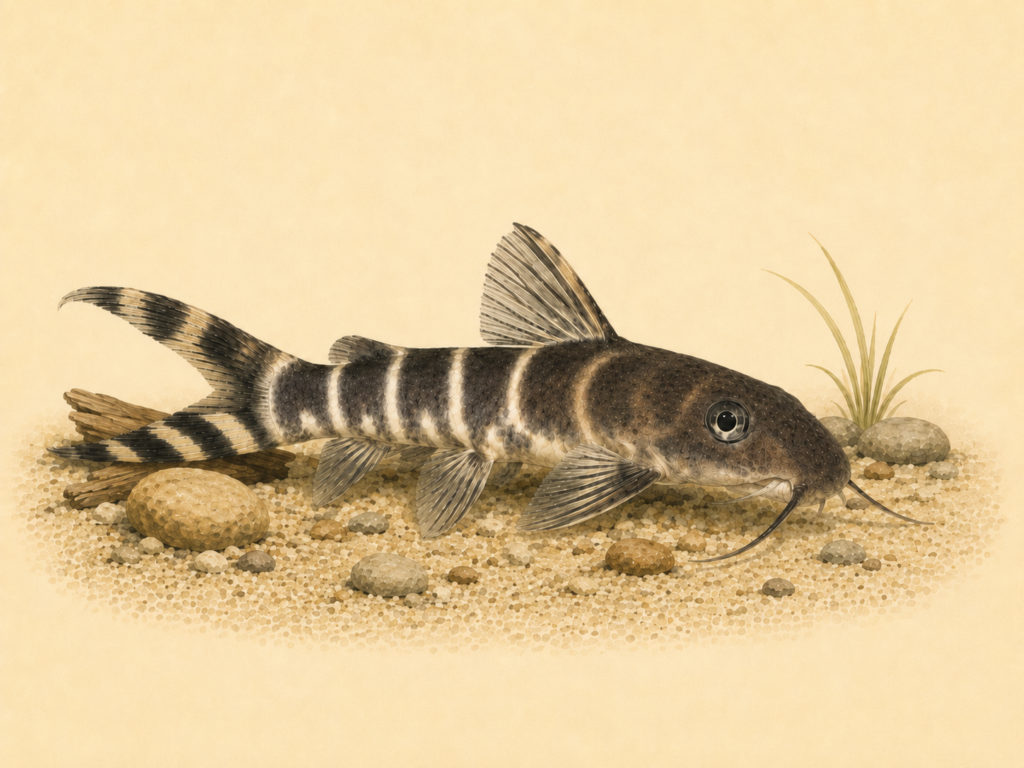
Quick summary
Synodontis brichardi is a striking but demanding rapids-dwelling catfish best suited to intermediate to advanced aquarists who can provide strong water flow, pristine water quality, and a spacious tank of at least 250 litres. It is not ideal for beginners, is mostly nocturnal, and is difficult to breed in captivity, so most specimens available in the trade are wild-caught.
🐠 Build a tank around this fish
In this guide:
- Introduction
- Quick Stats
- Appearance
- Natural Habitat
- Tank Size and Setup
- Water Parameters
- Filtration and Equipment
- Diet and Feeding
- Behaviour and Temperament
- Tank Mates
- Breeding
- Common Diseases
- FAQs
Introduction
Synodontis brichardi is a striking and somewhat elusive member of the squeaker catfish family, hailing from the turbulent rapids of the lower Congo River in the Democratic Republic of the Congo. Named in honour of the renowned aquarist and fish collector Pierre Brichard, this species has earned a devoted following among catfish enthusiasts for its elegant finnage, distinctive patterning, and fascinating rheophilic adaptations. Unlike many of its Synodontis relatives that inhabit calm lake waters, S. brichardi has evolved to thrive in fast-flowing, highly oxygenated environments, and understanding this fundamental aspect of its biology is key to keeping it successfully in the home aquarium.
Although it is not as commonly available in the trade as species such as Synodontis eupterus or Synodontis nigriventris, Synodontis brichardi does appear with reasonable regularity through specialist importers and dedicated catfish breeders. Its moderate adult size, peaceful disposition, and captivating appearance make it a rewarding species for the intermediate to advanced aquarist willing to replicate the conditions of its native rapids habitat. This care guide covers everything you need to know to provide an optimal environment for this remarkable catfish, from water chemistry and diet through to breeding and disease prevention.
Quick Stats
| Scientific name | Synodontis brichardi |
|---|---|
| Common names | Brichard's Synodontis, Brichard's Catfish, Congo Rapids Synodontis |
| Family | Mochokidae |
| Origin | Lower Congo River rapids, DR Congo |
| Adult size | 17 cm |
| Lifespan | 10–15 years |
| Difficulty | Intermediate |
| Breeding difficulty | Advanced |
| Temperature | 23–27 °C |
| pH | 6.2–7.5 |
| GH | 3–15 dGH |
| KH | 2–10 dKH |
| Minimum tank size | 250 L |
| Conservation status | Least Concern (IUCN) |
Appearance
Synodontis brichardi is an undeniably handsome catfish that stands out from many of its congeners through its combination of elongated finnage and refined patterning. The body is moderately compressed laterally with a gently sloping dorsal profile, giving it a streamlined shape well suited to life in fast water. The base colouration ranges from a warm brown to a greyish-tan, overlaid with a scattering of darker brown or black spots that vary in size and density between individuals. Some specimens display more of a marbled pattern, while others have clearly defined, well-spaced spots. The belly is typically lighter, ranging from pale cream to off-white.
One of the most attractive features of this species is its finnage. The dorsal fin is tall and often carries an extended filament on the leading spine, though the degree of extension can vary with age, sex, and condition. The caudal fin is deeply forked with elongated lobes that give the fish a graceful appearance as it navigates the water column. The pectoral fins are robust, equipped with strong, serrated spines, a characteristic shared with other Synodontis species and one that warrants careful handling, as these spines can easily become entangled in nets and can deliver a painful puncture. Three pairs of barbels surround the mouth: one pair of maxillary barbels (the longest), and two pairs of mandibular barbels, which are often branched or feathered, a feature particularly well developed in this species and useful for distinguishing it from similar-looking congeners.
Juveniles tend to display higher contrast in their patterning, with bolder spots against a lighter background. As the fish matures, the overall colouration can darken somewhat, though well-kept adults in optimal conditions retain excellent pattern definition. Sexual dimorphism is subtle; mature females are generally fuller-bodied when viewed from above, while males may develop slightly longer fin extensions, though this is not a reliable sexing method in isolation.
Natural Habitat
Synodontis brichardi is endemic to the lower reaches of the Congo River system, specifically the stretch of rapids and cataracts between Kinshasa and Matadi in the Democratic Republic of the Congo. This section of the river, often referred to as the Inga rapids or the Livingstone Falls, represents one of the most powerful and dynamic freshwater environments on Earth. The water here surges over and between enormous boulders, creating a complex mosaic of rapids, eddies, deep pools, and turbulent cascades. The sheer volume and force of water moving through this relatively narrow channel produces extraordinary levels of dissolved oxygen and constant water movement.
The substrate in these habitats is predominantly composed of large rocks, boulders, and bedrock, with pockets of coarse gravel and sand accumulating in calmer areas behind rock formations. Aquatic vegetation is sparse to non-existent in the strongest current zones, though biofilm, algae, and aufwuchs coat every available surface and form a significant part of the food web. The water itself is typically soft to moderately hard with a slightly acidic to neutral pH, and temperatures remain relatively stable year-round owing to the equatorial location, generally sitting between 24 and 27 °C.
This rheophilic environment has shaped many of the physical and behavioural traits observed in S. brichardi. Its streamlined body, strong pectoral spines for anchoring against rocks, and preference for highly oxygenated water are all adaptations to life in fast-flowing conditions. The lower Congo rapids are home to a remarkable assemblage of endemic species, many of which share the aquarium trade with S. brichardi, including various Steatocranus cichlids, Teleogramma species, and other rapids-adapted catfish. Understanding this natural context is essential for recreating appropriate conditions in captivity.
Tank Size and Setup
A minimum tank volume of 250 litres is recommended for a small group of Synodontis brichardi, though larger aquaria of 350 litres or more are preferable, particularly if you intend to keep them alongside other Congo rapids species. The tank dimensions matter as much as the volume itself; a longer footprint provides more horizontal swimming space and allows you to create varied current zones, which is important for replicating the natural habitat. A tank measuring at least 120 cm in length is ideal.
The aquascape should be designed around a foundation of large, smooth rocks and boulders arranged to create an abundance of caves, crevices, and overhangs. These structures serve as essential refuges for S. brichardi, which is primarily nocturnal and spends much of the daylight hours tucked away in sheltered spots. Use rounded river rocks or water-worn stones to avoid any sharp edges that could damage the fish’s barbels or skin. Stacking rocks securely is critical, consider using aquarium-safe silicone or egg crate at the base to prevent collapses, especially in tanks with vigorous water movement. The substrate should consist of fine to medium gravel or sand, preferably in a natural colour. Avoid sharp or angular substrates, as Synodontis catfish are bottom-dwellers that constantly probe the substrate with their sensitive barbels.
Live plants are not essential and can be difficult to maintain under the strong current conditions that this species prefers. If you wish to include vegetation, choose robust species that tolerate high flow, such as Anubias or Bolbitis heudelotii, which can be attached to rockwork or driftwood. Floating plants are generally unsuitable as the surface agitation will push them around constantly. Driftwood can also be incorporated into the layout, adding both visual interest and additional hiding spots, though it should be wedged firmly in place.
Lighting should be moderate to subdued. As a nocturnal species, S. brichardi is more active and confident under dimmer conditions. If you are running brighter lighting for the benefit of plants or other tank inhabitants, ensure there are ample shaded retreats where the catfish can escape the light. A moonlight or blue-spectrum LED setting during evening hours can encourage natural activity patterns and allow you to observe the fish during their most active period.
Water Parameters
Maintaining stable, high-quality water is arguably the single most important aspect of keeping Synodontis brichardi successfully. As a species adapted to fast-flowing, pristine rapids, it is less tolerant of poor water quality than many more commonly kept tropical fish. Ammonia and nitrite must be kept at undetectable levels at all times, and nitrate should be maintained as low as practicable through regular water changes and efficient biological filtration.
| Temperature | 23–27 °C |
| pH | 6.2–7.5 |
| General hardness (GH) | 3–15 dGH |
| Carbonate hardness (KH) | 2–10 dKH |
| Ammonia | 0 ppm |
| Nitrite | 0 ppm |
| Nitrate | Below 20 ppm |
Weekly water changes of 25–40% are recommended, using dechlorinated water matched to the tank temperature. The species is adaptable within the ranges listed above, but sudden swings in pH or hardness should be avoided. If your tap water is significantly outside these parameters, consider blending with RO (reverse osmosis) water to achieve a suitable composition. Consistency is more important than hitting a precise number, so aim for stability above all else.
Filtration and Equipment
Powerful filtration is non-negotiable for Synodontis brichardi. The goal is twofold: to maintain exceptional water quality and to generate strong water movement that mimics the rapids environment. A large external canister filter rated for at least 8–10 times the tank volume per hour is a sensible starting point. Many keepers of rheophilic Congo species run two canister filters simultaneously or supplement a primary canister with additional powerheads or wavemakers to create the desired flow patterns throughout the tank.
Position the filter outlet and any supplementary powerheads to generate a strong, directional current along the length of the tank, ideally with some areas of calmer water behind rock formations where the fish can rest when they choose. The current should be vigorous enough to produce visible surface agitation, which promotes excellent gas exchange and keeps dissolved oxygen levels high, a critical requirement for this species. Some aquarists also add airstones or air-driven sponge filters as additional oxygenation sources, which can be beneficial, particularly in warmer months when dissolved oxygen levels naturally drop.
Biological filtration capacity should be maximised by using high-quality biomedia such as sintered glass or ceramic rings within the canister filters. Mechanical filtration using foam pads of varying densities will help maintain water clarity and protect the biomedia from clogging. Chemical filtration in the form of activated carbon can be used periodically but is not strictly necessary with a solid water-change routine. A heater with a reliable thermostat, ideally an external inline heater to keep equipment out of the tank and away from curious catfish, will maintain stable temperatures. Always use a heater guard if an internal heater is employed, as Synodontis species can burn themselves resting against hot glass.
Diet and Feeding
Synodontis brichardi is an omnivore with a leaning towards meaty foods, though it readily accepts a wide range of prepared and fresh offerings. In the wild, its diet consists of aquatic invertebrates, insect larvae, small crustaceans, algae, and organic detritus scraped from rock surfaces. Replicating this dietary diversity in captivity is straightforward and contributes to optimal health, colouration, and longevity.
A high-quality sinking pellet or wafer designed for catfish or bottom-feeders should form the staple diet. Look for products with a good balance of animal and plant protein, and avoid those with excessive fillers such as wheat or corn. Supplement this staple with regular offerings of frozen or live foods, including bloodworm, brine shrimp, daphnia, mosquito larvae, and chopped earthworm. These protein-rich treats are eagerly consumed and help to condition the fish, particularly if breeding is a goal. Blanched vegetables such as courgette, cucumber, and shelled peas can also be offered occasionally, as can algae wafers, which provide useful plant-based nutrition and roughage.
Feeding should take place in the evening or after lights-out to coincide with the species’ natural nocturnal foraging behaviour. Drop sinking foods near the catfish’s preferred hiding spots to ensure they receive their share before more assertive tank mates consume everything. Two to three targeted feedings per week of frozen or live foods, alongside daily sinking pellets, will keep S. brichardi in excellent condition. Be mindful of overfeeding, as uneaten food will degrade water quality quickly in a heavily filtered, high-flow setup.
Behaviour and Temperament
Synodontis brichardi is a generally peaceful and retiring species that spends the majority of daylight hours concealed within rockwork. As dusk falls, it becomes noticeably more active, emerging to explore the tank, forage across the substrate, and interact with conspecifics. This crepuscular-to-nocturnal activity pattern is typical of many Synodontis species and should be expected rather than seen as a sign of stress. Providing adequate hiding places and subdued lighting will help the fish feel secure and may encourage earlier emergence in the evening.
Towards conspecifics, S. brichardi can be mildly territorial, particularly when competing for preferred caves and resting spots. This territoriality is rarely aggressive in the true sense and typically manifests as posturing, chasing, and the occasional audible “squeaking”, a sound produced by the pectoral spine mechanism that gives the Mochokidae family its common name. Keeping a small group of three to five individuals, with more hiding spots than fish, generally diffuses any tensions and allows a natural social hierarchy to establish itself without injury.
When startled, S. brichardi may lock its pectoral and dorsal spines in the erect position as a defensive measure. This is a reflex action and can cause problems if the fish becomes wedged in narrow gaps within the rockwork or tangled in netting. Always use a solid container rather than a net when catching or moving this species. The locked spines, while a minor inconvenience for the aquarist, are a remarkably effective anti-predator adaptation in the wild, making the fish extremely difficult for a predator to swallow.
Despite its retiring nature, a well-settled Synodontis brichardi can become surprisingly bold over time, particularly at feeding. Individuals kept in stable environments with consistent routines often learn to associate their keeper with food and may begin to emerge during the day when they sense activity near the tank.
Tank Mates
Synodontis brichardi is a compatible community fish provided that its tank mates are chosen with care. The ideal companions share its preference for well-oxygenated, fast-flowing water and are neither small enough to be considered prey nor large and aggressive enough to bully or outcompete the catfish. Given its Congo River origins, a biotope approach using other species from the same region creates both a visually cohesive and ecologically appropriate setup. That said, S. brichardi is adaptable enough to coexist with a range of robust tropical species from other regions, as long as water parameter requirements overlap.
Good tank mates
- Steatocranus casuarius (Buffalohead Cichlid), a fellow Congo rapids species that occupies a different ecological niche and coexists peacefully with Synodontis.
- Phenacogrammus interruptus (Congo Tetra), a robust, active schooling fish from the same region that appreciates moderate to strong current and provides excellent mid-water activity.
- Anomalochromis thomasi (African Butterfly Cichlid), a peaceful West African dwarf cichlid that is unlikely to compete with or threaten S. brichardi.
- Ancistrus sp. (Bristlenose Pleco), a hardy, peaceful bottom-dweller that occupies a similar but non-competitive niche and tolerates strong flow well.
- Upside-Down Catfish, a smaller, peaceful Synodontis species that can coexist in a sufficiently spacious tank with ample hiding spots.
- Melanotaenia spp. (Rainbowfish), Active, colourful schooling fish that enjoy current and are too large and fast to be bothered by S. brichardi.
- Pelvicachromis pulcher (Kribensis), a generally peaceful dwarf cichlid that can share the bottom of the tank, though breeding pairs may become territorial.
- Chromobotia macracanthus (Clown Loach), a sociable bottom-dweller that appreciates similar water conditions and is large enough to avoid any issues with the catfish.
Fish to avoid
- Astronotus ocellatus (Oscar), a large, predatory cichlid that would view S. brichardi as potential prey or at least subject it to severe harassment.
- Paracheirodon innesi (Neon Tetra), far too small and delicate, and could be consumed by a mature S. brichardi under cover of darkness.
- Phractocephalus hemioliopterus (Red-tail Catfish), a massive predatory catfish completely unsuitable as a companion due to its eventual size and predatory nature.
- Betta splendens (Siamese Fighting Fish), the strong current required by S. brichardi is completely unsuitable for the Betta, and the two species have incompatible temperaments.
- Danio margaritatus (Celestial Pearl Danio), too small and slow-moving to be safe companions, particularly in a dimly lit tank with a nocturnal predator.
- Flowerhorn Cichlid, highly aggressive and territorial, a Flowerhorn would dominate and likely injure S. brichardi.
- Poecilia reticulata (Guppy), Small, slow, and ill-suited to the high-flow environment, guppies are at risk of predation and would struggle in the required conditions.
- Parachromis managuensis (Jaguar Cichlid), a large, aggressive predator that would pose a serious threat to any Synodontis kept alongside it.
Breeding
Breeding Synodontis brichardi in captivity is a challenging undertaking that has been achieved only sporadically. Unlike some Synodontis species that have been bred commercially in significant numbers (often through hormonal induction), S. brichardi has proven reluctant to spawn under typical aquarium conditions. The difficulty lies partly in replicating the environmental cues that trigger spawning in the wild, which are likely related to seasonal fluctuations in water flow, temperature, and possibly water chemistry associated with the Congo River’s flood cycle.
Sexing adult fish is difficult but not impossible with practice. Mature females tend to be noticeably rounder when viewed from above or head-on, particularly when gravid. Males may display slightly more elongated fin filaments and a slimmer overall profile, though considerable variation exists between individuals. Examining the genital papilla can be helpful in well-conditioned adults: the female’s papilla is broader and more rounded, while the male’s is narrower and more pointed.
To encourage spawning, start with a group of at least five or six well-conditioned adults housed in a spacious tank of 400 litres or more. The tank should feature abundant rockwork with caves and crevices of varying sizes. Condition the fish heavily with a varied, protein-rich diet of live and frozen foods over several weeks. Spawning attempts can be triggered by simulating seasonal changes: gradually increase the water-change volume and frequency, slightly lower the temperature by one or two degrees, and increase the water flow. Some breeders have reported success after performing large (50–60%) water changes with slightly cooler, softer water, simulating the dilution effect of seasonal rains.
If spawning occurs, eggs are typically deposited within caves or crevices and may be guarded by one or both parents, though accounts vary. The eggs are adhesive and relatively large compared to those of smaller Synodontis species. Incubation times have been reported at approximately five to seven days at 25–26 °C, though precise data remain scarce. Fry are initially quite small and should be offered infusoria, micro-worms, or commercially available liquid fry food before graduating to newly hatched brine shrimp as they grow. Raising the fry in a separate, well-filtered tank with gentle flow and abundant hiding spots offers the best chance of survival.
It is worth noting that many Synodontis brichardi sold in the aquarium trade are wild-caught, reflecting the ongoing difficulty of captive breeding. Aquarists who succeed in breeding this species make a valuable contribution to reducing collection pressure on wild populations.
Common Diseases
Synodontis brichardi is a robust species when kept in appropriate conditions, and it is not especially prone to any species-specific ailments. However, like all freshwater fish, it can succumb to the usual range of diseases, particularly if water quality deteriorates or the fish is subjected to chronic stress.
White spot disease (ichthyophthiasis), caused by the protozoan parasite Ichthyophthirius multifiliis, is one of the most common illnesses seen in freshwater aquaria. Symptoms include small white cysts on the body and fins, flashing (rubbing against surfaces), and lethargy. Treatment involves raising the temperature slightly (to around 28–29 °C if the fish can tolerate it) and adding a suitable white spot remedy. It is crucial to note that Synodontis catfish, like most scaleless or reduced-scale species, can be sensitive to certain medications, particularly those containing copper or malachite green. Always use treatments at half the recommended dose initially and monitor the fish closely for adverse reactions. Where possible, choose formalin-based or heat-based treatments, which are generally safer for catfish.
Bacterial infections, including fin rot and skin ulcers, can develop following physical injury or in response to poor water conditions. These are best prevented through diligent maintenance routines and addressed promptly with appropriate antibacterial treatments if they occur. Fungal infections, appearing as cotton-wool-like growths on the body or fins, are also typically secondary to injury or stress and respond well to proprietary antifungal medications.
Internal parasites may occasionally present a problem, particularly in wild-caught specimens that have not been quarantined. Symptoms can include weight loss despite a healthy appetite, white or stringy faeces, and lethargy. Antiparasitic foods or dedicated internal parasite treatments can be used, but quarantining all new arrivals for a minimum of two to four weeks in a separate tank is the most effective preventive measure.
Maintaining pristine water quality, providing a balanced diet, minimising stress through appropriate tank setup and compatible tank mates, and quarantining new additions will prevent the vast majority of health problems in Synodontis brichardi.
FAQs
How big does Synodontis brichardi get?
In captivity, Synodontis brichardi typically reaches 15 to 18 cm (6 to 7 inches) in total length, including the extended caudal fin lobes. Growth rate is moderate, and it generally takes around two to three years for the fish to reach its full adult size when fed a varied diet and kept in good conditions. Occasional reports of slightly larger specimens exist, but these likely represent exceptional individuals kept in particularly spacious setups over many years.
Is Synodontis brichardi suitable for a beginner?
While not the most demanding Synodontis species, S. brichardi is best suited to aquarists with some prior experience in keeping tropical fish, particularly those who understand the importance of strong filtration, stable water parameters, and appropriate aquascaping. The need for powerful water movement and excellent water quality places it beyond the typical beginner setup, and its nocturnal habits can be frustrating for newcomers expecting a constantly visible fish. An aquarist who has successfully maintained a well-managed community aquarium for a year or more should have the skills needed to keep this species.
Can Synodontis brichardi be kept alone?
While a single specimen will survive, Synodontis brichardi is a more engaging and behaviourally interesting fish when kept in a small group of three to five individuals. Group keeping encourages natural social interactions, reduces individual stress levels, and results in bolder behaviour overall. If kept singly, ensure that the fish has ample hiding spots and compatible tank mates to prevent it from becoming overly withdrawn.
Does Synodontis brichardi swim upside down like other Synodontis species?
No, S. brichardi does not habitually swim in an inverted position. The famous upside-down swimming behaviour is primarily associated with Synodontis nigriventris and a few closely related species. S. brichardi may occasionally orient itself at unusual angles when resting under overhangs or within caves, but this is simply a response to the shape of its resting spot rather than a characteristic behaviour.
What is the best way to catch Synodontis brichardi without injury?
The serrated pectoral and dorsal spines of Synodontis species can easily become entangled in standard aquarium nets, causing injury to the fish and frustration for the keeper. The safest method is to gently guide the fish into a solid plastic container, a large measuring jug, or a purpose-made fish trap submerged within the tank. If you must use a net, opt for a fine-mesh net of appropriate size and work slowly, being prepared for the fish to lock its spines if it feels threatened. Never attempt to force a spine-locked Synodontis through a net opening, as this can cause severe fin damage.
Related Guides
- Synodontis eupterus (Featherfin Squeaker) Care Guide, a widely available and beginner-friendly Synodontis species that shares many care requirements with S. brichardi.
- Upside-Down Catfish, a smaller, more commonly kept Synodontis that can be housed alongside S. brichardi in spacious setups.
- Steatocranus casuarius (Buffalohead Cichlid) Care Guide, an ideal Congo rapids companion for S. brichardi, covered in detail for biotope enthusiasts.
- Congo Tetra Care Guide, a beautiful mid-water schooling fish from the same river system, ideal for creating a Congo biotope display.
- Freshwater Catfish Feeding Guide, a comprehensive resource covering diet and nutrition for a wide range of catfish species, including Synodontis.