Quick summary
Kribensis are an easy, hardy cichlid ideal for beginners, tolerating a wide range of water conditions and thriving in tanks as small as 75 litres while breeding readily in captivity. They stay peaceful with most community fish outside of breeding, when a pair will defend a small cave territory, making them a great choice if you can offer hiding spots and appropriately sized tank mates.
🐠 Build a tank around this species
In this guide:
- Introduction
- Quick Stats
- Appearance
- Varieties and Morphs
- Natural Habitat
- Tank Size and Setup
- Water Parameters
- Filtration and Equipment
- Diet and Feeding
- Behaviour and Temperament
- Tank Mates
- Breeding
- Common Diseases
- FAQs
Introduction
The Kribensis is one of the most rewarding cichlids available to freshwater aquarists, combining manageable size, vibrant colour, and genuinely fascinating behaviour in a single, hardy package. Native to the river systems of West Africa, Pelvicachromis pulcher has been a staple of the hobby since the mid-twentieth century and continues to earn admirers with each generation of fishkeepers. Unlike many cichlids that demand enormous aquaria and test an owner’s patience with relentless aggression, the Kribensis thrives in modestly sized tanks and generally coexists peacefully with a wide range of community fish, provided its territorial instincts during breeding are respected.
What truly sets this species apart is its accessibility. Beginners find the Kribensis forgiving of minor water-quality lapses, while experienced aquarists appreciate the species’ willingness to breed in captivity and the entrancing parental care both parents provide to their free-swimming fry. The female’s resplendent cherry-red belly, which deepens in intensity during courtship, is among the most striking displays in any community aquarium. Whether you are setting up your first planted tank or looking to add a centrepiece pair to an established West African biotope, this guide will walk you through everything you need to know to keep Kribensis healthy, colourful, and breeding successfully.
Quick Stats
| Scientific name | Pelvicachromis pulcher |
|---|---|
| Common names | Krib, Purple Cichlid, Rainbow Krib, Niger Cichlid, Palette Cichlid |
| Family | Cichlidae |
| Origin | Southern Nigeria and coastal Cameroon, West Africa |
| Adult size | 10 cm |
| Difficulty | Easy |
| Breeding difficulty | Easy |
| Temperature | 24–27 °C |
| pH | 5–7.5 |
| GH | 0–12 dGH |
| Minimum tank size | 71 L |
| Conservation status | Least Concern (IUCN, assessed 2019) |
Appearance
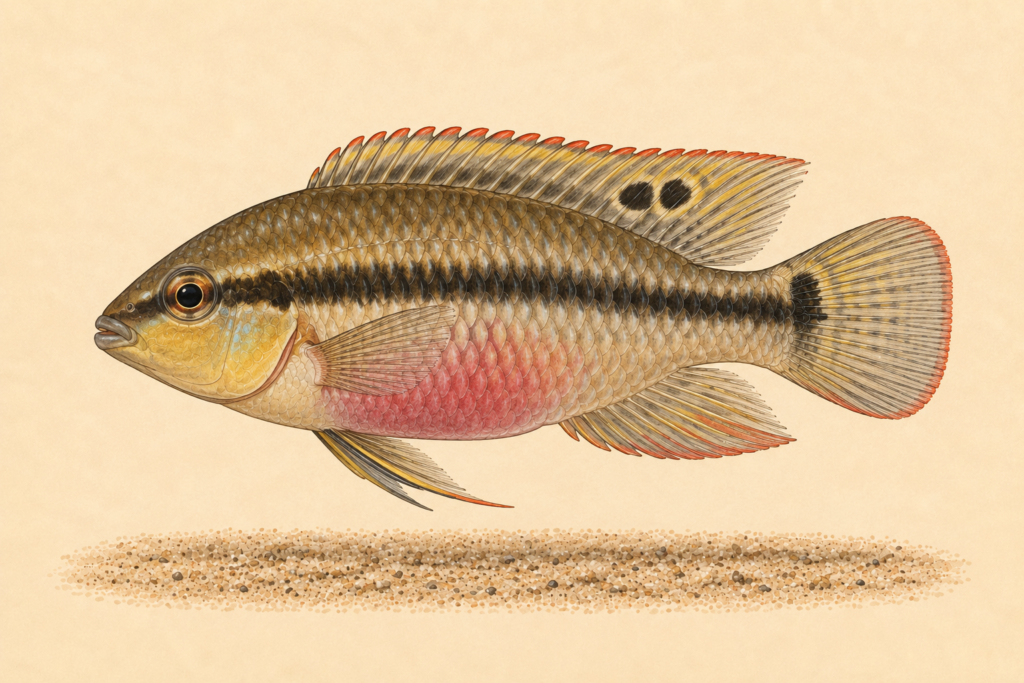
Pelvicachromis pulcher is a compact, laterally compressed cichlid with an elongated body and a gently rounded head. Both sexes display a broad, dark lateral stripe running from the snout through the eye to the base of the caudal fin, overlaid on a background that shifts between silver-grey and warm gold depending on mood and lighting. The dorsal fin in males is long and pointed, often edged with a thin band of orange or red and tipped with one or more prominent ocelli, dark eye-spots ringed in gold that serve as false targets for would-be predators. The caudal fin is spade-shaped and frequently marked with dark spots or a thin red margin.
Sexual dimorphism is pronounced and makes sexing straightforward even in sub-adult fish. Males are larger, more elongated, and tend to show stronger iridescent blues and greens across the gill covers and flanks. Females are smaller and rounder, with a notably plumper belly that flushes a rich cherry-red to deep plum during breeding condition. The female’s ventral fins are also rounder and darker, sometimes edged in metallic gold. In peak spawning dress, a healthy female Kribensis is arguably the more eye-catching of the pair, her vivid belly patch contrasting sharply with the golden and iridescent tones of the rest of her body.
Juveniles are relatively plain, displaying a muted version of the lateral stripe and little of the colour that will develop with maturity. Full adult colouration typically becomes apparent by around six months of age, though it may continue to intensify for another year under optimal conditions.
Varieties and Morphs
Although wild-type Kribensis remain the most widely available form, selective breeding and the collection of geographically distinct populations have given rise to several recognisable variants in the hobby. It is worth noting that some of these are locality forms rather than true captive-bred morphs, and mixing populations is generally discouraged to preserve genetic integrity.
The wild-type or standard Kribensis is the form most commonly seen in shops, displaying the classic silver-gold body, dark lateral stripe, and red female belly. The “Super Red” morph has been selectively bred for an intensified red-purple belly in females that extends further across the flanks, and males of this line often show stronger red in the dorsal and caudal fins. The “Albino Kribensis” is a true albino form with a pinkish-white body, red eyes, and a pastel pink belly in females, which remains popular with aquarists who prefer a paler palette. The Moliwe locality variant, collected near Moliwe in Cameroon, tends to display stronger yellow tones across the body and a more orange-red belly compared to the typical Nigerian form.
The Ndonga locality form is another Cameroonian variant distinguished by deeper reds and more prominent ocelli on the dorsal and caudal fins. The “Yellow” or “Golden” Kribensis is a selectively bred line that emphasises the gold and yellow body tones while reducing the dark lateral stripe, producing a warmer overall appearance. There is also a “Blue” form in limited circulation, in which breeders have enhanced the iridescent blue-green sheen on the male’s flanks and gill plates, though this remains relatively uncommon.
When purchasing any named variant, it is good practice to buy from reputable breeders who can confirm the lineage, as many locality forms have been inadvertently hybridised in the general trade.
Natural Habitat
Pelvicachromis pulcher is found in the lowland river systems of southern Nigeria and adjacent parts of Cameroon, with the bulk of wild populations concentrated in the Niger Delta, the Ethiop River, and various coastal drainages that empty into the Gulf of Guinea. These are warm, slow-moving to moderately flowing waters that range from clear to mildly tannin-stained, depending on the season and surrounding vegetation. The substrates are typically a mix of fine sand, mud, and leaf litter, with scattered rocks, submerged roots, and fallen branches providing an abundance of caves and crevices.
Water chemistry across the species’ range varies considerably. In the upper reaches of some rivers the water is soft and acidic, while closer to the coast brackish conditions can occur during tidal fluctuations. This broad natural tolerance is one reason the Kribensis adapts so readily to a range of aquarium water parameters. In the wild, Kribensis are found in pairs or loose groups, typically close to the substrate among tangles of roots and rocky overhangs where they establish small territories centred on a chosen cave or crevice.
The riparian vegetation in these habitats often includes dense marginal plants, floating vegetation, and submerged grasses that filter light and create a dappled, shaded environment. Replicating this sense of cover and subdued lighting in the aquarium helps bring out the best colouration and most natural behaviour from captive Kribensis.
Tank Size and Setup
A single pair of Kribensis can be kept comfortably in an aquarium of 75 litres or more, though a tank in the region of 100–120 litres is preferable if you intend to keep them as part of a community. If you plan to house multiple pairs or want to include a reasonable complement of tank mates, aim for 150 litres or above, as breeding pairs will defend a territory roughly 30–40 cm in radius around their chosen cave, and adequate space helps diffuse aggression.
The substrate should be fine sand or smooth gravel. Kribensis are enthusiastic diggers, particularly when preparing a spawning site, and coarse or sharp substrates can damage their mouths and ventral surfaces. A sandy base also allows the fish to engage in their natural sifting behaviour, in which they take mouthfuls of substrate and sort through it for edible particles, a delightful activity to observe.
Caves are the single most important décor element. Coconut shells with a small entrance hole, terracotta flower pots laid on their sides, stacked flat stones, or purpose-made ceramic cichlid caves all work well. Provide at least one cave per female in the tank, and ideally two or three, to give potential breeding pairs options and reduce conflict. Position caves so their entrances face slightly different directions and are not in direct line of sight of one another.
Driftwood and bogwood complement the setup nicely, both aesthetically and functionally, as they provide additional territorial markers and release tannins that gently lower pH, something Kribensis appreciate. Hardy plants such as Anubias, Java Fern, Bolbitis, and Cryptocoryne species are excellent choices; they tolerate the lower light levels that Kribensis prefer and are generally left alone by the fish. Floating plants like Amazon Frogbit or Salvinia help diffuse overhead light and give the fish a greater sense of security.
Moderate lighting is ideal. While Kribensis will not suffer under brighter lights, their colours are most vivid and their behaviour most relaxed when the aquarium is not overly illuminated. A dark or natural-toned background further enhances the display.
Water Parameters
| Temperature | 24–27 °C |
| pH | 5-7.5 |
| General hardness (GH) | 0-12 dGH |
| Ammonia | 0 ppm |
| Nitrite | 0 ppm |
| Nitrate | Below 20 ppm |
Kribensis are notably adaptable when it comes to water chemistry, which is one of the reasons they are recommended so frequently to newcomers. They will thrive in soft, acidic water and do perfectly well in moderately hard, neutral conditions. Extremes at either end, very hard, alkaline water or excessively acidic water, should be avoided. If you are hoping to breed the fish, slightly soft, acidic water in the range of pH 6.0–6.5 tends to produce the most balanced sex ratios in fry; more alkaline conditions have been observed to skew broods towards a higher proportion of males, while very acidic water tends to produce more females.
Consistency is more important than hitting a specific number. Kribensis do not respond well to sudden swings in temperature or pH, so aim for stability and perform regular, moderate water changes of around 20–25 per cent weekly. Use a quality dechlorinator and try to match the temperature and chemistry of replacement water to that already in the tank.
Filtration and Equipment
A reliable filter that turns over the tank volume four to six times per hour is sufficient for a Kribensis setup. Internal power filters, hang-on-back filters, and small canister filters all work well. Because Kribensis are substrate dwellers that appreciate a relatively calm environment, avoid creating excessively strong currents. If your filter’s output is too vigorous, a spray bar or lily pipe can help distribute flow more gently across the tank.
Sponge filters are an excellent secondary or sole filtration option, especially in breeding tanks, as they provide gentle water movement and biological filtration without any risk of trapping fry. If you use a power filter in a breeding setup, cover the intake with a fine sponge pre-filter to protect newborn fish.
A quality heater with a thermostat accurate to within one degree is important, as tropical temperatures must be maintained year-round in most UK homes. Place the heater near the filter outflow to ensure even heat distribution. A thermometer, preferably a digital one, should be positioned at the opposite end of the tank from the heater to confirm that temperature is consistent throughout the aquarium.
Lighting can be modest. A standard LED unit on a timer set to around 8–10 hours per day is more than adequate. If you are growing live plants, choose a light with a spectrum suitable for plant growth, but there is no need for high-intensity lighting for the sake of the fish themselves.
Diet and Feeding
Kribensis are omnivores with a preference for meaty foods, and they are thoroughly unfussy eaters in captivity. A high-quality cichlid pellet or flake should form the staple of their diet. Choose a product with a good balance of protein and vegetable matter, and select a pellet size appropriate for their relatively small mouths, micro or small pellets are ideal.
Supplement the staple diet regularly with frozen or live foods such as bloodworm, brine shrimp, daphnia, and mosquito larvae. These protein-rich additions promote vibrant colouration and help condition breeding pairs. Blanched vegetables like courgette, spinach, or shelled peas can be offered occasionally and are readily accepted, providing useful fibre and micronutrients.
Feed once or twice daily, offering only as much as the fish can consume within two to three minutes. Kribensis are relatively slow, methodical eaters that pick food from the substrate rather than chasing it at the surface, so sinking foods are generally better utilised than floating ones. Overfeeding should be avoided, as excess food will foul the substrate and degrade water quality. A weekly fast day can be beneficial for adult fish, helping to maintain digestive health.
Behaviour and Temperament
Outside of breeding, Kribensis are among the most peaceable of all cichlids. They spend much of their time exploring the lower regions of the aquarium, sifting through the substrate, investigating caves, and occasionally sparring mildly with one another in brief displays that rarely result in any damage. They are curious fish that quickly learn to recognise their keeper and will often approach the front glass at feeding time.
The dynamic changes considerably once a pair forms and begins to breed. Both parents become highly territorial, vigorously defending their chosen cave and the surrounding area against any fish that ventures too close. This aggression is focused and purposeful rather than indiscriminate, they are protecting eggs or fry, and once the brood becomes independent, territorial behaviour subsides to its usual low level. In a well-furnished tank with ample line-of-sight breaks, this breeding territoriality is easily managed and rarely causes lasting harm to tank mates.
Kribensis are best kept as a pair rather than in groups, unless the aquarium is large enough to support multiple territories. Unpaired individuals, particularly females, may harass one another. If you wish to keep more than one pair, provide a tank of at least 150 litres with multiple caves spaced well apart and plenty of visual barriers in between.
One of the most captivating aspects of Kribensis behaviour is parental care. Both parents share responsibility for guarding the eggs and later shepherding the free-swimming fry around the tank in a tight, disciplined school. The female typically stays closest to the brood, vibrating her body to communicate with the fry, while the male patrols the outer perimeter of the territory. Watching a Kribensis family unit navigate the aquarium is one of the genuine highlights of keeping this species.
Tank Mates
Good tank mates
- Congo Tetra, a mid-water schooling fish from the same region that is large enough to avoid being bullied and occupies a different zone of the tank.
- Rummy-Nose Tetra, a tight-schooling species that tends to stay in the mid-water column and is quick enough to evade a territorial Kribensis pair.
- Harlequin Rasbora, a peaceful, mid-dwelling shoaler that complements the Kribensis’ bottom-dwelling habits without competing for territory.
- Cherry Barb, a gentle, small barb that prefers planted areas and rarely interferes with substrate-level cichlid territories.
- Bristlenose Pleco, a robust algae-eater that generally holds its own against mild cichlid aggression, though cave competition during breeding should be monitored.
- Corydoras sterbai, a warm-water Corydoras species whose group activity and armoured body help it coexist with Kribensis, though they may be chased during breeding.
- Otocinclus, a small, inoffensive algae grazer that stays out of the Kribensis’ way and adds useful clean-up duty to the tank.
- African Butterfly Fish, a surface dweller from overlapping West African habitats that completely avoids the Kribensis’ bottom territory.
Fish to avoid
- Oscar, far too large and aggressive; an Oscar would view a Kribensis as potential food or a territorial rival to be destroyed.
- Convict Cichlid, another cave-breeding cichlid of similar size, leading to intense and often damaging territorial conflicts.
- Jack Dempsey, a large, aggressive Central American cichlid that will dominate and likely injure or kill a Kribensis.
- Tiger Barb, a notorious fin-nipper that will target the Kribensis’ flowing fins and provoke retaliatory aggression.
- Red-Tail Shark, a territorial bottom-dweller that will clash aggressively with Kribensis over the same substrate space.
- Jewel Cichlid, another West African cichlid that becomes extremely aggressive when breeding, creating dangerous conflicts in shared quarters.
- Green Terror, a large, highly territorial South American cichlid that would easily overpower and injure a Kribensis pair.
- Guppy, although peaceful, male guppies’ long, flowing tails can attract unwanted attention from Kribensis, and fry would be consumed immediately.
Breeding
Breeding Kribensis is a straightforward and deeply rewarding endeavour, and this species is often recommended as an ideal introduction to cichlid breeding. In many cases, a healthy, well-conditioned pair will breed without any special intervention from the aquarist, requiring little more than a suitable cave and stable water conditions.
To condition a pair for spawning, increase the proportion of protein-rich live or frozen foods in their diet for two to three weeks. The female will begin to display her most vivid belly colouration, arching her body and shimmying in front of the male to signal her readiness. When the male reciprocates, typically by intensifying his own colours and leading the female towards a chosen cave, spawning is imminent.
The female deposits between 50 and 300 adhesive eggs on the ceiling or inner walls of the cave, and the male enters briefly to fertilise them. From this point, the female assumes primary care of the eggs, rarely leaving the cave, while the male guards the entrance and surrounding territory. The eggs hatch in approximately three to four days at 26 °C, and the wrigglers remain attached to the cave surfaces, absorbing their yolk sacs for another four to five days before becoming free-swimming.
Once the fry emerge from the cave, both parents escort the brood around the tank as a tightly coordinated unit. The fry are small but are large enough to accept freshly hatched brine shrimp (Artemia nauplii), micro-worms, or finely crushed flake food from the moment they begin swimming. Feed small amounts several times a day and maintain excellent water quality through gentle water changes. A sponge filter is the safest filtration option in a breeding or fry-rearing tank.
It is worth noting that the pH of the water during egg development can influence the sex ratio of the brood. A pH around 7.0 or slightly above tends to produce a higher percentage of males, while a pH of 6.0–6.5 tends to yield a more balanced or female-skewed ratio. If you wish to produce a natural balance, aim for a slightly acidic pH during the incubation period.
Fry grow relatively quickly and begin to show colour at around four to six weeks. They can usually be left safely with the parents until the adults show signs of preparing for another spawning cycle, at which point the juveniles should be moved to a separate grow-out tank to avoid aggression from the newly territorial parents.
Common Diseases
Kribensis are robust fish that rarely fall ill when kept in clean, stable conditions, but they are susceptible to the same range of diseases that affect other tropical freshwater species. Ich (white spot disease) is perhaps the most common ailment, presenting as small white cysts on the fins and body. It is usually triggered by temperature fluctuations or stress and responds well to gradually raising the temperature to 30 °C over 48 hours while treating with a proprietary white spot remedy.
Hole-in-the-head disease, caused by the flagellate parasite Hexamita, occasionally affects Kribensis, particularly in tanks with poor water quality or inadequate diet. Symptoms include small pitting lesions on the head and lateral line. Improving water quality through more frequent changes, enhancing the diet with vitamin-rich foods, and treating with metronidazole-based medication typically resolves the condition if caught early.
Bacterial infections, including fin rot and body ulcers, can occur in stressed or injured fish. These often present as ragged or eroding fins, reddened patches, or open sores. Maintaining pristine water quality is both the best prevention and the first line of treatment; antibacterial medications may be required in more advanced cases.
Internal parasites may occasionally affect wild-caught or poorly quarantined fish, causing weight loss, stringy white faeces, and lethargy. A broad-spectrum anti-parasitic treatment is usually effective. As with all new acquisitions, quarantining Kribensis for two to four weeks before adding them to an established community is strongly recommended.
Prevention remains the best medicine. Consistent water parameters, a varied and nutritious diet, and a tank setup that minimises stress through adequate hiding places and appropriate tank mates will keep most health problems at bay.
FAQs
Can Kribensis be kept in a community tank?
Yes, Kribensis are excellent community fish for the vast majority of the time. They are peaceful outside of breeding and occupy primarily the lower third of the aquarium. The main consideration is that breeding pairs will defend a small territory around their cave, which can involve chasing tank mates away. In a well-furnished tank of 100 litres or more with plenty of hiding spots and visual barriers, this is rarely a serious problem, and most community fish learn to give the breeding pair a wide berth.
How can I tell male and female Kribensis apart?
Sexing Kribensis is relatively easy compared to many cichlid species. Males are larger, more elongated, and have pointed dorsal and anal fins, often decorated with one or more eye-spots (ocelli). Females are smaller and rounder, with a distinctly plumper belly that flushes cherry-red to deep plum, especially when in breeding condition. The female’s ventral fins are also more rounded and often show a darker, more metallic colouration. These differences are usually apparent from around three to four months of age.
Do Kribensis need caves?
Caves are essential for Kribensis, not merely desirable. In the wild, these fish rely on caves and crevices for shelter, breeding, and as the focal point of their territory. Without at least one suitable cave, Kribensis will often appear stressed, display washed-out colouration, and are unlikely to breed. Coconut shells, terracotta pots, ceramic caves, or arrangements of flat stones all serve the purpose admirably. Providing multiple cave options is especially important if you keep more than one female.
What is the ideal group size for Kribensis?
Kribensis are best kept as a single bonded pair in most aquarium settings. Unlike schooling species, they do not benefit from large group sizes, and keeping multiple pairs in an insufficiently large tank will lead to territorial disputes. If you wish to keep more than one pair, a tank of at least 150 litres with multiple well-spaced caves and abundant line-of-sight breaks is advisable. A lone individual can be kept, but they will not display the full range of their natural behaviour without a partner.
How long do Kribensis fry stay with their parents?
Kribensis parents typically shepherd their fry for three to six weeks, during which time both parents actively protect and guide the brood. As the fry grow and become more independent, parental interest gradually wanes, and the adults may begin preparing for another spawning cycle. It is best to separate the juveniles before this happens, as the parents’ renewed territorial behaviour can become directed at their own offspring. Moving the fry to a dedicated grow-out tank at around four weeks of age is a good rule of thumb.
Related Guides
- Bolivian Ram, another small, peaceful dwarf cichlid that makes an excellent community fish and shares similar care requirements with the Kribensis.
- Apistogramma cacatuoides, a popular South American dwarf cichlid with comparable cave-breeding behaviour and an equally manageable temperament.
- Bristlenose Pleco, a commonly paired tank mate for Kribensis, with guidance on managing potential cave competition during breeding periods.
- Congo Tetra, a West African schooling fish that complements a Kribensis biotope setup beautifully in both appearance and ecological niche.
- Jewel Cichlid, a fellow West African cichlid whose care requirements overlap but whose aggressive temperament demands a different management approach.