Synodontis Waterloti Care Guide — Tank Setup, Feeding and Breeding
Quick summary
Synodontis waterloti is a hardy, peaceful catfish suited to intermediate keepers who can provide a 200+ litre tank with plenty of hiding spots and stable water conditions, but breeding it is an advanced challenge best left to experienced aquarists. It’s a good fit for a West African community setup, though not ideal for beginners due to its need for consistent water quality and its predatory instinct toward very small tank mates.
🐠 Build a tank around this fish
In this guide:
- Introduction
- Quick Stats
- Appearance
- Natural Habitat
- Tank Size and Setup
- Water Parameters
- Filtration and Equipment
- Diet and Feeding
- Behaviour and Temperament
- Tank Mates
- Breeding
- Common Diseases
- FAQs
Introduction
Synodontis waterloti is one of the lesser-known members of the Synodontis genus, yet it remains a genuinely rewarding catfish for hobbyists who appreciate the quieter, more understated species in the squeaker catfish family. First described by Daget in 1962, this West African catfish has never achieved the mainstream popularity of its better-known relatives such as the Synodontis eupterus or the upside-down catfish, but it has carved out a loyal following among dedicated catfish enthusiasts and keepers of West African biotope aquaria.
Known variously as Waterlot’s Synodontis or simply the Waterlot catfish, this species offers the classic Synodontis appeal, a robust, attractively patterned body, engaging nocturnal behaviours, and a hardiness that makes it well suited to life in a well-maintained community aquarium. It is a species that rewards patience, as it can be secretive during the day but becomes noticeably more active and confident once settled into a properly furnished tank with plenty of hiding spots.
This care guide covers everything you need to know to keep Synodontis waterloti successfully, from water chemistry and tank design to diet, behaviour, and compatible tank mates. Whether you are considering adding one to an established community or building a West African biotope around it, the information here will help you provide the best possible environment for this charming catfish.
Quick Stats
| Scientific name | Synodontis waterloti |
| Common names | Waterlot’s Synodontis, Waterlot Catfish |
| Family | Mochokidae |
| Origin | West Africa, Senegal, Guinea, Sierra Leone, Mali (Niger and Senegal river basins) |
| Adult size | 15–19 cm |
| Lifespan | 10–15 years |
| Difficulty | Moderate |
| Breeding difficulty | Advanced |
| Temperature | 23–28 °C |
| pH range | 6.2–7.6 |
| General hardness (GH) | 3–15 dGH |
| Carbonate hardness (KH) | 2–10 dKH |
| Minimum tank size | 200 litres |
| Conservation status | Least Concern (IUCN) |
Appearance
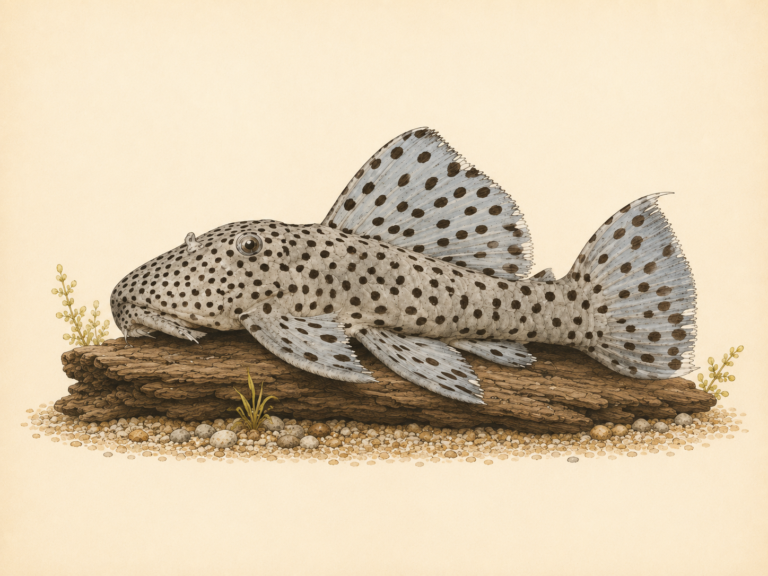
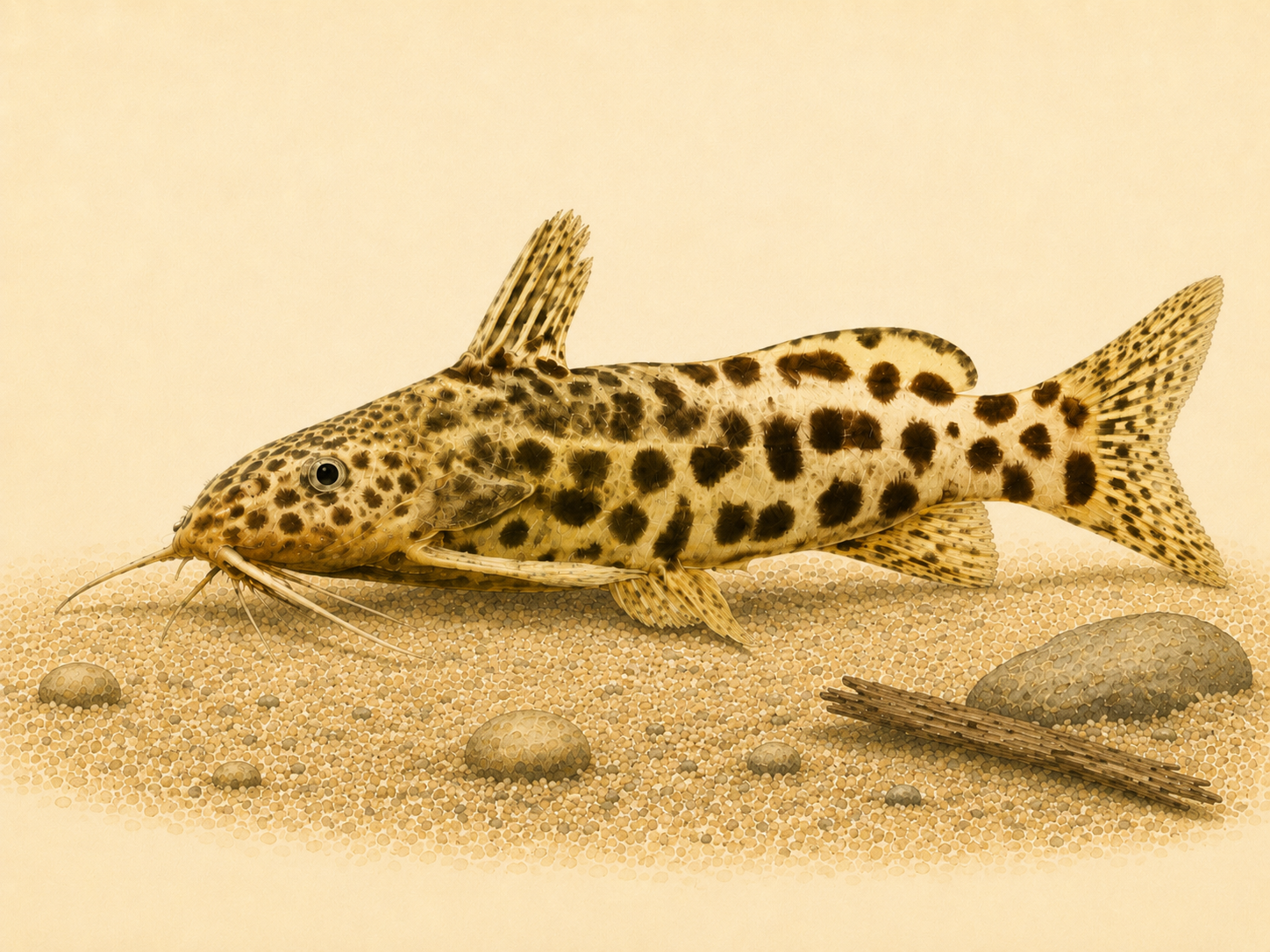
Synodontis waterloti is a moderately sized catfish with a body shape typical of many Synodontis species, laterally compressed with a somewhat flattened ventral profile and a high, triangular dorsal fin. The body is sturdy and muscular, tapering towards a forked caudal fin that provides efficient propulsion in the flowing waters of its native habitat. Three pairs of barbels adorn the mouth region: one pair of maxillary barbels, which are often branched or feathered, and two pairs of mandibular barbels. The maxillary barbels are notably well developed and can reach back along the flanks when held against the body.
The base colour of the body is typically a warm greyish-brown to olive-brown, overlaid with a pattern of darker spots and blotches that can vary considerably between individuals. In some specimens, these markings coalesce into irregular bands or mottled patches, while in others they remain as distinct, well-separated spots. The belly is generally paler, ranging from off-white to light grey. The fins are often marked with spots or bars that echo the body patterning, and the dorsal and pectoral fin spines are robust and sharp, a characteristic shared across the Synodontis genus that keepers should be mindful of when netting or handling the fish.
Juveniles tend to display higher contrast in their patterning, with bolder spots against a lighter ground colour. As the fish matures, the overall colouration may darken somewhat, though well-kept specimens retain attractive patterning throughout their lives. Sexual dimorphism is subtle; mature females are generally fuller bodied than males, particularly when viewed from above, but reliable sexing outside of breeding condition is difficult. Males may develop a slightly more elongated genital papilla, though this is not always easy to observe in a home aquarium setting.
Natural Habitat
Synodontis waterloti is native to several major river systems in West Africa, including the Niger, Senegal, and Gambia river basins. Its range extends across parts of Senegal, Guinea, Sierra Leone, and Mali, where it inhabits a range of freshwater environments from main river channels to tributary streams and seasonal floodplain pools. The species is predominantly found in areas with moderate to strong current, typically over substrates of sand, gravel, and rock.
The habitats it occupies are characterised by the presence of submerged rocks, boulders, fallen branches, and root tangles that provide essential shelter. During the dry season, these catfish concentrate in deeper pools and stretches of permanent water, while the wet season allows them to disperse into flooded marginal areas where food availability increases dramatically. The water in these environments is generally warm, soft to moderately hard, and ranges from slightly acidic to neutral. Turbidity varies with the season, clearer during low water and more turbid after rains, and the species is well adapted to fluctuating conditions.
The surrounding landscape of its native range includes both savannah and forested zones, and the rivers it inhabits can vary from broad, slow-moving lowland sections to faster-flowing rocky stretches at higher elevations. This ecological flexibility is reflected in the species’ adaptability in captivity, making it somewhat forgiving of varying tank conditions provided the fundamentals are met. Understanding this natural context is key to replicating an environment in which S. waterloti will thrive and display its full range of natural behaviours.
Tank Size and Setup
A minimum tank size of 200 litres is recommended for a single Synodontis waterloti, though a larger aquarium of 300 litres or more is preferable if you intend to keep a small group or house the fish alongside other community species. These catfish are moderately active, particularly during twilight and nighttime hours, and they appreciate having adequate swimming space as well as a complex arrangement of hiding places to retreat to during the day.
The substrate should ideally be fine sand or smooth rounded gravel. Sharp or coarse substrates should be avoided, as Synodontis species spend a great deal of time resting on the bottom and foraging through the substrate with their sensitive barbels. A sand substrate also better replicates the natural riverine environments the species originates from and allows for more natural feeding behaviour.
Hardscape is critically important for this species. Provide an abundance of hiding spots using driftwood, bogwood, smooth river rocks, and purpose-built caves or PVC pipe sections. Stacking rocks to create overhangs and crevices is particularly effective, as S. waterloti will often wedge itself into tight gaps during the day. Ensure all rockwork is securely placed and cannot topple, as these catfish are surprisingly strong and may rearrange lighter decorations. Multiple hiding spots should be offered even for a single specimen, as having a choice of refuges helps reduce stress and encourages the fish to settle in more quickly.
Live plants can be included and are generally left alone by this species, though robust species such as Anubias, Java fern, and Bolbitis are the best choices. These plants can be attached to hardscape pieces and do not require planting in the substrate, which suits the catfish’s tendency to forage and dig. Floating plants can also be beneficial, as they diffuse overhead lighting and create a more dimly lit environment that encourages daytime activity. Moderate lighting is ideal; overly bright lighting will drive the fish into permanent hiding and you will rarely see it.
A secure, tight-fitting lid is essential. While S. waterloti is not typically classified as a jumper, startled Synodontis can and do leap, and a gap in the cover is an invitation for an accident. Ensure any openings around filter intakes and heater cables are covered or minimised.
Water Parameters
Synodontis waterloti is reasonably adaptable with regard to water chemistry, which is one of the qualities that makes it suitable for aquarists with moderate experience. However, stability is far more important than hitting a specific number. Sudden fluctuations in temperature, pH, or hardness are far more damaging than water that sits slightly outside the textbook range but remains consistent. The following parameters represent the ideal target range for long-term health.
| Temperature | 23–28 °C |
| pH | 6.2–7.6 |
| General hardness (GH) | 3–15 dGH |
| Carbonate hardness (KH) | 2–10 dKH |
| Ammonia | 0 ppm |
| Nitrite | 0 ppm |
| Nitrate | Below 30 ppm |
Regular partial water changes of 20–30% per week are recommended to maintain water quality and keep nitrate levels in check. When performing water changes, ensure the replacement water is temperature matched and dechlorinated before adding it to the tank. Synodontis species in general are sensitive to elevated nitrate levels over time, and chronic exposure to poor water quality can lead to barbel erosion, fin damage, and increased susceptibility to bacterial infections.
Filtration and Equipment
Effective filtration is a cornerstone of successful Synodontis waterloti husbandry. These catfish produce a moderate bioload relative to their size, and the enclosed, cave-rich environments they prefer can trap detritus if water circulation is insufficient. An external canister filter rated for the tank volume, or ideally one size above, is the best choice. Canister filters provide excellent mechanical, biological, and chemical filtration capacity, and their adjustable outflow allows you to create the moderate current that S. waterloti appreciates without generating an excessively turbulent environment.
Positioning the filter outlet to generate a gentle to moderate flow across the length of the tank replicates the riverine conditions of the species’ natural habitat. Supplementary circulation can be achieved with a small powerhead or wavemaker if needed, particularly in larger tanks where dead spots might otherwise develop behind dense hardscape arrangements. Good oxygen levels are important, and surface agitation from the filter outflow is usually sufficient, though an airstone or additional surface skimmer can be added if oxygen levels are a concern, particularly during warmer months.
A reliable heater, or ideally two smaller heaters for redundancy in larger tanks, should maintain temperatures within the recommended range. An inline heater connected to the canister filter return is a tidy option that keeps the heater out of the aquarium itself, reducing the risk of the catfish resting against it and sustaining burns. If using an in-tank heater, a heater guard is a sensible precaution.
Lighting should be subdued. LED fixtures with adjustable intensity and colour temperature are ideal, as they allow you to dim the lighting to a level that encourages the catfish to emerge from cover during the day. A timer that includes a gradual dawn-dusk ramping period will reduce startling the fish with sudden light changes and more closely mimic natural conditions.
Diet and Feeding
Synodontis waterloti is an omnivorous species with a tendency towards opportunistic feeding. In the wild, its diet consists of a broad mix of aquatic invertebrates, insect larvae, small crustaceans, algae, plant matter, and organic detritus. This dietary flexibility makes it straightforward to feed in captivity, though variety is key to maintaining good health and colouration.
A high-quality sinking pellet or tablet should form the staple of the diet. Choose formulations designed for catfish or bottom-dwelling omnivores, as these tend to have an appropriate protein-to-vegetable matter ratio and sink quickly to the substrate where the catfish can find them. Supplement this staple with regular offerings of frozen or live foods such as bloodworm, brine shrimp, daphnia, and mosquito larvae. These protein-rich foods promote growth and help condition the fish, and the live options in particular stimulate natural foraging behaviour.
Vegetable matter should not be overlooked. Blanched courgette, cucumber medallions, shelled peas, and spinach leaves are all readily accepted and provide essential fibre and micronutrients. Sinking algae wafers or spirulina-based tablets can also be offered several times per week. A varied diet that rotates between several food types across the week will produce the best results in terms of health, colour, and activity levels.
Feeding is best done in the evening or shortly after lights out, as this coincides with the species’ natural activity peak. If you keep S. waterloti in a community setting with more assertive daytime feeders, evening feeding helps ensure the catfish receives its fair share. Observe the fish’s body condition over time, a healthy specimen should be rounded but not bloated, with a slightly convex belly when viewed from the side. Overfeeding should be avoided, as uneaten food will foul the water quickly in the enclosed spaces favoured by this species.
Behaviour and Temperament
Synodontis waterloti is a generally peaceful and somewhat reclusive catfish that fits well into a community of similarly tempered species. It is primarily crepuscular and nocturnal, meaning its peak activity occurs during twilight and nighttime hours. During the day, it will typically shelter within caves, beneath driftwood, or wedged into crevices between rocks. This is entirely normal behaviour and not a sign of stress, provided the fish emerges to feed and appears healthy in body condition.
As the fish settles into its environment over weeks and months, it often becomes bolder and may begin to appear during daylight hours, particularly in dimly lit tanks with ample cover nearby. Some keepers report that their S. waterloti gradually learns to associate their presence with feeding and will emerge expectantly, which speaks to the intelligence and adaptability typical of the Synodontis genus.
Intraspecific behaviour is generally tolerant, though some competition for preferred hiding spots can occur if multiple specimens are kept in a tank with insufficient cover. Providing more hiding places than there are fish is the simplest way to mitigate any territorial disputes. Aggression between conspecifics is usually limited to brief chases and the characteristic squeaking or grunting sounds produced by the pectoral fin spine locking mechanism, the behaviour from which the common name “squeaker catfish” derives. These vocalisations are a normal part of social interaction and are not in themselves a cause for concern.
Towards other species, S. waterloti is almost invariably peaceful. It will not harass or prey upon fish that are too large to swallow, though very small fish and fry may be consumed opportunistically, particularly during nighttime foraging. This is a natural predatory behaviour rather than aggression and should be considered when planning tank mates. The species does not damage plants and rarely disturbs the substrate to a problematic degree, making it a good citizen in a planted community tank.
Tank Mates
Synodontis waterloti is an accommodating community fish that coexists well with a broad range of similarly sized, peaceful to semi-aggressive species. The best tank mates are those that occupy different areas of the water column, as this reduces competition for space and resources. Mid-water and upper-water species make particularly good companions because they leave the bottom zone largely to the catfish. Avoid pairing S. waterloti with very small fish that could be swallowed, or with highly aggressive or territorial species that might bully the catfish and prevent it from feeding. Similarly, other large bottom-dwelling species that compete directly for hiding spots should be chosen with care, ensuring sufficient space and refuges for all occupants.
Good tank mates
- Congo Tetra, a peaceful, active mid-water schooling fish from West Africa that complements S. waterloti beautifully in a biotope setup.
- African Butterfly Fish, Occupies the surface exclusively, creating no competition for territory or food with a bottom-dwelling catfish.
- Jewel Cichlid, a robust West African cichlid that generally coexists well outside of breeding, provided the tank is large enough with ample hiding spots.
- Kribensis, a relatively peaceful dwarf cichlid that shares similar water parameter requirements and occupies the lower to mid-water zone without causing significant conflict.
- Synodontis eupterus, a similarly tempered Synodontis species that can cohabit successfully in a spacious, well-furnished tank.
- Rope Fish, a calm, nocturnal predator that is too slow-moving to bother a Synodontis and shares similar activity patterns.
- African Red-Eye Tetra, a hardy, active schooling fish from West African waters that adds movement to the mid-water zone.
- Bristlenose Pleco, although not from the same region, this peaceful algae-eater generally ignores Synodontis and vice versa, with minimal territorial overlap.
Fish to avoid
- Oscar, a large, aggressive cichlid that may bully or attempt to eat a moderate-sized Synodontis, and produces a very heavy bioload.
- Neon Tetra, far too small and easily swallowed by S. waterloti during nocturnal foraging.
- Red-Tail Catfish, a massive predatory catfish that will eventually consume almost any tank mate it can fit in its mouth.
- Jack Dempsey, a highly territorial and aggressive cichlid that is likely to harass or injure a peaceful catfish.
- Celestial Pearl Danio, Much too small to be safe with a medium-sized Synodontis and may be predated upon at night.
- Flowerhorn Cichlid, an extremely aggressive hybrid cichlid that is entirely unsuitable for community life with peaceful catfish.
- Freshwater Pufferfish, many puffer species are fin-nippers or outright aggressive, and their care requirements often differ significantly.
- Dwarf Shrimp, Will almost certainly be consumed by S. waterloti, as they fall squarely within its natural prey size range.
Breeding
Breeding Synodontis waterloti in captivity is a significant challenge and has rarely been documented in home aquaria. Like many Synodontis species, S. waterloti does not breed readily without specific environmental triggers, and the majority of specimens available in the hobby are wild-caught. This makes captive breeding both a worthwhile goal and a genuinely advanced undertaking.
In the wild, spawning is likely linked to the onset of the rainy season, when rising water levels, increased flow, and changes in water chemistry stimulate reproductive behaviour. To attempt to replicate these conditions in captivity, keepers have found success with large water changes using slightly cooler, softer water to simulate rainfall, combined with an increase in current strength and a varied, protein-rich diet to condition the adults. Raising the water level gradually over a period of days may also help trigger spawning behaviour.
Synodontis species are egg scatterers, and S. waterloti is presumed to follow this reproductive strategy. Eggs are released over the substrate and are not guarded by the parents. In fact, adult Synodontis are known to consume their own eggs if given the opportunity, so removing the adults or collecting the eggs for separate incubation is essential for any breeding attempt to succeed. A fine-meshed breeding grid placed above the substrate can help protect eggs from predation during and immediately after spawning.
Eggs typically hatch within 48 to 72 hours at temperatures around 26–27 °C, and the fry become free-swimming after absorbing their yolk sacs a few days later. Initial food should consist of infusoria or commercially available liquid fry food, graduating to freshly hatched brine shrimp nauplii as the fry grow. Growth can be slow in the early stages, and maintaining pristine water quality in the rearing tank is critical to survival. Given the scarcity of documented captive breeding, any successful attempt would be a notable contribution to the hobby and should be recorded and shared with the broader fishkeeping community.
Common Diseases
Synodontis waterloti is a hardy species that is not particularly prone to disease when kept in appropriate conditions. However, like all aquarium fish, it is susceptible to a range of common ailments if water quality deteriorates, diet is inadequate, or the fish is subjected to chronic stress from unsuitable tank mates or environmental conditions.
White spot disease, caused by the parasite Ichthyophthirius multifiliis, is one of the most frequently encountered illnesses in freshwater aquaria. It presents as small white cysts on the body and fins and is usually triggered by temperature fluctuations or the introduction of infected fish. Treatment involves raising the temperature gradually to 28–30 °C and administering a proprietary white spot remedy. It is important to note that many Synodontis species, including S. waterloti, are scaleless or partially scaleless and can be sensitive to certain medications, particularly those containing copper or malachite green. Always use medications at half the recommended dose when treating scaleless fish and monitor the fish closely during treatment.
Bacterial infections can manifest as fin rot, body ulcers, or cloudy eyes and are almost always secondary to poor water quality. The most effective prevention is maintaining clean water through regular water changes, efficient filtration, and avoiding overstocking. If bacterial infection does occur, improving water quality alone may resolve mild cases, while more severe infections may require treatment with a broad-spectrum antibacterial medication suitable for scaleless fish.
Barbel erosion is a common issue in Synodontis and other catfish species. It is typically caused by abrasive substrates, poor water quality, or bacterial infection of the barbel tissue. Using a fine sand substrate and maintaining low nitrate levels are the most effective preventative measures. If barbel erosion is observed, a thorough review of water quality and substrate type should be undertaken immediately.
Fungal infections, presenting as white cottony growths on the body or fins, can occur in stressed or injured fish. These are usually treatable with proprietary antifungal medications, again used at reduced dosages for scaleless species. Quarantining new arrivals for two to four weeks before introducing them to the main tank is one of the most effective ways to prevent the introduction of disease into an established system.
FAQs
How big does Synodontis waterloti get?
Synodontis waterloti typically reaches an adult size of 15 to 19 centimetres in captivity, though size can vary depending on tank conditions, diet, and genetics. Providing a spacious tank with good water quality and a varied diet will help the fish reach its full potential size. Growth is relatively steady during the first two years and then slows as the fish approaches maturity.
Is Synodontis waterloti nocturnal?
Yes, S. waterloti is primarily crepuscular and nocturnal, meaning it is most active during twilight and nighttime hours. During the day, it will typically hide in caves, beneath driftwood, or among rock formations. However, established specimens in dimly lit tanks often become more confident over time and may emerge during the day, particularly at feeding time. Providing subdued lighting and plenty of cover will encourage earlier and more frequent daytime appearances.
Can I keep Synodontis waterloti with other Synodontis species?
In most cases, yes. Synodontis waterloti is generally tolerant of other Synodontis species, and mixed Synodontis communities can work well in sufficiently large, well-furnished tanks. The key is to provide enough hiding spaces so that each individual can claim its own territory without constant competition. Species of similar temperament and size, such as Synodontis eupterus or Synodontis nigriventris, are typically the best choices for mixed Synodontis setups.
Does Synodontis waterloti eat plants?
Synodontis waterloti is not a significant plant eater. While it is omnivorous and may occasionally nibble on soft-leaved plants, it rarely causes meaningful damage to robust species such as Anubias, Java fern, or Bolbitis. Delicate stem plants and floating plants with fine roots may occasionally be disturbed during nocturnal foraging, but this is generally a minor issue. A well-fed specimen is even less likely to bother plants.
How long does Synodontis waterloti live in an aquarium?
With proper care, Synodontis waterloti can live for 10 to 15 years in captivity, and some individuals may exceed this. Longevity in Synodontis species is strongly correlated with water quality, diet, and stress levels. Maintaining stable, clean water conditions, offering a varied and nutritious diet, and housing the fish in an appropriately sized tank with compatible tank mates are the most important factors in ensuring a long and healthy life.
Related Guides
- Synodontis eupterus Care Guide, a closely related and similarly sized Synodontis species that makes an excellent companion or alternative for West African community tanks.
- Upside-Down Catfish, the classic upside-down catfish, a smaller Synodontis species ideal for those seeking a more compact member of the genus.
- Congo Tetra Care Guide, one of the best mid-water companions for Synodontis waterloti in a West African biotope setup.
- Kribensis Care Guide, a popular West African dwarf cichlid that shares compatible water requirements and pairs well with peaceful catfish.
- West African Biotope Aquarium Guide, a comprehensive guide to setting up an authentic West African biotope aquarium featuring species from the Niger and Senegal river basins.