Quick summary
The Three Spot Gourami is a hardy, adaptable fish that tolerates a wide range of water conditions, making it a great choice for beginners with at least a 115 litre tank. Just be aware that males can be territorial and aggressive, especially towards other gouramis, so careful stocking and plenty of plant cover are important.
🐠 Build a tank around this species
In this guide:
- Introduction
- Quick Stats
- Appearance
- Varieties and Morphs
- Natural Habitat
- Tank Size and Setup
- Water Parameters
- Filtration and Equipment
- Diet and Feeding
- Behaviour and Temperament
- Tank Mates
- Breeding
- Common Diseases
- FAQs
Introduction
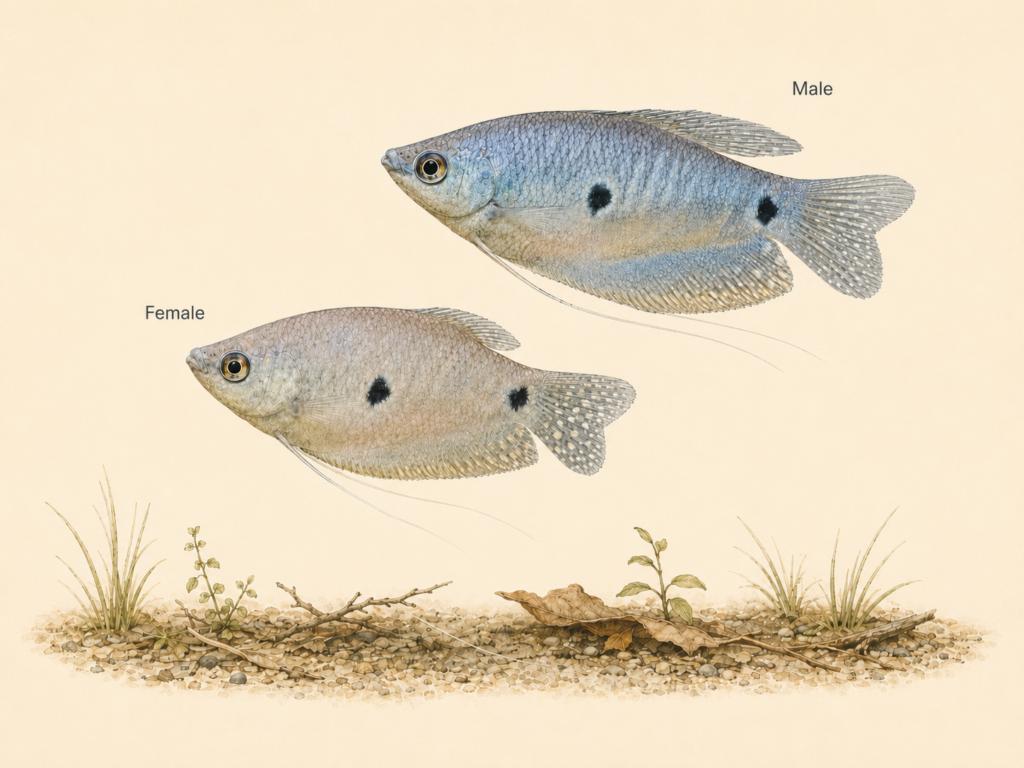
The Three Spot Gourami (Trichopodus trichopterus) is one of the most widely kept freshwater aquarium fish in the world, and for good reason. Hardy, adaptable, and visually appealing in its understated way, this Southeast Asian labyrinth fish has been a staple of the hobby for well over a century. Its common name derives from a charming optical trick: two dark spots adorn the body – one at the centre of the flank and another at the base of the caudal peduncle – while the fish’s eye serves as the apparent third spot, completing the trio.
This particular form represents the closest appearance to the wild-type colouration of Trichopodus trichopterus. It is worth noting that the species has been selectively bred into a number of well-known colour variants, including the Opaline Gourami (also called the Cosby Gourami) and the Gold Gourami. All of these are the same species – Trichopodus trichopterus – and share essentially identical care requirements. This guide focuses on the natural-type Three Spot form, though the husbandry information applies equally to all variants.
As a labyrinth fish, the Three Spot Gourami possesses a specialised organ that allows it to breathe atmospheric air directly from the surface. This adaptation, evolved in the warm, oxygen-poor waters of Southeast Asia, makes the species exceptionally tolerant of less-than-ideal water conditions – a trait that has cemented its reputation as an excellent beginner fish. However, ease of care should never be mistaken for a licence to neglect. Given the right environment, these gouramis display fascinating behaviour, subtle beauty, and a personality that rewards attentive fishkeeping.
Quick Stats
| Scientific name | Trichopodus trichopterus |
|---|---|
| Common names | Blue Gourami, Two Spot Gourami, Opaline Gourami, Cosby Gourami, Gold Gourami |
| Family | Osphronemidae |
| Origin | Southeast Asia (Thailand, Laos, Cambodia, Vietnam, Myanmar, Malaysia, Indonesia) |
| Adult size | 15 cm |
| Lifespan | 4–6 years |
| Difficulty | Easy |
| Breeding difficulty | Easy |
| Temperature | 22–28 °C |
| pH | 6–8 |
| GH | 5–20 dGH |
| KH | 3–10 dKH |
| Minimum tank size | 115 L |
| Conservation status | Least Concern (IUCN) |
Appearance
In its wild-type form, the Three Spot Gourami is a subtly attractive fish. The body is laterally compressed and elongated, with an oval profile that tapers gently towards the tail. The base colour is a pale silvery-blue to olive, overlaid with an irregular pattern of darker blue or grey-blue markings that can appear almost marbled in certain light. These markings tend to intensify or fade depending on the fish’s mood, health, and surrounding environment.
The two defining body spots are perhaps the most immediately recognisable feature. The first sits roughly in the centre of the body, aligned with the lateral midline, while the second appears at the base of the caudal fin. Both are dark, usually black or very deep brown, and remain visible regardless of the fish’s colour state. Combined with the dark eye, they give the species its common name.
The fins are largely translucent with a pale bluish or greenish tint. The dorsal fin is relatively short in females but extends to a longer, more pointed shape in mature males – this difference is one of the most reliable methods of sexing the species. The anal fin is notably long, running along much of the belly from just behind the pelvic fins to the caudal peduncle. The pelvic fins are modified into long, thread-like filaments that serve as tactile sensory organs, a characteristic trait of gouramis. These filaments are used to explore the environment, probe food items, and interact with conspecifics.
Males tend to display more vivid colouration than females, particularly during breeding condition. A mature male in good health will show intensified blue-silver tones across the body, and the marbled patterning may become more pronounced. Females are generally plumper, particularly when viewed from above, and their dorsal fin has a rounded rather than pointed tip.
Juvenile Three Spot Gouramis are paler and less distinctly marked than adults, but the two body spots are typically visible even in young fish. As they mature, the body fills out and the colouration deepens. A well-kept adult in a planted aquarium with dark substrate can be genuinely eye-catching, even when compared to the more vividly coloured selectively-bred variants of the same species.
Varieties and Morphs
Trichopodus trichopterus has been bred into several well-established colour morphs that are widely available in the aquarium trade, each typically sold under its own trade name despite being the same species.
The Opaline Gourami, also known as the Cosby Gourami or Marbled Gourami, is perhaps the most popular variant. It displays a heavily marbled pattern of dark blue or indigo blotches over a paler blue-silver base, often obscuring the two body spots almost entirely. The marbling varies considerably between individuals, and some specimens show particularly striking contrast. This morph was reportedly first developed in the United States by a hobbyist named Cosbybaugh, hence the alternate trade name.
The Gold Gourami is a xanthic variant that displays a warm golden-yellow to orange body colour, often with subtle darker banding or barring across the flanks. The two body spots are usually still visible, though they may appear faded or reduced compared to the wild-type form. Some specimens exhibit a particularly rich, deep gold hue that is quite attractive.
The Platinum Gourami, sometimes called the Silver Gourami, is a leucistic or very pale variant with a uniform silvery-white body and minimal patterning. The body spots are often absent or only faintly visible. This morph has a clean, almost ethereal appearance in a well-lit aquarium.
The Lavender Gourami, sometimes marketed as the Amethyst Gourami, shows a dusky purple-blue colouration that is distinct from both the wild-type and the opaline form. It is less commonly encountered in shops but is available through specialist breeders.
All of these morphs share identical care requirements, behaviour, and temperament with the wild-type Three Spot Gourami. The only differences are cosmetic. When purchasing any of these variants, be aware that they may be labelled under any number of creative trade names, but they are all Trichopodus trichopterus.
Natural Habitat
The Three Spot Gourami is native to a broad swathe of mainland and insular Southeast Asia. Its natural range encompasses Thailand, Laos, Cambodia, Vietnam, Myanmar, the Malay Peninsula, and the Indonesian islands of Sumatra, Java, and Borneo. This is one of the most widely distributed gourami species in the wild, and it has also been introduced – sometimes deliberately, sometimes accidentally – to numerous countries outside its native range, including the Philippines, Taiwan, Papua New Guinea, India, Colombia, and parts of the Caribbean.
In its native waters, Trichopodus trichopterus inhabits a remarkable range of habitats. It is found in lowland marshes, peat swamps, slow-moving rivers, canals, rice paddies, irrigation ditches, and floodplain lakes. It shows a strong preference for shallow, sluggish or still waters with abundant aquatic vegetation. Dense stands of emergent and submerged plants, floating vegetation, and overhanging riparian growth are typical features of its habitat.
Water conditions across this range vary enormously. In the blackwater peat swamps of Borneo, the water may be extremely soft and acidic, stained dark brown with tannins, while in the rice paddies of Thailand or the canals of Java, conditions may be harder, more alkaline, and considerably warmer. This natural exposure to such a wide spectrum of water chemistry is the foundation of the species’ legendary adaptability in captivity.
The labyrinth organ is a key adaptation to these environments. Many of the habitats occupied by Three Spot Gouramis are characterised by low dissolved oxygen levels, high organic loading, and elevated temperatures – conditions that would stress or kill many other fish species. The ability to supplement gill respiration with direct atmospheric air breathing allows the Three Spot Gourami to thrive where others cannot.
In the wild, Three Spot Gouramis are omnivorous and opportunistic, feeding on small invertebrates, insect larvae, zooplankton, algae, and plant material. They are also known to pick at the water’s surface, taking mosquito larvae and other aerial prey that fall onto the water. This generalist feeding strategy further contributes to their success both in the wild and in aquaria.
Tank Size and Setup
A single Three Spot Gourami or a pair can be kept in a tank of at least 115 litres. For a small group, or for a community tank that includes this species alongside other fish, 150-200 litres is more appropriate. Although these are not enormous fish, they are active and can become territorial – particularly males – so providing ample space helps to reduce aggression and allows subordinate fish to escape dominant individuals.
The ideal aquascape for Three Spot Gouramis draws inspiration from their natural habitat. A well-planted tank with areas of dense vegetation, some floating plants, and a few open swimming areas replicates the complexity of their wild environment. Tall stem plants such as Vallisneria, Hygrophila, and Limnophila work well as background planting, while mid-ground plants like Java Fern, Anubias, and Cryptocoryne provide shelter and visual barriers. Floating plants such as Amazon Frogbit, Water Lettuce, or Salvinia are particularly appreciated, as they diffuse overhead light and give the fish a sense of security at the surface where they naturally spend much of their time.
Ensure there is a gap between the water surface and the tank lid. As labyrinth fish, Three Spot Gouramis must be able to access the air above the water to breathe. A tightly sealed lid with no air gap can prevent this and cause distress. At the same time, the air above the water should be warm and humid, roughly matching the water temperature, to prevent damage to the labyrinth organ when the fish takes a gulp of cold air. A well-fitting lid that maintains a warm air layer while still allowing access to the surface is essential.
Substrate choice is largely a matter of personal preference. Fine gravel or sand in natural tones works well and complements the subtle colouration of the wild-type form. Darker substrates tend to bring out the best colour in the fish. Driftwood and bogwood pieces add visual interest and can help to soften the water slightly, which the fish will appreciate in most cases.
Provide plenty of visual barriers in the form of plant thickets, driftwood, and rockwork. These are important for reducing line-of-sight aggression between territorial males. A tank that is too open will often result in a dominant male harassing subordinates or other species relentlessly, while a tank with broken sightlines allows all inhabitants to coexist more peacefully.
Moderate lighting suits this species well. Intensely bright, unshaded lighting can cause the fish to become skittish and washed out in colour. Floating plants naturally help to temper the light levels and create the dappled, shaded conditions that Three Spot Gouramis prefer.
Water Parameters
| Temperature | 22-28 °C |
| pH | 6.0-8.0 |
| General hardness (GH) | 5-20 dGH |
| Carbonate hardness (KH) | 3-10 dKH |
| Ammonia | 0 ppm |
| Nitrite | 0 ppm |
| Nitrate | Below 40 ppm |
The Three Spot Gourami is famously tolerant of a wide range of water conditions, which is a significant part of its appeal to beginners. It will adapt to most tap water sources without difficulty, provided the water is dechlorinated and reasonably stable. That said, the species tends to look its best and behave most naturally in moderately soft, slightly acidic to neutral water at temperatures in the mid-twenties Celsius range.
While the fish can survive brief exposure to suboptimal conditions, long-term health depends on maintaining clean, stable water. Regular partial water changes of 20-30% weekly are recommended. Despite their tolerance for poor conditions, Three Spot Gouramis are still susceptible to the effects of accumulated nitrate and dissolved organic waste over time, and chronic exposure to poor water quality will shorten their lifespan and make them more vulnerable to disease.
Consistency matters more than hitting a specific number. Rapid swings in pH or temperature are far more harmful than keeping the fish at a pH of 7.5 rather than 6.5. Once you have established the parameters of your tap water, aim to maintain them consistently rather than chasing a particular target through chemical adjustment.
Filtration and Equipment
A standard hang-on-back filter or internal canister filter rated for the tank volume will serve a Three Spot Gourami setup well. The key consideration is that this species does not appreciate strong water flow. In the wild, it inhabits slow-moving or still waters, and excessive current in the aquarium will cause stress, make it difficult for the fish to build bubble nests, and interfere with its natural surface-breathing behaviour.
If your filter produces a strong outflow, use a spray bar, baffle, or flow-reducing attachment to diffuse the current. Sponge filters are an excellent choice for a gourami tank, as they provide gentle, effective biological filtration with minimal surface disturbance. They are particularly useful in breeding setups where strong currents would destroy the male’s bubble nest.
A reliable heater is necessary for maintaining tropical temperatures. Choose a heater rated appropriately for your tank volume and set it within the recommended range. A thermometer, ideally positioned at the opposite end of the tank from the heater, allows you to verify that the temperature is consistent and accurate.
Lighting should be moderate. LED units with adjustable brightness are convenient, as they allow you to dial the intensity down to a level that suits both the fish and the plants. A timer set to provide 8-10 hours of light per day will support plant growth while giving the fish a predictable day-night cycle.
A secure lid is essential. Three Spot Gouramis are capable jumpers, especially when startled. An uncovered tank risks losing fish to the floor. As mentioned above, the lid should allow for a warm, humid air gap between the water surface and the cover.
Diet and Feeding
Three Spot Gouramis are true omnivores and will accept virtually any aquarium food offered. This dietary flexibility is another reason they are so well suited to beginners. A high-quality flake or small pellet food formulated for tropical fish makes an excellent staple. Choose a product with a balanced blend of protein and plant-based ingredients.
Supplement the staple diet with regular offerings of frozen or live foods. Bloodworm, brine shrimp, daphnia, and mosquito larvae are all eagerly consumed and help to enhance colouration, promote breeding condition, and provide dietary enrichment. Blanched vegetables such as courgette, spinach, or shelled peas can also be offered occasionally. The fish will nibble at soft algae growth in the tank as well, though they should not be relied upon as an algae control measure.
Feed once or twice daily, offering only as much food as the fish can consume within two to three minutes. Three Spot Gouramis are not fussy eaters, but they can be somewhat slow, methodical feeders compared to fast-moving species like barbs or danios. In a community tank, take care to ensure that the gouramis are getting their share of food and are not being outcompeted at feeding time.
Variety is the key to good nutrition. Rotating between two or three different staple foods, supplemented with frozen and fresh items several times a week, will ensure the fish receives a complete nutritional profile. A monotonous diet, even of a good-quality food, is less ideal than a varied one.
Behaviour and Temperament
The Three Spot Gourami has a personality that belies its reputation as a simple beginner fish. It is intelligent, inquisitive, and often develops recognisable individual behaviours. Many keepers report that their gouramis learn to recognise them and will approach the front glass at feeding time or when the keeper is nearby.
However, it would be misleading to describe this species as universally peaceful. While many individuals are perfectly well-behaved community citizens, males can be significantly territorial and aggressive, particularly towards other gouramis and towards fish with similar body shapes or colouration. This tendency varies between individuals – some males are relatively docile, while others become persistent bullies. It is not possible to predict which temperament a given fish will display until it matures.
Male-to-male aggression is the most common behavioural issue. In a tank that is too small or lacks sufficient cover, a dominant male may relentlessly chase and harass subordinate males, potentially causing injury, chronic stress, and even death. For this reason, it is generally advisable to keep only one male per tank unless the aquarium is large enough and well-furnished enough to support separate territories. A single male with one or two females is often the most harmonious arrangement.
Three Spot Gouramis spend much of their time in the upper and middle levels of the water column. They will regularly visit the surface to breathe atmospheric air, which is a perfectly normal behaviour and not a sign of distress. They use their elongated pelvic filaments to explore surfaces, probe at food, and interact with tank mates – watching a gourami gently “feel” its way around the tank with these thread-like fins is one of the species’ most endearing characteristics.
During breeding, males construct bubble nests at the surface. This is a fascinating process to observe: the male gulps air and blows mucus-coated bubbles, which accumulate into a floating raft, often anchored among floating plants. Nest-building activity can occur even in the absence of a female and is a sign of a healthy, settled male.
Tank Mates
The Three Spot Gourami is generally compatible with a wide range of community fish, provided certain considerations are kept in mind. Avoid housing it with very small species that might be seen as prey, with fin-nipping species that will target the gourami’s long pelvic filaments, or with other male gouramis of the same or similar species that are likely to provoke territorial disputes. Equally, avoid very large, boisterous, or overtly aggressive species that might intimidate or injure the gourami. The best tank mates are calm, moderately sized fish that occupy different levels of the water column.
Good tank mates
- Corydoras Catfish – Peaceful bottom-dwellers that occupy a completely different zone of the tank and pose no threat to gouramis.
- Bristlenose Pleco – A calm, algae-eating catfish that stays near the substrate and is unlikely to interact with gouramis at all.
- Cherry Barb – A gentle, colourful barb that is too peaceful to cause fin-nipping issues and adds activity to the mid-water zone.
- Harlequin Rasbora – A classic Southeast Asian companion that shares similar water parameter preferences and is entirely non-aggressive.
- Kuhli Loach – A shy, nocturnal bottom-dweller that will rarely, if ever, come into conflict with surface-oriented gouramis.
- Swordtail – A hardy, moderately sized livebearer that coexists well with gouramis in a spacious, planted tank.
- Platy – Another peaceful livebearer that tolerates a similar range of water parameters and adds colour to the community.
- Yoyo Loach – An active bottom-dwelling loach that is robust enough to hold its own without provoking aggression.
Fish to avoid
- Tiger Barb – A notorious fin-nipper that will target the gourami’s trailing pelvic filaments relentlessly.
- Dwarf Gourami – Likely to be bullied or harassed by the larger Three Spot Gourami, particularly by territorial males.
- Siamese Fighting Fish – Another labyrinth fish that is likely to be targeted by the Three Spot Gourami or provoke mutual aggression.
- Convict Cichlid – An aggressive cichlid that will dominate and stress the gourami, especially during breeding.
- Red Tail Shark – A highly territorial species that may clash with a territorial male gourami in a confined space.
- Oscar – Far too large and predatory to house with Three Spot Gouramis, which would likely become prey or be badly injured.
- Serpae Tetra – Known fin-nippers that will nip at the gourami’s long fins and pelvic filaments, causing stress and damage.
Breeding
The Three Spot Gourami is one of the easiest aquarium fish to breed, making it an excellent species for hobbyists looking to experience bubble-nesting behaviour for the first time. Spawning can occur in a community tank, but for the best results and highest fry survival, a dedicated breeding tank is recommended.
Set up a breeding tank of approximately 40-75 litres. Keep the water level relatively shallow – around 15-20 cm is ideal – and ensure the temperature is at the warmer end of the range, around 26-28 degrees Celsius. Include floating plants such as Amazon Frogbit or Water Sprite to provide anchoring material for the bubble nest. Filtration should be gentle; a small sponge filter is perfect. Cover the tank securely to maintain warm, humid air above the water surface, which is critical for the development of the labyrinth organ in the fry.
Condition the breeding pair with generous feedings of high-protein foods such as live or frozen bloodworm and brine shrimp for one to two weeks before introducing them to the breeding tank. A well-conditioned female will appear noticeably plumper when viewed from above. Introduce the female first, allowing her to settle for a day or two, then add the male.
The male will begin constructing a bubble nest, typically among the floating plants. This process can take anywhere from a few hours to a couple of days. Once the nest is complete, the male will display to the female with flared fins and intensified colouration, attempting to lure her beneath the nest. If she is receptive, the pair will engage in a spawning embrace: the male wraps his body around the female, turning her upside down beneath the nest, and the eggs are released and fertilised simultaneously. The eggs float upwards into the bubble nest. This embrace is repeated multiple times, and a single spawning can produce several hundred to over a thousand eggs.
Remove the female immediately after spawning is complete. The male takes sole responsibility for guarding and tending the nest, and he may become aggressive towards the female, injuring or even killing her if she remains in the tank. The male will diligently maintain the nest, retrieving any eggs that fall and blowing fresh bubbles to keep the structure intact.
The eggs hatch in approximately 24-36 hours, and the fry become free-swimming two to three days later. At this point, the male should also be removed, as he may begin to eat the fry. The tiny fry require infusoria or liquid fry food for the first few days, graduating to freshly hatched brine shrimp nauplii and then finely crushed flake food as they grow. Growth is rapid, and the fry will begin to resemble miniature adults within a few weeks.
Common Diseases
The Three Spot Gourami is a robust species, but it is not immune to the common diseases that affect freshwater aquarium fish. Good husbandry, stable water quality, and a varied diet are the best preventative measures.
White spot disease (ichthyophthirius, commonly called ich) is perhaps the most frequently encountered ailment. It presents as small white cysts on the body and fins, and infected fish may flash (rub against surfaces) and show signs of irritation. Treatment involves raising the temperature gradually to 28-30 degrees Celsius and using a proprietary white spot medication according to the manufacturer’s instructions. Three Spot Gouramis generally tolerate ich treatment well.
Bacterial infections, including fin rot and ulcerative conditions, can occur, particularly in tanks with poor water quality or where the fish has sustained physical injuries from aggression. Symptoms include frayed or eroding fins, reddened areas on the body, or open sores. Improving water quality is the first and most important step, supplemented by antibacterial treatments if the condition does not resolve.
Gouramis as a group are sometimes reported to be susceptible to a condition known colloquially as “gourami disease,” which is caused by the iridovirus Megalocytivirus. This viral infection can cause lethargy, loss of colour, darkening of the body, swollen abdomen, and open sores. There is no reliable cure for viral infections in fish, and affected individuals should be isolated to prevent transmission. However, this condition is far more commonly reported in Dwarf Gouramis (Trichogaster lalius) than in Three Spot Gouramis.
Velvet disease (Oodinium) is another parasitic infection that occasionally affects gouramis. It appears as a fine, gold or rust-coloured dusting on the skin, and infected fish may clamp their fins and become lethargic. Treatment with copper-based medications is typically effective, though care should be taken with dosing if invertebrates are present in the tank.
Internal parasites may occasionally affect wild-caught specimens, though the vast majority of Three Spot Gouramis in the trade are captive-bred and less likely to carry parasitic loads. Signs of internal parasites include weight loss despite a good appetite, white or stringy faeces, and a hollow-bellied appearance. Antiparasitic foods or medications can be used to treat these conditions.
FAQs
Are Three Spot Gouramis, Opaline Gouramis, and Gold Gouramis the same species?
Yes, they are all Trichopodus trichopterus. The Three Spot Gourami represents the wild-type or natural colouration, while the Opaline (Cosby) and Gold forms are selectively bred colour variants. Their care requirements, behaviour, and breeding are identical. The only differences between them are cosmetic.
Can I keep two male Three Spot Gouramis together?
It is generally not advisable unless you have a very large, heavily planted tank with plenty of visual barriers. Male Three Spot Gouramis can be highly territorial towards one another, and in a standard-sized community tank, the dominant male is likely to harass and injure the subordinate. A single male with one or two females is usually the most harmonious arrangement.
Why does my Three Spot Gourami keep going to the surface?
This is completely normal behaviour for a labyrinth fish. Three Spot Gouramis possess a labyrinth organ that allows them to breathe atmospheric air directly from the surface. Regular trips to the surface to gulp air are a natural part of their physiology, not a sign of poor water quality or low oxygen levels. However, if the fish is gasping at the surface constantly and appears distressed, it is worth checking your water parameters to be safe.
How can I tell if my Three Spot Gourami is male or female?
The most reliable visual difference is the shape of the dorsal fin. In males, the dorsal fin is longer and comes to a distinct point, while in females it is shorter and has a more rounded edge. Mature females also tend to be slightly plumper in the body, particularly when carrying eggs. Males typically display more intense colouration, especially when in breeding condition or when asserting territorial dominance.
Do Three Spot Gouramis eat plants?
Three Spot Gouramis are omnivores and may occasionally nibble on soft-leaved plants, but they are not generally considered destructive plant eaters. Hardy species such as Java Fern, Anubias, and Vallisneria are rarely bothered. Providing a varied diet that includes some plant-based foods will help to reduce any tendency to graze on aquarium plants.
Related Guides
- Opaline Gourami – The popular marbled colour morph of the same species, Trichopodus trichopterus, with identical care requirements.
- Gold Gourami – The golden-yellow selectively bred variant of Trichopodus trichopterus, sharing the same husbandry needs as the Three Spot form.
- Pearl Gourami – A closely related and arguably even more beautiful gourami species that makes an excellent alternative for planted community tanks.
- Dwarf Gourami – A smaller gourami species with different care considerations, useful for comparison when choosing a gourami for your aquarium.
- Moonlight Gourami – Another larger Trichopodus species with a peaceful temperament and similar habitat requirements.