Quick Summary
The Ticto Barb is a hardy, peaceful shoaling fish that thrives in groups of six or more, making it an excellent choice for beginners setting up a planted community tank. Its modest adult size, tolerance of a broad range of water conditions, and lively disposition mean it rewards even novice keepers with colour and activity from day one.
🐠 Build a tank around this species
In this guide:
- Introduction
- Quick Stats
- Appearance
- Natural Habitat
- Tank Size and Setup
- Water Parameters
- Diet and Feeding
- Behaviour and Temperament
- Tank Mates
- Breeding
Introduction
The Ticto Barb (Pethia ticto) has been a fixture in the freshwater hobby for well over a century, yet it remains somewhat overshadowed by flashier relatives such as the Cherry Barb and Tiger Barb. That is a shame, because few small cyprinids combine ease of care, attractive markings, and genuinely peaceful behaviour quite so well. Originally described by Francis Hamilton in 1822, this little barb is native to a vast swathe of South Asia, from the slow-flowing hill streams of Nepal to lowland paddy fields in Sri Lanka. Its adaptability in the wild translates directly to the aquarium: it tolerates a wide pH band, is unfussy about food, and seldom bothers tank mates of any description.
In the trade the species sometimes appears under older synonyms such as Barbus ticto or Puntius ticto, and it may also be labelled the Two-Spot Barb or Twospot Barb – a reference to the dark shoulder blotch and a smaller, sometimes faint, spot near the caudal peduncle. Whatever the label on the shop tank, the care requirements are identical. This guide covers everything you need to keep a thriving group, from water chemistry and diet through to breeding tips and disease prevention.
Quick Stats
| Scientific name | Pethia ticto |
|---|---|
| Common names | Two-Spot Barb, Twospot Barb, Ticto Puntius |
| Family | Cyprinidae |
| Origin | South Asia (India, Nepal, Bangladesh, Sri Lanka, Pakistan, Myanmar) |
| Adult size | 6 cm |
| Lifespan | 4–6 years |
| Difficulty | Easy |
| Breeding difficulty | Moderate |
| Temperature | 18–26 °C |
| pH | 6–8 |
| GH | 2–15 dGH |
| KH | 2–10 dKH |
| Minimum tank size | 75 L |
| Conservation status | Least Concern (IUCN) |
Appearance
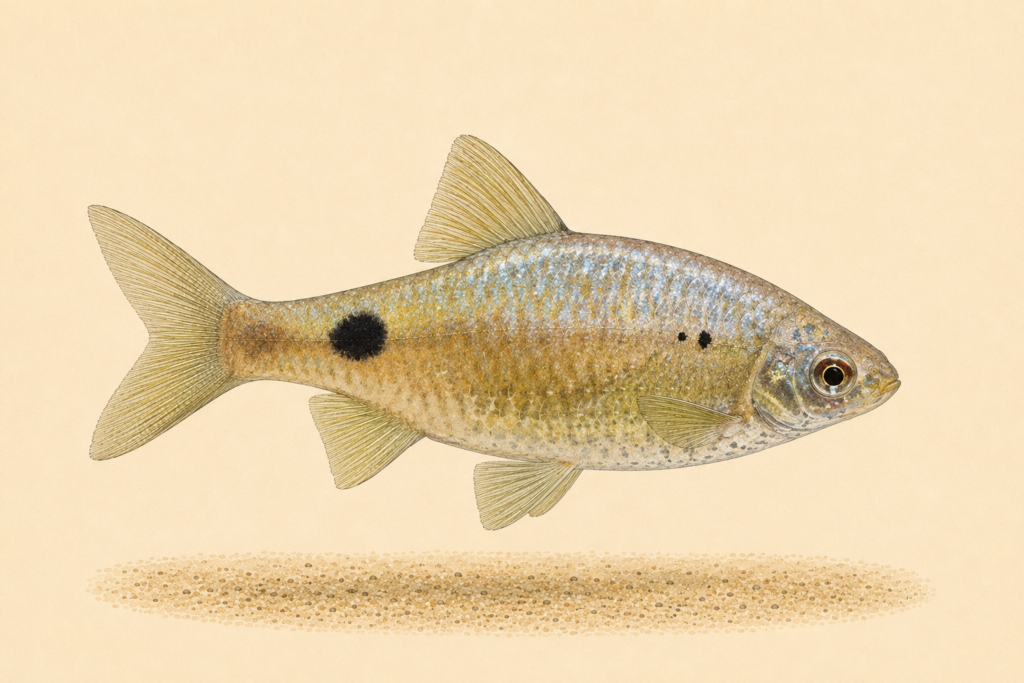
At first glance the Ticto Barb might seem understated, but a closer look at a well-conditioned specimen in good lighting reveals a subtle beauty. The body is laterally compressed and moderately deep, with a silvery to pale golden-olive base colour. Scales are individually outlined with a fine dark reticulation that gives the flanks a delicate mesh-like pattern when viewed close up. The defining field mark is a prominent, roughly circular dark blotch situated just behind and above the pectoral fin, on the shoulder. A second, smaller spot often appears near the base of the tail, though its visibility varies between individuals and populations – hence the alternative name Two-Spot Barb.
Sexual dimorphism is reasonably easy to spot in mature fish. Males develop warmer colouration, often acquiring a rosy or coppery flush along the flanks and into the fins, particularly during breeding condition. The dorsal fin of the male typically shows a bold black band or blotch bordered by a paler margin, which intensifies during courtship displays. Females are slightly deeper-bodied, more silvery, and generally lack the pronounced dorsal fin marking. Their bellies become noticeably rounded when full of eggs.
Juveniles are paler overall and the shoulder spot may not be fully defined until the fish reaches around 2-3 cm in length. Under optimal conditions and a varied diet, adult Ticto Barbs reach roughly 5 to 7 cm standard length, with males tending toward the smaller end of that range. The fins are largely transparent to pale yellow, though the anal and pelvic fins of males can take on a hint of red or orange.
Natural Habitat
Pethia ticto is one of the most widely distributed small cyprinids in South Asia. Its range extends across much of the Indian subcontinent, from the Himalayan foothills of Nepal southward through the plains of northern India, through Bangladesh, into Sri Lanka, parts of Pakistan, and potentially into western Myanmar. This enormous range encompasses a tremendous variety of habitats, which partly explains the species’ hardiness in captivity.
In the wild, Ticto Barbs are typically found in slow-moving to moderately flowing streams, irrigation canals, flooded rice paddies, ponds, and the margins of larger rivers. They tend to prefer shallow, well-vegetated areas where submerged and emergent plants provide cover and foraging opportunities. Substrates in these habitats range from sandy to muddy, and the water can vary from clear to moderately turbid depending on the season and the specific waterbody.
Seasonal monsoon cycles play a major role in the ecology of wild populations. During the wet season, fish disperse into flooded fields and temporary pools to spawn, taking advantage of the explosion of planktonic food and the relative safety of shallow, vegetated water. As waters recede, they retreat to more permanent channels and ponds. Water temperatures across this range can fluctuate considerably, from the low to mid teens Celsius during cool highland winters to the upper twenties in lowland summer months. This natural temperature tolerance is a boon for aquarists who keep unheated tanks in temperate climates.
Wild Ticto Barbs are omnivorous, feeding on small invertebrates, algae, detritus, and plant matter. They shoal in loose groups, foraging across the substrate and among vegetation. Predators include larger fish species, water birds, and snakes. Their alert, active nature and tendency to school tightly when threatened are anti-predator strategies that translate into lively, engaging behaviour in the aquarium.
Tank Size and Setup
A group of six Ticto Barbs can be comfortably housed in a tank of 75 litres or more. If you wish to keep a larger shoal – which is always preferable for barb species – or plan a mixed community, aim for 100 litres and upwards. Longer tanks are better than tall ones, as these fish spend most of their time in the mid-water and lower regions and appreciate horizontal swimming space.
Planting is highly recommended. Live plants serve multiple purposes: they break up sight lines, reduce stress, provide grazing surfaces, and mimic the vegetated habitats in which the species naturally occurs. Hardy, undemanding plants such as Java Fern, Anubias, Vallisneria, and Cryptocoryne species work well. Floating plants are useful for diffusing overhead light and giving the fish a sense of security, which encourages bolder behaviour and better colouration. Leave an open swimming area in the front or centre of the tank so you can appreciate the shoaling display.
Substrate choice is flexible. Fine gravel or sand both work. A darker substrate tends to bring out the best colouration in the fish. Driftwood, smooth stones, and leaf litter can be added to create a more natural-looking scape. Dried Indian almond leaves or similar botanicals will slowly release tannins, softening the water slightly and tinting it a pale amber, which many South Asian species appreciate.
A secure lid is advisable. While Ticto Barbs are not habitual jumpers, any active schooling fish may leap when startled, especially during the settling-in period or if water quality declines. Moderate lighting suits both the fish and most easy-care plant species. Extremely bright, unshaded light can make the barbs skittish.
Water Parameters
One of the strongest selling points of the Ticto Barb is its tolerance of a broad range of water conditions. This is a fish that thrives in soft, slightly acidic water but adapts perfectly well to moderately hard, alkaline tap water typical of many parts of the United Kingdom and Europe. Consistency and cleanliness matter more than hitting a precise number.
| Temperature | 18-26 C |
| pH | 6.0-8.0 |
| General hardness (GH) | 2-15 dGH |
| Carbonate hardness (KH) | 2-10 dKH |
| Ammonia | 0 ppm |
| Nitrite | 0 ppm |
| Nitrate | Below 30 ppm |
The wide temperature tolerance is noteworthy. In temperate climates, Ticto Barbs can be kept in unheated indoor aquaria provided room temperature remains above roughly 18 C. In tropical community setups alongside species that require warmer water, they do perfectly well at 24-26 C. Avoid sustained temperatures above 28 C, which can stress the fish and reduce dissolved oxygen levels.
Perform weekly water changes of 20-30% to keep nitrate levels in check and maintain stable chemistry. If your tap water is particularly hard or alkaline, the fish will still do well; there is no need to chase a specific softness unless you are attempting to breed them, in which case softer, slightly acidic conditions are beneficial.
Filtration and Equipment
Any reliable filter rated for the tank volume will serve a Ticto Barb community well. Hang-on-back filters and internal power filters are popular budget-friendly choices. Canister filters offer superior mechanical and biological filtration for larger setups and are worth the investment if you plan a well-stocked community. Sponge filters are an excellent option for breeding tanks, as they provide gentle flow and pose no risk to fry.
Flow rate should be moderate. Ticto Barbs are not rapid-water specialists; they come from slow to moderately flowing habitats. A gentle current across the length of the tank encourages natural shoaling behaviour without exhausting the fish. If your filter output is too strong, use a spray bar or baffle to diffuse it.
A heater is optional depending on your ambient room temperature. If you keep the tank in a heated room that stays above 20 C year-round, you may not need one. For mixed tropical communities, a thermostatically controlled heater set to 24-25 C is standard. Always use a separate thermometer to verify the heater’s accuracy.
Standard aquarium lighting suited to plant growth is appropriate. A timer that provides 8-10 hours of light per day helps maintain a consistent photoperiod. An air pump is not strictly necessary if the filter provides adequate surface agitation, but it can be useful in warmer months or in densely stocked tanks to boost oxygenation.
Diet and Feeding
The Ticto Barb is a true omnivore with a healthy appetite and no particular fussiness. In the wild it feeds on small aquatic invertebrates, insect larvae, algae, and organic detritus. In the aquarium, a varied diet keeps the fish healthy, colourful, and in good breeding condition.
A high-quality micro-pellet or flake food formulated for small tropical fish should form the staple. Choose products with whole fish meal or insect meal as a primary ingredient rather than grain fillers. Supplement this base diet two to three times per week with frozen or live foods such as bloodworm, daphnia, brine shrimp, or mosquito larvae. These protein-rich treats are particularly important for conditioning fish prior to breeding.
Vegetable matter should not be neglected. Blanched spinach, shelled peas, spirulina-based flakes, or small pieces of blanched courgette are all accepted readily. If the tank contains soft algae growth on rocks or glass, the barbs will happily graze on it.
Feed small amounts once or twice daily – only as much as the group can consume in two to three minutes. Overfeeding is a common beginner mistake that degrades water quality. Ticto Barbs are active foragers and will pick at leftover food and biofilm between meals, so there is no need to worry about them going hungry if you feed conservatively. A weekly fasting day can be beneficial for digestion, though it is not essential.
Behaviour and Temperament
Ticto Barbs are among the most peaceable members of the barb family. Unlike some of their larger relatives, they very rarely nip fins or harass tank mates. Their disposition is active, curious, and sociable. They spend much of the day in loose shoals, moving together through the mid-water and lower regions of the tank, occasionally breaking formation to investigate a piece of food or explore a new piece of decor.
Keep Ticto Barbs in groups of at least six. In smaller numbers they become visibly stressed, prone to hiding, and may occasionally direct nervous energy toward other species. In a properly sized group, intraspecific interactions are mostly benign: males will display to each other and to females, flaring their dorsal fins and intensifying their colouration. These displays are fascinating to watch and rarely result in any injury.
The species is diurnal, most active during daylight hours and resting quietly at night, often hovering among plants or near the substrate. They are not shy feeders and will quickly learn to associate your approach with food. In a well-planted tank with appropriate tank mates, they become bold and spend the majority of their time in open water, giving you an excellent view of their shoaling behaviour.
Ticto Barbs are not territorial. They do not establish or defend specific areas of the tank, which makes them ideal residents for community setups. They occupy the mid-water column primarily but will venture to the surface for floating food and to the substrate to pick at fallen particles.
Tank Mates
The peaceful, mid-water-dwelling nature of the Ticto Barb makes it compatible with a wide variety of community fish. The key considerations are size (avoid anything large enough to eat them), temperament (avoid aggressive or highly territorial species), and water parameter overlap. Because the Ticto Barb tolerates such a broad range of conditions, finding compatible species is straightforward.
Good tank mates
- Cherry Barb – A similarly sized, peaceful barb that shares the same water parameter preferences and shoaling habits.
- Rosy Barb – Another hardy South Asian barb that enjoys cooler temperatures and mixes well in larger community tanks.
- Zebra Danio – An active, hardy cyprinid that thrives in the same temperature range and adds upper-water movement.
- Harlequin Rasbora – A gentle shoaler that complements the Ticto Barb’s mid-water activity without competing for territory.
- Bronze Corydoras – A peaceful bottom-dweller that occupies a different zone and helps keep the substrate clean.
- Kuhli Loach – A shy, nocturnal bottom-dweller that poses no threat and benefits from the barbs’ daytime activity distracting potential aggressors.
- Bristlenose Pleco – A peaceful algae-eating catfish that stays out of the barbs’ way and helps with tank maintenance.
- Honey Gourami – A calm, slow-moving labyrinth fish that coexists peacefully in planted community tanks.
- Amano Shrimp – Large enough to avoid predation by adult Ticto Barbs and an excellent addition to a clean-up crew.
Fish to avoid
- Oscar – A large predatory cichlid that would view Ticto Barbs as food.
- Tiger Barb – Notoriously nippy in mixed-species setups, likely to harass the more docile Ticto Barbs.
- Green Terror – An aggressive, territorial cichlid far too large and belligerent for a small barb community.
- Red-Tail Black Shark – Territorial and aggressive toward bottom-to-mid-water species, especially in smaller tanks.
- Flowerhorn – A large, highly aggressive hybrid cichlid completely incompatible with small community fish.
- African Jewelfish – Extremely territorial when breeding and likely to injure or kill small barbs.
- Siamese Fighting Fish – While not aggressive toward barbs specifically, the Ticto Barb’s active nature can stress a slow-moving betta, and the betta’s long fins may invite occasional investigation.
Breeding
Breeding Ticto Barbs is achievable for moderately experienced hobbyists and can be a rewarding project. Like most small cyprinids, they are egg scatterers with no parental care – adults will readily consume their own eggs if given the opportunity, so a separate breeding setup or careful management is required.
Begin by conditioning a group of healthy adults on a protein-rich diet of live and frozen foods for one to two weeks. Males will intensify in colour and display more frequently to females, whose bellies will become visibly rounded with eggs.
Set up a dedicated breeding tank of around 20-30 litres. Fill it with aged water that is slightly softer and more acidic than the main tank – a pH of 6.5-7.0 and a GH of 4-8 dGH is ideal. Temperature should be at the warmer end of the species’ range, around 25-26 C. Place a layer of fine-leaved plants such as Java Moss or spawning mops on the bottom to catch the eggs, or use a mesh grid that allows eggs to fall through but prevents adult access.
Introduce a well-conditioned pair or a small group (two males to one female works well) in the evening. Spawning typically occurs the following morning as light levels increase. The male will chase and court the female, pressing against her side to stimulate egg release. Eggs are small, semi-adhesive, and scattered among the plants or mesh. A healthy female can produce 100-200 eggs in a single spawning event.
Remove the adults immediately after spawning to prevent egg predation. Eggs hatch in approximately 24-36 hours at 25 C. The fry are tiny and will absorb their yolk sacs over the next one to two days. Once free-swimming, they can be fed infusoria or commercially available liquid fry food for the first week, transitioning to freshly hatched brine shrimp nauplii and microworms as they grow. Growth is steady, and young fish begin to show the characteristic shoulder spot at around four to six weeks of age.
Maintain impeccable water quality in the fry tank with gentle sponge filtration and small, frequent water changes. Avoid strong currents that could sweep the tiny fry around. With good feeding and clean water, juvenile Ticto Barbs reach sellable size in roughly three to four months.
Common Diseases
Ticto Barbs are robust fish that rarely fall ill when kept in clean, well-maintained water. However, like all freshwater species, they can be susceptible to a number of common ailments, particularly if water quality lapses or new additions introduce pathogens.
White spot disease (Ichthyophthirius multifiliis), commonly known as ich, is perhaps the most frequently encountered problem. It presents as small white cysts on the fins and body, accompanied by flashing (rubbing against surfaces) and clamped fins. Ich is highly treatable if caught early. Gradually raising the temperature to 28-30 C over 24-48 hours accelerates the parasite’s life cycle and can be combined with a proprietary ich treatment containing malachite green or formalin. Maintain elevated temperature and treatment for the full recommended course even after spots disappear.
Fin rot is another common issue, usually triggered by poor water quality or physical damage. Frayed, discoloured fin edges are the hallmark symptom. Improving water quality through increased water changes is often sufficient to resolve mild cases. Stubborn infections may require treatment with antibacterial medications.
Internal parasites can occasionally affect wild-caught or poorly quarantined fish, manifesting as weight loss, a hollow belly, or pale, stringy faeces. Treat with an appropriate anti-parasitic medication if suspected. Quarantining all new fish for two to three weeks before adding them to the main display is the single most effective preventative measure against introducing disease.
Velvet disease (Oodinium), bacterial infections, and fungal infections are less common but possible. In virtually all cases, maintaining excellent water quality – zero ammonia, zero nitrite, low nitrate, stable temperature – is the best defence. A healthy, well-fed Ticto Barb has a strong immune system and is unlikely to succumb to opportunistic infections.
FAQs
How many Ticto Barbs should I keep together?
A minimum of six is recommended, though eight to ten or more is preferable if your tank allows it. Larger groups display more natural shoaling behaviour, show better colouration, and experience less stress. In groups of fewer than six, individuals may become withdrawn or occasionally direct nervous energy toward other species.
Can Ticto Barbs live in an unheated tank?
Yes, provided the room temperature remains above approximately 18 C. Their natural range includes areas with cool winters, so they tolerate lower temperatures better than many tropical species. They make excellent candidates for temperate or subtropical community setups alongside other cool-water-tolerant species like Zebra Danios, Rosy Barbs, and White Cloud Mountain Minnows.
Do Ticto Barbs nip fins?
Ticto Barbs are one of the least nippy barb species in the hobby. Fin nipping is extremely rare when they are kept in an appropriately sized group. They are generally safe with long-finned species, though very slow-moving, heavily finned fish like fancy guppies or male bettas are best paired cautiously, as any active mid-water fish can sometimes cause stress through sheer proximity and movement.
What is the difference between Pethia ticto and Pethia stoliczkana?
These two species are closely related and frequently confused in the trade. Pethia stoliczkana, the Odessa Barb or Stoliczkana Barb, typically displays a bolder red or orange horizontal stripe along the body in males and tends to be slightly larger. Pethia ticto is generally more subtly coloured, with a rosy flush rather than a vivid stripe, and its dorsal fin marking pattern can differ. Misidentification is common, so purchasing from a reputable dealer is recommended if species accuracy matters to you.
Are Ticto Barbs safe with shrimp?
Adult Ticto Barbs coexist well with larger shrimp species such as Amano Shrimp. However, they may prey on very small shrimp species like juvenile Cherry Shrimp or newborn shrimplets. If you keep a breeding colony of dwarf shrimp, provide dense plant cover – especially mosses – to give shrimplets hiding places. In a well-planted tank, enough shrimp will survive to maintain the colony, but losses should be expected.
Related Guides
- Cherry Barb Care Guide – Another peaceful small barb ideal for planted community tanks, with similar care requirements.
- Rosy Barb Care Guide – A larger, equally hardy South Asian barb that shares the Ticto Barb’s tolerance of cooler water.
- Odessa Barb Care Guide – A closely related and frequently confused species worth comparing if you are deciding between the two.
- Zebra Danio Care Guide – A classic beginner cyprinid that makes an excellent companion for Ticto Barbs in cooler community setups.
- White Cloud Mountain Minnow Care Guide – A top-tier choice for unheated tanks that pairs well with Ticto Barbs in temperate communities.