Quick Summary
The Two-stripe Corydoras is a charming, peaceful bottom-dwelling catfish that thrives in groups and is well suited to community aquariums with soft sand substrates. If you can provide a mature tank with clean water and a shoal of at least six, this hardy little cory makes an excellent choice for beginners and experienced keepers alike.
🐠 Build a tank around this species
In this guide:
- Introduction
- Quick Stats
- Appearance
- Natural Habitat
- Tank Size and Setup
- Water Parameters
- Diet and Feeding
- Behaviour and Temperament
- Tank Mates
- Breeding
Introduction
Corydoras bifasciatus, commonly known as the Two-stripe Corydoras, is a small armoured catfish belonging to the family Callichthyidae. Native to river systems in South America, this species is one of the many delightful members of the Corydoras genus that have become staples in the freshwater aquarium hobby. Its common name derives from the two prominent dark lateral stripes that run along its flanks, giving it a distinctive and attractive appearance among its close relatives.
Corydoras bifasciatus is the currently accepted scientific name for this species. Regardless of the label, the care requirements remain the same as those for most Corydoras species – soft sand substrate, pristine water quality, and the company of conspecifics in a group of six or more.
Like all corydoras, this species is an obligate air-breather that will periodically dash to the surface to gulp atmospheric air, which is absorbed through the intestinal lining. This behaviour is perfectly normal and should not be confused with a sign of distress, although excessively frequent surface visits can indicate poor dissolved oxygen levels in the water column. Overall, the Two-stripe Corydoras is a peaceful, endearing, and relatively straightforward fish to keep, making it a wonderful addition to planted community aquariums and species-only setups alike.
Quick Stats
| Scientific name | Corydoras bifasciatus |
|---|---|
| Common names | Two-striped Cory, Twostripe Catfish |
| Family | Callichthyidae |
| Origin | Suriname and French Guiana, South America |
| Adult size | 5.5 cm |
| Lifespan | 5–8 years |
| Difficulty | Easy |
| Breeding difficulty | Moderate |
| Temperature | 22–26 °C |
| pH | 6–7.5 |
| GH | 2–12 dGH |
| KH | 1–8 dKH |
| Minimum tank size | 75 L |
| Conservation status | Least Concern (IUCN, assessed 2018) |
Appearance
The Two-stripe Corydoras is a compact, somewhat stocky catfish that displays the classic Corydoras body plan – a flattened ventral surface, an arched dorsal profile, and overlapping bony scutes (plates) in place of scales that give the genus its characteristic armoured appearance. Adults typically reach between 5 and 6 centimetres in total length, making them a modestly sized member of the genus.
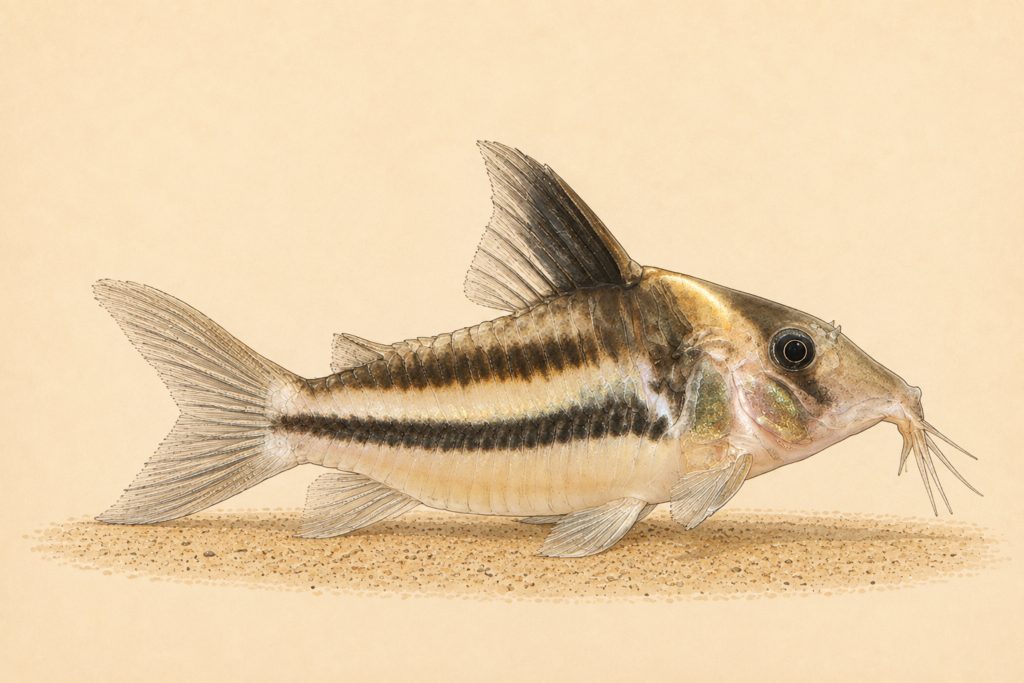
The most defining feature of Corydoras bifasciatus is the pair of dark, well-defined lateral stripes that run horizontally along each flank. The upper stripe tends to follow the junction between the upper and lower rows of scutes, while the lower stripe sits along the lower flank closer to the ventral surface. These stripes are usually dark brown to black and stand out clearly against the lighter base colouration, which ranges from a pale silvery-beige to a warm tan or light gold. The head often shows a darker mask or blotch across the top, and some specimens display fine speckling or stippling on the head and upper body.
The dorsal fin is relatively tall for a Corydoras and is usually clear to lightly pigmented, occasionally showing a faint dark blotch at the leading edge or base. The caudal fin is forked and typically transparent with faint barring or spotting in some individuals. The pectoral fins bear the characteristic stiffened first spine that all corydoras possess – a defensive adaptation that can lock into place when the fish feels threatened. This spine is worth noting because it can become entangled in fine mesh nets, so a container or cup should always be used when catching and moving these fish.
Sexing adult Two-stripe Corydoras follows the general guidelines for the genus. Females are typically broader and rounder when viewed from above, especially when carrying eggs, and tend to grow slightly larger overall. Males are usually more slender and streamlined. These differences become more apparent as the fish reach maturity, typically from around 12 months of age.
Natural Habitat
Corydoras bifasciatus is found in the freshwater river systems of Suriname and French Guiana in the northeastern part of South America. This region is characterised by tropical rainforest, with waterways that range from clear, gently flowing streams to tannin-stained blackwater tributaries. The species is typically found in slow-moving to moderately flowing waters where the substrate consists of fine sand, leaf litter, and organic debris.
In their natural environment, these catfish inhabit the benthic zone – the very bottom of the water column – where they forage through sand, silt, and decaying plant material in search of small invertebrates, worms, insect larvae, and organic detritus. The water in these habitats is generally soft and slightly acidic, often filtered through dense forest canopy that limits direct sunlight. Fallen leaves, submerged branches, and root tangles provide ample cover and create the shaded, sheltered microhabitats that corydoras prefer.
The surrounding aquatic vegetation varies but may include emergent and marginal plants along the banks, with less dense submerged plant growth in the shaded areas where the fish are most commonly found. Understanding this natural habitat is key to replicating suitable conditions in the home aquarium. The emphasis should be on soft, fine substrates, gentle water flow, subdued lighting or shaded areas, and the inclusion of natural decor such as driftwood, leaf litter, and live plants.
Tank Size and Setup
A minimum tank size of 75 litres is recommended for a group of six Two-stripe Corydoras. Because these fish are social and active foragers, a tank with a generous footprint (floor area) is more important than height. A standard rectangular aquarium measuring approximately 60 cm in length provides adequate space for a small group, but larger tanks of 100 litres or more are preferable, especially if you plan to keep them in a community setting with other species.
Substrate choice is critical for all Corydoras species. Fine, smooth sand is the only truly appropriate substrate. These fish spend the vast majority of their time on the bottom, sifting through the substrate with their sensitive barbels to locate food. Coarse gravel, sharp-edged substrates, or rough materials will damage and erode the barbels over time, leading to infection and a diminished ability to feed naturally. Play sand, pool filter sand, or aquarium-specific fine sand are all suitable options. A substrate depth of 2 to 4 centimetres is generally sufficient.
Decor should include pieces of driftwood, smooth rocks, and dense plantings to provide cover and visual barriers. Corydoras appreciate shaded resting spots where they can retreat during the day, so arrangements that create overhangs or caves are beneficial. Live plants such as Anubias, Java Fern, Cryptocoryne species, and various mosses work particularly well in a corydoras tank. These plants tolerate lower light levels and can be attached to hardscape rather than rooted in the substrate, reducing the need to disturb the sand bed.
Indian almond leaves or other dried botanicals can be added to the tank to release tannins, gently lower pH, and replicate the leaf litter habitat these fish encounter in the wild. This also encourages the growth of biofilm and microorganisms that corydoras will happily graze on between meals. Ensure there is open sand space in the foreground or centre of the tank for the group to forage together, as watching a shoal of corydoras systematically work their way across the substrate is one of the great pleasures of keeping these fish.
Lighting should be moderate to subdued. Bright overhead lighting without shade will cause the fish to hide more frequently and can increase stress levels. Floating plants such as Amazon frogbit or Salvinia are an excellent way to diffuse light and create a more natural, comfortable environment for the fish while still allowing sufficient light for other plant growth below.
Water Parameters
The Two-stripe Corydoras is adaptable within a reasonable range of water chemistry, but like all corydoras, it is sensitive to poor water quality, particularly elevated nitrate levels and the presence of any ammonia or nitrite. Maintaining stable, clean water is the single most important aspect of keeping this species healthy long-term.
| Temperature | 22 – 26 C |
| pH | 6.0 – 7.5 |
| General hardness (GH) | 2 – 12 dGH |
| Carbonate hardness (KH) | 1 – 8 dKH |
| Ammonia | 0 ppm |
| Nitrite | 0 ppm |
| Nitrate | Below 20 ppm |
Weekly water changes of 25 to 30 per cent are recommended to keep nitrate levels in check and maintain overall water quality. When performing water changes, ensure the replacement water is closely matched in temperature – sudden drops in temperature can trigger a stress response or even unwanted spawning activity. Using a thermometer to verify the temperature of incoming water before adding it to the tank is a simple but effective precaution.
Corydoras bifasciatus will do best in soft to moderately hard water with a slightly acidic to neutral pH. If your tap water is particularly hard or alkaline, the use of remineralised reverse osmosis (RO) water or a mix of RO and tap water can bring parameters into a more suitable range. However, stability is more important than chasing a specific number – a consistent pH of 7.2, for example, is far better than one that swings between 6.5 and 7.0 due to frequent chemical adjustments.
Filtration and Equipment
A reliable, appropriately sized filter is essential for maintaining the water quality that corydoras demand. Hang-on-back filters, internal canister filters, and sponge filters all work well for tanks housing Two-stripe Corydoras. Sponge filters are a particularly popular choice among cory keepers because they provide gentle, even water flow, excellent biological filtration, and pose no risk of trapping small fish or fry against an intake.
If using a hang-on-back or canister filter with a strong intake, fit a pre-filter sponge over the intake strainer to prevent the fish from being drawn against it and to protect any fry if breeding occurs. Flow rate should be moderate – corydoras do not come from stagnant water, so some current is natural and beneficial, but excessively strong flow will stress bottom-dwelling fish that spend their lives in the boundary layer of the substrate.
A heater is required to maintain the temperature within the 22 to 26 C range. Choose a heater rated appropriately for the tank volume and consider using a separate thermometer (digital or glass) to independently verify the heater’s accuracy, as built-in thermostats can drift over time. Place the heater where it receives good water flow to distribute heat evenly throughout the tank.
An air pump is not strictly necessary if your filter provides adequate surface agitation, but corydoras do appreciate well-oxygenated water. If you notice the fish making more frequent trips to the surface than usual, increasing surface agitation or adding an airstone may help improve dissolved oxygen levels, particularly during warmer months when oxygen solubility decreases.
Lighting equipment should allow for a natural day-night cycle of approximately 8 to 10 hours of light per day. Timer-controlled LED units are convenient and energy-efficient. As previously noted, subdued or diffused lighting is preferable for this species.
Diet and Feeding
The Two-stripe Corydoras is an omnivorous bottom feeder with a diet that should reflect the variety of food items it would encounter in the wild. In nature, these fish consume small invertebrates, insect larvae, worms, algae, and organic detritus sifted from the substrate. In captivity, replicating this variety is straightforward and contributes significantly to the health, colouration, and longevity of the fish.
A high-quality sinking pellet or wafer formulated for bottom-dwelling catfish should form the staple diet. These foods are designed to sink quickly and hold their shape long enough for the corydoras to find and consume them. Avoid relying solely on flake food that is intended for mid-water and surface feeders, as much of it may be consumed by other fish before it ever reaches the substrate.
Supplement the staple diet regularly with frozen or live foods. Bloodworm, daphnia, brine shrimp, tubifex, and micro worms are all eagerly accepted and provide essential proteins and fats. Live foods in particular stimulate natural foraging behaviour and can help condition fish for breeding. Blanched vegetables such as courgette (zucchini), cucumber, and shelled peas can be offered occasionally as a source of plant-based nutrition and fibre.
Feed once or twice daily, offering only as much food as the group can consume within a few minutes. Overfeeding is a common cause of water quality problems in aquariums housing bottom-dwelling fish, as uneaten food quickly decomposes in the substrate and contributes to elevated ammonia and nitrate levels. If you notice uneaten food remaining after feeding time, reduce the portion size at the next meal.
Do not assume that corydoras will survive on leftover food from other fish. This is one of the most persistent and harmful myths in the hobby. Corydoras require their own dedicated feeding to remain healthy and well-nourished. Relying on scraps leads to malnutrition, weakened immune systems, and significantly shortened lifespans.
Behaviour and Temperament
Corydoras bifasciatus is a quintessentially peaceful species that poses no threat to any tankmate. It is non-territorial, non-aggressive, and spends the vast majority of its time foraging along the substrate, resting in shaded areas, or interacting socially with its conspecifics. This gentle temperament is one of the primary reasons corydoras as a group are among the most widely recommended community fish in the hobby.
This species is strongly social and must be kept in groups of at least six individuals. In smaller numbers, corydoras become visibly stressed, spending more time hiding and less time engaging in their natural foraging and shoaling behaviours. In a suitably sized group, the fish will be noticeably more active, more confident, and more entertaining to observe. Groups of eight to twelve or more are even better and allow the full repertoire of social behaviour to be displayed.
One of the most endearing behaviours of corydoras is the characteristic “winking” – the fish will rapidly roll their eyes downward and back up, which is actually the movement of the eye within the socket and is thought to help dislodge particles or simply reorient the fish’s vision. Another common behaviour is the sudden dart to the surface to gulp air, as described in the introduction. This is a normal part of their biology and should not cause concern unless it becomes excessively frequent.
The Two-stripe Corydoras is primarily active during the twilight hours and into the evening, though in a well-established aquarium with subdued lighting and a sense of security, they will forage throughout the day. They are not fast swimmers by nature and prefer to move methodically along the substrate, occasionally pausing to probe the sand with their barbels. When startled, the entire group may scatter momentarily before regrouping in a sheltered area.
Tank Mates
The Two-stripe Corydoras is compatible with a wide range of peaceful community fish. When selecting tank mates, focus on species that share a preference for soft, slightly acidic water and that will not harass, outcompete, or predate upon the corydoras. Avoid large, aggressive, or highly territorial species, as well as any fish known to nip at slow-moving bottom dwellers. Because corydoras are relatively slow feeders, extremely fast or voracious mid-water species can make it difficult for them to receive adequate nutrition at feeding time.
Good tank mates
- Cardinal Tetra – A classic companion that shares a preference for soft, acidic water and occupies the mid-water column.
- Ember Tetra – A tiny, peaceful schooling fish that stays in the upper and middle water layers and won’t compete for food on the substrate.
- Harlequin Rasbora – A gentle, easy-going rasbora that thrives in similar water parameters and adds colour to the middle of the tank.
- Rummy-nose Tetra – An excellent dither fish that prefers the same soft, warm water and helps create a sense of security for bottom dwellers.
- Otocinclus – A small, peaceful algae-eating catfish that occupies a different ecological niche and coexists perfectly with corydoras.
- Kuhli Loach – Another bottom-dwelling species that is peaceful enough to share substrate space without conflict.
- Honey Gourami – A calm, slow-moving surface and mid-water dweller that makes a peaceful centrepiece fish alongside a cory shoal.
- Cherry Shrimp – Compatible invertebrates that share the same water parameters and will not be bothered by the corydoras.
Fish to avoid
- Oscar – Far too large and predatory; would view small corydoras as food.
- Red-tail Catfish – A massive predatory catfish completely unsuitable for community aquariums.
- Jack Dempsey – An aggressive cichlid that is territorial and likely to attack or kill small bottom dwellers.
- Convict Cichlid – Highly territorial, especially when breeding, and will harass corydoras relentlessly.
- Green Terror – A large, aggressive cichlid that poses a serious threat to any small, peaceful fish.
- Common Pleco – While not aggressive, it grows far too large for most community tanks and produces excessive waste that degrades water quality.
- Tiger Barb – A notorious fin nipper that can harass slow-moving bottom dwellers, particularly in insufficiently sized groups.
Breeding
Breeding Corydoras bifasciatus in captivity follows the general pattern seen across the Corydoras genus and is achievable for hobbyists with some experience, though it is not always straightforward. Conditioning the fish with a varied, protein-rich diet is the essential first step. Frequent offerings of live or frozen bloodworm, brine shrimp, and daphnia over a period of two to four weeks will help bring the fish into breeding condition. Females will become noticeably plumper as they develop eggs.
Spawning in corydoras is often triggered by environmental changes that simulate the onset of the rainy season in their natural habitat. The most commonly used technique is to perform a large, slightly cooler water change of 30 to 50 per cent, dropping the tank temperature by 2 to 3 degrees Celsius. This, combined with a drop in barometric pressure (which sometimes coincides naturally with stormy weather), can stimulate spawning behaviour within hours or the following day.
The spawning process itself is characteristic of the genus. The male will actively pursue the female, and when she is receptive, the pair will adopt the distinctive “T-position” – the female presses her head against the male’s ventral area near his pelvic fins. During this embrace, eggs are released into a pouch formed by the female’s pelvic fins, and fertilisation takes place. The female then swims to a suitable surface – typically the aquarium glass, broad leaves, or smooth hardscape – and carefully deposits the adhesive eggs. This process is repeated multiple times over the course of several hours, with each clutch typically consisting of anywhere between 50 and 200 eggs in total, depending on the size and condition of the female.
The eggs are small, round, and usually pale to off-white in colour. They will hatch in approximately four to five days at a temperature of around 24 C. Unfertilised eggs will turn white and fuzzy with fungus within a day or two and should be removed to prevent the fungus from spreading to viable eggs. Some breeders add a few drops of methylene blue to the water to inhibit fungal growth, while others use Indian almond leaf extract for its mild antifungal properties.
The fry are tiny upon hatching and will initially absorb their yolk sacs before becoming free-swimming. Once free-swimming, they can be fed infusoria, commercially available liquid fry food, or microworms. As they grow, they can be transitioned to newly hatched brine shrimp (Artemia nauplii) and then to crushed flake or micro pellets. Keeping the fry tank scrupulously clean with frequent small water changes is vital, as the young fish are highly susceptible to bacterial infections in dirty water.
Many breeders prefer to remove the eggs to a separate hatching container or small tank with a gentle sponge filter and matching water parameters. This protects the eggs and fry from being eaten by adult fish or other tank inhabitants. A bare-bottom container or one with a thin layer of sand makes it easier to keep the environment clean and to monitor the developing fry.
Common Diseases
Corydoras bifasciatus is a hardy species when kept in appropriate conditions, but like all aquarium fish, it is susceptible to certain diseases, particularly when water quality deteriorates or the fish is subjected to chronic stress.
Barbel erosion is one of the most frequently encountered problems with corydoras. This condition is caused by keeping the fish on sharp or rough substrates such as coarse gravel, which physically abrades the delicate barbels as the fish forages. It can also be caused or worsened by bacterial infections in dirty substrate. Prevention is straightforward – always use fine, smooth sand and maintain good substrate hygiene through regular gravel vacuuming (or, more accurately, sand-surface siphoning).
Ich (white spot disease), caused by the parasite Ichthyophthirius multifiliis, is a common affliction in freshwater aquariums and can affect corydoras. It presents as small white spots resembling grains of salt on the body and fins. Treatment involves raising the temperature slightly (to around 28 C, if the species tolerates it) and using an ich-specific medication. Corydoras are sensitive to many medications, particularly those containing copper and malachite green. Always use half-dose or corydoras-safe formulations and read product labels carefully before treating.
Fin rot is a bacterial infection that causes the edges of the fins to become ragged, discoloured, and progressively deteriorate. It is almost always associated with poor water quality and can be treated by improving water conditions through more frequent water changes, combined with an appropriate antibacterial treatment if necessary.
Internal parasites can occasionally affect wild-caught or poorly quarantined specimens. Symptoms may include weight loss despite a good appetite, white or stringy faeces, and lethargy. Antiparasitic medications formulated for use with scaleless or armoured catfish should be used under guidance.
Red blotch disease is another condition sometimes seen in corydoras, characterised by red, inflamed patches on the belly. The exact cause is debated but is generally linked to bacterial infection exacerbated by stress and poor water quality. Affected fish should be isolated and treated with a broad-spectrum antibacterial medication, and tank conditions should be thoroughly reviewed and improved.
Quarantining all new fish for a minimum of two to four weeks before introducing them to an established community tank is one of the most effective disease prevention measures available to the hobbyist. This simple practice can prevent the introduction of parasites, bacterial infections, and other pathogens into a healthy system.
FAQs
How many Two-stripe Corydoras should I keep together?
A minimum of six is strongly recommended, and larger groups of eight to twelve or more are even better. Corydoras are obligate shoaling fish that rely on the presence of conspecifics for a sense of security. Keeping them in smaller numbers leads to increased stress, more time spent hiding, and a diminished quality of life. In a suitably sized group, you will see far more natural behaviour, including active foraging, playful interactions, and confident exploration of the tank.
Can I keep Two-stripe Corydoras on gravel?
No. Fine, smooth sand is the only appropriate substrate for this species and for all corydoras. Gravel, especially if it is coarse or has sharp edges, will damage their sensitive barbels as they forage, leading to erosion, infection, and an inability to locate food effectively. If switching from gravel to sand, you can do so gradually by removing sections of gravel and replacing them with sand, or by simply adding a layer of sand over the existing gravel, though a full substrate swap is preferable for long-term fish health.
Why does my Two-stripe Corydoras keep darting to the surface?
Corydoras are facultative air-breathers. They possess a modified intestinal lining that can absorb oxygen directly from atmospheric air. Occasional trips to the surface to gulp air are completely normal and not a sign of distress. However, if the behaviour becomes very frequent – occurring every few seconds or minutes – it may indicate that dissolved oxygen levels in the tank are too low. Check your water temperature (warmer water holds less oxygen), ensure adequate surface agitation from your filter, and consider adding an airstone if needed.
Will Two-stripe Corydoras eat algae?
While corydoras will graze on biofilm and may incidentally consume some algae, they are not effective algae eaters and should not be relied upon for algae control. Their diet in nature and in captivity is primarily composed of small invertebrates, organic detritus, and prepared foods. If you need algae management in your tank, consider dedicated algae-eating species such as Otocinclus or Nerite snails alongside your corydoras.
Is Corydoras bifasciatus the same as Brochis bifasciata?
Yes. The species was previously placed in the genus Brochis by some taxonomic references, and you may still see this older name used on certain retailer websites or in older aquarium literature. The currently accepted scientific name is Corydoras bifasciatus, and this is the name you should use when researching care information. Regardless of the genus label, the care requirements are identical – the fish is the same species under either name.
Related Guides
- Bronze Corydoras – One of the most widely kept and well-known Corydoras species, sharing very similar care requirements and temperament.
- Panda Corydoras – A popular and attractive Corydoras species that thrives under the same conditions and makes an excellent alternative or companion shoal.
- Sterbai Corydoras – A strikingly patterned species that tolerates slightly warmer water, making it a good choice for tanks with discus or other warm-water species.
- Pygmy Corydoras – A much smaller species with slightly different habits, suitable for nano setups and an interesting comparison in Corydoras care.
- Otocinclus – A peaceful algae-eating catfish that pairs beautifully with corydoras in community planted aquariums.