Quick summary
The Emperor Tetra is a lively, peaceful freshwater fish from Colombia, and the males grow long extensions on their fins as they mature.
🐠 Build a tank around this species
In this guide:
- Introduction
- Quick Stats
- Appearance
- Varieties and Morphs
- Natural Habitat
- Tank Size and Setup
- Water Parameters
- Filtration and Equipment
- Diet and Feeding
- Behaviour and Temperament
- Tank Mates
- Breeding
- Common Diseases
- FAQs
- Related Guides
Introduction
The Emperor Tetra is an attractive freshwater fish from Colombia, and it is described as being among the best tetras for a general community tank. The species was first described scientifically in 1911. A conservation assessment in 2014 listed the species as Data Deficient.
Quick Stats
| Scientific name | Nematobrycon palmeri |
|---|---|
| Common names | Emperor Tetra |
| Family | Acestrorhamphidae (formerly Characidae) |
| Origin | South America: Atrato and San Juan River basins (Colombia) |
| Adult size | 4.2 cm |
| Difficulty | Intermediate |
| Breeding difficulty | Easy |
| Temperature | 23–27 °C |
| pH | 5–7.5 |
| GH | 1–12 dGH |
| Minimum tank size | 81 L |
| Conservation status | Data Deficient (IUCN, assessed 2014) |
Appearance
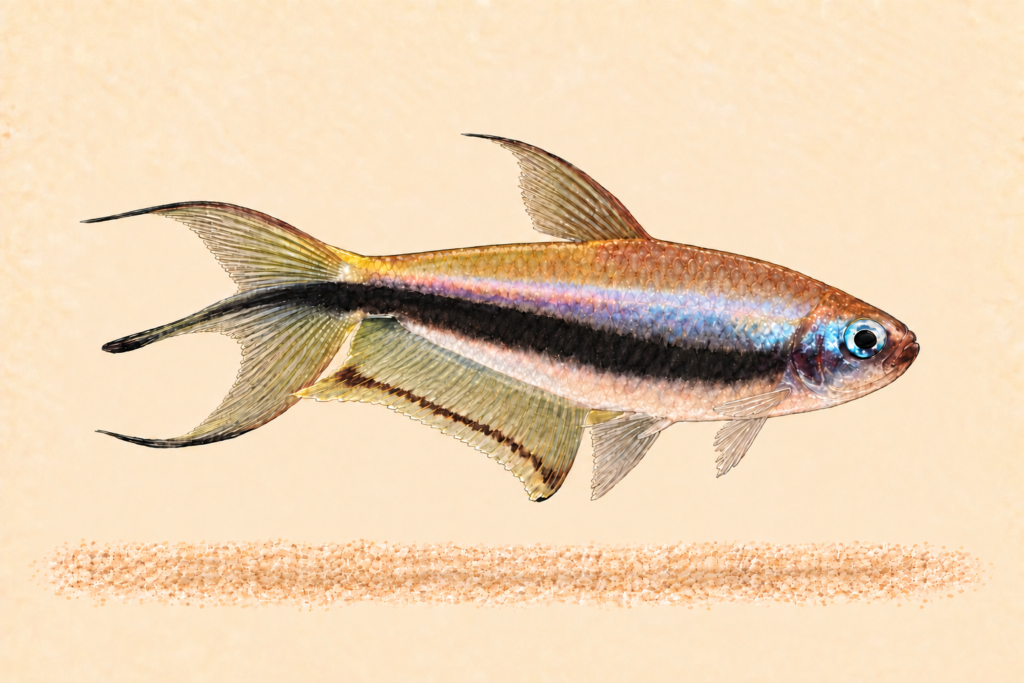
The Emperor Tetra reaches up to 4.2 cm, not counting the tail fin, and males end up larger than females. Males get stronger colours as they mature, and their dorsal, anal and tail fins stretch out much longer, including the central ray of the tail fin, which is unusual among related fish. Males have blue eyes, while females have green ones. It is often mistaken for the blue or purple emperor tetra, which stays much smaller and has no extended fins.
Varieties and Morphs
Most experts regard the black form sold as the black emperor tetra as a colour variation, not a separate species.
Natural Habitat
The Emperor Tetra is native to the Atrato and San Juan river basins in Colombia. Backwaters, minor tributaries and the gentler stretches of river are all home to this fish, and it is found right across its range.
Tank Size and Setup
We recommend a tank of at least 81 litres. A base of at least 90 by 30 cm, or equivalent, is the smallest the aquarium should have. Fill the tank with plants, both rooted and floating, and add some driftwood, with fine-leaved kinds being especially good. Floating plants make the fish feel safer and bring out richer colour.
Water Parameters
Aim for a temperature of 23 to 27 °C. Water with a pH from 5 to 7.5 suits Emperor Tetras.
| Temperature | 23–27 °C |
| pH | 5.0–7.5 |
| General hardness (GH) | 1–12 dGH |
| Ammonia | 0 ppm |
| Nitrite | 0 ppm |
| Nitrate | Below 20 ppm |
Keep the temperature steady too. A hardness of 1 to 12 degrees of general hardness (dGH) is also acceptable.
Filtration and Equipment
The tank should have gentle water flow along with efficient filtration. We recommend a filter that turns the water over four to five times an hour for a tank of at least 81 litres, and a heater to hold the temperature within 23 to 27 degrees Celsius.
Diet and Feeding
Emperor Tetras look their best on daily meals of small live or frozen foods such as water fleas and brine shrimp, which also help bring them into breeding condition. Dry foods that are small enough to eat are accepted, but they should not be the only thing on the menu. In the wild, they are likely to feed on small insects, worms, crustaceans and other small animals that live in the water.
Behaviour and Temperament
Lively and peaceful, the Emperor Tetra does much better in the company of its own kind. A group of at least six is advised, and preferably 10 or more. Having more females than males helps spread out male attention and limit territorial disputes, which is easiest to manage in larger groups. Males can be territorial with each other to a degree, though a roomy, well-furnished tank keeps their squabbles from causing real harm. Females spar with one another as well.
Tank Mates
Emperor Tetras are well suited to peaceful community aquariums containing other small, non-aggressive species. Their calm demeanour and preference for mid-water occupation mean they coexist harmoniously with a wide variety of fish, invertebrates, and bottom-dwellers. The best tank mates share similar water parameter preferences and temperaments, creating a balanced and stress-free environment. Avoid species that are overly boisterous, aggressive, or large enough to view Emperor Tetras as potential prey.
Good tank mates
- Cardinal Tetra, a similarly peaceful characin that thrives in the same soft, acidic water conditions and complements the Emperor Tetra’s colouration beautifully.
- Rummy-Nose Tetra, another gentle shoaling tetra that occupies similar water column space and shares compatible water parameter requirements.
- Corydoras sterbai, a peaceful bottom-dweller that stays out of the Emperor Tetra’s territory and helps keep the substrate clean.
- Otocinclus, a small, docile algae-eating catfish that poses no threat and appreciates the same calm, planted environments.
- Harlequin Rasbora, a gentle, easy-going shoaling fish with overlapping water parameter preferences and a complementary orange-copper colouration.
- Kuhli Loach, a shy, nocturnal bottom-dweller that coexists peacefully and adds interest to the lower levels of the tank.
- Honey Gourami, a calm, small labyrinth fish that occupies the upper water column and is far too placid to cause any issues.
- Amano Shrimp, a robust invertebrate that is too large to be eaten by Emperor Tetras and provides useful algae control.
- Cherry Shrimp, generally compatible, though adult shrimp are safe while very small juveniles may occasionally be taken as food.
- Bristlenose Pleco, a peaceful algae-eating catfish that stays primarily on surfaces and the substrate, well out of the Emperor Tetra’s way.
Fish to avoid
- Tiger Barb, a notorious fin nipper that is likely to harass Emperor Tetras, particularly males with their extended finnage.
- Convict Cichlid, far too aggressive and territorial, especially when breeding, and will bully or injure Emperor Tetras.
- Oscar, a large predatory cichlid that will readily consume any fish small enough to fit in its mouth.
- Red-Tail Shark, Territorial and aggressive, particularly towards fish occupying the lower to mid-water levels.
- African Cichlids, Require hard, alkaline water and are typically far too aggressive for peaceful community fish like Emperor Tetras.
- Jack Dempsey, a large, aggressive cichlid that is entirely unsuitable for housing with small, peaceful tetras.
- Bucktooth Tetra, despite being a tetra, this species is a notorious scale-eater and will attack tank mates.
- Green Terror, an aggressive, predatory cichlid that poses a serious threat to small community fish.
Breeding
Emperor Tetras are not difficult to breed, and plenty of small live foods during conditioning should let spawning go ahead without too many problems. Pair spawning gives the best results, though a group can also spawn, with six of each sex described as a good number. A larger tank is needed when spawning as a group, so that males have space for their territories. A separate tank is needed to raise large numbers of fry. Spawning mops, or java moss and other fine-leaved plants, give the fish a place to leave their eggs, and the breeding tank should be very dimly lit.
Mesh over the floor of the tank is another option, as long as the holes let eggs drop through while stopping the adults reaching them. The water should be soft and acidic, with a pH of 6.0 to 7.0, a general hardness of 1 to 10 dGH and a temperature of around 24 to 26.5 °C. For pair spawning, condition the males and females in separate groups and tanks. Evening is the time to move a pair to the spawning tank, choosing the fattest female and the best-coloured male once the females are clearly full of eggs and the males show their best colours.
The pair should then spawn the next morning. Remove the adults the moment eggs are noticed, because they will often eat their spawn if they get the chance. In a very heavily planted tank, the adults can alternatively stay put while the fry are siphoned out as they appear. The eggs take 24 to 36 hours to hatch, and the fry then need a further 4 to 5 days before they swim freely.
Common Diseases
Emperor Tetras can be affected by fin rot, white spot and bacterial infections in general. The species is described as hardy.
FAQs
How many Emperor Tetras should I keep together?
A group of at least six is advised, and preferably 10 or more.
How big does the Emperor Tetra get?
Adults reach up to 4.2 cm, not counting the tail fin, and males end up larger than females.
Which fish can live with Emperor Tetras?
Most commonly available livebearers, rasboras, other tetras, peaceful bottom dwellers such as corydoras, gouramis and dwarf cichlids can share the tank, but larger fish that may see it as food are not safe.
Is the Emperor Tetra difficult to breed?
Breeding is not difficult, but raising large numbers of fry needs a separate tank.
Related Guides
- Cardinal Tetra Care Guide, another South American tetra that shares similar water parameter preferences and makes an excellent companion species.
- Black Neon Tetra Care Guide, a hardy, similarly sized tetra with complementary dark colouration that thrives in the same type of planted community setup.
- Corydoras sterbai Care Guide, a popular warm-water bottom-dweller that pairs well with Emperor Tetras in community aquariums.
- How to Set Up a Blackwater Aquarium, a guide to creating the tannin-stained, soft-water environments in which Emperor Tetras look and feel their best.
- Honey Gourami Care Guide, a peaceful surface-dwelling companion that complements Emperor Tetras in temperament and habitat preferences.