Quick summary
The L114 Leopard Cactus Pleco is not a beginner’s fish. It grows to 20-25 cm, needs a 300+ litre tank with excellent, stable water quality, a protein-rich carnivorous diet rather than algae, and careful tank mate selection due to its territorial nature and sharp defensive spines.
🐠 Build a tank around this species
In this guide:
- Introduction
- Quick Stats
- Appearance
- Natural Habitat
- Tank Size and Setup
- Water Parameters
- Filtration and Equipment
- Diet and Feeding
- Behaviour and Temperament
- Tank Mates
- Breeding
- Common Diseases
- FAQs
Introduction
The L114 Leopard Cactus Pleco is one of the most visually striking members of the genus Pseudacanthicus, a group of armoured catfish collectively known as “cactus plecos” for the formidable array of sharp spines that cover their bodies. With a dramatic leopard-spotted pattern set against a dark base colour, this species commands attention in any large aquarium. It hails from the Rio Demini, a blackwater tributary of the Rio Negro in the Brazilian Amazon, and has been a prized fish in the hobby since its introduction to the aquarium trade.
A brief note on taxonomy is warranted here. The scientific name applied to the L114 in the aquarium hobby is Pseudacanthicus cf. leopardus. The use of “cf.” (meaning “compare to”) is deliberate and reflects genuine unresolved taxonomy. The species Pseudacanthicus leopardus was originally described from specimens collected in Guyana, where it is also traded under the L-numbers L600 and LDA073. Whether the Rio Demini population sold as L114 is truly the same species as the Guyanese P. leopardus, a geographic variant, or an entirely undescribed species remains scientifically unconfirmed. Hobbyists and retailers should be aware of this distinction, as it has implications for breeding programmes and accurate record-keeping. Throughout this guide, we refer to the fish by its trade designation, L114, for clarity.
Despite its impressive appearance, the L114 Leopard Cactus Pleco is not a beginner’s fish. It grows large, requires excellent water quality, and has a somewhat territorial disposition that demands careful tank planning. For experienced aquarists willing to provide the space and conditions it needs, however, this pleco is an immensely rewarding species to keep. This guide covers everything you need to know to maintain the L114 in good health and, for the ambitious hobbyist, to attempt breeding.
Quick Stats
| Scientific name | Pseudacanthicus cf. leopardus |
|---|---|
| Common names | L114 Leopard Cactus Pleco, L114 Pleco, Leopard Cactus Pleco, Demini Leopard Pleco |
| Family | Loricariidae |
| Origin | Rio Demini, Rio Negro basin, Brazil |
| Adult size | 22.5 cm |
| Lifespan | 10–15 years |
| Difficulty | Intermediate |
| Breeding difficulty | Advanced |
| Temperature | 26–30 °C |
| pH | 5.5–7 |
| GH | 1–10 dGH |
| KH | 0–4 dKH |
| Minimum tank size | 650 L |
| Conservation status | Least Concern (IUCN, assessed 2020) |
Appearance
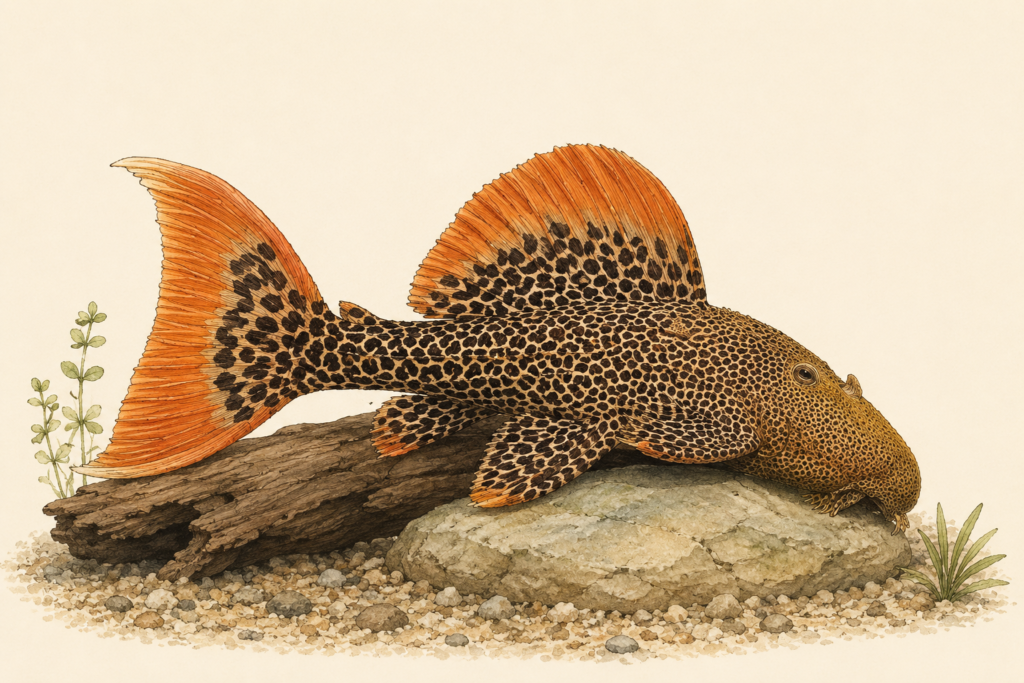
The L114 Leopard Cactus Pleco is a strikingly handsome fish that lives up to both parts of its common name. The body is robust and somewhat flattened ventrally, typical of the loricariid body plan, and is covered in bony plates (scutes) that provide a natural armour. The base colour is typically a warm tan to golden-orange, densely overlaid with dark brown to black spots of irregular size and shape. This leopard-like patterning extends across the head, body, and fins, giving the fish a wildly decorative appearance that few other plecos can rival.
The “cactus” designation comes from the profusion of sharp, thorn-like odontodes (dermal teeth) that cover the body, particularly along the pectoral fin spines, the interopercular region (the cheek area), and the leading rays of the dorsal and pectoral fins. These spines are not merely ornamental – they serve as effective defensive weapons, and careless handling can result in painful puncture wounds to the aquarist. The spines also have a tendency to become entangled in fine-mesh nets, so a rigid container or thick, coarse net should always be used when moving these fish.
The head is broad and slightly flattened, with relatively small eyes positioned high on the skull. The mouth is a well-developed suckermouth with strong teeth adapted for a partially carnivorous diet – a key distinction from many other pleco species that are primarily herbivorous. Males tend to develop more prominent odontodes than females, particularly along the pectoral fin spines and on the cheeks, and they generally exhibit a slightly broader head profile. Females are often somewhat rounder in the body when viewed from above, especially when carrying eggs.
Juveniles typically display the spotted pattern from a young age, though the contrast between the spots and the base colour may intensify as the fish matures. Some individuals develop a richer orange or golden tone to the base colour with age, making well-kept adult specimens particularly attractive. The dorsal fin is tall and sail-like, and the caudal fin is forked, both featuring the characteristic spotted patterning that makes this species so desirable.
Natural Habitat
The L114 Leopard Cactus Pleco originates from the Rio Demini, a significant tributary of the Rio Negro in the state of Amazonas, Brazil. The Rio Negro and its tributaries are among the most famous blackwater systems in the world, characterised by tea-coloured water stained dark by tannins leached from decomposing leaf litter and other organic matter. This results in extremely soft, acidic water with very low mineral content.
In its natural environment, the L114 inhabits rocky areas within the river, where it takes shelter among crevices, under boulders, and in gaps between large stones. The substrate in these areas is typically composed of sand and gravel interspersed with larger rock formations. The current can vary from moderate to strong, particularly in the main channels and rapids where Pseudacanthicus species are commonly found. These fish are well adapted to grip onto rocky surfaces with their powerful suckermouth even in fast-flowing water.
Water parameters in the Rio Demini are typically very soft, with a general hardness close to zero, and highly acidic, with pH values often falling between 4.0 and 6.0. Water temperatures are consistently warm, usually ranging from 26 to 30 degrees Celsius. The blackwater conditions mean that light penetration is reduced, and the fish is naturally adapted to relatively dim lighting. Aquatic vegetation in these environments tends to be sparse due to the acidity and low nutrient levels, and the ecosystem is heavily influenced by the surrounding forest canopy, which provides a constant input of leaves, branches, and fruit into the water.
Understanding this habitat is essential for replicating appropriate conditions in captivity. While the L114 does not require the extreme acidity of its wild environment to thrive in an aquarium, providing soft, slightly acidic water with good oxygenation and plenty of rocky hiding places will go a long way towards keeping this species healthy and displaying its best colours.
Tank Size and Setup
Given its adult size of 20 to 25 centimetres and its territorial nature, the L114 Leopard Cactus Pleco requires a generously sized aquarium. A minimum tank volume of 300 litres is recommended for a single specimen, and significantly more space should be provided if keeping multiple individuals or housing this pleco in a community setting. A tank with a footprint of at least 120 cm by 45 cm is ideal, as floor space is more important than height for this bottom-dwelling species.
The aquascape should be designed with the L114’s natural preferences in mind. Provide an abundance of rocky structures, including caves, overhangs, and crevices that the pleco can use as territorial retreats. Purpose-built pleco caves made from ceramic or slate are excellent choices and can be positioned to create distinct territories if multiple plecos are being kept. Driftwood is also appreciated and contributes tannins to the water, which this blackwater species benefits from. Large pieces of bogwood or mopani wood can serve as both decoration and functional shelter.
The substrate should ideally be fine sand or smooth gravel. Avoid sharp or jagged substrates, as these can damage the fish’s ventral surface as it moves about the tank floor. A sandy substrate also makes it easier for the pleco to forage and allows for a more natural look when combined with scattered river stones and leaf litter.
Lighting should be subdued to moderate. The L114 is naturally nocturnal and will be more active and visible during twilight and evening hours if the tank is not overly bright. Floating plants, overhanging driftwood, or dimmed LED lighting can all help create the low-light conditions that encourage this pleco to venture out. That said, many specimens do acclimatise to standard aquarium lighting over time and will emerge during the day, particularly at feeding time.
Ensure that the tank has a secure, tight-fitting lid. While the L114 is not typically a jumper, strong plecos can occasionally dislodge lids or cover glasses, and a secure top prevents accidents. All equipment, particularly heater cables and filter intakes, should be protected or positioned so that the pleco’s spines cannot become entangled.
Water Parameters
Maintaining stable, high-quality water is paramount for the long-term health of the L114 Leopard Cactus Pleco. As a species originating from pristine blackwater environments, it is sensitive to poor water quality, particularly elevated levels of nitrogenous waste. Regular water changes of 25 to 50 per cent weekly are strongly recommended, and even more frequent changes may be necessary in heavily stocked tanks or during warmer months.
| Temperature | 26-30 °C |
| pH | 5.5-7.0 |
| General hardness (GH) | 1-10 dGH |
| Carbonate hardness (KH) | 0-4 dKH |
| Ammonia | 0 ppm |
| Nitrite | 0 ppm |
| Nitrate | Below 20 ppm |
The L114 will tolerate a wider range of parameters than those found in its wild habitat, but it shows its best colours and exhibits the most natural behaviour when kept in soft, slightly acidic water. The addition of Indian almond leaves, alder cones, or peat filtration can help to lower pH naturally and release beneficial tannins into the water, replicating blackwater conditions. If using reverse osmosis (RO) water, remineralise it lightly to maintain a small amount of hardness for biological stability.
Ammonia and nitrite must always be maintained at zero, as even small spikes can cause stress, respiratory distress, and increased susceptibility to disease. Nitrate should be kept as low as possible, ideally below 20 ppm. Consistent parameters are as important as correct parameters – sudden fluctuations in pH or temperature can be highly stressful and should be avoided, particularly during water changes.
Filtration and Equipment
Robust filtration is non-negotiable for the L114 Leopard Cactus Pleco. This is a large, carnivorous pleco that produces a substantial bioload relative to its size. A high-quality external canister filter rated for at least 1.5 to 2 times the tank volume is the minimum requirement. Many experienced keepers opt for oversized filtration or run two filters in tandem to ensure adequate biological, mechanical, and chemical filtration capacity.
The L114 benefits from moderate to strong water flow, which mimics the riverine conditions of its natural habitat. Positioning the filter outlet to create a directional current across the length of the tank, or supplementing with a powerhead or wavemaker, will help to keep the water well oxygenated and circulating. An air stone or spray bar can provide additional surface agitation to maximise gas exchange, which is particularly important at the higher end of the temperature range where dissolved oxygen levels naturally decrease.
A reliable heater is essential, as the L114 requires consistently warm water. Choose a heater rated appropriately for the tank volume and consider using a heater guard to protect both the fish and the equipment – the L114’s spines can scratch or damage unprotected glass heaters, and the fish could potentially burn itself if it rests against an unguarded unit.
Lighting should be moderate and ideally adjustable, with a gradual dawn-to-dusk cycle that encourages natural activity patterns. Many modern LED units offer programmable dimming and colour temperature adjustments, which allow the aquarist to simulate the subdued lighting of a blackwater environment. A timer ensures consistency and prevents the stress associated with irregular photoperiods.
A thermometer, either digital or a reliable glass type, should be placed in the tank for continuous temperature monitoring. Periodic testing of water parameters with a liquid test kit is strongly recommended over strip tests for accuracy, particularly for pH, ammonia, nitrite, and nitrate.
Diet and Feeding
One of the most important aspects of L114 care that distinguishes it from many other plecos is its diet. The L114 Leopard Cactus Pleco is primarily carnivorous, not herbivorous. Unlike common plecos or bristlenose plecos that thrive on algae and vegetable matter, Pseudacanthicus species require a protein-rich diet to maintain health and condition. Treating this fish as an algae eater will lead to malnutrition and decline.
The staple diet should consist of high-quality sinking carnivore pellets or wafers designed for bottom-dwelling predatory catfish. These should be supplemented regularly with frozen or fresh foods such as bloodworm, mysis shrimp, krill, chopped prawns, mussel, cockle, and white fish. Occasional offerings of earthworms or live blackworms are relished and provide excellent nutrition. Some keepers also offer small amounts of squid or fish roe as treats.
While the L114 is not an herbivore, some individuals will accept small amounts of blanched courgette (zucchini), sweet potato, or cucumber. These can be offered occasionally for dietary variety, but they should not form a significant portion of the diet. Algae wafers formulated for herbivorous plecos are not an appropriate primary food for this species.
Feed the L114 in the evening or after lights-out, as this aligns with its naturally nocturnal feeding behaviour. Sinking foods should be placed near the pleco’s preferred hiding spot to ensure it gets its share before other tank mates can consume the food. In a community setting, it is important to verify that the L114 is actually eating, as more assertive tank mates may outcompete it for food during the initial acclimation period.
Remove uneaten food within a few hours to prevent it from fouling the water. Given the protein-rich nature of the diet, decomposing food can cause rapid spikes in ammonia and nitrite, making prompt removal and good filtration especially important.
Behaviour and Temperament
The L114 Leopard Cactus Pleco is a territorial and somewhat solitary species, particularly as it matures. Juveniles are generally peaceful and can coexist without significant conflict, but as adults, males in particular can become aggressive towards other bottom-dwelling fish, especially other plecos that venture into their established territory. This territorial behaviour is most intense around preferred caves and hiding spots.
In the aquarium, the L114 is primarily nocturnal. It will spend much of the day hidden within its cave or under cover, emerging at dusk to forage and patrol its territory. As it settles into the tank and becomes comfortable with its surroundings, it may become bolder and more visible during daylight hours, particularly in response to feeding cues. Patience is required during the initial acclimation period, as newly introduced specimens may remain hidden for days or even weeks.
The defensive spines of this species are not merely for show. When threatened or cornered, the L114 will flare its gill covers (interopercular spines) and lock its pectoral fin spines in an extended position. This makes the fish extremely difficult to swallow for would-be predators and equally hazardous to handle for the aquarist. Never attempt to handle this fish with bare hands or use fine nets, as the spines can cause painful injuries and will readily become entangled in mesh.
Despite its defensive capabilities, the L114 is not an aggressive fish towards midwater or upper-water species. It generally ignores fish that do not intrude upon its territory or compete directly for cave space. Aggression is most commonly directed at other loricariids and bottom-dwellers that share its ecological niche.
The L114 is a strong fish with a powerful grip. It can rearrange lightweight decorations, dislodge unsecured equipment, and move surprisingly quickly when startled. Ensure that rockwork and decorations are stable and cannot collapse, as this could injure the fish or crack the tank glass.
Tank Mates
Choosing appropriate tank mates for the L114 Leopard Cactus Pleco requires careful consideration of its territorial nature, its preference for warm, soft water, and its substantial adult size. The best companions are active, mid-water to upper-water species that will not compete for the pleco’s cave territory and that can tolerate similar water conditions. Avoid small, slow-moving bottom-dwellers that could be bullied or harassed, and steer clear of overly aggressive species that might stress the pleco or outcompete it for food.
Good tank mates
- Cardinal Tetra – A classic Rio Negro companion that thrives in the same soft, acidic water and occupies the mid-water column.
- Rummy-nose Tetra – Peaceful schooling fish that prefer warm, soft water and provide attractive upper-level activity.
- German Blue Ram – A small, warm-water cichlid that generally avoids the pleco’s territory and coexists peacefully.
- Angelfish – Elegant mid-water cichlids that are large enough not to be bothered and share a preference for warm, soft conditions.
- Hatchetfish – Surface-dwelling species that stay well out of the pleco’s way and appreciate blackwater conditions.
- Corydoras sterbai – A warm-water Corydoras species that is small and peaceful enough to coexist, provided there is ample floor space.
- Geophagus – Eartheater cichlids that are generally peaceful and inhabit mid to lower water levels without competing for caves.
- Discus – Both species require warm, soft water, and Discus occupy the mid-water column, avoiding territorial conflict.
Fish to avoid
- Common Pleco – Too large and territorial; will compete aggressively for cave space and resources.
- Royal Pleco – Another large, territorial loricariid that may clash with the L114 over hiding spots.
- Red-tail Catfish – A massive predatory catfish that will eventually consume any pleco it can fit in its mouth.
- Oscar – Highly aggressive and messy; will harass the pleco and produce excessive waste.
- African Cichlids – Require hard, alkaline water that is incompatible with the L114’s needs.
- Tiger Barb – Nippy and boisterous; may harass the pleco and cause stress, particularly to fins.
- Jaguar Cichlid – A large, highly predatory Central American cichlid that poses a serious threat.
- Green Terror – Aggressive cichlid that will relentlessly bully bottom-dwelling species in its territory.
Breeding
Breeding the L114 Leopard Cactus Pleco in captivity is a challenging but achievable goal. Successful spawnings have been reported by dedicated hobbyists, though the process requires a mature, well-conditioned pair, an appropriate setup, and patience. This species is a cave spawner, with the male taking primary responsibility for guarding the eggs and fry.
Sexing the L114 becomes easier as the fish mature. Males develop more pronounced odontodes along the pectoral fin spines, the interopercular region, and the body plates. Males also tend to have a broader, more angular head shape when viewed from above, while females appear slightly rounder and fuller-bodied, especially when gravid. These differences are subtle in juveniles and become more apparent as the fish approach breeding size, typically around 15 to 18 centimetres.
To condition a pair for breeding, provide a varied, protein-rich diet with regular feedings of high-quality frozen and fresh foods. Increase the frequency of water changes, performing large changes of 50 per cent or more with slightly cooler, soft water to simulate the influx of fresh water during the rainy season. A drop in temperature of 2 to 3 degrees Celsius during water changes, combined with a slight decrease in pH, can help to trigger spawning behaviour.
The spawning cave should be appropriately sized for the male – snug enough that he can block the entrance with his body but large enough for the female to enter and deposit eggs. Ceramic or PVC caves with a single entrance are commonly used. The male will select and defend a cave, and when a receptive female is present, she will enter to deposit a clutch of large, orange eggs on the cave ceiling or walls. Clutch sizes for Pseudacanthicus species typically range from 30 to over 100 eggs, depending on the size and condition of the female.
After spawning, the male will guard and fan the eggs, keeping them clean and well oxygenated. The female should not be removed unless she shows signs of stress or aggression from the male. The eggs typically hatch within 5 to 7 days at temperatures of 28 to 30 degrees Celsius. The fry absorb their yolk sacs over the following 7 to 10 days and can then be fed with crushed high-protein pellets, baby brine shrimp (Artemia nauplii), and microworms. The fry grow relatively slowly and require excellent water quality throughout their development.
Common Diseases
The L114 Leopard Cactus Pleco is generally a hardy species when kept in appropriate conditions, but like all aquarium fish, it is susceptible to certain health issues, particularly when water quality is suboptimal or the fish is stressed.
Bacterial infections are among the most common health problems seen in this species. These can manifest as reddened or inflamed areas on the body, fin erosion, or ulceration. Bacterial issues are almost always linked to poor water quality, particularly elevated ammonia, nitrite, or nitrate levels. Treatment typically involves improving water conditions through large water changes and, in severe cases, the application of a broad-spectrum antibacterial medication. Always check and correct water parameters before reaching for medication.
White spot disease (Ichthyophthirius multifiliis, commonly known as ich) can affect the L114, appearing as small white cysts scattered across the body and fins. This parasitic infection is usually triggered by temperature fluctuations or the introduction of infected fish. Treatment involves gradually raising the temperature to 30 degrees Celsius and administering a suitable ich medication at half the standard dose, as loricariids can be sensitive to certain treatments, particularly those containing copper or malachite green.
Fungal infections, appearing as cotton-wool-like growths on the body or fins, can occur following physical injury or in tanks with poor hygiene. The L114’s spiny nature makes it prone to minor abrasions during territorial disputes or when moving through tight spaces, and these wounds can become entry points for fungal pathogens. Antifungal treatments and improved water quality usually resolve the issue.
Nutritional deficiency is a significant concern for the L114 if its carnivorous dietary needs are not met. Fish fed an inappropriate herbivorous diet may develop sunken bellies, faded colouration, lethargy, and a weakened immune system. Ensuring a proper protein-rich diet is the most effective preventative measure.
Stress-related issues, including loss of appetite, excessive hiding, and increased susceptibility to secondary infections, are common in newly introduced specimens or fish kept in tanks with insufficient hiding places or overly aggressive tank mates. Providing a well-structured environment with multiple shelters and compatible companions is key to minimising stress.
FAQs
Is the L114 Leopard Cactus Pleco the same species as the L600?
This is an ongoing question in the hobby. The L114 from the Rio Demini in Brazil and the L600 (also known as LDA073) from Guyana are both traded as Pseudacanthicus leopardus, but whether they represent the same species has not been definitively confirmed by taxonomists. The “cf.” in the L114’s scientific name reflects this uncertainty. While they share a similar leopard-spotted appearance, there may be subtle morphological or genetic differences. For practical purposes, their care requirements are considered essentially identical, but hobbyists interested in breeding should try to avoid mixing the two populations to preserve genetic integrity.
Will the L114 eat algae in my tank?
No, the L114 Leopard Cactus Pleco is not an effective algae eater. Unlike bristlenose or common plecos, Pseudacanthicus species are primarily carnivorous and require a protein-rich diet. While an L114 might rasp at surfaces occasionally, it will not control algae growth in any meaningful way. If you need an algae-eating pleco, consider a bristlenose or a suitable Otocinclus species instead.
Can I keep more than one L114 in the same tank?
It is possible to keep multiple L114 specimens together, but it requires a large aquarium with ample floor space and multiple well-separated hiding places. Males can be territorial, particularly around caves, so providing more caves than there are plecos helps to reduce conflict. A tank of 500 litres or more is recommended for housing a pair or small group. Monitor for signs of aggression, especially during the initial settling-in period.
How fast does the L114 Leopard Cactus Pleco grow?
The L114 is a relatively slow-growing species. Juveniles purchased at 5 to 7 centimetres may take 3 to 5 years to reach their full adult size of 20 to 25 centimetres, depending on diet, water quality, and tank conditions. Providing a high-protein diet and maintaining excellent water quality will support steady, healthy growth without the stunting that can occur in undersized or poorly maintained tanks.
Is the L114 safe to keep with small fish?
Generally, yes. The L114 is not a piscivore and does not actively hunt other fish. Small, active mid-water species such as tetras and rasboras are typically safe companions. However, very small fry or tiny shrimp may occasionally be consumed opportunistically, particularly at night when the pleco is most active. Adult dwarf shrimp are generally too quick to be caught, but their offspring may be at risk in a tank with a large Pseudacanthicus.
Related Guides
- Bristlenose Pleco – A popular smaller pleco species, useful for comparison with the more demanding L114.
- L025 Scarlet Cactus Pleco – Another stunning Pseudacanthicus species with similar care requirements and temperament.
- Cardinal Tetra – An ideal Rio Negro tank mate for the L114 that shares its preference for soft, acidic water.
- Discus – A fellow warm-water, soft-water species that pairs well with the L114 in large community setups.
- Zebra Pleco (L046) – A related hypancistrus species for hobbyists interested in keeping and breeding rare L-number plecos.