Quick summary
The Red Tailed Synodontis is a large, hardy African catfish best suited to experienced aquarists who can provide at least a 400 litre tank, plenty of hiding spots, and careful handling around its sharp spines. It is not ideal for beginners or small community tanks, since it grows to 25-30 cm, is mostly nocturnal, and will eat very small fish or shrimp.
🐠 Build a tank around this species
In this guide:
- Introduction
- Quick Stats
- Appearance
- Natural Habitat
- Tank Size and Setup
- Water Parameters
- Filtration and Equipment
- Diet and Feeding
- Behaviour and Temperament
- Tank Mates
- Breeding
- Common Diseases
- FAQs
Introduction
The Red Tailed Synodontis (Synodontis clarias) holds a unique distinction in the world of aquarium catfish – it is the type species of the entire Synodontis genus, the very first species described and the one upon which all subsequent Synodontis classifications are based. Despite this historical significance, it remains comparatively uncommon in the hobby when set alongside more popular relatives such as the Upside-Down Catfish or the Featherfin Synodontis. For experienced aquarists seeking a robust, characterful African catfish with genuine pedigree, however, the Red Tailed Synodontis is a deeply rewarding species to keep.
Known also as the Mandi in parts of its native range, Synodontis clarias has one of the broadest distributions of any Synodontis species, occurring across a vast swathe of northern and western Africa. It inhabits river systems from the Nile basin through the Chad basin, the Niger, the Senegal, the Volta, and numerous other drainages. This widespread range has contributed to a degree of variability in appearance and size across populations, which can occasionally lead to confusion with other Synodontis species in the trade. Adults are large, powerful fish that demand spacious accommodations, and their somewhat boisterous nature means they are best suited to aquarists with some prior experience of keeping larger catfish.
In this comprehensive care guide, we cover everything you need to know about keeping Synodontis clarias in the home aquarium, from tank size and water parameters to diet, behaviour, breeding, and compatible tank mates. Whether you are considering this species for the first time or looking to refine the care you already provide, the information below will help you create the best possible environment for this remarkable African catfish.
Quick Stats
| Scientific name | Synodontis clarias |
|---|---|
| Common names | Red Tailed Synodontis, Mandi, Red-Tailed Squeaker |
| Family | Mochokidae |
| Origin | Northern and western Africa, Nile, Niger, Senegal, Volta, Chad and Gambia basins |
| Adult size | 30 cm |
| Lifespan | 15–20 years |
| Difficulty | Intermediate |
| Breeding difficulty | Advanced |
| Temperature | 22–28 °C |
| pH | 6.5–7.8 |
| GH | 5–20 dGH |
| KH | 4–15 dKH |
| Minimum tank size | 400 L |
| Conservation status | Least Concern (IUCN) |
Appearance
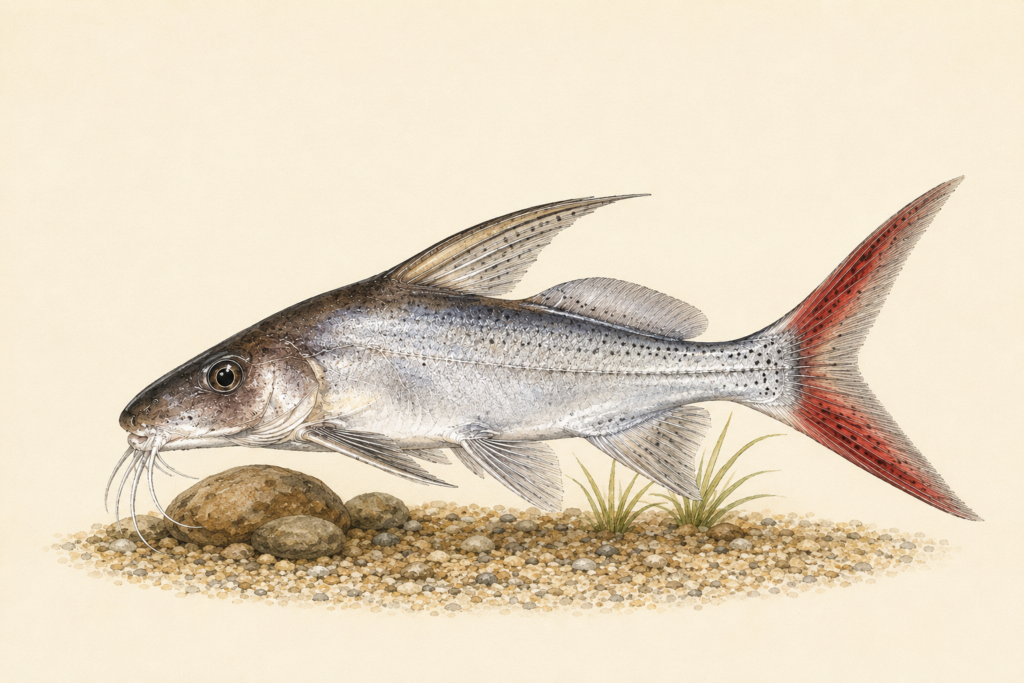
Synodontis clarias is a solidly built, somewhat elongated catfish with the characteristic flattened ventral profile and broad head typical of many Synodontis species. The body is laterally compressed towards the caudal peduncle, giving the fish a powerful, streamlined shape well suited to life in flowing river systems. Adults typically reach 25 to 30 centimetres in aquarium conditions, though wild specimens from larger river systems can occasionally exceed 35 centimetres.
The base colouration of the body is typically a greyish-brown to olive-brown, sometimes with a slight purplish or slate-grey sheen depending on the population of origin and the conditions under which the fish is kept. Younger specimens frequently display scattered dark spots or blotches across the flanks and dorsal surface, though these markings can fade or become less distinct with age. The belly is noticeably paler, ranging from off-white to a light cream colour.
The common name “Red Tailed Synodontis” refers to the distinctive reddish or rusty-orange hue that develops on the caudal fin, and sometimes extends to the adipose fin and the trailing edges of the other fins. This colouration is most pronounced in healthy, well-fed specimens and can vary in intensity between individuals and populations. Some fish display a vivid brick-red tail, while others show a more subtle warm brown or amber tinge. The dorsal fin is tall and features a strong, serrated leading spine – a characteristic shared with many mochokid catfish and one that demands careful handling, as the spine can easily become entangled in nets.
Three pairs of barbels adorn the head: one pair of maxillary barbels (the longest, extending from the upper jaw) and two pairs of mandibular barbels on the lower jaw, one of which is typically branched. These barbels are essential sensory organs used for foraging along the substrate in low-light conditions. The eyes are moderately large and positioned laterally on the head, reflecting the species’ largely crepuscular and nocturnal activity patterns.
Sexual dimorphism is subtle and generally unreliable for definitive identification outside of breeding condition. Mature females tend to be slightly rounder in the belly when viewed from above, while males may have a marginally more elongated body shape and slightly more pronounced genital papillae, though these differences require a trained eye to discern.
Natural Habitat
Synodontis clarias is one of the most widely distributed members of its genus, found across an enormous geographic range spanning much of northern and western Africa. It occurs naturally in the Nile River system (including the White Nile and Blue Nile tributaries), the Chad basin, the Niger River and its extensive delta, the Senegal River, the Volta River system, the Gambia River, and various smaller coastal drainages in West Africa. This breadth of distribution reflects the species’ considerable adaptability to a range of freshwater environments.
In the wild, Synodontis clarias inhabits a variety of habitats within these river systems. It is commonly found in the main channels of large rivers, where it favours areas with moderate to strong current flow and a substrate composed of sand, gravel, and rocky outcrops. It also occurs in floodplain lakes, seasonal pools, and the margins of reservoirs. During the wet season, when rivers overflow their banks, these catfish may move into inundated floodplain habitats to feed on the abundance of food resources available in the newly submerged vegetation and detritus.
The substrate in its natural habitats is typically a mixture of sand and mud, interspersed with rocks, submerged logs, and root tangles that provide essential shelter during daylight hours. Vegetation density varies considerably across its range, from sparsely vegetated rocky stretches in the upper reaches of river systems to densely vegetated floodplain margins further downstream. Water conditions across this range are equally variable, encompassing soft, slightly acidic waters in some tributaries to moderately hard, neutral to slightly alkaline conditions in others. This environmental flexibility is one of the reasons why Synodontis clarias adapts reasonably well to captive conditions, provided its basic requirements are met.
Water temperatures in its native range typically fall between 22 and 28 degrees Celsius, with some seasonal variation. During the cooler months of the dry season, temperatures in some parts of its range may drop somewhat lower, while the onset of the rains can bring slightly cooler, oxygen-rich water into the system. Light levels in the habitats it prefers are often subdued, as the fish tends to shelter among rocks, roots, and other structure during the day and becomes most active at dusk and during the night.
Tank Size and Setup
Given its potential adult size of 25 to 30 centimetres (and occasionally larger), Synodontis clarias requires a generously proportioned aquarium. A minimum tank volume of 400 litres is recommended for a single adult specimen, with larger tanks of 500 litres or more being preferable, particularly if you intend to keep a small group or house the catfish alongside other large species. The tank should have a footprint that provides ample floor space, as this is a bottom-dwelling species that spends much of its time foraging along and resting on the substrate. A tank measuring at least 150 centimetres in length is ideal.
The substrate should consist of fine to medium-grade sand or smooth rounded gravel. Avoid sharp or angular substrates, as these can damage the fish’s barbels during its constant foraging activity. A sandy substrate is the most naturalistic choice and allows the catfish to engage in its natural sifting behaviour without risk of injury.
Shelter is critically important for Synodontis clarias. In the wild, these fish spend the daylight hours concealed among rocks, roots, and submerged wood, and they require similar retreats in captivity. Provide a generous quantity of hiding places using a combination of large pieces of bogwood or driftwood, stacked rocks forming caves and overhangs, PVC pipe sections (if aesthetics are not a concern), and terracotta pots or purpose-built ceramic caves. Each fish should have access to at least one hiding spot large enough to accommodate its full body. Without adequate shelter, Synodontis clarias will become chronically stressed, leading to reduced colouration, suppressed appetite, and increased susceptibility to disease.
Live plants can be included in the setup, though robust, well-rooted species are advisable, as larger Synodontis may uproot or damage delicate plantings during their nocturnal foraging excursions. Anubias species attached to wood or rock, Java Fern, and Bolbitis are all suitable choices that can withstand some disturbance. Floating plants can also be beneficial in subduing the light levels in the tank, which encourages the catfish to emerge from hiding and become more active.
Lighting should be moderate to subdued. Synodontis clarias is primarily crepuscular and nocturnal, and bright overhead lighting will cause it to remain hidden for extended periods. A timer-controlled lighting schedule that includes a gradual dimming period can help simulate dusk and encourage more visible activity. Moonlight LEDs or dim blue lighting can also be used to observe the fish during its most active period without causing undue stress.
A secure, well-fitted lid or cover slides are essential. While Synodontis clarias is not typically considered a prolific jumper, sudden frights or disturbances – particularly during the first few weeks in a new tank – can prompt an escape attempt. The strong dorsal spine also makes retrieving a stranded fish from the floor a hazardous exercise for both fish and keeper.
Water Parameters
Synodontis clarias is an adaptable species that tolerates a fairly broad range of water parameters, reflecting the varied conditions found across its extensive natural range. Nevertheless, maintaining stable conditions within the recommended ranges is important for long-term health and vitality.
| Temperature | 22-28 °C |
| pH | 6.5-7.8 |
| General hardness (GH) | 5-20 dGH |
| Carbonate hardness (KH) | 4-15 dKH |
| Ammonia | 0 ppm |
| Nitrite | 0 ppm |
| Nitrate | Below 40 ppm |
While the species can tolerate a relatively wide pH range, most aquarists find that maintaining a neutral to slightly alkaline pH of around 7.0 to 7.5 produces the best results. Ammonia and nitrite must always be maintained at zero, as with all freshwater fish. Nitrate levels should be kept below 40 ppm through regular partial water changes, ideally aiming for below 20 ppm for optimal health. Weekly water changes of 25 to 30 per cent are recommended as a baseline, though larger or more frequent changes may be necessary in heavily stocked systems.
Temperature stability is more important than hitting a precise figure within the recommended range. Avoid sudden temperature fluctuations of more than two degrees Celsius within a 24-hour period. A reliable heater with an accurate thermostat is essential, and the use of a separate digital thermometer to verify the heater’s accuracy is good practice.
Filtration and Equipment
As a large, active catfish that produces a considerable bioload, Synodontis clarias demands robust filtration. An external canister filter rated for at least 1.5 times the tank’s volume is the minimum recommendation, and many experienced keepers opt for filters rated at two to three times the tank volume to provide an adequate margin of safety. Large sump-based filtration systems are an excellent choice for tanks housing this species, as they offer superior biological filtration capacity and make maintenance more convenient.
The filtration system should provide both efficient biological filtration and adequate mechanical filtration. Synodontis clarias is a messy eater that generates a significant amount of particulate waste, and fine mechanical media will need to be cleaned or replaced regularly to prevent clogging and maintain flow rates. Biological media such as ceramic rings, sintered glass, or similar high-surface-area materials should form the bulk of the filter media to support the bacterial colonies necessary for processing ammonia and nitrite.
Moderate water flow is beneficial and mirrors the riverine habitats this species naturally occupies. The filter outlet can be positioned to create a gentle current along the length of the tank, though excessively powerful flow is unnecessary and may cause stress if the fish cannot find areas of calmer water. Positioning the outlet near one end of the tank and providing shelter at the opposite end allows the catfish to choose its preferred level of flow.
An appropriately rated aquarium heater is essential for maintaining a stable temperature. For tanks of 400 litres or more, using two heaters of moderate wattage rather than a single high-wattage unit provides redundancy in case of failure and helps distribute heat more evenly throughout the tank. Heater guards are strongly recommended, as large catfish can occasionally knock against or rest on heaters, risking burns or damage to the equipment.
Adequate aeration is important, particularly in warmer water. An air pump driving a large airstone or sponge filter can supplement the gas exchange provided by the main filter, ensuring dissolved oxygen levels remain high. This is especially important during warmer months or if the tank is stocked at higher levels.
Diet and Feeding
Synodontis clarias is an omnivorous species with a hearty appetite and a willingness to consume a wide variety of foods. In the wild, its diet includes aquatic invertebrates, insect larvae, small crustaceans, detritus, algae, plant matter, and occasionally smaller fish. This dietary flexibility makes it straightforward to feed in captivity, though a varied diet is essential for optimal health, growth, and colouration.
A high-quality sinking pellet or tablet food should form the staple of the diet. Choose pellets formulated for omnivorous or carnivorous catfish, with a protein content of around 35 to 45 per cent. These should be supplemented regularly with frozen or live foods such as bloodworm, brine shrimp, chopped earthworms, mysis shrimp, and krill. Occasional offerings of blanched vegetables – such as courgette (zucchini) slices, shelled peas, cucumber, and spinach – provide valuable fibre and micronutrients and are usually accepted with enthusiasm.
Feed Synodontis clarias once or twice daily, offering only as much food as the fish can consume within a few minutes. Given this species’ nocturnal tendencies, feeding in the evening or shortly after lights-out often produces the best response, as the fish will be emerging from its daytime shelter and actively foraging. Sinking foods are essential, as this bottom-dweller will not readily take food from the surface.
Avoid overfeeding, as Synodontis clarias has a voracious appetite and will readily consume far more than is healthy if given the opportunity. Obesity can lead to liver problems and reduced lifespan. A weekly fast day can be beneficial for adult fish, helping to prevent excess weight gain and mimicking the natural variability in food availability that the species would experience in the wild.
Variety is the key to long-term health. Rotating between different food types throughout the week ensures a broad spectrum of nutrients and keeps the fish engaged and active during feeding. The occasional treat of a whole prawn (shell on) or a piece of mussel provides enrichment and helps wear down the fish’s pharyngeal teeth.
Behaviour and Temperament
Synodontis clarias is a predominantly nocturnal species that spends much of the daylight hours hidden among rocks, wood, and other shelter within the aquarium. As dusk approaches and lighting dims, it becomes increasingly active, emerging to patrol the tank and forage along the substrate. This pattern of activity can be somewhat frustrating for aquarists who wish to observe their fish during the day, but providing subdued lighting and ample hiding places paradoxically encourages the catfish to feel secure enough to venture out more frequently, even during daylight hours.
In terms of temperament, Synodontis clarias is generally peaceful towards fish of a similar or larger size but can be territorial towards conspecifics and other bottom-dwelling species, particularly in tanks that lack sufficient space and shelter. Aggression is most commonly expressed through chasing, fin-nipping, and the occupation and defence of preferred hiding spots. Providing multiple shelters well distributed around the tank helps to reduce territorial disputes by ensuring each fish can establish its own territory without constant confrontation.
When startled, Synodontis clarias can produce audible sounds – a squeaking or grunting noise created by the movement of the pectoral spine in its socket. This sound production is common to many Synodontis species and is the origin of the common name “squeaker catfish.” The noise is typically heard during handling, netting, or when two fish have a territorial dispute. It can also be heard occasionally during feeding if competition is intense.
The strong, serrated pectoral and dorsal spines that characterise this species are a highly effective defensive adaptation. When threatened, the fish will lock these spines into an erect position, making it extremely difficult for a predator (or an aquarist with a net) to swallow or handle the fish. Exercise extreme caution when netting or handling Synodontis clarias, as the spines can cause painful wounds and will easily become entangled in standard aquarium nets. A plastic container or specimen trap is a far safer method of capture.
Synodontis clarias is generally not aggressive towards mid-water or upper-water species, provided they are too large to be considered prey. However, very small fish – such as neon tetras or endlers – may be consumed, particularly at night when the catfish is at its most active and opportunistic. Any fish small enough to fit in the catfish’s mouth should be considered a potential meal.
Tank Mates
Selecting appropriate tank mates for Synodontis clarias requires consideration of the catfish’s size, nocturnal activity, territorial tendencies, and predatory potential towards very small fish. Ideal companions are robust, similarly sized or larger species that occupy different areas of the water column and are not easily intimidated by a boisterous bottom-dweller. Many medium to large African cichlids make excellent companions, as do other large, peaceful community fish. Avoid housing Synodontis clarias with very small, delicate, or slow-moving species that could be harassed or consumed.
Good tank mates
- African Butterfly Cichlid (Anomalochromis thomasi) – A peaceful West African cichlid that occupies the mid-water zone and is large enough to avoid predation.
- Jewel Cichlid (Hemichromis bimaculatus) – A robust and colourful African cichlid that can hold its own alongside larger Synodontis.
- African Red-Eye Tetra (Arnoldichthys spilopterus) – A lively, suitably sized schooling fish from West African rivers that shares similar water requirements.
- Congo Tetra (Phenacogrammus interruptus) – A beautiful, active mid-water schooling species large enough to coexist safely with this catfish.
- Senegal Bichir (Polypterus senegalus) – A hardy, bottom-dwelling African fish that tolerates the same conditions and is too armoured to be bothered.
- African Knife Fish (Xenomystus nigri) – A peaceful nocturnal species that shares similar activity patterns and water requirements.
- Featherfin Synodontis (Synodontis eupterus) – A related species of comparable size; ensure ample hiding spaces to reduce territorial friction.
- Bristlenose Pleco (Ancistrus sp.) – A hardy algae-eating catfish that generally stays out of the Synodontis’ way, though shelter competition should be managed.
Fish to avoid
- Neon Tetra (Paracheirodon innesi) – Far too small and will almost certainly be eaten during nocturnal foraging.
- Guppy (Poecilia reticulata) – Tiny and slow-moving, making them easy prey for a large, opportunistic catfish.
- Celestial Pearl Danio (Danio margaritatus) – Much too small to be housed safely with a predatory catfish of this size.
- Dwarf Gourami (Trichogaster lalius) – Small, slow, and prone to stress; a poor match for a large, boisterous bottom-dweller.
- Oscar (Astronotus ocellatus) – Highly aggressive and territorial; likely to bully or injure the Synodontis, despite being from a different continent.
- Flowerhorn Cichlid – Extremely aggressive and territorial; incompatible with virtually all tank mates, including Synodontis.
- Cherry Shrimp (Neocaridina davidi) – Will be treated as a food item and consumed immediately.
- Axolotl (Ambystoma mexicanum) – Requires cooler water and its external gills would be at risk from the catfish’s nocturnal activity and spine injuries.
Breeding
Breeding Synodontis clarias in captivity is a challenging endeavour that has been achieved only rarely by dedicated hobbyists and more commonly in commercial breeding facilities. The difficulty stems from a combination of factors, including the species’ large adult size, its requirement for specific environmental triggers, and the subtle nature of sexual dimorphism that makes pairing fish difficult.
In the wild, Synodontis clarias is believed to spawn during the rainy season, when rising water levels, increased current flow, and changes in water chemistry trigger reproductive behaviour. Replicating these conditions in the aquarium requires a dedicated breeding setup. A large tank – ideally 500 litres or more – should be set up with a sandy substrate, numerous flat rocks or slate pieces that can serve as potential spawning sites, and strong filtration providing a moderate current.
To simulate the onset of the rainy season, many breeders recommend a period of reduced feeding and slightly cooler temperatures (around 22-23 degrees Celsius) for several weeks, followed by a gradual increase in temperature to 26-28 degrees Celsius, accompanied by large daily water changes of 30 to 50 per cent using slightly cooler, softer water. Increasing the flow rate of the filter during this period can further simulate the environmental changes associated with the rains.
Spawning, when it occurs, typically takes place in a cave or sheltered location. The female deposits adhesive eggs on the ceiling or walls of the chosen site, and the male fertilises them. Clutch sizes can be substantial, with several hundred to over a thousand eggs produced by large females. Parental care is minimal to absent in most accounts, and the adults may consume the eggs if left in the breeding tank. Removing the adults or, alternatively, removing the spawning substrate with the eggs attached to a separate rearing tank is advisable.
Eggs typically hatch within 48 to 72 hours at 26-28 degrees Celsius, and the fry become free-swimming a few days later after absorbing their yolk sacs. First foods should be very fine – infusoria or liquid fry food initially, transitioning to newly hatched brine shrimp nauplii and microworms as the fry grow. Growth rates are moderate, and the fry can be sensitive to water quality, necessitating frequent small water changes and attentive maintenance of the rearing tank.
It is worth noting that some species of Synodontis, particularly those from the African Great Lakes, are known brood parasites that deposit their eggs among those of mouthbrooding cichlids. However, there is no strong evidence that Synodontis clarias engages in this behaviour in the wild, and its breeding ecology is more consistent with conventional substrate spawning.
Common Diseases
Synodontis clarias is a generally hardy species that, when kept in appropriate conditions, is not particularly prone to disease. However, like all aquarium fish, it can be affected by a range of common ailments, particularly if water quality deteriorates, the fish is stressed, or its immune system is compromised by poor nutrition or inadequate husbandry.
Ich (White Spot Disease) is one of the most frequently encountered diseases in freshwater aquaria, and Synodontis clarias is not immune. The characteristic white spots on the body and fins are caused by the protozoan parasite Ichthyophthirius multifiliis. Treatment typically involves raising the water temperature gradually to 28-30 degrees Celsius and, if necessary, administering a suitable medication. Note that many Synodontis species, including S. clarias, are sensitive to certain medications, particularly those containing copper or malachite green at full strength. Always use medications at half the recommended dose when treating scaleless or semi-scaleless catfish, and monitor the fish closely for any adverse reactions.
Bacterial infections, including fin rot and skin ulcers, can occur as secondary infections following physical injury or in response to poor water quality. Maintaining pristine water conditions through regular water changes and effective filtration is the best preventative measure. If bacterial infections do develop, antibacterial treatments formulated for use with sensitive species should be employed, again at reduced dosages where appropriate.
Fungal infections may appear on wounds or damaged skin, presenting as white or grey cotton-like growths. These are typically opportunistic and arise when the fish’s skin barrier has been compromised. Treatment with a suitable antifungal medication, combined with addressing the underlying cause of the injury, is usually effective.
Internal parasites, including intestinal worms, can occasionally be introduced with wild-caught specimens or through contaminated live foods. Symptoms may include weight loss despite a good appetite, bloating, or the presence of visible worms protruding from the vent. Antiparasitic treatments are available, and quarantining new arrivals for a minimum of two to four weeks before introducing them to the main tank is strongly recommended to reduce the risk of introducing parasites or other pathogens.
Barbel erosion is a condition sometimes seen in catfish kept on rough or inappropriate substrates, or in tanks with persistently poor water quality. The barbels become shortened, worn, or inflamed, which can impair the fish’s ability to forage effectively. Providing a soft, sandy substrate and maintaining excellent water quality are the most effective preventative measures.
FAQs
How big does a Red Tailed Synodontis get?
In aquarium conditions, Synodontis clarias typically reaches 25 to 30 centimetres in total length, though well-fed specimens in very large tanks can occasionally grow slightly larger. Wild fish from major river systems have been recorded at up to 35 centimetres. This is a substantial catfish that requires a spacious aquarium of at least 400 litres to thrive.
Can I keep a Red Tailed Synodontis in a community tank?
Yes, provided the tank is large enough and the other inhabitants are of appropriate size and temperament. Synodontis clarias is generally peaceful towards mid-water and surface-dwelling fish that are too large to be consumed. Very small fish, shrimp, and snails may be eaten, and the catfish can be territorial towards other bottom-dwellers if hiding spaces are insufficient. Choose robust, medium to large tank mates and provide plenty of shelter throughout the tank.
Is Synodontis clarias nocturnal?
Synodontis clarias is primarily crepuscular and nocturnal, meaning it is most active during dusk, dawn, and overnight. During the day, it typically retreats to a favourite hiding spot among rocks, wood, or other shelter. However, once well settled in an aquarium with subdued lighting and ample cover, many individuals gradually become bolder and more visible during daylight hours, particularly around feeding time.
What is the difference between Synodontis clarias and other Synodontis species?
Synodontis clarias is distinguished from many other Synodontis species by its relatively plain body colouration (greyish-brown to olive with variable spotting), its reddish or orange-tinged caudal fin, its large adult size, and its broad geographic distribution across northern and western Africa. It is the type species of the genus Synodontis, meaning it was the first species formally described. Accurate identification can be complicated by the superficial similarity of several Synodontis species in the trade, and misidentification is not uncommon. If in doubt, purchasing from a reputable specialist dealer is advisable.
Does Synodontis clarias need to be kept in groups?
Synodontis clarias can be kept singly or in small groups. A single specimen will do perfectly well on its own in an appropriately sized tank. If keeping multiple individuals, provide a tank of at least 600 litres with abundant hiding places to reduce territorial disputes. Groups of three or more often work better than pairs, as aggression is more evenly distributed and no single individual bears the brunt of territorial behaviour.
Related Guides
- Featherfin Synodontis (Synodontis eupterus) Care Guide – A closely related and popular Synodontis species with similar care requirements and a striking dorsal fin.
- Upside-Down Catfish (Synodontis nigriventris) Care Guide – The most widely kept Synodontis species, offering an interesting contrast in size and behaviour to S. clarias.
- Congo Tetra Care Guide – An excellent mid-water companion for large Synodontis species in an African biotope setup.
- Senegal Bichir (Polypterus senegalus) Care Guide – A compatible African bottom-dweller that makes an