Umbrella Dwarf Cichlid Care Guide — Tank Setup, Feeding and Breeding
Quick summary
The Umbrella Dwarf Cichlid is an easy, beginner-friendly dwarf cichlid that tolerates cooler unheated tanks and a broad range of water parameters, making it more forgiving than most Apistogramma species. It suits a modest 60-litre planted aquarium with peaceful community fish, though breeding it successfully requires moderate experience.
🐠 Build a tank around this fish
In this guide:
- Introduction
- Quick Stats
- Appearance
- Varieties and Morphs
- Natural Habitat
- Tank Size and Setup
- Water Parameters
- Filtration and Equipment
- Diet and Feeding
- Behaviour and Temperament
- Tank Mates
- Breeding
- Common Diseases
- FAQs
Introduction
The Umbrella Dwarf Cichlid, known scientifically as Apistogramma borellii, is one of the most endearing and beginner-friendly members of the Apistogramma genus. Named after the Italian naturalist Alfredo Borelli who collected specimens in South America during the late 19th century, this small cichlid has earned a devoted following among aquarists worldwide for its striking coloration, fascinating behaviour, and relatively undemanding care requirements compared to many of its Apistogramma relatives.
The common name “Umbrella Dwarf Cichlid” derives from the male’s impressive dorsal fin, which when fully extended resembles the canopy of an open umbrella. This display is most commonly seen during courtship and territorial interactions, making it one of the most visually rewarding species to observe in a well-planted community aquarium. Males in peak condition exhibit a breathtaking palette of blues, yellows, and iridescent hues that rival many marine species in their intensity.
What sets Apistogramma borellii apart from many other dwarf cichlids is its tolerance for cooler water temperatures. Originating from subtropical regions of South America, this species is comfortable at temperatures that would stress most other Apistogramma species, making it an excellent candidate for unheated indoor aquaria in temperate climates. This adaptability, combined with its peaceful disposition and modest space requirements, makes it an ideal entry point for aquarists wishing to explore the captivating world of dwarf cichlids.
Quick Stats
| Scientific name | Apistogramma borellii |
| Common names | Umbrella Dwarf Cichlid, Umbrella Cichlid, Borelli’s Dwarf Cichlid, Yellow Dwarf Cichlid |
| Family | Cichlidae |
| Origin | Southern Brazil, Paraguay, northern Argentina (Río Paraguay, Río Paraná, and Río Uruguay basins) |
| Adult size | Males 6–7 cm; Females 4–5 cm |
| Lifespan | 3–5 years |
| Difficulty | Easy |
| Breeding difficulty | Moderate |
| Temperature | 18–26 °C |
| pH range | 5.5–7.5 |
| General hardness (GH) | 1–12 dGH |
| Carbonate hardness (KH) | 1–8 dKH |
| Minimum tank size | 60 litres |
| Conservation status | Not Evaluated |
Appearance
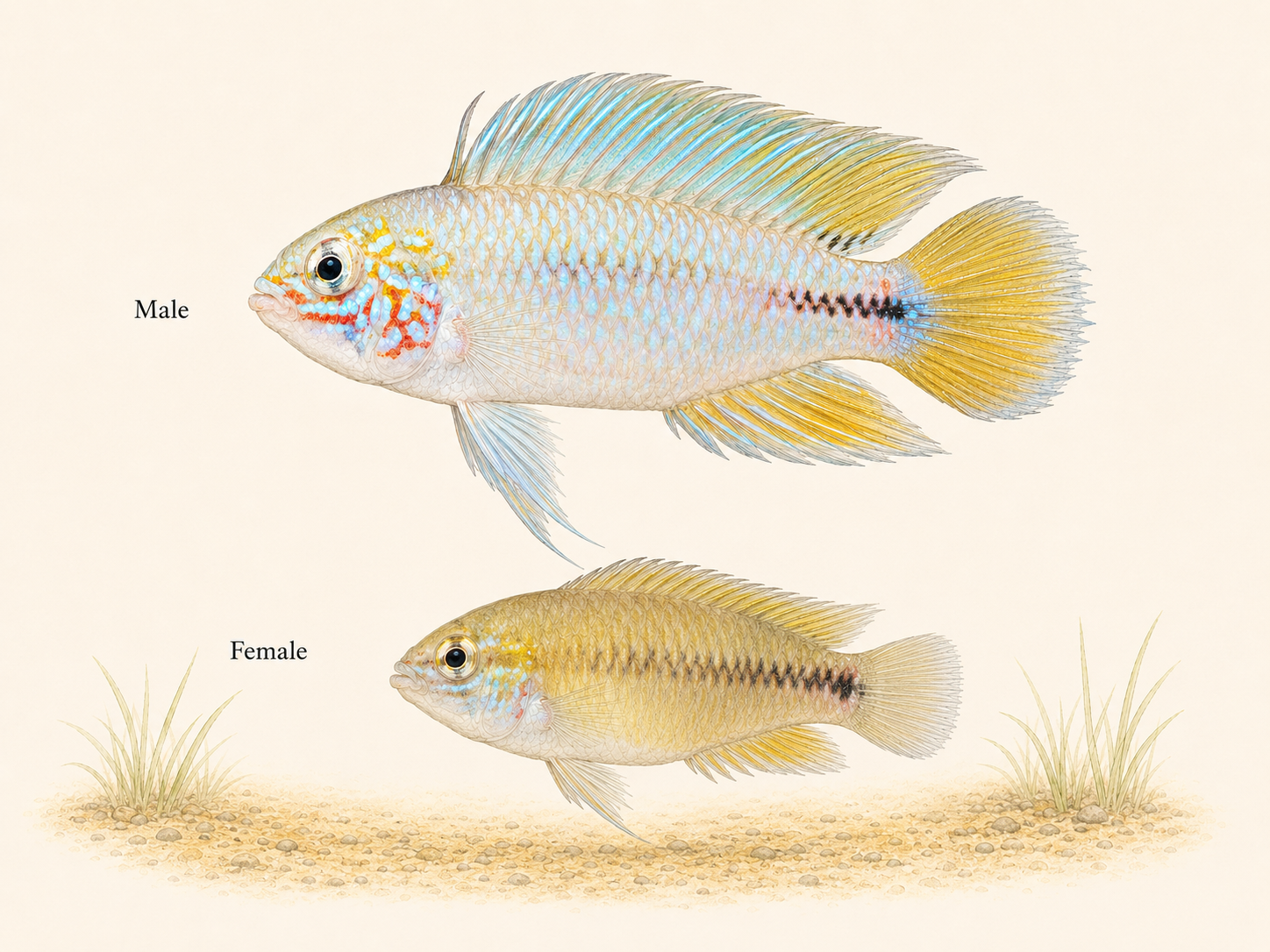
Apistogramma borellii is a sexually dimorphic species, meaning males and females differ considerably in both size and coloration. Males are the larger and more colourful of the two sexes, typically reaching around 6 to 7 centimetres in total length. Their body shape is laterally compressed and moderately elongated, with a rounded head profile and a slightly upturned mouth. The most striking feature of the male is undoubtedly the dorsal fin, which is tall and expansive with elongated anterior rays that create the characteristic umbrella-like silhouette when the fin is fully erect. The caudal fin is rounded to slightly lyrate, and the pelvic fins are elongated and pointed, often trailing elegantly as the fish swims.
In terms of coloration, wild-type males display a base colour that ranges from steely blue-grey to warm yellow, depending on the population and the fish’s mood. The face is typically adorned with a vivid pattern of iridescent blue streaks and spots, which intensify dramatically during courtship or territorial displays. A dark lateral band runs along the midline of the body, though this can fade or intensify depending on the fish’s emotional state. The dorsal fin often carries shades of orange, red, or yellow, edged with blue or white, whilst the caudal fin may be yellow or blue with a subtle spotted pattern.
Females are considerably smaller, reaching only 4 to 5 centimetres, and are generally more subdued in their everyday coloration, showing a yellowish-brown or olive body with a prominent dark lateral stripe. However, when in breeding condition, females undergo a remarkable transformation, turning a brilliant canary yellow with bold black markings on the face and ventral region. This striking breeding dress serves as a visual signal to males and also plays a role in fry defence. The fins of females are shorter and more rounded than those of the male.
Juvenile fish of both sexes tend to resemble females in their coloration, making sex determination difficult until the fish are several months old. As males mature, they begin to develop their extended finnage and more vivid coloration, typically becoming distinguishable from females at around three to four months of age.
Varieties and Morphs
Apistogramma borellii has a wide natural distribution, and several distinct geographical colour forms are recognised and traded under specific names in the aquarium hobby. Additionally, selective captive breeding has produced a number of intensified colour variants. Below are the most commonly encountered forms.
The “Opal” form is arguably the most popular and widely available variant. Males of this form display an intense steel-blue to sky-blue body coloration with a striking yellow face and head, creating a beautiful contrast. The dorsal fin is typically edged in orange or red. This is often the form that new keepers first encounter, and it is sometimes sold simply as Apistogramma borellii without any further designation.
The “Yellow Head” or “Yellow Face” variant closely resembles the Opal but places particular emphasis on the vivid golden-yellow coloration of the head and opercular region. In high-quality specimens, this yellow extends from the lips to the nape, contrasting sharply with the blue-grey body. This is sometimes considered synonymous with the Opal form, though some breeders distinguish between the two based on the extent and intensity of the yellow pigmentation.
The “Blue” form features males with an overall deep blue coloration that extends across much of the body and finnage, with comparatively less yellow on the head than the Opal type. The dorsal and caudal fins may show iridescent blue-green tones. This form is particularly striking under subdued lighting where the metallic blue sheen is most visible.
The “Paraguay” or “Wild” form refers to fish that closely resemble wild-caught specimens from the Río Paraguay drainage. These tend to display a more muted, natural palette with a warmer brownish-grey base colour, subtle blue facial markings, and yellow tones in the unpaired fins. They are less commonly available in the trade but are prized by purists and breeders interested in maintaining natural genetics.
The “Red Mask” or “Red Head” form is a less common variant in which males develop reddish-orange pigmentation on the face and operculum rather than the typical yellow. The body retains the characteristic blue-grey tones. This form appears sporadically in the hobby and may represent a specific wild population or a product of selective breeding.
Natural Habitat
Apistogramma borellii inhabits the subtropical lowland river systems of southern South America, with its range centred on the Río Paraguay, Río Paraná, and Río Uruguay basins spanning parts of southern Brazil, Paraguay, and northern Argentina. This distribution places it notably further south than most other Apistogramma species, which are predominantly found in tropical regions closer to the equator. This southerly range is directly responsible for the species’ remarkable tolerance for cooler water temperatures, an adaptation that distinguishes it from the majority of its congeners.
In the wild, Apistogramma borellii is typically found in slow-moving or still waters including the margins of rivers, oxbow lakes, flooded grasslands, and small streams. The substrate in these habitats is usually composed of sand, mud, or fine gravel, often covered by a layer of decomposing leaf litter. Submerged and emergent vegetation is frequently present, providing both cover and foraging opportunities. Fallen branches, root tangles, and other woody debris create the shaded retreats and cave-like structures that the species favours for shelter and breeding.
The water chemistry in these habitats varies considerably across the species’ range. In some areas, the water is soft and slightly acidic, tinted brown by tannins released from decaying organic matter. In other locations, particularly in the Pantanal wetlands and parts of the Río Paraguay, the water may be clearer and of moderate hardness with a more neutral pH. This natural variation in water chemistry is reflected in the species’ broad tolerance for different aquarium conditions and contributes to its reputation as one of the hardier and more adaptable Apistogramma species.
Seasonal flooding plays an important role in the ecology of Apistogramma borellii. During the wet season, rising water levels inundate surrounding grasslands and forests, vastly expanding the available habitat and food supply. As waters recede during the dry season, fish become concentrated in remaining pools and channels, where temperatures can fluctuate significantly between warm days and cool nights, particularly during the austral winter when night-time temperatures in parts of the species’ range may drop below 15 °C.
Tank Size and Setup
A single pair of Apistogramma borellii can be comfortably housed in an aquarium of 60 litres or more. For a small harem of one male with two or three females, a tank of 80 to 120 litres is recommended to allow each female to establish her own territory without excessive conflict. Larger groups or community setups should be planned around tanks of 120 litres and upward. It is important to consider the footprint of the tank as well as the volume; a longer, shallower aquarium with a greater base area is preferable to a tall, narrow design, as these cichlids are primarily bottom-dwelling and use horizontal space to define their territories.
The substrate should ideally be fine sand, which allows the fish to engage in their natural sifting and digging behaviours. Rounded gravel of a small grain size is also acceptable, though sharp-edged substrates should be avoided as they can damage the fish’s delicate ventral surfaces. A layer of dried leaf litter, such as Indian almond leaves, oak leaves, or beech leaves, placed on top of the substrate provides a naturalistic appearance, releases beneficial tannins into the water, and creates a substrate-level microhabitat rich in the microfauna that both adults and fry feed upon.
Providing ample cover and visual barriers is essential for the well-being of Apistogramma borellii. Driftwood, bogwood, and branching roots should be arranged to create shaded retreats and line-of-sight breaks throughout the aquarium. Small caves formed from coconut shell halves, clay flower pots laid on their sides, or purpose-made ceramic breeding caves are eagerly adopted by females as potential spawning sites. Each female in the tank should have access to at least two or three potential cave sites to choose from, as competition for spawning locations can cause stress if options are limited.
Live plants are highly recommended and serve multiple purposes in an Apistogramma borellii aquarium. Dense plantings of species such as Java fern, Anubias, Cryptocoryne, and various mosses provide additional cover, help stabilise water quality, and contribute to a more natural and visually appealing environment. Floating plants such as Amazon frogbit or water lettuce are particularly valuable, as they diffuse overhead light and create the dappled, shaded conditions that these fish prefer. Apistogramma borellii tends to appear more confident and display better coloration under subdued lighting.
Water Parameters
One of the most appealing aspects of keeping Apistogramma borellii is its relatively broad tolerance for different water conditions. Unlike many Apistogramma species that demand extremely soft, acidic water, A. borellii is comfortable across a wider range of parameters, reflecting the diversity of water chemistry found across its natural range. Nevertheless, maintaining stable conditions within the recommended ranges will promote the best health, coloration, and behaviour.
| Temperature | 20–26 °C |
| pH | 5.5–7.5 |
| General hardness (GH) | 1–12 dGH |
| Carbonate hardness (KH) | 1–8 dKH |
| Ammonia | 0 ppm |
| Nitrite | 0 ppm |
| Nitrate | Below 20 ppm |
The temperature tolerance of this species deserves particular emphasis. Apistogramma borellii is comfortable at temperatures as low as 18 °C and can tolerate brief dips below this, making it one of the few dwarf cichlids suitable for rooms that are not consistently heated to tropical levels. In fact, many experienced keepers report that the species thrives best with a moderate seasonal temperature variation, with slightly cooler conditions in winter months followed by a gradual warming in spring, which can serve as a trigger for breeding activity. That said, prolonged exposure to temperatures below 16 °C or above 28 °C should be avoided.
For general maintenance, a pH in the range of 6.0 to 7.0 and soft to moderately hard water will suit most captive-bred specimens well. If breeding is a priority, slightly softer and more acidic conditions, around pH 5.5 to 6.5 with a GH of 1 to 6 dGH, will typically improve egg fertility and fry survival rates. Water quality should be maintained through regular partial water changes of around 20 to 30 per cent weekly, ensuring that the replacement water is closely matched to the tank water in temperature and chemistry to avoid sudden fluctuations that can stress the fish.
Filtration and Equipment
Apistogramma borellii does not require powerful filtration, and in fact strong water currents should be avoided as this species originates from slow-moving or still waters. A gentle sponge filter is an excellent choice, particularly in breeding setups, as it provides reliable biological filtration without generating excessive flow and poses no risk to fry. Air-driven sponge filters also create minimal disturbance to the leaf litter and fine substrate that these fish appreciate. In larger community tanks, a small internal filter or a hang-on-back filter with an adjustable flow rate can be used, with the output diffused or directed against the glass to minimise current.
Canister filters are suitable for larger setups provided the flow is adequately baffled. A spray bar positioned along the back glass and aimed at the surface, or a flow diffuser fitted to the outlet, will help distribute the current gently across the tank. The inlet should be fitted with a fine pre-filter sponge to prevent fry from being drawn into the filter mechanism should breeding occur.
Heating may or may not be necessary depending on the ambient room temperature. In homes that maintain indoor temperatures above 18 °C year-round, a heater may not be required at all. However, if the room temperature drops below this threshold, particularly in winter, a thermostatically controlled heater set to around 20 to 22 °C is advisable. For those who wish to simulate a natural seasonal cycle, the heater can be set lower in winter and slightly higher in spring and summer.
Lighting should be moderate to subdued. Apistogramma borellii shows its best coloration and most confident behaviour under soft, diffused light. If the aquarium is planted, lighting should be sufficient for plant growth but supplemented with floating plants to provide shaded areas at the water’s surface. LED lighting with adjustable intensity or a timer set for around 8 to 10 hours per day is ideal.
Diet and Feeding
Apistogramma borellii is an omnivore with a strong preference for small invertebrates and other protein-rich foods. In the wild, its diet consists primarily of insect larvae, small crustaceans, worms, and other benthic organisms found in the leaf litter and substrate. In captivity, the species readily accepts a wide variety of foods, though the best health and coloration are achieved with a varied diet that includes both prepared and live or frozen options.
A high-quality micro pellet or slow-sinking granule designed for small cichlids or dwarf cichlids can serve as a staple food. These fish have small mouths relative to their body size, so food particles should be appropriately sized. Flake foods are also accepted but are less ideal as a primary food source, as they tend to disperse quickly and may not reach the bottom-dwelling fish before being consumed by surface-feeding tank mates.
Live and frozen foods should form a regular part of the diet. Frozen bloodworm, daphnia, brine shrimp, cyclops, and mosquito larvae are all eagerly consumed and provide essential nutrition that promotes vibrant coloration and breeding condition. Live foods such as freshly hatched brine shrimp nauplii, microworms, grindal worms, and white worms are particularly valuable when conditioning pairs for breeding or when raising fry. The movement of live prey also stimulates natural hunting behaviour and provides enrichment.
Feeding should be offered once or twice daily in small amounts that can be consumed within a few minutes. Overfeeding should be avoided, as uneaten food decomposing on the substrate can quickly degrade water quality in the relatively small aquaria that these fish typically inhabit. It is worth observing the fish during feeding to ensure that all individuals, including any subordinate females, are receiving their share, as dominant fish may monopolise food sources in heavily structured tanks.
Behaviour and Temperament
Apistogramma borellii is widely regarded as one of the more peaceful and mild-mannered members of its genus. Males are territorial but considerably less aggressive than many other Apistogramma species, and serious physical confrontations are rare in appropriately sized and furnished aquaria. Territorial disputes between males typically involve elaborate fin displays, lateral body flaring, and posturing rather than direct combat. A dominant male will claim a central territory within the tank and display frequently to attract and court nearby females.
Females maintain smaller, semi-independent territories within or adjacent to the male’s domain, each centred around a preferred cave or sheltered spawning site. While females are generally subordinate to males in everyday interactions, this dynamic reverses dramatically when a female has eggs or fry. A brooding female in her vivid yellow breeding dress becomes fiercely protective of her brood, readily chasing away the male and any other fish that venture too close to her cave.
This species spends much of its time near the substrate and among lower decorations, methodically exploring leaf litter, probing the sand, and investigating crevices in search of food. It is not a particularly active swimmer in the open water column, preferring instead to hover near cover and dart between sheltered spots. New specimens may be shy and reclusive for the first few days or weeks after introduction, spending much of their time hidden. With patience and a well-structured tank that provides ample security, they will gradually gain confidence and begin to display more openly.
Apistogramma borellii is generally indifferent to fish that occupy different areas of the water column and makes an excellent candidate for a peaceful community aquarium. Its territorial aggression is directed primarily at other bottom-dwelling cichlids and is proportional to the available space and cover. Providing sufficient visual barriers and multiple potential territories within the aquarium goes a long way towards minimising any aggression.
Tank Mates
Apistogramma borellii’s peaceful disposition and preference for the lower portions of the aquarium make it compatible with a broad range of small, non-aggressive community fish. The ideal tank mates are species that occupy different levels of the water column, do not compete for the same food or territory, and are too small or too docile to pose a threat. Care should be taken to avoid large, boisterous, or aggressive species that could intimidate or outcompete these relatively shy cichlids.
Good tank mates
- Cardinal Tetra, a small, peaceful shoaling fish that occupies the middle water column and complements the cichlid’s colours beautifully.
- Ember Tetra, its tiny size and gentle temperament make it an ideal dither fish that helps Apistogramma borellii feel more secure.
- Rummy-Nose Tetra, a well-behaved shoaling species that stays in mid-water and thrives in similar soft, acidic conditions.
- Harlequin Rasbora, a hardy, peaceful rasbora that prefers the middle to upper water column and tolerates the same water parameters.
- Pygmy Corydoras, a diminutive bottom-dweller that is too small and non-threatening to provoke territorial aggression from the cichlid.
- Otocinclus, a gentle algae-grazing catfish that minds its own business and occupies a different ecological niche entirely.
- Kuhli Loach, its nocturnal, burrowing habits mean it rarely comes into direct conflict with the diurnal cichlids.
- Honey Gourami, a placid surface-dwelling labyrinth fish that adds interest to the upper water column without causing problems below.
- Amano Shrimp, Large enough to avoid predation by adult borellii and useful as an algae-cleaning crew member.
- Beckford’s Pencilfish, a slim, peaceful surface-dweller that makes an unobtrusive and attractive companion.
Fish to avoid
- Convict Cichlid, far too aggressive and territorial, it will easily dominate and stress the much smaller Apistogramma.
- Oscar, a large, predatory cichlid that would view Apistogramma borellii as food rather than a tank mate.
- Tiger Barb, a notorious fin-nipper that would target the borellii’s elaborate finnage and cause chronic stress.
- Jack Dempsey, an aggressive, much larger cichlid wholly incompatible with small, peaceful dwarf species.
- Red Jewel Cichlid, highly territorial and aggressive, particularly when breeding, and would overwhelm the borellii.
- Chinese Algae Eater, Becomes increasingly aggressive and territorial with age and may harass slow-moving tank mates.
- Buenos Aires Tetra, a large, robust tetra that can be nippy and boisterous enough to intimidate dwarf cichlids.
- Green Terror, a large and highly aggressive South American cichlid entirely unsuitable for a dwarf cichlid community.
Breeding
Breeding Apistogramma borellii in captivity is a thoroughly rewarding experience and is achievable for aquarists with moderate experience. The species is a cave-spawning, substrate-brooding cichlid in which the female assumes primary responsibility for egg and fry care, while the male patrols the broader territory and defends against intruders. A well-conditioned pair in a suitably arranged aquarium will often spawn without any special intervention from the keeper.
To condition fish for breeding, offer a varied diet rich in live and frozen foods for several weeks prior to the anticipated spawning. Performing a partial water change with slightly cooler, softer water can simulate the onset of the rainy season and serve as a spawning trigger. Gradually increasing the temperature by one or two degrees over the course of a week, to around 24 to 26 °C, can also encourage reproductive activity.
When a female is ready to spawn, she will adopt her brilliant yellow breeding coloration and begin actively soliciting the male, displaying near the entrance to her chosen cave with exaggerated body movements and quivering fins. The male responds with his own displays, flaring his umbrella dorsal fin and intensifying his colours. If the male is receptive, the pair will enter the cave together. The female deposits a clutch of 40 to 80 small, adhesive eggs on the ceiling or walls of the cave, which the male fertilises in passes.
After spawning, the female becomes the sole guardian of the eggs and will aggressively drive the male and any other fish away from the cave entrance. She fans the eggs with her pectoral fins to ensure adequate oxygenation and removes any unfertilised or fungused eggs. The eggs typically hatch in two to four days depending on temperature. The larvae remain attached to the cave surfaces by their yolk sacs for a further three to five days, after which they become free-swimming and venture out of the cave under the watchful supervision of their mother.
Free-swimming fry are tiny and require appropriately sized first foods. Infusoria, vinegar eels, or commercially available liquid fry food can sustain them during the first few days, after which they should be transitioned to freshly hatched brine shrimp nauplii and microworms. The female will continue to guard and shepherd the fry for several weeks, leading them to food sources and herding them back to shelter at any sign of danger. This period of maternal care is one of the most fascinating aspects of keeping this species and is a joy to observe.
If the fry are to be raised in the community tank, survival rates will be lower due to predation by tank mates. For maximum fry survival, the female and her brood can be carefully transferred to a separate rearing tank, or the other fish can be temporarily removed. Some breeders prefer to pull the eggs from the cave and hatch them artificially using a gentle air supply and an antifungal agent such as methylene blue, though this deprives the keeper of the opportunity to witness the mother’s remarkable parental behaviour.
Common Diseases
Apistogramma borellii is a reasonably hardy species when kept in appropriate conditions, but it is susceptible to the same range of diseases that affect other freshwater tropical fish. Maintaining excellent water quality, avoiding overstocking, and providing a balanced diet are the most effective preventative measures against illness.
Ich, or white spot disease, caused by the protozoan parasite Ichthyophthirius multifiliis, is one of the most commonly encountered ailments. It presents as small white cysts on the skin, fins, and gills and is typically triggered by stress, poor water quality, or sudden temperature fluctuations. Treatment involves gradually raising the water temperature to around 28 to 30 °C over 24 to 48 hours, which accelerates the parasite’s life cycle and makes it vulnerable to treatment. A half dose of a proprietary ich medication suitable for scaleless fish companions should be used if other sensitive species are present in the tank.
Bacterial infections, including fin rot and body sores, can occur when fish are stressed or injured. These are generally secondary infections that take hold when the fish’s immune system is compromised. Treatment typically involves improving water quality, isolating the affected fish if possible, and administering a broad-spectrum antibacterial medication. Maintaining pristine water conditions will go a long way towards preventing bacterial issues.
Internal parasites can be a concern, particularly in wild-caught specimens. Signs of internal parasites include weight loss despite a healthy appetite, white or stringy faeces, and a sunken belly. Treatment with an appropriate antiparasitic medication, administered in food where possible, is usually effective. Quarantining all new fish for a minimum of two to four weeks before introducing them to an established tank is strongly recommended to reduce the risk of introducing parasites or other pathogens.
Hole-in-the-head disease, also known as head and lateral line erosion, occasionally affects dwarf cichlids. It manifests as small pits or lesions on the head and along the lateral line. The exact cause is debated, but it is generally associated with poor water quality, nutritional deficiencies (particularly a lack of vitamins and minerals), and possibly flagellate parasites. Improving diet, increasing water change frequency, and treating with metronidazole are the standard approaches to addressing this condition.
Fungal infections, recognisable by cotton-like white growths on the skin or fins, may appear on fish that have been injured or are already immunocompromised. These are treated with proprietary antifungal medications and, as with most diseases, are best prevented through good husbandry practices.
FAQs
Can Apistogramma borellii be kept without a heater?
Yes, in many cases. Apistogramma borellii is one of the few dwarf cichlids that tolerate cooler temperatures, thriving comfortably at 18 to 26 °C. If your home maintains a stable indoor temperature above 18 °C throughout the year, a heater may not be necessary. However, if your room temperature drops below this threshold, particularly during winter nights, a thermostatically controlled heater set to around 20 °C is advisable to prevent stress from prolonged cold exposure.
How many Apistogramma borellii can I keep together?
A single pair can be housed in a 60-litre aquarium. For a harem setup of one male with two or three females, aim for 80 to 120 litres with multiple caves and visual barriers to allow each female her own territory. Keeping more than one male in the same tank is possible only in larger aquaria of 150 litres or more with abundant cover and line-of-sight breaks, and even then, some degree of sparring should be expected.
Is Apistogramma borellii suitable for a beginner?
Apistogramma borellii is widely considered one of the best Apistogramma species for beginners, thanks to its tolerance for a broader range of water parameters, its relatively peaceful temperament, and its hardiness compared to more demanding species in the genus. That said, it still benefits from a mature, well-maintained aquarium with stable water quality, so it is best suited to aquarists who have some experience with basic fishkeeping principles.
Will Apistogramma borellii eat shrimp?
Adult Apistogramma borellii may prey on very small shrimp such as cherry shrimp, particularly juveniles and shrimplets. Larger shrimp species like Amano shrimp are generally safe with adult borellii. If you wish to keep dwarf shrimp in the same tank, providing dense plant cover and moss where shrimplets can hide will improve their survival rates, though some predation is likely inevitable.
How can I tell males from females?
Males are larger, more colourful, and possess the signature elongated dorsal fin that gives the species its common name. Females are smaller and more modestly coloured, with shorter, rounded fins. When in breeding condition, females turn a vivid yellow with black markings, making them unmistakable. In juveniles, sexing is difficult until the fish are around three to four months old, at which point males begin developing their extended finnage and brighter colours.
Related Guides
- Apistogramma cacatuoides (Cockatoo Dwarf Cichlid), another popular and beginner-friendly Apistogramma species