Quick Summary
The Blackfin Pearlfish is a stunning but short-lived South American annual killifish whose adults typically survive under a year even in perfect captivity conditions. It is best suited to experienced hobbyists who appreciate the unique lifecycle of annual killifish and are prepared for specialist breeding involving peat substrate and egg diapause rather than a long-term companion fish.
🐠 Build a tank around this species
In this guide:
- Introduction
- Quick Stats
- Appearance
- Natural Habitat
- Tank Size and Setup
- Water Parameters
- Diet and Feeding
- Behaviour and Temperament
- Breeding
Introduction
Austrolebias nigripinnis, commonly known as the Blackfin Pearlfish, is one of the most visually striking annual killifish available in the aquarium hobby. Males display a breathtaking pattern of iridescent blue-white pearl spots scattered across a deep black body and fins, making them one of the most beautiful freshwater fish of their size. However, the Blackfin Pearlfish comes with a caveat that every prospective keeper must understand before acquiring one: this species is naturally short-lived, with adults typically surviving between six and twelve months even under ideal aquarium conditions. This is not a sign of poor husbandry – it is an intrinsic part of the species’ biology, shaped by millions of years of evolution in seasonal pools that vanish entirely during the dry season.
In the wild, Austrolebias nigripinnis inhabits temporary freshwater pools and shallow wetlands across parts of southern Brazil, Uruguay, and north-eastern Argentina. These pools fill with seasonal rains, and the fish hatch, grow, mature, breed, and die within the space of a single wet season. Their eggs, buried in the soft substrate, enter a state of developmental arrest called diapause, remaining viable in damp peat or mud for months until the next rains trigger hatching. This extraordinary reproductive strategy means the species essentially exists as eggs for a significant portion of its annual cycle.
For aquarists, this lifecycle presents both a challenge and a fascination. Keeping Blackfin Pearlfish is less about maintaining a long-term display fish and more about engaging with one of the most remarkable reproductive strategies in the freshwater world. Breeding is the central focus of most killifish enthusiasts who keep this species, and it requires a willingness to work with peat moss spawning substrates, manage egg storage through diapause, and accept the bittersweet reality that even your healthiest adults will age rapidly and pass within months. If you approach the Blackfin Pearlfish with realistic expectations and a genuine interest in its biology, it is an immensely rewarding species to work with.
Quick Stats
| Scientific name | Austrolebias nigripinnis |
|---|---|
| Common names | Blackfin Pearlfish, Black-finned Pearl Killifish, Dwarf Argentine Pearl |
| Family | Rivulidae |
| Origin | Southern Brazil, Uruguay, north-eastern Argentina |
| Adult size | 7 cm |
| Lifespan | 0–1 years |
| Difficulty | Intermediate |
| Breeding difficulty | Moderate |
| Temperature | 16–22 °C |
| pH | 6–7.5 |
| GH | 2–12 dGH |
| KH | 1–8 dKH |
| Minimum tank size | 30 L |
| Conservation status | Near Threatened (IUCN, assessed 2021) |
Appearance
The Blackfin Pearlfish is a small, deep-bodied killifish that punches well above its weight in terms of visual impact. Sexual dimorphism is pronounced and develops early, making it straightforward to distinguish males from females once the fish reach a few weeks of age.
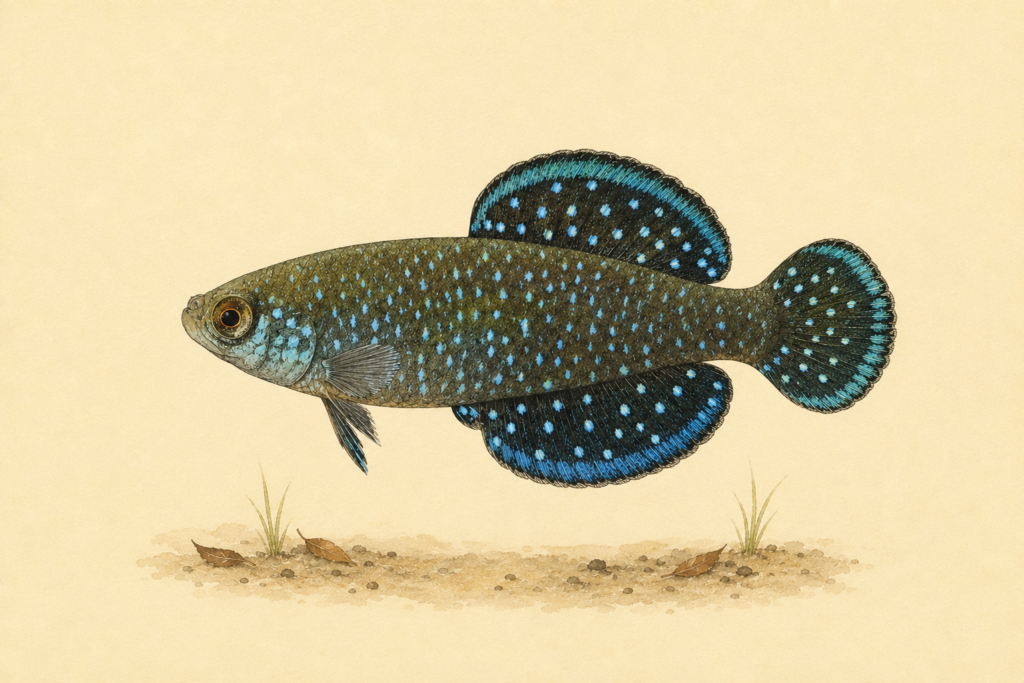
Males are the showpiece. The base body colour is a deep, velvety black that extends across the entire body and into all unpaired fins – the dorsal, anal, and caudal. Scattered across this dark canvas are dozens of small, intensely iridescent spots that range from sky blue to pearly white depending on the lighting and the individual. These pearl spots give the species its common name and create a striking celestial pattern, as though the fish were a fragment of night sky dotted with stars. The fins are large and rounded, particularly the anal fin which runs much of the ventral length, and the caudal fin which has a broad, fan-like shape. The overall silhouette is somewhat compressed laterally, giving the fish a slightly stocky, robust look despite its small adult size of around four to five centimetres.
Females are considerably plainer, as is common among Austrolebias species. They display a mottled grey-brown to olive base colour with darker barring or blotching along the flanks. Their fins are shorter and less ornate, and they lack the pearl spotting entirely. While less visually dramatic, females have their own subtle beauty, and their subdued colouring serves a practical function in the wild, providing camouflage in the murky, vegetated temporary pools the species inhabits.
As Blackfin Pearlfish age – and they age rapidly – males may show a gradual fading of colour intensity and may develop a slightly worn appearance to the fins. This is a natural consequence of their compressed lifecycle and should not necessarily be interpreted as illness, though it can overlap with genuine health decline in very old individuals.
Natural Habitat
Understanding the natural habitat of Austrolebias nigripinnis is essential to appreciating why this species behaves and lives the way it does in captivity. The Blackfin Pearlfish is found across the Pampa and lowland grassland regions of southern Brazil (particularly Rio Grande do Sul), Uruguay, and north-eastern Argentina. Its range falls within the broader La Plata basin system, but the fish does not inhabit permanent rivers or lakes. Instead, it lives in temporary, seasonal pools – shallow depressions in grasslands, floodplains, and marshy areas that fill with rainwater during the wet season and dry up completely during the dry months.
These ephemeral pools are typically shallow, rarely exceeding 30 to 50 centimetres in depth, and are often heavily vegetated with grasses, aquatic plants, and decomposing organic matter. The substrate is generally soft, dark mud or peat-like material rich in humic acids. Water chemistry in these pools tends to be soft to moderately soft and slightly acidic to neutral, though conditions can fluctuate considerably as pools fill and evaporate. Temperatures in these southern South American habitats are notably cooler than tropical norms, with water temperatures often ranging from the mid-teens to the low twenties Celsius. During the cooler parts of the wet season, overnight temperatures can drop even further.
The entire lifecycle of the Blackfin Pearlfish is dictated by the cycle of these pools. When rains fill the depressions, dormant eggs buried in the substrate hatch within days. The fry grow at a remarkable pace, reaching sexual maturity in as little as four to six weeks. Adults spawn prolifically, burying their eggs in the soft bottom substrate through a distinctive diving behaviour. As the pool begins to shrink and eventually dries entirely, the adults perish. The eggs, however, persist in the damp substrate, entering one or more stages of diapause – a genetically programmed developmental pause that can last weeks or months depending on environmental conditions. When the rains return and the pools refill, the cycle begins anew.
This habitat profile has several important implications for aquarium keeping. The species does not require – and in fact does not thrive in – the warm tropical temperatures that many aquarists default to. It benefits from softer, slightly acidic water. And the substrate must be considered carefully if breeding is intended, as the spawning behaviour is intimately tied to the availability of a soft, peat-like material the fish can dive into.
Tank Size and Setup
The Blackfin Pearlfish is a small fish and does not require a large aquarium. A tank of 30 litres is sufficient for a single pair or a trio consisting of one male and two females. For a small group of two males and several females, a tank of 45 to 60 litres provides adequate space and reduces the intensity of male-to-male interactions. Larger tanks are always welcome but are not strictly necessary given the species’ size and relatively sedentary habits.
The aquascape should reflect, at least loosely, the soft-bottomed, vegetated pools the species comes from. A dark, fine-grained substrate is ideal. Many killifish keepers use a thin layer of dark sand or fine gravel as the main substrate, with a separate container of boiled peat moss or coco peat placed on the tank bottom as a dedicated spawning site. This container – typically a small plastic tub or ceramic dish approximately 8 to 10 centimetres in diameter and 5 centimetres deep, filled with moistened peat – serves as the medium into which the fish will dive and deposit eggs. This setup allows the keeper to remove and store the peat with eggs for incubation without disturbing the rest of the tank.
Planting is beneficial and recommended. Floating plants such as Salvinia, Riccia, or duckweed help to diffuse lighting and provide a sense of security. Rooted or weighted plants like Java fern, Java moss, Cryptocoryne species, and Anubias all work well and tolerate the cooler temperatures this species prefers. Dense plantings along the back and sides of the tank, leaving an open area in the centre and around the spawning container, create a naturalistic environment that encourages the fish to display natural behaviour.
Driftwood and leaf litter are also excellent additions. Indian almond leaves or dried oak leaves placed on the substrate release tannins that tint the water a gentle amber, lower the pH slightly, and provide a more natural chemical environment. The Blackfin Pearlfish seems more at ease and displays better colour in tannin-stained water.
Lighting should be moderate to subdued. Bright overhead lighting can cause the fish to appear washed out and stressed. If you are using a standard aquarium light, floating plants will naturally filter the intensity. Many dedicated killifish keepers use no dedicated lighting at all, relying on ambient room light, which is perfectly acceptable for this species.
A tight-fitting lid or cover glass is important. While Blackfin Pearlfish are not habitual jumpers in the way some surface-dwelling killifish are, they can and do leap when startled, and the small tank sizes used for this species mean there is not a great deal of vertical buffer between the water surface and an open top.
Water Parameters
| Temperature | 16-22 C |
| pH | 6.0-7.5 |
| General hardness (GH) | 2-12 dGH |
| Carbonate hardness (KH) | 1-8 dKH |
| Ammonia | 0 ppm |
| Nitrite | 0 ppm |
| Nitrate | Below 20 ppm |
One of the most common mistakes made with Blackfin Pearlfish is keeping them too warm. This is a subtropical to cool temperate species, not a tropical one. At temperatures consistently above 24 C, the fish’s already short lifespan is compressed further, and they may show signs of stress, reduced appetite, and accelerated ageing. Room temperature in most UK and European homes – typically 18 to 21 C – is often ideal without any need for a heater. In warmer climates or during summer months, keeping the tank in a cooler room or using measures to prevent overheating may be necessary.
Water quality should be kept high through regular partial water changes. Weekly changes of 20 to 30 per cent are a sensible routine. Because the tanks used for this species tend to be small, water parameters can shift quickly if maintenance is neglected. Ammonia and nitrite must remain at zero, and nitrate should be kept below 20 ppm. The use of aged tap water that has been dechlorinated, or a mix of tap and reverse osmosis water to achieve the desired softness, works well. If your tap water is naturally soft and slightly acidic, it may require little to no modification.
The addition of tannins through Indian almond leaves, alder cones, or peat filtration can help maintain a slightly acidic, soft water profile and seems to benefit the overall health and colour of the fish. However, this is supplementary rather than essential – stable, clean water within the stated parameters is the priority.
Filtration and Equipment
Filtration for a Blackfin Pearlfish tank should be gentle. These fish come from still or very slow-moving water and do not appreciate strong currents. A small air-driven sponge filter is the preferred choice among killifish enthusiasts and is arguably the single best filtration option for this species. Sponge filters provide effective biological filtration, gentle water movement, and aeration without creating the powerful flow that hang-on-back or canister filters can produce. They also pose no risk of trapping small fry if breeding occurs in the display tank.
If you prefer a different filter type, a small internal filter with an adjustable flow rate turned to its lowest setting can work, but ensure the intake is covered with a fine sponge pre-filter to prevent any fish or fry from being drawn in. Canister filters are generally overkill for the small tanks used for this species.
A heater is typically unnecessary and may even be counterproductive. As discussed, the Blackfin Pearlfish prefers cooler water than most tropical fish. If your home drops below 14 C in winter, a low-wattage heater set to 16 or 17 C can serve as a safeguard, but in most cases ambient room temperature will suffice. If you do use a heater, choose one with a reliable thermostat and check it regularly – an overheating malfunction in a small tank can be rapidly fatal.
An air pump powering the sponge filter also provides surface agitation for gas exchange. No additional powerheads or wavemakers are needed. A thermometer – ideally a digital one for accuracy – is useful for monitoring temperature, particularly during seasonal transitions when room temperatures may fluctuate.
Diet and Feeding
The Blackfin Pearlfish is primarily a carnivore in the wild, feeding on small invertebrates, insect larvae, and microcrustaceans found in its temporary pool habitat. In captivity, it strongly prefers live and frozen foods and may be reluctant to accept dry prepared foods, particularly if it has been raised on live fare.
The best staple foods for this species include live or frozen bloodworms, daphnia, brine shrimp (both adult and newly hatched nauplii), mosquito larvae, grindal worms, and white worms. Tubifex worms can also be offered but should be sourced from reputable suppliers to minimise the risk of introducing pathogens. A varied diet rotating between several of these foods will keep the fish in the best condition and support the vibrant colouration of males.
Some individuals can be gradually weaned onto high-quality micro pellets or crushed flake food, but this should not be relied upon as the primary diet. Many Blackfin Pearlfish will simply ignore dry foods entirely, and attempting to starve them into acceptance is counterproductive given their already brief lives. If you are considering keeping this species, you should be prepared to provide live or frozen foods as the dietary mainstay.
Feeding should be done once or twice daily in small amounts. Because of the species’ rapid metabolism and short lifespan, slight overfeeding is less of a long-term health concern than it would be with a fish expected to live for years, but uneaten food still degrades water quality and should be removed promptly. In a small tank with minimal filtration, water quality can deteriorate quickly if feeding is not managed carefully.
Newly hatched fry are tiny and require infusoria, vinegar eels, or paramecium cultures for the first few days, transitioning to freshly hatched brine shrimp nauplii within a week. The rapid growth rate of annual killifish fry means they can graduate to larger foods relatively quickly.
Behaviour and Temperament
The Blackfin Pearlfish is a relatively peaceful species by Austrolebias standards, though males will spar with one another when in close proximity. These interactions are usually ritualised displays involving flared fins, parallel swimming, and brief lateral pushes rather than outright violence, but in very small tanks a dominant male may persistently harass a subordinate to the point of chronic stress. For this reason, keeping a single male with one or two females is the simplest and most harmonious arrangement. If multiple males are desired, a larger tank with broken sight lines – achieved through plants, driftwood, or other decor – helps to manage aggression.
Males spend a significant portion of their time displaying to females, spreading their dark, pearl-spotted fins in an impressive courtship posture. When a receptive female approaches, the pair will swim together to the spawning substrate – typically the peat-filled container – and dive side by side into the peat, pressing close together as eggs are deposited and fertilised. This diving behaviour is one of the most fascinating aspects of keeping annual killifish and is readily observed in a well-set-up tank.
Outside of spawning and male-to-male interactions, the Blackfin Pearlfish is a calm, somewhat deliberate swimmer. It tends to occupy the lower and middle levels of the tank, often hovering near the substrate or resting among plants. It is not a highly active, constantly moving species – there are periods of relative stillness interspersed with bursts of display and foraging activity. This can sometimes concern new keepers who mistake restfulness for lethargy, but it is normal behaviour for the species.
As the fish age – and given the compressed lifespan, visible ageing can begin within a few months of reaching maturity – activity levels may gradually decrease. Older fish may spend more time resting and show less interest in display. This is a natural part of the species’ lifecycle and, while poignant, should be expected.
Tank Mates
Choosing tank mates for the Blackfin Pearlfish requires careful consideration of its specific needs: cooler water, gentle flow, small tank size, and its relatively timid nature. Many popular tropical community fish are unsuitable simply because they require warmer temperatures. Ideal companions are small, peaceful species that tolerate or prefer the cooler, subtropical temperature range the Blackfin Pearlfish needs. That said, many experienced killifish keepers maintain Austrolebias nigripinnis in species-only setups, which is the simplest and most reliable approach, particularly if breeding is the goal.
Good tank mates
- White Cloud Mountain Minnow – Thrives in the same cool temperature range and is peaceful enough not to bother the killifish.
- Celestial Pearl Danio – A small, peaceful species comfortable in cooler subtropical conditions with similar water chemistry preferences.
- Pygmy Corydoras – Tiny, bottom-dwelling catfish that are gentle and tolerant of cooler temperatures, though ensure the tank is large enough for both species.
- Cherry Shrimp – Hardy invertebrates that coexist peacefully, though very small juveniles may occasionally be eaten.
- Endler’s Livebearer – Small and active, tolerant of a range of temperatures including the cooler end if acclimatised gradually.
- Rosy Loach – A diminutive, peaceful loach species suited to smaller tanks and comfortable at subtropical temperatures.
Fish to avoid
- Betta – Requires warmer tropical temperatures and may be aggressive toward the similarly shaped male Blackfin Pearlfish.
- Tiger Barb – An active, nippy schooling fish that would harass the slower killifish and prefers warmer water.
- Angelfish – Far too large, requires warmer conditions, and would likely view the Blackfin Pearlfish as food.
- African Cichlids – Completely incompatible in terms of temperament, water chemistry, and temperature requirements.
- Common Pleco – Grows far too large and produces excessive waste for the small tanks suited to this species.
- Guppy – While superficially similar in size, guppies prefer warmer, harder water and males may provoke territorial responses.
Breeding
Breeding the Blackfin Pearlfish is one of the primary reasons hobbyists keep this species, and it is where the extraordinary biology of annual killifish truly comes to life. While the process requires some specialist knowledge and equipment, it is well within the capabilities of a moderately experienced aquarist and is deeply rewarding.
To begin, you need a healthy, mature pair or trio. Given the species’ rapid growth rate, fish can reach sexual maturity within four to eight weeks of hatching. Males will begin displaying to females almost as soon as they develop their adult colouration, and spawning can commence shortly thereafter.
The spawning substrate is the most critical element. Place a small container – a plastic tub, ceramic bowl, or purpose-made spawning dish – filled with a layer of boiled, squeezed, and cooled peat moss (specifically sphagnum peat, not garden compost) approximately 3 to 5 centimetres deep on the tank floor. Coco peat (coir) is an acceptable alternative and is more sustainably sourced. The peat should be dark, soft, and free of additives or fertilisers. Boiling it before use removes tannins that could excessively discolour the water and helps to sterilise it.
When ready to spawn, the male will position himself alongside the female near the peat container. Through a series of fin displays and gentle nudges, he guides her to the surface of the peat. The pair then dives together into the peat, pressing side by side as the female releases one or a few eggs which the male simultaneously fertilises. They may repeat this many times over the course of a day, burying eggs at various depths within the peat. This diving spawning behaviour is characteristic of substrate-spawning Austrolebias species and is fascinating to observe.
After one to two weeks – or sooner if spawning has been prolific – the peat should be carefully removed from the tank. Gently squeeze out excess water until the peat is damp but not dripping, roughly the consistency of a wrung-out sponge. Place the damp peat with eggs into a sealed plastic bag or container, label it with the date, and store it in a dark location at room temperature (approximately 18 to 22 C). Do not allow the peat to dry out completely – a slight residual moisture is essential for egg survival during diapause.
The eggs will undergo diapause, a genetically controlled developmental pause that occurs in one or more stages. The duration of diapause varies but typically lasts between three and six months for this species, though it can be shorter or longer depending on temperature and individual genetic variation. Periodically – perhaps every four to six weeks – you can open the bag, gently spread the peat on a white surface, and inspect the eggs with a magnifying glass or loupe. Healthy developing eggs will appear round and amber to golden in colour. Eggs that have turned white or fuzzy have died and should be removed.
When the eggs show fully developed embryos – visible as dark-eyed larvae curled within the egg membrane – they are ready to hatch. Place the peat into a shallow container and add cool, soft water (ideally matching the species’ preferred parameters) to a depth of a few centimetres. Hatching is often triggered within hours of wetting, though some eggs may take a day or two. The hatching water should be at the cooler end of the species’ range, around 16 to 18 C, to mimic the influx of cool rainwater that triggers hatching in the wild.
Fry are tiny but immediately free-swimming and ready to eat. Offer infusoria, paramecium, or vinegar eels for the first few days, transitioning to freshly hatched brine shrimp nauplii as soon as the fry are large enough to take them – usually within three to five days. Growth is rapid, and with good feeding and clean water, young fish can begin to show sexual dimorphism within three to four weeks.
After the initial wetting, not all eggs will hatch simultaneously. Re-dry the peat gently and store it again for another few weeks before wetting a second time. This staggered hatching is a survival strategy in the wild, ensuring that not all offspring emerge at once and are vulnerable to a single catastrophic event.
Common Diseases
The Blackfin Pearlfish is reasonably hardy within its preferred conditions, but its short lifespan means that any illness or environmental stress has a disproportionate impact – there simply is not time for a slow recovery. Prevention through stable water quality, appropriate temperatures, and a nutritious diet is far more effective than treatment.
Velvet disease (Oodinium) is one of the more common ailments seen in killifish and can affect Austrolebias nigripinnis, particularly if water quality deteriorates or the fish are stressed. It presents as a fine, gold-to-rust-coloured dusting on the skin and fins, often accompanied by clamped fins, scratching against objects, and rapid gill movement. Treatment involves raising the temperature very slightly (a degree or two at most, given this species’ sensitivity to warmth), dimming the lights, and using a copper-based medication at a reduced dose appropriate for small, sensitive fish. Salt baths can also be effective.
Ich (white spot disease) can occur, though it is somewhat less common in cooler-water setups. The characteristic white cysts on the body and fins are easy to identify. Treatment with proprietary ich medications or a gradual increase in temperature combined with aquarium salt can be effective, but be cautious about raising temperatures excessively with this cool-water species.
Bacterial infections, including fin rot and body ulcers, can arise from poor water quality or physical injuries sustained during male sparring. Maintaining clean water through regular changes is the best prevention. Mild cases may resolve with improved water quality alone; more advanced infections may require treatment with antibacterial medications.
Internal parasites can be introduced through live foods, particularly tubifex and wild-caught invertebrates. Symptoms include weight loss despite normal feeding, bloating, or stringy white faeces. Anti-parasitic medications are available but should be used with care in small tanks.
Perhaps the most common “concern” new keepers face is the natural ageing and decline of older fish. A Blackfin Pearlfish that is seven or eight months old is, in biological terms, elderly. Gradual loss of colour, reduced activity, thinning, and eventual death are natural processes for this annual species and should not be mistaken for treatable disease. This is a difficult reality to accept, but it is fundamental to the species’ biology.
FAQs
Why does my Blackfin Pearlfish only live for a few months?
Austrolebias nigripinnis is an annual killifish, meaning its entire adult life cycle in the wild occurs within a single rainy season lasting just a few months. This short lifespan is genetically programmed and is not a result of poor care. Even in perfect aquarium conditions, most individuals will live between six and twelve months. The species perpetuates itself through diapausing eggs that survive the dry season buried in the substrate.
Do Blackfin Pearlfish need a heater?
In most homes, no. This species prefers cooler water between 16 and 22 C, which aligns well with typical room temperatures in the UK and much of Europe. A heater is only necessary if your home regularly drops below about 14 C. In fact, keeping the tank too warm – above 24 C – can shorten the fish’s lifespan further and cause stress.
Can I keep Blackfin Pearlfish in a community tank?
You can, but with significant caveats. Tank mates must tolerate the same cooler temperature range and must be small and peaceful enough not to bully the killifish. Species-only setups are generally preferred, especially if breeding is planned, as other fish may disturb spawning behaviour or eat eggs and fry.
How do I store the eggs during diapause?
After collecting the peat containing the eggs, squeeze out excess water until the peat is damp but not waterlogged. Place it in a sealed plastic bag labelled with the species name and date, then store it at room temperature in a dark cupboard. Check periodically for mould (which indicates the peat is too wet) or excessive drying. The eggs typically need three to six months of diapause before they are ready to hatch.
Can I use coconut fibre instead of peat moss for spawning?
Yes, coco peat or coconut coir is a widely used and more sustainable alternative to sphagnum peat moss. It should be rinsed and boiled before use to remove any residual salts or dust. Many killifish breeders have successfully raised multiple generations of Austrolebias nigripinnis using coco peat as the sole spawning medium.
Related Guides
- Argentine Pearlfish (Austrolebias bellottii) – A closely related annual killifish with similar care requirements and spawning behaviour, offering a useful comparison species.
- Nothobranchius rachovii – An African annual killifish that shares the diapause breeding strategy, ideal for keepers interested in comparing annual killifish from different continents.
- White Cloud Mountain Minnow – One of the best potential tank mates for the Blackfin Pearlfish, sharing its preference for cooler water.