Quick summary
The Green Fire Tetra is a freshwater fish from South America that lives in streams and rivers, particularly where floating or overhanging plants give shade.
🐠 Build a tank around this species
- Introduction
- Quick Stats
- Appearance
- Varieties and Morphs
- Natural Habitat
- Tank Size and Setup
- Water Parameters
- Filtration and Equipment
- Diet and Feeding
- Behaviour and Temperament
- Tank Mates
- Breeding
- Common Diseases
- FAQs
- Related Guides
Introduction
The Green Fire Tetra was first described scientifically in 1907. Its conservation status is listed as Least Concern. Other names include Rathbun’s Bloodfin and Redflank Bloodfin.
Quick Stats
| Scientific name | Aphyocharax rathbuni |
|---|---|
| Common names | Green Fire Tetra, Rathbun's Bloodfin, Redflank Bloodfin |
| Family | Characidae |
| Origin | South America: Paraguay River basin (Bolivia, Argentina, Uruguay and Paraguay) |
| Adult size | 4.5 cm |
| Difficulty | Easy |
| Breeding difficulty | Moderate |
| Temperature | 20–26 °C |
| pH | 6.5–7.5 |
| GH | 2–20 dGH |
| Minimum tank size | 54 L |
| Conservation status | Least Concern (IUCN, assessed 2021) |
Appearance
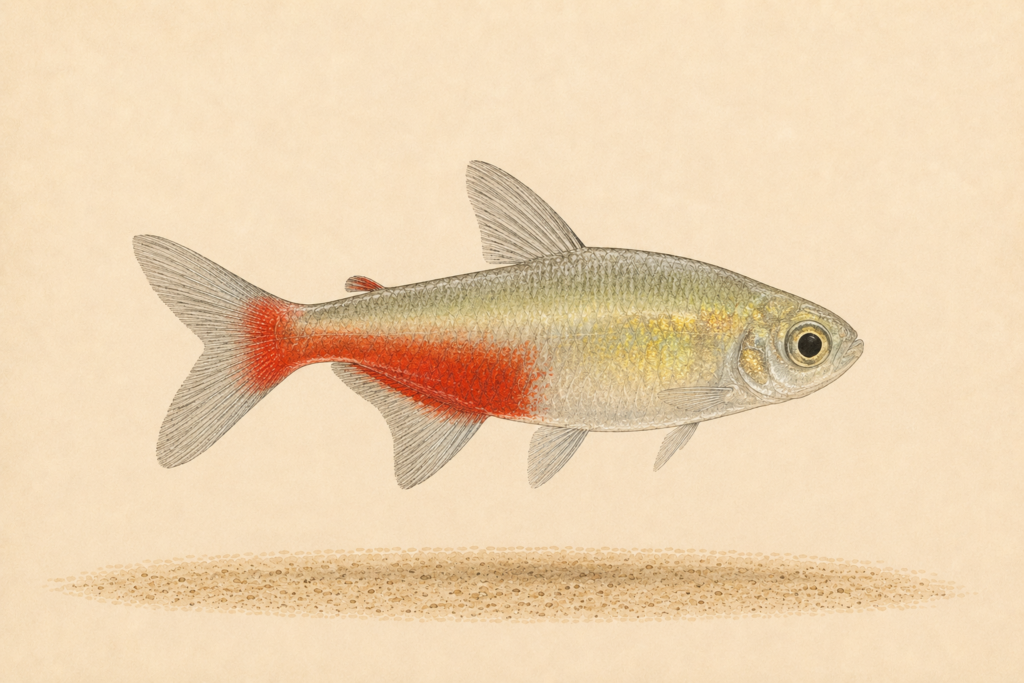
The Green Fire Tetra grows up to 4.5 cm, not counting the tail fin. Males are brighter than females and carry white tips on several of their fins. Females in breeding condition have fuller bodies. Adult colour is richer than that of young fish, which often look drab, because colours improve with age.
Varieties and Morphs
We do not yet have reliable variety information for the Green Fire Tetra.
Natural Habitat
The Green Fire Tetra comes from the Paraguay River basin in South America, with a range covering Bolivia, Argentina, Uruguay and Paraguay.
Tank Size and Setup
We recommend a tank of at least 54 litres. Plenty of plants over a sandy floor is the recommended setup, and bogwood, roots and pebbles can decorate the tank. Lighting is not critical.
Water Parameters
Keep the water between 20 and 26 °C. A pH of 6.5 to 7.5 suits the fish, along with hardness of 2 to 20 dGH (degrees of general hardness).
| Temperature | 20 to 26 °C |
| pH | 6.5 – 7.5 |
| General hardness (GH) | 2 – 20 dGH |
| Ammonia | 0 ppm |
| Nitrite | 0 ppm |
| Nitrate | Below 20 ppm |
The water needs to hold a steady pH. Spawning setups call for very soft water and a pH close to 6.5.
Filtration and Equipment
The Green Fire Tetra appreciates moderate water flow in its tank. We recommend a filter that turns the water over four to five times an hour for a tank of at least 54 litres, and a heater to hold the temperature within 20 to 26 degrees Celsius.
Diet and Feeding
Most aquarium foods are accepted, since the fish is not a fussy eater in captivity. Regular servings of live or frozen food are advised.
Behaviour and Temperament
Keep the Green Fire Tetra in a group of at least six. The species can live in a community aquarium, but it has a reputation for nipping the fins of other fish. Tank mates should therefore be robust and faster moving. Fish with long fins, such as many cichlids, are best avoided as neighbours.
Tank Mates
The Green Fire Tetra is compatible with a wide range of peaceful community species of similar size and temperament. The ideal tank mates are those that can tolerate similar water parameters, are not intimidated by active swimmers, and do not have long, flowing fins that might attract nipping. Avoid very large, predatory, or highly aggressive species that could eat or bully the tetras.
Good tank mates
- Cardinal Tetra, a classic companion that shares similar water chemistry preferences
- Rummy-nose Tetra, another active shoaling species that occupies similar water levels
- Ember Tetra, a small, peaceful tetra that adds warm colour contrast
- Harlequin Rasbora, a gentle mid-water swimmer that coexists easily
- Corydoras sterbai, a bottom-dwelling catfish that stays out of the tetras’ way
- Bristlenose Pleco, a peaceful algae-eating catfish suitable for the same tank size
- Kuhli Loach, a shy bottom-dweller that complements active mid-water species
- Cherry Barb, a peaceful, similarly sized barb with compatible requirements
- Otocinclus, a small algae grazer that shares a preference for soft, clean water
- Amano Shrimp, a useful clean-up crew member large enough to avoid predation by small tetras
Fish to avoid
- Oscar, far too large and predatory for any small tetra
- Male Betta, long fins make it a likely target for nipping, and the betta may also be stressed by fast swimmers
- Angelfish, adults may eat small tetras, and their trailing fins invite nipping
- Tiger Barb, a known fin-nipper that can bully smaller species in mixed groups
- Red-tail Black Shark, territorial and aggressive toward small fish in confined spaces
- Jack Dempsey, a large, aggressive cichlid entirely unsuitable for tetra communities
- Flowerhorn, an extremely aggressive cichlid that would treat small tetras as food
- Green Terror, large and highly territorial, dangerous to any small fish
- Guppy, the long, flowing tails of fancy guppies are likely to attract nipping from Aphyocharax species
- Endler’s Livebearer, also has trailing finnage that may provoke nipping, and prefers harder water.
Breeding
The fish spawn in groups, scattering their eggs. A breeding tank of around 24 by 12 by 12 inches is suggested. Little or no lighting is needed there.
Because the eggs are adhesive, the breeding tank should be well planted, for instance with Java moss or other plants with fine leaves, to give them shelter as spawning goes on. A sponge filter driven by air is all the breeding tank needs. Within 24 hours of the adults going into the breeding tank, spawning is likely to start, though it can take longer, and it often begins early in the morning.
Common Diseases
White spot (ich) can turn up in any freshwater fish, especially when a fish is stressed or when a newly added fish brings it into the tank.
FAQs
How many Green Fire Tetras should be kept together?
Aim for a group of at least six fish.
Do Green Fire Tetras nip fins?
They have a reputation for fin nipping, so robust, faster moving tank mates are the better choice.
What do Green Fire Tetras eat?
They accept most aquarium foods, and live or frozen foods should be offered regularly.
How big do Green Fire Tetras get?
Adults grow to about 4.5 cm, not counting the tail fin.