Half Banded Kuhli Loach Care Guide — Tank Setup, Feeding and Breeding
Introduction
The Half Banded Kuhli Loach, known scientifically as Pangio semicincta, is one of the most charming and endearing bottom-dwelling fish available in the freshwater aquarium hobby. Often confused with its close relative Pangio kuhlii, this slender, eel-like loach has captivated fishkeepers for decades with its distinctive banding pattern, peaceful nature, and fascinating nocturnal behaviour. Native to the slow-moving waterways of Southeast Asia, this species thrives in softly lit, well-planted aquariums with plenty of hiding spots — conditions that closely replicate its natural environment.
Despite their somewhat secretive habits, Half Banded Kuhli Loaches are surprisingly rewarding fish to keep. They become increasingly bold over time, especially when maintained in groups, and their habit of weaving through plants, burrowing into soft substrate, and occasionally resting in the most unexpected positions provides endless entertainment. Their small adult size, peaceful temperament, and relatively undemanding care requirements make them an excellent choice for community aquariums, though a basic understanding of their specific needs is essential for long-term success.
It is worth noting that there has been considerable taxonomic confusion surrounding the various Pangio species in the aquarium trade. Many fish sold as “Kuhli Loaches” are actually Pangio semicincta rather than Pangio kuhlii. The two species are closely related but can be distinguished by subtle differences in their banding patterns, which we shall explore in the appearance section below. Regardless of the exact species, the care requirements are broadly similar, and this guide will provide everything you need to keep these delightful loaches healthy and thriving in your home aquarium.
Quick Stats
| Scientific name | Pangio semicincta |
| Common names | Half Banded Kuhli Loach, Half-Banded Coolie Loach, Kuhli Loach, Coolie Loach |
| Family | Cobitidae |
| Origin | Southeast Asia — Peninsular Malaysia, Sumatra, Borneo |
| Adult size | 8–10 cm (3–4 inches) |
| Lifespan | 8–10 years |
| Difficulty | Easy |
| Breeding difficulty | Difficult |
| Temperature | 22–28 °C |
| pH range | 5.5–7.0 |
| General hardness (GH) | 1–8 dGH |
| Carbonate hardness (KH) | 0–5 dKH |
| Minimum tank size | 60 litres |
| Conservation status | Not Evaluated |
Appearance
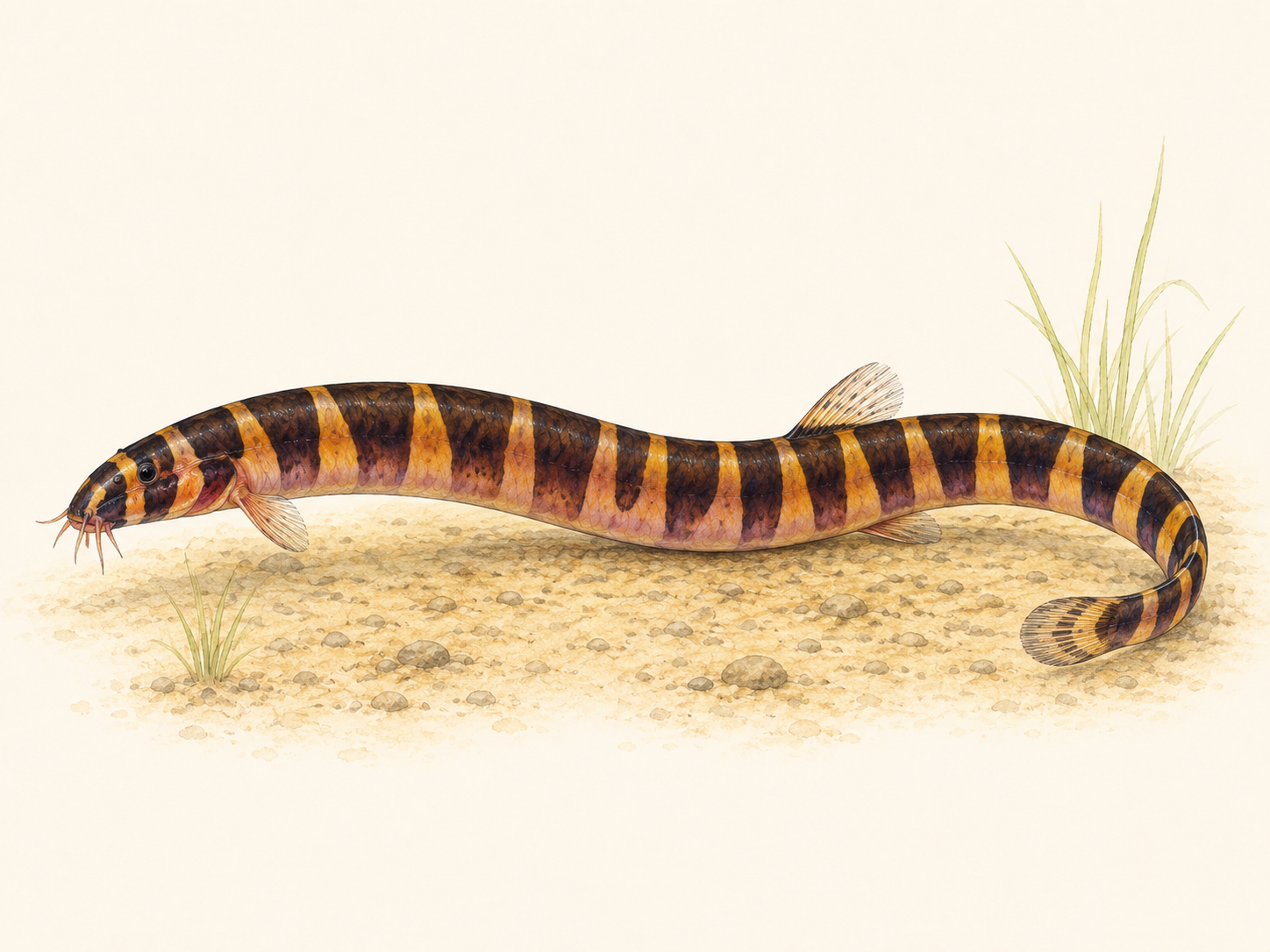
Pangio semicincta possesses the characteristic elongated, serpentine body shape shared by all members of the Pangio genus. The body is laterally compressed, smooth, and remarkably flexible, allowing the fish to navigate through the tightest crevices and burrow into soft substrates with ease. Adults typically reach between 8 and 10 centimetres in length, though they appear even more slender than this measurement might suggest due to their narrow body profile.
The base coloration of the Half Banded Kuhli Loach ranges from a warm salmon-pink to a rich yellowish-orange, with the ventral surface being noticeably paler. The most striking feature is the series of dark brown to black bands that encircle the upper portion of the body. Crucially, and as the common name implies, these bands typically do not extend fully around the belly, instead stopping partway down the flanks. This is the key distinguishing feature that separates Pangio semicincta from Pangio kuhlii, in which the bands generally extend further around or completely encircle the body. The bands themselves vary in width and spacing between individuals, and some may appear slightly irregular or fragmented, adding to each fish’s unique appearance.
The head is small and somewhat pointed, equipped with four pairs of delicate barbels around the mouth. These sensory organs are essential for locating food in dim light and amongst substrate particles. The eyes are relatively small and covered by a transparent skin, reflecting the species’ preference for low-light conditions. A small, erectile suborbital spine is present beneath each eye, which the fish can extend as a defensive mechanism — something to be aware of when netting these loaches, as the spines can become entangled in fine mesh.
The fins are small, rounded, and largely transparent, with the dorsal fin positioned far back along the body, closer to the caudal fin than in many other fish species. There is very little obvious sexual dimorphism, though mature females tend to be slightly plumper than males, particularly when carrying eggs, and their greenish ovaries may sometimes be visible through the translucent skin of the belly.
Natural Habitat
Pangio semicincta is found across a broad range in Southeast Asia, primarily in Peninsular Malaysia, Sumatra, and parts of Borneo. These loaches inhabit slow-moving lowland streams, forest brooks, and the shallow margins of rivers where the water flow is gentle. Their preferred habitats are characterised by dense overhead vegetation that creates deeply shaded conditions, with the water itself often stained a dark amber colour by tannins released from decomposing leaf litter and other organic material.
The substrates in these environments are typically composed of fine sand, mud, or a mixture of both, overlain with thick layers of fallen leaves, submerged roots, and decaying wood. This detritus-rich environment provides both food and shelter for the loaches, which spend much of the daylight hours hidden beneath leaf litter or burrowed into the soft substrate. The water in these habitats is generally very soft and acidic, with pH values often falling between 4.0 and 6.5, and minimal dissolved mineral content due to the ancient, nutrient-poor soils through which the waterways flow.
Understanding the natural habitat of Pangio semicincta is crucial for replicating appropriate conditions in the aquarium. The dim lighting, soft substrate, abundant hiding places, gentle water movement, and soft, acidic water chemistry of their wild environment should all inform the way we set up and maintain their captive home. Fish kept in conditions that closely mirror their natural habitat will display more natural behaviour, better colouration, and greater overall health.
Tank Size and Setup
A minimum tank size of 60 litres is recommended for a small group of Half Banded Kuhli Loaches, though larger aquariums of 80 litres or more are preferable, particularly if you plan to keep them in a community setting. While these are not large fish, they are active foragers during the evening and night hours and benefit from having ample floor space to explore. A longer, shallower tank is generally more suitable than a tall, narrow design, as these loaches are almost exclusively bottom-dwelling.
The substrate is arguably the single most important element of the aquarium setup for Kuhli Loaches. A fine, smooth sand substrate is strongly recommended, as it allows the fish to exhibit their natural burrowing behaviour without risk of injury to their delicate barbels or scaleless skin. Coarse or sharp-edged gravels should be avoided, as these can cause abrasions and potentially lead to bacterial infections. A layer of sand at least 3 to 5 centimetres deep will give the loaches sufficient depth to partially bury themselves, which is a behaviour commonly observed in settled, comfortable specimens.
Abundant hiding places are essential. Driftwood, smooth rocks, coconut shells, and purpose-made ceramic caves all make excellent refuges. Arranging these decorations to create a network of shaded nooks and crannies will encourage the loaches to feel secure and, paradoxically, will often result in them spending more time out in the open. Live plants are highly beneficial and help to create the dappled, low-light conditions these fish prefer. Species such as Java Fern, Anubias, Cryptocoryne, and Java Moss are all excellent choices, as they thrive in similar water conditions and do not require intense lighting. Floating plants can be used to further reduce light levels reaching the substrate.
A layer of dried Indian almond leaves or other suitable leaf litter scattered across the substrate will help to replicate the natural environment beautifully. As the leaves decompose, they release tannins that gently acidify the water and produce the amber-tinted conditions the loaches are accustomed to. The decomposing leaves also support colonies of microorganisms that serve as a supplementary food source. It is essential to ensure that the tank has a secure, tightly fitting lid. Kuhli Loaches are remarkably adept escape artists and will find even the smallest gap. Any openings around filter intakes, heater cables, or tubing should be sealed or covered to prevent the fish from climbing out or becoming trapped.
Water Parameters
Maintaining stable, appropriate water parameters is vital for the long-term health of Pangio semicincta. These fish originate from soft, acidic waterways and perform best when kept in conditions that reflect this. While they are reasonably adaptable and can tolerate a modest range of conditions, pushing them towards the extremes of their tolerance — particularly in terms of hardness and pH — can lead to stress and increased susceptibility to disease.
| Temperature | 22–28 °C |
| pH | 5.5–7.0 |
| General hardness (GH) | 1–8 dGH |
| Carbonate hardness (KH) | 0–5 dKH |
| Ammonia | 0 ppm |
| Nitrite | 0 ppm |
| Nitrate | Below 20 ppm |
As scaleless fish, Kuhli Loaches are particularly sensitive to poor water quality and dissolved toxins. Ammonia and nitrite must always be maintained at zero, and nitrate levels should be kept as low as practicable through regular partial water changes. A weekly water change of 20 to 25 per cent is generally sufficient for a well-stocked aquarium, though more frequent changes may be necessary in smaller tanks or those with heavier bioloads. When performing water changes, it is important to match the temperature and chemistry of the new water closely to that already in the tank, as sudden shifts can be stressful for these sensitive fish.
The use of a quality dechlorinator is non-negotiable, as chlorine and chloramine are harmful to all fish but especially so to scaleless species. If your local tap water is very hard or alkaline, you may need to consider using reverse osmosis water blended with a small amount of tap water or a suitable remineraliser to achieve the desired soft, slightly acidic conditions.
Filtration and Equipment
Filtration for a Kuhli Loach aquarium should prioritise gentle water flow and excellent biological capacity. These fish inhabit slow-moving waters in the wild and can become stressed by strong currents. A sponge filter is an excellent choice for smaller tanks, as it provides effective biological filtration without generating excessive flow and, critically, poses no risk of the loaches being sucked into the intake. For larger aquariums, a hang-on-back filter or a small canister filter with an adjustable flow rate works well, provided the intake is fitted with a fine sponge pre-filter guard to prevent the slender loaches from being drawn in or trapped.
Heating is essential unless you live in a consistently warm climate. A reliable, adjustable aquarium heater should be used to maintain a stable temperature within the recommended range. It is advisable to use a heater guard to prevent the loaches from resting directly against the heating element and sustaining burns, as they have a tendency to wedge themselves into any available crevice.
Lighting should be subdued. These are naturally crepuscular to nocturnal fish that become more active as light levels drop. Intense lighting will cause them to remain hidden for the majority of the time. Using floating plants or adjustable LED lighting set to a lower intensity will create a more comfortable environment and encourage the fish to emerge during viewing hours. A timer that provides a consistent photoperiod of around 8 to 10 hours is beneficial for both the fish and any live plants in the aquarium.
An air pump with a gentle airstone can be a useful addition, particularly in warmer months when dissolved oxygen levels may drop. However, this is not strictly necessary if the tank has adequate surface agitation from the filter output. Ensure that all equipment leads and tubing are properly secured where they enter or exit the tank, as Kuhli Loaches will exploit even the narrowest gaps to escape.
Diet and Feeding
Half Banded Kuhli Loaches are omnivorous scavengers with a diet that, in the wild, consists primarily of small invertebrates, insect larvae, worms, and organic detritus found in and around the substrate and leaf litter. In the aquarium, they are generally unfussy eaters that will accept a wide variety of foods, though some consideration should be given to their nocturnal feeding habits and bottom-dwelling lifestyle.
A high-quality sinking pellet or wafer should form the staple of their captive diet. Formulations designed for bottom feeders or loaches are ideal, as they sink quickly and soften on the substrate where the loaches can locate them using their sensitive barbels. These should be supplemented regularly with frozen or live foods such as bloodworm, daphnia, tubifex, and brine shrimp, all of which are eagerly consumed and provide valuable protein and variety. Frozen foods should be thawed before being added to the aquarium.
Because Kuhli Loaches tend to feed primarily during the evening and night, it can be beneficial to offer their main meal shortly after the lights are turned off. This ensures that the food reaches them before more assertive daytime-active tank mates have consumed everything. In a busy community tank, it is particularly important to monitor feeding to ensure the loaches are getting their fair share, as their shy and retiring nature can mean they miss out if food is offered only during peak daylight hours.
Blanched vegetables such as courgette, cucumber, and spinach can be offered occasionally as an additional source of nutrition and variety. These should be removed after a few hours if not fully consumed to prevent them from fouling the water. The decomposing leaf litter recommended in the tank setup also serves as a continuous source of biofilm and microorganisms that the loaches will graze upon between meals.
Behaviour and Temperament
Pangio semicincta is an exceptionally peaceful species that poses no threat whatsoever to other aquarium inhabitants. These loaches are gregarious by nature and should always be kept in groups of at least five or six individuals, though larger groups of ten or more are preferable. When kept singly or in very small numbers, Kuhli Loaches tend to be extremely reclusive, often hiding for days or weeks at a time and rarely being seen. In a sufficiently large group, however, they draw confidence from one another’s presence and become noticeably bolder, spending more time foraging in the open and displaying a wider range of natural behaviours.
One of the most endearing aspects of Kuhli Loach behaviour is their tendency to rest in piles. It is not uncommon to find an entire group wedged together in a favourite hiding spot, their bodies intertwined in a tangle of stripes and barbels. This communal resting behaviour appears to provide a sense of security and is a sign of well-settled, comfortable fish.
Activity levels increase markedly as light levels drop. During the daytime, the loaches will typically remain hidden or only partially visible, peeking out from beneath driftwood or between plant roots. As evening approaches and the tank lights dim, they become increasingly active, emerging to forage across the substrate, sifting sand through their gills, and investigating every corner of the aquarium. In well-established tanks with dim lighting and plenty of cover, some individuals may become active during the day as well, particularly around feeding times.
Burrowing is another characteristic behaviour. Given a suitably fine, soft substrate, Kuhli Loaches will frequently bury themselves either partially or completely, with only their heads or barbels visible above the surface. This can occasionally cause alarm among new keepers who believe their fish have vanished, but it is entirely normal and healthy behaviour. Their scaleless, mucus-coated skin is well-adapted to this lifestyle and helps protect them from abrasion.
Tank Mates
The peaceful, retiring nature of the Half Banded Kuhli Loach makes it an ideal community fish, provided its tank mates are chosen with care. The best companions are other small, gentle species that will not outcompete the loaches for food or harass them. Aggressive, territorial, or large predatory fish should be avoided entirely, as should species that are known to be particularly boisterous or nippy.
Good tank mates
- Harlequin Rasbora — A peaceful, similarly sized schooling fish from the same geographic region that thrives in identical water conditions.
- Celestial Pearl Danio — A gentle, diminutive species that occupies the mid-water column and poses no competitive threat to bottom-dwelling loaches.
- Ember Tetra — A small, calm tetra that appreciates soft, acidic water and subdued lighting, making it a natural companion.
- Cherry Barb — A peaceful barb that is far too small and gentle to trouble Kuhli Loaches and adds welcome colour to the mid-water zone.
- Pygmy Corydoras — Another small, peaceful bottom dweller that shares similar habitat preferences without competing aggressively for food or space.
- Otocinclus — A gentle algae-eating catfish that stays small and occupies a slightly different feeding niche, making cohabitation straightforward.
- Honey Gourami — One of the most placid gourami species, unlikely to bother bottom-dwelling loaches and well-suited to soft, warm water.
- Amano Shrimp — Hardy, large enough to avoid predation, and an excellent clean-up crew member that coexists peacefully with Kuhli Loaches.
- Nerite Snail — A useful algae eater that is entirely ignored by Kuhli Loaches and contributes to tank cleanliness.
- Sparkling Gourami — A tiny, peaceful labyrinth fish that enjoys similar water conditions and occupies the upper water column.
Fish to avoid
- Oscar — A large, predatory cichlid that would readily consume Kuhli Loaches and requires vastly different water conditions.
- Convict Cichlid — An aggressive, territorial species, particularly during breeding, that would bully and stress peaceful loaches.
- Tiger Barb — A notoriously nippy species that may harass slow-moving, docile loaches, especially in insufficient numbers.
- Red-Tailed Catfish — A massive predatory catfish that would easily swallow Kuhli Loaches whole.
- Green Terror — A highly aggressive cichlid that is completely incompatible with small, peaceful bottom dwellers.
- Common Pleco — While not aggressive, it grows far too large for the tank sizes suited to Kuhli Loaches and produces excessive waste.
- African Cichlids — Require hard, alkaline water that is the polar opposite of what Kuhli Loaches need, and many species are highly territorial.
- Chinese Algae Eater — Becomes increasingly aggressive and territorial with age and has been known to latch onto the sides of other fish.
Breeding
Breeding Pangio semicincta in captivity is considered difficult and occurs only infrequently, often unexpectedly rather than as the result of deliberate effort. While it is not impossible, success typically requires a combination of optimal water conditions, a well-established group of mature fish, and a measure of good fortune.
Sexing adult Kuhli Loaches is challenging. The most reliable indicator is body shape, with gravid females appearing noticeably rounder and plumper than males, particularly when viewed from above. In some females, the developing eggs may be visible as a greenish mass through the translucent skin of the abdomen. Males tend to be slightly slimmer and may have marginally more developed pectoral fins, though these differences are subtle and not always easy to discern.
In the wild, spawning is thought to be triggered by seasonal changes in water chemistry and temperature, associated with the onset of the rainy season. To encourage breeding in the aquarium, some keepers have had success simulating these conditions by gradually lowering the water level and then performing a large water change with slightly cooler, softer water, mimicking the influx of fresh rainwater. Maintaining pristine water quality, a varied diet rich in live and frozen foods, and a dimly lit, heavily planted tank with abundant hiding spots all appear to increase the likelihood of spawning.
When spawning does occur, the female typically releases adhesive green eggs amongst floating plants, plant roots, or fine-leaved vegetation near the surface. The adults show no parental care and will consume the eggs if given the opportunity, so prompt removal of either the eggs or the adults is necessary to achieve any survival of fry. The eggs are small and hatch within approximately 24 to 48 hours, depending on temperature. The resulting fry are tiny and require infusoria or other microscopic foods for the first few days before graduating to newly hatched brine shrimp nauplii and finely crushed dry foods. Raising the fry successfully demands meticulous attention to water quality and feeding, and losses are common even under the best of circumstances.
Common Diseases
Half Banded Kuhli Loaches are generally hardy fish when kept in appropriate conditions, but their lack of scales makes them more vulnerable to certain diseases and more sensitive to medications than fully scaled species. Prevention through good husbandry is always preferable to treatment.
Ich, or white spot disease, is one of the more common ailments that may affect Kuhli Loaches, typically manifesting as small white cysts scattered across the body and fins. Scaleless fish are particularly susceptible to this parasite, and treatment requires extra caution. Many commercial ich remedies contain ingredients such as malachite green or formalin at concentrations that can be harmful or even lethal to scaleless species. When treating Kuhli Loaches for ich, it is generally advisable to use medications at half the standard dose and to raise the water temperature gradually to around 28–30 °C, which accelerates the parasite’s life cycle and can help clear the infection more quickly. Salt-based treatments should be used with extreme caution, as Kuhli Loaches have a very low tolerance for elevated salinity.
Bacterial infections can occur, particularly if the fish sustain injuries from rough substrates, sharp decorations, or aggressive tank mates. Symptoms may include redness, ulceration, or fraying of the fins and skin. Maintaining a clean, well-maintained aquarium with a smooth, soft substrate is the best preventative measure. If treatment is required, antibacterial medications should be used conservatively and at reduced dosages where possible.
Skinny disease, characterised by a progressive loss of body condition despite the fish continuing to eat, can occasionally affect Kuhli Loaches. This is often associated with internal parasites, particularly in wild-caught specimens. Treatment with a suitable anti-parasitic medication, dosed carefully for scaleless fish, is usually effective if the condition is caught early. Quarantining new arrivals for a minimum of two to four weeks before introducing them to an established tank is a sensible precaution that can help prevent the introduction of both parasites and diseases.
Stress-related conditions are also a concern. Kuhli Loaches kept in inadequate numbers, under bright lighting, in tanks lacking sufficient hiding places, or with aggressive tank mates may exhibit chronic stress, which suppresses the immune system and leaves them vulnerable to opportunistic infections. Addressing the underlying environmental or social causes of stress is essential for any treatment to be effective in the long term.
FAQs
How many Kuhli Loaches should I keep together?
Kuhli Loaches are highly social fish that should be kept in groups of at least five or six, though groups of ten or more are ideal. When kept in very small numbers or singly, they tend to become extremely shy and reclusive, rarely emerging from their hiding spots. A larger group provides a greater sense of security, and you will be rewarded with bolder, more active fish that spend far more time out in the open engaging in their natural behaviours.
Are Half Banded Kuhli Loaches the same as regular Kuhli Loaches?
The fish most commonly sold as “Kuhli Loach” in the aquarium trade is actually Pangio semicincta, the Half Banded Kuhli Loach, rather than the true Pangio kuhlii. The two species are closely related and have very similar care requirements, but they can be distinguished by their banding patterns. In Pangio semicincta, the dark bands typically do not extend fully around the belly, stopping partway down the flanks, whereas in Pangio kuhlii the bands tend to encircle the body more completely. For practical purposes, the care advice for both species is essentially identical.
Why do my Kuhli Loaches keep disappearing?
This is an extremely common concern among new Kuhli Loach keepers. These fish are expert hiders and can conceal themselves remarkably well by burrowing into the substrate, wedging themselves into the tiniest crevices in driftwood or rockwork, or hiding behind equipment. If your loaches have recently been introduced to the tank, they may remain hidden for days or even weeks while they acclimatise. Keeping them in larger groups, providing subdued lighting, and feeding after the lights go off will all help encourage them to emerge more frequently. Ensure your tank has a secure lid, as they are also capable of escaping through surprisingly small openings.
Can Kuhli Loaches live with shrimp?
Kuhli Loaches are generally safe to keep with adult shrimp of medium to large species such as Amano Shrimp and adult Cherry Shrimp. However, they may opportunistically consume very small shrimplets if they happen to encounter them while foraging. If you are attempting to breed dwarf shrimp in the same tank, there is a reasonable chance that some juvenile shrimp will be lost to predation. For a dedicated shrimp breeding setup, it is best to keep the loaches in a separate aquarium.
Do Kuhli Loaches eat snails?
Kuhli Loaches are not effective snail predators. While they may occasionally consume a very small snail or snail egg if they stumble upon one, they lack the crushing jaw structure necessary to tackle anything beyond the tiniest specimens. If you are looking for a fish to control a snail population, other species such as certain loach species in the genus Botia or assassin snails would be far more effective. Kuhli Loaches can be kept safely alongside most ornamental snail species without any concern for predation.
Related Guides
- Kuhli Loach (Pangio kuhlii) Care Guide — A closely related species often confused with Pangio semicincta, with nearly identical care requirements.
- Java Loach (Pangio oblonga) Care Guide — Another Pangio species with a similar body shape but lacking the distinctive banding pattern, offering an alternative for loach enthusiasts.
- Pygmy Corydoras Care Guide — A small, peaceful bottom dweller that makes an excellent companion species and shares similar tank requirements.
- Harlequin Rasbora Care Guide — A classic community fish from the same geographic region that pairs beautifully with Kuhli Loaches in a Southeast Asian biotope setup.
- How to Set Up a Blackwater Aquarium — A comprehensive guide to creating the tannin-rich, softwater environment in which Kuhli Loaches naturally thrive.