
Quick summary
Yes, the Bronze/Albino Corydoras is an excellent choice for beginners, being hardy, peaceful, and easy to breed, though it needs a group of six or more, fine sand substrate to protect its barbels, and clean, low-nitrate water to thrive. At a minimum tank size of 75 litres and with simple omnivorous feeding needs, it’s a low-maintenance, forgiving fish as long as basic water quality and shoaling requirements are met.
🐠 Build a tank around this species
In this guide:
- Introduction
- Quick Stats
- Appearance
- Varieties and Morphs
- Natural Habitat
- Tank Size and Setup
- Water Parameters
- Filtration and Equipment
- Diet and Feeding
- Behaviour and Temperament
- Tank Mates
- Breeding
- Common Diseases
- FAQs
Introduction
The Bronze Corydoras is one of the most recognisable and widely kept freshwater catfish in the aquarium hobby. First described by Theodore Gill in 1858, Corydoras aeneus has earned its place as a staple community fish thanks to its peaceful disposition, hardy constitution, and endearing bottom-dwelling behaviour. Often seen shuffling across the substrate in small groups, these charming catfish have been delighting fishkeepers for well over a century and remain one of the most frequently recommended species for beginners and experienced aquarists alike.
Native to a vast range across South America, the Bronze Corydoras is remarkably adaptable. It thrives in a variety of water conditions and readily accepts most commercially available foods. Its tendency to sift through the substrate in search of morsels has led to an enduring but somewhat misleading reputation as a “clean-up crew” fish. While it is true that corydoras will consume uneaten food that settles on the bottom of the tank, they should never be relied upon as a substitute for proper tank maintenance, and they require a dedicated feeding regimen of their own.
Beyond their practical utility, Bronze Corydoras are genuinely fascinating fish to observe. They are highly social, communicating with one another through subtle body language and even producing audible sounds by locking and rotating their pectoral fin spines, a behaviour thought to serve as a distress signal. Their ability to gulp atmospheric air at the water’s surface, using a modified section of the intestine to absorb oxygen, is another remarkable adaptation that allows them to survive in oxygen-poor waters. This comprehensive guide covers everything you need to know to keep these wonderful catfish healthy and thriving in your aquarium.
Quick Stats
| Scientific name | Corydoras aeneus |
|---|---|
| Common names | Bronze Catfish, Green Corydoras, Lightspot Corydoras, Wavy Catfish, Albino Corydoras, Gold Stripe Corydoras, Gold Laser Corydoras |
| Family | Callichthyidae |
| Origin | South America, from Trinidad to Argentina |
| Adult size | 6.5 cm |
| Lifespan | 5–10 years |
| Difficulty | Easy |
| Breeding difficulty | Easy |
| Temperature | 22–27 °C |
| pH | 6–8 |
| GH | 2–15 dGH |
| KH | 1–10 dKH |
| Minimum tank size | 75 L |
| Conservation status | Least Concern (IUCN, assessed 2018) |
Appearance
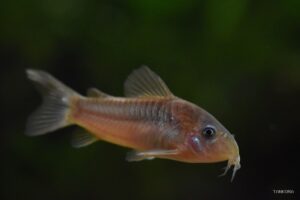
The Bronze Corydoras is a compact, heavily armoured little catfish with a distinctly rounded body profile. Rather than possessing traditional scales, its flanks are covered by two rows of overlapping bony plates known as scutes, which give it a slightly rigid, armoured appearance. The head is broad and slightly flattened, tapering to a blunt snout equipped with two pairs of sensitive barbels that the fish uses to probe the substrate for food.
The wild-type colouration that gives this species its common name is a warm, iridescent bronze or olive-green hue across the upper body and flanks. This metallic sheen can shift between green, gold, and copper depending on the angle of the light. The belly is typically pale cream or pinkish-white. A broad, darker band often runs along the lateral line from behind the gill cover to the base of the tail, though this can vary in intensity between individuals and populations. The fins are generally translucent with a slight yellowish or orange tinge.
Like all corydoras, the Bronze Corydoras possesses a sharp, lockable spine at the leading edge of both the dorsal and pectoral fins. These spines serve as a defensive mechanism and can easily become entangled in fine mesh nets, so aquarists should use rigid containers rather than nets when moving these fish. Sexual dimorphism is moderately apparent in mature specimens: females tend to be noticeably larger and broader when viewed from above, particularly when full of eggs, while males are generally slimmer and slightly smaller.
Varieties and Morphs
The Bronze Corydoras is one of the most extensively bred corydoras species, and decades of selective captive breeding have produced several widely recognised colour morphs. These variants are genetically the same species and require identical care, but they differ significantly in appearance.
The Albino Corydoras is by far the most common morph, featuring a pale pinkish-white body with red or pink eyes. It is sold in virtually every aquarium shop and is just as hardy as the wild-type form. The Gold Stripe Corydoras, sometimes marketed as the Gold Laser Corydoras, displays a vivid golden-yellow body with a prominent metallic stripe running along its flank. It is an attractive variant that commands a modestly higher price.
The Green Corydoras refers to wild-type specimens that exhibit a particularly strong green iridescence, sometimes sold under a distinct trade name despite being the natural form of the species. The Peru Green Stripe variant is collected from Peruvian waterways and tends to show an especially vivid emerald sheen. The Long-Fin Bronze Corydoras is a selectively bred variety with notably elongated dorsal, pectoral, and caudal fins, giving it an elegant, flowing appearance. This morph is available in both the standard bronze and albino colour forms.
The Red or Orange Venezuela Corydoras is a geographic variant, sometimes considered a separate subspecies or population, that displays a striking orange-red colouration across much of its body. It is highly sought after and typically more expensive. The Black Venezuela variant from the same region shows a much darker, almost melanistic colouration, with a deep chocolate-brown to near-black body. Both Venezuelan forms are occasionally assigned to Corydoras venezuelanus, though their taxonomic status remains debated.
Natural Habitat
Corydoras aeneus is found across an exceptionally broad range in South America, inhabiting river systems from Trinidad and Tobago in the north through Venezuela, Colombia, and the Guianas, south through Peru, Bolivia, Brazil, Paraguay, and into northern Argentina. This vast distribution encompasses a wide variety of habitats, which partly explains the species’ remarkable adaptability in captivity.
In the wild, Bronze Corydoras typically inhabit slow-moving, shallow waters such as tributary streams, small rivers, floodplain pools, and marshy areas. They show a strong preference for soft, sandy substrates where they can forage freely using their sensitive barbels. The waters they occupy are often shaded by overhanging riparian vegetation and cluttered with leaf litter, submerged roots, and fallen branches, which provide shelter from predators and create a complex microhabitat rich in invertebrate prey.
Water conditions across their range vary considerably, from soft, slightly acidic blackwater streams to harder, more neutral waterways. During the rainy season, Bronze Corydoras may move into temporarily flooded grasslands and forest margins to feed and breed. This seasonal flooding often coincides with their reproductive cycle, and the influx of cool, soft rainwater is a well-known trigger for spawning behaviour, a phenomenon that aquarists can replicate in captivity to encourage breeding.
Tank Size and Setup
A group of six Bronze Corydoras can be comfortably housed in an aquarium of at least 75 litres, though a larger tank of 100 litres or more is always preferable, particularly if they are being kept as part of a mixed community. Because corydoras are obligate social fish that should be maintained in groups of six or more, the footprint of the tank is more important than its height. A long, shallow aquarium provides more bottom surface area for foraging than a tall, narrow design.
Substrate choice is one of the most critical aspects of setting up a tank for corydoras. These fish spend the vast majority of their time in direct contact with the substrate, actively pushing their barbels and snouts into it to search for food. Coarse, sharp-edged gravel can damage their delicate barbels, leading to erosion, infection, and a significant reduction in the fish’s quality of life. Fine, smooth sand is the ideal substrate and allows the fish to exhibit their full range of natural foraging behaviours. If sand is not an option, a very fine, rounded gravel can serve as an acceptable alternative.
The aquarium should include plenty of shaded resting spots. Driftwood, smooth rocks, and dense plantings of species such as Java Fern, Anubias, and Vallisneria create a sense of security and mimic the cluttered environments these fish occupy in nature. Floating plants are an excellent addition, as they diffuse overhead lighting and reduce stress. Dried leaf litter, such as Indian almond leaves, can also be scattered across the substrate to replicate the leaf-strewn stream beds of their natural habitat, with the added benefit of releasing beneficial tannins into the water.
It is important to leave open areas of substrate free from decoration so the corydoras have ample space to forage and interact with one another. A well-designed tank balances sheltered zones with clear foraging ground, allowing the fish to move freely between the two.
Water Parameters
The Bronze Corydoras is one of the most tolerant freshwater fish when it comes to water chemistry, accepting a broad range of pH and hardness values. That said, maintaining stable, clean water conditions is far more important than hitting any specific number. Sudden fluctuations in temperature or chemistry are far more damaging to these fish than a reading that sits slightly outside the textbook ideal.
| Temperature | 22–27 °C |
| pH | 6.0–8.0 |
| General hardness (GH) | 2–15 dGH |
| Carbonate hardness (KH) | 1–10 dKH |
| Ammonia | 0 ppm |
| Nitrite | 0 ppm |
| Nitrate | Below 20 ppm |
Corydoras are particularly sensitive to elevated nitrate levels and poor substrate hygiene. Because they spend their lives in direct contact with the bottom of the tank, they are among the first fish to be affected by a build-up of organic waste. Regular partial water changes of 20–30% per week are essential, and the substrate should be gently vacuumed during these changes to prevent detritus from accumulating in the sand. Keeping nitrate levels consistently below 20 ppm will go a long way towards maintaining the health of these fish.
Filtration and Equipment
A reliable filter with a gentle to moderate flow rate is ideal for a Bronze Corydoras tank. These fish come from slow-moving waters and do not appreciate strong currents, particularly along the bottom of the aquarium where they spend most of their time. An internal filter, a hang-on-back filter with an adjustable flow outlet, or a canister filter with a spray bar positioned to disperse the flow are all suitable choices. Sponge filters are another excellent option, especially in breeding tanks, as they provide gentle biological filtration without any risk of trapping fry.
Although Bronze Corydoras can gulp atmospheric air to supplement their oxygen intake, this behaviour should not be a constant occurrence. If the fish are frequently dashing to the surface to breathe, it may indicate insufficient oxygenation in the water. An air stone or a filter outlet positioned to create gentle surface agitation will help maintain healthy dissolved oxygen levels. Occasional trips to the surface are perfectly normal and should not cause concern, but persistent, frantic gulping warrants investigation.
A heater is generally recommended to maintain a stable temperature within the preferred range, although this species can tolerate room temperature in warmer climates. A standard aquarium thermometer should be used to monitor conditions. Lighting should be moderate to subdued; overly bright illumination can cause stress, particularly if the tank lacks floating plants or other shade-providing features. A timer-controlled lighting schedule of 8–10 hours per day replicates a natural photoperiod and benefits both the fish and any live plants in the setup.
Diet and Feeding
Bronze Corydoras are omnivorous and remarkably unfussy eaters, which is part of what makes them so straightforward to keep. In the wild, they feed primarily on insect larvae, worms, small crustaceans, and organic detritus that they sift from the substrate. In captivity, their diet should reflect this varied natural intake.
A high-quality sinking pellet or wafer designed for bottom-dwelling fish should form the foundation of their diet. These foods are formulated to sink quickly and hold together on the substrate long enough for the corydoras to find and consume them. It is a common mistake to assume that corydoras will subsist happily on whatever food falls past the mid-water fish, in a busy community tank, very little may actually reach the bottom, and the corydoras can quietly go hungry.
Supplement the staple diet with regular offerings of frozen or live foods such as bloodworm, daphnia, brine shrimp, and tubifex worms. These protein-rich treats are especially valuable for conditioning fish for breeding. Blanched vegetables such as courgette, cucumber, or shelled peas can also be offered occasionally and are usually accepted with enthusiasm. Variety is the key to good nutrition, and rotating between several food types will ensure the fish receive a broad spectrum of nutrients.
Feed once or twice daily, offering only as much food as the fish can consume within a few minutes. It is often helpful to feed corydoras in the evening or just after lights-out, as they tend to be most active during the twilight hours. Overfeeding should be avoided, as uneaten food quickly fouls the substrate and degrades water quality, precisely the conditions that corydoras are most vulnerable to.
Behaviour and Temperament
The Bronze Corydoras is an exceptionally peaceful, sociable fish that poses no threat to any tank mate. It is entirely non-territorial and non-aggressive, spending its days methodically working its way across the substrate in the company of its shoal mates. Groups of corydoras frequently move together in loose formation, pausing intermittently to probe the sand with their barbels before shuffling onwards. This synchronised foraging behaviour is one of the most appealing aspects of keeping these fish.
Corydoras are gregarious by nature and should always be kept in groups of at least six individuals. Solitary specimens or pairs tend to be noticeably more timid and stressed, spending excessive amounts of time hiding and failing to display their natural repertoire of behaviours. In a suitably sized group, they become bold, active, and endlessly entertaining. They will often rest together in a favourite spot during the quieter parts of the day, sometimes piling on top of one another in comical heaps.
The occasional rapid dash to the surface to gulp a mouthful of air is perfectly normal behaviour and not a cause for alarm, provided it happens only intermittently. Corydoras are also known to produce audible clicking or squeaking sounds by rotating their pectoral fin spines, most commonly when they are startled or handled. This sound production is thought to function as a warning signal to other group members.
Bronze Corydoras are primarily crepuscular, meaning they are most active during dawn and dusk. In a well-established aquarium with subdued lighting and plenty of cover, however, they will often be active throughout the day. They tend to become more reclusive under harsh overhead lighting or in tanks that lack sufficient hiding places.
Tank Mates
The Bronze Corydoras is one of the most compatible community fish available. Its peaceful temperament, bottom-dwelling habits, and manageable size make it an excellent companion for a wide range of similarly tempered species. The best tank mates are those that occupy different levels of the water column and share comparable requirements for temperature and water chemistry.
Good tank mates
- Neon Tetra, a classic mid-water schooling fish that occupies a completely different zone of the tank and shares a preference for soft, slightly acidic water.
- Cardinal Tetra, another small, peaceful tetra that adds vibrant colour to the mid-water level without competing with corydoras for food or space.
- Harlequin Rasbora, a gentle, easy-going rasbora that thrives in the same temperature range and makes an ideal upper-level companion.
- Cherry Barb, a peaceful barb species that stays small and does not bother bottom-dwelling fish.
- Honey Gourami, a calm, slow-moving surface dweller that complements corydoras perfectly in a quiet community setup.
- Otocinclus Catfish, a small, algae-eating catfish that shares the same peaceful disposition and tolerance for similar water conditions.
- Kuhli Loach, another gentle bottom-dweller that coexists well with corydoras, provided the tank offers sufficient floor space for both species.
- Bristlenose Pleco, a manageable pleco species that peacefully shares the lower levels of the tank and helps keep surfaces clean.
- Ember Tetra, a tiny, vibrant tetra that is far too small and docile to pose any threat to corydoras.
- Endler’s Livebearer, an active, colourful surface-dwelling fish that completely ignores bottom-dwelling species.
Fish to avoid
- Oscar, a large, predatory cichlid that will readily consume small catfish as it grows.
- Jack Dempsey Cichlid, an aggressive, territorial species that can injure or kill corydoras with ease.
- Green Terror, a highly aggressive cichlid that will dominate the bottom of the tank and attack small tank mates.
- Common Pleco, while not aggressive, it grows far too large for most community tanks and produces excessive waste that degrades water quality.
- Red-Tail Catfish, an enormous predatory catfish that will swallow corydoras whole.
- Tiger Barb, a nippy, boisterous barb that can harass slower-moving bottom-dwellers, particularly in small groups.
- African Cichlids (Mbuna), these territorial, hard-water cichlids are incompatible in both temperament and water chemistry requirements.
- Flowerhorn Cichlid, an extremely aggressive, large cichlid that should be kept alone or with equally robust species.
Breeding
The Bronze Corydoras is one of the easiest egg-laying fish to breed in captivity, and many aquarists have successfully raised fry even without specifically intending to. Spawning can occur in the main display tank, but a dedicated breeding setup gives significantly better results and dramatically improves fry survival rates.
To condition a breeding group, select two or three males for every female and feed them generously on protein-rich live and frozen foods such as bloodworm, daphnia, and brine shrimp for two to three weeks. Females will visibly plump up as they develop eggs. The classic trigger for spawning involves performing a large water change of 50% or more with water that is slightly cooler, around 2–3 °C below the tank temperature, and softer than usual. This simulates the influx of cool rainwater that initiates breeding in the wild during the rainy season. Dropping the barometric pressure by performing the water change during stormy weather is anecdotally reported to further enhance the trigger, though this is difficult to control deliberately.
Spawning typically commences within hours of the water change, often during the evening or early morning. The courtship ritual is distinctive and fascinating to watch. Males will pursue females energetically, nudging their flanks and swimming alongside them. When a female is ready to deposit eggs, she adopts the characteristic “T-position,” pressing her mouth against the male’s genital region. It was historically believed that sperm was ingested and passed through the female’s gut to fertilise the eggs, though more recent research suggests sperm is directed along the female’s body via water currents. The female cups a small clutch of one to four large, adhesive eggs between her pelvic fins, then swims to a chosen surface, typically a broad leaf, the aquarium glass, or a piece of décor, and firmly presses the eggs onto it. This process repeats many times over several hours, with the female depositing anywhere from 100 to 300 eggs in total.
Once spawning is complete, the adults should ideally be removed or the eggs should be carefully transferred to a separate rearing tank, as corydoras will readily eat their own eggs if given the opportunity. The eggs are surprisingly firm and can be gently rolled off surfaces with a finger or a credit card. Place them in a small, gently aerated container with water from the spawning tank. Adding a few drops of methylene blue or a piece of Indian almond leaf helps prevent fungal growth on unfertilised eggs.
Eggs typically hatch within three to five days at 24–25 °C. The newly emerged fry are tiny but relatively robust, absorbing their yolk sacs over the first day or two. Once free-swimming, they can be fed on infusoria, commercially available liquid fry food, or very finely crushed flake. Within a week, they are usually large enough to accept microworms and freshly hatched baby brine shrimp, which are excellent first foods for promoting rapid, healthy growth. Frequent small water changes in the rearing tank are essential to maintain water quality as the fry grow.
Common Diseases
Bronze Corydoras are generally hardy fish, but they are susceptible to a number of conditions, particularly when water quality is allowed to deteriorate. Their intimate contact with the substrate means that poor bottom hygiene affects them disproportionately compared to mid-water and surface-dwelling species.
Barbel erosion is one of the most frequently encountered problems. When corydoras are kept on sharp or dirty substrates, their sensitive barbels can become worn down, damaged, or infected. In severe cases, the barbels may erode completely, severely impacting the fish’s ability to forage. Prevention is straightforward: use fine, smooth sand and maintain clean substrate conditions through regular vacuuming during water changes.
White spot disease, also known as ich (caused by the parasite Ichthyophthirius multifiliis), can affect corydoras just as it does other freshwater fish. It presents as small white cysts scattered across the body and fins. Treatment should be approached with care, as corydoras are scaleless fish and can be more sensitive to certain medications. It is generally advisable to use half the recommended dose of copper-based treatments, or to opt for heat treatment (gradually raising the temperature to 30 °C over 48 hours) combined with increased aeration and salt-free remedies.
Bacterial infections, including fin rot and red blotch disease, can occur when fish are stressed by poor water quality, overcrowding, or recent transport. Symptoms include reddened patches on the belly, frayed fins, and lethargy. These infections typically respond well to broad-spectrum antibacterial treatments, provided they are caught early and the underlying cause is addressed.
Internal parasites can occasionally affect corydoras, particularly wild-caught specimens. Signs include weight loss despite a healthy appetite, white stringy faeces, and a sunken belly. Anti-parasitic foods or dedicated internal parasite treatments are effective when used as directed. Quarantining new arrivals for two to four weeks before introducing them to an established tank is the best way to prevent the inadvertent introduction of parasites and other pathogens.
FAQs
How many Bronze Corydoras should I keep together?
A minimum group of six is recommended, though larger groups of eight to twelve or more are even better. Corydoras are highly social fish that rely on the safety and comfort of their shoal. Keeping them in insufficient numbers leads to stress, timidity, and a marked reduction in natural behaviour. In a suitably sized group, they are far more active, confident, and enjoyable to watch.
Can Bronze Corydoras live with a Betta?
Bronze Corydoras and Bettas can often be housed together successfully, provided the tank is large enough, ideally 75 litres or more, and offers adequate hiding places. Corydoras occupy the bottom of the tank and largely stay out of a Betta’s way. However, success depends heavily on the individual Betta’s temperament. Exceptionally aggressive Bettas may harass bottom-dwelling fish, so observe the pairing closely during the first few days and have a contingency plan in place.
Why do my corydoras keep swimming to the surface?
Occasional trips to the surface to gulp atmospheric air are entirely normal for corydoras and are part of their natural physiology. They possess a modified section of the intestine that can absorb oxygen directly from swallowed air. However, if this behaviour becomes constant or frantic, it may indicate low dissolved oxygen levels in the water, elevated ammonia or nitrite, or generally poor water quality. Test your water parameters and ensure the tank has adequate aeration and filtration.
Do Bronze Corydoras need sand substrate?
While Bronze Corydoras can technically survive on gravel, fine, smooth sand is strongly recommended. Sand allows them to exhibit their full range of natural foraging behaviour, sifting mouthfuls of substrate through their gills to extract food particles. Sharp or coarse gravel can damage their delicate barbels over time, leading to erosion and secondary infections. If you must use gravel, choose a very fine, rounded variety and keep it impeccably clean.
Are albino corydoras the same species as Bronze Corydoras?
Yes, the commonly sold Albino Corydoras is simply a colour morph of Corydoras aeneus. It lacks the pigmentation of the wild-type form, resulting in a pale pinkish-white body with red or pink eyes, but it is genetically the same species. Albino specimens require identical care and can be kept alongside standard bronze individuals without any issues. They share the same lifespan, dietary requirements, and behavioural traits.
Related Guides
- Panda Corydoras Care Guide, a popular related species with striking black-and-white markings and similar care requirements.
- Sterbai Corydoras Care Guide, a beautifully patterned corydoras species that thrives in slightly warmer water, making it ideal for discus community tanks.
- Pygmy Corydoras Care Guide, a miniature corydoras species suited to smaller tanks and nano setups.
- Julii Corydoras Care Guide, a commonly available spotted corydoras often confused with the similar-looking Corydoras trilineatus.
- Best Substrate for Corydoras, a detailed guide to choosing the ideal substrate for bottom-dwelling catfish.
- Community Tank Setup Guide, Essential advice for building a balanced, peaceful freshwater community aquarium.
