Quick summary
The YoYo Loach is a lively, snail-eating bottom dweller best suited to keepers who can provide a 200+ litre tank, stable water quality, and a group of at least five, so it’s not ideal for beginners with smaller setups or single-fish plans. It gets on well with robust community fish but will eat dwarf shrimp and ornamental snails, and breeding it at home is not realistic.
🐠 Build a tank around this species
In this guide:
- Introduction
- Quick Stats
- Appearance
- Natural Habitat
- Tank Size and Setup
- Water Parameters
- Filtration and Equipment
- Diet and Feeding
- Behaviour and Temperament
- Tank Mates
- Breeding
- Common Diseases
- FAQs
Introduction
The YoYo Loach is one of the most engaging and characterful freshwater fish available to hobbyists, combining attractive patterning with a lively, inquisitive personality that makes it a firm favourite among community aquarium keepers. First described by the zoologist J. E. Gray in 1831 under the name Botia almorhae, this species has since undergone some taxonomic shuffling and is sometimes listed as Botia lohachata in older references, though modern consensus places it firmly within the genus Botia. The common name “YoYo Loach” was reportedly coined because the bold dark markings on juvenile specimens can appear to spell out the letters Y-O-Y-O along the flanks, a quirky observation that has stuck in the hobby ever since.
Native to the clear, oxygen-rich rivers and streams of the Indian subcontinent, the YoYo Loach brings a slice of Himalayan foothill ecology into the home aquarium. It is a bottom-dwelling species that spends much of its time foraging amongst rocks and driftwood, occasionally darting to the surface or resting in tight crevices. Unlike some loach species that remain permanently hidden, YoYo Loaches are frequently visible during daylight hours, particularly when kept in a group, which encourages bolder behaviour. Their propensity for hunting pest snails also makes them a practical addition to planted aquaria plagued by unwanted mollusc populations.
Despite their appealing nature, YoYo Loaches are not a beginner’s throwaway purchase. They grow to a respectable size, require stable water conditions, and have specific social needs that must be met for them to thrive. This guide covers everything you need to know to keep Botia almorhae successfully, from tank setup and feeding to breeding and disease prevention.
Quick Stats
| Scientific name | Botia almorhae |
|---|---|
| Common names | Almora Loach, Pakistani Loach, Reticulated Loach |
| Family | Botiidae |
| Origin | India, Nepal, Pakistan (Ganges river basin) |
| Adult size | 13.5 cm |
| Lifespan | 8–15 years |
| Difficulty | Intermediate |
| Breeding difficulty | Advanced |
| Temperature | 24–28 °C |
| pH | 6–7.5 |
| GH | 3–12 dGH |
| KH | 2–8 dKH |
| Minimum tank size | 250 L |
| Conservation status | Least Concern (IUCN) |
Appearance
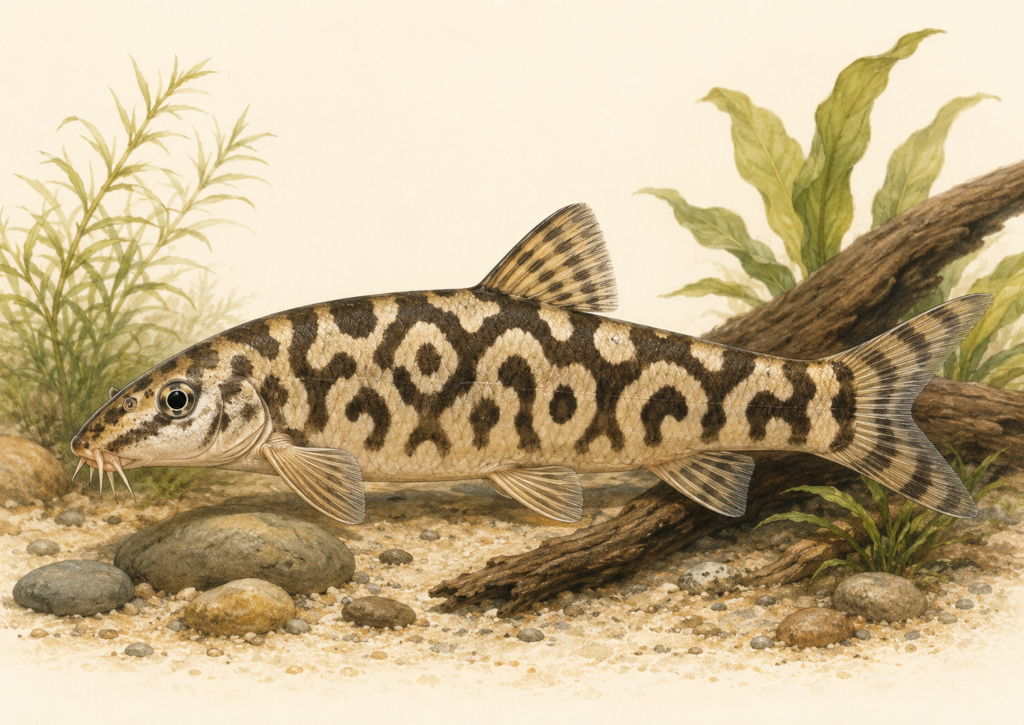
The YoYo Loach possesses a streamlined, laterally compressed body typical of the Botia genus, with a slightly arched dorsal profile and a flat ventral surface suited to its bottom-dwelling lifestyle. The head is blunt and rounded, featuring four pairs of barbels around the mouth that the fish uses constantly to probe the substrate for food. Like all botiid loaches, Botia almorhae has a sharp, bifid suborbital spine concealed beneath each eye, which can be erected when the fish is stressed or handled. Aquarists should be aware of this spine, as it can snag in nets and cause injury to both the fish and the keeper.
The base body colour is a silvery to pale gold, overlaid with an intricate network of dark brown to black markings. In juveniles, these markings tend to form relatively distinct vertical bands and blotches that create the famous “Y-O-Y-O” appearance. As the fish matures, the pattern becomes increasingly reticulated, with the dark markings branching and merging into a complex chain-link or maze-like design. The intensity of patterning can vary considerably between individuals, and the contrast often deepens or fades depending on mood, health, and environmental conditions. Stressed or ill specimens typically appear washed out, whereas confident, well-kept individuals display bold, high-contrast markings.
The fins are generally translucent with faint banding or spotting, and the caudal fin is forked. Males and females are difficult to distinguish when young, but sexually mature females tend to be noticeably rounder and fuller in the belly when viewed from above, particularly when carrying eggs. Males may appear slightly more slender and can sometimes develop a reddish tinge around the barbels during spawning condition, though this is not a reliable identification method in all cases. Adult size typically falls between 12 and 15 centimetres in aquarium conditions, though wild specimens may reach slightly larger proportions.
Natural Habitat
Botia almorhae is found across a broad range within the Ganges river drainage system, including tributaries flowing through northern India, Nepal, and parts of Pakistan. Its range extends from the foothills of the Himalayas down into the lowland plains, which means the species is adapted to a reasonably wide set of environmental conditions. However, its preferred habitats are typically clear, moderately fast-flowing streams and rivers with rocky or gravelly substrates, where it shelters among boulders, submerged roots, and other natural crevices during the day.
These waterways tend to be well-oxygenated and relatively cool by tropical standards, with seasonal fluctuations in flow rate, temperature, and turbidity driven by the monsoon cycle. During the rainy season, rivers swell dramatically, and many loach species, including Botia almorhae, are believed to undertake upstream spawning migrations in response to the changing conditions. The substrates in these habitats are composed primarily of smooth river stones, pebbles, and coarse sand, with pockets of leaf litter and decaying organic matter providing additional foraging opportunities.
The water chemistry across the species’ natural range is typically soft to moderately hard and slightly acidic to neutral, though conditions can vary locally. Understanding these origins is essential for replicating a suitable captive environment. The emphasis on high oxygenation, moderate current, and ample hiding places should inform every aspect of aquarium design for this species.
Tank Size and Setup
A minimum aquarium volume of 200 litres is recommended for a small group of YoYo Loaches, and larger tanks of 300 litres or more are strongly preferred, particularly if you intend to keep them alongside other active species. These loaches are not sedentary fish, they forage constantly, engage in social chasing, and appreciate room to explore. A tank that is too small will lead to heightened aggression within the group and increased stress levels. The aquarium should ideally have a footprint that prioritises length and width over height, as YoYo Loaches spend the vast majority of their time on or near the substrate.
The choice of substrate is important. Fine to medium-grade sand or smooth rounded gravel is ideal, as the fish dig and sift through the substrate with their sensitive barbels. Sharp or angular substrates can cause damage to these delicate sensory organs, leading to infection and reduced feeding efficiency. A layer of sand at least three to four centimetres deep gives the loaches the opportunity to engage in their natural foraging behaviour.
Hardscape should feature plenty of caves, crevices, and sheltered spots. Stacked smooth river rocks, pieces of driftwood with natural hollows, and ceramic or coconut-shell caves all serve well. YoYo Loaches are notorious for squeezing into impossibly tight spaces, so ensure that any gaps in the rockwork are either wide enough for a fish to pass through comfortably or too narrow for one to enter at all, fish that become wedged can injure or kill themselves. Providing at least as many hiding spots as there are loaches in the group helps to reduce territorial disputes.
Live plants can be included, though robust species such as Anubias, Java Fern, and Vallisneria are better choices than delicate stem plants, which may be uprooted during the loaches’ enthusiastic digging. Floating plants can be used to diffuse overhead lighting, which YoYo Loaches appreciate, as they tend to be more active and visible under subdued illumination. A secure, well-fitting lid is essential, as these loaches are surprisingly capable jumpers, particularly when startled or during periods of heightened activity.
Water Parameters
Maintaining stable water conditions is more important than hitting exact numerical targets, but the following ranges represent the optimal conditions for Botia almorhae in captivity. Sudden swings in temperature, pH, or hardness are far more damaging to loaches than slightly imperfect but consistent values.
| Temperature | 24–28 °C |
| pH | 6.0–7.5 |
| General hardness (GH) | 3–12 dGH |
| Carbonate hardness (KH) | 2–8 dKH |
| Ammonia | 0 ppm |
| Nitrite | 0 ppm |
| Nitrate | Below 20 ppm |
YoYo Loaches are scaleless fish, or more accurately, they possess very small, deeply embedded scales, which makes them more susceptible to poor water quality and more sensitive to medications than fully scaled species. Ammonia and nitrite must always read zero in a properly cycled aquarium, and nitrate should be kept as low as practically achievable through regular water changes. A weekly water change of 25–30% is a good baseline, though more frequent changes may be necessary in heavily stocked systems.
Temperature stability is particularly important. Rapid temperature drops can trigger outbreaks of white spot disease (ich), to which loaches are notoriously prone. When performing water changes, always ensure that replacement water is matched to the tank temperature as closely as possible. Using a reliable, high-quality heater with an accurate thermostat is well worth the investment for a loach aquarium.
Filtration and Equipment
Given their preference for well-oxygenated, moderately flowing water, YoYo Loaches do best with robust filtration that provides both effective biological processing and a gentle to moderate current. An external canister filter rated for the tank’s volume, or ideally somewhat above it, is the most popular choice among experienced loach keepers. Canister filters offer excellent biological and mechanical filtration, quiet operation, and the flexibility to adjust flow rates and outlet positioning. Spray bars or lily pipes can be used to distribute the return flow evenly across the tank, avoiding overly strong currents in any single area while still maintaining good circulation throughout.
Supplementary aeration from an air stone or powerhead is beneficial, especially during warmer months when dissolved oxygen levels naturally decline. YoYo Loaches will sometimes be seen gulping at the surface if oxygen levels are insufficient, which is a clear sign that aeration needs to be improved. An adjustable heater set to maintain a consistent temperature within the recommended range is essential, and a thermometer placed at the opposite end of the tank from the heater helps you verify that heat is being distributed evenly.
Lighting should be moderate rather than intense. These loaches are more active under subdued conditions, and bright overhead lighting can make them reclusive. Timers that provide a consistent photoperiod of around 8–10 hours per day help maintain a natural day-night cycle. If the tank includes live plants that require stronger light, floating plants or shaded areas created by overhanging hardscape can offer the loaches refuge from the brightness.
Diet and Feeding
YoYo Loaches are true omnivores with a hearty appetite and a particular fondness for meaty foods. In the wild, their diet consists primarily of aquatic invertebrates, insect larvae, worms, small crustaceans, and organic detritus, supplemented by algae and plant matter. In captivity, they readily accept a wide range of prepared and fresh foods, making them straightforward to feed provided their dietary needs for protein-rich fare are met.
A high-quality sinking pellet or wafer designed for bottom-dwelling omnivores should form the staple of their diet. These foods sink quickly to the substrate where the loaches can find them easily and are formulated to provide balanced nutrition. Supplement this base diet regularly with frozen or live foods such as bloodworm, daphnia, brine shrimp, tubifex, and chopped earthworms. These protein-rich treats promote good growth, vivid colouration, and overall vitality. Blanched vegetables such as courgette, cucumber, and spinach are also accepted and provide useful fibre and micronutrients.
One of the most celebrated dietary habits of the YoYo Loach is its voracious appetite for snails. These loaches are among the most effective biological snail controllers available to freshwater aquarists. They will actively hunt and consume pest snails such as bladder snails, ramshorn snails, and Malaysian trumpet snails, crunching through the shells with their strong pharyngeal teeth. If you are deliberately keeping ornamental snails, introducing YoYo Loaches is likely to spell trouble for your mollusc collection. Conversely, if you are battling an unwanted snail population, a group of YoYo Loaches can bring numbers under control remarkably quickly.
Feed once or twice daily, offering only as much food as the group can consume within a few minutes. Because loaches are primarily crepuscular, most active at dawn and dusk, feeding just before lights-out or shortly after lights-on can encourage more natural feeding behaviour. Overfeeding should be avoided, as uneaten food will decay and compromise water quality.
Behaviour and Temperament
YoYo Loaches are gregarious, socially complex fish that should always be kept in groups. A minimum of five individuals is recommended, though larger groups of six or more are preferable wherever space allows. When kept singly or in pairs, these loaches often become stressed, reclusive, or problematically aggressive towards other tank mates. In a suitably sized group, however, they establish a fascinating social hierarchy characterised by near-constant interaction, playful chasing, and an endearing tendency to pile into the same hiding spot despite having multiple shelters available.
A characteristic and sometimes alarming behaviour displayed by YoYo Loaches is what aquarists often call “loach play”, bouts of intense, apparently aggressive chasing and wrestling that can involve the entire group spinning and darting around the tank. This is normal social behaviour and is rarely harmful, though monitoring for signs of genuine bullying, such as torn fins, weight loss, or a single individual being persistently excluded from the group, is always prudent. In most cases, the hierarchy settles relatively quickly once fish have been together for a few weeks.
Another behaviour that often concerns new owners is the tendency of YoYo Loaches to lie on their sides or wedge themselves into seemingly uncomfortable positions within the décor. This is entirely normal resting behaviour for botiid loaches and is not a sign of illness. They may also produce audible clicking sounds, particularly during feeding or social interactions, generated by the movement of their pharyngeal teeth or the suborbital spines.
YoYo Loaches are curious and intelligent by fish standards. They quickly learn to associate their keeper with food and will often swim to the front of the tank when they see someone approach. Some individuals become remarkably tame over time, even accepting food from the hand. Their active, engaging nature is a major part of their appeal and stands in contrast to many other bottom-dwelling species that remain hidden for much of the day.
Tank Mates
YoYo Loaches are generally good community fish provided their tank mates are chosen with some care. They can be boisterous during their social interactions, and their constant foraging activity means very timid or slow-moving species may find their presence stressful. Equally, extremely aggressive or territorial fish can bully loaches, particularly as they compete for the same bottom-dwelling territory. The ideal companions are active, robust, mid-water or upper-water species that are large enough not to be harassed and confident enough not to be intimidated.
Good tank mates
- Cherry Barb, a peaceful, mid-water schooling fish that occupies a different zone of the tank and tolerates the same water parameters comfortably.
- Tiger Barb, an active, hardy barb whose boisterous nature matches the energy of YoYo Loaches, provided both species are kept in adequate numbers.
- Congo Tetra, a larger tetra that is too robust to be bothered by loach activity and adds colour and movement to the mid-water zone.
- Bristlenose Pleco, a peaceful bottom-dweller with different dietary focus, unlikely to compete directly with loaches for food or territory.
- Pearl Gourami, a calm, elegant gourami that stays in the upper to middle water column and is large enough to coexist without issues.
- Boesemani Rainbowfish, an active, colourful schooling fish that appreciates similar water conditions and adds visual interest to the upper tank levels.
- Corydoras Catfish, a gentle bottom-dweller that usually coexists well with loaches, though ensure the tank is large enough to provide ample substrate territory for both species.
- Swordtail, a hardy, adaptable livebearer that occupies the mid-water column and is sufficiently robust to share a tank with active loaches.
Fish to avoid
- Betta Fish, slow-moving and possessing long, flowing fins that may attract unwanted attention from inquisitive loaches, leading to fin nipping and stress.
- Fancy Goldfish, require cooler water temperatures and are too slow-moving to cope with the boisterous activity of YoYo Loaches.
- Celestial Pearl Danio, far too small and timid to coexist safely with active, sizeable loaches that may outcompete or intimidate them.
- Dwarf Shrimp (Neocaridina/Caridina), YoYo Loaches will readily hunt and consume small shrimp, making any dwarf shrimp colony unsustainable in the same tank.
- Oscar, a large, aggressive cichlid that will view loaches as potential prey or competitors and can inflict serious harm.
- Flowerhorn Cichlid, highly territorial and aggressive, posing a direct threat to any loach sharing its space.
- Mystery Snail, while peaceful, ornamental snails of this type will almost certainly be attacked and eaten by YoYo Loaches over time.
- Endler’s Livebearer, too small and delicate to thrive alongside the activity and size of adult YoYo Loaches.
Breeding
Breeding YoYo Loaches in captivity is extremely challenging and has only been achieved reliably under controlled conditions, often involving hormonal induction. In the wild, Botia almorhae is believed to be a seasonal migratory spawner, undertaking upstream movements during the monsoon rains to reach suitable spawning grounds. The environmental triggers associated with these migrations, changes in water flow, temperature, barometric pressure, and water chemistry, are exceptionally difficult to replicate in the home aquarium, which is why captive breeding remains firmly in the realm of expert-level fishkeeping and commercial aquaculture.
Sexing adult YoYo Loaches is difficult outside of breeding condition. Females in spawning readiness become noticeably plumper when viewed from above, and their body may take on a slightly warmer tone, though these differences are subtle. Males tend to be more slender and may develop slight reddish colouration on the barbels and around the mouth area.
In commercial breeding operations, mature fish are typically conditioned on high-protein diets for several weeks before being subjected to hormonal injections that stimulate ovulation and sperm release. Spawning is then induced in large tanks or ponds with strong water flow and abundant hiding places. The eggs are small, non-adhesive, and scattered freely, with no parental care provided. Fry are tiny upon hatching and require infusoria or other microscopic first foods before graduating to newly hatched brine shrimp.
For the vast majority of hobbyists, breeding YoYo Loaches at home is not a realistic goal. The species is primarily supplied to the trade through wild collection and, increasingly, through hormone-assisted captive breeding in Asian fish farms. If you are interested in attempting a breeding project, researching the scientific literature on botiid reproduction and consulting with experienced loach breeders is essential before making the attempt.
Common Diseases
YoYo Loaches are moderately hardy once established in a stable, well-maintained aquarium, but their reduced scalation makes them more vulnerable to certain diseases and more sensitive to many common medications than fully scaled fish. Understanding these vulnerabilities is essential for effective disease prevention and treatment.
White spot disease, commonly known as ich, is the single most frequent health problem encountered with YoYo Loaches. These fish seem particularly susceptible to Ichthyophthirius multifiliis, and outbreaks are often triggered by temperature fluctuations, such as those that can occur during water changes or equipment failures. The classic white salt-grain spots appear on the body and fins, and affected fish may flash against surfaces and show increased respiratory effort. Treatment should be approached cautiously, many ich medications contain copper or malachite green at concentrations that are toxic to loaches. Half-dosing medications or using temperature-based treatments (raising the tank temperature to 30 °C gradually over 24–48 hours while increasing aeration) is generally safer for scaleless and semi-scaleless species. Always read medication labels carefully and research loach-safe formulations before dosing.
Skinny disease is another condition that occasionally affects newly imported YoYo Loaches. Fish that eat voraciously but fail to gain weight or gradually lose condition may be harbouring internal parasites, which is common in wild-caught specimens. Treatment with a broad-spectrum anti-parasitic food or medication designed for internal parasites, such as those containing praziquantel or levamisole, can be effective. Quarantining new arrivals for at least two to four weeks before adding them to an established tank is strongly advisable to catch such issues early.
Bacterial infections, including fin rot and skin ulcers, can occur in tanks with poor water quality or in fish that have been injured during squabbles or by sharp décor. Maintaining excellent water quality is the best defence against bacterial infections, and mild cases often resolve with improved conditions alone. More severe infections may require treatment with antibacterial medications, again at reduced doses if using products known to be harsh on scaleless fish.
Fungal infections can occasionally develop on wounds or in fish already weakened by other conditions. These appear as white, cotton-like growths and should be treated promptly with an appropriate antifungal agent. As with all medications used with loaches, proceed with caution and monitor the fish closely during treatment for any signs of adverse reaction.
FAQs
How many YoYo Loaches should I keep together?
A minimum group of five is recommended, with six or more being preferable. YoYo Loaches are highly social fish that rely on group dynamics to feel secure and exhibit natural behaviour. Keeping fewer than five often leads to excessive shyness, stress, or misdirected aggression towards other tank mates. In a suitably large aquarium, a group of eight or more will display the most engaging and natural social interactions.
Will YoYo Loaches eat all my snails?
YoYo Loaches are enthusiastic and effective snail predators. They will consume most pest snail species, including bladder snails, ramshorn snails, and Malaysian trumpet snails, often reducing a large population to virtually nothing within a few weeks. If you keep ornamental snails such as mystery snails or nerite snails, introducing YoYo Loaches will put those snails at significant risk. However, some larger-shelled species may survive longer, particularly if they are already well established and can retreat to safety.
Are YoYo Loaches safe with live plants?
Generally, yes. YoYo Loaches are not herbivorous and do not typically eat or deliberately damage live plants. However, their vigorous digging and foraging activity can uproot delicate or newly planted specimens, particularly those with shallow root systems. Hardy, well-established plants or species attached to hardscape, such as Anubias and Java Fern, fare best. Using plant weights or allowing new plantings time to root before introducing loaches can also help.
Why is my YoYo Loach lying on its side?
This is one of the most common concerns among new YoYo Loach owners, and in the vast majority of cases it is perfectly normal behaviour. Botiid loaches frequently rest in unusual positions, including lying on their sides, wedging themselves upside down in crevices, or draping themselves over décor at odd angles. As long as the fish is eating normally, shows no signs of disease such as spots, lesions, or laboured breathing, and resumes normal activity when disturbed or at feeding time, there is usually nothing to worry about.
Can I keep a single YoYo Loach?
While a single YoYo Loach can survive, it is strongly discouraged. Solitary individuals typically become reclusive, stressed, and may develop behavioural problems such as aggression towards other species. The social needs of this species are genuine and significant, and keeping them alone denies them the opportunity to engage in the complex group dynamics that are essential to their wellbeing. If tank space is a constraint, consider a smaller loach species that is better suited to limited quarters rather than keeping a single YoYo Loach in isolation.
Related Guides
- Clown Loach Care Guide, a closely related and popular botiid loach with similar care requirements, ideal reading for anyone considering a larger loach setup.
- Kuhli Loach Care Guide, a smaller, more slender loach species that shares the preference for soft substrates and hiding spots, useful for comparing care approaches.
- Zebra Loach Care Guide, another Botia-family loach with comparable needs and temperament, often considered as an alternative or companion species.
- Bristlenose Pleco Care Guide, a popular bottom-dwelling tank mate for YoYo Loaches, with complementary care information for community setups.
- Freshwater Snail Control Guide, useful background reading for aquarists considering YoYo Loaches specifically as a biological solution to pest snail problems.