Electric Blue Hap Care Guide — Tank Setup, Feeding and Breeding
Introduction
The Electric Blue Hap is one of the most visually striking cichlids found in Lake Malawi and has become a firm favourite among African cichlid enthusiasts worldwide. Known scientifically as Sciaenochromis fryeri, this species is often the fish that draws newcomers into the rewarding world of Malawi cichlid keeping. The males develop an intense, metallic blue colouration that rivals almost anything found in marine aquaria, making them a spectacular centrepiece for a freshwater setup.
Despite their dazzling appearance, Electric Blue Haps are relatively straightforward to keep, provided their basic requirements for water quality, space, and social structure are met. They occupy a middle ground in terms of aggression — less belligerent than many mbuna species but still unmistakably cichlid in temperament. This guide covers everything you need to know to keep Sciaenochromis fryeri healthy and thriving, from tank setup and water chemistry through to breeding, diet, and suitable companions.
It is worth noting that this species has suffered from considerable taxonomic confusion over the years. It was previously placed in the genus Haplochromis and has been sold under a range of names including Sciaenochromis ahli, a misidentification that persists in some corners of the trade to this day. The true Sciaenochromis ahli is actually a different, rarer species. When purchasing, always look for Sciaenochromis fryeri to ensure you are getting the correct fish.
Quick Stats
| Scientific name | Sciaenochromis fryeri |
| Common names | Electric Blue Hap, Electric Blue Ahli, Electric Blue Cichlid, Fryeri, Hap Ahli |
| Family | Cichlidae |
| Origin | Lake Malawi, East Africa (found along rocky shorelines throughout the lake in Malawi, Mozambique, and Tanzania) |
| Adult size | 15–20 cm (6–8 inches) |
| Lifespan | 7–10 years |
| Difficulty | Moderate |
| Breeding difficulty | Easy |
| Temperature | 24–28 °C |
| pH range | 7.5–8.8 |
| General hardness (GH) | 10–18 dGH |
| Carbonate hardness (KH) | 6–12 dKH |
| Minimum tank size | 300 litres |
| Conservation status | Least Concern (IUCN) |
Appearance
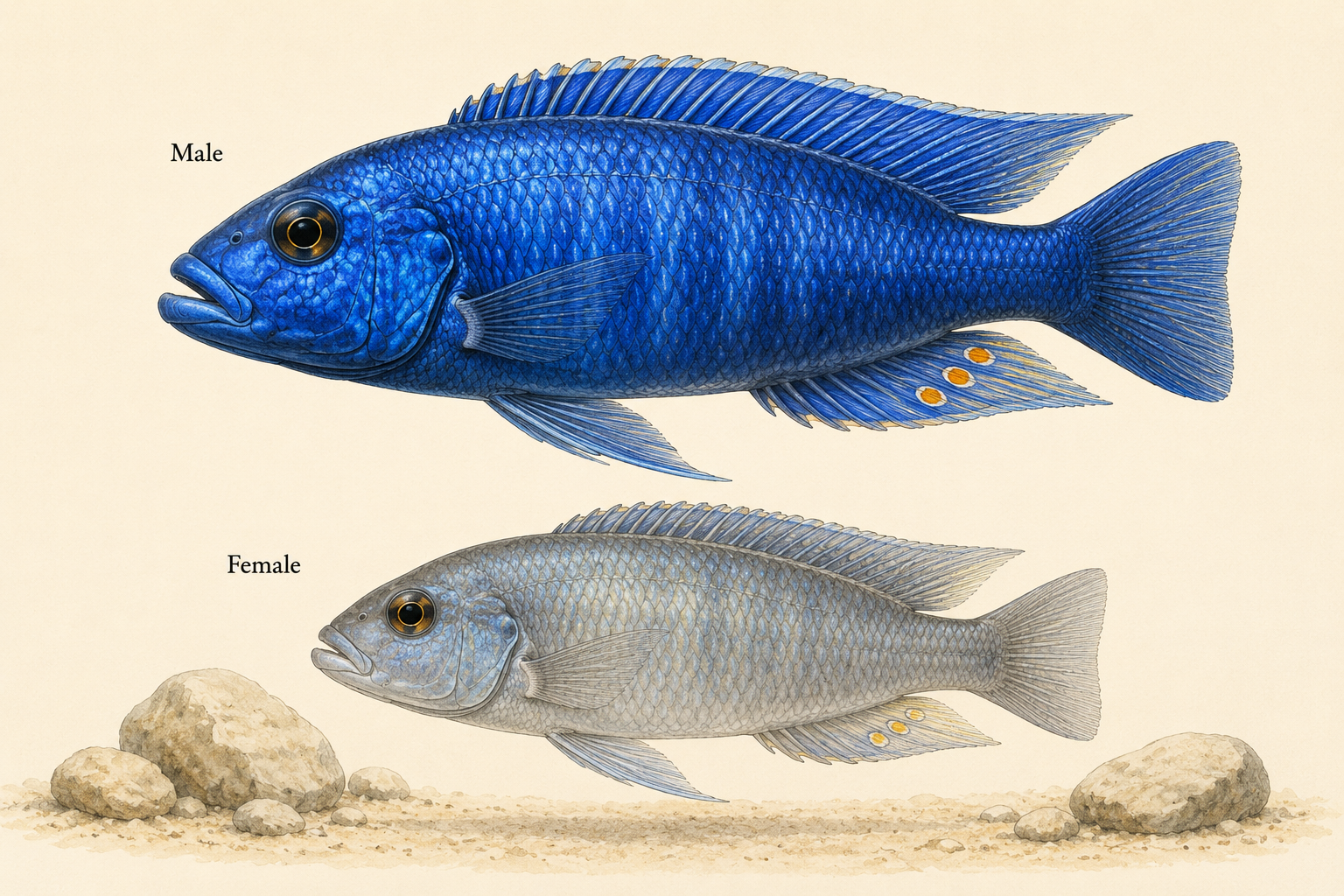
The Electric Blue Hap is sexually dimorphic, meaning males and females look markedly different once they reach maturity. Dominant males develop a brilliant, all-over metallic blue colouration that can range from a deep cobalt to a vivid electric blue, depending on the individual’s genetics, diet, and mood. The dorsal, anal, and caudal fins typically carry the same intense blue hue, and many males display a narrow white or pale blue margin along the upper edge of the dorsal fin, adding a crisp highlight. Some populations also show faint vertical barring that becomes more pronounced during periods of stress or when the fish is subdominant.
Females and juveniles are considerably more understated. They are typically a silvery grey to brownish colour with faint vertical barring along the flanks. This subdued palette serves as camouflage in their natural rocky habitat. Juvenile males begin to show hints of blue colouration from around 5–6 cm in length, but full colour development often takes a year or more and is heavily influenced by social hierarchy — subdominant males may retain a washed-out, intermediate colouration for extended periods.
In terms of body shape, Sciaenochromis fryeri has the typical elongated, laterally compressed profile of the haplochromine cichlids. The head is slightly pointed with a moderately large mouth, reflecting its predatory nature in the wild. Adults are robust without being overly deep-bodied, and they carry themselves with a confident, purposeful swimming style that adds to their appeal in the aquarium. Full-grown males typically reach around 16–18 cm in captivity, although exceptional specimens can push towards 20 cm in spacious tanks with optimal conditions.
Varieties and Morphs
While Sciaenochromis fryeri does not have the same proliferation of line-bred morphs as some mbuna species, there are several notable variants available in the hobby, most of which relate to geographical collection points or selective breeding programmes.
The standard wild-type form is the most commonly encountered, featuring the classic deep electric blue colouration in males. Fish sold simply as “Electric Blue Hap” or “Electric Blue Ahli” usually represent this form. Some breeders have selectively bred for particularly intense blue colouration, producing strains with exceptionally vivid metallic sheen.
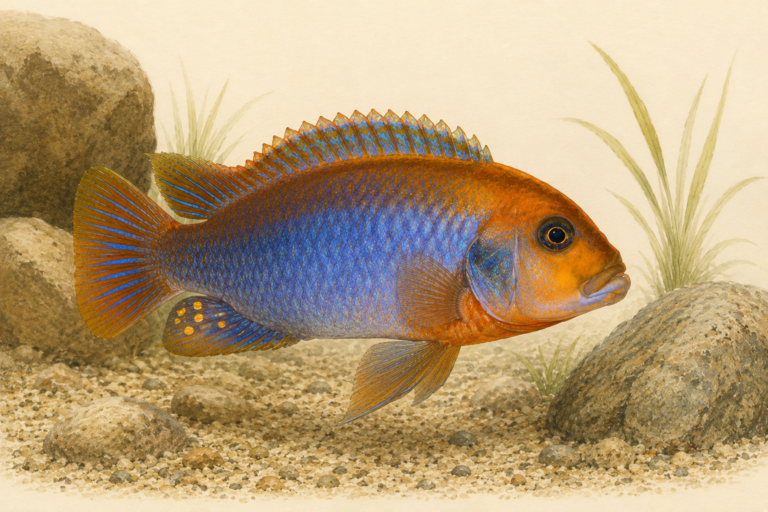
The Iceberg morph, sometimes referred to as the “Snow White” or “Ice Blue” variant, is a captive-bred colour form in which males display a pale whitish-blue to icy blue body instead of the typical deep electric blue. These fish are striking in their own right and have a dedicated following among hobbyists who enjoy unusual colour forms.
An albino form exists in the trade as well, featuring the characteristic pink-red eyes and a pale body with faint yellowish or pinkish tones. While not as popular as the standard blue form, albino Electric Blue Haps are occasionally available from specialist breeders.
Various wild-caught populations from different locations around Lake Malawi can show subtle differences in the shade and intensity of blue, as well as variations in the extent of white edging on the dorsal fin. Fish from Maleri Island, for instance, are sometimes noted for particularly rich colouration. However, these geographical variants are more commonly distinguished by experienced hobbyists and are not always reliably labelled in the general trade.
Natural Habitat
Sciaenochromis fryeri is endemic to Lake Malawi, one of the great African Rift Valley lakes located in East Africa. The lake is shared by Malawi, Mozambique, and Tanzania, and it is home to an extraordinary diversity of cichlid species — estimates suggest well over 800 species, many of which are found nowhere else on Earth. Lake Malawi is renowned for its remarkably stable water chemistry, with warm, hard, alkaline water that has remained largely unchanged for millennia.
In the wild, Electric Blue Haps are found along the rocky shorelines and intermediate zones of the lake, typically at depths ranging from 5 to 25 metres. They are not strictly restricted to a single habitat type and are considered one of the more widely distributed haplochromine species in the lake, occurring at numerous locations along the Malawian, Mozambican, and Tanzanian coastlines. They tend to favour areas where rocky substrates meet open water, using the rocks as shelter and territorial markers while venturing into more open areas to feed.
This species is a piscivore by nature, preying primarily on the fry and juveniles of other cichlid species, particularly mbuna. In the wild, males will often lurk near the spawning sites of other cichlids, ambushing newly released fry. This predatory behaviour is an important consideration for aquarists, as it influences both the diet and the tank mate choices that are appropriate in captivity. The lake itself has a pH typically between 7.8 and 8.6, a temperature range of roughly 24–28 °C, and high mineral content that produces hard, well-buffered water.
Tank Size and Setup
A single male Electric Blue Hap with a small group of females requires a tank of at least 300 litres, though 400 litres or more is strongly recommended, especially if you plan to keep them in a community with other Malawi cichlids. These are active, moderately territorial fish that need room to establish their space without constantly harassing their tank mates. A tank measuring at least 120 cm in length is ideal, as horizontal swimming space matters more to these fish than depth or height.
The substrate should be fine sand, which mimics the lake bed and allows for natural foraging behaviour. Avoid sharp gravel that could damage the mouths of fish that sift through the substrate. Rockwork is essential and should be arranged to create caves, overhangs, and visual barriers. The goal is to break up sight lines so that subordinate fish and females can escape the attention of a dominant male. Stack rocks securely — use aquarium-safe silicone or rock supports if necessary to prevent collapses. Ocean rock, limestone, and Texas holey rock are all popular choices for Malawi setups, as they can help buffer the water towards the alkaline pH these fish prefer.
Live plants are not strictly necessary and will likely be uprooted or eaten by most Malawi cichlids. However, hardy species such as Anubias and Java Fern, which can be attached to rocks, sometimes survive in a Malawi tank. Vallisneria is another option that some keepers have success with. Artificial plants or no plants at all are perfectly acceptable alternatives.
Ensure the tank has a secure, well-fitting lid. While Electric Blue Haps are not notorious jumpers, startled cichlids can leap, and a lid also reduces evaporation — something worth considering given the warm temperatures these fish require. Lighting should be moderate; overly bright lighting can wash out the fish’s colours and cause stress. A standard LED light on a timer providing 8–10 hours of illumination per day is sufficient.
Water Parameters
Maintaining stable water chemistry is arguably the single most important aspect of keeping any Malawi cichlid, and Sciaenochromis fryeri is no exception. These fish have evolved in a lake with exceptionally stable conditions, and they do not tolerate significant fluctuations well. Consistency matters more than hitting a precise number, so aim to keep your parameters steady within the following ranges.
| Temperature | 24–28 °C |
| pH | 7.5–8.8 |
| General hardness (GH) | 10–18 dGH |
| Carbonate hardness (KH) | 6–12 dKH |
| Ammonia | 0 ppm |
| Nitrite | 0 ppm |
| Nitrate | Below 20 ppm |
If your tap water is naturally soft and acidic, you will need to use a buffer or mineral additive to raise the pH and hardness to suitable levels. Commercial Malawi salt mixes and cichlid buffers are widely available and make this straightforward. Crushed coral or aragonite can be added to the substrate or filter media to provide a gradual, natural buffer. Regular water changes of 25–30% weekly are essential to keep nitrate levels low and maintain overall water quality. Always match the temperature and chemistry of new water to the tank before adding it.
Filtration and Equipment
Robust filtration is non-negotiable for a Malawi cichlid tank. These are messy, protein-rich feeders, and a tank housing several large cichlids generates a considerable bioload. An external canister filter rated for at least 1.5 times the tank volume is a sensible minimum, and many experienced keepers opt for filters rated at twice the tank volume or run two filters simultaneously for redundancy and increased biological capacity. Popular choices include canister filters from established brands, which offer excellent mechanical, biological, and chemical filtration in a single unit.
Supplementary filtration in the form of a sponge filter or an internal powerhead with a pre-filter sponge can be beneficial, particularly in larger setups or heavily stocked community tanks. Good water circulation is important, as Lake Malawi has relatively well-oxygenated water, and Electric Blue Haps appreciate moderate flow. An air pump with an airstone can further enhance oxygenation and surface agitation, though this is often unnecessary if your main filter already provides adequate turnover.
A reliable heater is essential. Choose a heater rated appropriately for your tank volume and, in larger setups, consider using two smaller heaters rather than one large unit. This provides a safety net — if one heater fails, the other prevents a catastrophic temperature drop, and if one malfunctions and sticks on, it is less likely to overheat the tank on its own. A quality thermometer, whether digital or a simple glass one, should be used to verify the temperature regularly.
Diet and Feeding
In the wild, Sciaenochromis fryeri is primarily a piscivore, feeding on the fry and small juveniles of other cichlid species. In captivity, however, they adapt readily to a varied diet of prepared and frozen foods. A high-quality cichlid pellet should form the staple of their diet. Look for pellets that list whole fish or seafood as the primary ingredients and avoid those with excessive fillers or plant-based proteins. Pellet size should be appropriate for the fish’s mouth — medium-sized pellets work well for adults.
Supplement the staple pellet with regular offerings of frozen foods such as brine shrimp, mysis shrimp, krill, and chopped prawns. These provide variety, enhance colouration, and help maintain the fish’s interest in feeding. Occasional treats of live foods like brine shrimp or daphnia are also appreciated, though live feeder fish should be avoided due to the risk of disease transmission and the ethical concerns associated with their use.
One important dietary consideration is to avoid foods high in fat and mammalian protein. Beefheart and other mammalian meats, while sometimes used in cichlid keeping, are poorly digested by African cichlids and can lead to a condition known as Malawi bloat, which is often fatal. Bloodworm should also be offered sparingly if at all, as it has been linked to digestive issues in some Malawi species.
Feed once or twice daily, offering only as much food as the fish can consume within two to three minutes. Overfeeding is a common mistake that degrades water quality rapidly and can lead to health problems. On one day per week, consider fasting the fish entirely — this mimics the natural variation in food availability and gives the digestive system a rest.
Behaviour and Temperament
The Electric Blue Hap is classified as a mildly to moderately aggressive cichlid, which places it firmly in the middle of the Malawi aggression spectrum. It is considerably less aggressive than most mbuna species but more assertive than the gentler, open-water Utaka cichlids. Dominant males are territorial, particularly during breeding, and will defend a chosen area of the tank with vigour. They may chase rivals and harass females, which is why a properly structured tank with adequate hiding spots and visual barriers is so important.
In a well-designed setup, much of this aggression is manageable. Keeping one male with three or four females is the recommended ratio, as this distributes the male’s attention and reduces stress on any single female. Keeping two males in the same tank is generally inadvisable unless the aquarium is very large — upwards of 600 litres — with extensive rockwork and sight-line breaks. In smaller tanks, the dominant male will relentlessly pursue the subordinate, often to the point of serious injury or death.
Electric Blue Haps are active swimmers and tend to occupy the middle and upper levels of the water column, though they will frequently explore rockwork and the substrate. They are curious and intelligent fish that quickly learn to recognise their keeper, often approaching the front of the tank at feeding time. This interactive quality is part of their appeal and makes them genuinely engaging pets. They are diurnal, most active during the day, and tend to rest in or near shelter at night.
Subdominant males and juveniles will often display a muted, greyish colouration to signal submission and avoid confrontation with the dominant male. This is entirely normal behaviour and not a sign of illness. If a subdominant male is being excessively harassed, however, it should be removed to a separate tank for its own welfare.
Tank Mates
Choosing appropriate companions for the Electric Blue Hap requires a careful balance. You want species that are robust enough to hold their own without being so aggressive that they bully or stress the fryeri. As a general rule, other similarly sized haplochromine cichlids and certain peacock cichlids (Aulonocara) make the best companions. Avoid keeping them with very small fish, which may be viewed as food, or with species that share an almost identical colour and pattern, as this can trigger heightened aggression.
Good tank mates
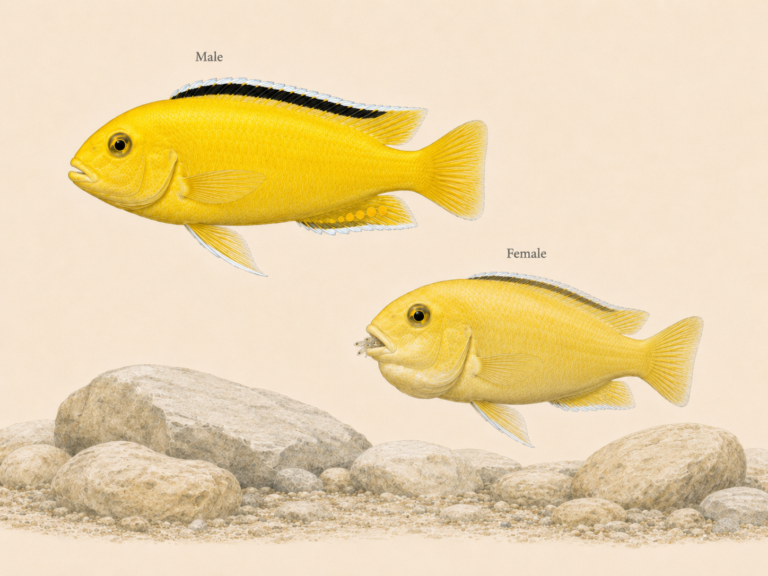
- Yellow Lab Cichlid (Labidochromis caeruleus) — One of the least aggressive mbuna, its bright yellow colouration contrasts well and it rarely competes directly with the Electric Blue Hap.
- Red Empress Cichlid (Protomelas taeniolatus) — A similarly sized haplochromine with a red and orange colour palette that minimises territorial rivalry based on appearance.
- Yellow Peacock Cichlid (Aulonocara baenschi) — A peaceful Aulonocara species whose yellow colouration avoids confusion with the blue Electric Blue Hap.
- Frontosa Cichlid (Cyphotilapia frontosa) — A large, calm species from Lake Tanganyika that can coexist in very large tanks, though water parameter overlap should be verified.
- Bristlenose Pleco (Ancistrus sp.) — A hardy algae-eater that generally stays out of the way and can tolerate the hard, alkaline water conditions required.
- Synodontis multipunctatus — A Rift Lake catfish that thrives in identical water conditions and adds interest to the lower levels of the tank.
- Copadichromis borleyi — A peaceful, open-water haplochromine with a distinct red colouration that contrasts with the Electric Blue Hap.
- OB Peacock Cichlid (Aulonocara sp. OB) — A colourful and generally peaceful peacock variant that coexists well in mixed Malawi communities.
Fish to avoid
- Auratus Cichlid (Melanochromis auratus) — An extremely aggressive mbuna that will dominate and stress most haplochromine species in all but the very largest tanks.
- Venustus Cichlid (Nimbochromis venustus) — A large predatory haplochromine that may outcompete and bully the Electric Blue Hap as it matures.
- Oscar (Astronotus ocellatus) — A South American cichlid requiring entirely different water chemistry, making them fundamentally incompatible.
- Neon Tetra (Paracheirodon innesi) — Far too small and delicate; they would be eaten quickly and require soft, acidic water.
- Jaguar Cichlid (Parachromis managuensis) — A large, highly aggressive Central American cichlid that would pose a serious threat and requires different water conditions.
- Demasoni Cichlid (Pseudotropheus demasoni) — While a stunning fish, its intense blue and black barring can trigger aggression from male Electric Blue Haps due to colour similarity.
- Jewel Cichlid (Hemichromis bimaculatus) — A West African species with incompatible water requirements and a highly territorial disposition, especially when breeding.
- Guppy (Poecilia reticulata) — Far too small and slow, guppies would be treated as live food and cannot tolerate the hard, alkaline water of a Malawi setup.
Breeding
Sciaenochromis fryeri is a maternal mouthbrooder, and breeding in captivity is relatively straightforward, making this species an excellent choice for hobbyists looking to experience cichlid reproduction for the first time. The process begins with the male selecting and defending a territory, typically a flat rock or a cleared area of substrate. He intensifies his colouration to its most vibrant state and performs an elaborate courtship display, shimmying and flaring his fins to attract a receptive female.
When a female is ready to spawn, she follows the male to his chosen site. The pair then engages in a circular spawning dance. The female deposits a small number of eggs, which she immediately picks up in her mouth. She then mouths at the egg spots on the male’s anal fin, stimulating him to release milt, which fertilises the eggs inside her buccal cavity. This process is repeated in several rounds until the female has collected a full clutch, typically numbering between 20 and 60 eggs depending on her size and maturity.
Once spawning is complete, the female retreats to a sheltered area and begins the incubation period, which lasts approximately 18 to 28 days depending on temperature. During this time, she does not eat and may appear visibly thinner, with an obviously distended throat pouch. It is crucial not to disturb or stress holding females, as they may spit out or swallow the eggs prematurely.
Many breeders choose to strip the eggs or fry from the mother’s mouth at around day 14 to 18, transferring them to a separate tumbler or rearing tank. This approach increases survival rates and allows the female to recover and feed sooner. However, experienced females can be left to release the fry naturally. Free-swimming fry are surprisingly large for cichlid fry and can immediately accept crushed flake, finely ground pellet, or freshly hatched brine shrimp nauplii.
To encourage breeding, maintain optimal water quality with regular water changes, provide a varied and nutritious diet, and ensure the male-to-female ratio is at least one male to three or four females. Slightly raising the water temperature to the upper end of the acceptable range, around 27–28 °C, can also stimulate spawning behaviour.
Common Diseases
The Electric Blue Hap is a hardy species when kept in appropriate conditions, but like all aquarium fish, it is susceptible to certain diseases, particularly when water quality deteriorates or when the fish is stressed.
Malawi bloat is perhaps the most feared illness among Malawi cichlid keepers. It manifests as abdominal swelling, loss of appetite, lethargy, and often rapid breathing. The condition is associated with poor diet — particularly overfeeding of high-fat or inappropriate foods — and poor water quality. It can progress rapidly and is frequently fatal if not addressed early. Treatment involves moving the affected fish to a hospital tank, raising the temperature slightly, and administering metronidazole-based medication. Prevention through proper diet and water management is far more effective than treatment.
Ich, or white spot disease, caused by the protozoan parasite Ichthyophthirius multifiliis, is another common affliction. It presents as small white spots resembling grains of salt scattered across the body and fins. Infected fish may flash against rocks and substrate in an attempt to relieve irritation. Treatment involves gradually raising the temperature to 28–30 °C and adding an appropriate ich medication. Malawi cichlids generally tolerate treatment well if it is started promptly.
Bacterial infections, often secondary to physical injuries sustained during territorial disputes, can also occur. These may present as reddened areas, fin erosion, or cotton-like growths on wounds. Maintaining excellent water quality is the best prevention, and treatment typically involves antibacterial medications. Fungal infections can appear in a similar fashion and are treated with antifungal preparations.
Internal parasites are occasionally seen, particularly in wild-caught specimens. Symptoms include weight loss despite normal feeding, white or stringy faeces, and a generally poor condition. A broad-spectrum antiparasitic treatment is usually effective. Quarantining all new fish for a minimum of two to four weeks before introducing them to an established tank is strongly recommended to prevent the introduction of parasites and pathogens.
FAQs
How can I tell the difference between male and female Electric Blue Haps?
Sexing juvenile Electric Blue Haps can be challenging, as both sexes appear greyish-silver when young. As they mature, males develop the iconic electric blue colouration, while females remain a relatively plain silver-grey with faint vertical barring. Males also tend to grow slightly larger and develop more prominent egg spots on the anal fin. Venting — examining the genital papillae — is the most reliable method for sexing younger or subdominant individuals that have not yet coloured up.
Can I keep Electric Blue Haps with mbuna?
It is possible but requires careful species selection. Highly aggressive mbuna such as Melanochromis auratus or Pseudotropheus crabro can bully and stress haplochromine species like the Electric Blue Hap. However, less aggressive mbuna such as Labidochromis caeruleus (Yellow Labs) or Iodotropheus sprengerae (Rusty Cichlids) can coexist successfully in a sufficiently large and well-structured tank. Avoid mbuna with similar blue colouration to reduce aggression triggers.
Why has my male Electric Blue Hap lost his colour?
Colour loss in males is typically caused by stress, which can result from poor water quality, bullying by a more dominant fish, illness, or insufficient hiding places. Subdominant males will deliberately suppress their colour to avoid confrontation with a dominant male. Check your water parameters, assess the social dynamics in the tank, and ensure there are enough visual barriers. If the fish is being bullied, consider rehoming either the aggressor or the affected fish. Colour should return once the source of stress is resolved.
How many Electric Blue Haps can I keep together?
The ideal group consists of one male and three to four females. Keeping multiple males together is risky in tanks under 600 litres, as the dominant male will typically harass subordinates relentlessly. In very large aquaria of 600 litres or more with extensive rockwork, it may be possible to keep two males, but this is not guaranteed to work and requires close monitoring. Having too few females relative to males increases stress and the risk of injury to individual females.
Is the Electric Blue Hap the same as Sciaenochromis ahli?
No, although this confusion is extremely common in the hobby and persists in many online resources and fish shops. Sciaenochromis fryeri was long misidentified as Sciaenochromis ahli, and the name “Electric Blue Ahli” is still widely used as a trade name. The true Sciaenochromis ahli is a separate, less commonly kept species. The fish almost universally sold in the aquarium trade as the “Electric Blue” is Sciaenochromis fryeri. When purchasing, confirm the scientific name with the seller wherever possible.
Related Guides
- Red Empress Cichlid Care Guide — Another popular Lake Malawi haplochromine that makes an excellent companion for the Electric Blue Hap.
- Yellow Lab Cichlid Care Guide — A peaceful mbuna species often kept alongside haplochromines in mixed Malawi community tanks.
- Aulonocara Peacock Cichlid Care Guide — Covers the care of peacock cichlids, which share similar water requirements and are frequently housed with Electric Blue Haps.
- Malawi Cichlid Tank Setup Guide — A comprehensive guide to designing and establishing a Lake Malawi biotope aquarium.
- Synodontis multipunctatus Care Guide — A Rift Lake catfish that thrives in the same conditions and makes a useful bottom-dwelling addition to a Malawi tank.