Quick Summary
The Altum Angelfish is not a beginner’s fish – it is a demanding, wild-caught cichlid that requires very soft, acidic, warm water and an experienced keeper who can maintain pristine, stable conditions in a tall aquarium. If you are looking for an easy angelfish, choose Pterophyllum scalare instead; if you are an advanced hobbyist willing to invest in specialised water chemistry and a carefully managed setup, the Altum rewards you with arguably the most majestic profile of any freshwater fish.
🐠 Build a tank around this species
In this guide:
- Introduction
- Quick Stats
- Appearance
- Natural Habitat
- Tank Size and Setup
- Water Parameters
- Diet and Feeding
- Behaviour and Temperament
Introduction
The Altum Angelfish, Pterophyllum altum, is one of the tallest-bodied angelfish species and one of the most visually striking freshwater fish available to the aquarium hobby. Native to the blackwater and clearwater tributaries of the Orinoco River basin in Venezuela and Colombia, as well as parts of the upper Rio Negro drainage in Colombia and Venezuela, the species inhabits waters that are extremely soft, acidic, and warm. These environmental requirements carry over directly into captive care and are the primary reason the Altum is considered an advanced-level species.
It is essential to distinguish Pterophyllum altum from the far more common aquarium angelfish, Pterophyllum scalare. The latter has been captive-bred for decades, is available in dozens of colour morphs, and tolerates a wide range of water conditions. The true Altum, by contrast, is almost always wild-caught, has no established captive-bred colour morphs, and is considerably less forgiving of poor water quality, parameter swings, or inappropriate tank mates. Many fish labelled “Altum” in shops are actually tall-bodied strains of P. scalare or the closely related Pterophyllum leopoldi, so purchasing from a reputable specialist dealer is important.
The appeal of the Altum lies in its sheer presence. A fully grown adult can stand over 35 cm from dorsal fin tip to the end of its elongated ventral filaments, dwarfing even the largest P. scalare. The body is laterally compressed and notably taller relative to its length, with a steep, almost angular forehead profile and deeply notched dorsal and anal fins. When kept in appropriate conditions – a tall, dimly lit tank with tannin-stained water and a calm community – a group of Altums is genuinely breathtaking. However, achieving and maintaining those conditions requires commitment, knowledge, and often a significant financial investment in both the fish themselves and the equipment needed to support them.
Quick Stats
| Scientific name | Pterophyllum altum |
|---|---|
| Common names | Deep Angelfish, Orinoco Angelfish, Alto Angelfish |
| Family | Cichlidae |
| Origin | Orinoco River basin (Venezuela, Colombia); upper Rio Negro (Brazil, Venezuela) |
| Adult size | 18 cm |
| Difficulty | Advanced |
| Breeding difficulty | Advanced |
| Temperature | 28–31 °C |
| pH | 4.5–6.5 |
| GH | 1–6 dGH |
| Minimum tank size | 350 L |
| Conservation status | Least Concern (IUCN, assessed 2020) |
Appearance
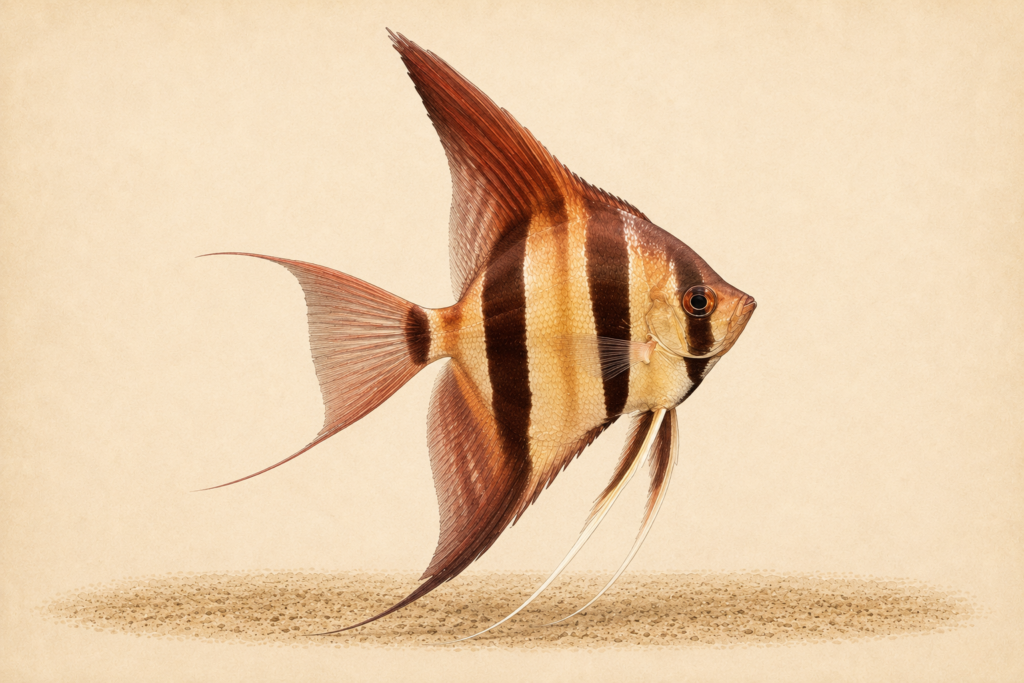
The Altum Angelfish is unmistakable once you have seen one in the flesh beside a common angelfish. The body is a laterally compressed diamond shape, but the key distinguishing feature is the pronounced vertical height of the body itself – the distance from the base of the dorsal fin to the base of the anal fin is proportionally much greater in P. altum than in P. scalare. Adults also display a distinctive steep, almost concave forehead profile, giving the face an angular, somewhat regal appearance.
The base body colour is a warm silver to pale bronze, overlaid with three bold, dark vertical bars. The first bar passes through the eye, the second through the middle of the body, and the third runs from the rear base of the dorsal fin down through the caudal peduncle. Between these primary bars, additional fainter reddish-brown or dark brown bars are often visible, particularly when the fish is relaxed and at ease. Stressed Altums may darken considerably or, conversely, lose almost all barring and appear washed out. The dorsal and anal fins are tall and deeply notched, with long, trailing filament extensions. The ventral (pelvic) fins are elongated into extremely long, thread-like filaments that can extend well past the tail, sometimes reaching twice the body length. These filaments are delicate and can be damaged by aggressive tank mates or sharp decor.
The eyes are proportionally large, with a reddish or orange iris that can appear quite vivid under subdued lighting. Fin colouration varies with locality but generally consists of translucent greyish or brownish membranes with subtle striping that continues the body’s vertical bar pattern. There is sometimes a faint greenish or bluish iridescence along the flanks, particularly noticeable in fish from certain Rio Negro localities. Juveniles resemble adults in pattern but are less dramatic in finnage and colouration until they begin to mature at around 8-12 months of age.
Sexual dimorphism is minimal and difficult to assess outside of breeding condition. Mature males may develop a smaller version of the nuchal hump seen in many cichlids, typically only around breeding time, and during spawning the genital papilla differs in shape – the male’s is pointed and narrow while the female’s is broader and blunt. Outside of spawning, reliable sexing is extremely challenging even for experienced keepers.
Natural Habitat
The Altum Angelfish inhabits the slow-moving blackwater and clearwater tributaries of the Orinoco River basin in southern Venezuela and eastern Colombia. It is also found in the upper reaches of the Rio Negro drainage, which connects to the Amazon system. These habitats are characterised by water that is extremely soft, highly acidic, and warm year-round. Blackwater environments, stained dark brown by tannins and humic acids leaching from submerged leaf litter and decaying wood, are perhaps the most iconic Altum biotope. In such waters, conductivity can be almost negligibly low, pH may drop below 5.0, and general hardness is effectively zero.
In the wild, Altums are found among submerged root tangles, fallen branches, and the flooded margins of rainforest where trees and shrubs extend into the water. They tend to occupy sheltered areas with minimal current, hovering in small groups among vertical structures such as tree roots and stems. The substrate is typically composed of fine sand covered by a thick layer of decomposing leaves. Light levels are subdued, filtered through the forest canopy above and further dimmed by the dark, tea-coloured water. Aquatic plant growth in these habitats is generally sparse due to the low light and extremely acidic conditions, though emergent and marginal vegetation is common.
Water temperatures in the Altum’s range typically sit between 28 and 31 degrees Celsius throughout the year, with seasonal variation driven more by water level fluctuations during the rainy and dry seasons than by significant temperature changes. During the wet season, flooded forest areas expand dramatically, providing additional habitat and food sources. The fish feed on a varied diet of small invertebrates, insect larvae, tiny crustaceans, and organic detritus in these environments.
Understanding this natural habitat is critical for captive success. The Altum has evolved over millennia in conditions that most tap water supplies cannot replicate without deliberate intervention. Attempting to keep this species in standard, moderately hard, neutral-pH community tank conditions is a recipe for stress, disease, and premature death. Replicating – or at least closely approximating – the soft, acidic, warm conditions of its native waters is not optional but essential.
Tank Size and Setup
The single most important dimension for an Altum Angelfish tank is height. A fully grown adult with extended fins can stand 35 cm or more from tip to tip, and the fish needs sufficient vertical space to move, display, and behave naturally without constantly brushing its fins against the surface or substrate. A minimum tank height of 55-60 cm is strongly recommended, with 65 cm or more being ideal. Tanks shorter than 50 cm are unsuitable for adult Altums regardless of volume.
In terms of volume, a group of five to six juveniles can begin life in a 300-350-litre tank, but plan for considerably more room, ideally 400 litres or more, as the fish mature: pairs will start to form and territorial aggression escalates, and a group that outgrows its space can quickly become stressed or start fighting in earnest. A standard 350-litre tank with appropriate height is a reasonable starting point, but be prepared to upgrade as the group matures and establishes pairs. Keeping Altums in groups is important for their social structure and sense of security; a lone Altum will typically be nervous and stressed. A group of five or six is a good minimum, which reinforces the need for generous volume.
Aquascaping should aim to replicate the fish’s natural environment. Use fine sand as a substrate – dark-coloured sand is preferable as it absorbs rather than reflects light, reducing stress. Incorporate plenty of vertically oriented hardscape: tall pieces of driftwood, branching roots, and even vertical lengths of bogwood that reach from the substrate towards the surface. These structures provide the visual barriers and shelter that Altums instinctively seek. Dried Indian almond leaves (Terminalia catappa) or other botanical additions such as oak leaves and alder cones can be scattered across the substrate to release tannins, acidify the water gently, and create a natural, leaf-litter biotope aesthetic.
Live plants are optional and should be chosen with care. The extremely soft, acidic water and high temperatures preferred by Altums limit plant selection. Hardy species such as Java Fern (Microsorum pteropus), Java Moss (Taxiphyllum barbieri), Anubias species, and certain Cryptocoryne species can do well. Avoid plants that require high light or harder water. Floating plants such as Amazon Frogbit (Limnobium laevigatum) or Water Lettuce (Pistia stratiotes) are excellent choices as they diffuse overhead light and provide a sense of overhead cover that helps Altums feel secure.
Lighting should be subdued. Altums come from dim, shaded environments and will show their best colouration and most natural behaviour under low to moderate lighting. Bright overhead lighting causes stress, washed-out colours, and increased skittishness. If you need brighter light for plants, use floating plant cover to create shaded areas.
The tank should have a tight-fitting lid or cover. Although Altums are not habitual jumpers in the way some other species are, startled fish can and do leap, and a panicked Altum launching itself out of the tank is a real risk, particularly during the initial settling-in period. Cover also helps maintain the high air temperature above the water surface, which is important for labyrinth-organ-free fish living at elevated temperatures – cold draughts across the surface can contribute to chilling and respiratory issues.
Water Parameters
| Temperature | 28-31 C |
| pH | 4.5-6.5 |
| General hardness (GH) | 1-6 dGH |
| Ammonia | 0 ppm |
| Nitrite | 0 ppm |
| Nitrate | Below 10 ppm |
Water chemistry is the single most critical factor in successfully keeping Altum Angelfish. Unlike their captive-bred P. scalare cousins, true Altums have virtually no tolerance for hard, alkaline water. They require very soft, acidic conditions that closely mirror their wild habitat. In most parts of the United Kingdom and Europe, tap water is far too hard and alkaline for Altums, meaning keepers must use reverse osmosis (RO) water or a combination of RO water and carefully measured remineralisation salts to achieve the necessary parameters.
A pH between 5.0 and 6.0 is the sweet spot for most keepers, though many successful Altum tanks run even lower. General hardness should ideally be below 3 dGH, and carbonate hardness should be as low as possible – ideally below 1 dKH. At these very low KH values, pH can swing rapidly if not managed, so it is important to use a reliable buffer system. Tannins from botanicals and driftwood provide some natural buffering and acidification, but many advanced keepers use peat filtration or other tannin sources to help stabilise pH; controlled CO2 injection, if already used for planted-tank purposes, should not be relied on as a primary method of pH control, since it produces only a temporary, easily reversed shift rather than addressing underlying alkalinity.
Temperature is notably higher than for most tropical community fish. Altums thrive at 28-31 C, with 29-30 C being optimal for long-term health. At these elevated temperatures, dissolved oxygen levels are lower, which means excellent surface agitation and filtration are necessary to maintain adequate oxygenation. Running a tank at 30 C also accelerates the metabolism of nitrifying bacteria and increases the rate at which organic waste decomposes, so filtration capacity and water change frequency must be adjusted accordingly.
Stability is paramount. Wild-caught Altums are notoriously sensitive to sudden changes in pH, temperature, or hardness. Even a shift of 0.5 pH units over a short period can trigger severe stress, loss of appetite, or disease outbreaks. All water changes should be performed with pre-prepared water that has been matched to the tank’s parameters. Topping up with untreated tap water – even small amounts – can cause dangerous parameter spikes in a very soft, low-KH system. A dedicated water storage and preparation setup is effectively a necessity for serious Altum keeping.
Nitrate levels should be kept as low as possible. While many tropical fish tolerate nitrates up to 20-40 ppm, Altums do best when nitrate is kept as low as reasonably achievable This demands regular, consistent water changes – typically 20-30% twice per week – combined with efficient biological filtration and careful feeding practices to minimise waste accumulation.
Filtration and Equipment
Given the Altum’s sensitivity to water quality and the challenges of maintaining extremely soft, acidic water, filtration must be robust, well-maintained, and thoughtfully designed. A large external canister filter rated for at least 1.5 times the tank’s volume per hour is the standard recommendation. Many keepers run two separate canister filters for redundancy and increased biological capacity. Should one filter fail or need servicing, the other continues to maintain water quality while the first is repaired or cleaned.
Biological filtration media should make up the majority of the filter’s capacity. Sintered glass media, ceramic rings, or high-surface-area bio-media are all suitable. Chemical filtration can include activated carbon for occasional polishing, but the most useful chemical medium for Altum tanks is peat. Aquarium-grade peat granules placed in a filter media bag inside the canister will slowly release tannins and humic acids, helping to maintain a low pH and soft water conditions. This approach mimics the natural tannin input from leaf litter in the wild.
Flow rate and current direction require attention. Altums are not strong swimmers and dislike powerful currents. They naturally inhabit slow-moving or still waters. The filter output should be diffused using a spray bar set along the back wall of the tank or directed against the glass to spread and soften the flow. A gentle, even circulation that avoids creating strong directional currents is ideal. Surface agitation should be sufficient to maintain gas exchange and oxygenation at the elevated temperatures required, but not so vigorous as to create turbulence that stresses the fish.
Heating is best managed with a high-quality, reliable thermostat heater or, ideally, an inline heater connected to the canister filter’s return line. Inline heaters distribute heat more evenly and eliminate the risk of the fish resting against a hot glass heater, which can cause burns – a real concern with the Altum’s long fins. The heater must be powerful enough to maintain 29-30 C consistently, even during cooler months. For tanks of 350 litres or more, two heaters placed at opposite ends of the tank provide more even heating and backup in case one fails.
An RO unit is, for most keepers, a non-negotiable piece of equipment. Unless your tap water is naturally very soft and acidic – uncommon in most of the UK – you will need to produce RO water for all water changes and top-ups. A four-stage RO unit with a deionisation (DI) cartridge produces water with near-zero TDS, which can then be carefully remineralised to the desired parameters before use. Storing prepared water in food-safe containers with a small heater and circulation pump ensures it is temperature-matched and ready for use at water change time.
UV sterilisers are a worthwhile addition for Altum tanks. Wild-caught fish are more susceptible to certain parasitic and bacterial infections, and a UV steriliser in the return line from the canister filter helps to reduce free-floating pathogens in the water column. This is a preventive measure, not a cure, but it adds an extra layer of protection for these valuable and sensitive fish.
Diet and Feeding
Altum Angelfish are omnivores with a strong preference for meaty, protein-rich foods. In the wild they feed on small invertebrates, insect larvae, tiny crustaceans, and various organic matter. In captivity, the biggest initial challenge is often getting newly imported wild-caught Altums to accept any food at all. Freshly arrived fish are frequently stressed, and many will refuse all food for days or even weeks. Patience and the right food choices during this acclimatisation period are critical.
Live foods are the most reliable way to trigger a feeding response in newly imported Altums. Bloodworm (chironomid larvae), live brine shrimp (Artemia), Daphnia, and Moina are all eagerly accepted. Once the fish are feeding confidently on live foods, you can gradually introduce high-quality frozen foods: frozen bloodworm, frozen brine shrimp, frozen Mysis shrimp, and frozen cyclops are all excellent staples. Variety is important to ensure a balanced nutritional profile.
Transitioning Altums to dry foods can be difficult and is not always fully achievable. Some individuals will learn to accept high-quality pellets or flakes, particularly if these are offered alongside familiar frozen foods. Slow-sinking granules or small pellets designed for cichlids tend to be more readily accepted than flakes. However, many Altum keepers find that their fish always prefer frozen and live foods and only reluctantly pick at dry alternatives. This is acceptable provided the frozen and live diet is sufficiently varied.
Feed two to three times daily in moderate amounts. Altums are not aggressive feeders and can be outcompeted by faster, bolder tank mates if housed in a community. Each feeding should be small enough that all food is consumed within two to three minutes. Overfeeding is a significant risk in Altum tanks because uneaten food rapidly degrades water quality in the warm, soft water these fish require. Any uneaten food should be removed promptly.
Supplementation with vitamin-enriched foods or the addition of a liquid vitamin supplement to frozen foods before feeding can support immune function, particularly in recently imported wild-caught specimens. Garlic-based food soaks are also popular among Altum keepers as an appetite stimulant and for their purported anti-parasitic properties.
Behaviour and Temperament
Altum Angelfish are cichlids, and they display the typical cichlid intelligence and social complexity, albeit in a more subdued and graceful manner than many of their more boisterous relatives. They are generally peaceful, somewhat shy, and can be easily intimidated by aggressive or overly boisterous tank mates. In a well-set-up tank with appropriate companions, Altums spend much of their time hovering among vertical structures, drifting slowly through the water column, and occasionally sparring gently with conspecifics.
Keeping Altums in a group is strongly recommended. Solitary individuals tend to be nervous, skittish, and prone to hiding. A group of five or six provides the social structure these fish need to feel secure. Within the group, a loose hierarchy will establish itself over time, with dominant individuals claiming preferred positions in the tank. Aggression within the group is typically limited to fin displays, lateral posturing, and brief chases rather than serious physical harm, though pairs that form during breeding may become more assertive in defending their chosen spawning site.
Altums are notably more sensitive to environmental disturbances than common angelfish. Loud noises, sudden movements near the tank, vibrations from nearby equipment or foot traffic, and abrupt changes in lighting can all trigger panic responses, including rapid darting, crashing into the glass, or even jumping. Placing the tank in a calm, low-traffic area of the home and using a gradual lighting ramp-up and ramp-down (if your light unit supports it) will help minimise these stress responses.
New imports are often extremely shy and may hide behind hardscape or in corners for days or weeks after being introduced to their new tank. This is normal and expected behaviour. Resist the temptation to rearrange the tank, add new fish, or otherwise disturb the environment during this settling-in period. Patience is essential. Once acclimated, Altums gradually become bolder and will learn to associate your presence with feeding, eventually approaching the front glass at mealtimes.
Tank Mates
Choosing tank mates for Altum Angelfish requires careful consideration of water parameters, temperament, and size. Any companion species must tolerate – and ideally thrive in – the very soft, acidic, warm water that Altums require. This immediately rules out a large number of popular community fish that prefer harder, cooler, or more neutral conditions. Tank mates should also be peaceful, non-nippy, and not so fast or competitive at feeding time that the Altums miss out on food. Very small species that could fit in an adult Altum’s mouth should be avoided, as Altums will eat anything they can swallow.
Good tank mates
- Cardinal Tetra – Shares the same blackwater habitat requirements and forms a stunning visual contrast in a large school alongside Altums.
- Rummy Nose Tetra – Thrives in warm, soft, acidic water and its tight schooling behaviour complements the Altum’s stately presence.
- Green Neon Tetra – Despite sharing the same blackwater parameters, this species is small enough to be eaten by an adult Altum and is best avoided as a tank mate.
- Sterbai Corydoras – One of the few Corydoras species that tolerates temperatures above 28 C, making it a suitable bottom-dweller for an Altum tank.
- Marbled Hatchetfish – A peaceful surface-dweller from similar soft, acidic habitats that occupies a different water column zone from the Altums.
- Chocolate Gourami – Requires similarly soft, acidic, warm water and is peaceful enough not to conflict with Altums, though it demands its own careful husbandry.
- Emperor Tetra – A calm, mid-water schooling species that adapts well to soft, acidic conditions and is too large for adult Altums to eat.
- Bristlenose Pleco – Tolerates warm, soft water reasonably well and provides useful algae control without bothering the Altums.
Fish to avoid
- Tiger Barb – A notorious fin nipper that will relentlessly target the Altum’s long, trailing finnage, causing severe stress and physical damage.
- African Cichlids – Require hard, alkaline water that is completely incompatible with Altum requirements, and most are far too aggressive.
- Convict Cichlid – Highly aggressive, territorial, and needs different water parameters; will bully and injure Altums.
- Buenos Aires Tetra – A large, boisterous tetra that can nip fins and outcompete Altums for food.
- Goldfish – A coldwater species with completely incompatible temperature, pH, and hardness requirements.
- Serpae Tetra – Known fin nipper, particularly problematic with slow-moving, long-finned species like the Altum.
- Oscar – Far too large, aggressive, and messy to coexist with the delicate Altum in the same setup.
Breeding
Breeding Altum Angelfish in captivity is exceptionally difficult and is achieved only rarely, even by experienced keepers and specialist breeders. The species has proven far more resistant to captive breeding programmes than Pterophyllum scalare, and the vast majority of Altums in the hobby remain wild-caught. Successful spawning reports are uncommon, and rearing fry to adulthood is rarer still.
The first and most significant challenge is obtaining a compatible pair. Because sexing Altums outside of spawning condition is extremely difficult, the most reliable approach is to raise a group of six or more juveniles together and allow pairs to form naturally over time. This process can take one to two years or longer, as Altums are slow to reach sexual maturity compared to common angelfish.
Spawning triggers appear to include a combination of very soft, acidic water (pH below 5.5, GH below 1 dGH), elevated temperatures (30-31 C), and a period of increased feeding with high-quality live foods. Some breeders report success following large water changes with slightly cooler, very soft water to simulate the onset of the rainy season in the fish’s natural habitat. The pair will select a vertical spawning surface – a flat leaf, a piece of slate, or a section of vertical driftwood – and clean it meticulously before the female deposits rows of adhesive eggs. The male follows, fertilising each row in turn.
Both parents typically guard the eggs, fanning them to maintain water flow and removing unfertilised or fungused eggs. However, many captive pairs eat their eggs within hours of spawning, particularly if disturbed or stressed. First-time pairs are especially prone to egg consumption. Some breeders remove the spawning substrate and eggs to a separate hatching tank with matching water parameters, gentle aeration, and methylene blue added to prevent fungal growth. Eggs typically hatch within 48-72 hours at 30 C, and the free-swimming fry emerge approximately five to seven days after hatching.
Fry are tiny and require very fine first foods such as infusoria, vinegar eels, or freshly hatched baby brine shrimp (Artemia nauplii). Growth is slow compared to P. scalare fry, and maintaining the pristine, extremely soft water conditions required throughout the rearing process is demanding. Losses during the first few weeks are common. For these reasons, captive-bred Altums remain exceptionally rare in the hobby, and any breeder who achieves consistent results with this species has accomplished something truly noteworthy.
Common Diseases
Wild-caught Altum Angelfish are susceptible to a range of diseases and parasites, some of which can be devastating if not identified and treated promptly. The species’ sensitivity to water quality means that stress-related disease outbreaks are common, particularly during and after importation, quarantine, or any significant change in water conditions.
Quarantine all new Altums for a minimum of four to six weeks before adding them to an established display tank. This is not optional. Wild-caught fish frequently carry internal and external parasites, bacterial infections, and other pathogens that may not be immediately apparent. A dedicated quarantine tank with matched water parameters allows observation and prophylactic treatment without risking the health of existing stock.
Ich (white spot disease), caused by Ichthyophthirius multifiliis, is one of the most common problems, particularly in newly imported or stressed fish. The elevated temperatures preferred by Altums (29-31 C) actually help to accelerate the parasite’s lifecycle, making heat-based treatment – raising the temperature to 32 C for several days – a viable first-line approach. However, at these temperatures dissolved oxygen is low, so increased aeration is essential. If medication is required, choose treatments appropriate for a normally-scaled cichlid and avoid copper-based products, which are poorly tolerated in very soft water.
Hexamita and Spironucleus (hole-in-the-head disease and internal flagellate infections) are another significant concern with wild-caught cichlids. Symptoms include white, stringy faeces, loss of appetite, weight loss, and in advanced cases, pitting or lesions on the head and lateral line. Metronidazole is the standard treatment, administered either in food or dissolved in the water column. Maintaining excellent water quality is the best prevention.
Bacterial infections, including fin rot and columnaris, can occur when water quality deteriorates or the fish are stressed. These present as fraying or eroding fins, white or greyish patches on the body, or rapid, laboured breathing. Antibiotic treatments may be necessary, though availability varies by country. In the UK, prescription-only antibiotics may require a veterinary consultation.
Internal parasites, including nematodes and tapeworms, are common in wild-caught specimens. Prophylactic deworming during quarantine with an appropriate anthelmintic (such as levamisole or praziquantel) is standard practice among experienced Altum keepers. Flashing, scratching against objects, and general listlessness can indicate external or gill parasites, which may require targeted treatment.
FAQs
How can I tell a true Altum Angelfish from a common angelfish?
The most reliable way to identify a true Pterophyllum altum is its proportionally much taller, more vertically elongated body compared to Pterophyllum scalare, combined with its steep, almost concave forehead profile. Many fish sold as “Altum” are actually tall-bodied strains of P. scalare or the closely related Pterophyllum leopoldi, so purchasing from a reputable specialist dealer is important.
What size tank do Altum Angelfish need?
Altum Angelfish require a minimum tank size of 350 litres. Because of their extreme vertical height – up to 35-38 cm from dorsal fin tip to the end of the ventral filaments – a tall aquarium is essential. The tank should also be dimly lit and furnished with decor that won’t damage their delicate, elongated fin filaments.
What water parameters do Altum Angelfish require?
Altum Angelfish need very soft, acidic, warm water. The temperature should be maintained between 28-31°C, with a pH of 4.5-6.5, general hardness of 1-6 dGH, and carbonate hardness of 0-2 dKH. These demanding parameters reflect their natural blackwater and clearwater habitats in the Orinoco River basin and upper Rio Negro drainage, and stable conditions are critical as Altums are considerably less forgiving of parameter swings than common angelfish.
Can you sex Altum Angelfish?
Sexual dimorphism in Altum Angelfish is minimal and extremely difficult to assess outside of breeding condition. Mature males may develop a slightly steeper forehead profile and a marginally more robust body. During spawning, the genital papilla can be used to differentiate them – the male’s is pointed and narrow while the female’s is broader and blunt. Outside of spawning, reliable sexing is extremely challenging even for experienced keepers.
Are Altum Angelfish suitable for beginners?
No. The Altum Angelfish is rated as an advanced-level species with expert-level breeding difficulty. It is almost always wild-caught, requires very specific water chemistry (extremely soft, acidic, and warm), and is far less forgiving of poor water quality or parameter fluctuations than the common angelfish. Beginners looking for an angelfish are advised to choose Pterophyllum scalare instead.
Related Guides
- Checkerboard Dwarf Cichlid – A fellow South American cichlid that thrives in soft, acidic water, making it a potential companion species for experienced keepers.
- Elegant Corydoras – A peaceful bottom-dwelling catfish from South America that can complement an Altum Angelfish setup as a calm, non-aggressive tank mate.
- Demon Eartheater – Another advanced South American cichlid suited to warm, soft-water aquariums similar to those required by Altum Angelfish.
- Dwarf Pleco – A small, unobtrusive pleco that can share a large, warm, soft-water setup without competing with tall-bodied cichlids for swimming space.
- Altifron Eartheater – An eartheater species from similar South American river systems that appreciates comparable soft, acidic water conditions.