Quick Summary
The Checkerboard Dwarf Cichlid is a stunning but delicate species best suited to experienced fishkeepers who can provide soft, acidic water and consistently pristine conditions. This is not a beginner dwarf cichlid – it demands more care than popular alternatives like German Blue Rams or Apistogramma species, and will not thrive in hard, alkaline, or poorly maintained water. We don’t have a formally rated difficulty score for this species from our usual reference sources, but in practice it suits experienced keepers and is challenging to breed at home.
🐠 Build a tank around this species
In this guide:
- Introduction
- Quick Stats
- Appearance
- Natural Habitat
- Tank Size and Setup
- Water Parameters
- Diet and Feeding
- Behaviour and Temperament
- Tank Mates
- Breeding
Introduction
Dicrossus filamentosus, widely known as the Checkerboard Dwarf Cichlid, is one of the most visually captivating small cichlids available in the freshwater hobby. Originating from blackwater streams and tributaries across the Orinoco and upper Negro river basins in South America, this species has earned a devoted following among experienced aquarists who appreciate its subtle beauty, fascinating behaviour, and the rewarding challenge of keeping it well.
Unlike more forgiving dwarf cichlids such as Apistogramma cacatuoides or Mikrogeophagus ramirezi, the Checkerboard Dwarf Cichlid is genuinely sensitive to water chemistry and quality. It requires soft, acidic conditions that replicate its native blackwater environment, and it will languish – or simply perish – in the moderately hard, neutral-pH tap water that many fishkeepers take for granted. Elevated nitrate levels, fluctuating parameters, or inadequate biological filtration can quickly lead to stress, disease, and mortality. For this reason, this species is firmly in the “experienced keeper” category and should not be purchased on impulse by newcomers to the hobby.
That said, for those willing to invest the effort, Dicrossus filamentosus rewards handsomely. Males develop dramatic elongated filaments on their caudal and dorsal fins, and their courtship displays are mesmerising. Pairs may form temporary breeding bonds, and breeding behaviour – while difficult to trigger and sustain – is endlessly fascinating to observe. The species is peaceful by cichlid standards, making it a viable centrepiece for a carefully planned community of soft-water species.
In this guide, we cover everything you need to know to keep Checkerboard Dwarf Cichlids successfully, from tank setup and water chemistry to diet, behaviour, breeding, and compatible tank mates.
Quick Stats
| Scientific name | Dicrossus filamentosus |
|---|---|
| Common names | Checkerboard Cichlid, Lyretail Checkerboard Cichlid, Filament Cichlid |
| Family | Cichlidae |
| Origin | Orinoco and upper Rio Negro basins, Colombia, Venezuela, and Brazil |
| Adult size | Male: 10.2 cm · Female: 6.8 cm |
| Difficulty | Advanced |
| Breeding difficulty | Advanced |
| Temperature | 27–30 °C |
| pH | 4.5–6.5 |
| GH | 1–6 dGH |
| Minimum tank size | 80 L |
| Conservation status | Least Concern (IUCN, assessed 2020) |
Appearance
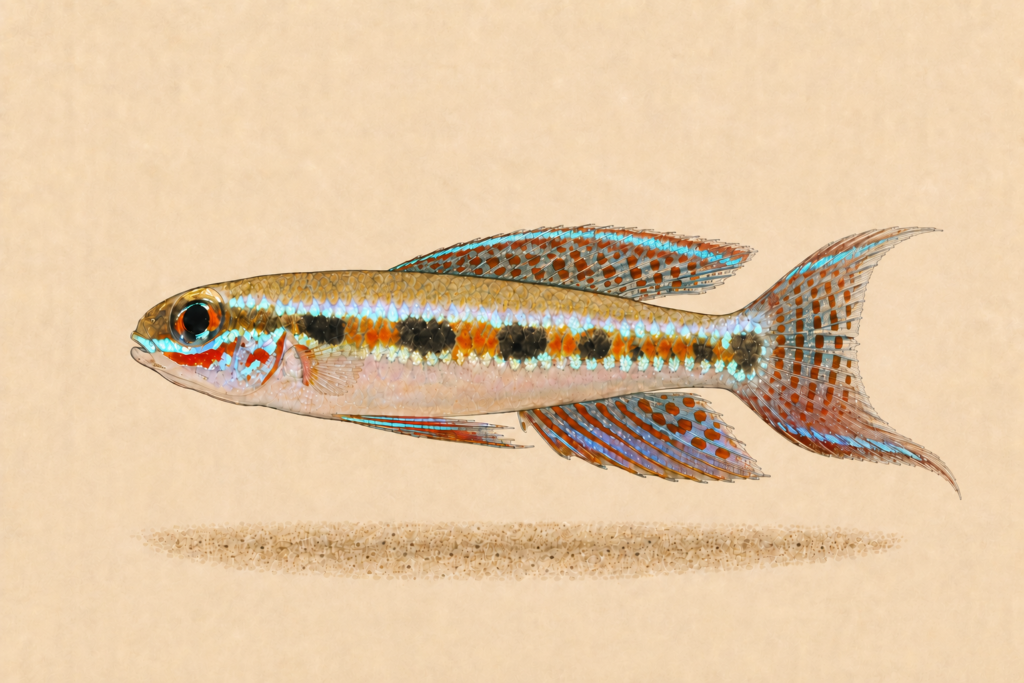
The Checkerboard Dwarf Cichlid is named for the distinctive pattern of dark, roughly square blotches arranged in a horizontal checkerboard-like row along the lateral line of the body. These dark markings sit against a base colour that ranges from creamy silver to a warm golden-beige, depending on the fish’s mood, health, and environmental conditions. In optimal blackwater setups with tannin-stained water, the base coloration often takes on a richer, more golden hue that makes the checkerboard pattern stand out even more strikingly.
Sexual dimorphism is pronounced in mature specimens. Males are somewhat larger than females, reaching up to 10.2 cm in total length, with females noticeably smaller. The most immediately obvious difference, however, is in the fins. Males develop elongated, filamentous extensions on both the caudal (tail) fin and the dorsal fin – it is these threadlike projections that give the species both its scientific epithet (filamentosus) and one of its common names, the Lyretail Checkerboard Cichlid. When a male is in full display mode, flaring his fins at a rival or courting a female, these filaments can extend dramatically, giving him an almost ethereal appearance.
Males also tend to show more vivid colouration overall. In breeding condition, they may display subtle red or orange tones in the dorsal and caudal fins, along with faint iridescent blue-green highlights on the body. The unpaired fins often carry fine spotting or vermiculation patterns. Females, while less flamboyant, are by no means drab. They display the same checkerboard patterning but with a slightly more compact body shape, shorter fins, and a rounder belly. During spawning, females may develop a noticeable pinkish or reddish flush to their ventral region.
Juveniles and stressed individuals show muted colouration and may display a single dark lateral stripe rather than distinct separate blotches. As the fish settle in and mature, the characteristic pattern develops more clearly. It is worth noting that imported wild-caught specimens sometimes arrive looking washed out and stressed, so patience is required before their full beauty becomes apparent.
Natural Habitat
Dicrossus filamentosus inhabits blackwater and clear-water tributaries, small streams, and flooded forest areas within the Orinoco basin in Colombia and Venezuela, as well as the upper Rio Negro system in Brazil. These are classic South American blackwater environments: the water is stained a deep amber-brown by tannins leaching from decaying leaves and wood, and it is extremely soft and acidic, often with a pH below 5.0 and negligible mineral content.
The substrate in these habitats is typically fine white or pale sand, overlaid with a thick carpet of decomposing leaf litter from the surrounding riparian forest. Fallen branches, submerged root tangles, and driftwood create a complex three-dimensional structure at the bottom of shallow, slow-moving waterways. Aquatic plants may be sparse or entirely absent in the most heavily shaded blackwater streams, though marginal vegetation and overhanging terrestrial plants provide cover and reduce light levels.
Water flow in these habitats is generally gentle. In the wild, this species is typically found in cooler waters than its recommended aquarium range would suggest, with field records around 23-25C, whereas in the home aquarium it does well and breeds readily at the warmer 27-30C range given in the tank parameters above. The combination of high tannin concentrations, low mineral content, and acidic pH gives the water mild natural antibacterial properties, a common feature of blackwater environments generally. When kept in harder, more alkaline, or less pristine water, fish evolved for these conditions can become more vulnerable to bacterial and parasitic infections.
The species shares its habitat with a wide variety of small characins (including the cardinal tetra), pencilfish, hatchetfish, and other dwarf cichlids, as well as various catfish species. Like most small fish in these waterways, it likely faces predation pressure from larger fish and birds, which may help explain its cautious, bottom-dwelling temperament and reliance on cover.
Tank Size and Setup
A minimum tank size of 80 litres is recommended for a pair or a small group (one male with two or three females). If you intend to keep a community of Checkerboard Dwarf Cichlids alongside other species, a tank of 120 litres or more is preferable. Longer, shallower tanks are better suited to this species than tall, narrow designs, as Dicrossus filamentosus spends the vast majority of its time in the lower third of the water column.
Substrate should be fine, soft sand. This is not optional. Checkerboard Dwarf Cichlids sift through the substrate when foraging, and coarse gravel can damage their delicate gill filaments and mouths. Pale sand mimics the natural environment and also provides a pleasing contrast to the fish’s colouration. Play sand or purpose-made aquarium sand in a light colour works well.
Driftwood is an essential component of the setup. Use multiple pieces of branching wood, bogwood, or spider wood to create sheltered areas, overhangs, and visual barriers. The tannins released by driftwood will naturally help to lower pH and soften the water, which is beneficial. Indian almond leaves (Terminalia catappa), oak leaves, or other dried botanical leaves should be scattered across the substrate to create a leaf litter layer. This not only replicates the natural habitat but also provides additional tannin release, promotes beneficial biofilm and microfauna growth (which fry and adults will graze on), and offers the fish a sense of security.
Live plants are not strictly necessary but can be included if they tolerate the soft, acidic conditions. Suitable choices include Java Fern (Microsorum pteropus), Java Moss (Taxiphyllum barbieri), Anubias species (attached to wood rather than planted in substrate), and various Cryptocoryne species that tolerate low hardness. Floating plants such as Amazon Frogbit or Salvinia can be used to diffuse lighting and create the subdued, shaded environment that Checkerboard Dwarf Cichlids prefer.
Lighting should be moderate to low. Intense lighting will cause stress and encourage the fish to hide constantly. If you are growing plants, use a light that provides adequate PAR for the plant species chosen, but supplement with floating plants or tannin-stained water to reduce the intensity reaching the bottom of the tank.
Provide plenty of cover and visual breaks throughout the tank. Flat stones, coconut shells, and ceramic caves can all serve as potential spawning sites, though this species typically prefers to spawn on flat surfaces such as smooth stones, broad leaves, or even directly on the sand substrate.
Water Parameters
Getting the water chemistry right is the single most critical factor in keeping Dicrossus filamentosus alive and healthy. This cannot be overstated. The species is adapted to extremely soft, acidic water with minimal dissolved minerals. Attempting to keep it in typical UK or European tap water – which often has a pH of 7.0 or above and moderate to high hardness – is a recipe for failure.
| Temperature | 27-30 C |
| pH | 4.5-6.5 |
| General hardness (GH) | 1-6 dGH |
| Ammonia | 0 ppm |
| Nitrite | 0 ppm |
| Nitrate | Below 10 ppm |
Most keepers will need to use reverse osmosis (RO) water, either pure or remineralised very lightly with a product designed for soft-water species. Some areas with naturally soft tap water may be able to use dechlorinated tap water directly, but always test your source water before committing. TDS (total dissolved solids) should ideally be kept below 50-80 ppm.
The addition of tannins through driftwood, leaf litter, and commercially available blackwater extracts or alder cones will help to maintain an acidic pH and create the tea-coloured water that replicates the natural environment. Be aware that with very low KH, pH can fluctuate if not monitored; however, the biological processes in a well-established, lightly stocked tank with adequate botanical material tend to keep things stable.
Nitrate must be kept very low – ideally below 10 ppm at all times. This species is far more sensitive to nitrate accumulation than many commonly kept tropical fish. Regular partial water changes of 20-30% weekly, using temperature-matched RO or equivalent water, are essential. Overfeeding and overstocking are the primary drivers of nitrate buildup and must be avoided.
Temperature stability is also important. While the species tolerates a range of 27-30 C, sudden swings of more than 1-2 degrees can cause stress. Use a reliable, adjustable heater and a separate thermometer to verify accuracy.
Filtration and Equipment
Filtration for Dicrossus filamentosus needs to achieve two things simultaneously: excellent biological filtration capacity to keep ammonia, nitrite, and nitrate at negligible levels, and gentle water flow that does not stress the fish. This species comes from slow-moving or nearly still water, and strong currents will cause chronic stress, reduce feeding efficiency, and may damage the males’ delicate fin filaments.
A well-sized sponge filter is an excellent primary or supplementary filtration choice. Sponge filters provide superb biological filtration, produce gentle flow, and create no risk of trapping or injuring small fish. They also harbour the biofilm and microfauna that Checkerboard Dwarf Cichlids and their fry will graze on. For tanks of 80-120 litres, a large double-sponge filter driven by a small air pump is often sufficient on its own, particularly if the tank is not heavily stocked.
Small external canister filters or hang-on-back (HOB) filters can also be used, provided the outflow is diffused or baffled to reduce current strength. Spray bars, lily pipes aimed at the glass, or filter sponges over the outflow nozzle can all help to disperse the flow. Avoid powerheads or wavemakers entirely.
Chemical filtration media such as activated carbon will remove tannins from the water, which is counterproductive if you are trying to maintain a blackwater environment. If you want tannin-stained water, omit carbon from your filter media. Peat granules can be used in the filter to further soften and acidify the water, though this requires careful monitoring.
An adjustable heater rated for the tank volume is essential. Choose a reliable brand and use an external digital thermometer to cross-check the temperature. In soft, acidic water with low mineral content, heater malfunctions that cause temperature spikes can be especially devastating, so investing in quality equipment is worthwhile.
Lighting, as mentioned earlier, should be subdued. A dimmable LED unit is ideal, as it allows you to dial down the intensity to suit the fish. A timer ensuring a consistent photoperiod of 8-10 hours per day will help maintain a stable routine.
Diet and Feeding
In the wild, Dicrossus filamentosus feeds on small invertebrates, insect larvae, micro-crustaceans, and organic detritus sifted from the substrate and leaf litter. In captivity, it can be somewhat particular about food, especially newly imported wild-caught specimens that may initially refuse dried foods.
A varied diet works well, and most specimens will accept quality sinking cichlid pellets as a staple. Newly hatched brine shrimp (Artemia nauplii), frozen adult brine shrimp, frozen daphnia, frozen cyclops, frozen bloodworm (in moderation), and live grindal worms or micro worms are all excellent choices. Moina and other small live crustaceans are particularly relished and can be cultured at home relatively easily.
High-quality sinking cichlid pellets are usually well accepted and can form a dietary staple, varied with vegetarian flakes and live or frozen foods, particularly for conditioning breeders. Choose foods specifically formulated for small cichlids or dwarf cichlids, and avoid anything with excessive fillers or artificial colouring. Sinking granules are preferable to floating foods, given the species’ bottom-dwelling tendencies.
Feed small amounts two to three times per day rather than one large feeding. This mimics the natural foraging pattern, reduces waste, and helps keep water quality high. Remove any uneaten food after a few minutes. Overfeeding is a common cause of water quality deterioration in soft-water setups, where the low mineral content and buffering capacity mean that waste products can cause rapid parameter shifts.
The biofilm and microfauna that develop on leaf litter, driftwood, and sponge filters provide an additional, continuous food source that the fish will graze on throughout the day. This is another reason why a well-established tank with plenty of botanicals is so beneficial for this species.
Behaviour and Temperament
Dicrossus filamentosus is one of the most peaceful dwarf cichlids available. It is markedly less confrontational than many other dwarf cichlids kept in the hobby. Males will display to one another and to females, flaring their elongated fins and intensifying their colouration, but these confrontations are almost always ritualistic and rarely result in physical damage.
The species is best described as shy and retiring, particularly when first introduced to a new tank. Expect newly added fish to spend much of their time hiding among driftwood, leaf litter, and plants. With patience, a well-structured tank with plenty of cover, and the absence of boisterous or aggressive tank mates, Checkerboard Dwarf Cichlids will gradually become bolder and begin to spend more time in the open. Even well-settled specimens, however, tend to be more reserved than many other dwarf cichlids.
Males establish small, loosely defined territories centred around favoured hiding spots or display sites. In a sufficiently large and well-decorated tank, multiple males can coexist, though they will spar mildly at territory boundaries. A ratio of one male to two or three females is generally recommended to distribute any male attention and reduce stress on individual females.
The courtship display of the male is a highlight of keeping this species. He will position himself in front of or beside a female, spread all his fins to their fullest extent – showcasing the dramatic filaments – and vibrate his body while intensifying his colour pattern. The female, if receptive, will respond with her own colour changes, often developing a pinkish ventral flush.
Checkerboard Dwarf Cichlids spend most of their time in the lower portion of the tank, sifting through sand and leaf litter, exploring driftwood crevices, and hovering near the substrate. They are not active, open-water swimmers and will avoid the upper reaches of the tank almost entirely. This bottom-dwelling nature means they pair well with mid-water and surface-dwelling species that occupy different zones of the aquarium.
Tank Mates
Choosing tank mates for Dicrossus filamentosus requires careful thought. The fish themselves are entirely peaceful, but they are also small, shy, and slow-moving, which makes them vulnerable to bullying, outcompetition for food, and stress from boisterous or aggressive companions. Any tank mate must be peaceful, small to moderate in size, and comfortable in the same soft, acidic water conditions. Avoid anything large, territorial, fast-moving, or nippy.
Good tank mates
- Cardinal Tetra – A classic blackwater species that thrives in identical water conditions and occupies the mid-water column, leaving the bottom to the cichlids.
- Green Neon Tetra – Tiny, peaceful, and perfectly suited to very soft, acidic water; an excellent companion that will not compete or cause stress.
- Rummy-nose Tetra – A gentle schooling species that does well in soft, warm water and adds movement to the mid-water zone.
- Marbled Hatchetfish – A surface-dwelling species that occupies a completely different area of the tank and thrives in blackwater conditions.
- Beckford’s Pencilfish – Calm, slender, and at home in soft, acidic water; a peaceful mid-water companion.
- Pygmy Corydoras – Small, gentle bottom-dwellers that share similar water requirements and will not bother the cichlids.
- Otocinclus – Peaceful algae grazers that coexist perfectly and appreciate soft, clean water.
- Chocolate Gourami – Another blackwater specialist that is calm and unobtrusive, though it requires equally precise water conditions.
Fish to avoid
- Tiger Barb – Nippy, boisterous, and likely to harass the cichlids and damage their delicate fin filaments.
- Convict Cichlid – Far too aggressive and territorial; would dominate and likely injure or kill Checkerboard Dwarf Cichlids.
- African Rift Lake Cichlids – Require completely different water chemistry (hard, alkaline) and are generally too aggressive.
- Common Pleco – Grows far too large, produces excessive waste, and may disturb the cichlids at night.
- Chinese Algae Eater – Becomes aggressive and territorial with age and may harass or latch onto the cichlids.
- Buenos Aires Tetra – Too large, too active, and a notorious fin nipper that would stress and damage these delicate cichlids.
- Angelfish – Large enough to view Checkerboard Dwarf Cichlids as potential prey, and can be territorial during spawning.
Breeding
Breeding Dicrossus filamentosus in captivity is achievable but challenging, and it represents one of the more rewarding accomplishments for experienced dwarf cichlid enthusiasts. The species is a substrate spawner, and the female takes the primary role in brood care, though the male will patrol and defend the broader territory.
To trigger breeding, water conditions must be optimal: pH should be 5.0-5.5 or lower, GH near zero, KH near zero, and temperature around 27-28 C. Many successful breeders use almost pure RO water with heavy tannin staining from leaves and driftwood. The water must be immaculate – any detectable ammonia, nitrite, or elevated nitrate will prevent spawning or cause egg fungus and fry mortality.
Condition the pair (or group) with a varied diet of high-quality live and frozen foods for several weeks before attempting to breed. Increased frequency of feedings with protein-rich foods such as live brine shrimp, daphnia, and grindal worms will help bring the fish into spawning condition. Females will become noticeably plumper as they develop eggs.
Spawning typically occurs on a flat, smooth surface – a clean stone, a broad leaf, or sometimes directly on the sand substrate. The female cleans the chosen site meticulously before depositing a relatively small clutch of eggs, usually between 50 and 150. The eggs are small, adhesive, and pale in colour. The male fertilises them in passes between the female’s egg-laying runs.
After spawning, the female assumes guardianship of the eggs, fanning them to maintain water flow and removing any that become fungused. The male patrols a wider perimeter. Incubation takes approximately 2 days at 28-29 C, and the fry become free-swimming roughly 5-8 days after hatching. The female will continue to guard and shepherd the free-swimming fry, leading them around the tank in a tight group.
Fry are extremely small and require correspondingly tiny first foods. Infusoria, vinegar eels, and paramecium cultures are ideal for the first few days. Once the fry are large enough, they can be transitioned to newly hatched brine shrimp nauplii. Maintaining pristine water quality during the fry-rearing stage is critical – even minor lapses can cause heavy losses. Many breeders prefer to raise fry in a separate, bare-bottomed rearing tank with gentle sponge filtration to maximise control over water quality and feeding.
It is worth noting that egg and fry survival rates can be low, especially in early attempts. Egg fungus is common in water that is not sufficiently soft and acidic, and fry are vulnerable to water quality fluctuations. Persistence and meticulous attention to water chemistry are the keys to success.
Common Diseases
Dicrossus filamentosus is not especially prone to any unique disease, but its sensitivity to water quality means that common aquarium ailments can take hold more quickly and progress more rapidly than in hardier species. Prevention through excellent husbandry is always preferable to treatment.
Bacterial infections are the most frequent health issue. These typically manifest as fin rot, body ulcers, or general lethargy and loss of appetite. They are almost always linked to suboptimal water quality – elevated nitrate, pH that is too high, or insufficient water changes. Treatment with broad-spectrum antibacterial medications can be effective, but correcting the underlying water chemistry issue is essential for long-term recovery.
Ich (White Spot Disease) can affect Checkerboard Dwarf Cichlids, particularly after stressful events such as transport, introduction to a new tank, or temperature fluctuations. The parasite presents as small white cysts on the body and fins. Raising the temperature gradually to 30 C and treating with a half-dose of a malachite green or formalin-based medication is the standard approach, though care is needed as these fish are more sensitive to medications than many species. Follow the specific product’s dosing instructions rather than a blanket reduced dose, since sensitivity varies by medication and by fish, and monitor closely.
Velvet disease (Oodinium) can also occur, presenting as a fine, gold-dusted appearance on the skin. It is treated similarly to ich but can be more difficult to detect in its early stages. Good water quality and stable parameters are the best preventative measures.
Hole-in-the-head disease (HITH) occasionally affects cichlids kept in suboptimal conditions. It presents as small pits or erosions on the head and lateral line area. The exact cause is debated, but poor water quality, nutritional deficiencies, and the parasite Hexamita are all implicated. A varied, high-quality diet and impeccable water conditions are the best defences.
Internal parasites can be present in wild-caught specimens. Signs include weight loss despite eating, white or stringy faeces, and general decline. Prophylactic treatment of new wild-caught arrivals with a suitable anti-parasitic medication is a prudent measure, undertaken during quarantine.
Always quarantine new fish for a minimum of two to four weeks before adding them to an established tank. This is standard practice for all species but is especially important with sensitive fish like Dicrossus filamentosus, where the introduction of disease into a carefully maintained setup can be devastating.
FAQs
Can I keep Checkerboard Dwarf Cichlids in tap water?
In most cases, no. The vast majority of tap water supplies are too hard and too alkaline for this species. Dicrossus filamentosus requires very soft, acidic water with a pH below 6.5 and a GH of 1-6 dGH. Unless your tap water naturally falls within these parameters – which is uncommon in the UK and much of Europe – you will need to use reverse osmosis (RO) water, either pure or very lightly remineralised. Always test your tap water before considering it as a source.
Are Checkerboard Dwarf Cichlids suitable for beginners?
No. This species is significantly more demanding than commonly recommended dwarf cichlids such as German Blue Rams or many Apistogramma species. It requires precise water chemistry, consistently pristine water quality, and a carefully managed setup. Beginners looking for their first dwarf cichlid should consider more forgiving species and return to Dicrossus filamentosus once they have gained experience with soft-water aquarium management.
How many Checkerboard Dwarf Cichlids can I keep together?
A single pair can be housed in an 80-litre tank. For a small group – which is the preferred way to keep them, as it encourages natural social behaviour and displays – aim for one male with two or three females in a tank of 100-120 litres or more. Multiple males can coexist in larger, well-decorated tanks (150 litres or above) with plenty of visual barriers and territory boundaries, though some mild sparring is to be expected.
Why are my Checkerboard Dwarf Cichlids hiding all the time?
Persistent hiding is usually a sign of stress. Common causes include water parameters outside the species’ comfort zone (especially pH that is too high or hardness that is too great), lighting that is too bright, aggressive or boisterous tank mates, or insufficient cover in the tank. Review each of these factors systematically. Adding more driftwood, leaf litter, and floating plants will often help, as will dimming the lights and ensuring tank mates are truly compatible. Newly introduced fish may hide for a week or more before gaining confidence.
Do Checkerboard Dwarf Cichlids need live food?
While they can be weaned onto high-quality frozen and eventually some dry foods, live food is strongly recommended, particularly for newly imported or wild-caught specimens. Live foods such as brine shrimp, daphnia, and grindal worms are more readily accepted, provide superior nutrition, and help bring the fish into breeding condition. A diet based primarily on frozen and live foods, supplemented with quality micro pellets, will produce the best health and colouration.