Quick summary
The Emperor Tetra is an easy, hardy, and peaceful fish that’s ideal for beginners setting up a soft-water planted community tank, though a small group of at least six is needed for them to show their best colours and behaviour. Breeding is more involved, requiring soft, acidic water and a separate setup, so it’s rated as moderate difficulty.
🐠 Build a tank around this species
In this guide:
- Introduction
- Quick Stats
- Appearance
- Varieties and Morphs
- Natural Habitat
- Tank Size and Setup
- Water Parameters
- Filtration and Equipment
- Diet and Feeding
- Behaviour and Temperament
- Tank Mates
- Breeding
- Common Diseases
- FAQs
Introduction
The Emperor Tetra (Nematobrycon palmeri) is one of the most regal and visually striking small characins available in the freshwater aquarium hobby. First described by Eigenmann in 1911, this species has earned its common name through its dignified bearing, rich colouration, and the distinctive trident-shaped caudal fin of mature males. Native to the slow-moving rivers and streams of western Colombia, the Emperor Tetra has been a staple in the hobby for decades, yet it remains somewhat underappreciated compared to more widely marketed tetras such as the neon or cardinal.
What makes the Emperor Tetra particularly appealing is the combination of beauty, hardiness, and personality it brings to a community aquarium. Unlike many smaller tetras that can appear somewhat anonymous in large shoals, individual Emperor Tetras develop recognisable characters, with males in particular establishing subtle hierarchies and engaging in fascinating display behaviours. They are well suited to planted aquariums, where their dark, iridescent flanks catch the light beautifully against a backdrop of lush greenery. For aquarists seeking a tetra with a little more presence and personality than the usual fare, the Emperor Tetra is an outstanding choice.
Quick Stats
| Scientific name | Nematobrycon palmeri |
|---|---|
| Common names | Rainbow Tetra, Palmer's Tetra |
| Family | Acestrorhamphidae (formerly Characidae) |
| Origin | Western Colombia (Atrato and San Juan river basins) |
| Adult size | 4.2 cm |
| Difficulty | Easy |
| Breeding difficulty | Moderate |
| Temperature | 23–27 °C |
| pH | 5–7.5 |
| GH | 1–12 dGH |
| Minimum tank size | 75 L |
| Conservation status | Data Deficient (IUCN, assessed 2014) |
Appearance
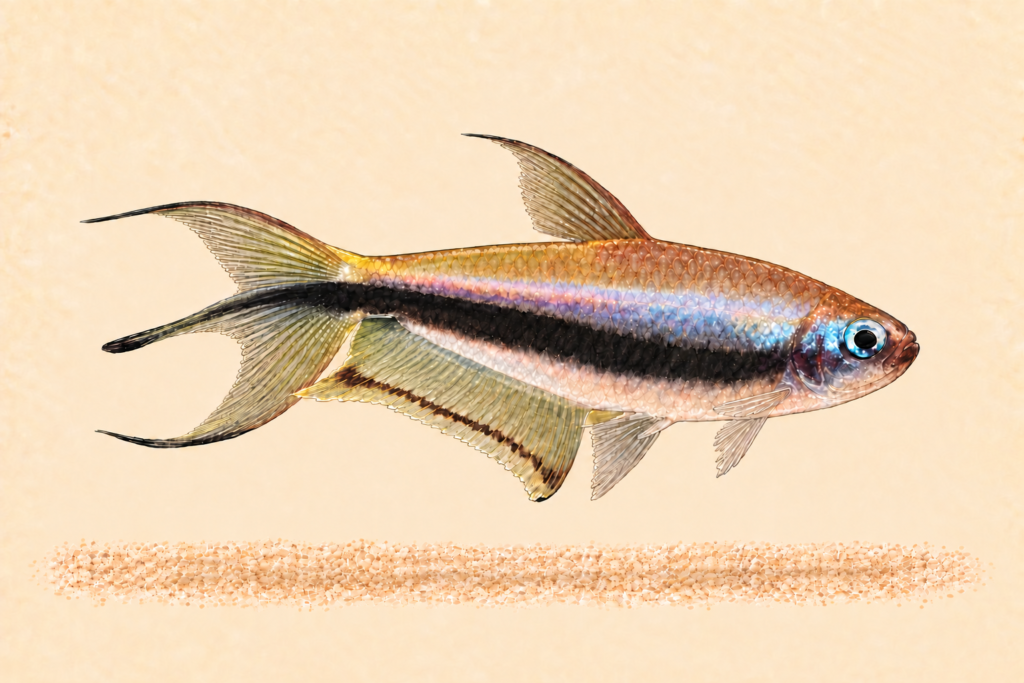
The Emperor Tetra is a fish that rewards careful observation. At first glance it may appear as a rather subdued, dark-bodied tetra, but under good lighting and in optimal conditions its full splendour becomes apparent. The body is moderately deep and laterally compressed, with a gently arched dorsal profile that lends it a somewhat more robust appearance than many of its slimmer tetra relatives.
The base body colour ranges from a creamy lavender to a soft blue-grey, overlaid with a broad, dark horizontal stripe that runs from the snout through the eye and along the full length of the flanks to the tail. Above and below this dark band, the scales shimmer with iridescent blues, greens, and purples that shift and change depending on the angle of light. The eyes are a striking blue-green, sometimes appearing almost turquoise, which adds considerably to the fish’s expressive appearance.
Sexual dimorphism in Emperor Tetras is pleasingly pronounced, making sexing mature specimens relatively straightforward. Males are the more colourful sex, developing deeper, more saturated body tones and longer, more elaborate finnage as they mature. The dorsal fin in males becomes distinctly pointed and elongated, while the anal fin also extends further than in females. Most characteristically, the central rays of the male’s caudal fin extend beyond the upper and lower lobes, creating a distinctive three-pronged or trident shape that is unique among common aquarium tetras. The eyes of males also tend to be a more vivid blue-green. Females are slightly smaller, rounder in the body (particularly when gravid), and have shorter, more rounded fins. Their colouration, while still attractive, is less intense, with a more brownish or olive tone compared to the richer purple-blue of males.
Varieties and Morphs
While the Emperor Tetra does not have as many commercially available morphs as some other popular aquarium species, there are a few noteworthy variants that appear in the trade. The most significant is the Black Emperor Tetra, sometimes sold under the name Nematobrycon palmeri “Black” or simply as the Black Emperor. This variant displays a dramatically darker overall colouration, with the dark lateral band expanding to cover much of the body, giving the fish an almost entirely deep purple-black appearance. The iridescent highlights remain visible, creating a stunning contrast. Black Emperors are particularly popular in planted aquascapes where their dark silhouettes stand out beautifully against green foliage.
It is important to note that the closely related species Nematobrycon lacortei, commonly known as the Rainbow Emperor Tetra, is sometimes confused with or sold alongside Nematobrycon palmeri. While N. lacortei is a separate species rather than a morph, it shares the same genus and general body shape, differing primarily in its red eyes and a red-orange extension of the caudal fin rays rather than the standard dark colouration. The two species should not be housed together if breeding is intended, as hybridisation may occur. Some aquarists also report a “Blue Emperor” variant, which typically refers to particularly well-conditioned specimens of the standard form displaying heightened blue iridescence rather than a genetically distinct morph. Occasionally, an albino form surfaces in the hobby, though this remains rare and is not widely available commercially.
Natural Habitat
The Emperor Tetra originates from the tropical lowland rivers and streams of western Colombia, specifically within the Atrato and San Juan river basins. These waterways drain into the Pacific slope of the Andes and flow through dense tropical rainforest, creating a habitat characterised by warm, soft, and mildly acidic water. The streams where Emperor Tetras are found are typically slow-moving or still, with beds of leaf litter, submerged roots, fallen branches, and overhanging riparian vegetation providing abundant cover and shade.
The water in these habitats is often stained a light amber or tea colour by tannins leaching from decomposing organic matter on the substrate. Light levels beneath the forest canopy tend to be relatively low, and the fish have adapted to thrive under these subdued conditions. The substrate is usually composed of sand, fine gravel, and a thick layer of decomposing leaves. Aquatic vegetation may be present but is not always abundant, as the shaded conditions limit plant growth in some areas. Understanding this natural environment is key to replicating conditions that bring out the best in Emperor Tetras in captivity, particularly in terms of their colouration and breeding behaviour.
Tank Size and Setup
A group of Emperor Tetras can be comfortably housed in an aquarium of 75 litres or more, though a larger tank of 100 litres or above is preferable, particularly if you plan to keep them in a community setting. These fish are not overly active swimmers, but males do establish small territories, so additional space helps to distribute aggression and allows subordinate fish to retreat when necessary.
The ideal aquascape for Emperor Tetras draws inspiration from their natural habitat. A dark substrate of fine sand or small-grained gravel provides a foundation that encourages the fish to display their best colours, as they tend to pale against light-coloured substrates. Driftwood, twisted roots, and smooth bogwood pieces should be arranged to create visual barriers and sheltered areas. The addition of dried leaf litter, such as Indian almond leaves or oak leaves, is highly beneficial, not only replicating the natural environment but also releasing tannins that soften and slightly acidify the water. These leaves also promote the growth of beneficial microorganism colonies that serve as supplementary food for both adults and fry.
Live plants are an excellent addition and complement the Emperor Tetra beautifully. Species that tolerate lower light levels, such as Java Fern, Anubias, Cryptocoryne, and various mosses, are particularly well suited. Floating plants such as Amazon Frogbit or Salvinia can be used to diffuse overhead light, creating the dappled, shaded conditions these fish prefer. Avoid overly bright, open tank setups, as Emperor Tetras will appear washed out and stressed under intense illumination with no cover.
Emperor Tetras are not known jumpers under normal circumstances, but a tight-fitting lid or cover glass is always a sensible precaution, particularly during settling-in periods or if anything might startle them. Ensure that the tank has gentle to moderate water flow, as these are not fish adapted to strong currents.
Water Parameters
Emperor Tetras are adaptable fish that will tolerate a reasonable range of water conditions, but they look and behave their best when kept in soft, slightly acidic water that mimics their natural habitat. Consistency and stability of parameters are more important than hitting exact numbers, so focus on maintaining steady conditions within the recommended ranges.
| Temperature | 23–27 °C |
| pH | 5.0–7.5 |
| General hardness (GH) | 1–12 dGH |
| Ammonia | 0 ppm |
| Nitrite | 0 ppm |
| Nitrate | Below 20 ppm |
For general keeping, a pH between 6.0 and 7.0 and a temperature around 25 °C represent the sweet spot. If you intend to breed Emperor Tetras, softer and more acidic conditions, with a pH of 5.5–6.5 and a GH below 5 dGH, will significantly improve your chances of success. Regular partial water changes of around 20–25 per cent weekly will help maintain water quality and keep nitrate levels in check. If your local tap water is particularly hard or alkaline, consider using a blend of reverse osmosis water and tap water to achieve suitable parameters.
Filtration and Equipment
Emperor Tetras do not have demanding filtration requirements, but they do benefit from clean, well-oxygenated water with gentle flow. A quality hang-on-back filter or a small canister filter rated for the tank volume is more than adequate. If using a canister filter, consider directing the outflow against the glass or fitting a spray bar to diffuse the current, as Emperor Tetras prefer calm to moderate water movement and may become stressed in a strong flow.
Sponge filters are an excellent alternative, particularly in breeding setups, as they provide gentle biological filtration without any risk of trapping eggs or fry. An air-driven sponge filter also adds gentle surface agitation for gas exchange without creating excessive current. For larger community tanks, a canister filter with biological and mechanical media stages provides the most thorough filtration.
A reliable heater is essential, as Emperor Tetras are tropical fish that require stable warm temperatures. Choose a heater rated appropriately for your tank volume and pair it with a separate thermometer to verify accuracy. Lighting should be moderate to subdued. LED units with adjustable brightness or a timer-controlled photoperiod of around 8–10 hours work well, especially when combined with floating plants that naturally soften the light reaching the lower levels of the tank.
Diet and Feeding
Emperor Tetras are omnivores with a natural diet consisting primarily of small invertebrates, insect larvae, worms, and organic detritus found among the leaf litter and vegetation of their native streams. In the aquarium, they are not fussy eaters and will readily accept a wide range of foods, making them straightforward to feed.
A high-quality micro-pellet or flake food designed for small tropical fish should form the staple of their diet. Choose products with a good proportion of animal protein and avoid those that rely heavily on fillers such as wheat or soy. To enhance colouration and promote overall health, supplement this staple diet regularly with live or frozen foods. Daphnia, brine shrimp, bloodworm, mosquito larvae, and cyclops are all eagerly taken and provide essential nutrients and enrichment. Live foods in particular stimulate natural foraging behaviours and can help condition fish for breeding.
Feed Emperor Tetras two to three times daily in small portions that can be consumed within two to three minutes. Overfeeding should be avoided, as uneaten food will decompose and compromise water quality. These fish feed primarily in the mid-water column but will also pick food from the surface and occasionally forage near the substrate. Varying the diet not only ensures comprehensive nutrition but also keeps the fish active and engaged. Occasional fasting days, perhaps once a week, can be beneficial for digestive health.
Behaviour and Temperament
The Emperor Tetra is a peaceful species with a fascinating social structure that sets it apart from many other small tetras. While they are social fish that should always be kept in groups, they are not strict shoaling fish in the way that neon tetras or rummy-nose tetras are. Instead of forming tight, coordinated shoals, Emperor Tetras tend to occupy a shared territory in a loose aggregation, with individuals maintaining a degree of personal space and males periodically engaging in display behaviour.
Males are mildly territorial and will establish small domains within the aquarium, often centred around a favoured piece of décor or a particularly attractive patch of plants. Rival males engage in ritualised sparring that is more theatrical than harmful. These displays typically involve the fish positioning themselves side by side with fins fully flared, intensifying their colours and quivering at each other. Actual physical contact is rare, and these interactions are a genuinely captivating aspect of keeping the species. To allow for this natural behaviour without any single male being overly harassed, keep Emperor Tetras in groups of at least six, with a ratio of two or three females per male being ideal.
Towards other species, Emperor Tetras are reliably peaceful and make excellent community tank inhabitants. They are not fin nippers and rarely show aggression beyond their own kind. They can, however, be somewhat timid if housed with boisterous or significantly larger tank mates, and may retreat to cover and become reluctant to feed. A well-planted tank with plenty of refuges helps to build their confidence. When kept in appropriate conditions with compatible companions, Emperor Tetras are bold, inquisitive, and remarkably engaging fish to watch.
Tank Mates
Emperor Tetras are well suited to peaceful community aquariums containing other small, non-aggressive species. Their calm demeanour and preference for mid-water occupation mean they coexist harmoniously with a wide variety of fish, invertebrates, and bottom-dwellers. The best tank mates share similar water parameter preferences and temperaments, creating a balanced and stress-free environment. Avoid species that are overly boisterous, aggressive, or large enough to view Emperor Tetras as potential prey.
Good tank mates
- Cardinal Tetra, a similarly peaceful characin that thrives in the same soft, acidic water conditions and complements the Emperor Tetra’s colouration beautifully.
- Rummy-Nose Tetra, another gentle shoaling tetra that occupies similar water column space and shares compatible water parameter requirements.
- Corydoras sterbai, a peaceful bottom-dweller that stays out of the Emperor Tetra’s territory and helps keep the substrate clean.
- Otocinclus, a small, docile algae-eating catfish that poses no threat and appreciates the same calm, planted environments.
- Harlequin Rasbora, a gentle, easy-going shoaling fish with overlapping water parameter preferences and a complementary orange-copper colouration.
- Kuhli Loach, a shy, nocturnal bottom-dweller that coexists peacefully and adds interest to the lower levels of the tank.
- Honey Gourami, a calm, small labyrinth fish that occupies the upper water column and is far too placid to cause any issues.
- Amano Shrimp, a robust invertebrate that is too large to be eaten by Emperor Tetras and provides useful algae control.
- Cherry Shrimp, generally compatible, though adult shrimp are safe while very small juveniles may occasionally be taken as food.
- Bristlenose Pleco, a peaceful algae-eating catfish that stays primarily on surfaces and the substrate, well out of the Emperor Tetra’s way.
Fish to avoid
- Tiger Barb, a notorious fin nipper that is likely to harass Emperor Tetras, particularly males with their extended finnage.
- Convict Cichlid, far too aggressive and territorial, especially when breeding, and will bully or injure Emperor Tetras.
- Oscar, a large predatory cichlid that will readily consume any fish small enough to fit in its mouth.
- Red-Tail Shark, Territorial and aggressive, particularly towards fish occupying the lower to mid-water levels.
- African Cichlids, Require hard, alkaline water and are typically far too aggressive for peaceful community fish like Emperor Tetras.
- Jack Dempsey, a large, aggressive cichlid that is entirely unsuitable for housing with small, peaceful tetras.
- Bucktooth Tetra, despite being a tetra, this species is a notorious scale-eater and will attack tank mates.
- Green Terror, an aggressive, predatory cichlid that poses a serious threat to small community fish.
Breeding
Breeding Emperor Tetras is an achievable goal for dedicated hobbyists, though it requires a little more preparation and attention than some of the easier egg-scattering tetras. The species is an egg scatterer that shows no parental care, and adults will readily consume their own eggs and fry if given the opportunity. For this reason, a separate breeding setup is strongly recommended.
Begin by conditioning a selected pair or small group with frequent offerings of high-quality live and frozen foods for one to two weeks. This dietary enrichment helps females develop eggs and brings both sexes into peak breeding condition. During conditioning, males will intensify their colours and increase their display activity, while females will become noticeably rounder as they fill with eggs.
The breeding tank need not be large; a 20–30 litre aquarium is sufficient. Fill it with soft, acidic water with a pH of 5.5–6.5 and a temperature of around 26–27 °C. The GH should ideally be below 5 dGH. Use a sponge filter set to a gentle flow for filtration, and keep lighting dim. The bottom of the tank should be covered with fine-leaved plants such as Java Moss or spawning mops, which provide a substrate for the eggs to fall into and offer some protection from the parents. Alternatively, a mesh or grid placed above the base can prevent the adults from reaching fallen eggs.
Introduce the conditioned pair to the breeding tank in the evening. Spawning typically occurs the following morning and involves the male displaying intensely to the female, flaring his fins and leading her into the plant thickets. The female deposits eggs among the vegetation in small batches, with the male fertilising them as they are released. A single spawning event can produce anywhere from 50 to over 100 eggs, though counts vary depending on the size and condition of the female.
Once spawning is complete, remove the adults immediately to prevent egg predation. The eggs are small, semi-transparent, and slightly adhesive. They are also sensitive to light and fungal infection, so keep the tank dimly lit and consider adding a few drops of methylene blue to inhibit fungus growth. Hatching occurs within 24 to 48 hours at 26 °C, and the tiny fry will become free-swimming after a further three to four days once they have absorbed their yolk sacs.
Free-swimming fry are extremely small and require infusoria, commercially available liquid fry food, or freshly hatched baby brine shrimp nauplii as their first foods. Feed small amounts several times daily, keeping the water scrupulously clean with gentle siphoning and small partial water changes using water of identical parameters. As the fry grow, they can be graduated onto larger foods such as micro-worms and finely crushed flake. Growth is steady, and young Emperor Tetras begin to show their adult colouration from around eight to ten weeks of age.
Common Diseases
Emperor Tetras are generally hardy fish that are not particularly susceptible to any species-specific diseases. However, like all aquarium fish, they can be affected by common freshwater ailments if water quality deteriorates or if they are subjected to chronic stress from poor husbandry, inappropriate tank mates, or sudden changes in water parameters.
Ich, or white spot disease, caused by the parasite Ichthyophthirius multifiliis, is one of the most frequently encountered illnesses. It presents as small white spots covering the body and fins, accompanied by flashing behaviour as the fish attempts to rub against surfaces to relieve irritation. Ich is highly treatable if caught early, using commercially available ich medications and by gradually raising the water temperature to around 28–30 °C over a few days to accelerate the parasite’s life cycle.
Fin rot is another condition that may occur, typically as a result of poor water quality or physical damage to the fins. It manifests as fraying, discolouration, or erosion of the fin edges and, if left untreated, can progress to more serious bacterial infections. Maintaining pristine water quality through regular water changes and adequate filtration is the best prevention, and mild cases often resolve simply by improving conditions. More advanced cases may require treatment with a broad-spectrum antibacterial medication.
Fungal infections can appear as white or grey cotton-like growths on the body or fins, often developing on damaged tissue. These respond well to antifungal treatments available at most aquarium retailers. Neon tetra disease, caused by the microsporidian parasite Pleistophora hyphessobryconis, is a concern for many small characins including Emperor Tetras, though it is less commonly reported in this species. It causes loss of colour, muscle wasting, and erratic swimming, and unfortunately there is no effective treatment. Affected fish should be removed and humanely euthanised to prevent spread.
Internal parasites can occasionally affect Emperor Tetras, particularly wild-caught or recently imported specimens. Symptoms include weight loss despite a healthy appetite, white or stringy faeces, and a generally emaciated appearance. Anti-parasitic medications containing praziquantel or levamisole can be effective against common internal parasites. As with all fish health matters, prevention through good husbandry, quarantine of new arrivals, and a nutritious varied diet is far more effective than treating disease after the fact.
FAQs
How many Emperor Tetras should I keep together?
Emperor Tetras should be kept in groups of at least six, though eight or more is preferable. A larger group allows for natural social interactions, distributes any male-to-male rivalry, and makes the fish feel more secure. In groups that are too small, subdominant fish may be persistently harassed, and the fish tend to be less confident and display less vibrant colours.
Are Emperor Tetras suitable for a planted aquarium?
Emperor Tetras are among the best tetras for planted aquariums. They do not eat or uproot plants and actually look their finest when housed in a well-planted setup with subdued lighting. The dark greens of plants like Java Fern, Anubias, and Cryptocoryne provide a stunning backdrop that highlights the fish’s iridescent colouration. Floating plants are also beneficial, as they create the dappled light conditions these fish naturally prefer.
Can Emperor Tetras be kept with shrimp?
Adult Emperor Tetras are generally safe with larger shrimp species such as Amano Shrimp and adult Cherry Shrimp. However, very small shrimp and newly hatched shrimplets may be viewed as food, as is the case with most fish of a similar size. If you are breeding shrimp in the same tank, provide dense plant cover, particularly mosses, to give juvenile shrimp hiding spots and improve their survival rate.
Do Emperor Tetras need soft water?
While Emperor Tetras thrive best in soft, slightly acidic water that reflects their natural habitat, they are more adaptable than many hobbyists assume. Most captive-bred specimens will do well in moderately hard water with a neutral pH, provided the conditions are stable and the water quality is maintained. However, if you wish to breed them, soft acidic water with a GH below 5 dGH and a pH of 5.5–6.5 is strongly recommended for good egg viability and hatching rates.
What is the difference between the Emperor Tetra and the Rainbow Emperor Tetra?
The Emperor Tetra (Nematobrycon palmeri) and the Rainbow Emperor Tetra (Nematobrycon lacortei) are two distinct species within the same genus. The most reliable way to tell them apart is by eye colour: N. palmeri has blue-green eyes, whereas N. lacortei has distinctly red eyes. Additionally, N. lacortei typically displays more red or orange in the extended central caudal fin rays. Both species have similar care requirements, but they should ideally be kept separately to avoid potential hybridisation.
Related Guides
- Cardinal Tetra Care Guide, another South American tetra that shares similar water parameter preferences and makes an excellent companion species.
- Black Neon Tetra Care Guide, a hardy, similarly sized tetra with complementary dark colouration that thrives in the same type of planted community setup.
- Corydoras sterbai Care Guide, a popular warm-water bottom-dweller that pairs well with Emperor Tetras in community aquariums.
- How to Set Up a Blackwater Aquarium, a guide to creating the tannin-stained, soft-water environments in which Emperor Tetras look and feel their best.
- Honey Gourami Care Guide, a peaceful surface-dwelling companion that complements Emperor Tetras in temperament and habitat preferences.