Quick summary
The Banded Corydoras is a striking, larger-than-average catfish with bold markings and real personality, but it prefers cooler water than most tropical fish, so it works best in a subtropical or unheated setup alongside compatible species. If you can provide a spacious tank with clean, slightly cool water and a soft substrate, this fish will reward you with fascinating behaviour and good looks for years.
🐠 Build a tank around this species
- Introduction
- Quick stats
- Appearance
- Natural habitat
- Tank size and setup
- Water parameters
- Filtration and equipment
- Diet and feeding
- Behaviour and temperament
- Tank mates
- Breeding
- Common diseases and health
- Frequently asked questions
- Related guides
Introduction
The Banded Corydoras, scientifically known as Scleromystax barbatus, is one of the most visually impressive members of the broader Corydoras family. Formerly classified under the genus Corydoras, it was moved to Scleromystax to reflect differences in body shape, size, and breeding behaviour. Despite the reclassification, fishkeepers still commonly refer to it as the Banded Cory or Bearded Catfish, and it remains a sought-after species for planted and subtropical community tanks.
People love this fish for a few good reasons. Males develop an extraordinary golden-spotted face and prominent cheek bristles that become especially pronounced during breeding season, giving the species an almost regal appearance. Beyond the looks, they have a relaxed, sociable temperament and spend their time rooting through the substrate, foraging together in a way that is genuinely entertaining to watch. They also tend to be hardier than some of the smaller, more delicate Corydoras species, provided their cooler temperature preference is respected.
This species suits intermediate keepers who have a cycled tank and a basic understanding of water quality management. It is not a difficult fish to keep, but its need for cooler water, a larger footprint than typical corys, and its sensitivity to poor substrate conditions mean beginners should have at least one successful tank under their belt before taking it on. If you are already comfortable maintaining stable water parameters and choosing appropriate tank mates, the Banded Corydoras is a wonderful next step.
Quick stats
| Scientific name | Scleromystax barbatus |
| Family | Callichthyidae |
| Origin | Coastal rivers and streams of southeastern Brazil (Rio de Janeiro and São Paulo states) |
| Adult size | Up to 10 cm (males), females slightly smaller at around 7 to 8 cm |
| Lifespan | 5 to 8 years |
| Difficulty | Intermediate |
| Breeding difficulty | Moderate |
| Temperature | 18 to 24 °C |
| pH range | 6.0 to 7.5 |
| Minimum tank size | 250 L |
| Conservation status | Least Concern (IUCN, assessed 2018) |
Appearance
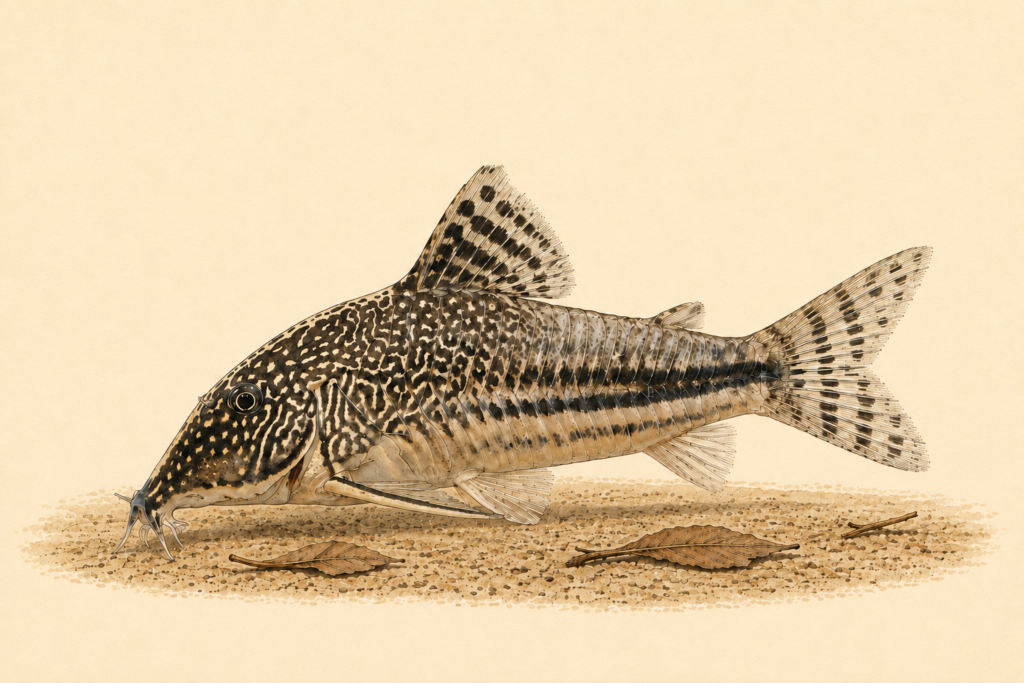
The Banded Corydoras is a robust, somewhat elongated catfish that stands out immediately among the smaller, rounder Corydoras species. Its base colour ranges from creamy yellow to light brown, overlaid with a dense pattern of dark brown to black spots and irregular bands that run along the flanks. The head and snout are usually covered in a fine scatter of golden or yellowish spots, which become especially vivid in dominant males. The fins are large relative to the body, and the dorsal fin often carries dark markings. Overall, the fish has a solid, muscular build that hints at its active, bottom-dwelling lifestyle.
Sexual dimorphism is more pronounced in this species than in most corys. Males grow larger, develop thicker pectoral fin spines, and, most distinctively, grow bristle-like odontodes (small bony projections) on their cheeks and along the sides of the head. During breeding condition, these bristles become especially noticeable and give rise to the common name “Bearded Catfish.” Males also tend to show more golden colouration on the face. Females are smaller, rounder in the belly when viewed from above, and lack the cheek bristles, making sexing relatively straightforward once the fish reach maturity.
Natural habitat
Scleromystax barbatus is found in the coastal river systems of southeastern Brazil, primarily in the states of Rio de Janeiro and São Paulo. These are typically clear, moderately flowing streams and small rivers that run through Atlantic Forest, a highly biodiverse and increasingly threatened biome. The water in these habitats tends to be slightly acidic to neutral, soft to moderately hard, and notably cooler than the warm lowland rivers where many popular tropical species originate.
The substrates in these streams are a mix of sand, fine gravel, and leaf litter, with rocks and submerged wood providing cover. Seasonal temperature swings are common, with cooler periods dropping well below 20 °C. Understanding this natural environment is essential for keeping the species successfully in captivity. Warm, stagnant tanks will stress them, while a well-oxygenated, slightly cool setup with a soft substrate and plenty of hiding spots will bring out their best behaviour and colour.
Tank size and setup
A group of four to six Banded Corydoras should be housed in a tank of at least 115 litres, with a preference for tanks that offer a large footprint rather than height. These fish spend virtually all their time on the bottom, so floor space matters far more than water column depth. A 90 cm by 30 cm base or larger is a sensible starting point. If you want a bigger group, add roughly 15 litres per additional fish.
Substrate choice is critical. Fine sand, such as pool filter sand or a dedicated aquarium sand like JBL Sansibar or CaribSea Super Naturals, is the best option. Coarse or sharp gravel can damage their delicate barbels over time, leading to erosion and secondary infections. A natural sand colour complements their markings nicely and encourages natural foraging behaviour.
For plants, choose species that tolerate cooler water. Java Fern (Microsorum pteropus), Anubias, Java Moss (Taxiphyllum barbieri), and Cryptocoryne wendtii are all good choices. Vallisneria spiralis is another option that thrives in the low-to-mid 20s and adds vertical structure to the background. Floating plants like Amazon Frogbit can help diffuse bright light, which the fish appreciate.
Driftwood and smooth rocks should be used to create sheltered areas and break up sightlines. A scattering of dried Indian almond leaves or oak leaves on the substrate adds a natural touch and releases mild tannins that can benefit water quality. Lighting should be moderate, as these catfish are not fond of harsh, direct light and will be more active in slightly subdued conditions. A gentle to moderate water flow across the tank replicates their natural stream habitat nicely without creating strong currents that batter smaller tank mates.
Water parameters
| Parameter | Ideal range |
|---|---|
| Temperature | 18 to 24 °C |
| pH | 6.0 to 7.5 |
| General hardness (GH) | 2 to 15 dGH |
| Ammonia | 0 ppm |
| Nitrite | 0 ppm |
| Nitrate | Below 20 ppm |
The cooler temperature preference is the single most important parameter to get right. Keeping the Banded Corydoras at 26 °C or above for extended periods will stress the fish, shorten their lifespan, and increase susceptibility to disease. Many keepers in temperate climates can house them in an unheated indoor tank, as room temperature often sits comfortably in the 18 to 22 °C range through much of the year. A heater set to 20 or 21 °C can be used as a safety net to prevent temperatures from dipping too low in winter, but full tropical heating is not needed. Keep nitrates low with regular weekly water changes of around 25 to 30%, and always dechlorinate new water before adding it to the tank.
Filtration and equipment
A quality canister filter or a large internal filter is the best choice for a Banded Corydoras tank. Canister filters like the Fluval 207 or Eheim Classic 250 provide strong biological and mechanical filtration while allowing you to control the outflow rate. These fish appreciate well-oxygenated water, so positioning the return nozzle to create gentle surface agitation is helpful. Sponge filters can also work, especially in a breeding setup, and have the added benefit of being completely safe for fry.
As mentioned, a heater is often optional depending on your room temperature, but a reliable adjustable heater such as the Eheim Jager or Fluval M series set to around 20 to 21 °C provides peace of mind in cooler months. A good thermometer, either a digital probe or a glass stick-on, is essential for monitoring temperature.
A reliable water testing kit is non-negotiable. The API Freshwater Master Test Kit covers ammonia, nitrite, nitrate, and pH, and is the most cost-effective option for regular testing. Test weekly, or more often if you notice behavioural changes, and always test during the cycling phase before adding any fish.
Diet and feeding
In the wild, Scleromystax barbatus is an omnivorous bottom feeder that sifts through sand and leaf litter for insect larvae, worms, microcrustaceans, and plant detritus. In captivity, replicating this varied diet is straightforward and keeps the fish healthy and vibrant.
A high-quality sinking pellet or wafer should form the staple. Hikari Sinking Wafers, Sera Catfish Chips, or Northfin Kelp Wafers are all reliable options. Supplement these several times a week with frozen or live foods such as bloodworm, daphnia, brine shrimp, and tubifex. Live blackworms are an especially prized treat and help condition fish for breeding. Blanched vegetables like courgette (zucchini) slices, cucumber, and spinach are usually accepted and add variety.
Feed once or twice daily, offering only as much food as the group can consume within two to three minutes. Because these catfish feed on the bottom, make sure food actually reaches them, especially in community tanks where mid-water fish may intercept sinking pellets before they land. Feeding just after lights-out can help ensure the corys get their share, as they tend to become more active in dim conditions.
Behaviour and temperament
The Banded Corydoras is a peaceful, social fish that does best in groups of at least four to six. In a group, they spend much of the day foraging together, methodically working their way across the substrate and occasionally darting to the surface to take a gulp of air, a behaviour common to all callichthyids and completely normal. They tend to be most active during dawn, dusk, and after dark, resting in sheltered spots during the brightest parts of the day.
Males can be mildly competitive with each other, particularly during breeding season, and you may see brief displays of posturing or chasing. This is rarely harmful and is part of their natural social dynamic. Having more females than males (a ratio of roughly two females per male) helps reduce any tension. Unlike some of the smaller cory species that can seem timid or easily startled, the Banded Corydoras is relatively bold once settled, and it tends to become more confident and visible in a well-planted tank with plenty of cover.
Tank mates
Good tank mates
- White Cloud Mountain Minnow, an excellent match because it also thrives in cooler, subtropical temperatures
- Zebra Danio, a hardy, active mid-water fish comfortable in cooler water and peaceful enough not to cause trouble
- Rosy Barb, tolerates the same temperature range and adds lively colour to the mid-water zone
- Bristlenose Pleco, a peaceful bottom dweller that coexists well and can handle cooler subtropical setups
- Cherry Shrimp, safe companions in a well-planted tank, unlikely to be bothered by these catfish
- Peppered Corydoras, another cool-water cory that occupies the same temperature range and gets along well
- Hillstream Loach, enjoys similar cooler, well-oxygenated conditions and stays out of direct competition for food
Fish to avoid
- Discus, requires much warmer water (28 to 30 °C) and a completely different setup
- Oscar, large, predatory cichlid that would view Banded Corydoras as food
- Tiger Barb, a known fin nipper that can harass slow-moving bottom dwellers
- Common Pleco, grows far too large and can become territorial over bottom space
- Betta, prefers warmer water and calm conditions, and the temperature mismatch makes cohabitation impractical
- Aggressive cichlids such as Convict Cichlids, will bully and stress these peaceful catfish
Breeding
Breeding the Banded Corydoras is achievable for hobbyists with some experience, though it requires a bit more effort than breeding the common Bronze or Peppered Cory. Sexing adults is fairly easy once they mature. Males are larger, more colourful, and develop the characteristic cheek bristles and thicker pectoral fin spines. Females are rounder in the belly and lack the facial ornamentation.
To condition a breeding group, increase the proportion of protein-rich live and frozen foods in their diet for two to three weeks. Bloodworm, blackworm, and daphnia are all good conditioning foods. A large, cooler water change simulating seasonal rain is often the trigger for spawning. Drop the temperature by two to three degrees with a 50% water change using slightly cooler, soft water, and raise it back gradually over the following day. This simulates the cool rain events that trigger breeding in their native streams.
Spawning follows the classic “T position” seen in many corydoradine catfish. The female holds a small number of eggs between her pelvic fins while the male fertilises them, and she then deposits the adhesive eggs onto flat surfaces such as plant leaves, tank glass, or smooth rocks. A single spawning event can produce 50 to 100 or more eggs. The parents do not guard the eggs and may eat them if given the opportunity, so either remove the adults after spawning or carefully transfer the eggs to a separate hatching container with gentle aeration and a few drops of methylene blue to prevent fungal growth.
Eggs typically hatch in four to six days depending on temperature. The fry are tiny and will initially feed on their yolk sacs before becoming free-swimming. First foods should include infusoria, microworm, or commercially prepared fry food such as Hikari First Bites. After a week or two, they can graduate to freshly hatched baby brine shrimp. Keep the fry tank scrupulously clean with small daily water changes, and growth will be steady if food is plentiful and water quality remains high.
Common diseases and health
Barbel erosion. This is one of the most common issues in all bottom-dwelling catfish and is almost always caused by keeping them on sharp or dirty substrate. Symptoms include shortened, reddened, or missing barbels. Prevention is straightforward: use fine, smooth sand and keep the substrate clean with regular light vacuuming. If erosion has already occurred, improving substrate quality and water conditions will usually allow the barbels to regrow over several weeks.
Ich (white spot disease). Ichthyophthirius multifiliis presents as small white spots across the body and fins, often accompanied by flashing (rubbing against surfaces) and lethargy. Because Banded Corydoras are scaleless catfish, they are sensitive to many standard ich medications, so always use a half dose of malachite green or formalin-based treatments and avoid copper-based remedies. Raising the temperature slightly (to around 24 °C) alongside treatment can speed up the parasite’s lifecycle and improve treatment effectiveness.
Bacterial infections. Red patches, fin rot, or cloudy eyes can indicate a bacterial issue, usually secondary to poor water quality or injury. Maintain pristine water conditions and treat with a fish-safe antibacterial such as eSHa 2000 or API Melafix for mild cases. Severe infections may require stronger antibiotics and should ideally be treated in a quarantine tank.
Speaking of quarantine, always isolate new fish for at least two to three weeks before adding them to your main display tank. A simple quarantine setup with a sponge filter, heater (if needed), and a few hiding spots is all that is required. This single practice will prevent most disease introductions and save you a great deal of stress and expense in the long run.
Frequently asked questions
Do Banded Corydoras need a heater?
In many homes, especially in temperate climates, a heater is not strictly necessary as long as the room temperature stays above 18 °C. However, a heater set to around 20 °C provides a useful safety margin during colder months. The key is to avoid letting the water get too warm, as these fish are stressed by sustained temperatures above 24 °C.
How many Banded Corydoras should I keep together?
A minimum group of four is recommended, with six or more being ideal. They are social fish that display more natural behaviour and feel more secure in a group. Keeping them singly or in pairs often leads to shy, stressed fish that hide constantly.
Can Banded Corydoras live with tropical fish?
They can live with tropical species that tolerate the lower end of the tropical range, around 22 to 24 °C. However, pairing them with fish that need temperatures of 26 °C or higher, such as Discus or Rams, will compromise the health of one species or the other. Choose tank mates that share the subtropical to lower tropical range.
Why is my Banded Corydoras gulping air at the surface?
This is completely normal behaviour for all Corydoras and Scleromystax species. They possess a modified intestine that allows them to absorb atmospheric oxygen. Occasional trips to the surface are nothing to worry about. However, if the fish is doing it constantly and seems distressed, check your water quality and oxygen levels, as it can indicate low dissolved oxygen or poor water conditions.
Is the Banded Corydoras the same as Corydoras barbatus?
Yes, they are the same fish. The species was originally described as Corydoras barbatus but was later reclassified into the genus Scleromystax based on morphological differences. You will still see it listed under both names in shops and online, so do not be confused. The correct current scientific name is Scleromystax barbatus.
Related guides
- Banded Corydoras breeding guide
- Banded Corydoras tank setup and equipment guide
- Banded Corydoras diet and feeding guide
- Best tank mates for Banded Corydoras
- Banded Corydoras diseases and health guide
- Why is my Banded Corydoras losing colour?
- Back to the fish species directory
- Beginner’s guide to cycling your tank