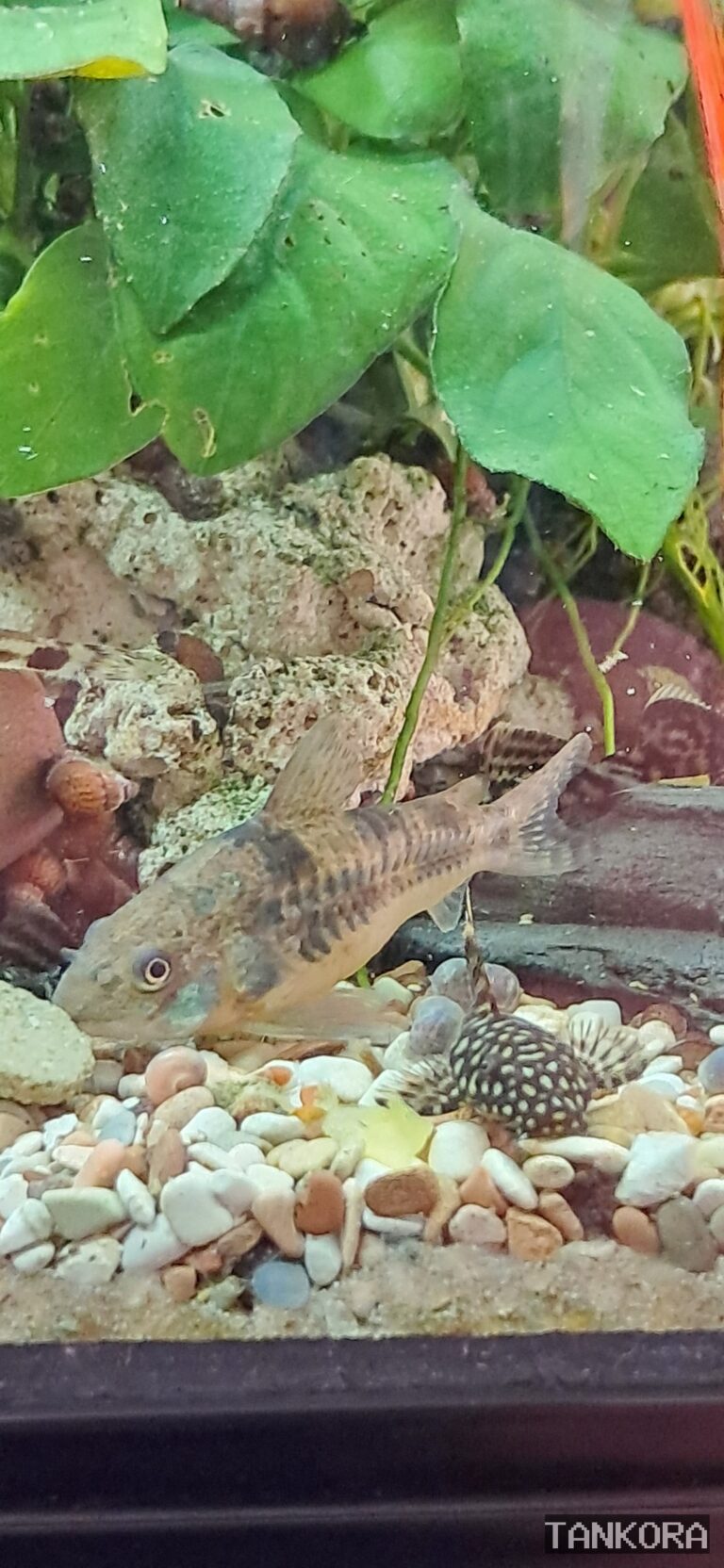
Quick Summary
The Peppered Corydoras is one of the hardiest and most beginner-friendly bottom-dwelling catfish available, tolerating cooler subtropical temperatures that most tropical fish cannot handle – ideal for unheated indoor aquariums or community tanks kept at the lower end of the tropical range, provided you keep them in groups of six or more on a soft sand substrate.
🐠 Build a tank around this species
In this guide:
- Introduction
- Quick Stats
- Appearance
- Varieties and Morphs
- Natural Habitat
- Tank Size and Setup
- Water Parameters
- Diet and Feeding
- Behaviour and Temperament
- Tank Mates
- Breeding
- Common Diseases
- FAQs
- Related Guides
Introduction
The Peppered Corydoras has been a staple of the freshwater aquarium hobby for well over a century, and with good reason. First described scientifically by Jenyns in 1842, this unassuming little armoured catfish from South America was among the very first tropical fish to be bred in captivity, with successful spawnings documented in Europe as far back as the 1870s. It remains one of the most widely available and affordable Corydoras-type species in the trade today, found in virtually every aquarium shop around the world.
Taxonomically, this species has recently undergone a significant reclassification. Following a major revision of the Corydoradinae subfamily published in 2024, the Peppered Corydoras was moved from the genus Corydoras into Hoplisoma. Its current valid scientific name is therefore Hoplisoma paleatum. However, the overwhelming majority of shops, books, websites, and hobbyists still refer to it as Corydoras paleatus, and you will see this older name on tank labels, online listings, and in older literature for years to come. Both names refer to the same fish, so do not be confused if you encounter either.
What sets the Peppered Corydoras apart from most of its relatives is its tolerance of cooler water temperatures. While the majority of Corydoras-type species hail from warm tropical lowlands and require water in the mid-to-upper twenties Celsius, Hoplisoma paleatum originates from more temperate and subtropical regions of South America. This means it can thrive in water as cool as 18 degrees Celsius, making it one of very few species in its family suitable for unheated indoor aquariums in temperate climates. This cool tolerance, combined with its hardiness, peaceful nature, and entertaining behaviour, makes it an exceptional choice for beginners and experienced aquarists alike.
Quick Stats
| Scientific name | Hoplisoma paleatum (formerly Corydoras paleatus) |
|---|---|
| Common names | Peppered Catfish, Peppered Cory, Salt and Pepper Cory, Blue Leopard Corydoras |
| Family | Callichthyidae |
| Origin | South America (Argentina, Uruguay, southern Brazil, Paraguay) |
| Adult size | 6 cm |
| Lifespan | 5–8 years |
| Difficulty | Easy |
| Breeding difficulty | Easy |
| Temperature | 18–24 °C |
| pH | 6–7.5 |
| GH | 2–15 dGH |
| KH | 1–10 dKH |
| Minimum tank size | 70 L |
| Conservation status | Least Concern (IUCN) |
Appearance
The Peppered Corydoras is a compact, robust little catfish with the classic Corydoras body shape – a rounded, somewhat flattened belly, a high-arched back, and a blunt, downturned snout flanked by two pairs of sensitive barbels used for foraging along the substrate. Like all members of the Callichthyidae family, its body is protected by two rows of overlapping bony plates (scutes) rather than traditional scales, giving it a subtly armoured appearance. The dorsal, pectoral, and adipose fins each bear a stiff, sharp leading spine that can lock into position as a defence mechanism – a feature worth being aware of when netting these fish, as the spines can easily become entangled in fine mesh.
The base body colour is a pale olive to silvery-grey, liberally speckled and mottled with dark greenish-black or charcoal patches and spots – the distinctive “peppered” pattern that gives the species its common name. The patterning is highly variable between individuals; some fish display dense, almost uniform dark mottling across the flanks, while others show more discrete, well-separated spots and blotches against a paler background. A prominent dark marking typically runs from the base of the dorsal fin down through the eye, and the dorsal fin itself usually bears a bold dark blotch or band. The remaining fins are generally clear to lightly spotted. Under good conditions and appropriate lighting, the flanks can exhibit a subtle iridescent green or bluish sheen, particularly noticeable in mature specimens.
Females tend to be noticeably larger and broader-bodied than males when viewed from above, especially when in breeding condition and carrying eggs. Males are generally more slender and slightly smaller, with a more pointed dorsal fin. In the standard form, fin lengths are moderate and proportional to the body, though the popular Long-Fin variant (discussed below) alters this considerably.
Varieties and Morphs
While the wild-type Peppered Corydoras remains by far the most commonly sold form, a well-established captive-bred variant is widely available in the aquarium trade.

The Long-Fin Peppered Corydoras (also sold as the Hi-Fin Peppered Cory) is a selectively bred variant in which the dorsal, pectoral, ventral, and anal fins are significantly elongated compared to the standard form. The dorsal fin, in particular, can become impressively tall and flowing, sometimes reaching a length that rivals or exceeds the depth of the fish’s body. The pectoral fins also extend noticeably, trailing elegantly as the fish swims along the substrate. The overall body shape, colouration, and patterning remain identical to the wild-type – the same peppered olive-grey markings are present – so the variant is distinguished purely by its exaggerated finnage. This is a stable, heritable trait that breeds true when Long-Fin individuals are crossed with one another, though crossing a Long-Fin with a standard-fin fish typically produces offspring with intermediate fin lengths.
The Long-Fin variant is readily available in most well-stocked aquarium shops, often at a modest premium over the standard form. Care requirements are identical in every respect. It is worth noting that the elongated fins can be slightly more susceptible to damage from rough substrates or boisterous tank mates, so particular attention to providing a smooth sand substrate and peaceful companions is advisable. Some hobbyists also report that Long-Fin males can be marginally less agile during the vigorous chasing involved in courtship, though breeding success is generally not impaired.
Unlike some other popular Corydoras-type species, the Peppered Corydoras has not been selectively bred into albino or other colour morphs to any significant commercial extent. Occasional albino individuals have been reported, but they are not commonly available in the trade as a named variant.
Natural Habitat
The Peppered Corydoras is native to the temperate and subtropical river systems of south-eastern South America, with its range spanning parts of Argentina (particularly the Rio de la Plata basin and its tributaries), Uruguay, southern Brazil (Rio Grande do Sul), and Paraguay. This is a notably more southerly distribution than most Corydoras-type species, and the climate across much of this range is significantly cooler than the warm tropical lowlands inhabited by the majority of its relatives. Seasonal water temperatures in these regions can drop to 15-16 degrees Celsius during winter months and rarely exceed 24-25 degrees Celsius even at the height of summer.
In the wild, Peppered Corydoras inhabit slow-moving to moderately flowing streams, rivers, tributaries, and shallow floodplain lagoons. The substrate in their native habitats is typically composed of sand, fine gravel, or mud, often covered with a layer of decomposing leaf litter and organic detritus. Marginal vegetation, submerged roots, and fallen branches provide cover and foraging opportunities. The water is generally clear to slightly tannin-stained, soft to moderately hard, and slightly acidic to neutral in pH.
These fish are strictly benthic, spending the vast majority of their time on or very near the substrate, systematically sifting through sand and sediment with their barbels in search of small invertebrates, insect larvae, worms, and organic matter. They are social animals found in loose aggregations in the wild, often numbering dozens or even hundreds of individuals in favourable habitats. This gregarious nature is a critical aspect of their biology that must be replicated in captivity.
It is worth noting that the Peppered Corydoras has been introduced to waters well outside its native range, including parts of North America, Europe, and East Asia, likely through releases by aquarists. Established feral populations exist in several countries, a testament to the species’ adaptability and hardiness.
Tank Size and Setup
A minimum tank size of 75 litres is recommended for a group of six Peppered Corydoras. This provides sufficient floor space for the fish to forage naturally, which is essential for their well-being. Because these are bottom-dwelling fish, the footprint (length and width) of the aquarium matters more than height. A tank measuring approximately 60 cm long by 30 cm wide at the base is a good starting point. If you plan to keep a larger group – which is always preferable – or house them in a community setting with other species, scale up accordingly. A 100 to 150 litre tank provides a much more comfortable environment for a mixed community.
The single most important aspect of the setup is the substrate. Peppered Corydoras, like all Corydoras-type catfish, feed by sifting through the substrate with their sensitive barbels. Coarse gravel, sharp-edged substrates, or rough materials will abrade and damage these delicate sensory organs, leading to erosion, infection, and significant distress. A fine, smooth, rounded sand is essential. Play sand, pool filter sand, or purpose-sold aquarium sand are all suitable options. Avoid any substrate with sharp or angular grains.
Decor should include plenty of cover to make the fish feel secure. Driftwood, smooth stones and pebbles, clay pots or coconut shells, and live or artificial plants all serve this purpose well. Peppered Corydoras do not eat or damage live plants, so a well-planted tank is entirely compatible with keeping them. Floating plants can be useful for diffusing overhead light, as these fish prefer moderate lighting and can appear skittish under very bright, unshaded conditions. Ensure there are some open sandy areas for foraging, as well as shaded retreats where the group can rest together during quieter periods.
A secure lid or cover glass is advisable. While Corydoras-type catfish are not habitual jumpers, they are capable of gulping air from the surface (a normal behaviour related to supplementary intestinal respiration), and the occasional startled dash to the surface can result in a fish leaving the water if the tank is uncovered.
Water Parameters
One of the key advantages of the Peppered Corydoras is its flexibility regarding water parameters. It is tolerant of a broader range of temperatures and water chemistry than most tropical aquarium fish, reflecting its subtropical origins. That said, providing conditions within the optimal range will promote the best health, colouration, and longevity.
| Temperature | 18 – 24 C |
| pH | 6.0 – 7.5 |
| General hardness (GH) | 2 – 15 dGH |
| Carbonate hardness (KH) | 1 – 10 dKH |
| Ammonia | 0 ppm |
| Nitrite | 0 ppm |
| Nitrate | Below 20 ppm |
The temperature range of 18 to 24 degrees Celsius is the most notable feature here. This species genuinely thrives at the lower end of this range and should not be kept in tanks maintained at standard tropical temperatures of 25 to 28 degrees Celsius for extended periods. Sustained high temperatures (above 25 C) will stress Peppered Corydoras, shorten their lifespan, and increase susceptibility to disease. If you are setting up a community tank, choose tank mates that share a preference for cooler water rather than forcing this species into an environment that suits warm-water tropicals.
Water quality is more important than hitting a specific pH or hardness value. Peppered Corydoras are sensitive to elevated ammonia and nitrite levels, as are all fish, and they are also intolerant of high nitrate concentrations. Regular partial water changes of 25 to 30 per cent weekly are recommended to maintain low nitrate levels and good overall water quality. When performing water changes, ensure the replacement water is dechlorinated and reasonably close in temperature to the tank water to avoid thermal shock.
Filtration and Equipment
Standard aquarium filtration is perfectly adequate for Peppered Corydoras. A hang-on-back filter, internal canister filter, or sponge filter rated for the volume of the tank will all work well. Sponge filters are a particularly popular choice among Corydoras keepers and breeders because they provide gentle water flow, excellent biological filtration, and pose no risk of trapping small fish or fry. They also do not create the strong currents that powerful canister filters can produce – while Peppered Corydoras can tolerate moderate flow, they prefer calmer water and will be most active and comfortable without a strong current pushing them around the tank floor.
If using a hang-on-back or canister filter with a strong output, consider directing the flow against the back glass or using a spray bar to diffuse it. The intake should be protected with a sponge pre-filter to prevent barbels or fins from being drawn against it, and this is especially important if you intend to breed the fish, as fry can easily be sucked into unprotected intakes.
A heater is often unnecessary for this species if your home is maintained at a reasonable indoor temperature year-round. In most UK homes, room temperature during the warmer months will naturally fall within the 18 to 22 degree Celsius range that suits these fish perfectly. During winter, if the room temperature drops below 16 to 17 degrees Celsius for extended periods, a low-wattage heater set to 18 or 19 degrees Celsius can be used as a safeguard. Conversely, if you are keeping them in a heated community tank, ensure the heater is not set above 24 degrees Celsius.
Lighting should be moderate. Peppered Corydoras are most active in subdued light and at dawn and dusk. Standard LED aquarium lighting on a timer set for 8 to 10 hours daily is fine, but the addition of floating plants or shaded areas in the tank will encourage more natural, confident behaviour.
Diet and Feeding
Peppered Corydoras are omnivorous scavengers with a diet that, in the wild, consists primarily of small benthic invertebrates, insect larvae, worms, and organic detritus sifted from the substrate. In the aquarium, they are thoroughly unfussy eaters that will accept virtually any food that sinks to the bottom of the tank.
A good staple diet should be based on high-quality sinking pellets or wafers formulated for bottom-dwelling fish. These ensure the food reaches the substrate where the corydoras feed, rather than being intercepted by mid-water or surface-feeding tank mates. Supplement this staple with regular offerings of frozen or live foods such as bloodworm, daphnia, tubifex, brine shrimp, and white worms. These protein-rich foods promote excellent health, vibrant colouration, and are particularly important for conditioning fish for breeding.
Blanched vegetables such as courgette (zucchini), cucumber, or shelled peas can be offered occasionally and are usually accepted with enthusiasm. Algae wafers are also eaten, though Peppered Corydoras are not effective algae cleaners and should never be relied upon to keep a tank free of algae.
A common and harmful misconception is that corydoras can survive solely on leftover food that falls from other fish. While they will certainly scavenge uneaten food, this is not sufficient nutrition and relying on scraps will lead to malnourished, unhealthy fish. Always feed corydoras specifically and directly, ensuring enough food reaches the bottom of the tank for the entire group.
Feed once or twice daily, offering only as much food as the group can consume within a few minutes. Feeding in the evening or just after lights-out can be effective, as these fish are naturally more active during lower-light periods and will feed more confidently.
Behaviour and Temperament
Peppered Corydoras are quintessentially peaceful, social, and endlessly entertaining bottom-dwellers. They spend the majority of their waking hours methodically working their way across the substrate, probing the sand with their barbels in a characteristic snuffling, shuffling motion that is one of the great pleasures of keeping corydoras. This foraging behaviour is constant, purposeful, and fascinating to watch.
These are obligate shoaling fish that must be kept in groups. A minimum group size of six is essential, and larger groups of eight to twelve or more are strongly recommended. In insufficient numbers, Peppered Corydoras become visibly stressed, withdrawn, and inactive, spending most of their time hiding rather than displaying their natural foraging and social behaviours. In a proper-sized group, they will form a cohesive, active shoal that moves around the tank together, often resting in a tightly packed cluster in a favourite spot during quiet periods.
One behaviour that often alarms new keepers is the periodic dash to the surface to gulp air. This is completely normal and not a sign of poor water quality (though it can increase in frequency if dissolved oxygen levels are genuinely low). Corydoras-type catfish possess a modified intestine that allows them to extract oxygen from swallowed air, a supplementary respiratory mechanism that evolved in their often oxygen-poor native habitats. Occasional surface dashes are expected even in perfectly oxygenated water.
Peppered Corydoras are not territorial and show no aggression towards one another or towards other species. They are, in fact, one of the most reliably peaceful freshwater fish available. Their only defensive strategy when threatened is to lock their pectoral and dorsal spines into an erect position, making them more difficult for a predator to swallow. This is a passive defence and is never directed aggressively at tank mates.
Activity levels tend to peak during dawn, dusk, and at night. Under bright, unshaded lighting, the group may spend more time resting in cover, emerging to forage when conditions feel safer. Providing a natural day-night cycle and some shaded areas in the tank will encourage the most natural behaviour patterns.
Tank Mates
The Peppered Corydoras is an exceptionally accommodating community fish that can coexist peacefully with a wide range of species, provided one crucial factor is respected: tank mates must be compatible with the cooler water temperatures this species prefers (18 to 24 degrees Celsius). Many popular tropical community fish require warmer water and are therefore unsuitable long-term companions. Beyond temperature, avoid any species large enough to predate on the corydoras, any species known for aggressive or fin-nipping behaviour, and any species that will monopolise the bottom of the tank or outcompete the corydoras for food.
Good tank mates
- White Cloud Mountain Minnow – An excellent match, sharing a preference for cooler subtropical temperatures and peaceful temperament.
- Zebra Danio – Hardy, active mid-water swimmer that thrives in the same cooler temperature range.
- Rosy Barb – Tolerates cooler water well and occupies the mid-to-upper water column, leaving the substrate to the corydoras.
- Variatus Platy – One of the few livebearers genuinely comfortable in subtropical temperatures, peaceful and colourful.
- Bristlenose Pleco – A peaceful bottom-dweller that tolerates the same temperature range and generally ignores corydoras.
- Cherry Barb – Peaceful, small barb that adapts well to the lower end of the tropical range.
- Bronze Corydoras – A closely related species with overlapping care needs that can be kept alongside Peppered Corydoras, though each species should be kept in its own group of six or more.
- Weather Loach – A fellow cool-water bottom-dweller, though ensure the tank is large enough for this species, which grows considerably larger.
Fish to avoid
- Oscar – Far too large and predatory; will readily consume corydoras.
- Tiger Barb – Notorious fin nipper that can harass bottom-dwellers, and prefers warmer water.
- Discus – Requires water temperatures of 28 to 30 degrees Celsius, which would be dangerously warm for Peppered Corydoras.
- Common Pleco – Grows extremely large and can become territorial over bottom space in smaller tanks.
- Convict Cichlid – Aggressive and territorial, especially when breeding; will bully and stress corydoras.
- Cardinal Tetra – While peaceful, requires consistently warm tropical temperatures (above 25 C) that are unsuitable for Peppered Corydoras long-term.
- Red Tail Shark – Highly territorial bottom-dweller that will aggressively chase and harass corydoras.
Breeding
The Peppered Corydoras is one of the easiest egg-laying aquarium fish to breed, making it an ideal species for hobbyists looking to experience fish breeding for the first time. Captive breeding of this species has been documented for over 150 years, and the process is well understood and highly repeatable.
Sexing adult fish is relatively straightforward. Females are noticeably larger, rounder, and broader when viewed from above, particularly when carrying eggs. Males are slimmer, slightly smaller, and often have a more pointed dorsal fin. For the best breeding results, condition a group containing at least two males per female with generous feedings of high-protein live or frozen foods – bloodworm, daphnia, and brine shrimp are all excellent – for two to three weeks.
Spawning is most reliably triggered by simulating the onset of the rainy season. Perform a large water change (50 per cent or more) using water that is several degrees cooler than the tank water and slightly softer if possible. A drop in barometric pressure can also act as a trigger, and many breeders report spontaneous spawning events coinciding with stormy weather. The combination of cooler water, a sudden change in conditions, and well-conditioned fish will often induce spawning within hours.
The spawning behaviour of Corydoras-type catfish is distinctive and immediately recognisable. Males will pursue and nudge the female vigorously, and courtship culminates in the characteristic “T-position” – the female presses her mouth against the male’s ventral area to collect sperm while simultaneously releasing a small clutch of eggs, which she holds in a pouch formed by her cupped pelvic fins. She then swims away to deposit the adhesive eggs on a hard surface – aquarium glass, plant leaves, filter intakes, and decor are all common sites. This process is repeated many times over several hours, with a single spawning event producing anywhere from 50 to over 200 eggs.
The eggs are relatively large, round, and whitish to pale amber in colour. They are adhesive and stick firmly to whatever surface the female chooses. Unfortunately, both parents and other tank inhabitants will readily eat the eggs if given the opportunity. For maximum yield, the eggs should be carefully removed – either by gently rolling them off the glass with a finger or by removing the object they are attached to – and transferred to a separate hatching container with matching water parameters and gentle aeration. A few drops of methylene blue can be added to inhibit fungal growth on unfertilised eggs.
At approximately 20 to 22 degrees Celsius, the eggs typically hatch in four to six days. The newly hatched fry are tiny but reasonably robust, and they will absorb their yolk sacs over the first 24 to 48 hours before requiring their first external food. Suitable first foods include commercially prepared fry powders, microworms, newly hatched brine shrimp (Artemia nauplii), and finely crushed sinking pellets. Keep the fry container scrupulously clean with small, frequent water changes, and the young fish will grow steadily, reaching a recognisable miniature corydoras shape within a few weeks.
Common Diseases
Peppered Corydoras are generally hardy fish with good disease resistance when kept in appropriate conditions. However, they are susceptible to several health issues, most of which are directly linked to poor water quality, inappropriate substrate, or thermal stress.
Barbel erosion is one of the most frequently encountered problems in corydoras kept on unsuitable substrates. Sharp gravel or rough materials abrade the delicate barbels as the fish forage, leading to progressive shortening, reddening, and eventual infection. In severe cases, the barbels may erode down to stumps, significantly impairing the fish’s ability to find food. Prevention is simple and absolute: use only fine, smooth sand. If barbel damage is detected early and the substrate is corrected, regrowth is possible, though it may be slow and incomplete.
White spot disease (Ichthyophthirius multifiliis, commonly called ich or ick) can affect Peppered Corydoras, particularly after sudden temperature drops or during periods of stress. The characteristic white spots on the body and fins are usually straightforward to treat, but it is essential to note that corydoras and other scaleless or armoured catfish are sensitive to many common medications, particularly those containing copper or malachite green at full dose. Always use medications at half the recommended dose for scaleless fish, or choose formulations specifically labelled as safe for catfish. Raising the temperature slightly (to 24-25 degrees Celsius) and adding aquarium salt at a low concentration can aid treatment, though corydoras are also somewhat sensitive to salt, so use it judiciously.
Fin rot, caused by bacterial infection, can occur in tanks with poor water quality or where the fish have sustained fin damage. It presents as ragged, whitish, or reddened fin edges that progressively deteriorate. Improving water quality through more frequent water changes is the first and most important step. Antibacterial treatments may be necessary in advanced cases, again at reduced doses appropriate for catfish.
Red blotch disease is a condition sometimes reported in corydoras, characterised by haemorrhagic red patches on the belly or body. The exact cause is debated but is generally associated with bacterial infection secondary to poor water quality or stress. Treatment involves improving water conditions and, if necessary, antibacterial medication.
Internal parasites can occasionally affect wild-caught specimens, though the majority of Peppered Corydoras available in the trade are captive-bred and less likely to carry significant parasite loads. Signs include weight loss despite normal feeding, white stringy faeces, and lethargy.
FAQs
Do Peppered Corydoras need a heater?
In many cases, no. If your home maintains an indoor temperature above approximately 17 to 18 degrees Celsius year-round, a heater is unnecessary and the fish will thrive at room temperature. This is one of the key advantages of the species. However, if your room temperature regularly drops below 16 degrees Celsius in winter, a low-wattage heater set to 18 or 19 degrees Celsius is a sensible precaution. Conversely, avoid using a heater set to typical tropical temperatures (25 degrees Celsius or above), as sustained warmth will stress this species.
How many Peppered Corydoras should I keep together?
A minimum of six is essential, and more is always better. These are social, shoaling fish that display markedly different behaviour depending on group size. In pairs or trios, they tend to be shy, stressed, and inactive. In groups of six or more, they become confident, active, and endlessly engaging to watch as they forage across the substrate together. If your tank can accommodate it, groups of eight to twelve are ideal.
Can Peppered Corydoras live with tropical fish?
They can coexist with tropical fish that tolerate the lower end of the tropical temperature range – around 22 to 24 degrees Celsius. Species such as Zebra Danios, Cherry Barbs, and Bristlenose Plecos can work well. However, they should not be kept with fish that require temperatures above 25 degrees Celsius, such as Discus, Rams, or Cardinal Tetras. The temperature incompatibility will compromise the health of one species or the other.