Quick summary
Betta channoides suits hobbyists with some experience who can commit to soft, acidic blackwater conditions, rather than true beginners. If you can maintain low pH and soft water, this peaceful, mouthbrooding species rewards you with vivid colour and fascinating breeding behaviour.
🐠 Build a tank around this species
In this guide:
- Introduction
- Quick Stats
- Appearance
- Varieties and Morphs
- Natural Habitat
- Tank Size and Setup
- Water Parameters
- Filtration and Equipment
- Diet and Feeding
- Behaviour and Temperament
- Tank Mates
- Breeding
- Common Diseases
- FAQs
Introduction
Betta channoides is a small, strikingly coloured wild betta species that has steadily gained popularity among dedicated betta enthusiasts and blackwater aquarium hobbyists. Commonly known as the Snakehead Betta – a name it shares loosely with several other members of the Betta albimarginata complex – this species hails from the peat swamps and forest streams of East Kalimantan on the island of Borneo. It was formally described by Kottelat and Ng in 1994, and since then it has become a prized species in the specialist aquarium trade, though it remains far less common than its domesticated cousin, Betta splendens.
Betta channoides is a paternal mouthbrooder, meaning the male incubates the fertilised eggs in his mouth for approximately two weeks until the fry are fully developed and free-swimming. This fascinating reproductive strategy sets it apart from the bubble-nesting bettas most hobbyists are familiar with and makes breeding both a rewarding and captivating experience. The species is closely related to Betta albimarginata, with which it is sometimes confused in the trade. However, careful observation of fin patterning and body colouration allows reliable identification, as discussed in detail below.
Keeping Betta channoides successfully requires a commitment to providing soft, acidic blackwater conditions that mirror its natural habitat. While not the most demanding wild betta to maintain, it is not a beginner’s fish. Those willing to invest in appropriate water chemistry and a thoughtfully designed aquarium will be rewarded with a species that displays remarkable behaviour, vivid colouration, and a peaceful disposition that makes it a joy to observe.
Quick Stats
| Scientific name | Betta channoides |
|---|---|
| Common names | Snakehead Betta, Channoides Betta |
| Family | Osphronemidae |
| Origin | Mahakam River basin, East Kalimantan, Borneo, Indonesia |
| Adult size | 4 cm |
| Difficulty | Intermediate |
| Breeding difficulty | Moderate |
| Temperature | 23–30 °C |
| pH | 4–6.5 |
| GH | 1–5 dGH |
| Minimum tank size | 41 L |
| Conservation status | Endangered (IUCN, assessed 2019) |
Appearance
Betta channoides is a compact, elongated fish with a body shape that lends itself to the “snakehead” common name shared among several members of its species complex. Adults typically reach between 4 and 5 cm in total length, making this one of the smaller wild betta species. The body is laterally compressed but somewhat cylindrical, giving it a streamlined profile well-suited to navigating through dense vegetation and leaf litter in its natural environment.
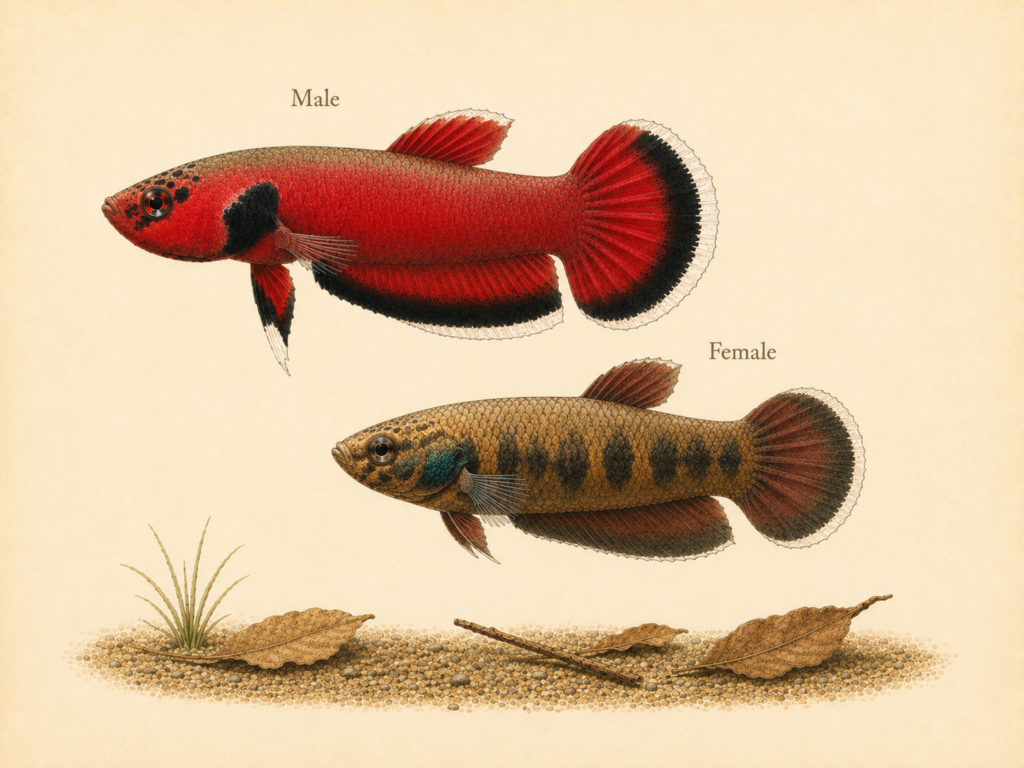
The most striking feature of Betta channoides is its vivid scarlet colouration. When in full breeding dress, males display an intense, almost luminous scarlet red across the body, fins, and head. This scarlet hue is a key distinguishing characteristic from the closely related Betta albimarginata, which tends towards a deeper brick-red or orange-red tone. The intensity of the red colouration can vary depending on the fish’s mood, health, and dominance status, with dominant breeding males displaying the most saturated colours.
The most reliable way to distinguish Betta channoides from Betta albimarginata is by examining the dorsal fin. In Betta channoides, the dorsal fin is almost entirely plain red or scarlet, with only a thin white distal edge (the outermost margin of the fin). By contrast, Betta albimarginata displays a distinctive pattern on all unpaired fins, including the dorsal, consisting of a prominent black submarginal band followed by a broader white margin. This black-band-then-white-margin pattern on the dorsal fin is characteristic of albimarginata and is absent in channoides, where the dorsal appears predominantly red with just the slenderest white trim.
The anal and caudal fins of Betta channoides may show some degree of dark edging and a thin white margin, but this patterning is less pronounced and less structured than in albimarginata. The pectoral fins are translucent to lightly tinted. The head features a relatively blunt snout, and the eyes are proportionally large, giving the fish an alert, inquisitive appearance. A dark lateral stripe may be visible along the body, particularly in stressed or subdominant individuals, and can serve as a useful indicator of the fish’s emotional state.
Females are considerably less colourful than males, typically displaying a tan, brown, or muted reddish-brown base colour. They tend to be slightly smaller and have shorter fins. Juveniles of both sexes resemble females in colouration and gradually develop adult patterning as they mature. Sexing young fish can be challenging, but as males begin to colour up – usually from around three to four months of age – the differences become more apparent.
Varieties and Morphs
Unlike the domesticated Betta splendens, which has been selectively bred into a dizzying array of colour forms, tail types, and patterns, Betta channoides exists in the hobby almost exclusively in its wild-type form. There are no established ornamental varieties or selectively bred morphs of this species. This is typical of wild betta species, where the emphasis among hobbyists is on maintaining pure, genetically healthy populations that closely represent the natural form.
That said, some degree of natural variation exists among Betta channoides populations. Fish from different collection localities within the Mahakam River basin may exhibit subtle differences in the intensity of their red colouration, the extent of dark markings, or the precise width of the white fin edging. These are natural population-level variations rather than distinct morphs, and responsible hobbyists typically keep locality-specific populations separate to preserve genetic integrity.
It is worth noting that Betta channoides is occasionally confused with or mislabelled as Betta albimarginata in the trade, and vice versa. This is partly because both species belong to the Betta albimarginata species complex and share a broadly similar body plan and colour scheme. Hobbyists purchasing these fish should take care to verify identification using the dorsal fin pattern described above. Mixed pairs or groups of the two species should be avoided, as hybridisation is possible and would compromise the genetic purity of both species.
Natural Habitat
Betta channoides is endemic to the Mahakam River basin in East Kalimantan, the Indonesian portion of the island of Borneo. This is a different river system from the habitat of Betta albimarginata, which occurs further north in the Berau and Kelai river systems. The Mahakam is one of the longest rivers on Borneo and drains a vast area of lowland and hilly tropical rainforest, including extensive peat swamp forests.
In the wild, Betta channoides inhabits shallow, slow-moving or still forest streams, pools, and swampy areas within dense tropical rainforest. The substrate in these habitats typically consists of a deep layer of decomposing leaf litter, fallen branches, and organic debris. The water is heavily stained by tannins released from decaying plant matter, creating the characteristic dark, tea-coloured blackwater conditions for which these habitats are named.
The water parameters in these natural habitats are extreme by typical aquarium standards. The pH can drop as low as 3.5 to 4.0, and the water is exceptionally soft, with negligible general and carbonate hardness. Dissolved mineral content is very low. The temperature tends to remain relatively stable in the range of 23 to 26 degrees Celsius, moderated by the dense forest canopy overhead, which also limits direct sunlight, keeping ambient light levels low.
The forest canopy and dense riparian vegetation create a dimly lit environment with dappled shade. Aquatic and semi-aquatic plants may be present but are often sparse, with the leaf litter and woody debris providing the primary structural complexity. This habitat supports a rich community of small fishes, invertebrates, and amphibians, all adapted to the unique chemistry of blackwater environments. Unfortunately, these habitats are increasingly threatened by deforestation, palm oil plantation expansion, and peat fires, which degrade water quality and destroy the forest cover upon which these ecosystems depend.
Tank Size and Setup
A pair of Betta channoides can be comfortably housed in a tank of 41 litres or more. For a small group or breeding colony of one male with two or three females, a tank of 60 to 80 litres is preferable. Larger tanks of 100 litres or more allow for keeping multiple males, provided sufficient visual barriers and territories are available. Despite their small size, these fish are territorial during breeding, and cramped conditions can lead to stress and suppressed behaviour.
The aquarium should be set up to replicate the dimly lit, tannin-rich forest streams of their natural habitat. A dark substrate of fine sand or soil is ideal, as it provides a natural appearance and helps the fish feel secure. Lighter-coloured substrates can cause the fish to appear washed out and stressed. A generous layer of dried leaf litter – Indian almond leaves (Terminalia catappa), oak leaves, or beech leaves – should be scattered across the bottom of the tank. This leaf litter serves multiple purposes: it releases tannins that acidify and soften the water, provides foraging opportunities for microfauna, and creates a naturalistic environment that encourages the fish to display their best colours and most natural behaviours.
Driftwood, bogwood, and small branches should be arranged to create hiding spots, caves, and visual barriers. Pieces of wood with nooks and crevices are particularly valuable, as males may use sheltered spots as retreats during mouthbrooding. Coconut shells with holes cut into them, ceramic caves, or small terracotta pots can also serve as hides. Dense planting is not strictly necessary but can be beneficial. Hardy, low-light plants such as Java fern, Java moss, Bucephalandra, and Cryptocoryne species are well-suited to the soft, acidic conditions and low light levels this species prefers.
Lighting should be subdued. Bright overhead lighting will stress the fish and cause them to hide or display muted colouration. Floating plants such as Salvinia, Amazon frogbit, or water lettuce are excellent for diffusing light and creating the shaded conditions these fish prefer. If using an LED light, choose a dimmable unit or one with a low output, and consider running it for no more than 8 hours per day.
A tight-fitting lid or cover glass is essential. Like all members of the suborder Anabantoidei, Betta channoides possesses a labyrinth organ that allows it to breathe atmospheric air. The fish will regularly visit the surface to gulp air, and a layer of warm, humid air above the water surface is important for the health of this organ. A lid also prevents the fish from jumping, which they are capable of doing, particularly when startled.
Water Parameters
Maintaining appropriate water chemistry is arguably the single most important aspect of keeping Betta channoides successfully. This species requires soft, acidic water that replicates the blackwater conditions of its natural habitat. Using water that is too hard or too alkaline will stress the fish, suppress their immune system, and make breeding extremely unlikely.
| Temperature | 23–30 °C |
| pH | 4.0-6.5 |
| General hardness (GH) | 1–5 dGH |
| Ammonia | 0 ppm |
| Nitrite | 0 ppm |
| Nitrate | Below 20 ppm |
Many hobbyists find that reverse osmosis (RO) water or rainwater is necessary to achieve the required softness and low pH. Tap water in most regions is far too hard and alkaline for this species. RO water can be used pure or remineralised very lightly with a product designed for soft-water species. The addition of Indian almond leaves, alder cones, peat, or commercial blackwater extracts will help to lower the pH naturally, tint the water, and provide beneficial humic substances and tannins.
Temperature should be kept on the cooler side for a tropical species. Betta channoides does not thrive in excessively warm water. Temperatures above 27 degrees Celsius should be avoided, as prolonged exposure to higher temperatures can shorten the fish’s lifespan and increase susceptibility to disease. In many homes, room temperature may be sufficient during the warmer months, but a reliable heater with a thermostat is recommended to prevent temperature drops during cooler periods.
Regular water changes are important to maintain water quality, but they should be performed with care to avoid sudden shifts in pH or hardness. Small, frequent water changes of 10 to 15 per cent once or twice per week are preferable to large, infrequent changes. Always ensure that replacement water is matched to the tank’s temperature and chemistry before adding it.
Filtration and Equipment
Betta channoides comes from still or very gently flowing water, and strong currents should be avoided in the aquarium. A sponge filter is the ideal choice for this species. Sponge filters provide gentle biological and mechanical filtration, create minimal water movement, and are safe for fry if the fish breed. An air-driven sponge filter connected to a small air pump is the simplest and most effective setup.
If using a hang-on-back or small internal power filter, the flow rate should be reduced as much as possible. This can be achieved by using a spray bar, directing the outflow against the glass, or fitting a pre-filter sponge to baffle the current. Canister filters are generally unnecessary for the small tanks suited to this species and tend to create too much flow unless heavily baffled.
A reliable heater with an adjustable thermostat is recommended to maintain stable temperatures within the 22 to 26 degrees Celsius range. In smaller tanks, a 25-watt or 50-watt heater is usually sufficient. Choose a heater with a guard or place it where the fish cannot rest against it to avoid burns.
A thermometer – either a digital probe or a glass stick-on type – should be used to monitor water temperature consistently. An accurate pH test kit or digital pH meter is essential for monitoring the acidic conditions this species requires. A GH and KH test kit is also valuable, particularly when working with RO water or attempting to breed the fish.
Lighting should be low intensity. A simple LED strip light on a timer, set to provide 6 to 8 hours of subdued illumination, is ideal. If the aquarium receives ambient room light, additional lighting may not even be necessary, though it can help to sustain any live plants in the setup. Floating plants will naturally reduce the amount of light reaching the lower levels of the tank.
Diet and Feeding
Betta channoides is a micro-predator in the wild, feeding on small invertebrates, insect larvae, tiny crustaceans, and other live prey found among the leaf litter and detritus of its forest stream habitat. In captivity, this dietary preference should be accommodated as closely as possible for optimal health, colouration, and breeding condition.
Live foods are the gold standard for this species. Newly hatched brine shrimp (Artemia nauplii), Daphnia, Moina, micro worms, grindal worms, and wingless fruit flies are all eagerly accepted. Culturing your own live foods is highly recommended, as it provides a consistent, high-quality food source and reduces the risk of introducing pathogens from wild-caught live foods.
Frozen foods are a practical and widely available alternative. Frozen bloodworm, frozen brine shrimp, frozen Daphnia, and frozen Cyclops are all suitable. Thaw small portions in a little tank water before feeding to prevent digestive issues associated with consuming frozen food directly. Variety is important – aim to rotate between at least two or three different frozen food types throughout the week.
Some individuals can be trained to accept high-quality micro pellets or granules designed for small carnivorous fish, but acceptance of dry foods is not guaranteed and varies between individuals. Dry foods should be considered a supplement rather than a staple. Flake food is generally ignored by this species.
Feed small amounts once or twice daily, offering only what the fish can consume within two to three minutes. Overfeeding should be avoided, as uneaten food will decompose quickly in the warm, acidic water and contribute to water quality problems. If a male is holding eggs or fry in his mouth, he will not eat for the duration of the brooding period (approximately 10 to 14 days), and no food should be offered to him during this time. The female and any other tank mates should continue to be fed as normal.
Behaviour and Temperament
Betta channoides is one of the more peaceful members of the Betta genus. Unlike the infamously aggressive Betta splendens, this species can be kept in pairs or small groups, and male-on-male aggression is generally limited to posturing, flaring, and brief chases rather than the sustained, damaging fights seen in siamese fighting fish. That said, a dominant male will establish a territory and may assert himself over subordinate males, particularly in smaller tanks with insufficient cover.
Males display their most vivid colouration when interacting with each other or when courting females. Displays include flaring the gill covers (opercles), spreading the fins, and intensifying their scarlet body colour. These displays are fascinating to observe and are a key part of the species’ appeal. Subordinate males may adopt duller colouration and tend to stay in peripheral areas of the tank to avoid confrontation.
The species is naturally shy and somewhat retiring, especially when first introduced to a new aquarium. It can take several days to a few weeks for the fish to settle in and begin displaying normal behaviour. Providing ample hiding spots, dim lighting, and a quiet location for the tank will help the fish acclimate more quickly. Once settled, they become bolder and more visible, often hovering near the leaf litter or perching on plant leaves and driftwood.
Betta channoides tends to occupy the middle and lower levels of the water column, spending much of its time near or among the leaf litter and hardscape. They are not particularly active swimmers and tend to move in short, deliberate bursts rather than constant swimming. This leisurely pace is part of their charm and makes them well-suited to nano and biotope aquariums where close observation is possible.
The mouthbrooding behaviour of the male is perhaps the most captivating aspect of keeping this species. After spawning, the male collects the eggs in his mouth and incubates them for roughly 10 to 14 days. During this time, his throat appears visibly distended, and he may be seen making subtle chewing motions to turn and aerate the eggs. He will typically retreat to a sheltered area and remain relatively inactive throughout the brooding period.
Tank Mates
Due to its peaceful nature and small size, Betta channoides can be kept with carefully selected tank mates, provided they are similarly sized, non-aggressive, and compatible with the soft, acidic water conditions this species requires. The most important consideration when choosing tank mates is water chemistry compatibility – many popular community fish species cannot tolerate the extremely low pH and soft water that Betta channoides needs. Active, boisterous, or fin-nipping species should be avoided, as they will stress the bettas and may outcompete them for food.
Good tank mates
- Chocolate Gourami – A fellow blackwater species that thrives in the same soft, acidic conditions and shares a peaceful temperament.
- Harlequin Rasbora – A small, gentle schooling fish that tolerates soft, acidic water well and occupies the mid-water level without bothering bettas.
- Ember Tetra – A tiny, peaceful tetra that does well in warm, soft water and adds gentle activity to the mid-water zone.
- Pygmy Corydoras – A diminutive bottom-dwelling catfish that peacefully scavenges the substrate without disturbing territorial bettas.
- Kuhli Loach – A slender, nocturnal bottom-dweller that coexists peacefully and appreciates the leaf litter habitat.
- Celestial Pearl Danio – A small, peaceful species that can adapt to softer water conditions and occupies different areas of the tank.
- Sparkling Gourami – Another small labyrinth fish that does well in blackwater conditions and is generally compatible in terms of temperament.
- Betta albimarginata – A close relative with identical water requirements, though the two species should ideally be kept separately to prevent hybridisation.
Fish to avoid
- Tiger Barb – A notorious fin nipper that will harass and stress slow-moving bettas relentlessly.
- Betta splendens – Domesticated bettas are far more aggressive and may attack or be attacked by wild bettas; water parameter needs also differ.
- African Cichlids – Require hard, alkaline water completely incompatible with Betta channoides, and are far too aggressive.
- Guppy – Prefers hard, alkaline water and will not thrive in the acidic blackwater conditions required by this species.
- Chinese Algae Eater – Becomes aggressive and territorial as it grows and may harass or injure small bettas.
- Convict Cichlid – Highly aggressive, territorial, and requires entirely different water chemistry.
- Buenos Aires Tetra – Too large, active, and boisterous for a peaceful betta tank, and may nip fins.
- Rainbow Shark – Territorial, grows much too large, and will dominate and stress small tank mates.
Breeding
Breeding Betta channoides is a deeply rewarding experience and is achievable for hobbyists with moderate experience, provided the correct conditions are met. This species is a paternal mouthbrooder, and the entire reproductive process – from courtship to the release of free-swimming fry – is fascinating to observe.
To encourage breeding, ensure that a well-conditioned pair or small group is housed in a mature aquarium with stable, soft, acidic water. A pH of 4.5 to 5.5, near-zero hardness, and a temperature of around 24 to 25 degrees Celsius seem to be optimal for triggering spawning. Condition the fish with a varied diet of live and frozen foods for several weeks prior to any breeding attempt. Indian almond leaves and other botanical materials should be present in abundance to maintain the blackwater chemistry.
Courtship is a subtle affair. The male will display to the female by flaring his fins and intensifying his scarlet colouration. If the female is receptive, she will approach the male, and the pair will engage in a nuptial embrace similar to that seen in other anabantoids. The male wraps his body around the female, and she releases a small number of eggs – typically between 10 and 40 – which are fertilised externally. The eggs sink or are caught by the anal fin of the female, and both fish participate in gathering them. The male then takes all the eggs into his mouth.
Once the male is holding, he should not be disturbed or subjected to any stressful changes in the environment, as this may cause him to swallow or spit out the eggs prematurely. The male will incubate the eggs for approximately 10 to 14 days, during which time he will not eat. His buccal cavity (throat area) will appear noticeably swollen. Towards the end of the incubation period, you may be able to see the eyes of the developing fry through the thin skin of the male’s lower jaw.
When the fry are released, they are fully formed, free-swimming, and relatively large compared to the fry of bubble-nesting bettas. They can typically accept newly hatched brine shrimp, micro worms, or vinegar eels as a first food from day one. The fry should be kept in the same soft, acidic water as the parents. Growth is steady but not rapid, and the young fish will begin to show colour at around two to three months of age.
If the parents are well-fed and the fry have sufficient cover in the form of leaf litter and plant matter, they can often be raised in the same tank as the adults without significant predation. However, separating the fry into a dedicated rearing tank gives better control over feeding and water quality and generally results in higher survival rates.
Common Diseases
Betta channoides is a generally hardy species when kept in appropriate conditions, but like all fish, it is susceptible to certain diseases and health issues, particularly when stressed by poor water quality, incorrect water chemistry, or inappropriate tank mates.
Velvet disease (Piscinoodinium) is one of the more common ailments seen in wild bettas kept in soft, acidic water. It presents as a fine, gold or rust-coloured dusting on the body and fins, often first visible under a torch beam. Affected fish may clamp their fins, rub against objects, and become lethargic. Treatment involves raising the temperature slightly, dimming the lights, and using a copper-based medication, though care must be taken as some medications are poorly tolerated in very soft, acidic water.
Ich (white spot disease, caused by Ichthyophthirius multifiliis) can occur, particularly in fish that have been recently imported or subjected to temperature fluctuations. It appears as small white spots on the body and fins. Raising the temperature to 28 degrees Celsius for a short period can accelerate the parasite’s life cycle and, combined with appropriate medication, resolve the infection.
Bacterial infections, including fin rot and body infections, can arise in fish kept in poor water conditions or those that have suffered physical injuries. Maintaining excellent water quality through regular water changes and careful monitoring is the best prevention. Mild cases may resolve with improved water quality alone, while more severe infections may require treatment with antibacterial medications.
Internal parasites can sometimes be present in wild-caught specimens. Signs include weight loss despite normal feeding, white or stringy faeces, and a generally hollow or emaciated appearance. Quarantining new arrivals and, if necessary, treating with an appropriate anti-parasitic medication can address this issue.
Stress is the underlying cause of most health problems in Betta channoides. Ensuring that water chemistry is correct, the tank is well-structured with plenty of hiding spots, lighting is dim, and tank mates are appropriate will go a long way towards preventing disease. A quarantine protocol for all new fish before they are introduced to an established tank is strongly recommended.
FAQs
How can I tell Betta channoides apart from Betta albimarginata?
The most reliable distinguishing feature is the dorsal fin. In Betta channoides, the dorsal fin is almost entirely plain scarlet with only a very thin white distal edge. In Betta albimarginata, the dorsal fin – along with the anal and caudal fins – displays a prominent black submarginal band followed by a broader white margin. Additionally, Betta channoides tends towards a brighter scarlet body colour, whereas albimarginata leans towards brick-red or orange-red.
Can I keep multiple males of Betta channoides together?
Yes, in most cases. Betta channoides is considerably less aggressive than Betta splendens, and multiple males can coexist in a sufficiently large, well-structured tank with plenty of visual barriers and hiding spots. A tank of at least 80 to 100 litres is recommended for housing more than one male. Some posturing and flaring is normal and is part of the species’ natural social behaviour.
What is the best way to achieve the soft, acidic water this species needs?
Reverse osmosis (RO) water is the most reliable method for most hobbyists. RO water has virtually no dissolved minerals and a neutral pH, which can then be lowered naturally through the addition of Indian almond leaves, alder cones, peat, driftwood, and other botanical materials. Commercial blackwater extracts can also be used. Avoid using pH-adjusting chemicals without also addressing hardness, as they can cause unstable and dangerous pH swings.
How long does the male hold the fry in his mouth?
The male typically broods the eggs and developing fry for approximately 10 to 14 days, though this can vary slightly depending on temperature. During this period, the male does not eat. It is essential not to disturb him, as stress can cause him to swallow or prematurely release the developing eggs or fry.
Will Betta channoides eat dry foods like pellets?
Some individuals can be trained to accept small, high-quality pellets or granules, but acceptance varies. Many Betta channoides show a strong preference for live and frozen foods and may refuse dry foods entirely. Live and frozen foods should form the staple diet, with dry foods offered only as an occasional supplement if accepted.