Betta albimarginata Care Guide – Tank Setup, Feeding and Breeding
Quick summary
Betta albimarginata is a moderately difficult, peaceful mouthbrooding fish best suited to hobbyists with some experience maintaining stable, soft, acidic blackwater conditions, not beginners. It’s a poor fit if you can’t provide soft, acidic, tannin-stained water with a tight-fitting lid and gentle filtration, but rewarding for those willing to keep a small social group and even attempt breeding.
🐠 Build a tank around this fish
In this guide:
- Introduction
- Quick Stats
- Appearance
- Varieties and Morphs
- Natural Habitat
- Tank Size and Setup
- Water Parameters
- Filtration and Equipment
- Diet and Feeding
- Behaviour and Temperament
- Tank Mates
- Breeding
- Common Diseases
- FAQs
Introduction
Betta albimarginata is one of the most visually striking and endearing wild betta species available in the freshwater aquarium hobby. Known commonly as the Whiteseam Fighter or Strawberry Betta, this diminutive mouthbrooding species hails from a remarkably narrow range in the rainforests of East Kalimantan, Indonesian Borneo. Unlike its domesticated cousin, the ubiquitous Betta splendens, Betta albimarginata is a peaceful, social fish that thrives in groups and displays fascinating parental behaviour – the male incubates eggs and fry in his mouth for up to two weeks or more without feeding.
Despite its small size of only 3 to 4 centimetres, Betta albimarginata packs an extraordinary amount of colour into its tiny frame. Its warm reddish-orange body is complemented by a striking fin pattern of broad black submarginal bands edged with bright white margins across all fins, including the dorsal – a feature that gives the species both its scientific name (albimarginata, meaning “white-margined”) and its common name, the Whiteseam Fighter. This fin patterning is the key diagnostic feature that distinguishes it from its close relative, Betta channoides.
This species is classified within the Betta albimarginata complex of the genus Betta, a group of small paternal mouthbrooders endemic to Borneo. In the wild, populations are restricted to the Sebuku River basin and surrounding tributaries in East Kalimantan, where they inhabit shallow, tannin-stained blackwater streams flowing through dense tropical forest. Habitat destruction, primarily driven by palm oil plantation expansion, logging, and mining, has placed wild populations under considerable pressure. The species is listed on the IUCN Red List and is considered at high risk in its native range, making captive breeding efforts by dedicated hobbyists all the more important for the long-term conservation of this remarkable fish.
For aquarists willing to replicate the soft, acidic blackwater conditions this species requires, Betta albimarginata is a truly rewarding fish to keep. It is generally considered moderate in difficulty – not a beginner’s fish, but well within reach for hobbyists with some experience in maintaining stable water parameters and a willingness to learn about the specific needs of wild bettas.
Quick Stats
| Scientific name | Betta albimarginata |
| Common names | Whiteseam Fighter, Strawberry Betta, White-edged Betta |
| Family | Osphronemidae |
| Origin | Sebuku River basin, East Kalimantan, Borneo, Indonesia |
| Adult size | 3 – 4 cm |
| Lifespan | 3 – 5 years |
| Difficulty | Moderate |
| Breeding difficulty | Moderate |
| Temperature | 22 – 26 °C |
| pH range | 4.0 – 6.5 |
| General hardness (GH) | 0 – 5 dGH |
| Carbonate hardness (KH) | 0 – 2 dKH |
| Minimum tank size | 40 litres |
| Conservation status | Vulnerable (IUCN Red List) |
Appearance
Betta albimarginata is a genuinely tiny species, with adults typically reaching only 3 to 4 centimetres in total length. Despite its diminutive stature, it is one of the most colourful wild betta species kept in the hobby, and its appearance is instantly recognisable once you know what to look for.
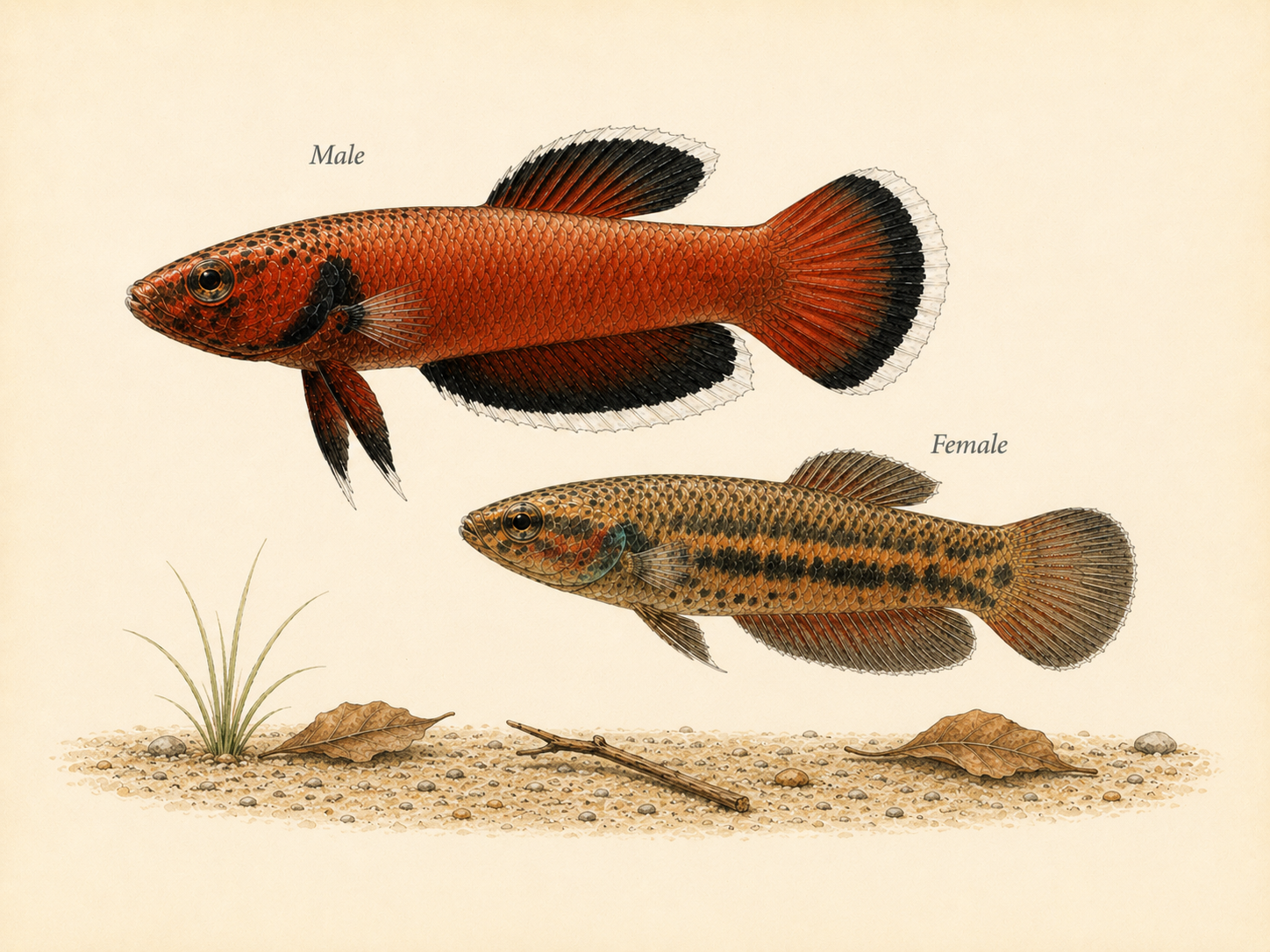
The body is laterally compressed and elongated, typical of the mouthbrooding betta body plan. The base colour of the body ranges from a warm reddish-orange to a deep strawberry red – the latter hue giving rise to the popular trade name “Strawberry Betta.” The intensity of body colour varies depending on mood, dominance status, and overall health, with dominant or displaying males typically showing the most vivid colouration. In subdued or stressed individuals, the body colour may fade to a brownish-orange.
The defining feature of Betta albimarginata – and the characteristic from which it derives its scientific name – is the broad white distal band present on all fins, including the dorsal, anal, caudal, and pelvic fins. This white margin is preceded by a wide, conspicuous black submarginal band, creating a striking tricolour pattern of red-orange base, black band, and white edge across every fin. This white edging on the dorsal fin is the key feature distinguishing Betta albimarginata from its close relative Betta channoides, which lacks or has a much reduced white margin on the dorsal fin.
The head features a relatively short snout and a slightly upturned mouth. The eyes are proportionally large for the body size. The opercular (gill cover) region may display dark markings, and during displays, males will flare their opercula to reveal darker membranes beneath.
Sexual dimorphism is present but can be subtle, particularly in young or non-breeding individuals. Males tend to be slightly more intensely coloured, with broader and more prominent white fin margins. Males also tend to have slightly larger heads relative to body size, a feature associated with their mouthbrooding habit. Females are typically a touch smaller and may show slightly less intense colouration, though healthy, dominant females can also display vivid colours. Sexing juveniles can be challenging and often requires patience until the fish mature.
Varieties and Morphs
Betta albimarginata does not have the extensive range of selectively bred varieties seen in domesticated Betta splendens. As a wild species with a very restricted natural range, the variation that exists is primarily geographic and natural rather than the result of human selective breeding.
There are reported locality variants that may differ slightly in the intensity of body colouration or the precise width of the black and white fin bands. Some populations exhibit a deeper, more saturated strawberry-red body colour, while others lean more towards a brownish-orange or copper tone. These differences are generally subtle and may also be influenced by water conditions, diet, and individual genetic variation within a population.
In the aquarium trade, fish are sometimes sold with locality information attached – for example, “Betta albimarginata Malinau” or “Betta albimarginata Sebuku” – though the accuracy of such labels can vary depending on the source. Hobbyists who are serious about conservation breeding are encouraged to keep different locality populations separate and to maintain records of provenance where possible, to preserve the genetic integrity of captive lines.
It is worth noting that Betta albimarginata is sometimes confused with Betta channoides in the trade. Both species share a similar body shape, reddish-orange colouration, and black banding on the fins. However, the reliable distinguishing feature remains the broad white distal margin on all fins – including the dorsal – in Betta albimarginata, which is absent or greatly reduced in Betta channoides. If purchasing from a dealer, it is advisable to inspect the dorsal fin carefully or to buy from a reputable breeder who can confirm the species identification.
Natural Habitat
Betta albimarginata is endemic to the Sebuku River basin and nearby tributary systems in East Kalimantan, on the island of Borneo, Indonesia. Its known distribution is extremely limited, confined to a small geographic area within the lowland and foothill rainforests of this region.
In the wild, this species inhabits small, slow-moving or still forest streams, rivulets, and shallow pools within dense tropical rainforest. These waterways are typically heavily shaded by the forest canopy, resulting in dim lighting conditions at the water’s surface. The substrate is generally composed of a deep layer of decomposing leaf litter, fallen branches, submerged roots, and organic debris.
The water in these habitats is classic blackwater – heavily stained with tannins and humic acids released from the decomposing organic matter. This gives the water a characteristic dark tea-brown colour. The resulting chemistry is extremely soft and acidic, often with a pH below 5.0 and negligible mineral content. General hardness and carbonate hardness are typically near zero. The tannin-rich water also possesses mild antibacterial and antifungal properties, which may play a role in the health of the fish and the success of mouthbrooding.
Water flow in these habitats is minimal – often barely perceptible. Depth is typically shallow, ranging from just a few centimetres to perhaps 30 centimetres. Temperature is relatively stable due to the insulating effect of the forest canopy, generally ranging from the low to mid-twenties Celsius.
The wild habitat of Betta albimarginata is under severe threat from deforestation, primarily for the establishment of oil palm plantations, but also from logging, mining, and agricultural expansion. The loss of forest cover leads to increased water temperatures, siltation, altered water chemistry, and the destruction of the specific microhabitat conditions upon which this species depends. These pressures are the primary reasons for the species’ vulnerable conservation status and make the preservation of captive breeding populations a matter of genuine conservation importance.
Tank Size and Setup
Despite their tiny size, Betta albimarginata benefit from a thoughtfully designed aquarium that replicates the key features of their natural blackwater forest stream habitat. A minimum tank size of 40 litres is recommended for a pair or a small group of three to four individuals. For a larger group of six or more – which is highly recommended for this social species – a tank of 60 litres or more is preferable. Longer, shallower tanks are generally better than tall, narrow ones, as the species naturally inhabits shallow water.
The aquascape should prioritise cover, shade, and the creation of multiple hiding spots and visual barriers. A deep layer of dried leaf litter – Indian almond (Terminalia catappa) leaves, oak leaves, or beech leaves – should form the foundation of the setup. This leaf litter serves multiple purposes: it provides hiding spots and foraging areas, it releases tannins that soften and acidify the water, and it promotes the growth of biofilm and microfauna that supplement the diet of both adults and fry.
Driftwood, particularly pieces with complex branching structures or small caves and crevices, should be used to create additional cover and territorial boundaries. Coconut shells with small entry holes also make excellent retreats. Live plants tolerant of very soft, acidic water and low light – such as Java fern (Microsorum pteropus), Java moss (Taxiphyllum barbieri), Bucephalandra species, and various Cryptocoryne species – can be used to further furnish the tank and provide additional cover.
The substrate can be a fine dark sand or a thin layer of peat, though many keepers opt for a bare bottom covered entirely with leaf litter, which simplifies maintenance and makes it easier to spot fry. A dark substrate or background helps the fish feel secure and displays their colouration to best effect.
Lighting should be kept dim. The natural habitat is heavily shaded, and bright overhead lighting can cause stress and washed-out colouration. Floating plants such as Salvinia, Amazon frogbit (Limnobium laevigatum), or duckweed can be used to diffuse light, or the tank can simply be positioned away from strong light sources. The tannin-stained water itself will naturally reduce light penetration.
A tight-fitting lid is essential. Like many betta species, Betta albimarginata can and will jump, particularly if startled. Even small gaps around filter inlets, heater cables, or other equipment should be covered.
Water Parameters
Maintaining appropriate water parameters is arguably the single most important aspect of keeping Betta albimarginata successfully. This species is adapted to extremely soft, acidic blackwater conditions, and while captive-bred individuals may tolerate slightly harder or more neutral water than wild-caught fish, the goal should always be to replicate their natural chemistry as closely as practicable.
| Temperature | 22 – 26 °C |
| pH | 4.0 – 6.5 |
| General hardness (GH) | 0 – 5 dGH |
| Carbonate hardness (KH) | 0 – 2 dKH |
| Ammonia | 0 ppm |
| Nitrite | 0 ppm |
| Nitrate | Below 20 ppm |
The ideal pH for Betta albimarginata sits between 4.5 and 6.0. A pH above 7.0 should be avoided, as prolonged exposure to neutral or alkaline conditions can cause chronic stress and increased susceptibility to disease. For breeding, a pH at the lower end of the range – around 4.5 to 5.5 – is generally preferred and appears to improve mouthbrooding success.
The use of RO (reverse osmosis) or demineralised water is strongly recommended if your tap water is moderately hard or alkaline, as is the case in many parts of the United Kingdom. RO water can be remineralised very lightly with a specialist product if desired, or used neat with the addition of tannin sources to provide trace minerals. Indian almond leaves, alder cones, peat, and commercially available blackwater extracts can all be used to acidify the water and add the beneficial tannins and humic substances that characterise the natural habitat.
Temperature should be kept relatively cool by tropical standards. Betta albimarginata does not require the warm temperatures of Betta splendens and can suffer in water consistently above 27 or 28 degrees Celsius. A range of 22 to 25 degrees Celsius is ideal, and many keepers find that room temperature in a well-insulated house in the UK may suffice during summer months, though a reliable heater with a thermostat is recommended to prevent significant drops during cooler periods.
Stability is paramount. Sudden swings in pH, temperature, or hardness are far more dangerous than a parameter sitting slightly outside the ideal range. Regular, small water changes using pre-treated, temperature-matched water are preferable to large, infrequent changes.
Filtration and Equipment
Filtration for a Betta albimarginata tank should be gentle and unobtrusive. In the wild, this species inhabits near-still waters, and strong currents will cause stress, fatigue, and reluctance to feed or breed. The filter should turn over the tank volume gently, providing biological and mechanical filtration without creating significant water movement.
An air-driven sponge filter is the most commonly recommended and widely used option for this species. Sponge filters provide excellent biological filtration, create minimal current, are inexpensive, and are completely safe for fry – an important consideration if you hope to breed these fish. A small, fine-pored sponge filter rated for the tank size, powered by a low-output air pump, is ideal. The air flow can be regulated with a valve to achieve the gentlest possible output.
Small internal filters or hang-on-back filters can also be used if the flow is baffled or reduced significantly. Some keepers use a piece of filter sponge or a spray bar to diffuse the outflow. Canister filters are generally unnecessary for the small tank sizes involved and tend to produce too much flow unless heavily modified.
A reliable, adjustable heater is recommended to maintain a stable temperature within the preferred range. For small tanks of 40 to 60 litres, a 25 to 50 watt heater is typically sufficient. The heater should be set to the lower end of the acceptable range – around 23 to 24 degrees Celsius – rather than pushing towards the upper limit.
A thermometer – ideally a digital one for accuracy – should be placed in the tank to allow regular monitoring. In very soft, acidic water, pH can be less stable than in buffered systems, so a reliable pH test kit or digital pH meter is also a valuable tool.
As noted in the tank setup section, a tight-fitting lid is essential to prevent jumping. Betta albimarginata, as a labyrinth fish, does require access to atmospheric air at the water’s surface, so there should be a small air gap between the water surface and the lid. However, all potential escape routes should be sealed.
Diet and Feeding
Betta albimarginata is a micro-predator in the wild, feeding on small invertebrates, insect larvae, and other tiny organisms found among the leaf litter and along the stream margins of its forest habitat. In captivity, the species will accept a range of live, frozen, and – with patience – prepared foods, though a diet with a strong emphasis on live and frozen offerings will produce the best health, colouration, and breeding condition.
Live foods are the gold standard for this species. Daphnia, baby brine shrimp (Artemia nauplii), grindal worms, micro worms, Moina, and small white worms are all excellent choices. Fruit flies (Drosophila, wingless or flightless varieties) are also eagerly accepted and provide variety. Culturing one or two of these live foods at home is highly recommended for anyone serious about keeping and breeding Betta albimarginata.
Frozen foods make a convenient supplement and are readily accepted by most individuals. Frozen bloodworm (chopped if necessary, as these are small fish), frozen daphnia, and frozen baby brine shrimp are all suitable. Thaw frozen foods in a small amount of tank water before feeding and discard any uneaten portions promptly to avoid fouling the water.
High-quality dry foods – specifically small, slow-sinking granules or micro pellets formulated for small carnivorous fish or bettas – may be accepted by some captive-bred individuals, though many wild-caught fish will refuse them entirely. Dry foods should never form the sole basis of the diet but can be used as an occasional supplement if the fish will take them.
Feed small amounts two to three times daily rather than a single large feeding. The tiny mouths and stomachs of Betta albimarginata mean that overfeeding is easy and can quickly degrade water quality. Observe the fish during feeding to ensure all individuals are getting food, as subordinate fish may be reluctant to feed in the presence of dominant individuals.
Males that are holding eggs or fry in their mouths will not feed for the duration of the incubation period, which typically lasts 10 to 17 days. This is entirely normal and the male should not be force-fed or disturbed. He will resume feeding once the fry are released.
Behaviour and Temperament
Betta albimarginata is one of the more peaceful and social species within the genus Betta. Unlike the famously aggressive Betta splendens, Betta albimarginata can and should be kept in pairs or, ideally, in small groups. In a suitably sized and well-furnished tank, multiple males and females can coexist with relatively little serious conflict.
Males will display to one another – flaring their opercula, spreading their fins, and intensifying their body colour – particularly in the presence of females or when establishing territorial boundaries. These displays are generally ritualised and rarely escalate to actual physical harm, provided the tank offers sufficient space, visual barriers, and hiding places. Occasional minor chasing and posturing is normal and healthy social behaviour.
The species is naturally shy and retiring, particularly when first introduced to a new environment. Fish may hide among the leaf litter and driftwood for several days or even weeks before becoming confident enough to venture into open areas. Patience is key during this acclimatisation period. Dim lighting, plenty of cover, and the presence of conspecifics (their own kind) all help to build confidence.
Once settled, Betta albimarginata can become surprisingly bold and inquisitive, often approaching the front glass to observe their keeper, particularly at feeding time. They are intelligent fish that learn to associate their keeper’s presence with food and will soon emerge from cover when they see you approach the tank.
As labyrinth fish, Betta albimarginata possess a labyrinth organ that allows them to breathe atmospheric air directly from the surface. You will regularly observe fish rising to the surface to take a gulp of air – this is entirely normal behaviour and not a sign of oxygen deprivation.
Perhaps the most fascinating behavioural aspect of this species is the paternal mouthbrooding. After spawning, the male collects the fertilised eggs in his mouth and incubates them for approximately 10 to 17 days. During this period, the male’s buccal cavity is visibly distended, and he will not feed. He may become more reclusive and spend extended periods hidden among the leaf litter or within caves. This natural behaviour should be respected and the brooding male should be left undisturbed as far as possible.
Tank Mates
Betta albimarginata is a peaceful, tiny, and somewhat timid species that is best kept in a species-only setup or with carefully chosen tank mates that share similar requirements for soft, acidic water and a gentle temperament. Any potential tank mate must be small, non-aggressive, and comfortable in the same blackwater conditions. Overly active, boisterous, or competitive fish will outcompete Betta albimarginata for food and cause chronic stress.
Good tank mates
- Chocolate Gourami (Sphaerichthys osphromenoides) – A peaceful, similarly sized labyrinth fish that thrives in the same soft, acidic blackwater conditions.
- Pygmy Corydoras (Corydoras pygmaeus) – A tiny, peaceful bottom-dweller that appreciates soft water and will not compete for the same space or food.
- Ember Tetra (Hyphessobrycon amandae) – A diminutive, calm schooling fish that tolerates soft, acidic conditions well and adds gentle mid-water activity.
- Chili Rasbora (Boraras brigittae) – An excellent nano companion that shares the same preference for blackwater, leaf-litter environments and is far too small to pose any threat.
- Exclamation Point Rasbora (Boraras urophthalmoides) – Another tiny Boraras species well suited to the same low-pH, soft-water setup.
- Kuhli Loach (Pangio kuhlii) – A peaceful, nocturnal bottom-dweller that will occupy a different niche and tolerate soft, acidic conditions.
- Sparkling Gourami (Trichopsis pumila) – A small, quiet labyrinth fish that suits the same dim, tannin-rich setup.
- Otocinclus (Otocinclus vittatus) – A gentle algae grazer that will help keep surfaces clean without disturbing the bettas, provided the water is not excessively acidic.
Fish to avoid
- Betta splendens – Much more aggressive and territorial; will likely attack or stress Betta albimarginata and requires different care parameters.
- Tiger Barb (Puntigrus tetrazona) – An active, nippy species that will harass slow-moving bettas and outcompete them for food.
- Convict Cichlid (Amatitlania nigrofasciata) – Far too large, aggressive, and territorial for any tank containing Betta albimarginata.
- Guppy (Poecilia reticulata) – Requires hard, alkaline water that is fundamentally incompatible with the soft, acidic conditions needed by Betta albimarginata.
- Chinese Algae Eater (Gyrinocheilus aymonieri) – Grows large, becomes aggressive with age, and may harass or attach to slow-moving tank mates.
- Angelfish (Pterophyllum scalare) – Too large and predatory; a full-grown angelfish could easily consume a Betta albimarginata.
- Serpae Tetra (Hyphessobrycon eques) – A known fin nipper that will target the fins of slow-moving betta species.
- African Dwarf Frog (Hymenochirus boettgeri) – While not aggressive, these frogs are clumsy feeders that may compete for food and accidentally disturb brooding males.
Breeding
Betta albimarginata is a paternal mouthbrooder, and breeding this species in captivity is one of the most rewarding experiences available to the dedicated aquarist. Unlike the bubble-nesting Betta splendens, there is no bubble nest involved. Instead, the male incubates the fertilised eggs in his buccal cavity (mouth) until the fry are fully developed and free-swimming.
To encourage breeding, maintain a well-conditioned group of at least one male and one or two females in a mature, well-furnished tank with the water parameters described above. A pH of 4.5 to 5.5 and a temperature of around 24 degrees Celsius seem to be optimal for triggering spawning behaviour. A varied diet rich in live foods – particularly daphnia, grindal worms, and baby brine shrimp – will bring the fish into breeding condition.
Spawning typically occurs in a secluded area of the tank, often among leaf litter or within a cave formed by driftwood or other decor. The courtship involves the male displaying intensely to the female, with flared fins and vivid colouration. The female may reciprocate by displaying lateral bars or intensifying her own colour. The pair will eventually engage in a spawning embrace, wrapping around each other in a manner typical of anabantoid fishes. Eggs are released in small batches and fertilised during these embraces. The eggs settle to the substrate or are caught by the anal fin, and the female (or sometimes the male) picks them up in her mouth before transferring them to the male, who takes them into his buccal cavity.
A typical spawn is small, usually consisting of between 10 and 40 eggs. Once the male is holding, he should not be disturbed or stressed unnecessarily, as this can cause him to swallow or spit the eggs prematurely. The male’s throat will appear visibly distended, and he will cease feeding for the duration of the incubation period.
Incubation lasts approximately 10 to 17 days, depending on temperature. When the fry are fully developed, the male will release them – typically in a single event, though he may release them in small groups over a day or two. The fry are tiny but fully formed and capable of swimming freely. They will immediately seek cover among the leaf litter.
Fry can be fed infusoria, vinegar eels, or commercially available liquid fry food for the first few days, transitioning to freshly hatched baby brine shrimp and micro worms within the first week. Growth is slow but steady. In a well-maintained species tank with plenty of leaf litter and microfauna, fry can sometimes survive and grow alongside the adults without being predated, as Betta albimarginata adults are generally not aggressive towards their own young. However, survival rates will be higher if fry are raised in a separate rearing container or tank with similar water parameters.
Common Diseases
Betta albimarginata is generally a hardy species when kept in appropriate conditions, but it is susceptible to the same range of diseases that affect other freshwater fish, particularly when water quality deteriorates or the fish is subjected to chronic stress from incorrect parameters, aggressive tank mates, or poor diet.
Velvet disease (Oodinium) is one of the more common ailments seen in wild bettas kept in soft, acidic water. It presents as a fine, gold or rust-coloured dusting on the skin and fins, often most visible under torchlight. Affected fish may clamp their fins, scratch against objects, and become lethargic. Treatment involves raising the temperature slightly (if within the safe range), darkening the tank, and administering an appropriate medication. The tannin-rich blackwater environment may offer some natural protection, but it is not a substitute for treatment once infection is established.
Fungal infections can occur, particularly on damaged fins or skin. These appear as white, cotton-like growths. Maintaining clean water and the presence of tannins from leaf litter and botanicals can help prevent fungal issues. Mild cases may resolve with improved water quality; more serious infections may require antifungal medication.
Bacterial infections – including fin rot, body sores, and dropsy – are usually secondary to poor water quality, injury, or stress. Prevention through excellent husbandry is the best approach. If bacterial infection is suspected, isolate the affected fish if possible and treat with an appropriate antibacterial remedy.
Internal parasites may be present in wild-caught individuals. Symptoms can include weight loss despite a good appetite, white or stringy faeces, and a sunken belly. Prophylactic deworming of newly acquired wild-caught fish is practised by some experienced keepers, though this should be done with caution and under guidance.
Stress-related issues are perhaps the most common cause of health problems in this species. Incorrect pH, excessively hard water, bright lighting, aggressive tank mates, and lack of cover can all cause chronic stress that suppresses the immune system and predisposes the fish to infection. The best disease prevention strategy is to provide the correct environment and maintain stable, clean water conditions.
FAQs
How can I tell the difference between Betta albimarginata and Betta channoides?
The most reliable distinguishing feature is the dorsal fin. Betta albimarginata has a broad white distal margin on all fins, including the dorsal fin. In Betta channoides, the white margin on the dorsal fin is absent or very narrow. Both species share similar body shapes and reddish-orange colouration, so checking the dorsal fin is the key to accurate identification.
Can I keep Betta albimarginata in a community tank?
Yes, but only with very carefully chosen, small, peaceful species that thrive in the same soft, acidic blackwater conditions. Overly active, competitive, or large tank mates should be avoided. A species-only setup is generally the safest and most rewarding option, particularly if you wish to breed them.
Do I need to use RO water for Betta albimarginata?
In most areas of the UK, where tap water tends to be moderately hard and alkaline, RO water is strongly recommended. Betta albimarginata requires very soft, acidic water that