Betta mulyadii Care Guide – Tank Setup, Feeding and Breeding
Quick summary
Betta mulyadii is a tiny, jewel-like wild betta suited only to advanced aquarists who can provide and maintain very soft, acidic blackwater conditions, so it is not recommended for beginners or standard community tanks. If you can commit to a dedicated species setup with stable water chemistry, it rewards you with vivid red and blue coloration and the chance to breed a rare, likely endangered fish.
🐠 Build a tank around this fish
In this guide:
- Introduction
- Quick Stats
- Appearance
- Natural Habitat
- Tank Size and Setup
- Water Parameters
- Filtration and Equipment
- Diet and Feeding
- Behaviour and Temperament
- Tank Mates
- Breeding
- Common Diseases
- FAQs
Introduction
Betta mulyadii is a diminutive and strikingly beautiful wild betta belonging to the coccina species group, a complex of small, jewel-like bubble-nesting bettas found across the peat swamp forests of Southeast Asia. For years before its formal scientific description, this fish circulated in the specialist hobby under the informal placeholder name “Betta sp. Api Api,” a reference to a hidden peat swamp collection locality in Sumatra, Indonesia. Hobbyists, breeders, and specialist retailers all used this trade name, and it became firmly embedded in online forums, import lists, and care sheets.
In 2025, the species was formally described by Ding, Lei, Haryono, Shi and Zhang, who assigned it the scientific name Betta mulyadii. Importantly, the formal description established the type locality as Duri in Riau Province, Sumatra – not Tanjung Api Api as some older retailer listings and hobbyist references had assumed based on the informal trade name. The “Api Api” label was always a loose placeholder rather than a precise geographic designation, and the formal taxonomic work clarified the species’ actual provenance. If you have previously purchased or kept fish labelled as “Betta sp. Api Api,” it is very likely that you were keeping Betta mulyadii, though as with all informally named wild bettas, there is always some potential for confusion with undescribed populations from nearby localities.
This is a fish for the dedicated specialist. Betta mulyadii is tiny, rarely exceeding 3 to 4 centimetres in total length, and it demands extremely soft, acidic blackwater conditions that replicate the tannin-stained peat swamps of its native habitat. It is not a beginner’s fish, nor is it suited to a standard community aquarium. However, for aquarists willing to create and maintain the right environment, it rewards with extraordinary colour – males display a rich, glowing red body overlaid with metallic blue eyes and delicate white edging on the fins. The species is a bubble-nester, and breeding behaviour is fascinating to observe in a well-maintained species tank.
Betta mulyadii is considered rare in the wild and is almost certainly under significant threat from habitat destruction, as peat swamp forests across Sumatra continue to be drained for agriculture and palm oil plantations. Although the species has not yet been formally assessed by the IUCN, its apparent restriction to a single fragile locality makes it highly vulnerable. Responsible captive breeding by dedicated hobbyists may play a meaningful role in maintaining viable populations outside of the wild.
Quick Stats
| Scientific name | Betta mulyadii |
| Common names | Betta mulyadii, Betta sp. Api Api |
| Family | Osphronemidae |
| Origin | Duri, Riau Province, Sumatra, Indonesia |
| Adult size | 3-4 cm |
| Lifespan | 3-5 years |
| Difficulty | Advanced |
| Breeding difficulty | Moderate |
| Temperature | 22-27 °C |
| pH range | 5.0-6.5 |
| General hardness (GH) | 0-3 dGH |
| Carbonate hardness (KH) | 0-1 dKH |
| Minimum tank size | 30 litres |
| Conservation status | Not Evaluated (likely endangered due to restricted range and habitat loss) |
Appearance
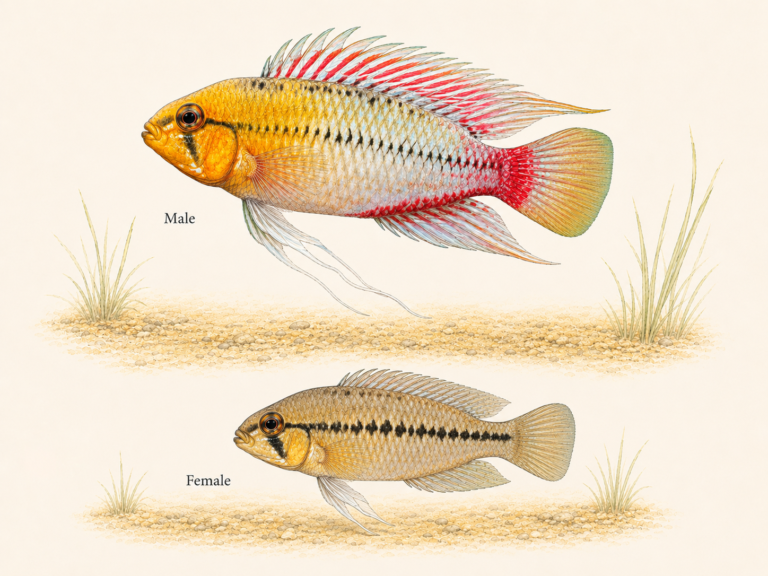
Betta mulyadii is a small, slender fish that exemplifies the understated elegance of the coccina group. Males in full breeding colour are genuinely breathtaking despite their tiny size. The body is a deep, saturated red that can range from a warm brick tone to a vivid, almost luminous crimson depending on mood, condition, and lighting. This red coloration extends across most of the body and into the unpaired fins. The most immediately eye-catching feature, aside from the red body, is the pair of brilliant metallic blue-green eyes that seem to glow against the dark background of a properly set-up blackwater aquarium.
The fins of the male are relatively modest in size compared to domesticated Betta splendens, reflecting the species’ wild origins. The dorsal, anal, and caudal fins carry the same red base colour as the body, edged with a fine, crisp white margin that provides a striking contrast. In dominant males displaying to a rival or courting a female, the colours intensify dramatically, and the fish can appear almost to radiate colour. A dark lateral band may be visible along the flank, becoming more or less prominent with mood.
Females are considerably more subdued. They are typically a warm brown to tan colour with faint barring or mottling, and they lack the intense red of the males. Females may show hints of red in the fins, but the white edging is usually absent or much less pronounced. The metallic eye colour is present in both sexes, though it tends to be more vivid in males. Juveniles of both sexes resemble females and only begin to develop sex-specific coloration as they mature, usually from around three to four months of age.
The overall body shape is elongate and laterally compressed, with a relatively pointed head and an upturned mouth typical of surface-feeding labyrinth fish. The species is small even by coccina group standards, with most adults reaching between 3 and 4 centimetres in total length. This diminutive size makes it easy to overlook in a retail setting, but in a dedicated blackwater setup with subdued lighting and dark substrate, Betta mulyadii is one of the most visually arresting freshwater fish available to the hobby.
Natural Habitat
Betta mulyadii originates from peat swamp forests in the Duri area of Riau Province, Sumatra, Indonesia. These habitats are among the most chemically extreme freshwater environments on earth. The water is extremely soft, with negligible mineral content, and profoundly acidic, often registering pH values between 3.5 and 5.5 in the most pristine areas. The water itself is stained a deep amber to dark tea colour by humic acids and tannins leached from the thick layer of decomposing leaf litter and peat that forms the substrate.
The swamps are typically shallow, often only a few centimetres to a metre deep, and the water is slow-moving to virtually stagnant. The canopy of the surrounding forest casts deep shade, resulting in very low light levels reaching the water’s surface. The substrate is a thick accumulation of fallen leaves, branches, roots, and decomposing organic matter. Aquatic vegetation is sparse due to the extreme acidity and low light, though emergent plants and overhanging terrestrial vegetation are common.
Dissolved oxygen levels in these habitats are often low, which is why Betta mulyadii, like all bettas, possesses a labyrinth organ that allows it to breathe atmospheric air directly from the surface. This adaptation is essential for survival in oxygen-poor waters. The fish inhabits the shallowest margins and leaf-litter zones, where it finds shelter among submerged roots, fallen leaves, and waterlogged wood.
The peat swamp forests of Sumatra are under severe and ongoing threat. Large-scale drainage for palm oil plantations, pulpwood agriculture, and development has destroyed vast areas of this habitat type. Peat swamp fires, often linked to land clearance, further devastate these ecosystems. Because Betta mulyadii appears to be restricted to a single known locality, any localised destruction could have catastrophic consequences for the wild population. This precarious situation underscores the importance of responsible captive husbandry and breeding efforts within the hobby.
Tank Size and Setup
Despite its tiny size, Betta mulyadii benefits from a thoughtfully arranged aquarium that replicates the conditions of its peat swamp home. A minimum tank size of 30 litres is recommended for a single pair or a small group. Larger tanks of 40 to 60 litres are preferable if keeping a group of one male with two or three females, as these provide more space for subordinate fish to retreat from occasional aggression. Nano tanks smaller than 30 litres can be used for a single pair but make it more difficult to maintain stable water parameters, which is a significant concern given the species’ sensitivity.
The tank should be set up to mimic the dark, tannin-rich environment of a Sumatran peat swamp. Begin with a dark substrate – fine sand or a thin layer of peat is ideal. Bright, reflective substrates should be avoided, as they will stress the fish and wash out their colour. Add a generous quantity of dried leaf litter to the bottom of the tank. Indian almond leaves (Terminalia catappa), oak leaves, or ketapang bark are all suitable. The leaf litter serves multiple purposes: it releases tannins and humic acids that naturally acidify the water and tint it brown, it provides shelter and foraging areas, and it supports the growth of biofilm and microfauna that supplement the fish’s diet.
Driftwood and bogwood should be used liberally. Small pieces of Malaysian driftwood, cholla wood, or other hardwood that leaches tannins are ideal. Arrange these to create sheltered areas and visual barriers. Live plants are not essential and many species will struggle in the extremely soft, acidic water and low light conditions preferred by this species. However, species such as Cryptocoryne species adapted to acidic conditions, Java fern (Microsorum pteropus), and Java moss (Taxiphyllum barbieri) can be used if desired. Floating plants such as Salvinia or Limnobium are excellent additions, as they dim the light further and provide surface cover that makes the fish feel secure.
Lighting should be subdued. These fish come from deeply shaded habitats and will show their best colour and most natural behaviour under low to moderate lighting. If using stronger aquarium lights, ensure that floating plants or a dense canopy of emergent growth provides significant shade. A tight-fitting lid or cover glass is essential, as Betta mulyadii can jump, and the labyrinth organ requires access to warm, humid air above the water surface. A gap between the water surface and the lid of a few centimetres is ideal.
Water Parameters
Maintaining appropriate water chemistry is the single most critical aspect of keeping Betta mulyadii successfully. This species is adapted to some of the softest, most acidic freshwater environments on the planet, and it does not tolerate standard tap water conditions well. If you cannot provide and maintain very soft, acidic water, this is not the right species for you.
| Temperature | 22-27 °C |
| pH | 5.0-6.5 |
| General hardness (GH) | 0-3 dGH |
| Carbonate hardness (KH) | 0-1 dKH |
| Ammonia | 0 ppm |
| Nitrite | 0 ppm |
| Nitrate | Below 10 ppm |
In practice, most keepers of Betta mulyadii use reverse osmosis (RO) water or rainwater as a base, then adjust it with botanicals. Tap water in most regions will be far too hard and alkaline. RO water should be used pure or with only the slightest remineralisation – a GH of 1 to 2 dGH is generally sufficient, and many experienced keepers use pure RO water with no mineral additives at all, relying on the trace minerals released by decomposing leaves and wood.
The pH should ideally be maintained between 5.0 and 6.0 for long-term health, though the species will tolerate up to 6.5. The addition of generous quantities of Indian almond leaves, peat, alder cones, and driftwood will naturally lower pH and add beneficial tannins. Some keepers use peat filtration or commercial blackwater extracts to achieve the desired water colour and chemistry. The water should have a distinctly tea-coloured tint when conditions are right.
Temperature is best kept in the range of 23 to 26 degrees Celsius. This species does not require the high temperatures often recommended for Betta splendens. Avoid temperatures consistently above 28 degrees Celsius, as this can accelerate metabolism and shorten lifespan. A stable temperature is more important than hitting a precise number – avoid rapid fluctuations.
Water changes should be performed regularly but carefully. Small, frequent changes of 10 to 15 per cent once or twice per week are preferable to large changes, as these minimise disruption to the delicate water chemistry. Always ensure that replacement water is matched as closely as possible to the tank water in terms of temperature, pH, and hardness.
Filtration and Equipment
Betta mulyadii originates from virtually stagnant water and does not appreciate strong water flow. Filtration should be gentle – an air-driven sponge filter is the ideal choice for this species. Sponge filters provide adequate biological filtration, create minimal current, and offer surfaces for beneficial bacterial colonisation without producing the turbulence that would stress these small, slow-moving fish.
A small, air-driven box filter filled with peat or a combination of sponge and peat can serve double duty, providing both biological filtration and natural acidification of the water. If using a hang-on-back or small internal filter, reduce the flow rate to its lowest setting and consider baffling the output with sponge or directing it against the glass to dissipate the current.
A heater is generally necessary unless the room in which the aquarium is kept is consistently maintained at 23 to 26 degrees Celsius. A small, adjustable heater rated for the tank’s volume is recommended. Position the heater where it will not come into direct contact with leaf litter or other botanicals, which could pose a minor fire risk if the water level drops unexpectedly. A thermometer should be used to monitor temperature consistently.
As previously mentioned, a tight-fitting lid is essential. The labyrinth organ functions best when the air above the water surface is warm and humid, and a covered tank maintains these conditions while also preventing the fish from jumping out. Ensure there is no gap large enough for the fish to escape through.
Lighting should be kept low. A simple LED light on a dimmer or a low-wattage fixture is sufficient. If the tank is positioned in a naturally well-lit room, ambient light may be adequate, especially if the surface is covered with floating plants. Avoid intense lighting, which will cause the fish to hide and appear washed out.
Diet and Feeding
Betta mulyadii is a micro-predator in the wild, feeding primarily on tiny invertebrates, insect larvae, and other small organisms found in and around the leaf litter. In captivity, the species accepts a range of small live and frozen foods but can be reluctant to take dry prepared foods, particularly when newly imported.
The ideal staple diet consists of small live foods such as Daphnia, Moina, baby brine shrimp (Artemia nauplii), micro worms, Grindal worms, and vinegar eels. These foods are nutritionally excellent, stimulate natural hunting behaviour, and are readily accepted by even the most finicky individuals. Live foods should form the core of the diet whenever possible.
Frozen foods are a good alternative when live cultures are unavailable. Frozen Daphnia, frozen baby brine shrimp, frozen cyclops, and frozen bloodworm (chopped finely due to the fish’s small mouth) are all suitable. Thaw frozen foods in a small amount of tank water before feeding to avoid introducing cold water or preservatives directly into the aquarium.
Some individuals will eventually accept high-quality micro pellets or crushed flake food, but this should not be relied upon as the primary diet. If offering dry food, choose a product designed for small carnivorous fish, and ensure the pellet size is appropriate for the species’ tiny mouth. Many keepers find that Betta mulyadii will only accept dry food after a period of conditioning, and some individuals never take it readily.
Feed small amounts once or twice daily. These are small fish with small stomachs, and overfeeding is a greater risk than underfeeding. Uneaten food should be removed promptly to prevent water quality deterioration, which is especially critical in the soft, acidic conditions this species requires. The leaf litter in a well-established tank will also support populations of infusoria and other microfauna that the fish graze on between feedings.
Behaviour and Temperament
Betta mulyadii is a generally peaceful species, far removed from the aggression associated with domesticated Betta splendens. Males will display to one another and engage in ritualised sparring, flaring their fins and intensifying their colours, but serious physical confrontation resulting in injury is uncommon in a properly sized and furnished tank with adequate visual barriers and retreat options.
This is a shy, retiring species that spends much of its time in and around cover – among leaf litter, beneath driftwood, or sheltering under floating plants. It is most active during the early morning and evening hours, and may be largely hidden during the brightest part of the day if lighting is not sufficiently subdued. In a well-set-up tank with appropriate water conditions and low light, the fish will become increasingly bold over time and will eventually come to the front of the tank at feeding time.
Males are territorial but not excessively so. A single male can be kept with one to three females in a 30 to 40 litre tank without significant problems, provided there is ample cover. If keeping more than one male, a larger tank with extensive visual barriers is necessary. In a spacious, densely furnished aquarium of 60 litres or more, two males may coexist by establishing separate territories, though this should be monitored carefully.
Betta mulyadii is best observed in a species-only setup or with very carefully chosen, non-competitive tank mates. Its small size and retiring nature mean it is easily outcompeted for food and stressed by larger, more boisterous fish. The species is best appreciated for what it is: a tiny, exquisitely coloured jewel that rewards patient observation in a carefully curated environment.
Tank Mates
Betta mulyadii is best kept in a species-only aquarium, and this is the setup most likely to result in successful breeding and natural behaviour. However, it can be housed with a small number of carefully selected tank mates that share its requirements for extremely soft, acidic water and its preference for a calm, dimly lit environment. Any tank mates must be small, peaceful, and non-competitive for food. Avoid any species that is significantly larger, faster, more aggressive, or that prefers harder, more alkaline water. The extreme water parameters required by Betta mulyadii naturally limit the range of compatible species.
Good tank mates
- Chocolate Gourami (Sphaerichthys osphromenoides) – Shares the requirement for very soft, acidic blackwater and is similarly peaceful and slow-moving.
- Liquorice Gourami (Parosphromenus deissneri) – Another tiny blackwater specialist from the same geographic region with nearly identical water requirements.
- Harlequin Rasbora (Trigonostigma heteromorpha) – A peaceful, small schooling fish that thrives in soft, acidic conditions and will not bother Betta mulyadii.
- Pygmy Rasbora (Boraras maculatus) – A tiny, unobtrusive schooling species ideally suited to soft, acidic water and small tank setups.
- Ember Tetra (Hyphessobrycon amandae) – Very small, peaceful, and tolerant of soft, acidic conditions, though it originates from South America rather than Southeast Asia.
- Kuhli Loach (Pangio kuhlii) – A peaceful bottom-dweller that tolerates soft, acidic water and occupies a different zone of the tank.
- Sparkling Gourami (Trichopsis pumila) – A small, peaceful labyrinth fish compatible with blackwater conditions, though watch for minor territorial interactions.
Fish to avoid
- Betta splendens (Siamese Fighting Fish) – Significantly larger, more aggressive, and likely to bully or attack Betta mulyadii.
- Tiger Barb (Puntigrus tetrazona) – Active, nippy, and far too boisterous for this shy, small species.
- Guppy (Poecilia reticulata) – Requires hard, alkaline water that is fundamentally incompatible with the conditions needed by Betta mulyadii.
- African Cichlids – Require hard, alkaline water and are far too aggressive and territorial for any cohabitation.
- Angelfish (Pterophyllum scalare) – Much too large and would view Betta mulyadii as potential prey.
- Platy (Xiphophorus maculatus) – A hardwater livebearer entirely unsuited to the soft, acidic conditions this species requires.
Breeding
Betta mulyadii is a bubble-nester, and breeding is achievable in captivity for keepers who can provide optimal water conditions and a stable, undisturbed environment. The species is somewhat easier to breed than mouthbrooding wild bettas, though it still requires more care and attention than domesticated Betta splendens.
Conditioning a pair for spawning involves feeding generously with live foods for two to four weeks. Males in breeding condition will display heightened colour intensity and will begin constructing a bubble nest, typically beneath a broad leaf, a piece of floating plant, or an overhanging surface such as a film canister or Indian almond leaf positioned near the surface. The bubble nest is usually modest in size compared to those of Betta splendens.
When ready to spawn, the male will court the female with a series of lateral displays, flaring his fins and showing his brightest colours. If the female is receptive, she will approach the nest and the pair will engage in the typical anabantoid spawning embrace, with the male wrapping his body around the female beneath the nest. The female releases a small number of eggs with each embrace, and the male fertilises them and collects them into the bubble nest. The process may be repeated several times over the course of an hour or more.
Clutch sizes are small, typically between 20 and 50 eggs. After spawning is complete, the male takes sole responsibility for guarding the nest and tending the eggs. The female should be removed or given sufficient space to retreat, as the male may become aggressive towards her while guarding. The eggs hatch in approximately 24 to 48 hours, depending on temperature, and the fry become free-swimming two to three days later.
Free-swimming fry are extremely tiny and require correspondingly small first foods. Infusoria, paramecium, or commercially available liquid fry food should be offered for the first week to ten days, after which the fry can graduate to freshly hatched baby brine shrimp and micro worms. Growth is slow, and the fry require the same soft, acidic water conditions as the adults. Maintain excellent water quality with minimal disturbance during the early weeks. Partial water changes should be very small and very carefully matched to tank conditions.
Given the species’ rarity and likely endangered status in the wild, successful captive breeding is strongly encouraged. Any hobbyist who manages to breed Betta mulyadii is contributing to the maintenance of a potentially critical captive population.
Common Diseases
Betta mulyadii is susceptible to the same diseases that affect other small labyrinth fish, though its sensitivity to water chemistry means that disease prevention through excellent husbandry is far more important than reactive treatment. Many common aquarium medications are poorly tolerated by fish kept in extremely soft, acidic water, and dosages may need to be reduced.
Velvet disease (Oodinium) is perhaps the most significant threat to this species in captivity. It manifests as a fine, gold or rust-coloured dusting on the skin and fins, accompanied by lethargy, clamped fins, and loss of appetite. Velvet is highly contagious and can spread rapidly in a tank. Treatment typically involves raising the temperature slightly, dimming the lights (the parasite is photosynthetic), and applying a copper-based medication at a reduced dose appropriate for soft water. Prevention through quarantine of new fish and maintenance of optimal water quality is preferable.
Ich (white spot disease) caused by Ichthyophthirius multifiliis can also occur, presenting as small white cysts on the body and fins. Treatment involves gradually raising the temperature to 28 to 30 degrees Celsius and, if necessary, using a half-dose of a suitable medication. Salt-based treatments should be avoided or used with extreme caution in the very soft water this species requires.
Fin rot, typically caused by bacterial infection secondary to stress or poor water quality, can affect Betta mulyadii. It appears as fraying, discolouration, or erosion of the fin margins. Improving water quality and performing additional water changes is often sufficient to resolve mild cases. In more severe instances, antibacterial treatments may be necessary, but again, dose carefully in soft water.
Fungal infections can occur on the body or fins, particularly following physical injury or in tanks with poor water quality. These appear as white, cotton-like growths. Treatment with a suitable antifungal medication at reduced dosage is usually effective. Indian almond leaves and other botanicals have mild antifungal and antibacterial properties and may help prevent such infections in a well-maintained blackwater setup.
Internal parasites can be introduced with wild-caught fish. Newly imported Betta mulyadii should be quarantined and observed carefully for signs of weight loss, white or stringy faeces, or lethargy that might indicate internal parasites. Treatment with an appropriate anti-parasitic medication may be necessary, but seek advice from experienced keepers before dosing in extremely soft water.
FAQs
Is Betta mulyadii the same as Betta sp. Api Api?
Yes. Betta mulyadii was known in the aquarium trade for many years under the informal placeholder name “Betta sp. Api Api” before being formally described in 2025 by Ding, Lei, Haryono, Shi and Zhang. The formal description clarified the species’ identity and established its type locality as Duri in Riau Province, Sumatra, rather than Tanjung Api Api as some older sources had assumed. If you have previously kept or purchased fish labelled as Betta sp. Api Api, they are almost certainly the species now formally known as Betta mulyadii.
Can I keep Betta mulyadii in tap water?
In the vast majority of cases, no. Tap water in most regions is far too hard and alkaline for this species. Betta mulyadii requires extremely soft water with a GH of 3 dGH or below and a pH between 5.0 and 6.5. Most keepers use reverse osmosis water or collected rainwater as a base, supplemented with Indian almond leaves, driftwood, and other botanicals to achieve the appropriate chemistry and tannin staining. Attempting to keep this species in unsuitable water will result in stress, poor colour, susceptibility to disease, and a significantly shortened lifespan.
How many Betta mulyadii can I keep together?
A single pair can be comfortably housed in a 30-litre tank with adequate cover. A trio of one male and two females, or a small group of one male and three females, works well in a 40 to 60 litre tank. Multiple males can be kept together in larger, densely furnished tanks of 60 litres or more, provided there are sufficient visual barriers for each male to establish a territory. Monitor for any signs of excessive aggression or stress, particularly in smaller setups.
Will Betta mulyadii eat dry food?
Some individuals will learn to accept high-quality micro pellets or finely crushed flake food over time, but many will not. Live and frozen foods should form the staple diet. Baby brine shrimp, Daphnia, Moina, micro worms, and Grindal worms are all eagerly accepted. If you wish to attempt transitioning to dry food, do so gradually while continuing to offer live or frozen foods to ensure the fish maintains good condition.
Is Betta mulyadii endangered?
Betta mulyadii has not been formally assessed by the IUCN, so it does not have an official conservation status. However, based on its apparent restriction to a single known locality in Sumatra and the severe ongoing destruction of peat swamp habitats across the region for agriculture and palm oil production, it is very likely endangered or at significant risk. Responsible captive breeding by hobbyists is encouraged as a means of maintaining viable populations outside of the wild and reducing collection pressure on wild stocks.
Related Guides
- Betta coccina Care Guide – The namesake species of the coccina complex, with very similar care requirements and husbandry challenges to Betta mulyadii.
- Betta persephone Care Guide – Another small, rare coccina group species from Peninsular Malaysia with comparable blackwater needs.
- Betta brownorum Care Guide – A closely related coccina group member from Sarawak, Borneo, requiring similar soft, acidic conditions.
- Liquorice Gourami (Parosphromenus) Care Guide – A fellow blackwater specialist from the same geographic region, often kept alongside or in similar setups to coccina group bettas.
- Chocolate Gourami Care Guide – Another demanding Southeast Asian blackwater species with overlapping habitat requirements and care considerations.