Quick summary
The Black Banded Leporinus is a striking but demanding fish, growing 25 to 30 cm and needing at least 450 litres, so it’s best suited to experienced keepers with large tanks rather than beginners. It can be territorial or fin-nippy, will destroy live plants, and is a strong jumper requiring a secure lid, so careful planning around tank size and tank mates is essential.
🐠 Build a tank around this species
In this guide:
- Introduction
- Quick Stats
- Appearance
- Natural Habitat
- Tank Size and Setup
- Water Parameters
- Filtration and Equipment
- Diet and Feeding
- Behaviour and Temperament
- Tank Mates
- Breeding
- Common Diseases
- FAQs
Introduction
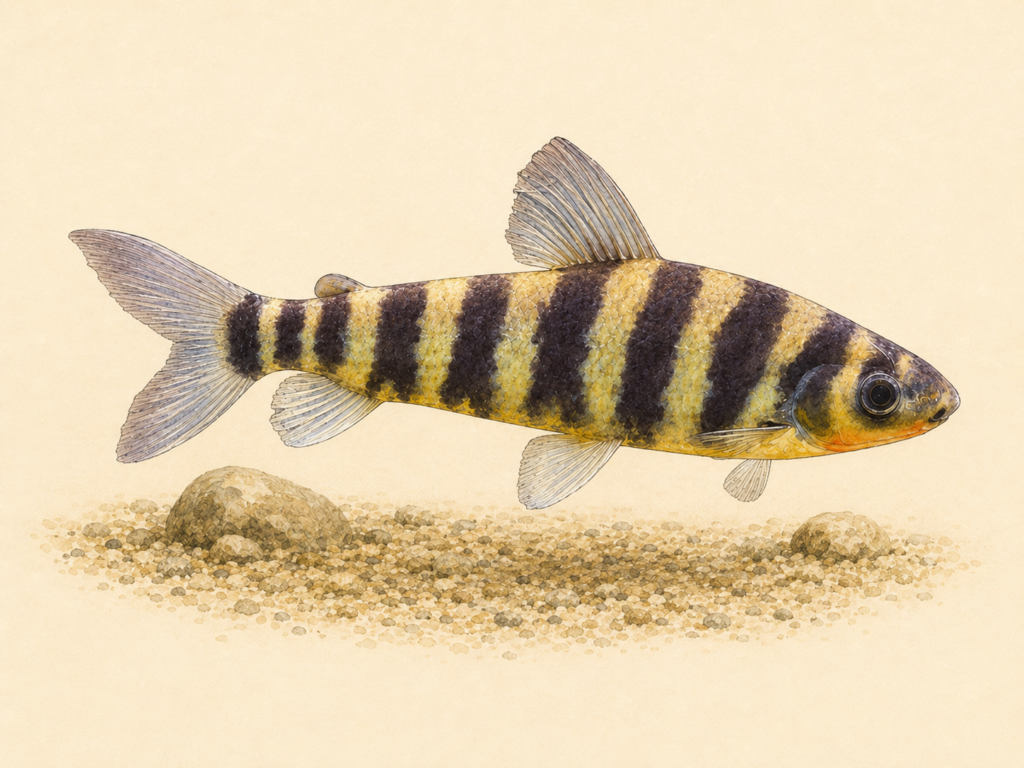
The Black Banded Leporinus is one of the most visually striking freshwater fish available to the home aquarist. With its bold, alternating yellow and black vertical bands, torpedo-shaped body, and lively swimming behaviour, it commands attention in any large aquarium. Native to the river systems of South America, this species has been a staple of the aquarium hobby for decades, prized for its dramatic colouration and engaging personality.
However, the Black Banded Leporinus is not a fish to be acquired on impulse. It grows considerably larger than many hobbyists expect, can be assertive or even aggressive towards certain tank mates, and has a well-documented appetite for live aquarium plants. Keeping this species successfully requires a spacious tank, careful planning around tank mates, and an understanding of its natural behaviour. For those prepared to meet its needs, the Black Banded Leporinus rewards its keeper with years of activity and visual spectacle in a way that few other freshwater species can match.
This guide covers everything you need to know about caring for Leporinus fasciatus in the home aquarium, from water parameters and diet through to breeding and disease prevention.
Quick Stats
| Scientific name | Leporinus fasciatus |
|---|---|
| Common names | Banded Leporinus, Striped Leporinus |
| Family | Anostomidae |
| Origin | South America, Amazon, Orinoco and Parana river basins |
| Adult size | 27 cm |
| Lifespan | 10–12 years |
| Difficulty | Intermediate |
| Breeding difficulty | Advanced |
| Temperature | 22–28 °C |
| pH | 5.5–7.5 |
| GH | 2–15 dGH |
| KH | 2–10 dKH |
| Minimum tank size | 450 L |
| Conservation status | Least Concern (IUCN, assessed 2020) |
Appearance
The Black Banded Leporinus possesses one of the most immediately recognisable colour patterns in the freshwater hobby. Its elongated, torpedo-shaped body is adorned with bold, alternating bands of bright golden-yellow and deep black that run vertically from the dorsal surface down to the belly. Juvenile specimens typically display five such black bands, but as the fish matures, additional thinner bands appear between the original ones, ultimately resulting in nine or ten bands in fully grown adults. This gradual increase in band count is one of the species’ most distinctive developmental traits.
The body shape is somewhat cylindrical and laterally compressed, built for navigating moderate to strong currents in its natural riverine habitat. The mouth is small and slightly upturned, adapted for nibbling at surfaces, a characteristic reflected in the genus name Leporinus, which loosely translates to “little hare,” a reference to the prominent front teeth that resemble those of a rabbit. These teeth are clearly visible when the fish feeds and are used to rasp algae and plant material from rocks and wood.
The fins are relatively short and translucent, often tinged with a faint yellow or amber wash. The caudal fin is forked, aiding the fish’s powerful and sometimes surprisingly rapid swimming bursts. The eyes are proportionally large and expressive, adding to the fish’s animated appearance. Sexual dimorphism is minimal, making it extremely difficult to distinguish males from females visually. Some sources suggest that females may be slightly plumper when gravid, and that males may develop a slightly more reddish hue to the throat region during breeding condition, but these differences are subtle and unreliable.
Natural Habitat
Leporinus fasciatus is widely distributed across South America, occurring throughout the Amazon basin, the Orinoco drainage, the rivers of the Guiana Shield, and the Paraná-Paraguay system. This extensive range means that the species inhabits a surprisingly diverse array of freshwater environments, though it shows a clear preference for flowing water over still or stagnant conditions.
In the wild, the Black Banded Leporinus is most commonly found in the main channels and tributaries of large rivers, often in areas with moderate to strong current. It favours stretches of river with rocky substrates, submerged logs, and overhanging vegetation, where it can forage for algae, plant matter, seeds, and small invertebrates. During the wet season, these fish may move into flooded forest areas to exploit the abundance of fruit and plant material that falls into the water.
The water in its native habitat varies considerably depending on the specific river system. In blackwater tributaries of the Amazon, the water may be soft and acidic with a pH as low as 5.0, stained dark with tannins from decomposing leaf litter. In the clearer waters of the Paraná system, conditions tend to be slightly harder and closer to neutral pH. This adaptability to a range of water chemistries is one reason the species has proved relatively straightforward to maintain in captivity, provided basic water quality standards are met.
The species is typically encountered in loose groups or small shoals in the wild, though it does not form the tight, coordinated schools seen in many smaller characins. Individuals maintain a social hierarchy within these groups, and dominant fish will assert themselves over subordinates, a behaviour that carries over directly into aquarium life.
Tank Size and Setup
The single most common mistake made with the Black Banded Leporinus is underestimating the amount of space it requires. Juvenile specimens are frequently sold at 5–8 cm and look perfectly manageable in a modest community aquarium. However, these fish grow steadily and can reach 25–30 cm within a couple of years. A minimum tank size of 450 litres is recommended for a single specimen or a small group, and larger is always better. Tanks measuring at least 150 cm in length are ideal, as this species is an active and powerful swimmer that needs room to move.
The aquascape should prioritise open swimming space while providing some structure for the fish to explore and retreat to when it feels the need. Large pieces of driftwood, smooth river rocks, and sturdy décor items create a naturalistic environment and help break up sight lines, which is important for managing aggression if more than one Leporinus is kept. Avoid sharp or jagged decorations, as these fish can be startled into sudden bursts of speed and may injure themselves on rough surfaces.
Live plants are generally not recommended for tanks housing Black Banded Leporinus. This species is a notorious plant eater and will consume or destroy the vast majority of aquatic plant species in short order. If greenery is desired for aesthetic purposes, robust species such as Java Fern or Anubias attached to hardscape may survive longer than rooted stem plants, as their tough, bitter leaves are less palatable. Artificial plants or a hardscape-only design are more practical alternatives for most keepers.
A secure, tight-fitting lid is absolutely essential. The Black Banded Leporinus is a capable jumper, and unsecured tanks will inevitably lead to a lost fish. Even small gaps around filter intakes or heater cables should be covered, as this species can exploit remarkably narrow openings when startled or stressed. Weighting down the lid or using clips is advisable if the fish is particularly large or skittish.
The substrate can be sand or smooth gravel. A darker substrate tends to bring out the intensity of the yellow and black banding, creating a more visually impressive display. Lighting should be moderate; excessively bright illumination may cause the fish to feel exposed and stressed, particularly in sparsely decorated tanks.
Water Parameters
The Black Banded Leporinus is reasonably adaptable when it comes to water chemistry, reflecting the wide range of habitats it occupies in the wild. However, it does best in clean, well-oxygenated water with stable parameters. Sudden swings in temperature or pH should be avoided, as these can cause stress and increase susceptibility to disease.
| Temperature | 22–28 °C |
| pH | 5.5–7.5 |
| General hardness (GH) | 2–15 dGH |
| Carbonate hardness (KH) | 2–10 dKH |
| Ammonia | 0 ppm |
| Nitrite | 0 ppm |
| Nitrate | Below 30 ppm |
A temperature of around 24–26 °C represents the comfortable midpoint for most captive specimens. Slightly acidic to neutral water with a pH of 6.0–7.0 is ideal, though the species tolerates conditions outside this range without difficulty. Regular water changes of 25–30% on a weekly basis are important for keeping nitrate levels in check, particularly given the size and metabolic output of this fish. Consistent attention to water quality is the foundation of good health for this species.
Filtration and Equipment
Given the adult size and relatively high bio-load of the Black Banded Leporinus, robust filtration is non-negotiable. A large external canister filter rated for the tank volume, or ideally somewhat above it, is the best choice. Many experienced keepers opt for a filter rated for 1.5 to 2 times the actual volume of the aquarium to ensure adequate biological and mechanical filtration capacity. Sump-based filtration systems are also an excellent option for the larger tanks that this species demands.
Good water circulation is beneficial, as this fish naturally inhabits rivers with moderate to strong currents. A supplementary powerhead or wavemaker can help create the sense of flow that encourages natural swimming behaviour and keeps the water well-oxygenated throughout the tank. Position the flow so that it runs along the length of the aquarium, giving the Leporinus the opportunity to swim into the current as it would in the wild.
A reliable heater appropriate for the tank’s volume is essential for maintaining stable tropical temperatures. In tanks of 450 litres or more, using two heaters placed at opposite ends of the aquarium provides better heat distribution and offers a safety net in case one unit fails. A heater guard is a sensible precaution, as this species can be boisterous and may knock against equipment during rapid movements.
Lighting should be moderate and ideally adjustable. If the tank lacks live plants, the lighting setup can be chosen primarily for aesthetic effect. A timer-controlled photoperiod of 8–10 hours per day helps establish a consistent day-night cycle, which supports the fish’s natural behavioural rhythms. As mentioned previously, a well-secured lid is critical and should be considered an essential piece of equipment rather than an optional accessory.
Diet and Feeding
The Black Banded Leporinus is an omnivore with a strong herbivorous leaning. In the wild, its diet consists largely of algae, aquatic plants, fruits, seeds, and a proportion of small invertebrates such as insect larvae and crustaceans. Replicating this dietary balance in captivity is straightforward and important for maintaining good health and vibrant colouration.
A high-quality spirulina-based or vegetable-enriched flake or pellet food should form the staple of the diet. Sinking pellets designed for large herbivorous or omnivorous fish are particularly useful, as they allow the Leporinus to feed naturally from the substrate and mid-water rather than exclusively from the surface. Supplement this base diet with regular offerings of blanched vegetables such as courgette (zucchini), spinach, lettuce, cucumber, and peas. These are eagerly accepted and provide essential fibre and micronutrients.
To satisfy the fish’s need for animal protein, occasional feedings of frozen or live foods such as bloodworm, brine shrimp, daphnia, and chopped earthworm are recommended. These should be offered once or twice a week rather than daily, as overfeeding protein-rich foods can contribute to digestive issues and water quality problems. The variety in diet is important; a monotonous feeding regime can lead to nutritional deficiencies over time.
Feed once or twice daily, offering only as much as the fish can consume within a few minutes. Remove any uneaten vegetable matter after a few hours to prevent it from decomposing and fouling the water. Bear in mind that this species has a relentless appetite for live plants, and any planted aquarium will essentially function as a supplementary food source rather than a permanent display.
Behaviour and Temperament
The Black Banded Leporinus is an active, intelligent, and characterful fish, but it is not without its challenges in terms of temperament. It occupies a middle ground between a peaceful community fish and an outright aggressor, its behaviour depends heavily on individual personality, tank size, group dynamics, and the species it is housed with.
In terms of activity, this is a fish that rarely sits still during daylight hours. It patrols the tank methodically, investigating every surface and frequently nibbling at rocks, wood, and glass in search of algae and biofilm. This constant movement makes it a captivating centrepiece species, but it also means that smaller or more timid tank mates may find its restless presence stressful.
Aggression is the primary behavioural concern. The Black Banded Leporinus can be territorial and is known to harass or nip at other fish, particularly those with similar body shapes, colouration, or slow-moving dispositions. Conspecific aggression is also common, and keeping two specimens together in an insufficiently sized tank often results in the dominant individual persistently bullying the subordinate. If multiple Leporinus are to be kept, a group of five or more is generally recommended to diffuse aggression, though this requires a tank of 700 litres or more to be practical.
Fin-nipping is another well-documented behaviour. Long-finned species such as angelfish, bettas, and fancy guppies are frequent targets. The Leporinus’s strong front teeth make these nipping episodes particularly damaging, and repeated attacks can lead to serious injury and secondary infections in the victim. Choosing tank mates with short fins and robust constitutions goes a long way towards preventing this issue.
Despite these caveats, many keepers successfully maintain Black Banded Leporinus in large community setups by providing ample space, plenty of visual barriers, and carefully selected companions. The fish is not indiscriminately aggressive; rather, it tends to test boundaries and will generally coexist peacefully with species that are too large to bully and too fast to catch.
Tank Mates
Selecting appropriate tank mates for the Black Banded Leporinus requires careful consideration of size, temperament, and body type. The ideal companions are medium to large fish that are robust, reasonably fast-moving, and not easily intimidated. Very small fish will be stressed or potentially eaten, while slow-moving or long-finned species are likely to suffer from nipping. Bottom-dwelling species that occupy different areas of the water column can work well, as can other large characins and cichlids of a similar disposition.
Good tank mates
- Severum (Heros efasciatus), a similarly sized, relatively peaceful cichlid that holds its own without provoking unnecessary conflict.
- Silver Dollar (Metynnis argenteus), a peaceful, shoaling characin large enough to avoid being bullied, sharing a preference for vegetable-heavy diets.
- Common Pleco (Hypostomus plecostomus), a heavily armoured bottom-dweller that is largely ignored by Leporinus and occupies a different niche in the tank.
- Oscar (Astronotus ocellatus), a robust, confident cichlid that matches the Leporinus in size and assertiveness, though both require a very large tank.
- Firemouth Cichlid (Thorichthys meeki), a moderately sized cichlid capable of standing its ground without being overly aggressive.
- Clown Loach (Chromobotia macracanthus), an active, social bottom-dweller that is large enough and fast enough to coexist peacefully.
- Blue Acara (Andinoacara pulcher), a sturdy, medium-sized cichlid with a calm but confident temperament.
- Giant Gourami (Osphronemus goramy), Suitable only for very large aquaria, but its size and placid nature make it a compatible companion.
Fish to avoid
- Angelfish (Pterophyllum scalare), their long, flowing fins make them an irresistible target for nipping.
- Neon Tetra (Paracheirodon innesi), far too small; they may be eaten or constantly harassed.
- Betta (Betta splendens), Slow-moving with elaborate finnage, making them extremely vulnerable to attack.
- Discus (Symphysodon spp.), Sensitive, slow, and laterally compressed, they are easily stressed and prone to fin damage from a Leporinus.
- Fancy Guppy (Poecilia reticulata), Tiny and long-finned, they would be relentlessly harassed.
- Pearl Gourami (Trichopodus leerii), a gentle, slow-moving species whose trailing ventral fins are vulnerable to nipping.
- Corydoras Catfish (Corydoras spp.), generally too small and peaceful to cope with the boisterous behaviour of a large Leporinus.
- Cherry Shrimp (Neocaridina davidi), Would be consumed as a snack without hesitation.
Breeding
Breeding the Black Banded Leporinus in captivity is exceptionally rare and has only been achieved under highly specialised conditions. The species is not considered a viable candidate for home breeding, and the overwhelming majority of specimens in the trade are wild-caught or produced in large-scale commercial facilities in South America and Southeast Asia, often with the aid of hormonal induction techniques.
The primary obstacle to captive breeding is the difficulty of sexing this species. As noted earlier, there are no reliable external differences between males and females outside of the spawning season, and even during breeding condition the cues are subtle at best. Obtaining a confirmed pair typically requires keeping a group and observing behaviour over an extended period, or relying on techniques such as ultrasound or gentle abdominal palpation by an experienced fish biologist.
In the wild, spawning is believed to be triggered by seasonal flooding, which brings changes in water temperature, chemistry, and food availability. Replicating these environmental triggers in an aquarium setting is challenging but would involve gradually lowering the temperature by a few degrees over a period of weeks, followed by a gradual warming, along with an increase in water changes to simulate rainfall and a shift towards a more protein-rich diet.
When spawning does occur, the female scatters adhesive eggs over rocks and submerged wood. The eggs are relatively small and numerous. Neither parent provides any care after spawning, and in most cases the adults will readily consume the eggs if given the opportunity. Egg removal to a separate hatching tank is therefore necessary for any chance of successful rearing.
Fry are small and require microscopic foods such as infusoria or commercially prepared liquid fry food for the first few days, transitioning to newly hatched brine shrimp as they grow. Growth rate is moderate, and the characteristic banding pattern develops within the first few weeks. For hobbyists interested in attempting to breed this species, a dedicated breeding tank of considerable size, meticulous control of water parameters, and a substantial amount of patience are prerequisites.
Common Diseases
The Black Banded Leporinus is a reasonably hardy species that is not prone to any unique or species-specific diseases. However, like all freshwater fish, it is susceptible to the common ailments that affect tropical aquarium inhabitants, particularly when water quality is poor or when the fish is stressed by inappropriate tank conditions or aggressive tank mates.
White spot disease, caused by the parasite Ichthyophthirius multifiliis, is perhaps the most frequently encountered illness. It manifests as small white cysts on the skin and fins, accompanied by flashing (rubbing against surfaces) and increased respiratory rate. Treatment involves raising the water temperature gradually to around 30 °C and administering a proprietary white spot medication. Leporinus fasciatus generally tolerates standard ich treatments well, though it is advisable to use medications at half strength initially if the fish has not been treated before, monitoring for any adverse reactions.
Bacterial infections, including fin rot and body ulcers, can occur in fish kept in tanks with elevated ammonia or nitrite levels, or in individuals that have sustained injuries from jumping, collisions with décor, or aggression from tank mates. Maintaining excellent water quality through regular water changes and efficient filtration is the best preventive measure. Affected fish should be treated promptly with an appropriate antibacterial medication, and the underlying cause of the infection should be identified and addressed.
Internal parasites are a possibility, particularly in wild-caught specimens. Signs include weight loss despite a good appetite, white or stringy faeces, and a generally emaciated appearance. Anti-parasitic medications containing praziquantel or levamisole are effective treatments. A quarantine period of two to four weeks for all newly acquired fish is strongly recommended to observe for signs of parasitic infection before introducing the specimen to an established display tank.
Hole-in-the-head disease (hexamitiasis), while more commonly associated with cichlids, has been reported in large characins kept in suboptimal conditions. It presents as pitting lesions on the head and lateral line. Improving water quality and diet, along with treatment with metronidazole, is typically effective if the condition is caught early.
FAQs
How big do Black Banded Leporinus get?
In captivity, the Black Banded Leporinus typically reaches 25–30 cm (10–12 inches) in length when fully grown. Growth to this size usually occurs within two to three years, depending on diet and tank conditions. This is considerably larger than many hobbyists anticipate when purchasing a small juvenile, so it is essential to plan for the adult size from the outset and provide an appropriately sized aquarium.
Can I keep a Black Banded Leporinus in a planted aquarium?
In practical terms, no. The Black Banded Leporinus is one of the most enthusiastic plant eaters in the freshwater hobby and will consume, uproot, or shred the vast majority of aquatic plant species. Some keepers report limited success with particularly tough-leaved species like Anubias and Java Fern, but even these are not guaranteed to survive. A hardscape-only or artificial plant setup is far more practical for tanks housing this species.
Are Black Banded Leporinus aggressive?
They can be, though the degree of aggression varies between individuals. Black Banded Leporinus are known to be territorial, to chase tank mates, and to nip at the fins of slower or long-finned species. Conspecific aggression is also common, particularly in pairs. Providing a large tank with plenty of visual barriers and choosing robust, appropriately sized tank mates significantly reduces the likelihood of serious aggression-related problems.
Can I keep just one Black Banded Leporinus?
Yes, keeping a single specimen is actually the most common and often the most practical approach for home aquarists. A lone individual tends to be less aggressive than one kept in a pair, where dominant-subordinate dynamics can lead to persistent bullying. If you wish to keep multiple specimens, a group of five or more is recommended to spread aggression, but this requires a very large tank of 700 litres or more.
Do Black Banded Leporinus jump?
Yes, and they are remarkably good at it. This species is a prolific jumper, and an unsecured tank will almost certainly result in a lost fish sooner or later. A tight-fitting, weighted lid with no gaps large enough for the fish to exploit is absolutely essential. This is especially important during the initial settling-in period, when the fish is most likely to be startled, and during feeding times when excitement levels are high.
Related Guides
- Silver Dollar Care Guide, another large, herbivorous South American characin that makes an excellent tank mate for the Black Banded Leporinus.
- Oscar Care Guide, a popular large cichlid often kept alongside Leporinus in spacious community tanks.
- Common Pleco Care Guide, a robust bottom-dweller that pairs well with Leporinus and shares similar water parameter requirements.
- Severum Care Guide, a peaceful, medium-to-large cichlid from the same geographic region, offering good compatibility in a mixed species setup.
- Clown Loach Care Guide, an active, sociable species that thrives in the same large, well-filtered aquaria that Leporinus require.