Quick summary
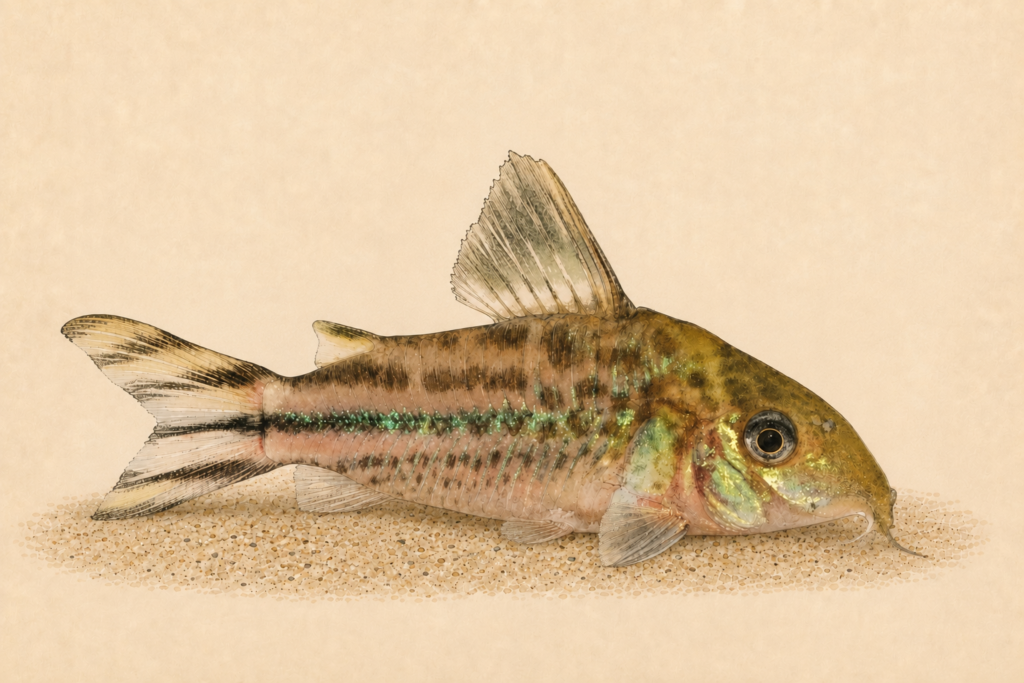
The flagtail corydoras (Brochis robineae, formerly Corydoras robineae) is a striking and unusual catfish from the upper Rio Negro basin in Brazil, best known for its unique black and white horizontally striped caudal fin. It is a rewarding species for intermediate to advanced keepers willing to provide the soft, acidic water conditions it requires, though it remains uncommon in the UK trade and specific husbandry information is limited compared to more mainstream corydoradine catfish.
🐠 Build a tank around this species
Last researched and fact-checked: September 2026.
- Introduction
- Quick Stats
- Appearance
- Natural habitat
- Tank size and setup
- Water parameters
- Filtration and equipment
- Diet and feeding
- Behaviour and temperament
- Tank mates
- Breeding
- Common diseases and health
- Frequently asked questions
- Related guides
Introduction
The flagtail corydoras has long been a quietly celebrated fish among catfish enthusiasts, prized for its distinctive tail pattern that sets it apart from virtually every other member of the corydoradine group. Originally described by Burgess in 1983 as Corydoras robineae, it was reclassified in 2024 by Dias et al. into the resurrected genus Brochis as part of a broader taxonomic revision of the Corydoradinae. It is important to note that this species sits in a different sub-clade within Brochis from the large, well-known emerald catfish group (Brochis splendens and Brochis britskii). Despite now sharing a genus name, the flagtail corydoras is only distantly related to those heavier-bodied species, and keepers should not assume its care requirements or adult size are comparable. In the aquarium trade, it is still overwhelmingly sold under the name Corydoras robineae, and this is likely to persist for some time.
Wild-caught specimens appear in the UK hobby sporadically, often commanding a premium price. The species’ appeal lies not just in its unusual tail markings but in its overall elegance: a relatively slender body, a long snout, and subtle but attractive body patterning. It is a genuine blackwater species from the upper Rio Negro, meaning it thrives in soft, acidic conditions that can be challenging to replicate in areas with hard tap water. For keepers already running a Rio Negro or similar biotope setup, this fish makes an excellent and characterful addition. For newcomers to soft-water fishkeeping, it may prove a demanding first choice.
Documentation on this species in the aquarium literature is relatively sparse. Much of what is published focuses on identification and habitat rather than long-term captive care, and breeding reports are scarce. This guide draws together what is genuinely known and documented, and is honest about the gaps.
Quick Stats
| Scientific name | Brochis robineae |
|---|---|
| Common names | Flagtail catfish, Mrs Robine's corydoras, Corydoras robineae |
| Family | Callichthyidae |
| Origin | Upper Rio Negro basin, Brazil |
| Adult size | 6 cm |
| Lifespan | 5–10 years |
| Difficulty | Advanced |
| Breeding difficulty | Advanced |
| Temperature | 24–28 °C |
| pH | 4–6.5 |
| GH | 1–10 dGH |
| KH | 0–5 dKH |
| Minimum tank size | 60 L |
| Conservation status | Least Concern (IUCN) |
Appearance
The most immediately recognisable feature of Brochis robineae is its caudal fin, which bears bold horizontal black and white stripes. This pattern is unique among corydoradine catfish and is shared, remarkably, only by the unrelated porthole catfish (Dianema urostriatum), which belongs to a different subfamily of callichthyids. The stripes on the tail are crisp and high-contrast, giving the fish an eye-catching flag-like display, particularly when the tail is spread during swimming.
The body itself is relatively slender and elongated compared to many of the more compact, rotund corydoradine species. The snout is notably long and pointed, giving the head a somewhat elegant profile. The body is covered in the overlapping bony scutes typical of the family, providing a slightly armoured look. Body colouration is generally a muted olive to brownish tone on the upper flanks, transitioning to a paler, sometimes slightly pinkish or cream underbelly. There is typically a pattern of small dark spots or a reticulated network along the flanks, though the intensity of this can vary between individuals and with the fish’s mood and condition. A dark stripe often runs along the lateral line area.
The dorsal fin and other unpaired fins may carry some subtle spotting or banding, but it is the tail that remains the defining visual feature. The pectoral and pelvic fins are generally clear or lightly tinted. As with all corydoradine catfish, the first ray of the pectoral fin is a stiffened spine that can be locked erect as a defence mechanism, so care should be taken when netting this species.
Sexual dimorphism is not extensively documented for this species specifically, but as is typical for corydoradine catfish, mature females are likely to be somewhat fuller-bodied than males, particularly when viewed from above. Males may appear slightly more slender, with possibly marginally longer pectoral fin spines, though this has not been thoroughly described for B. robineae in the literature.
Natural habitat
The flagtail corydoras is found in the upper Rio Negro basin in the Amazonas state of Brazil. The Rio Negro is one of the world’s great blackwater river systems, characterised by extremely soft, acidic water stained a deep tea-brown colour by humic acids and tannins leaching from decaying leaf litter and forest soils. These waters are famously mineral-poor, with conductivity levels sometimes barely above that of distilled water.
In this environment, the pH is typically very low, often between 4.0 and 5.5, and general hardness is negligible. Water temperatures are warm and relatively stable, reflecting the equatorial climate. The substrate in these habitats tends to be fine sand, often covered with a thick layer of decomposing leaf litter and submerged woody debris. Aquatic plant growth in true blackwater habitats is typically sparse due to the very limited light penetration through the tannin-stained water, though marginal vegetation and root tangles from riparian trees provide important cover.
This species inhabits the shallower, slower-moving areas of these waterways, including forest streams, flooded margins, and quiet backwaters. Like other corydoradine catfish, it is a benthic species, foraging along the substrate for small invertebrates, worms, and organic detritus. Wild populations would be subject to seasonal fluctuations in water level and flow as the Amazon basin cycles through its annual flood and dry seasons.
Specific ecological data on population density, predator-prey relationships, and microhabitat preferences for B. robineae are limited in the published literature. The species is listed as Least Concern, though this broad status does not rule out localised pressure – the upper Rio Negro region faces ongoing pressures from deforestation, mining, and collection for the aquarium trade.
Tank size and setup
A minimum tank size of 75 litres (approximately 20 US gallons) is appropriate for a small group of six flagtail corydoras. As with all corydoradine catfish, keeping them in groups is essential, and six should be considered the minimum number. A larger group in a bigger tank will produce more natural, confident behaviour. A 100 to 150 litre (26 to 40 US gallon) aquarium would be preferable where space allows, particularly if keeping them alongside other species.
The footprint of the tank matters more than its height for a benthic species. A tank with a longer, wider base provides more foraging area and is always preferable to a tall, narrow design. Fine, smooth sand is the ideal substrate. Coarse or sharp-edged gravel should be avoided as it can damage the delicate barbels that corydoradine catfish rely on for foraging. Healthy, intact barbels are a good indicator of proper substrate choice.
To replicate the species’ natural blackwater environment, the tank should include a generous amount of leaf litter, driftwood, and root tangles. Indian almond leaves (Terminalia catappa), dried oak leaves, or beech leaves serve multiple purposes: they release tannins that stain the water and gently lower pH, they provide surfaces for microbial biofilm growth (a supplementary food source), and they create a naturalistic, visually appealing environment. Driftwood pieces, particularly those with branching root-like structures, offer hiding spots and shade.
Lighting should be subdued. In the wild, these fish inhabit dimly lit waters, and they will be noticeably more active and confident under low light. Floating plants such as Amazon frogbit or red root floaters can help diffuse overhead lighting effectively. If rooted plants are desired, species tolerant of low light and soft, acidic water are the best choices, such as various Cryptocoryne species, Java fern, and Java moss, though dense planting is not characteristic of a true Rio Negro biotope.
The tank should be well-covered. Corydoradine catfish are facultative air-breathers that periodically dash to the surface to gulp atmospheric air, which is absorbed in their highly vascularised hindgut. A gap between the water surface and the tank lid allows access to air while preventing the fish from leaping out, a behaviour that can occur, especially when startled.
Water parameters
This is a true blackwater species and it requires soft, acidic conditions to thrive. Keeping it in hard, alkaline water is likely to cause chronic stress and health problems. In areas of the UK with hard tap water, a reverse osmosis (RO) unit or similar remineralisation-free water source will be necessary.
| Temperature | 24 – 28 °C (75 – 82 °F) |
| pH | 4.0 – 6.5 |
| General hardness (GH) | 0 – 4 dGH |
| Ammonia | 0 ppm |
| Nitrite | 0 ppm |
| Nitrate | Below 10 ppm |
The extremely low pH range listed here reflects the genuine conditions found in the upper Rio Negro. In practice, many keepers maintain this species successfully at a pH of 5.0 to 6.5. Attempting to maintain a pH below 5.0 in an aquarium requires considerable experience, as biological filtration efficiency drops significantly at very low pH values and the system becomes more difficult to manage safely. Stability is more important than hitting an exact number at the extreme low end.
Nitrate should be kept as low as possible. A target of below 10 ppm is appropriate for a wild-caught blackwater species that originates from waters with virtually no measurable nitrate. Regular partial water changes using appropriately conditioned soft water are the most reliable way to achieve this. Temperature should be kept stable; avoid placing the tank near radiators, draughty windows, or in direct sunlight.
Filtration and equipment
Filtration for a flagtail corydoras tank should prioritise biological and mechanical efficiency while producing a gentle to moderate flow. In the wild, this species inhabits calmer waters, and excessively strong currents will cause stress and force the fish to expend unnecessary energy. A well-sized internal filter, a small canister filter, or a mature sponge filter will all work well. Sponge filters driven by an air pump are a particularly good choice for soft-water setups as they provide gentle flow and excellent biological filtration without disrupting the substrate unduly.
In very soft, acidic water (pH below 5.5), the efficiency of nitrifying bacteria can be significantly reduced. Keepers maintaining very low pH systems should be aware of this and may need to rely more heavily on regular water changes and careful stocking levels to manage waste. Monitoring ammonia and nitrite with liquid test kits is particularly important in these conditions, as standard test strips may lack the sensitivity required.
A heater rated appropriately for the tank volume is necessary to maintain the warm temperatures this tropical species requires. A heater guard is a sensible precaution to prevent burns, especially for a bottom-dwelling fish that may rest against equipment. A thermometer placed away from the heater gives a more accurate reading of the ambient water temperature.
Aeration is beneficial, though not to the point of creating excessive surface agitation that drives off the CO2 that helps maintain a low pH in a blackwater setup. The fish’s ability to breathe atmospheric air provides a buffer, but well-oxygenated water is still important for overall water quality and the health of the biological filter.
Diet and feeding
Like other corydoradine catfish, the flagtail corydoras is an omnivorous benthic forager that feeds primarily on small invertebrates, insect larvae, worms, and organic detritus in the wild. In captivity, it should be offered a varied diet that includes both high-quality prepared foods and live or frozen options.
Sinking pellets and wafers designed for bottom-dwelling catfish form a good staple diet. These should be of reputable quality and appropriately sized for the fish’s small mouth. Supplement this regularly with frozen or live foods such as bloodworm, daphnia, brine shrimp, tubifex, and micro-worms. These protein-rich foods help maintain condition and encourage natural foraging behaviour. If live foods are available, they are generally taken with particular enthusiasm.
Feeding should ideally take place in the evening or after lights-out, as corydoradine catfish are naturally most active during twilight and nocturnal periods, though they will readily learn to feed during the day in a calm aquarium. Ensure food reaches the substrate rather than being intercepted by mid-water tank mates. Scattering food across the tank floor rather than placing it in a single spot encourages more natural foraging.
The leaf litter recommended for the tank setup also serves as a continuous supplementary food source. Biofilm and micro-organisms colonise decomposing leaves, and the catfish will graze on these throughout the day. This is an important part of their diet in the wild and contributes to overall gut health and condition in captivity.
Avoid overfeeding. Uneaten food in a soft-water, low-pH system will decompose and contribute to water quality problems. Feed amounts that the group will consume within a few minutes, removing any obvious uneaten remnants.
Behaviour and temperament
The flagtail corydoras is a peaceful, social species that should always be kept in groups. A minimum of six is recommended, and larger groups will display more confident and interesting behaviour. Solitary or paired individuals tend to be shy, reclusive, and chronically stressed, which compromises their immune system and lifespan.
In a well-set-up tank with subdued lighting and ample cover, a group of B. robineae will spend much of their time foraging actively across the substrate, probing the sand and leaf litter with their barbels in a characteristic shuffling motion. They are particularly active during dusk and dawn. Periodic dashes to the surface to gulp air are entirely normal and not a sign of distress, provided they are not occurring with frantic frequency (which could indicate poor water quality or low dissolved oxygen).
This species is not territorial and shows no aggression towards conspecifics or other fish. Within the group, individuals often shoal loosely, sometimes resting together in favoured spots beneath driftwood or among leaf litter. They may also associate peacefully with other small corydoradine species if kept in a mixed-species setup, though mixing species from very different water parameter requirements is not advisable.
Newly imported wild-caught specimens can be quite shy and may take several weeks to settle into a new aquarium. Patience, stable water conditions, and a carefully planned environment with plenty of visual barriers and hiding spots will help them acclimatise.
Tank mates
The flagtail corydoras is entirely peaceful and can be kept with other small, non-aggressive species that share its preference for soft, acidic, warm water. The main constraint on tank mate selection is water chemistry: any companion species must genuinely thrive in the very soft, acidic conditions this fish requires. Species from the Rio Negro or similar blackwater habitats are the most natural and practical choices.
Good tank mates
- Cardinal tetra, a classic Rio Negro companion that thrives in identical water conditions
- Green neon tetra, another upper Rio Negro native and an ideal match
- Rummy-nose tetra, a peaceful schooling fish comfortable in warm, soft water
- Ember tetra, a tiny, peaceful species well suited to soft, acidic setups
- Chocolate gourami, a quiet, soft-water species that occupies the mid to upper levels
- Pencilfish, various Nannostomus species are excellent blackwater tank mates
- Otocinclus, a gentle algae grazer that stays small and shares the lower levels peacefully
- Pygmy corydoras, a diminutive relative that enjoys similar conditions, though it tends to swim more in the water column
- Apistogramma, many dwarf cichlid species from soft-water habitats coexist well, provided the tank offers sufficient floor space and cover
- Hatchetfish, surface-dwelling species that stay well out of the corydoras’ way
Fish to avoid
- African cichlids, require hard, alkaline water and are often aggressive or territorial
- Oscar, far too large and predatory; would view small corydoras as food
- Common pleco, grows far too large and produces excessive waste for a small soft-water tank
- Tiger barb, a fin-nipper that can harass slower bottom-dwellers
- Goldfish, a cold-water species with incompatible temperature and water chemistry needs
- Guppy, requires harder, more alkaline water to thrive and is a poor match for blackwater conditions
- Molly, needs hard, often slightly brackish water and is completely unsuitable
- Red-tail catfish, a massive predator entirely unsuitable for a community aquarium
- Jack Dempsey, a large, aggressive cichlid that would bully or eat small corydoras
- Convict cichlid, territorial and aggressive, especially when breeding, and prefers harder water
Breeding
Specific, documented breeding reports for Brochis robineae in captivity are extremely scarce. This species has not been bred on any significant commercial scale, and the vast majority of specimens available in the trade are wild-caught. The limited information that follows is based on the general reproductive biology of corydoradine catfish, and keepers should be aware that species-specific details may differ.
Corydoradine catfish generally spawn in response to environmental triggers that simulate the onset of the rainy season: a drop in temperature (often achieved through a large cool water change), a drop in barometric pressure, increased oxygenation, and an abundance of high-quality food in the preceding weeks. Given the extreme soft-water requirements of B. robineae, it is reasonable to assume that any breeding attempt would need to take place in very soft, acidic water, likely at the lower end of the species’ pH range.
The typical corydoradine spawning behaviour involves a “T-position,” where the female clasps the male’s pelvic area with her barbels and pectoral fins during fertilisation. Eggs are usually adhesive and deposited in small clusters on flat surfaces such as plant leaves, aquarium glass, or smooth driftwood. Clutch size and egg development time have not been specifically documented for this species.
If any eggs are obtained, removing them to a separate rearing container with matching water parameters is advisable to protect them from being eaten by adults or tank mates. An anti-fungal treatment such as a few drops of methylene blue can help prevent fungal growth on infertile eggs from spreading to viable ones. Fry of corydoradine catfish are typically very small and require correspondingly tiny first foods such as infusoria, microworms, or newly hatched brine shrimp nauplii.
Anyone who succeeds in breeding this species is encouraged to document and share their experience, as it would represent a genuinely valuable contribution to the hobby’s collective knowledge.
Common diseases and health
The flagtail corydoras is susceptible to the same range of health issues that affect other corydoradine catfish, though its specific disease profile has not been the subject of dedicated veterinary study. As a wild-caught species typically imported from remote Amazonian collection points, newly acquired specimens may arrive stressed, underfed, or carrying internal parasites. A quarantine period of at least two to four weeks in a separate tank with matching water parameters is strongly recommended before introducing new fish to an established community.
Barbel erosion is one of the most common problems seen in corydoradine catfish and is almost always caused by poor substrate choice (sharp or coarse gravel) or dirty substrate conditions. In healthy conditions with fine, clean sand, the barbels should be long, intact, and actively used for foraging. Shortened or absent barbels indicate a husbandry problem that needs correcting. Bacterial infections, including fin rot and skin ulceration, can develop when water quality deteriorates or when fish are kept in inappropriate water chemistry. The very soft, acidic water this species requires can be less forgiving of lapses in maintenance, as the low buffering capacity means that pH can swing rapidly if organic waste accumulates. Consistent maintenance routines are essential.
White spot disease (ich, caused by Ichthyophthirius multifiliis) can affect this species as it does any freshwater fish, though it is worth noting that corydoradine catfish can be sensitive to some common ich medications, particularly those containing copper or formalin at full strength. Half-dosing, or using heat-based treatment (raising the temperature gradually to 30 °C / 86 °F for a short period, where the species can tolerate it), is often recommended for scaleless or armoured catfish. Always research medication compatibility before dosing a tank containing corydoradine catfish. Good husbandry, stable water parameters, a varied diet, and minimal stress remain the best defences against disease.
Frequently asked questions
Is the flagtail corydoras the same as the emerald catfish?
No. Although both species now sit within the genus Brochis following the 2024 taxonomic revision by Dias et al., the flagtail corydoras (Brochis robineae) belongs to a different sub-clade from the emerald catfish (Brochis splendens) and the related Brochis britskii. They are only distantly related within the genus. The emerald catfish group are larger, deeper-bodied fish with a metallic green sheen, while the flagtail corydoras is a smaller, more slender species with an entirely different appearance and more demanding water requirements.
Why is this fish still sold as Corydoras robineae?
The reclassification into Brochis was published in 2024 and is very recent. Trade names and common usage typically lag behind taxonomic changes by years or even decades. Most retailers, wholesalers, and hobbyist resources will continue to use Corydoras robineae for the foreseeable future, and this name will remain perfectly understood. Both names refer to the same species.
Can I keep flagtail corydoras in hard, alkaline tap water?
This is strongly discouraged. The flagtail corydoras is a genuine blackwater species from the upper Rio Negro, where the water is extremely soft and acidic. Keeping it in hard, alkaline conditions is likely to cause chronic stress, reduced lifespan, and increased susceptibility to disease. If your tap water is hard, you will need to use reverse osmosis (RO) water or a similar source to create appropriate conditions.
How many flagtail corydoras should I keep?
A minimum of six is recommended, as with all corydoradine catfish. They are social, shoaling fish that display much more natural and confident behaviour in groups. Larger groups of eight to twelve or more are even better if tank space permits.
Are flagtail corydoras easy to breed?
Documented breeding reports for this species are extremely limited. It has not been bred commercially in any significant numbers, and the overwhelming majority of specimens in the trade are wild-caught. Breeding would likely require expert-level soft-water management and careful environmental conditioning, and even then, success is not guaranteed. This is not a species to choose if captive breeding is a primary goal.
What makes the tail pattern so unusual?
The horizontal black and white stripes on the caudal fin are unique among corydoradine catfish. The only other callichthyid with a similar tail pattern is Dianema urostriatum (the flagtail catfish), which belongs to a different subfamily entirely. The convergence is a striking example of similar patterns arising independently in unrelated lineages.
Is this species endangered?
The flagtail corydoras is listed as Least Concern by the IUCN. It has a relatively restricted range in the upper Rio Negro basin, and like many Amazonian fish, its habitat faces pressures from deforestation and other human activities. The species is not listed under CITES.