Giraffe Catfish Care Guide – Tank Setup, Feeding and Breeding
Quick summary
The Giraffe Catfish is a striking, peaceful African bottom-dweller, but it grows to 45-60 cm, needs at least a 750 litre tank with a fine sand substrate, and can live 15-20 years, so it’s only suitable for committed aquarists with serious space and equipment. It’s a moderate difficulty species that’s easy to feed and mostly hardy, but breeding it at home is very difficult and rarely achieved.
🐠 Build a tank around this fish
In this guide:
- Introduction
- Quick Stats
- Appearance
- Natural Habitat
- Tank Size and Setup
- Water Parameters
- Filtration and Equipment
- Diet and Feeding
- Behaviour and Temperament
- Tank Mates
- Breeding
- Common Diseases
- FAQs
Introduction
The Giraffe Catfish (Auchenoglanis occidentalis) is one of the most visually striking freshwater catfish available to aquarists, named for the beautiful spotted and blotched pattern across its body that closely resembles the markings of its namesake mammal. Native to a wide swathe of tropical Africa, this species is found in river basins, lakes, and floodplains across the continent, where it has adapted to a bottom-dwelling, sand-sifting lifestyle that makes it a fascinating addition to large aquaria.
Despite its undeniable charm and relatively placid temperament, the Giraffe Catfish is not a species to be taken on lightly. Adults regularly reach 45-60 cm in captivity and can exceed 70 cm in the wild, meaning that only aquarists with very large tanks should consider keeping this fish. Its long lifespan – often exceeding 15 years with proper care – further underscores the commitment required. However, for those with the space and resources, the Giraffe Catfish rewards its keeper with engaging behaviour, a calm disposition, and a truly spectacular appearance that only improves with age as its patterning becomes more defined and contrasted.
In the wild, Auchenoglanis occidentalis is an opportunistic omnivore that spends much of its time sifting through sandy substrates in search of invertebrates, organic detritus, and plant matter. This natural behaviour translates beautifully into the aquarium, where the fish can frequently be observed methodically working through sand, expelling clouds of substrate through its gills in search of food. This sand-sifting habit is not only entertaining to watch but also serves a practical purpose, helping to turn over and aerate the substrate.
The Giraffe Catfish has been known to science since 1821, when it was first described by Achille Valenciennes. It belongs to the family Claroteidae (formerly placed within Bagridae by some authors), a group of African catfishes that includes several other species occasionally seen in the aquarium trade. While not as commonly available as many South American catfish species, the Giraffe Catfish appears regularly enough in specialist shops and through importers to be obtainable for dedicated enthusiasts.
This care guide covers everything you need to know to keep Auchenoglanis occidentalis successfully, from tank requirements and water parameters to diet, behaviour, and breeding. Whether you are researching this species before purchase or seeking to refine the care of a specimen you already own, the information below will help you provide the best possible environment for this remarkable African catfish.
Quick Stats
| Scientific name | Auchenoglanis occidentalis |
| Common names | Giraffe Catfish, Bubu, Giraffe Nosed Catfish, African Giraffe Catfish |
| Family | Claroteidae |
| Origin | Widespread across tropical Africa – Nile, Niger, Volta, Chad, Congo, and Senegal river basins; Lakes Chad, Turkana, and Albert |
| Adult size | 45-60 cm (up to 70 cm in the wild) |
| Lifespan | 15-20 years |
| Difficulty | Moderate |
| Breeding difficulty | Difficult |
| Temperature | 22-28 °C |
| pH range | 6.5-7.8 |
| General hardness (GH) | 5-20 dGH |
| Carbonate hardness (KH) | 4-15 dKH |
| Minimum tank size | 750 litres |
| Conservation status | Least Concern (IUCN) |
Appearance
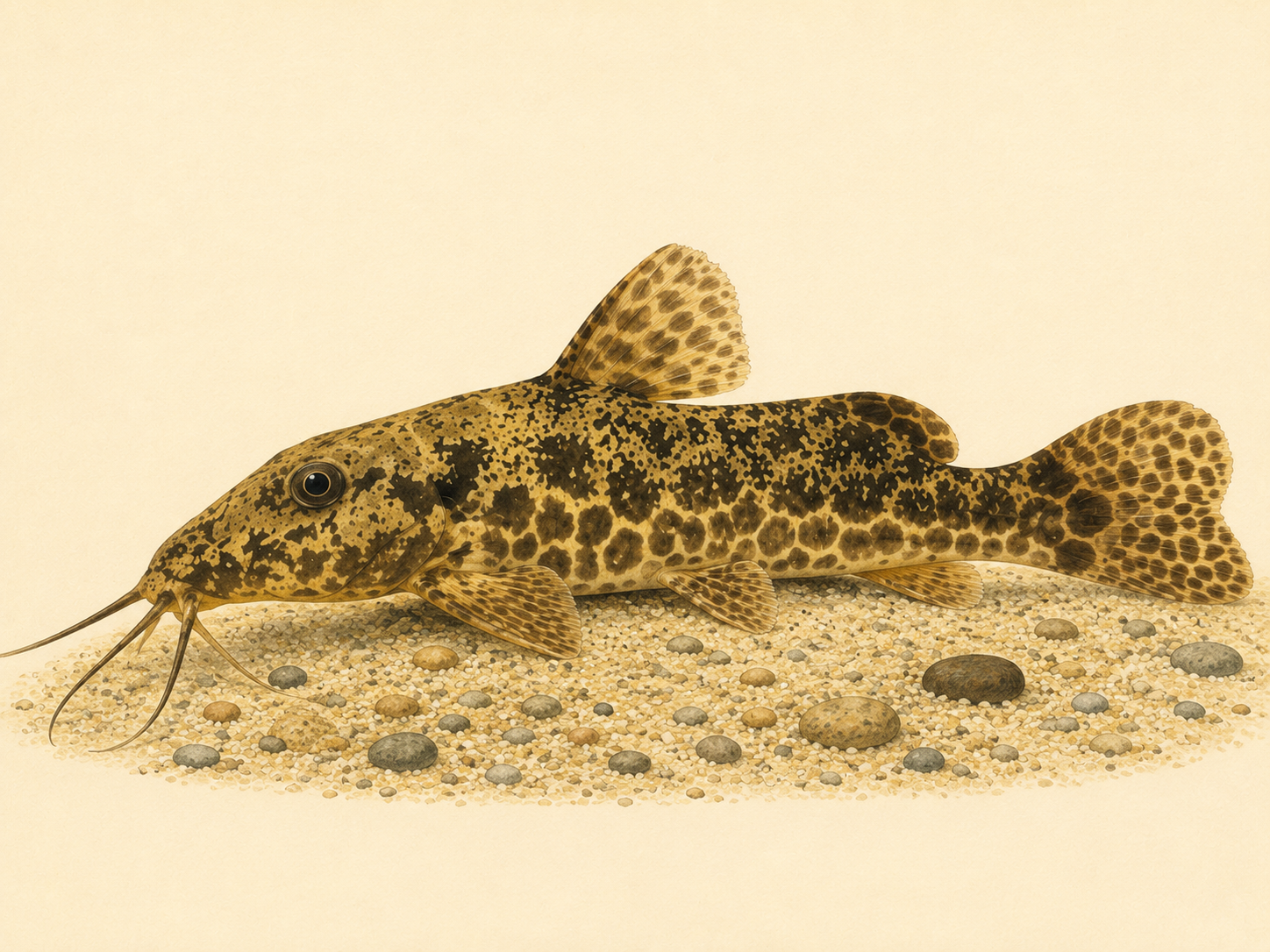
The Giraffe Catfish possesses a robust, elongated body typical of many large claroteids, with a broad, somewhat flattened head and a wide, subterminal mouth ideally suited to its sand-sifting feeding strategy. The body is deep and laterally compressed towards the caudal peduncle, giving the fish a powerful, solidly built profile. Three pairs of barbels adorn the mouth area – one pair of maxillary barbels that can be quite long, reaching back towards the pectoral fins, and two pairs of shorter mandibular barbels. These barbels are highly sensitive and are used constantly as the fish probes the substrate for food.
The defining feature of this species is, of course, its remarkable coloration. The base colour ranges from a warm golden-brown to a creamy yellow, overlaid with an irregular network of darker brown to chocolate-coloured spots, blotches, and vermiculations. This patterning is highly variable between individuals, with some specimens displaying large, well-defined spots while others show a more reticulated or marbled pattern. The overall effect is strikingly reminiscent of giraffe skin, hence the common name. The fins are typically marked with the same spotted patterning, though they may be somewhat lighter in colour than the body. The ventral surface is generally paler, often a plain cream or off-white.
Juvenile Giraffe Catfish tend to show higher contrast in their patterning, with darker spots against a lighter background. As the fish matures, the coloration may deepen and the pattern can become more complex, though the fundamental spotted appearance is maintained throughout life. The eyes are relatively small in proportion to the large head, positioned laterally and slightly upward, reflecting the species’ primarily benthic lifestyle.
The dorsal fin is relatively tall with a strong, serrated first spine – a characteristic shared with many catfish species and one that aquarists should be aware of when handling or netting the fish, as it can easily become entangled in nets and can cause a painful puncture wound. The adipose fin is well developed, and the caudal fin is forked, providing good propulsion when the fish chooses to swim in open water. The pectoral fins also feature a strong leading spine. Overall, the Giraffe Catfish is an imposing and beautiful fish whose appearance only becomes more impressive as it grows.
Natural Habitat
Auchenoglanis occidentalis is one of the most widespread catfish species in Africa, found across an enormous range that encompasses numerous major river systems and lake environments. Its distribution includes the Nile basin (including the White Nile), the Niger and Benue river systems, the Volta basin, the Chad basin, the Senegal and Gambia rivers, the Congo basin, and various East African lakes including Lakes Chad, Turkana (formerly Rudolf), and Albert. This vast range reflects the species’ adaptability and tolerance for a variety of aquatic conditions.
In its natural habitat, the Giraffe Catfish inhabits a range of freshwater environments, from slow-moving rivers and their associated floodplains to the margins of large lakes. It shows a particular preference for areas with soft, sandy or muddy substrates where it can engage in its characteristic sand-sifting feeding behaviour. During the wet season, these fish may move onto inundated floodplains to feed on the abundance of food available in these seasonally flooded areas, returning to the main river channels or deeper lake waters as water levels recede.
The water conditions across its natural range vary considerably. In many West African river systems, the water tends to be slightly acidic to neutral with moderate hardness, while in the East African lakes and the Nile system, conditions can be harder and more alkaline. This broad range of natural conditions is one reason the Giraffe Catfish is relatively adaptable in captivity, tolerating a wider range of water parameters than many other large catfish species. Water temperatures in its native habitat typically range from 22 to 28 degrees Celsius, with seasonal fluctuations.
The species is primarily nocturnal or crepuscular in the wild, spending daylight hours sheltering amongst submerged roots, rocky overhangs, or within dense vegetation before emerging at dusk to feed. In many parts of its range, it is an important food fish for local communities and is caught using a variety of methods including gill nets, hook and line, and basket traps. Despite this fishing pressure, the species remains classified as Least Concern by the IUCN, largely due to its extensive distribution and apparent resilience.
Tank Size and Setup
A minimum tank size of 750 litres is recommended for a single adult Giraffe Catfish, and larger is always better. Given that this species can reach 60 cm in length and is a moderately active swimmer, the footprint of the tank is arguably more important than the total volume. A tank measuring at least 200 cm in length and 60 cm in width should be considered the minimum for long-term housing. If you intend to keep the Giraffe Catfish with other large species – as many keepers do – then tanks of 1,000 litres or more become necessary.
The substrate choice is critically important for this species. Fine sand is essential, as the Giraffe Catfish’s natural feeding behaviour involves taking mouthfuls of substrate and sifting it through its gills to extract food items. Gravel, coarse substrates, or bare-bottom setups are unsuitable and will prevent the fish from engaging in this fundamental behaviour, potentially leading to stress and poor condition. Play sand, pool filter sand, or purpose-made aquarium sand in a neutral colour all work well. A depth of 5-8 cm allows the fish to dig and sift comfortably.
Decor should be chosen with the fish’s size and activity in mind. Large pieces of bogwood, smooth rocks, and sturdy cave structures provide welcome hiding spots and help the fish feel secure, particularly during daylight hours. Ensure that any rockwork is securely positioned and ideally resting on the tank base rather than on the sand, as the Giraffe Catfish’s digging behaviour can undermine poorly placed decorations. PVC pipes of appropriate diameter can also serve as effective, if unattractive, hiding spots and can be concealed behind other decor.
Live plants are generally not practical with Giraffe Catfish. Their constant substrate disturbance will uproot most rooted plants, and while robust species like Anubias and Java Fern attached to hardscape may survive, they will likely accumulate sand deposits from the fish’s feeding activity. If you wish to include plants, epiphytic species attached to wood or rock above the substrate line are your best option.
Lighting should be subdued, in keeping with the species’ preference for low-light conditions. The Giraffe Catfish is more likely to be active and visible during the day if the lighting is not too intense. Floating plants, if practical, can help diffuse overhead light, or simply using a dimmer LED fixture set to lower intensity will suffice. A consistent photoperiod of 10-12 hours is appropriate.
A secure, well-fitting lid or cover glasses are recommended. While the Giraffe Catfish is not a habitual jumper, large catfish can occasionally surge to the surface during feeding or when startled, and the powerful thrust of a 50 cm fish can displace a surprising amount of water or even launch itself partially out of an open-top tank.
Water Parameters
The Giraffe Catfish is relatively tolerant of a range of water conditions, reflecting its broad natural distribution across multiple African river basins and lake systems. However, consistency is more important than hitting a specific target within the acceptable range. Sudden fluctuations in temperature, pH, or hardness can cause stress, and a stable environment within the parameters below will yield the best results.
| Temperature | 22-28 °C |
| pH | 6.5-7.8 |
| General hardness (GH) | 5-20 dGH |
| Carbonate hardness (KH) | 4-15 dKH |
| Ammonia | 0 ppm |
| Nitrite | 0 ppm |
| Nitrate | Below 40 ppm |
A temperature of 24-26 degrees Celsius represents a comfortable middle ground and is ideal for most community setups featuring this species. The Giraffe Catfish tolerates moderately hard water well, which makes it suitable for many tap water supplies across the United Kingdom without the need for significant modification. Aim to keep nitrate levels as low as practical – while the species will tolerate up to 40 ppm, levels below 20 ppm are preferable and will support better long-term health and coloration.
Regular water changes are essential, particularly given the volume of waste produced by a large catfish. A weekly water change of 25-30% is recommended, and this should be increased if nitrate levels tend to climb quickly. When performing water changes, ensure that the replacement water is temperature-matched and has been dechlorinated. The use of a Python-style water changer or similar system is highly recommended for tanks of this size, as carrying buckets becomes impractical for the volumes involved.
Filtration and Equipment
Filtration for a tank housing a Giraffe Catfish needs to be robust and generously rated. This is a large fish with a healthy appetite that produces a correspondingly significant amount of waste. Aim for a total filtration turnover of at least 8-10 times the tank volume per hour. For a 750-litre tank, this means a combined filter output of 6,000-7,500 litres per hour. In practice, this is best achieved by running two or more large external canister filters, or a single high-capacity sump system.
External canister filters from reputable manufacturers such as Fluval, Eheim, or Oase are popular choices for tanks of this size. Running two filters rather than relying on a single unit provides redundancy – if one filter fails or needs servicing, the other continues to maintain biological filtration. Sump systems offer even greater capacity for biological media and are easier to maintain on very large setups, with the added benefit of increasing the total water volume in the system.
Mechanical filtration is particularly important with a sand-sifting species, as the fish’s feeding activity sends fine particles into the water column. Coarse and fine mechanical filter media will need to be cleaned or replaced more frequently than in a typical setup. Pre-filter sponges on canister filter inlets help protect impellers from sand ingestion and should be rinsed regularly.
Biological filtration should be prioritised, with the bulk of available media space dedicated to high-surface-area biological media such as ceramic rings, sintered glass, or purpose-made bio-media. The ammonia and nitrite produced by a large catfish can overwhelm an undersized biological filter, so err on the side of excess capacity.
An appropriately sized heater – or preferably two heaters for redundancy and even heat distribution – is necessary to maintain stable temperatures. For a 750-litre tank, two 300-watt heaters positioned at opposite ends of the tank provide good coverage. In-line heaters fitted to the canister filter outlet are an excellent option, keeping equipment out of the tank and away from the fish’s potentially destructive activities.
Aeration should be adequate, as large catfish are sensitive to dissolved oxygen levels. Surface agitation from filter outlets is usually sufficient, but an additional air pump with a large air stone can be beneficial, particularly in warmer weather when dissolved oxygen levels naturally decrease. If using a sump, the water cascading back into the main tank provides excellent gas exchange.
Diet and Feeding
The Giraffe Catfish is an omnivorous species with a strong inclination towards protein-rich foods, though it readily accepts a wide variety of food types in captivity. In the wild, its diet consists primarily of benthic invertebrates including insect larvae, crustaceans, and worms, supplemented by organic detritus and plant matter extracted during sand-sifting. Replicating this varied diet in the aquarium is straightforward and contributes to good health and coloration.
A high-quality sinking pellet or tablet food should form the staple diet. Large catfish pellets, sinking cichlid pellets, or purpose-made bottom-feeder tablets from reputable brands provide a balanced nutritional foundation. Choose pellets large enough that they are not immediately lost in the sand, as the fish will locate them quickly using its sensitive barbels.
This staple diet should be supplemented regularly with frozen and live foods. Bloodworm, mysis shrimp, krill, chopped prawns, earthworms, and mussel are all accepted with enthusiasm. Earthworms in particular are an excellent food source and can be cultured at home or purchased from fishing tackle shops. Larger specimens will also take whole prawns, lance fish, and other chunky frozen foods. Blanched vegetables such as courgette, cucumber, sweet potato, and shelled peas provide valuable fibre and plant matter and should be offered once or twice a week.
Feed once or twice daily, offering only as much food as the fish will consume within a few minutes. It is easy to overfeed large catfish, as their seemingly insatiable appetite can encourage keepers to offer excessive quantities. Overfeeding leads to poor water quality and obesity, both of which shorten the fish’s lifespan. One fasting day per week is beneficial for adult specimens, allowing the digestive system to clear and helping to maintain water quality.
One of the most engaging aspects of keeping a Giraffe Catfish is watching it feed naturally from the substrate. Scattering small food items such as frozen bloodworm or crushed pellets across the sand encourages the fish to sift through the substrate in search of food, replicating its wild behaviour and providing valuable enrichment.
Behaviour and Temperament
The Giraffe Catfish is a generally peaceful species for its size, displaying a calm and placid temperament that makes it compatible with a range of similarly sized tank mates. It is not aggressive or territorial in the typical sense, though it will defend its immediate resting spot from other bottom-dwelling fish if space is limited. This defence is usually limited to posturing and gentle nudging rather than outright aggression.
This species is primarily crepuscular to nocturnal in its activity patterns. In a newly set up tank or during the initial settling-in period, the Giraffe Catfish may remain hidden for extended periods, emerging only after lights-out to feed and explore. As it acclimates to its environment and feeding routine, however, most specimens become increasingly bold and will venture out during daylight hours, particularly around feeding time. Subdued lighting encourages daytime activity.
The sand-sifting behaviour is the most characteristic and entertaining aspect of keeping this species. The fish takes large mouthfuls of sand, processes it internally, and expels it through its gill openings, extracting any edible particles in the process. This behaviour is performed almost constantly when the fish is active and results in noticeable rearrangement of the substrate over time. Aquarists should be prepared for the fish to create shallow depressions, uncover buried items, and generally remodel the sandscape to its own preferences.
Giraffe Catfish are not strongly social in the way that some shoaling catfish species are, but they are tolerant of conspecifics and can be kept in groups if the tank is large enough. A group of three or more in an appropriately sized system (1,500 litres or more) can make for a spectacular display. Solitary specimens also do perfectly well and show no signs of loneliness or stress when kept alone, provided the tank is otherwise well furnished and other community fish are present.
The species possesses the ability to produce audible sounds by stridulation of its pectoral fin spines, a behaviour most commonly observed when the fish is handled, stressed, or during interactions with conspecifics. These sounds can be surprisingly loud and are sometimes audible from across the room.
Tank Mates
Selecting appropriate tank mates for the Giraffe Catfish requires consideration of the fish’s large adult size, its peaceful but occasionally clumsy nature, and its preference for the bottom and lower portions of the water column. Ideal companions are large, robust species that occupy the mid-water and upper levels of the tank, are not overly aggressive, and are too large to be accidentally ingested. Any fish small enough to fit in the Giraffe Catfish’s mouth will eventually be eaten, even though this species is not an active predator. This generally rules out any tank mate smaller than about 10-12 cm.
Good tank mates
- Bichir (Polypterus species) – Fellow African bottom-dwellers that are robust, similarly sized, and tolerant of the same water conditions.
- African Butterfly Fish (Pantodon buchholzi) – Occupies the surface exclusively, staying well away from the catfish’s domain, though ensure it is not too small for the tank’s other inhabitants.
- Synodontis eupterus (Featherfin Squeaker) – A hardy African catfish that coexists peacefully with larger claroteids and adds mid-to-bottom activity.
- Oscar (Astronotus ocellatus) – A large, robust cichlid that can hold its own and typically ignores a peaceful bottom-dwelling catfish.
- Severum (Heros severus) – A generally peaceful large cichlid that provides attractive mid-water presence without harassing bottom-dwellers.
- Silver Dollar (Metynnis hypsauchen) – A large, peaceful schooling fish that occupies mid-water and is too deep-bodied to be eaten by the catfish.
- Tinfoil Barb (Barbonymus schwanenfeldii) – Active, large schooling fish that use the upper water column and are too big to be considered prey.
- Clown Loach (Chromobotia macracanthus) – Another large, peaceful bottom-dweller that cohabits well, provided the tank is spacious enough for both species.
Fish to avoid
- Neon Tetra (Paracheirodon innesi) – Far too small and will be consumed by even a juvenile Giraffe Catfish.
- Red Devil Cichlid (Amphilophus labiatus) – Extremely aggressive and territorial, likely to attack and injure the peaceful Giraffe Catfish.
- Flowerhorn Cichlid – Highly aggressive hybrid cichlid that will dominate and stress a non-confrontational catfish.
- Cherry Shrimp (Neocaridina davidi) – A tiny invertebrate that will be immediately consumed as food.
- Guppy (Poecilia reticulata) – Much too small to house with a large predatory-capable catfish; will be eaten overnight.
- African Pike Cichlid (Hepsetus odoe) – An aggressive predatory fish that could injure or stress the Giraffe Catfish.
- Tiger Shovelnose Catfish (Pseudoplatystoma fasciatum) – An extremely large, aggressive predatory catfish that may attack or outcompete the Giraffe Catfish.
- Corydoras Catfish – Far too small to safely cohabit with a large catfish; risk of predation is very high.
Breeding
Breeding the Giraffe Catfish in captivity is a rare achievement and has been accomplished only infrequently in home aquaria. The majority of specimens available in the trade are wild-caught, with limited captive breeding taking place primarily in large-scale commercial facilities in Asia and occasionally in public aquaria with suitably large displays.
Sexing adult Giraffe Catfish is difficult, with no easily identifiable external sexual dimorphism in juveniles. In mature specimens, females are generally fuller-bodied when viewed from above, particularly when carrying eggs, while males may develop a slightly broader, flatter head. These differences are subtle and unreliable unless comparing multiple individuals of similar size and age side by side.
In the wild, Auchenoglanis occidentalis is believed to breed during the rainy season, when rising water levels, changes in water chemistry, and increased food availability trigger spawning behaviour. The fish is reported to construct rudimentary nests or depressions in the substrate, and there is evidence of some degree of parental care, particularly by the male, who may guard the eggs until hatching.
To attempt breeding in captivity, a very large tank (well in excess of 1,500 litres) housing a group of mature adults would be necessary. Simulating seasonal changes – a gradual increase in temperature, a reduction in water hardness through dilution with soft water, and an increase in feeding with high-protein foods – may help to trigger spawning behaviour. Large water changes with slightly cooler, softer water can mimic the onset of the rainy season.
Eggs are relatively large for a catfish species and are deposited on a flat surface or in a prepared depression. Incubation time is reported to be in the range of 48-72 hours depending on temperature, with the fry becoming free-swimming within a few days of hatching. Fry can be started on newly hatched brine shrimp (Artemia nauplii), microworms, and finely ground quality fry food, transitioning to larger foods as they grow. Growth rates are moderate, and it takes several years for the fish to reach sexual maturity.
Given the challenges involved – the need for a very large tank, difficulty in sexing, uncertain triggers, and the long time to maturity – breeding the Giraffe Catfish remains a project for the most dedicated and well-resourced aquarists. For most keepers, simply providing excellent long-term care for this species is a rewarding endeavour in itself.
Common Diseases
The Giraffe Catfish is a reasonably hardy species that, when kept in appropriate conditions, tends to be resistant to many common aquarium diseases. However, like all fish, it is susceptible to certain health problems, particularly when water quality is allowed to deteriorate or when the fish is subjected to stress from overcrowding, poor diet, or incompatible tank mates.
White spot disease (Ichthyophthirius multifiliis) is one of the most common ailments that can affect this species, particularly newly imported wild-caught specimens. The classic white granular spots on the body and fins are easy to identify. Treatment should be approached with caution, as catfish are generally more sensitive to medications than scaled fish. Reduce the dosage of any copper-based or malachite green-based medication to half the standard rate when treating scaleless or partially scaled catfish like Auchenoglanis. Raising the temperature gradually to 28-30 degrees Celsius and adding aquarium salt (if no salt-sensitive tank mates are present) can support recovery.
Bacterial infections, including fin rot and skin ulceration, can occur when water quality is poor or when the fish sustains physical injuries. The Giraffe Catfish’s barbels are particularly susceptible to bacterial erosion if the substrate is dirty or if sharp gravel is used instead of fine sand. Maintaining excellent water quality through regular water changes and proper filtration is the best prevention. Antibiotic or antibacterial treatments may be necessary for established infections.
Fungal infections sometimes affect catfish, appearing as cotton-like white growths on the body or fins. These are often secondary infections that take hold on damaged tissue. Treatment with an aquarium-safe antifungal medication at a reduced dose is typically effective.
Internal parasites are a concern with wild-caught specimens. Signs include weight loss despite a good appetite, stringy white faeces, and a gradual loss of condition. A precautionary course of treatment with an appropriate anti-parasitic medication during the quarantine period is advisable for newly acquired wild-caught fish.
Nutritional deficiencies can manifest over time if the diet is too monotonous. A varied diet including both protein-rich and vegetable-based foods helps prevent issues such as poor coloration, reduced immunity, and fatty liver disease. The latter is a particular risk in large catfish that are overfed on high-fat foods.
FAQs
How big do Giraffe Catfish get in captivity?
In a sufficiently large aquarium with good care, Giraffe Catfish typically reach 45-60 cm in total length. Some specimens may approach 70 cm, though this is more common in the wild. Growth is relatively steady during the first few years and then slows as the fish approaches its maximum size. Do not purchase this species expecting it to remain small – it requires a very large tank from the outset or a clear plan to upgrade as it grows.
Can I keep a Giraffe Catfish in a gravel-substrate tank?
It is strongly inadvisable. The Giraffe Catfish is a committed sand-sifter that feeds by taking mouthfuls of substrate and processing it through its gills. Gravel prevents this natural behaviour, can damage the fish’s delicate gill rakers, and may cause injury to its barbels. Fine sand is essential for the health and wellbeing of this species. If your existing tank has a gravel substrate, consider either switching to sand or creating a large sand-filled area where the catfish can feed naturally.
Are Giraffe Catfish aggressive towards other fish?
No, the Giraffe Catfish is one of the more peaceful large catfish species available. It is not territorial in a meaningful way and generally ignores other fish that are too large to eat. However, any fish small enough to fit in its mouth may be consumed, particularly at night when the catfish is most active. Choose tank mates of appropriate size and temperament, and the Giraffe Catfish will coexist peacefully with them.
Do Giraffe Catfish need to be kept in groups?
No, a single Giraffe Catfish will do perfectly well on its own. While the species is tolerant of conspecifics and can be kept in groups in very large systems, it is not a social species that requires the company of its own kind to thrive. A solitary specimen housed in a well-furnished tank with appropriate tank mates will display normal behaviour and live a full, healthy life.
How often should I feed my Giraffe Catfish?
Adult Giraffe Catfish should be fed once or twice daily, with one fasting day per week to aid digestion and help maintain water quality. Juveniles under 20 cm can be fed twice daily without a fasting day to support their more rapid growth. Always observe the fish during feeding to gauge the appropriate quantity – the food should be consumed within a few minutes, with nothing left to decompose in the tank.
Related Guides
- Synodontis eupterus (Featherfin Squeaker) Care Guide – Another popular African catfish species that makes an excellent companion for the Giraffe Catfish in large setups.
- Bichir (Polypterus) Care Guide –