Quick summary
The Gold Barb is an excellent choice for beginners, thanks to its hardiness, peaceful temperament, and easy care, breeding, and feeding requirements. It does best in a shoal of six or more in a tank of at least 75 litres, kept in cooler water than many tropical fish (18-24 °C).
🐠 Build a tank around this species
In this guide:
- Introduction
- Quick Stats
- Appearance
- Varieties and Morphs
- Natural Habitat
- Tank Size and Setup
- Water Parameters
- Filtration and Equipment
- Diet and Feeding
- Behaviour and Temperament
- Tank Mates
- Breeding
- Common Diseases
- FAQs
Introduction
The Gold Barb (Barbodes semifasciolatus) is one of the most enduringly popular freshwater aquarium fish, prized for its warm, luminous colouration, peaceful temperament, and exceptional hardiness. A member of the Cyprinidae family, this small barb hails from Southeast Asia, with wild populations found across parts of Vietnam, Taiwan, and southwestern China. Unlike many barb species that carry a reputation for fin-nipping and boisterous behaviour, the Gold Barb is notably calm and well-mannered, making it an excellent choice for community aquaria of all kinds.
The golden-yellow form that dominates the aquarium trade is a selectively bred colour variant, widely believed to have been developed during the 1960s through careful line-breeding of the wild-type fish. The wild form, often sold under the names Chinese Barb or Green Barb, displays a more subdued but equally attractive olive-green to bronze colouration with distinctive vertical barring. Both forms are generally treated as colour variants of the same species, and their care requirements are identical.
Gold Barbs are a shoaling species that thrive when kept in groups of six or more. They are active swimmers that bring constant motion and colour to the middle and lower levels of the aquarium, yet they rarely harass tank mates or damage plants. Their tolerance of a wide range of water parameters, combined with a willingness to accept virtually any food offered, makes them one of the most forgiving species available to the hobby. Whether you are setting up your first community tank or adding a reliable centrepiece shoal to an established aquarium, the Gold Barb is a species well worth considering.
Quick Stats
| Scientific name | Barbodes semifasciolatus |
|---|---|
| Common names | Golden Barb, Chinese Barb, Green Barb, Schuberti Barb, Half-Striped Barb |
| Family | Cyprinidae |
| Origin | Vietnam, Taiwan, and southwestern China |
| Adult size | 7 cm |
| Lifespan | 4–6 years |
| Difficulty | Easy |
| Breeding difficulty | Easy |
| Temperature | 18–24 °C |
| pH | 6–8 |
| GH | 5–19 dGH |
| KH | 4–10 dKH |
| Minimum tank size | 75 L |
| Conservation status | Least Concern (IUCN) |
Appearance
The Gold Barb is a compact, laterally compressed fish with a classic barb body shape – slightly elongated and deepest at the midpoint of the body, tapering to a moderately forked caudal fin. Adults typically reach around 7 cm in total length, though individuals kept in spacious, well-maintained tanks may occasionally grow slightly larger. The body profile is somewhat rounded compared to more streamlined cyprinids, giving the fish a robust, well-fed appearance even when in peak condition.
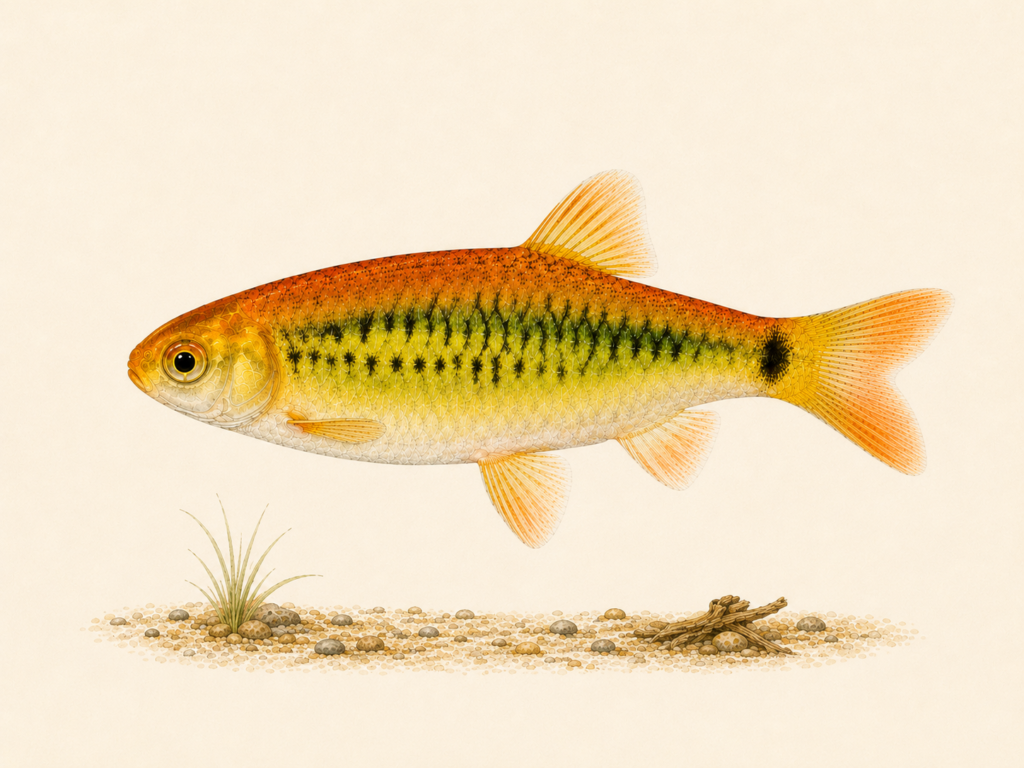
In the selectively bred gold form that is most commonly available in the hobby, the body is a rich, warm golden-yellow that extends from the snout to the caudal peduncle. The intensity of the gold colouration can vary considerably between individuals and is influenced by diet, water quality, stress levels, and the fish’s mood. In optimal conditions, the flanks take on an almost metallic sheen, and scattered dark markings – remnants of the vertical barring found in wild-type fish – may be visible along the lateral line, appearing as small black or dark olive blotches. These markings are generally more pronounced in some individuals than others and tend to be most visible when the fish is relaxed and displaying to conspecifics.
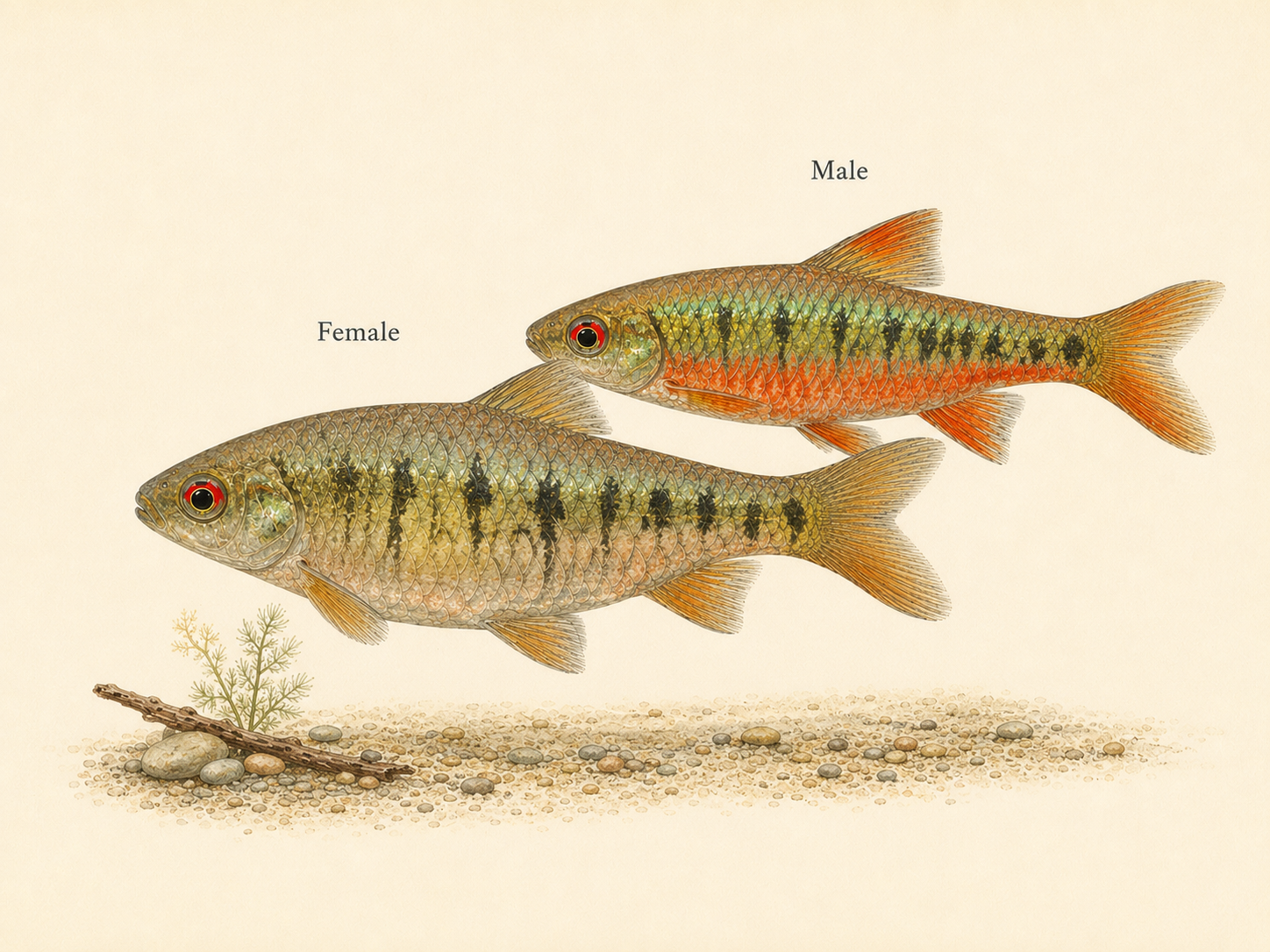
The fins are typically translucent to pale yellow, with the pelvic, anal, and caudal fins sometimes showing a reddish or orange tinge, particularly in breeding males. Males are generally slimmer and more intensely coloured than females, often displaying a deeper, more saturated gold with a reddish flush along the belly and lower flanks during breeding condition. Females tend to be slightly larger and rounder-bodied, with a somewhat paler, more silvery-gold colouration, especially when gravid with eggs.
Gold Barbs possess a single pair of short barbels at the corners of the mouth, though these can be difficult to see without close inspection. The eyes are relatively large and dark, contributing to an alert, lively expression. The scales are moderately sized and well defined, catching the light attractively as the fish moves through the water column.
Varieties and Morphs
The most commonly encountered form in the aquarium trade is the Gold Barb (sometimes labelled Schuberti Barb, after the name Barbus schuberti, which was historically used for this colour form before being synonymised with Barbodes semifasciolatus). This is the familiar golden-yellow variant that was developed through selective breeding, most likely during the 1960s, though the precise details of its breeding history are not comprehensively documented by all sources. The gold form displays a solid, warm golden-yellow body colour that can range from pale lemon in subdued individuals to a rich, deep orange-gold in well-conditioned specimens. Scattered dark spots or partial vertical bars may be present along the flanks, though these are typically faint or absent altogether. The fins are often tinged with orange or red, and males in breeding condition develop an especially vivid reddish hue along the ventral area. This is by far the most widely available form and the one most aquarists picture when they hear the name Gold Barb.
The Wild-Type form, commonly sold as the Chinese Barb or Green Barb, is considerably less common in the trade but is occasionally available through specialist retailers and breeders. This form displays the natural colouration of the species as found in its native habitats. The body colour is an olive-gold to green-bronze, with a subtle metallic quality that shifts between greenish and golden tones depending on the angle of the light. The most distinctive feature of the wild-type is a series of darker vertical bars or bands along the flanks, which can range from prominent and well-defined to somewhat diffuse, depending on the individual’s mood and condition. The lower body and belly typically show a warm reddish-orange flush, providing an attractive contrast against the darker dorsal colouration. The fins may be yellowish to reddish, and the overall impression is of a more cryptically coloured fish compared to the vivid gold of the captive-bred form. Despite the quite different visual appearance, most authorities treat the wild-type and the gold form as colour variants of the same species, though a few sources note that the exact breeding history and the degree of selective line-crossing involved in producing the gold form is not fully documented, so some caution in treating this as entirely settled is warranted.
Beyond these two primary forms, occasional references to albino or leucistic Gold Barbs appear in the hobby literature, though these are rare and not widely established as distinct trade varieties. Some breeders have also produced individuals with enhanced red or orange finnage, but these are typically sold under the standard Gold Barb name rather than as separate morphs.
Natural Habitat
In the wild, Barbodes semifasciolatus inhabits a range of freshwater environments across its native range in Vietnam, Taiwan, and parts of southwestern China, particularly the Red River basin and surrounding drainages. The species is found in slow-moving to moderately flowing streams, rivers, and their tributaries, as well as in ponds, reservoirs, irrigation channels, and other still or slow-moving water bodies at low to moderate elevations.
These habitats are typically characterised by relatively clear water with a substrate of sand, gravel, or mud, often with an accumulation of leaf litter and organic detritus. Aquatic vegetation is frequently present, ranging from submerged plants and marginal grasses to overhanging riparian vegetation that provides shade and contributes to the organic material entering the water. The species tends to be found in areas where there is some form of cover available, whether in the form of plant growth, submerged roots, fallen branches, or rocky outcrops.
Water conditions in these natural habitats can vary considerably. Temperatures may range from relatively cool in highland streams to warm in lowland ponds, and the species is known to tolerate a broad spectrum of pH and hardness values. This environmental adaptability is one of the key factors behind the Gold Barb’s exceptional hardiness in captivity. Seasonal fluctuations in water level, temperature, and flow rate are common throughout the species’ range, and the fish appears well adapted to coping with changing conditions.
In their native waters, Gold Barbs are typically found in loose shoals, foraging along the substrate and among vegetation for small invertebrates, algae, plant matter, and organic detritus. They occupy a generalised ecological niche as opportunistic omnivores, a feeding strategy that translates directly into the ease with which they can be fed in the aquarium.
Tank Size and Setup
A group of six Gold Barbs can be comfortably housed in a tank of 75 litres or more, though larger tanks of 100 litres and above are preferable, especially when keeping the species as part of a community. As active swimmers, Gold Barbs benefit from tanks that offer a reasonable length of open swimming space – a standard rectangular tank measuring 80 cm or more in length is ideal. Taller, narrower tank designs are less suitable as they limit the horizontal swimming area that this species appreciates.
The aquascape should aim to balance open swimming space with areas of cover. A sandy or fine gravel substrate works well and allows natural foraging behaviour. Planting the tank moderately to heavily around the sides and back, using hardy species such as Java Fern, Anubias, Vallisneria, or Cryptocoryne, provides shelter and visual barriers without unduly restricting swimming room. Gold Barbs are not habitual plant eaters, though they may occasionally nibble on very soft-leaved species if their diet is lacking in vegetable matter.
Pieces of bogwood, smooth rocks, and other hardscape elements can be used to create additional structure and hiding places. The species does not have specific requirements for caves or enclosed spaces, but the presence of some visual complexity in the aquascape helps to reduce stress and encourages natural behaviour. A darker substrate and background tend to bring out the best colouration in Gold Barbs, as the fish can appear somewhat washed out against very pale or reflective surfaces.
Lighting can be moderate to bright, especially if live plants are used. Gold Barbs are not particularly light-sensitive, though they may be slightly more reserved under very intense lighting if insufficient cover is provided. A lid or cover glass is recommended, as barbs can occasionally jump, particularly when startled or during active courtship displays.
Water Parameters
One of the Gold Barb’s greatest strengths as an aquarium species is its remarkable tolerance of a wide range of water conditions. This adaptability makes it suitable for a variety of water chemistries, from soft and slightly acidic to moderately hard and alkaline. Maintaining stable parameters within the recommended ranges is more important than hitting any specific target value.
| Temperature | 18-24 °C |
| pH | 6.0-8.0 |
| General hardness (GH) | 5-19 dGH |
| Carbonate hardness (KH) | 4-10 dKH |
| Ammonia | 0 ppm |
| Nitrite | 0 ppm |
| Nitrate | Below 30 ppm |
The relatively cool temperature preference of this species is worth noting. Gold Barbs are comfortable at temperatures that would be too cool for many tropical species, and they can even tolerate short-term dips below 18 °C without ill effects. This makes them suitable for unheated indoor aquaria in temperate climates, as well as for subtropical or temperate-themed community setups. Conversely, prolonged exposure to temperatures above 26 °C can cause stress and may shorten their lifespan, so they are not the best choice for tanks maintained at the upper end of the tropical range.
Regular partial water changes of 20-30% per week are recommended to keep nitrate levels low and maintain overall water quality. As with all freshwater fish, ammonia and nitrite must be maintained at 0 ppm at all times, as even trace levels of these compounds are toxic and can cause gill damage, stress, and disease susceptibility.
Filtration and Equipment
Gold Barbs do not require any specialised filtration equipment. A standard hang-on-back filter, internal power filter, or canister filter rated for the tank’s volume will provide adequate mechanical and biological filtration. The filter should turn over the tank volume approximately four to six times per hour, which is sufficient to maintain good water quality without creating excessive current. Gold Barbs are comfortable in gentle to moderate flow, so if the filter output is very strong, consider using a spray bar or directing the flow against the glass to diffuse it.
An air stone or additional surface agitation can be beneficial for oxygenation, particularly in warmer conditions or in tanks with a high bioload. However, Gold Barbs are not especially oxygen-demanding, and adequate surface movement from the filter outlet is usually sufficient.
A heater may or may not be necessary depending on the ambient room temperature. In homes that remain consistently above 18 °C, an unheated tank is perfectly acceptable for Gold Barbs. If room temperatures fluctuate significantly, a heater set to around 20-22 °C will help maintain stability. An aquarium thermometer should be used regardless, as consistent monitoring of temperature is a simple but effective way to prevent stress-related health issues.
Standard aquarium lighting suitable for the chosen plants is all that is required. LED fixtures designed for planted tanks work well and are energy-efficient. A timer to provide a consistent photoperiod of 8-10 hours per day is recommended to support plant growth and to establish a regular day-night cycle for the fish.
A tight-fitting lid or cover glass is advisable, as Gold Barbs can occasionally leap from the water, especially during feeding frenzies or when startled by sudden movements or sounds outside the tank.
Diet and Feeding
The Gold Barb is a thoroughly omnivorous species that will accept virtually any food offered in the aquarium. In the wild, its diet consists of small invertebrates, insect larvae, algae, plant matter, and organic detritus, and this broad palate translates into an extremely easy-to-feed captive fish.
A high-quality flake or micro-pellet food should form the staple of the diet. Choose a product formulated for tropical or community fish, as these typically contain a balanced blend of protein, fats, and vegetable matter. Supplement this staple diet regularly with live or frozen foods such as bloodworm, daphnia, brine shrimp, and tubifex. These protein-rich foods help to maintain condition, enhance colouration, and can serve as valuable conditioning foods prior to breeding attempts.
Vegetable matter should also feature in the diet. Blanched spinach, shelled peas, spirulina-based flakes or wafers, and blanched courgette slices are all readily accepted. Including regular vegetable supplements helps to ensure that the fish receive a balanced nutritional intake and may reduce any tendency to nibble on aquarium plants.
Feed Gold Barbs two to three times daily, offering only as much food as the shoal can consume within two to three minutes at each feeding. Overfeeding is one of the most common mistakes in fishkeeping and can lead to poor water quality, obesity, and associated health problems. Gold Barbs are enthusiastic feeders and will always appear hungry, so it is important not to be swayed by their eager behaviour into providing more food than is appropriate.
Variety is the key to a healthy, well-coloured Gold Barb. Rotating between several different food types throughout the week ensures that the fish receive a comprehensive range of nutrients and helps to maintain their interest in feeding.
Behaviour and Temperament
The Gold Barb is one of the more peaceful and well-behaved members of the barb family. Unlike some of its relatives, such as the Tiger Barb, which is notorious for fin-nipping, the Gold Barb is a gentle, sociable species that rarely causes problems in a community setting. While occasional low-level chasing and jostling within the shoal is normal – particularly among males establishing a loose hierarchy – this rarely escalates to the point of causing stress or physical harm.
This is a shoaling species that should always be kept in groups of six or more. In smaller numbers, Gold Barbs can become withdrawn, nervous, and prone to stress-related health issues. In a properly sized group, the fish are noticeably more confident, active, and colourful. The shoal will spend much of its time cruising through the mid-water and lower levels of the tank, periodically breaking apart as individuals forage among the substrate and plants before regrouping. The dynamic, constantly shifting movement of a Gold Barb shoal is one of the species’ most appealing qualities.
Males will regularly display to one another and to females, spreading their fins and intensifying their colouration. These displays are typically brief and non-aggressive, serving primarily as a means of establishing social standing within the group. Keeping a roughly equal ratio of males to females, or a slight surplus of females, helps to distribute any attention from males across the group and prevents any single individual from being persistently pursued.
Gold Barbs are active during daylight hours and tend to rest quietly among plants or near the substrate during darkness. They are not nocturnal feeders and will quickly learn to associate the approach of their keeper with feeding time, often swimming eagerly to the front of the tank when they detect movement nearby.
Tank Mates
The Gold Barb’s peaceful temperament and tolerance of a wide range of water conditions make it compatible with a broad selection of community fish. When choosing tank mates, focus on species that share similar water parameter preferences and are neither small enough to be intimidated by a group of active barbs nor large and aggressive enough to bully them. Avoid pairing Gold Barbs with slow-moving, long-finned species, as even this relatively gentle barb may occasionally show interest in trailing fins if kept in too small a group. The species’ preference for slightly cooler temperatures should also be considered – very warm-water species may not be ideal companions.
Good tank mates
- Cherry Barb – Another peaceful barb species that thrives in similar water conditions and temperature ranges.
- White Cloud Mountain Minnow – An excellent match in terms of temperature preference, temperament, and size, ideal for a cooler community setup.
- Bristlenose Pleco – A hardy, peaceful bottom-dweller that occupies a different zone in the tank and shares a preference for well-oxygenated water.
- Pepper Corydoras – A robust, cool-water-tolerant catfish that makes an ideal bottom-dwelling companion for Gold Barbs.
- Zebra Danio – An active, hardy shoaling species with a similar tolerance for cooler temperatures and a peaceful disposition.
- Rosy Barb – A larger but generally peaceful barb that shares the Gold Barb’s preference for cooler water and active swimming behaviour.
- Platy – A peaceful, hardy livebearer that adapts well to the moderate water parameters preferred by Gold Barbs.
- Amano Shrimp – Large enough to avoid predation, these useful algae-eating shrimp coexist peacefully with Gold Barbs.
Fish to avoid
- Oscar – A large, predatory cichlid that would view Gold Barbs as food.
- Siamese Fighting Fish – Their long, flowing fins and slow swimming make them vulnerable to fin-nipping, and they prefer warmer water.
- Red-Tail Black Shark – Territorial and aggressive, particularly towards bottom-dwelling and mid-water fish in its territory.
- Green Terror – A large, aggressive cichlid that would bully and potentially injure Gold Barbs.
- Tiger Barb – While related, Tiger Barbs are significantly more boisterous and may harass the more placid Gold Barb.
- Discus – Requires much warmer water and very specific conditions that are incompatible with the Gold Barb’s preferences.
- Jewel Cichlid – Highly territorial and aggressive, especially during breeding, posing a serious threat to peaceful community fish.
- Flowerhorn – An extremely aggressive, large cichlid that is entirely unsuitable for community tanks with small barbs.
Breeding
Gold Barbs are one of the easier barb species to breed in captivity, and spawning can occur in a community tank, though raising fry to a useful size typically requires a dedicated breeding setup. The species is an egg-scattering spawner that does not exhibit any parental care – in fact, the adults will readily consume their own eggs and fry if given the opportunity.
To condition a breeding pair or group, separate the sexes for one to two weeks and feed them a rich diet of live and frozen foods such as bloodworm, daphnia, and brine shrimp. Females in breeding condition will become noticeably rounder as they fill with eggs, while males will display intensified colouration with a deeper gold and reddish flush.
The breeding tank should be at least 40 litres in capacity, filled to a depth of around 15-20 cm, and maintained at a temperature of 22-24 °C with a slightly acidic to neutral pH of around 6.5-7.0. The substrate should be covered with spawning mops, fine-leaved plants such as Java Moss, or a layer of glass marbles to provide crevices into which the eggs can fall and be protected from the adults. Filtration should be gentle – a simple air-driven sponge filter is ideal to avoid sucking up eggs or fry.
Introduce the conditioned pair or a small group (one or two males with two or three females works well) to the breeding tank in the evening. Spawning typically occurs the following morning, triggered by the first light. The male will chase and display to the female, and spawning takes place amid the plants or spawning mops, with the female scattering several hundred small, adhesive eggs over the available surfaces. A single female can produce 200-400 eggs in a single spawning event.
Remove the adults immediately after spawning is complete, as they will consume the eggs if left in the tank. The eggs are small, yellowish, and semi-adhesive, and will hatch within 24-48 hours at the recommended temperature. The newly hatched fry are tiny and will initially feed on their yolk sacs for a further one to two days before becoming free-swimming.
Free-swimming fry should be fed infusoria or commercially available liquid fry food for the first few days, then gradually transitioned to freshly hatched brine shrimp nauplii and microworms as they grow. Growth is relatively rapid with frequent small feedings and regular water changes. The fry will begin to show colouration at around four to six weeks of age and will reach a sellable size within three to four months.
Common Diseases
Gold Barbs are a robust and disease-resistant species, and health problems are uncommon in well-maintained aquaria. However, like all freshwater fish, they are susceptible to a range of common ailments, particularly when stressed by poor water quality, overcrowding, temperature fluctuations, or an inadequate diet.
Ich (white spot disease), caused by the protozoan parasite Ichthyophthirius multifiliis, is perhaps the most common disease encountered. It presents as small white spots across the body and fins, accompanied by flashing (rubbing against surfaces), clamped fins, and lethargy. Treatment involves raising the water temperature gradually to 28-30 °C over 24-48 hours (if tank mates can tolerate this) combined with the use of a commercially available ich medication. Since Gold Barbs prefer cooler water, the temperature elevation itself can be uncomfortable, so treatment with medication at a moderate temperature increase is often preferable.
Fin rot, a bacterial infection that causes progressive deterioration of the fin edges, is usually a secondary condition resulting from poor water quality or physical injury. It is treated by improving water conditions through frequent water changes and, if necessary, applying a broad-spectrum antibacterial treatment. Catching fin rot early is important, as advanced cases can lead to systemic bacterial infections.
Fungal infections, appearing as cotton-wool-like growths on the body or fins, are another occasional issue, again most commonly linked to wounds or poor water conditions. Antifungal medications are effective if treatment is begun promptly.
Internal parasites can affect Gold Barbs, particularly wild-caught or recently imported specimens. Symptoms may include weight loss despite a healthy appetite, stringy or white faeces, and a generally unthrifty appearance. Antiparasitic foods or bath treatments can be used under guidance from a specialist retailer or veterinary professional.
The best defence against all disease is prevention through excellent husbandry. Maintaining stable water parameters, performing regular water changes, avoiding overcrowding, quarantining new arrivals for at least two to three weeks before introducing them to an established tank, and providing a varied, nutritious diet will go a long way towards keeping Gold Barbs healthy throughout their lives.
FAQs
How many Gold Barbs should I keep together?
Gold Barbs are a shoaling species and should be kept in groups of at least six, though larger groups of eight to ten or more are preferable if tank space allows. In smaller numbers, they tend to become shy, stressed, and less active. A properly sized shoal will display far more natural behaviour, better colouration, and greater confidence in the aquarium. Keeping them in groups also helps to distribute any minor chasing behaviour among the shoal rather than concentrating it on a single individual.
Can Gold Barbs live in an unheated tank?
Yes, Gold Barbs are well suited to unheated indoor aquaria in many temperate climates. They are comfortable at temperatures as low as 18 °C and can tolerate brief dips below this. As long as the room temperature remains reasonably stable and does not drop below approximately 16 °C for extended periods, a heater is not strictly necessary. This makes them an excellent choice for fishkeepers looking for a colourful, active species that does not require tropical temperatures.
Are Gold Barbs fin-nippers?
Gold Barbs are significantly less prone to fin-nipping than many other barb species, such as the Tiger Barb. In a properly sized group, fin-nipping is rare and usually limited to minor interactions within the shoal itself. However, it is still prudent to avoid housing them with very slow-moving, long-finned species such as fancy guppies or Siamese Fighting Fish, as the temptation presented by trailing fins can occasionally override their generally peaceful nature, particularly in smaller groups.
What is the difference between a Gold Barb and a Chinese Barb?
The Gold Barb and the Chinese Barb (also called the Green Barb) are generally considered to be colour variants of the same species, Barbodes semifasciolatus. The Gold Barb is the selectively bred golden-yellow form commonly seen in the hobby, while the Chinese Barb is the wild-type form, which displays an olive-green to bronze body colour with darker vertical barring and reddish-orange lower body. Their care requirements are identical. It is worth noting that some sources acknowledge the exact breeding history of the gold form is not fully documented in every detail, but the consensus is that they are the same species.
Do Gold Barbs eat live plants?
Gold Barbs are not typically destructive to aquarium plants. While they are omnivorous and may occasionally nibble on very soft or delicate plant species, they are generally considered safe in planted tanks. Providing regular vegetable matter in their diet, such as blanched spinach or spirulina flakes, can help to minimise any interest in live plants. Hardy species like Java Fern, Anubias, and Vallisneria are unlikely to be damaged at all.
Related Guides
- Cherry Barb Care Guide – Another peaceful, small barb species with similar care requirements, ideal for comparison when choosing community barbs.
- Rosy Barb Care Guide – A larger barb that shares the Gold Barb’s preference for cooler water temperatures and makes a striking tank mate.
- White Cloud Mountain Minnow Care Guide – An excellent companion species for subtropical and cooler community setups alongside Gold Barbs.
- Tiger Barb Care Guide – A more boisterous relative – useful for understanding the differences in temperament across barb species.
- Zebra Danio Care Guide – A hardy, active cyprinid that thrives in similar conditions and makes a natural companion for Gold Barbs.