Quick summary
The Golden Tetra (Hyphessobrycon moniliger) is a diminutive and relatively uncommon South American characin that can make a charming addition to a small, peaceful community aquarium. Aquarium literature on this species is genuinely sparse, so prospective keepers should be aware that much of the available care guidance is inferred from closely related Hyphessobrycon species rather than drawn from extensive species-specific documentation.
🐠 Build a tank around this species
Last researched and fact-checked: September 2026.
- Introduction
- Quick Stats
- Appearance
- Natural habitat
- Tank size and setup
- Water parameters
- Filtration and equipment
- Diet and feeding
- Behaviour and temperament
- Tank mates
- Breeding
- Common diseases and health
- Frequently asked questions
- Related guides
Introduction
The Golden Tetra, Hyphessobrycon moniliger, was formally described in 2002 by Moreira, Lima and Costa from specimens collected in Brazil’s Araguaia-Tocantins and upper Tapajós river basins. It is sometimes sold under the name “Jeweled Golden Tetra,” though neither common name is fully standardised in the hobby and you may encounter the fish under slightly different trade labels depending on the importer.
This is a genuinely small tetra, with a maximum recorded standard length of around 3.1 cm. Its golden body colouration and modest adult size make it visually appealing for nano and small community setups, but it remains an uncommon species in the UK trade. Most hobbyists who encounter it will find it offered only through specialist importers or occasionally in mixed shipments of wild-caught Brazilian tetras.
It is worth being upfront about the state of available information. Unlike heavily documented species such as the Neon Tetra or Cardinal Tetra, H. moniliger has very little species-specific aquarium literature. There are no widely published, detailed care sheets based on long-term captive observations, and breeding reports specific to this species are, at the time of writing, effectively absent from the English-language hobby literature. Throughout this guide, we have noted where recommendations are based on the general requirements of small Hyphessobrycon species from similar habitats, and where genuine species-specific data is lacking. We would rather be honest about these gaps than present borrowed information as established fact.
Juveniles of H. moniliger bear a superficial resemblance to the Silvertip Tetra (Hasemania nana), a species far more commonly seen in the hobby. One reliable way to distinguish the two is to check for an adipose fin: Hyphessobrycon moniliger possesses one, while Hasemania nana characteristically lacks an adipose fin entirely. If you have purchased fish labelled as Golden Tetras and are unsure of the identification, the presence or absence of this small fin between the dorsal and caudal fins is a useful first check.
Quick Stats
| Scientific name | Hyphessobrycon moniliger |
|---|---|
| Common names | Jeweled Golden Tetra |
| Family | Acestrorhamphidae (formerly Characidae) |
| Origin | Araguaia-Tocantins and upper Tapajos basins, Brazil |
| Adult size | 3.5 cm |
| Lifespan | 2–4 years |
| Difficulty | Intermediate |
| Breeding difficulty | Advanced |
| Temperature | 24–28 °C |
| pH | 5.5–7 |
| GH | 1–8 dGH |
| KH | 0–4 dKH |
| Minimum tank size | 60 L |
| Conservation status | Least Concern (IUCN) |
Appearance
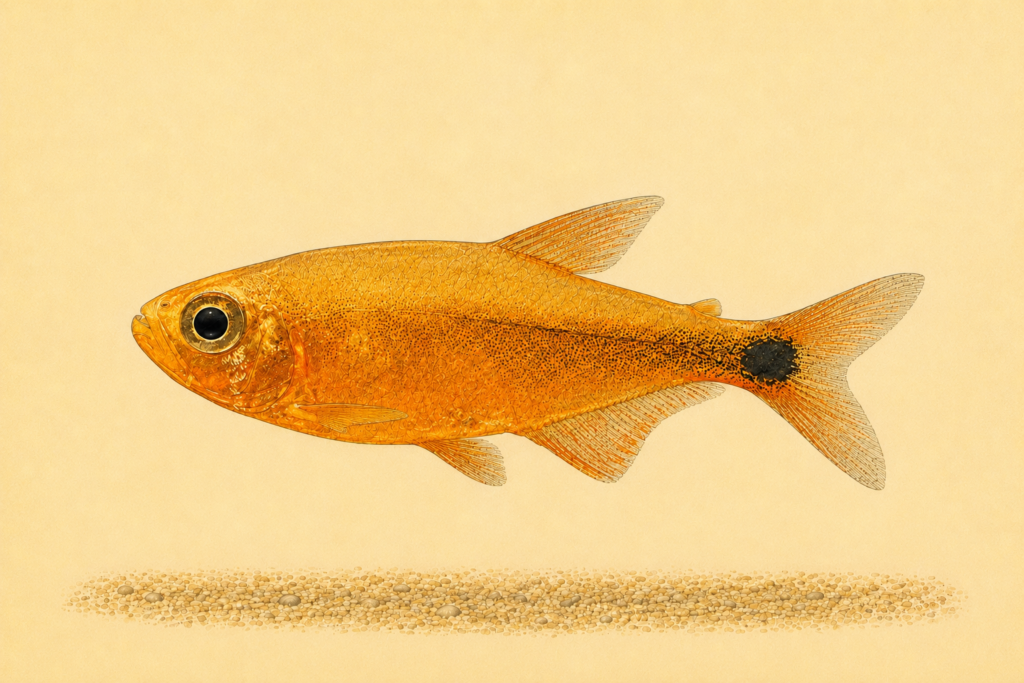
Hyphessobrycon moniliger is a small, laterally compressed tetra with a warm golden to yellowish body tone that gives it both its common name and its visual appeal. The body shape is typical of many small Hyphessobrycon species: slightly deep-bodied relative to its length, with a rounded profile and transparent to lightly tinted fins.
Beyond the general golden colouration, detailed descriptions of colour patterning in live specimens are limited in the published literature. The species name “moniliger” derives from Latin roots relating to a necklace or chain of beads, which may allude to a row of scales or markings along the body, but comprehensive photographic documentation in hobby sources is scarce. Specimens in the trade sometimes show subtle darker markings along the lateral line or a faint humeral spot, though variation between individuals and depending on condition, stress levels, and lighting can be significant.
As noted in the introduction, the presence of an adipose fin is a key distinguishing feature separating this species from the superficially similar Silvertip Tetra (Hasemania nana), which lacks one. Both species can display warm golden tones, particularly as juveniles, and misidentification in mixed shipments is not unheard of.
Sexual dimorphism has not been extensively documented for this species. In many small Hyphessobrycon species, mature females tend to be slightly fuller-bodied than males, and males may show marginally more intense colouration or slightly longer fin extensions, but we cannot confirm whether these generalisations hold reliably for H. moniliger specifically.
Natural habitat
Hyphessobrycon moniliger originates from the Araguaia-Tocantins and upper Tapajós river basins in Brazil. These are major tributaries of the Amazon system, flowing through a range of habitats from open cerrado (savanna) landscapes to more densely forested regions. Small characins in these basins are typically found in slower-moving tributaries, streams, and flooded marginal areas rather than in the main river channels.
The waters in these habitats tend to be soft and slightly acidic to neutral, often stained with tannins from decaying leaf litter and organic matter. Substrates are commonly sandy or composed of fine sediment, with submerged wood, leaf litter, and marginal vegetation providing cover and foraging areas. Light levels at the water surface can be subdued where overhanging vegetation or floating plants are present.
Specific ecological data for H. moniliger, such as preferred microhabitat, water chemistry at collection sites, or diet in the wild, does not appear to be widely published beyond what is typical for small Hyphessobrycon from this region. Keepers should therefore treat the habitat description above as a reasonable general picture rather than a precisely documented account for this species alone.
The species is listed as Least Concern by the IUCN Red List, though this broad status does not rule out localised pressure from habitat degradation and deforestation in parts of the Araguaia-Tocantins and Tapajós basins, both well-documented concerns for many freshwater species in the region.
Tank size and setup
Given its small adult size of around 3.1 cm SL, H. moniliger does not require a large aquarium. A tank of at least 60 litres (approximately 13 UK gallons) is a sensible minimum for a small group, providing enough swimming space and volume for stable water conditions. Larger tanks are always preferable if keeping a bigger shoal or housing them in a community setting.
As a shoaling species (based on the behaviour typical of small Hyphessobrycon tetras), a group of at least six individuals is recommended, with eight to ten or more being preferable. In too-small a group, small tetras often become visibly stressed, spend more time hiding, and may not display natural social behaviours or their best colouration.
The aquarium setup should aim to loosely replicate the conditions of a South American stream or tributary. A dark, fine-grained substrate such as sand will show off the fish’s golden colouration effectively and is more natural than brightly coloured gravel. Pieces of bogwood or driftwood, along with a scattering of dried leaf litter (Indian almond leaves, oak leaves, or similar), will provide shelter, create natural tannin-stained conditions, and encourage the fish to behave more naturally. Live plants are not strictly necessary but are beneficial. Species that tolerate soft, slightly acidic water, such as Java Fern, Anubias, Cryptocoryne species, and floating plants like Amazon Frogbit, work well and help to diffuse lighting.
Subdued lighting, or at least areas of shade created by floating plants or overhanging decor, is likely to make this species feel more secure. Bright, unshaded tanks may cause the fish to appear washed out and spend more time hiding.
A secure, well-fitting lid or cover slides are important. Small tetras are capable jumpers, particularly when startled, and an uncovered tank carries a real risk of losses.
Water parameters
Specific water chemistry data from collection sites for H. moniliger is not readily available in published sources. The parameters below are based on conditions typical of the Araguaia-Tocantins and upper Tapajós basins and the general requirements of small Hyphessobrycon species from soft, acidic to neutral waters. They should be treated as reasonable guidelines rather than precisely documented optima for this species.
| Temperature | 24 – 28 °C (75 – 82 °F) |
| pH | 5.5 – 7.0 |
| General hardness (GH) | 2 – 10 dGH |
| Ammonia | 0 ppm |
| Nitrite | 0 ppm |
| Nitrate | Below 20 ppm |
As with most wild-caught or rarely bred small tetras, stable water conditions are likely more important than hitting an exact number within these ranges. Sudden swings in pH, temperature, or hardness are more harmful than being slightly outside an ideal range. If your tap water is moderately hard or alkaline, as is common in many parts of the UK, you may need to use RO (reverse osmosis) water remineralised to a suitable level, or blend RO water with tap water to achieve softer, more acidic conditions. Peat filtration or the use of botanicals such as Indian almond leaves can also help lower pH and soften water gradually.
Regular partial water changes of around 20 – 30% weekly are good practice for maintaining water quality and keeping nitrate levels in check. Always match the temperature and, as closely as possible, the pH and hardness of replacement water to the tank water to avoid shocking the fish.
Filtration and equipment
Filtration for a tank housing H. moniliger should be efficient but gentle. A small sponge filter or a hang-on-back filter with an adjustable flow rate is well suited to a nano or small community setup. Internal canister filters can also work well, provided the output is baffled or directed to avoid creating a strong current. Small tetras from relatively calm waters can become stressed by excessive flow, and very small fish may even be drawn against filter intakes if these are not properly guarded.
A reliable heater rated appropriately for the tank volume is necessary to maintain temperatures within the 24 – 28 °C (75 – 82 °F) range. In the UK, ambient room temperature is rarely warm enough year-round for tropical species, so a heater is not optional. A thermometer (ideally a separate one rather than relying solely on the heater’s built-in thermostat) is useful for monitoring.
Lighting should be moderate to subdued. If the tank includes live plants, a basic LED light designed for planted aquariums will suffice. The addition of floating plants is an easy way to reduce light intensity at the water surface, creating the dappled, shaded conditions that small forest-stream tetras tend to prefer.
An air pump is not strictly necessary if the filter provides adequate surface agitation for gas exchange, but one can be useful in warmer weather when dissolved oxygen levels may drop.
Diet and feeding
The diet of H. moniliger in the wild has not been specifically documented in readily available sources. However, small Hyphessobrycon species are generally omnivorous micro-predators, feeding on tiny invertebrates, insect larvae, small crustaceans, and organic detritus in the wild.
In the aquarium, this species should accept a varied diet of suitably small foods. A high-quality micro-pellet or finely crushed flake food can form the staple, supplemented regularly with small live or frozen foods such as baby brine shrimp (Artemia nauplii), micro worms, daphnia, and cyclops. Given the very small adult size of this fish, food particle size is an important consideration. Standard-sized pellets or flakes may need to be crushed or broken down to be manageable.
Feeding once or twice daily in small amounts that the fish can consume within a couple of minutes is a sensible approach. Overfeeding is a common cause of water quality problems in small aquariums and should be avoided.
Variety in the diet is beneficial for overall health, colouration, and condition. A monotonous diet of dry food alone is unlikely to bring out the best in any small tetra.
Behaviour and temperament
Specific behavioural observations for H. moniliger in captivity are limited in the published literature. Based on its size and taxonomic placement, it is reasonable to expect behaviour broadly typical of small, peaceful Hyphessobrycon tetras: a loosely shoaling species that spends much of its time in the mid-water column, displaying occasional chasing or sparring between males (if present) but without causing real harm.
Like most small tetras, H. moniliger is likely to be more confident and active when kept in an appropriately sized group. In groups of fewer than six, individuals may become shy, remain hidden among decor, and fail to display their natural colouration or behaviour. A group of eight or more is preferable.
This is a peaceful species that poses no threat to other fish of similar size and temperament. It may, however, be outcompeted at feeding time by larger, more assertive species, and its very small size makes it vulnerable to predation by anything large enough to fit it in its mouth.
Tank mates
Hyphessobrycon moniliger is best kept with other small, peaceful species that share similar water chemistry requirements. Its very small adult size means that tank mate selection should prioritise fish that will not outcompete it for food or view it as prey. South American species from soft, slightly acidic waters are the most natural companions, but other peaceful community fish that tolerate similar conditions can also work well.
Good tank mates
- Ember Tetra, a similarly tiny and peaceful tetra ideal for the same soft-water setup
- Green Neon Tetra, a small, gentle shoaler from soft, acidic waters
- Celestial Pearl Danio, a diminutive and peaceful species suited to similar tank sizes
- Pygmy Corydoras, a tiny bottom-dwelling catfish that thrives in small community setups
- Dwarf Pencilfish, a calm, slender species that occupies the upper water layers
- Chocolate Gourami, a quiet soft-water species, though it requires experienced care
- Otocinclus, a small algae-eating catfish that coexists peacefully with tiny tetras
- Amano Shrimp, a useful and peaceful invertebrate for planted setups
- Cherry Shrimp, a colourful dwarf shrimp compatible with small, peaceful fish
- Sparkling Gourami, a tiny and peaceful labyrinth fish suited to quiet community tanks
Fish to avoid
- Oscar, a large, predatory cichlid that would eat this species without hesitation
- Angelfish, large enough as adults to prey on very small tetras
- Tiger Barb, a boisterous fin-nipper that would harass and outcompete this tiny fish
- Convict Cichlid, an aggressive cichlid entirely unsuitable for small peaceful species
- Red-tail Black Shark, a territorial bottom-dweller that can bully small tank mates
- Jack Dempsey, a large and aggressive predatory cichlid
- Green Terror, a large, aggressive South American cichlid
- African Butterfly Fish, a surface-dwelling predator that readily takes small fish
- Bucktooth Tetra, a deceptively aggressive scale-eating tetra
- Flowerhorn, a large, territorial hybrid cichlid completely incompatible with nano species
Breeding
Specific breeding reports for Hyphessobrycon moniliger are, at the time of writing, essentially absent from the English-language aquarium literature. We have not been able to locate published accounts of successful captive breeding for this species, and any detailed protocol would therefore be speculative.
In general terms, many small Hyphessobrycon species are egg-scattering spawners that show no parental care. Spawning typically occurs among fine-leaved plants or spawning mops, with eggs being scattered and falling into the substrate or plant material. Adults will usually eat eggs and fry if given the opportunity, so breeders of related species typically remove the adults after spawning or use a separate breeding tank with a mesh or grid to protect the eggs.
For related species, conditioning with high-quality live or frozen foods, soft and acidic water (often pH 5.5 – 6.5 with very low hardness), slightly elevated temperature, and dim lighting are commonly used to encourage spawning. Whether H. moniliger responds to exactly these triggers has not been documented.
If you do attempt to breed this species, maintaining a detailed record of conditions, behaviour, and outcomes would be a valuable contribution to the hobby, given the current lack of published information. Any successful breeding reports shared with hobbyist communities or species databases would help future keepers considerably.
Common diseases and health
There are no documented disease concerns unique to Hyphessobrycon moniliger specifically. Like all small freshwater tropical fish, it is susceptible to the common ailments that affect aquarium species generally. Ich (white spot disease), caused by the parasite Ichthyophthirius multifiliis, is one of the most frequently encountered problems, particularly in newly imported or stressed fish. Symptoms include visible white cysts on the body and fins, flashing (rubbing against surfaces), and lethargy. Treatment with a proprietary white spot remedy, combined with a gradual temperature increase to around 28 – 30 °C (82 – 86 °F) where the fish can tolerate it, is the standard approach.
Bacterial and fungal infections can occur, particularly if water quality deteriorates or if the fish sustains minor injuries. Maintaining consistently good water quality through regular partial water changes, avoiding overstocking, and not overfeeding are the most effective preventive measures. Velvet disease (caused by Piscinoodinium), fin rot, and columnaris are other conditions occasionally seen in small tropical fish, particularly in tanks where hygiene or water parameters are suboptimal.
Newly acquired wild-caught specimens, which most H. moniliger in the trade are likely to be, may carry internal parasites. A period of quarantine in a separate tank before introducing new fish to an established community is always good practice. This allows you to observe the newcomers for signs of illness and treat if necessary without exposing your existing stock. Small tetras can be sensitive to some medications, particularly those containing copper, so always check dosing instructions carefully and consider using half-strength doses where advised for scaleless or very small species.
Frequently asked questions
Is the Golden Tetra the same as the Silvertip Tetra?
No. The Golden Tetra (Hyphessobrycon moniliger) and the Silvertip Tetra (Hasemania nana) are different species from different genera. Juveniles can look superficially similar, but H. moniliger has an adipose fin, while Hasemania nana lacks one entirely. This is one of the easiest ways to tell them apart.
How many Golden Tetras should I keep together?
A minimum group of six is recommended, with eight to ten or more being preferable. Small tetras are shoaling fish and are more confident, active, and colourful when kept in appropriately sized groups.
Can I keep Golden Tetras in hard, alkaline water?
This species originates from soft, acidic to neutral waters, and it is likely to fare best in similar conditions in the aquarium. While many tetras can adapt to moderately harder water over time, very hard or strongly alkaline conditions are not ideal. If your tap water is hard, consider blending with RO water to achieve a more suitable chemistry.
Is this species easy to find in UK shops?
Hyphessobrycon moniliger is uncommon in the general UK aquarium trade. It is most likely to be found through specialist importers, online retailers dealing in wild-caught South American fish, or occasionally in mixed tetra shipments. It is not a species you would typically expect to find at a high-street pet shop.
Why is there so little information available about this fish?
The species was only described in 2002 and has never been widely established in the aquarium hobby. It is not commonly bred in captivity, and most available specimens are wild-caught. Combined with its limited range in the trade, this means that detailed care experience and breeding data have simply not accumulated in the way they have for more popular species. This is not unusual for many of the hundreds of small Hyphessobrycon species described in recent decades.
What size tank do I need for Golden Tetras?
A tank of at least 60 litres (approximately 13 UK gallons) is suitable for a small group. This provides adequate swimming space and enough water volume for reasonably stable conditions. Larger tanks are always beneficial if keeping bigger groups or a community of mixed species.