Quick summary
The Green Fire Tetra (Aphyocharax rathbuni) is a small, active, and beautifully iridescent characin that works well in peaceful community aquariums of 75 litres or more. Its shimmering green-gold body and fiery red-orange belly make it a striking addition to a planted tank, though its speed, jumping habit, and need for a shoal mean it suits fishkeepers with at least a little experience.
🐠 Build a tank around this species
Last researched and fact-checked: June 2025.
- Introduction
- Quick Stats
- Appearance
- Natural habitat
- Tank size and setup
- Water parameters
- Filtration and equipment
- Diet and feeding
- Behaviour and temperament
- Tank mates
- Breeding
- Common diseases and health
- Frequently asked questions
- Related guides
Introduction
The Green Fire Tetra, Aphyocharax rathbuni, is a member of the genus Aphyocharax, the same group that includes the well-known Bloodfin Tetra (Aphyocharax anisitsi). The species was described by Eigenmann in 1907 and belongs to the family Characidae. Despite being a genuinely attractive fish with a distinctive colour combination, A. rathbuni has historically received less attention in the hobby than many other small tetras. In recent years, however, it has become more widely available in the UK trade, and its popularity has grown as aquarists have discovered just how eye-catching a well-settled shoal can be under good aquarium lighting.
Like its relatives, this is a fast, active swimmer that spends much of its time in the middle and upper water column. It is a known jumper, a trait shared across the Aphyocharax genus, so a tight-fitting lid is not optional. In a suitably sized, well-planted aquarium with a secure cover, the Green Fire Tetra is a hardy and relatively undemanding species that rewards the keeper with lively behaviour and subtle, shimmering beauty.
One honest caveat worth stating upfront: while the Green Fire Tetra is reasonably well documented in terms of basic care requirements, detailed scientific literature specifically about A. rathbuni (as opposed to the genus or family in general) is limited. Breeding accounts, precise wild habitat data, and longevity records are less thoroughly published than for more mainstream tetra species. This guide draws on the best available documented sources, and where information is sparse, it says so rather than filling gaps with guesswork.
Quick Stats
| Scientific name | Aphyocharax rathbuni |
|---|---|
| Common names | Redflank Bloodfin |
| Family | Characidae |
| Origin | Paraguay and Bolivia, Rio Paraguay basin |
| Adult size | 4.5 cm |
| Difficulty | Easy |
| Breeding difficulty | Moderate |
| Temperature | 20–26 °C |
| pH | 6.5–7.5 |
| GH | 2–20 dGH |
| Minimum tank size | 75 L |
| Conservation status | Least Concern (IUCN, assessed 2021) |
Appearance
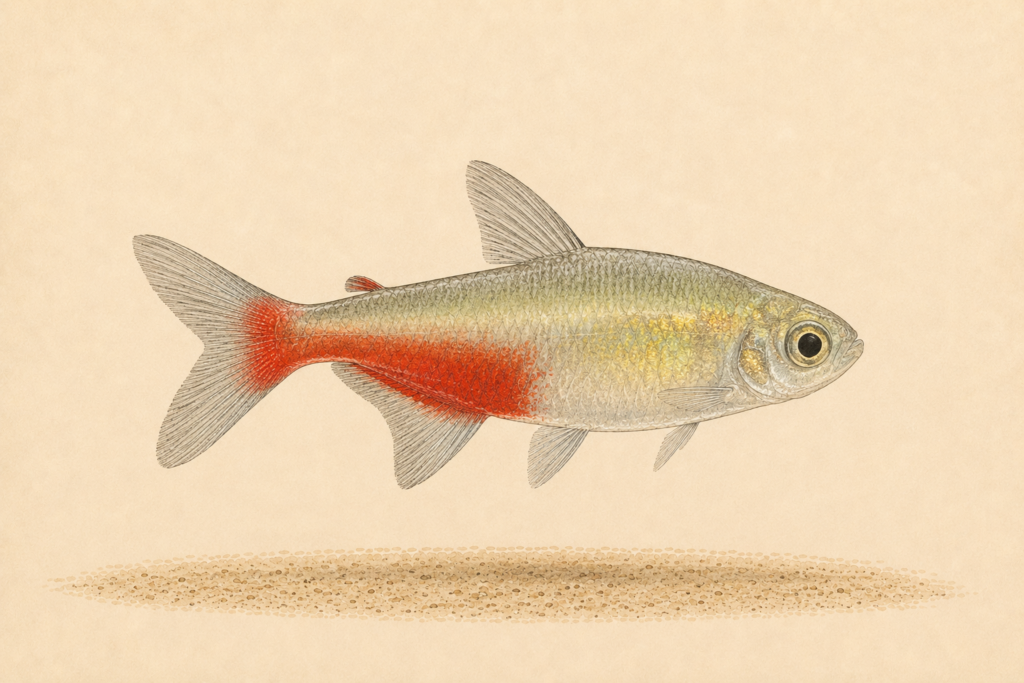
The Green Fire Tetra earns its common name honestly. The upper body displays a vivid iridescent green to green-gold sheen that shifts and intensifies depending on the angle of light and the fish’s condition. This metallic lustre is most pronounced along the lateral line and upper flanks, where it can appear almost emerald under strong aquarium lighting. The “fire” part of the name refers to the warm red-orange flush that colours the lower belly and the base of the anal fin, creating a striking contrast with the cooler green tones above.
The fins are largely translucent with a slight yellowish or reddish tint, and the tips of the anal, pelvic, and caudal fins often carry milky-white highlights. The eye is relatively large and may show a reddish or coppery upper edge. Overall, the body shape is typical of the genus: laterally compressed, somewhat elongate, and streamlined for fast swimming.
Adults reach approximately 3.5 – 4 cm in standard length. Sexual dimorphism is subtle. Mature females tend to be slightly deeper-bodied and may appear a little rounder when in breeding condition, while males are often slimmer with marginally more intense colouration. However, reliable sexing can be difficult outside of spawning readiness, and documented accounts of clear external sexual differences in this species are limited.
It is worth noting that the full beauty of this fish is only apparent in healthy, well-settled specimens kept under appropriate conditions. Stressed or recently imported fish often look washed-out and pale, which can lead new keepers to underestimate the species. Once established in a mature aquarium with dark substrate, good planting, and suitable lighting, the transformation in colour intensity can be remarkable.
Natural habitat
Aphyocharax rathbuni originates from the Paraguay and Bolivia region, specifically river systems within the Rio Paraguay drainage basin. This is a vast lowland river system in South America, characterised by a range of habitats from fast-flowing tributaries to slower, vegetated marginal waters, flooded plains, and swampy areas.
Detailed ecological studies of the precise microhabitat preferences of A. rathbuni in the wild are not widely published. However, the broader Rio Paraguay system and associated drainages where the genus Aphyocharax is found typically feature warm, soft to moderately hard water with a slightly acidic to neutral pH. Water temperatures in these subtropical to tropical lowland habitats commonly range from the low to mid-twenties Celsius, rising higher during the warmer months.
In the wild, fish in this genus are generally found in moderately flowing or still waters with some degree of vegetation or marginal cover. They tend to inhabit the mid-water column and are schooling fish by nature, congregating in groups for protection from predation. The presence of overhanging vegetation and submerged plant matter is typical in their natural environment, providing both food sources and shelter.
The species has not been formally assessed by the IUCN, so its wild conservation status is unknown. It is not listed on any CITES appendix. Most specimens available in the UK aquarium trade are commercially bred rather than wild-caught, though wild-caught individuals do appear from time to time.
Tank size and setup
A minimum tank size of 75 litres is recommended for a shoal of Green Fire Tetras. This provides adequate horizontal swimming space for a species that is notably fast and active. Longer, shallower tanks are preferable to tall, narrow ones, as the fish primarily occupy the middle and upper water column and benefit from open swimming lanes. A tank measuring 60 cm or more in length is a sensible starting point for a group of six to eight fish. Larger tanks of 100 litres and above allow for bigger shoals and more natural behaviour, as well as a wider range of compatible tank mates.
Planting is beneficial and strongly encouraged. Dense planting around the sides and back of the tank, with open swimming space in the centre and front, mimics the kind of vegetated habitat margins these fish would encounter in the wild. Stem plants such as Vallisneria, Hygrophila, and Cabomba work well, as do floating plants, which help to diffuse overhead light and reduce stress. A dark substrate will bring out the best colours in this species, as the iridescent green and red-orange tones appear more vivid against a contrasting background.
Driftwood and smooth stones can be used to create additional structure and visual barriers without impeding swimming space. Leaf litter is an option for keepers who want to replicate a more biotope-accurate setup, though this is not essential for the species to thrive.
The single most critical aspect of the tank setup is a tight-fitting lid. The Green Fire Tetra, like other Aphyocharax species, is a known jumper. Even small gaps around filter inlets, heater cables, or airline tubing can provide an escape route for a startled fish. Ensure that every opening in the lid is sealed or covered. This is not a species that can be kept safely in an open-top aquarium.
Water parameters
The Green Fire Tetra is adaptable within a reasonable range of water chemistry, which is one of the reasons it is considered a relatively easy species for community aquariums. Stability matters more than hitting an exact number, so aim to keep conditions consistent rather than chasing a precise target.
| Temperature | 20 – 26 °C (68 – 79 °F) |
| pH | 6.5 – 7.5 |
| General hardness (GH) | 2 – 20 dGH |
| Ammonia | 0 ppm |
| Nitrite | 0 ppm |
| Nitrate | Below 20 ppm |
The species does well in soft to moderately hard water, making it compatible with the majority of UK tap water supplies once properly treated with a dechlorinator. Very hard, alkaline water is not ideal and may dull colouration over time, but well-acclimated specimens can tolerate a surprisingly wide range. For the best colour development and long-term health, softer, slightly acidic to neutral conditions are preferable.
Temperature-wise, the middle of the range, around 24 – 26 °C (75 – 79 °F), is a comfortable sweet spot for general maintenance. The fish can tolerate the cooler and warmer ends of the range, but prolonged exposure to temperatures above 28 °C (82 °F) is best avoided.
As with all freshwater fish, ammonia and nitrite must be maintained at zero. The tank should be fully cycled before any fish are introduced. Regular partial water changes, typically 20 – 30% weekly, will help keep nitrate levels comfortably below 20 ppm and maintain overall water quality.
Filtration and equipment
A standard internal or external filter rated for the tank volume is sufficient for a community containing Green Fire Tetras. The species appreciates some degree of water movement but does not require strong current, so aim for a gentle to moderate flow that keeps the water well oxygenated and circulated without creating a relentless torrent. An external canister filter or a quality hang-on-back filter works well for tanks in the 75 – 150 litre range. Sponge filters are adequate for smaller or breeding-focused setups, though they provide less mechanical filtration.
A reliable aquarium heater is essential for maintaining a stable tropical temperature. Choose a heater rated appropriately for the tank volume and consider using a separate thermometer (digital or glass) to verify accuracy, as built-in heater thermostats can drift over time.
Lighting should be moderate. Very intense overhead lighting can cause the fish to appear washed-out and skittish, while subdued or well-diffused lighting, especially with the help of floating plants, encourages natural behaviour and brings out the iridescent colours. Standard LED aquarium lights on a timer providing 8 – 10 hours of light per day are perfectly adequate.
As emphasised above, a secure, well-fitting lid is a non-negotiable piece of equipment for this species. Condensation covers or glass lids with no gaps are ideal. If using a rimless tank, consider a mesh or acrylic jump guard specifically designed for open-top aquariums.
Diet and feeding
The Green Fire Tetra is an omnivore with no special dietary requirements, making feeding straightforward. In the wild, Aphyocharax species feed on small invertebrates, insect larvae, zooplankton, and plant matter. In the aquarium, they readily accept a wide range of prepared and live foods.
A good quality micro-pellet or flake food formulated for small tropical fish should form the staple diet. This provides a balanced nutritional base. Supplement this regularly with small frozen or live foods such as daphnia, baby brine shrimp (Artemia nauplii), cyclops, and bloodworm. These protein-rich foods help to enhance colour and condition the fish, and they also encourage natural foraging behaviour.
Feed small amounts once or twice daily, offering only what the fish can consume within a couple of minutes. Green Fire Tetras are enthusiastic feeders and will quickly learn to associate the keeper with food, often rushing to the front of the tank at feeding time. Despite their eagerness, avoid overfeeding, as uneaten food will degrade water quality.
The species has a small mouth, so ensure that food items are appropriately sized. Crush larger flakes if necessary, and avoid large pellets that the fish cannot manage. Variety is key to long-term health: rotating between two or three different staple foods and offering live or frozen treats a few times per week is a sound approach.
Behaviour and temperament
The Green Fire Tetra is a lively, fast-swimming species with a peaceful but energetic temperament. It is a shoaling fish and should always be kept in groups. A minimum of six individuals is widely recommended, though groups of eight to ten or more are preferable, as larger numbers encourage more natural behaviour, reduce individual stress, and result in a more visually impressive display. In too-small groups, individual fish may become nervous, hide excessively, or occasionally nip at the fins of tank mates.
Within the shoal, interactions are generally amicable. Males may engage in brief displays and chasing, particularly in the presence of females, but these encounters rarely result in injury. The fish tend to occupy the middle and upper layers of the water column, zipping back and forth in loose formation. They are not a tightly schooling species in the way that Rummy-nose Tetras are, but they do tend to stay within the same general area of the tank and will often move together when startled or exploring.
Activity levels are notably higher than in many commonly kept tetras. Keepers accustomed to the relatively sedate pace of Neon or Cardinal Tetras may be surprised by how quickly Green Fire Tetras move. This energetic nature is part of the species’ appeal but also contributes to the jumping risk. Sudden movements near the tank, a loud noise, or a change in lighting can trigger a burst of speed that ends with a fish on the floor if the tank is not properly covered.
The species is not aggressive toward other fish and can be described as a good community citizen, provided that tank mates are chosen with some care. Its speed and activity can intimidate very slow or timid species, and its occasional tendency to nip may be problematic for long-finned fish, a trait documented in several Aphyocharax species. This is typically more of a concern in understocked or bored groups, and keeping a sufficient number of Green Fire Tetras together usually redirects any nippy behaviour within the shoal.
Tank mates
The Green Fire Tetra is compatible with a wide range of peaceful community species of similar size and temperament. The ideal tank mates are those that can tolerate similar water parameters, are not intimidated by active swimmers, and do not have long, flowing fins that might attract nipping. Avoid very large, predatory, or highly aggressive species that could eat or bully the tetras.
Good tank mates
- Cardinal Tetra, a classic companion that shares similar water chemistry preferences
- Rummy-nose Tetra, another active shoaling species that occupies similar water levels
- Ember Tetra, a small, peaceful tetra that adds warm colour contrast
- Harlequin Rasbora, a gentle mid-water swimmer that coexists easily
- Corydoras sterbai, a bottom-dwelling catfish that stays out of the tetras’ way
- Bristlenose Pleco, a peaceful algae-eating catfish suitable for the same tank size
- Kuhli Loach, a shy bottom-dweller that complements active mid-water species
- Cherry Barb, a peaceful, similarly sized barb with compatible requirements
- Otocinclus, a small algae grazer that shares a preference for soft, clean water
- Amano Shrimp, a useful clean-up crew member large enough to avoid predation by small tetras
Fish to avoid
- Oscar, far too large and predatory for any small tetra
- Male Betta, long fins make it a likely target for nipping, and the betta may also be stressed by fast swimmers
- Angelfish, adults may eat small tetras, and their trailing fins invite nipping
- Tiger Barb, a known fin-nipper that can bully smaller species in mixed groups
- Red-tail Black Shark, territorial and aggressive toward small fish in confined spaces
- Jack Dempsey, a large, aggressive cichlid entirely unsuitable for tetra communities
- Flowerhorn, an extremely aggressive cichlid that would treat small tetras as food
- Green Terror, large and highly territorial, dangerous to any small fish
- Guppy, the long, flowing tails of fancy guppies are likely to attract nipping from Aphyocharax species
- Endler’s Livebearer, also has trailing finnage that may provoke nipping, and prefers harder water
Breeding
Specific, detailed breeding reports for Aphyocharax rathbuni in captivity are limited in the published literature. What follows draws on the general reproductive biology known for the genus and the broader family Characidae, supplemented by the handful of hobbyist accounts that exist. Where a point is an inference rather than a documented fact for this exact species, it is noted.
Like other small characins, the Green Fire Tetra is an egg-scattering species. It does not provide parental care. In the wild and in aquaria, spawning likely involves the female releasing eggs among fine-leaved plants or over open substrate, with the male fertilising them externally. The adults will eat the eggs if given the opportunity, which is typical behaviour for egg-scattering tetras.
To attempt breeding, most hobbyist sources suggest conditioning a group with high-quality live and frozen foods for one to two weeks before moving a pair or small group to a separate, dimly lit breeding tank. The breeding tank should be furnished with fine-leaved plants such as java moss or spawning mops to catch the eggs, and the water should ideally be soft and slightly acidic (a pH around 6.0 – 6.5 and a GH below 8 dGH are commonly recommended for Aphyocharax breeding attempts). Temperature at the warmer end of the range, around 26 – 28 °C (79 – 82 °F), may help trigger spawning.
If spawning occurs, the adults should be removed promptly to prevent egg predation. Eggs of small characins are typically small and adhesive or semi-adhesive, hatching within 24 – 48 hours at tropical temperatures. Fry are initially very small and will require infusoria or other extremely fine first foods, graduating to newly hatched brine shrimp as they grow.
It is honest to say that confirmed, repeatable breeding protocols documented specifically for A. rathbuni are not abundant. Most of the guidance available is extrapolated from breeding methods used for closely related species such as the Bloodfin Tetra. Keepers interested in breeding this species should expect a degree of experimentation and should not assume that success will come easily or on the first attempt.
Common diseases and health
The Green Fire Tetra is a reasonably hardy species with no documented susceptibility to species-specific diseases. Like all small tropical fish, however, it is vulnerable to the common ailments that affect freshwater aquarium inhabitants. Ich (white spot disease), caused by the parasite Ichthyophthirius multifiliis, is probably the most frequently encountered problem and can be triggered by temperature fluctuations, stress from transport, or poor water quality. It presents as small white spots on the body and fins and is treatable with widely available medications and a gradual increase in temperature. Velvet disease, caused by Piscinoodinium, can present similarly but with a finer, more dust-like appearance and is less commonly seen.
Bacterial infections, including fin rot and columnaris, can occur if water quality deteriorates or if fish are injured. Maintaining stable, clean water through regular partial changes, avoiding overstocking, and promptly removing uneaten food are the most effective preventative measures. Stress, whether from poor water quality, inadequate group size, or bullying by tank mates, is the single biggest predisposing factor for disease in small tetras. A well-maintained tank with stable parameters and a properly sized shoal will significantly reduce the risk of illness.
New fish should always be quarantined for at least two weeks before being added to an established community. This allows any latent infections picked up during transport and retail holding to manifest and be treated without exposing the main tank. Watch for signs of clamped fins, loss of colour, lethargy, rapid breathing, or refusal to eat, all of which can indicate underlying health problems. Early intervention is key with small species, as their low body mass means they can decline quickly once visibly unwell.
Frequently asked questions
How many Green Fire Tetras should I keep together?
A minimum of six is recommended, but groups of eight to ten or more are better. Larger groups spread out any minor aggression, reduce stress, and produce a far more natural and visually appealing display. Understocked groups are more likely to show nervousness and fin-nipping behaviour.
Do Green Fire Tetras jump?
Yes. Like other members of the genus Aphyocharax, this species is a known jumper. A tightly fitting lid with no gaps is essential. Open-top aquariums are not suitable unless fitted with a secure mesh or acrylic jump guard.
Are Green Fire Tetras fin-nippers?
They can be, particularly if kept in too-small groups or with slow-moving, long-finned tank mates. The tendency to nip is documented across the Aphyocharax genus. Keeping a proper shoal and avoiding tank mates with trailing fins (such as fancy guppies, bettas, and angelfish) minimises this risk considerably.
Can I keep Green Fire Tetras with shrimp?
Adult Amano Shrimp are generally safe. Smaller shrimp species such as Cherry Shrimp may coexist with Green Fire Tetras, but very small shrimp and shrimplets could be at risk of predation, especially in sparsely planted tanks. Dense planting provides refuges that help shrimp populations sustain themselves alongside small tetras.
What is the difference between the Green Fire Tetra and the Bloodfin Tetra?
Both belong to the genus Aphyocharax and share a similar body shape and active temperament. The Bloodfin Tetra (Aphyocharax anisitsi) is slightly larger, typically reaching around 5.5 cm, and has a more silvery body with vivid red fins. The Green Fire Tetra is smaller and distinguished by its iridescent green-gold body and red-orange belly colouration rather than red fins. Care requirements are broadly similar for both species.
Will Green Fire Tetras eat plants?
No. While they are omnivorous, they do not damage aquarium plants. They are perfectly safe in planted tanks and in fact benefit from the cover and security that live plants provide.
How long do Green Fire Tetras live?
A lifespan of 3 – 5 years is commonly cited in hobbyist sources, though well-documented longevity data specifically for A. rathbuni is limited. Good water quality, a varied diet, and low stress should help fish reach the upper end of this range.
Are Green Fire Tetras suitable for beginners?
They are suitable for beginners who have a cycled, covered aquarium and a basic understanding of tropical fishkeeping. The main additional considerations compared to more commonly recommended beginner tetras are the jumping risk and the need to avoid long-finned tank mates. As long as these points are addressed, the species is hardy and undemanding.