Quick Summary
The Marbled Headstander is a striking but semi-aggressive characin best suited to experienced fishkeepers who can provide a spacious tank, a heavily vegetable-based diet, and robust tank mates that will not be bullied or have their fins nipped.
🐠 Build a tank around this species
In this guide:
- Introduction
- Quick Stats
- Appearance
- Natural Habitat
- Tank Size and Setup
- Water Parameters
- Diet and Feeding
- Behaviour and Temperament
- Tank Mates
- Breeding
Introduction
The Marbled Headstander (Abramites hypselonotus) is one of the more recognisable members of the family Anostomidae, a group of South American characins collectively known as headstanders because of their habit of hovering at a distinctive head-down angle. This particular species takes its common name from the bold, irregular dark bands and marbled patterning that run across its deep, laterally compressed body – a pattern that makes it an eye-catching centrepiece in a suitably designed aquarium.
Despite its visual appeal, the Marbled Headstander is not a species for beginners. Adults can become territorial and assertive, especially in cramped quarters or when housed with slow-moving, long-finned tank mates. The species also has strongly herbivorous tendencies, and if its plant-matter requirements are not met through diet, it will happily turn its attention to live aquarium plants – and sometimes to the fins of other fish. Getting the balance right with this species requires forethought, patience, and a willingness to cater to its specific behavioural and dietary needs.
First described scientifically in 1849, A. hypselonotus has been available in the aquarium trade intermittently for decades but has never achieved the mass popularity of more docile community species. It occupies something of a niche: appreciated by keepers who enjoy robust, characterful fish with strong personalities, but respected for the challenges it can present. This guide covers everything you need to know to keep a Marbled Headstander successfully, from water chemistry and tank layout through to feeding strategies and compatible companions.
Quick Stats
| Scientific name | Abramites hypselonotus |
|---|---|
| Common names | Marbled Headstander, High-backed Headstander |
| Family | Anostomidae |
| Origin | South America, Amazon, Orinoco and Parana basins |
| Adult size | 13 cm |
| Lifespan | 8–10 years |
| Difficulty | Intermediate |
| Breeding difficulty | Advanced |
| Temperature | 23–28 °C |
| pH | 5.8–7.5 |
| GH | 4–14 dGH |
| KH | 2–8 dKH |
| Minimum tank size | 250 L |
| Conservation status | Least Concern (IUCN, assessed 2020) |
Appearance
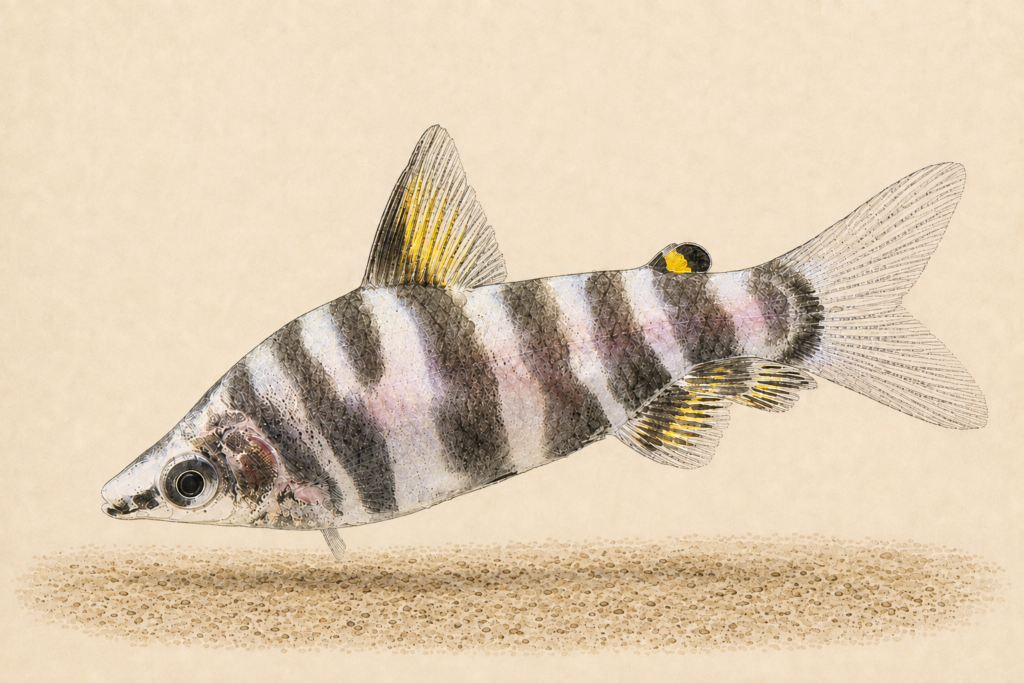
The Marbled Headstander has a notably deep, laterally compressed body with a high dorsal profile – the specific epithet hypselonotus translates roughly as “high-backed,” and the description is apt. The body shape is somewhat disc-like when viewed from the side, tapering to a relatively small, downward-pointing mouth perfectly adapted for grazing on surfaces.
The base colour is a warm silvery-gold to pale cream, overlaid with a series of broad, dark brown to black vertical bars or bands. These bands are somewhat irregular in shape and spacing, giving the fish the “marbled” appearance referenced in its common name. In healthy, well-kept specimens the contrast between the pale base and the dark markings can be quite dramatic. The fins are generally translucent to slightly yellowish, sometimes showing a faint continuation of the dark banding, particularly in the caudal fin.
Juveniles tend to display the banding pattern most sharply. As the fish matures, the markings may become slightly less defined or take on a more brownish tone, though this varies between individuals and populations. The eye is relatively large and set high on the head, and there is a noticeable adipose fin – a hallmark of the broader characin group.
Sexual dimorphism is minimal and unreliable. Mature females may appear slightly deeper-bodied and fuller when viewed from above, particularly when gravid, but there is no consistent colour or finnage difference between the sexes. This makes sexing Marbled Headstanders a challenge outside of spawning condition.
Natural Habitat
Abramites hypselonotus is found across a wide swathe of tropical South America, inhabiting river systems within the Amazon, Orinoco, and Parana basins. Its range spans parts of Brazil, Peru, Colombia, Venezuela, and Paraguay, making it one of the more widely distributed members of the Anostomidae.
In the wild, the Marbled Headstander favours slow to moderately flowing stretches of rivers, tributaries, and floodplain lakes. It is typically found in areas with submerged vegetation, fallen branches, root tangles, and overhanging riparian plants. The head-down posture for which headstanders are named is not merely an aquarium curiosity; in the wild, this orientation allows the fish to graze efficiently on algae, aufwuchs (the biofilm of microorganisms that coats submerged surfaces), and plant matter growing on wood, rocks, and leaf litter.
Water conditions across its range vary considerably, from the acidic blackwater tributaries of the Amazon to the somewhat harder, more neutral waters of the Parana system. In general, the species experiences warm temperatures year-round, soft to moderately hard water, and a pH that ranges from mildly acidic to neutral. Seasonal flooding cycles bring fluctuations in water depth, flow rate, and available food sources, and these environmental rhythms likely play a role in triggering natural breeding behaviour.
The substrate in its native habitats is typically sand, fine gravel, or a mixture of decomposing leaf litter and organic detritus. Tannin-stained water is common but not universal. Understanding this natural context helps inform the best way to set up a captive environment: plenty of grazing surfaces, some cover and visual barriers, and water that is warm, clean, and on the softer side.
Tank Size and Setup
A single Marbled Headstander should be housed in a tank of at least 250 litres. If you plan to keep a small group or house this species alongside other robust fish – which is the recommended approach – then 350 to 450 litres or more is far more appropriate. The extra space is not merely about water volume; it is about providing enough territory and visual barriers to reduce aggression, which is one of the primary management challenges with this species.
Tank dimensions matter as much as raw capacity. A long, wide aquarium is preferable to a tall, narrow one. Aim for a footprint of at least 120 cm in length and 45 cm in depth (front to back) as a minimum for a single specimen. This gives the fish adequate swimming room and allows you to create distinct zones within the tank.
Decor should be chosen with both the fish’s behaviour and its dietary habits in mind. Driftwood, large smooth stones, and robust hardscape elements provide grazing surfaces that the fish will naturally explore in its head-down posture. These elements also serve as territorial markers and sight-line breaks, helping to diffuse aggression if multiple individuals or other assertive species share the tank.
Live plants are generally not recommended in a tank housing Marbled Headstanders unless you are willing to have them eaten. This species will graze on and damage the vast majority of aquarium plants, including many that are considered “tough.” If you wish to include plants at all, try robust species such as Anubias or Java Fern attached to hardscape (these are sometimes left alone, though there are no guarantees). Alternatively, artificial plants can provide visual cover without becoming an expensive salad bar.
A sand or fine gravel substrate works well and mimics the natural environment. Ensure that any decor does not have sharp edges that could injure the fish as it manoeuvres head-down among surfaces. A secure, well-fitting lid is advisable, as headstanders can be surprisingly capable jumpers when startled.
Moderate lighting is suitable. The Marbled Headstander does not have extreme lighting preferences, but excessively bright conditions with no shaded retreats can increase stress. A mix of open swimming areas and shaded spots beneath overhanging decor or floating plants (if not eaten) provides a good balance.
Water Parameters
| Temperature | 23-28 C |
| pH | 5.8-7.5 |
| General hardness (GH) | 2-15 dGH |
| Carbonate hardness (KH) | 1-10 dKH |
| Ammonia | 0 ppm |
| Nitrite | 0 ppm |
| Nitrate | Below 30 ppm |
The Marbled Headstander is reasonably adaptable in terms of water chemistry, which is unsurprising given its wide natural range. That said, it does best in warm, clean water that leans towards the softer, slightly acidic end of the spectrum. A temperature of around 25-27 C, a pH of 6.0-7.0, and moderate hardness represent the sweet spot for long-term health and the best colouration.
Water quality is more important than hitting an exact number on any single parameter. Ammonia and nitrite must always be at zero, and nitrate should be kept as low as practical – certainly below 30 ppm, and ideally below 20 ppm. This species comes from environments with relatively clean, well-oxygenated water and does not thrive in tanks where maintenance is neglected.
Perform weekly water changes of 25-30% to maintain stable conditions and dilute dissolved organic waste. If you use tap water, treat it with a dechlorinator and ensure the replacement water is temperature-matched before adding it to the tank. Sudden swings in pH or temperature can stress the fish and increase susceptibility to disease.
Adding Indian almond leaves or small amounts of peat filtration can gently lower pH and introduce tannins that mimic the blackwater conditions found in parts of the species’ natural range, though this is an optional refinement rather than a necessity.
Filtration and Equipment
Given the moderate adult size of the Marbled Headstander and the tank volumes recommended, a quality external canister filter is the most practical choice. Select a model rated for the full volume of your tank, or ideally slightly above it. The species appreciates clean, well-oxygenated water but does not require an excessively strong current – a gentle to moderate flow is appropriate.
Biological filtration capacity is the top priority. Ensure the filter media includes ample ceramic rings, sintered glass, or similar high-surface-area biological media. Mechanical filtration (sponge and floss layers) should be rinsed regularly in old tank water to prevent clogging and maintain flow rate. If you wish to lower pH naturally, a small compartment of peat granules in the filter can be effective, though monitor pH closely when first introducing it.
A reliable heater is essential. Choose a heater appropriate for the tank volume and consider using two smaller heaters rather than one large one for redundancy in larger setups. A quality aquarium thermometer – digital or glass – should be placed where it is easily visible so you can spot temperature deviations quickly.
Standard aquarium lighting will suffice. If you are not attempting to grow live plants (and with this species, you may well choose not to), then lighting can be kept moderate. A timer set to provide 8-10 hours of light per day helps establish a stable day-night cycle. An air pump or additional surface agitation is beneficial if you notice any signs of low oxygen, though a well-positioned filter outlet typically provides adequate gas exchange.
Diet and Feeding
Diet is arguably the single most important management consideration for the Marbled Headstander. This species is predominantly herbivorous and must receive a diet rich in vegetable matter. Failure to provide adequate plant-based food is the number one cause of the destructive behaviours for which this fish is sometimes criticised – namely, devouring live plants and nipping the fins of tank mates.
The foundation of the diet should be high-quality spirulina-based flakes or pellets, algae wafers, and blanched vegetables. Courgette (zucchini) rounds, blanched spinach, shelled peas, cucumber slices, and blanched romaine lettuce are all readily accepted. Attach vegetables to a clip or weight them down so they sink to the bottom or rest against decor, mimicking the surfaces the fish naturally grazes upon.
Supplement the vegetable base with occasional offerings of protein-rich foods. Frozen or live bloodworm, daphnia, brine shrimp, and high-quality omnivore pellets can be offered two to three times per week. This mirrors the natural diet, which includes invertebrates and small amounts of animal protein alongside the predominant plant matter. Do not, however, allow meaty foods to become the majority of the diet – a ratio of roughly 70% plant-based to 30% protein-based is a good guideline.
Feed once or twice daily, offering only what the fish can consume within a few minutes. Remove any uneaten blanched vegetables after a few hours to prevent them from fouling the water. If you notice the fish persistently attacking live plants or nipping the fins of tank mates, this is often a sign that more vegetable matter is needed in the diet. Increasing the frequency and variety of plant-based offerings usually helps to reduce these behaviours, though it may not eliminate them entirely in all individuals.
Behaviour and Temperament
The Marbled Headstander is best described as semi-aggressive. Juveniles are typically more peaceable and may even appear shy, but as the fish matures it often becomes increasingly territorial and assertive, particularly towards conspecifics and similarly shaped or slow-moving species.
The characteristic head-down posture is not a sign of illness or distress – it is the natural resting and feeding orientation for all headstanders. In the aquarium, you will observe the fish hovering at angles of 30 to 45 degrees (or sometimes nearly vertical) as it grazes on surfaces, inspects decor, or simply rests among cover. This behaviour is perfectly normal and is, in fact, one of the species’ most appealing traits.
Territorial aggression is the primary behavioural concern. A single specimen in a suitably sized tank with appropriate tank mates is generally the least problematic arrangement. Keeping two Marbled Headstanders together is often the worst combination, as one will typically dominate and harass the other relentlessly. If you wish to keep multiples, a group of five or more in a very large tank (450 litres or above) can help to spread aggression so that no single individual bears the brunt of it – but this approach requires significantly more space and careful monitoring.
Fin nipping is the other major concern. The Marbled Headstander has a well-documented tendency to nip the fins of slow-moving, long-finned, or passive tank mates. Angelfish, gouramis, and fancy livebearers with trailing fins are particularly at risk. This behaviour can be exacerbated by hunger (especially a lack of vegetable matter) or by overcrowding, but some individuals will nip regardless. Choosing robust, fast-moving, short-finned tank mates is the best preventative measure.
Despite these challenges, the Marbled Headstander is an intelligent, curious fish that can become quite bold once settled into its environment. It will often learn to recognise its keeper and may approach the front glass at feeding time. Many long-term keepers find its personality and unusual posture genuinely rewarding, provided the right precautions are taken.
Tank Mates
Choosing tank mates for the Marbled Headstander requires careful thought. The ideal companions are robust, moderately active species that are large enough not to be bullied, fast enough to evade any nipping attempts, and lacking in long, trailing fins that might attract unwanted attention. Avoid anything small enough to be intimidated, anything very slow or docile, and anything with extravagant finnage. Bottom-dwelling species that occupy a different zone of the tank are often a safe choice, as are medium-sized, assertive (but not overly aggressive) cichlids and larger characins.
Good tank mates
- Silver Dollar (Metynnis spp.) – Robust, fast-moving herbivorous characins that occupy similar water conditions and are too large and active to be bullied.
- Blue Acara (Andinoacara pulcher) – A moderately assertive cichlid that holds its own without being overly aggressive, and lacks trailing fins.
- Bristlenose Pleco (Ancistrus spp.) – A hardy bottom-dweller that stays out of the headstander’s way and is well-armoured against nipping.
- Clown Loach (Chromobotia macracanthus) – Active, social bottom-dwellers large enough to coexist peacefully, provided the tank is spacious.
- Severum (Heros severus) – A calm but sturdy cichlid that can share space with a headstander in a large tank.
- Giant Danio (Devario aequipinnatus) – Fast and active enough to avoid fin nipping, and adds movement to the upper water column.
- Rainbow Shark (Epalzeorhynchos frenatum) – A territorial bottom-dweller that is assertive enough to hold its own ground.
- Firemouth Cichlid (Thorichthys meeki) – A moderately assertive Central American cichlid that pairs well with semi-aggressive community setups in larger tanks.
Fish to avoid
- Angelfish (Pterophyllum scalare) – Slow-moving with long trailing fins that are an irresistible target for nipping.
- Betta (Betta splendens) – Slow, long-finned, and far too vulnerable to be housed with a semi-aggressive headstander.
- Guppy (Poecilia reticulata) – Too small and too slow, with flowing fins that invite nipping.
- Neon Tetra (Paracheirodon innesi) – Far too small and delicate to coexist safely with an assertive adult headstander.
- Pearl Gourami (Trichopodus leeri) – A gentle, slow-moving species with long ventral fins that are extremely susceptible to nipping.
- Discus (Symphysodon spp.) – Sensitive, slow, and easily stressed by the assertive behaviour of a headstander.
- Corydoras (Corydoras spp.) – Small, peaceful bottom-dwellers that may be harassed or outcompeted for food.
Breeding
Breeding the Marbled Headstander in captivity is difficult and only rarely accomplished in home aquaria. The vast majority of specimens available in the trade are wild-caught, and there is limited documented information on successful captive breeding protocols.
Part of the challenge lies in the difficulty of sexing this species. As noted above, there are no reliable external differences between males and females outside of spawning condition, when females may appear slightly fuller-bodied. Obtaining a potential breeding pair or group therefore typically involves purchasing several juveniles and growing them on, hoping for a mix of sexes.
In the wild, spawning is believed to be triggered by seasonal changes associated with the onset of the rainy season – rising water levels, increased flow, a drop in conductivity, and an abundance of fresh food. Replicating these conditions in captivity involves gradually lowering water hardness and pH, performing large cool water changes to simulate rainfall, and ensuring the fish are in peak condition through heavy feeding with a varied diet rich in vegetable matter and live or frozen protein.
The species is thought to be an egg scatterer, depositing eggs among vegetation or over fine-leaved substrates. If spawning occurs, the parents should be removed promptly, as they will readily consume the eggs. Eggs are small and may take one to two days to hatch, with fry becoming free-swimming a few days thereafter. Fry should be offered infusoria or liquid fry food initially, transitioning to newly hatched brine shrimp and finely crushed spirulina flake as they grow.
Given the challenges involved, breeding this species is best considered a project for advanced hobbyists with the facilities, patience, and experience to manipulate water conditions safely and manage potentially aggressive adults in a breeding setup. For most keepers, simply maintaining a healthy adult specimen or small group is achievement enough.
Common Diseases
The Marbled Headstander is not especially disease-prone when maintained in clean, stable water with an appropriate diet. However, like all freshwater fish, it can be affected by a range of common ailments, particularly when stressed by poor water quality, inadequate nutrition, or unsuitable tank mates.
White spot disease (ichthyophthirius, commonly known as ich) is one of the most frequently encountered problems. It presents as small white cysts on the body and fins, and is typically triggered by temperature fluctuations or the introduction of new fish without adequate quarantine. Treatment involves gradually raising the temperature to 28-30 C and administering a proprietary white spot remedy according to the manufacturer’s instructions. Maintaining stable temperatures and quarantining new arrivals helps prevent outbreaks.
Fin rot can occur if water quality deteriorates or if the fish sustains fin damage from aggression or nipping. Symptoms include fraying, discolouration, or erosion of the fin edges. Improving water quality through increased water changes is the first and most important step, supplemented by antibacterial treatment if the condition is advanced.
Intestinal parasites are a possibility, particularly in wild-caught specimens. Signs may include weight loss despite a good appetite, stringy or pale faeces, and a generally emaciated appearance. A veterinary-grade anti-parasitic treatment may be necessary, and newly acquired wild-caught fish should ideally be quarantined and observed for several weeks before being added to the main display tank.
Nutritional deficiency can manifest as dull colouration, lethargy, or an increased tendency towards plant destruction and fin nipping. Ensuring a diet rich in vegetable matter, supplemented with varied protein sources, is the best preventative measure. Vitamin-enriched foods or occasional soaks in a liquid vitamin supplement can help maintain optimal health.
As a general rule, prevention is always preferable to treatment. Consistent water quality maintenance, a balanced diet, stable temperatures, and careful quarantine of new additions will go a long way towards keeping your Marbled Headstander healthy throughout its potentially long lifespan.
FAQs
Can I keep a Marbled Headstander in a planted tank?
It is not recommended unless you are prepared to lose plants. The Marbled Headstander is a dedicated herbivore that will graze on and damage most aquarium plant species. Very tough plants like Anubias or Java Fern attached to hardscape are sometimes left alone, but there are no guarantees. Most keepers opt for artificial plants or a hardscape-only setup.
How many Marbled Headstanders can I keep together?
A single specimen is the simplest and safest option for most aquaria. Keeping two often results in one bullying the other. If you want a group, aim for five or more in a tank of at least 450 litres, with plenty of sight-line breaks and hiding spots to distribute aggression. Even then, monitor closely for signs of persistent harassment.
Why does my Marbled Headstander swim head-down?
This is completely normal behaviour and is the characteristic posture for which all headstander species are named. The head-down angle is used for grazing on surfaces, resting, and foraging. It is not a sign of illness or distress. If the fish is lying on its side or struggling to maintain any position at all, that would be a cause for concern – but a controlled, angled posture is perfectly healthy.
Will a Marbled Headstander eat algae in my tank?
Yes, to some extent. The species will graze on algae and biofilm that develops on rocks, wood, and glass, which is part of its natural feeding behaviour. However, it should not be relied upon as an algae control measure. Its dietary needs go well beyond what naturally occurring algae can provide, and a dedicated feeding regimen of spirulina-based foods and blanched vegetables is essential.
Is the Marbled Headstander suitable for a community tank?
It can work in a community setting, but only with careful species selection. Tank mates must be robust, moderately active, and lacking in long or trailing fins. Small, delicate, or slow-moving fish are not suitable. Think of it as a semi-aggressive community species rather than a peaceful one – it needs companions that can hold their own without escalating into outright conflict.
Related Guides
- Silver Dollar Care Guide – Another robust South American herbivore that makes an excellent tank mate and shares similar dietary requirements.
- Striped Headstander (Anostomus anostomus) Care Guide – A closely related headstander species with similar care needs but slightly different temperament and markings.
- Blue Acara Care Guide – A sturdy, compatible cichlid often recommended alongside semi-aggressive characins in larger community setups.
- Bristlenose Pleco Care Guide – A reliable, herbivorous bottom-dweller that pairs well with the Marbled Headstander.
- Severum Care Guide – A large, peaceful cichlid from South America that thrives in similar water conditions and tank setups.