Quick Summary
The Paraguay Eartheater is a rewarding, characterful South American cichlid suited to intermediate keepers who can provide a spacious tank with fine sand substrate and stable, warm water. It is not ideal for beginners or community nano setups, but in the right environment it is hardy, long-lived, and endlessly entertaining to watch as it sifts mouthfuls of sand for food.
🐠 Build a tank around this species
In this guide:
- Introduction
- Quick Stats
- Appearance
- Natural Habitat
- Tank Size and Setup
- Water Parameters
- Diet and Feeding
- Behaviour and Temperament
- Tank Mates
- Breeding
Introduction
Gymnogeophagus balzanii, widely known as the Paraguay Eartheater, is one of the most accessible members of the eartheater group of South American cichlids. Found across a broad range of river systems in southern South America, it has been a staple of the cichlid hobby for decades, prized for its robust constitution, attractive colouration, and fascinating substrate-sifting behaviour. The common name “eartheater” – a literal translation of the genus name Geophagus in the broader sense – perfectly describes the species’ most distinctive habit: it takes mouthfuls of fine substrate, works the material through its gill rakers to extract tiny invertebrates, algae, and organic particles, and then expels the cleaned sand. This behaviour is not simply charming to observe; it is a fundamental part of the fish’s biology, and replicating the conditions that allow it is central to responsible husbandry.
The Paraguay Eartheater belongs to the genus Gymnogeophagus, a group of eartheaters distributed in the subtropical and temperate river systems of the Rio de la Plata basin. Unlike some of their tropical cousins in the genus Geophagus or Satanoperca, Gymnogeophagus species naturally experience cooler water temperatures, particularly in winter, which makes them somewhat unusual among commonly kept cichlids. This tolerance of lower temperatures opens up interesting stocking possibilities and means the species does not always require a heater in warmer climates, though stable, moderately warm conditions are best for long-term health in the aquarium.
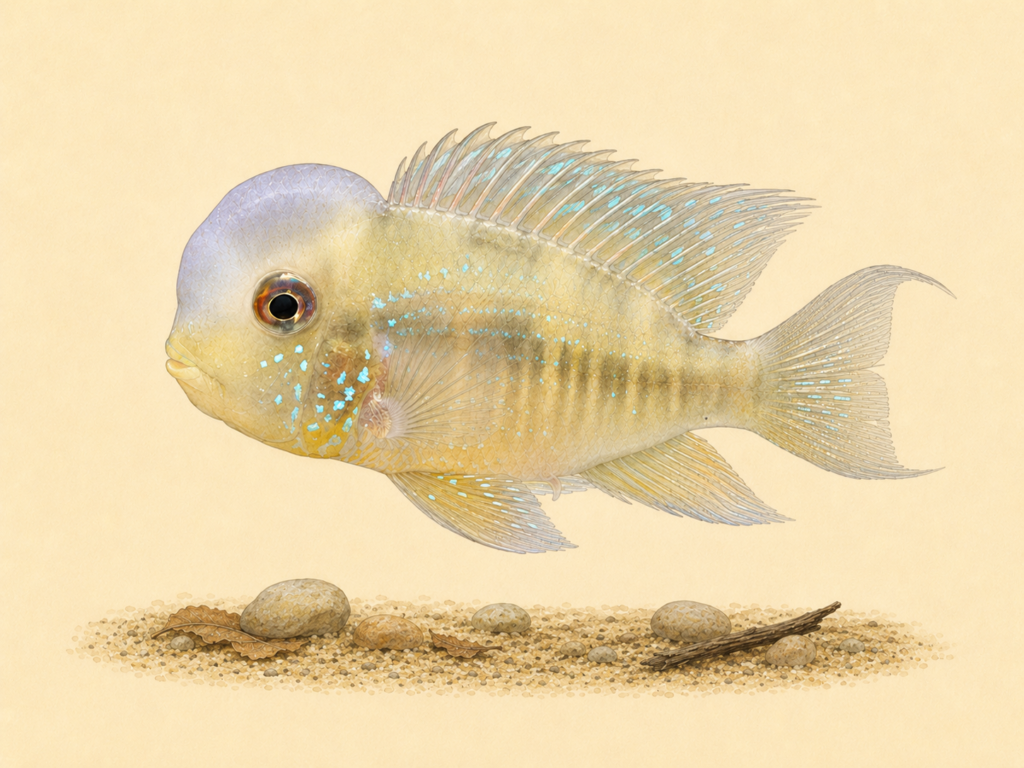
Males develop a pronounced nuchal hump – a fatty deposit on the forehead – as they mature, giving dominant individuals a distinctive, imposing profile. Females remain more streamlined. Both sexes display attractive body patterning and can develop vivid colour when kept in good conditions, particularly during breeding. While not as immediately dazzling as some Malawi or Central American cichlids, the Paraguay Eartheater rewards patient keepers with subtle beauty, complex social behaviour, and a personality that quickly endears it to anyone who watches it interact with its environment.
This guide covers everything you need to know to keep Gymnogeophagus balzanii successfully, from tank dimensions and substrate choice to diet, breeding, and compatible tank mates.
Quick Stats
| Scientific name | Gymnogeophagus balzanii |
|---|---|
| Common names | Argentine Humphead Eartheater, Balzani's Eartheater |
| Family | Cichlidae |
| Origin | Parana River basin: Paraguay drainage (Brazil, Paraguay), Parana drainage (Argentina), lower Uruguay drainage (Uruguay, Brazil); also recorded from Bolivia within the Parana basin |
| Adult size | 20 cm |
| Difficulty | Advanced |
| Breeding difficulty | Moderate |
| Temperature | 21–25 °C |
| pH | 6–7.5 |
| GH | 2–15 dGH |
| Minimum tank size | 300 L |
| Conservation status | Least Concern (IUCN, assessed 18 November 2020) |
Appearance
The Paraguay Eartheater is a moderately sized, laterally compressed cichlid with a deep body and a large, subterminal mouth well adapted for scooping up substrate. The base body colour varies from olive-green to golden-brown, overlaid with a series of darker vertical bars that become more or less pronounced depending on mood, social status, and environmental conditions. A dark midlateral blotch is usually present roughly midway along the flank, and a second spot often appears at the base of the caudal peduncle. In good conditions and particularly during breeding, the body can take on warm golden, bronze, or even reddish tones, and the fins develop attractive blue-green iridescent highlights.
The dorsal fin is long and may carry subtle orange or red edging. The caudal fin is rounded to slightly truncate, and the anal and pelvic fins often develop more intense colouration in males. The eye is relatively large with a reddish-orange iris, contributing to the species’ alert, expressive appearance.
The most striking feature in mature males is the nuchal hump – a pronounced fatty deposit on the forehead that grows with age and dominance. In fully mature, dominant males this hump can become very large, giving the fish a dramatically steep head profile. Females lack this feature or develop only the faintest swelling, making sexing straightforward in adults. Males also tend to be somewhat larger and deeper-bodied than females. Juvenile fish of both sexes look similar and are difficult to sex reliably until they reach approximately 8-10 cm.
Colouration intensity is heavily influenced by diet, water quality, substrate colour, and social dynamics. Fish kept over pale, fine sand in a well-maintained aquarium with a varied diet will display noticeably brighter colours than those on dark substrates or in stressful environments. This responsiveness makes the Paraguay Eartheater a particularly rewarding species to optimise conditions for.
Natural Habitat
Gymnogeophagus balzanii is native to the Parana River basin, including the Paraguay drainage in Brazil and Paraguay and the Parana drainage in Argentina, as well as the lower Uruguay drainage in Uruguay and Brazil. The Catalog of Fishes additionally records the species from Bolivia within the Parana basin. This does not include the Guapore basin, which belongs to a different river system. This is one of the most southerly distributed cichlid species in the world, and its range includes areas that experience significant seasonal temperature variation – a point that has important implications for aquarium care.
In the wild, the Paraguay Eartheater inhabits slow-moving rivers, streams, lagoons, and flooded marginal areas with sandy or muddy substrates. It is typically found in areas with moderate current, often near submerged wood, leaf litter, marginal vegetation, or rocky outcrops that provide shelter and territorial boundaries. The substrate in these habitats is predominantly fine sand or silt, which allows the fish to engage in its characteristic sifting behaviour without damaging its delicate gill structures.
Water conditions across its range are variable. In the Rio Paraguay, waters tend to be slightly alkaline and moderately hard; in tributaries and seasonal flooded areas, they may be softer and more acidic. Water temperatures in the species’ range can drop to 15-18 C in winter and rise to 28-30 C in the peak of summer, though the fish are typically most active and reproductively engaged when temperatures are in the 22-26 C range. This seasonal fluctuation is worth noting: while the species tolerates a wide temperature range, it does not thrive in the constant high temperatures (28-32 C) that some tropical cichlids require. Providing a slight seasonal temperature variation, or at least keeping the aquarium at the moderate end of the tropical range, is beneficial.
The habitats of Gymnogeophagus balzanii are generally well-oxygenated and relatively clear, though seasonal flooding can increase turbidity. In the aquarium, this translates to a need for good filtration, reasonable water movement, and clean conditions, without the extreme blackwater parameters sometimes associated with other South American cichlids.
Tank Size and Setup
A single Paraguay Eartheater can be maintained in a tank of around 200 litres, but for a pair or small group – which is how the species is best kept – a minimum of 300 litres is recommended. If you wish to keep a group of four to six individuals alongside other species, aim for 400 litres or more. Floor space is more important than height for this bottom-dwelling species, so favour long, wide tanks over tall, narrow ones. A 120 x 45 cm footprint is a reasonable starting point for a pair; 150 x 50 cm or larger is preferable for a group.
Sand substrate is not optional for this species. The Paraguay Eartheater’s sifting behaviour is a core biological need. Using sharp gravel, coarse substrate, or bare glass denies the fish the ability to feed naturally and can cause physical damage to the mouth, gill rakers, and pharyngeal structures. Choose a fine, smooth, ideally pale-coloured sand – play sand, pool filter sand, or aquarium-specific silica sand all work well. A generous depth (a few centimetres at least) is sufficient. The fish will constantly rearrange the substrate, so any aquascaping that relies on precise sand placement will need to be accepted as temporary.
Decor should include pieces of driftwood, smooth river rocks, and hardy plants if desired. Wood and rocks provide visual barriers and territorial boundaries, which are important for managing aggression in groups. Create distinct zones within the tank so that subordinate fish can retreat from the line of sight of dominant individuals. Avoid sharp or rough rocks that could injure the fish, particularly around areas where they sift.
Live plants can be used but must be robust and well-anchored. The constant substrate disturbance means that delicate or newly rooted plants will be uprooted. Anubias and Java Fern attached to wood or rock, Vallisneria with established root systems, or floating plants such as Amazon Frogbit are all suitable choices. Stem plants pushed into the sand are unlikely to survive the fish’s attention.
Moderate lighting is appropriate. The species does not require intense light and will feel more comfortable and display better colour under subdued to moderate illumination. If keeping live plants, balance their light requirements with the fish’s preference for dimmer conditions by using floating plants to create shaded areas.
Water Parameters
| Temperature | 21-25 C |
| pH | 6.0-7.5 |
| General hardness (GH) | 2-15 dGH |
| Ammonia | 0 ppm |
| Nitrite | 0 ppm |
| Nitrate | Below 20 ppm |
The Paraguay Eartheater is notably adaptable regarding water chemistry, reflecting the range of habitats it occupies in the wild. Most tap water in the UK, adjusted to a neutral or slightly acidic pH, will be perfectly acceptable. The species does well in soft to moderately hard water and does not require extreme conditions in either direction. Avoid very hard, highly alkaline water (pH above 8.0, GH above 20 dGH), which falls outside its natural range.
Temperature management is an area where this species differs from many popular tropical cichlids. G. balzanii is a subtropical fish and genuinely thrives at temperatures that would be considered too cool for many aquarium species. A year-round temperature of 22-24 C is ideal for most keepers. The species will tolerate brief dips to 18 C and can handle warmer spells up to 26-27 C, but prolonged exposure to temperatures above 28 C is stressful and should be avoided. If you keep your home at typical UK room temperatures, a heater set to 22-23 C will provide an appropriate baseline.
Water quality must be kept high. The continuous substrate sifting releases organic matter into the water column, and the fish itself is a moderately heavy waste producer for its size. Weekly water changes of 30-50% are recommended, and nitrate levels should be kept below 20 ppm. Ammonia and nitrite must always read zero in an established aquarium. Invest in a reliable liquid test kit and monitor parameters regularly, especially after adding new fish or making changes to filtration.
Filtration and Equipment
Good mechanical and biological filtration is essential. The Paraguay Eartheater’s constant substrate sifting suspends fine particulates in the water column, which means your filter needs to handle a higher than average sediment load. A canister filter rated for the tank volume, or slightly above, is the best choice. Models with large media baskets that allow generous amounts of biological media (ceramic rings, sintered glass, or similar) alongside effective mechanical filtration (filter floss, fine sponge pads) will perform well. Sponge filters are generally insufficient as the sole filtration for tanks of this size and bioload.
Position filter inlet strainers so that they are not buried by the fish’s landscaping activities – raising the intake slightly off the substrate or protecting it with a prefilter sponge is advisable. The prefilter sponge also prevents fine sand from being drawn into the impeller, which can damage the motor over time.
Flow should be moderate. A gentle to moderate current across the tank replicates natural conditions, aids oxygenation, and helps keep suspended particles moving towards the filter intake. Avoid very strong flow that pins the fish to one end of the tank, especially if keeping juveniles or females.
A heater is usually required in the UK to maintain a stable 22-24 C. Choose a reliable, thermostatically controlled heater of appropriate wattage for the tank volume and consider a heater guard if keeping large or boisterous fish, as a cracked heater in an aquarium is dangerous. An air stone or surface agitation from the filter return is usually sufficient to maintain dissolved oxygen levels, but supplemental aeration is beneficial in warmer months when dissolved oxygen drops.
Diet and Feeding
In the wild, the Paraguay Eartheater is an omnivore, sifting the substrate for small invertebrates and organic matter. In the aquarium, this translates to a need for a varied, high-quality diet that emphasises protein-rich foods alongside vegetable matter.
A good-quality cichlid pellet or granule – ideally one designed for eartheaters or South American cichlids – should form the dietary staple. Sinking pellets are preferred, as they encourage the fish to feed in its natural position near the substrate. Supplement this with regular offerings of frozen or live foods: bloodworm, brine shrimp, daphnia, mosquito larvae, and chopped earthworm are all excellent choices and will bring out the best colour and condition. Blanched vegetables such as courgette, spinach, or peas can be offered occasionally and are usually accepted once the fish learns to recognise them as food.
One of the most enjoyable aspects of keeping this species is watching it feed from the substrate. Scatter sinking pellets or thawed frozen food directly onto the sand and allow the fish to sift through the substrate to find each morsel. This replicates natural foraging and provides mental stimulation. If you notice the fish ignoring food that sinks into crevices between rocks or decor, the food may be inaccessible – ensure that the majority of feeding takes place over open sand areas.
Feed once or twice daily, offering only as much as the fish can consume in a few minutes. Overfeeding quickly degrades water quality, which is a particular concern with a species that already stirs up the substrate. Occasional fasting days (once a week) are not harmful and can help prevent obesity, which is a genuine concern with well-fed captive cichlids, particularly large males with nuchal humps.
Behaviour and Temperament
The Paraguay Eartheater is a semi-aggressive cichlid whose temperament is best described as moderately territorial, context-dependent, and considerably more nuanced than a simple label of “aggressive” or “peaceful” would suggest. For much of the time, outside breeding, established groups coexist with relatively little overt conflict. There is a clear dominance hierarchy, particularly among males, and this is expressed through body language – fin displays, colour changes, lateral posturing, and occasional jaw-locking or chasing – rather than through the kind of relentless, damaging aggression seen in some Central American cichlids.
Territorial behaviour intensifies significantly during breeding. The female, who alone guards the eggs and fry after the male is driven off, will defend her chosen site vigorously against all comers, including conspecifics and tank mates of other species. In a tank that is too small or lacks adequate visual barriers, this can lead to stress, injury, or death for subordinate fish that cannot escape the breeding pair’s territory. This is the primary reason a spacious tank with plenty of line-of-sight breaks is so important.
Gymnogeophagus balzanii is best kept in groups of four to six or more, which distributes aggression and allows a natural social hierarchy to develop. A single male with two or three females is a classic ratio, but a group with multiple males can also work in a sufficiently large aquarium. Keeping just two fish risks one dominating the other relentlessly, especially if both are male.
Towards non-cichlid tank mates, the Paraguay Eartheater is generally tolerant provided the other fish are not small enough to be eaten and do not compete directly for the same substrate territory. The species will largely ignore midwater and surface-dwelling fish. Very small fish – neon tetras and similar species under 3 cm – may be seen as food by a large adult, so choose tank mates of a reasonable size.
The substrate-sifting behaviour is constant and endlessly entertaining. Expect to see the fish methodically working across the sand, taking large mouthfuls, chewing the material through its gill rakers, and expelling clean sand in puffs from the gills. This activity is a sign of a healthy, behaviourally enriched fish. If a Paraguay Eartheater stops sifting, investigate water quality and health immediately.
Tank Mates
The Paraguay Eartheater can be successfully housed with a range of species provided certain criteria are met: tank mates should be too large to be eaten, not overly aggressive or competitive for bottom territory, and tolerant of the same moderate temperature range. Avoid very small fish, fin-nipping species, and highly aggressive cichlids that would bully or outcompete the eartheater. The subtropical temperature preference of G. balzanii narrows the field somewhat – strictly tropical species that require temperatures above 26 C are not suitable long-term companions.
Good tank mates
- Buenos Aires Tetra – A robust, subtropical tetra that thrives in the same temperature range and is too large to be eaten by adult eartheaters.
- Diamond Tetra – A peaceful, attractively iridescent tetra that occupies the midwater column and tolerates cooler temperatures well.
- Bristlenose Pleco – A hardy, algae-eating catfish that stays out of the eartheater’s way and tolerates the same water parameters.
- Bronze Corydoras – Another subtropical South American bottom-dweller that coexists peacefully, though ensure the sand substrate suits both species.
- Peppered Corydoras – A cooler-water Corydoras species that is an excellent match for the eartheater’s preferred temperature range.
- Rainbowfish (Melanotaenia spp.) – Active, colourful midwater fish that add movement and tolerate moderate temperatures, though select species at the cooler end of the rainbowfish spectrum.
- Keyhole Cichlid – A peaceful, similarly sized South American cichlid that rarely causes territorial disputes.
- Swordtail – A hardy livebearer that occupies the upper water column and tolerates a broad temperature and pH range.
Fish to avoid
- Oscar – Far too large and aggressive; will dominate and likely injure or kill the eartheater in most setups.
- Jack Dempsey – A highly territorial Central American cichlid that is too aggressive to coexist safely with Gymnogeophagus.
- Neon Tetra – Too small; adult eartheaters will readily consume fish of this size.
- Cardinal Tetra – Similarly too small to be safe, and requires warmer water than the eartheater prefers.
- Convict Cichlid – Extremely aggressive when breeding and will clash directly with eartheaters over substrate territory.
- Tiger Barb – A persistent fin-nipper that will harass the eartheater, particularly targeting its flowing fins.
- Discus – Requires much warmer, softer water and is far too sensitive and slow to thrive alongside semi-aggressive eartheaters.
Breeding
Breeding the Paraguay Eartheater in captivity is achievable for hobbyists with moderate experience and a well-maintained, spacious aquarium. Gymnogeophagus balzanii is a delayed maternal mouthbrooder. The eggs are initially laid on a cleaned surface. After roughly 24 to 36 hours, usually shortly before hatching, the female takes them into her mouth and continues brooding alone. The male does not provide prolonged biparental fry care and may court other females. Give a brooding female a quiet refuge and do not assume she can safely remain exposed to male or tank mate pressure.
To encourage breeding, maintain a group of four to six fish and allow pairs to form naturally. Forcing a pair by placing an arbitrary male and female together often leads to aggression rather than bonding. A slight increase in temperature to 24-26 C, combined with increased feeding of high-protein live or frozen foods, can stimulate breeding behaviour. Large water changes with slightly cooler water sometimes trigger spawning, mimicking the onset of the rainy season.
When ready to spawn, the pair will clean a flat surface – typically a smooth rock, a piece of driftwood, or even an area of cleared sand. The female deposits rows of adhesive eggs while the male fertilises them. Clutch sizes vary considerably but typically range from 200 to 500 eggs. The female guards the spawning site closely before taking the eggs into her mouth. Once brooding, she should be given a quiet refuge and will not eat during this period; do not assume she can safely remain exposed to male or tank mate pressure. Free-swimming fry are small but large enough to accept freshly hatched brine shrimp nauplii and finely crushed flake or powder food once released. Raise fry in clean water with frequent small water changes and plentiful food.
Common Diseases
White spots, wasting, stringy faeces, skin lesions and head erosion can have several causes and cannot be diagnosed reliably from appearance alone. Isolate the affected fish where practical and check ammonia, nitrite, nitrate, temperature and oxygenation. Seek diagnosis from an aquatic veterinarian or experienced fish health professional when illness persists or is severe. Treat only after identifying the likely cause, using a product licensed for ornamental fish and following its label exactly. Do not automatically raise the temperature, add salt, combine medicines, reduce a labelled dose or deworm fish prophylactically. Maintain strong aeration and complete the full labelled course.
FAQs
Can I keep a Paraguay Eartheater in a community tank?
Yes, provided the tank is large enough (300 litres minimum with tank mates), the other species are appropriately sized and temperamentally compatible, and there are enough visual barriers to manage territorial behaviour during breeding. Avoid very small fish that could be eaten and overly aggressive cichlids that would bully the eartheater.
Do Paraguay Eartheaters need sand substrate?
Yes, this is a genuine welfare requirement rather than simply an aesthetic preference. The species’ entire feeding strategy revolves around taking mouthfuls of fine substrate and sifting it through its gills. Sharp gravel can cause mouth injuries, gill damage, and chronic stress. Use smooth, fine sand – play sand or pool filter sand works well and is inexpensive.
Can I keep Paraguay Eartheaters in an unheated tank?
In some climates, yes. This subtropical species tolerates temperatures down to around 18 C and does not require the high temperatures of many tropical cichlids. In the UK, most indoor environments will still benefit from a heater set to 22-23 C to prevent temperature swings, particularly in winter. In consistently warm homes, an unheated tank may be feasible during summer months, but a heater provides valuable stability year-round.
How can I tell the difference between male and female Paraguay Eartheaters?
Adult males are typically larger, deeper-bodied, and develop a pronounced nuchal hump on the forehead – this is the most reliable visual indicator. Males also tend to show more intense colouration, particularly during breeding. Females are smaller, slimmer, and lack the nuchal hump. Sexing juveniles under 8-10 cm is difficult and often unreliable without venting.
Will Paraguay Eartheaters destroy my planted aquarium?
They will uproot any plants that are simply pushed into the substrate. However, a planted tank is achievable if you use species attached to hardscape (Anubias, Java Fern, Bucephalandra on wood or stone), well-established Vallisneria with deep roots, or floating plants. Avoid delicate stem plants rooted in the sand, as they will be excavated within hours.
Related Guides
- Geophagus sveni – A tropical eartheater with similar substrate-sifting behaviour, useful to compare husbandry requirements and temperature preferences.
- Satanoperca leucosticta – Another popular eartheater species that shares many care principles with G. balzanii but requires warmer water.
- Bristlenose Pleco – One of the best bottom-dwelling tank mates for the Paraguay Eartheater, with overlapping parameter needs.
- Bronze Corydoras – A subtropical Corydoras species that pairs well with the eartheater and shares its preference for sandy substrates.
- Keyhole Cichlid – A peaceful South American cichlid that makes an excellent companion in larger eartheater setups.