Quick summary
The Keyhole Cichlid is a hardy, peaceful cichlid that’s great for beginners and community tanks, thanks to its easygoing temperament and undemanding care needs. It can be shy, so provide plenty of plants and hiding spots, and avoid pairing it with aggressive or boisterous tank mates.
🐠 Build a tank around this species
In this guide:
- Introduction
- Quick Stats
- Appearance
- Natural Habitat
- Tank Size and Setup
- Water Parameters
- Filtration and Equipment
- Diet and Feeding
- Behaviour and Temperament
- Tank Mates
- Breeding
- Common Diseases
- FAQs
Introduction
The Keyhole Cichlid (Cleithracara maronii) is one of the most peaceful and endearing cichlids available in the freshwater aquarium hobby. Named for the distinctive keyhole-shaped marking on its flank, this gentle South American species has been a firm favourite among aquarists since it was first imported in the early twentieth century. Unlike many of its cichlid relatives, the Keyhole Cichlid is remarkably docile, making it an excellent choice for community aquariums where aggression would be unwelcome.
Originally described by the ichthyologist Franz Steindachner in 1881, Cleithracara maronii is the sole member of its genus, a distinction that underscores its unique position within the cichlid family. Its modest size, hardy constitution, and peaceful demeanour make it suitable for aquarists of all experience levels, though its somewhat shy nature means that thoughtful tank design is essential for bringing out its best colours and most natural behaviours. In this comprehensive care guide, we cover everything you need to know to keep Keyhole Cichlids healthy and thriving in your home aquarium.
Quick Stats
| Scientific name | Cleithracara maronii |
|---|---|
| Common names | Keyhole Acara |
| Family | Cichlidae |
| Origin | Northern South America, coastal drainages of Guyana, Suriname, French Guiana, and the Orinoco Delta region of Venezuela |
| Adult size | 11 cm |
| Difficulty | Intermediate |
| Breeding difficulty | Moderate |
| Temperature | 22–28 °C |
| pH | 5.5–7.5 |
| GH | 2–12 dGH |
| Minimum tank size | 150 L |
| Conservation status | Least Concern (IUCN) |
Appearance
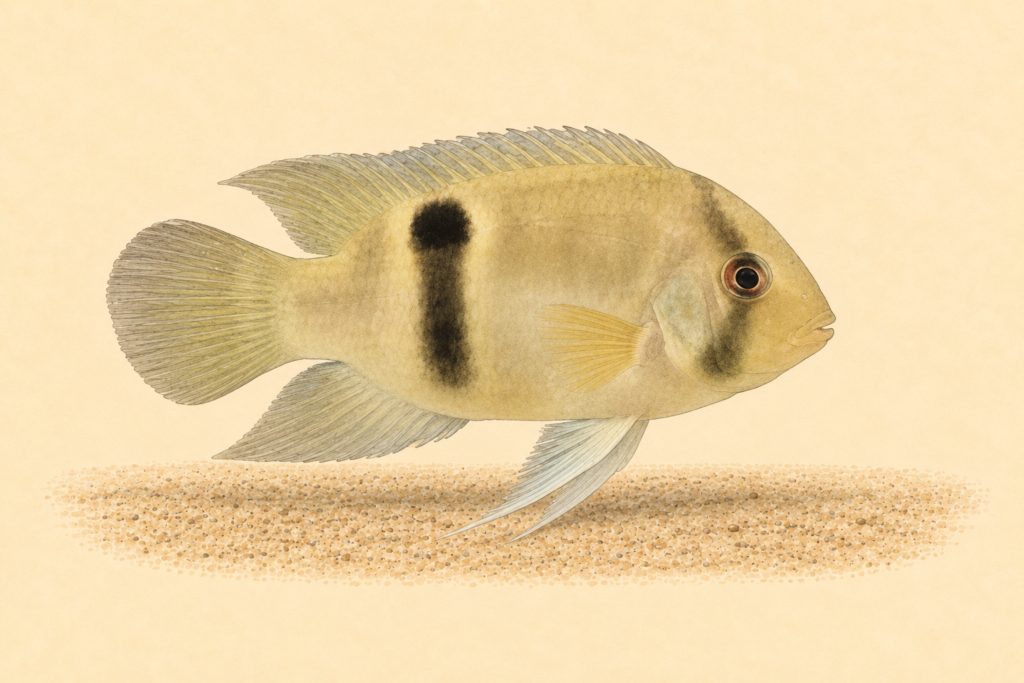
The Keyhole Cichlid possesses a compact, somewhat oval body that is laterally compressed, typical of many South American dwarf and medium-sized cichlids. Its base colouration ranges from creamy beige to pale olive or warm yellow-brown, and the body is often suffused with subtle pastel tones that shift depending on the fish’s mood, environment, and breeding condition. When settled and comfortable, well-kept specimens display a warm, golden hue that is quietly attractive without being garish.
The fish’s most distinguishing feature is the dark, keyhole-shaped blotch situated on the upper flank, roughly midway along the body. This marking typically consists of a rounded spot with a narrow stripe extending downward, resembling a traditional keyhole when viewed from the side. In addition to this signature marking, a dark stripe often runs through the eye from the top of the head, serving as camouflage in the wild. Depending on the fish’s emotional state, additional faint vertical bars may appear across the body. When stressed or frightened, the entire body can darken dramatically, sometimes becoming almost uniformly dark brown or charcoal, which can alarm novice keepers who mistake this colour change for illness.
The fins are generally translucent to pale yellow, with the dorsal fin bearing a modest extension in mature males. Sexual dimorphism is present but easy to overlook when fish are young; males grow considerably larger than females and develop extended dorsal and anal fins as they mature. However, reliable sexing outside of breeding condition is notoriously difficult, and many aquarists choose to purchase a small group and allow pairs to form naturally.
Natural Habitat
Cleithracara maronii inhabits slow-moving streams, tributaries, and still backwaters in the coastal river drainages of the Guiana Shield region, including the Maroni River (which gives the species its specific epithet), the Suriname River, and various waterways in Guyana. It has also been recorded in parts of the lower Orinoco drainage in Venezuela and on the island of Trinidad, although populations there may have been introduced.
In its native range, the Keyhole Cichlid is typically found in shallow, heavily vegetated areas with plenty of submerged root structures, fallen branches, and leaf litter. The water is generally soft and slightly acidic, often stained a tea-brown colour by tannins leaching from decomposing organic matter. Substrates tend to be sandy or composed of fine gravel mixed with detritus. These environments are characteristically dimly lit due to overhanging riparian vegetation and the tannin-stained water column, and they provide an abundance of hiding places amongst roots and submerged wood.
Understanding this natural habitat is key to successful captive care. The Keyhole Cichlid is a species that feels most at home when provided with subdued lighting, plenty of shelter, and soft, slightly acidic water. Replicating these conditions in the aquarium encourages natural behaviour, reduces stress, and allows the fish to display its best colouration.
Tank Size and Setup
A single pair of Keyhole Cichlids can be comfortably housed in an aquarium of at least 150 litres, though a larger tank of 200 litres or more is preferable, particularly if you intend to keep them in a community setting with other species. If you wish to maintain a small group to allow natural pair formation, a tank of 250 litres or more is recommended to provide each fish with adequate personal space and reduce low-level social tension.
The aquascape should draw inspiration from the species’ natural habitat. A substrate of fine sand or smooth, rounded gravel works well and allows the fish to engage in natural foraging behaviour without risk of injury. Driftwood and bogwood should feature prominently, as these not only provide essential hiding spots but also release tannins into the water that mimic the blackwater conditions the species encounters in the wild. The addition of dried Indian almond leaves (Terminalia catappa) or oak leaves to the substrate further enhances the natural aesthetic and contributes beneficial tannins and microfauna.
Dense planting is highly recommended. Hardy species such as Java Fern, Anubias, Vallisneria, and Amazon Sword plants all work well in a Keyhole Cichlid tank. Unlike many cichlids, Cleithracara maronii is generally respectful of live plants and rarely uproots or damages them, making planted aquascapes a viable and attractive option. Floating plants such as Amazon Frogbit or Water Lettuce can also be used to diffuse overhead lighting, which helps the fish feel more secure and reduces stress-related colour changes.
Provide multiple hiding spots using caves formed from stacked rocks, coconut shell halves, or purpose-built cichlid caves. These retreats are essential for a species that tends towards shyness, especially during the acclimatisation period. A well-decorated tank with broken sightlines and plenty of cover will result in a more confident fish that spends more time in the open, which may seem counterintuitive but is a well-established principle in cichlid husbandry.
Water Parameters
The Keyhole Cichlid is a reasonably adaptable species that can tolerate a range of water conditions, though it thrives best in soft, slightly acidic to neutral water that reflects its natural habitat. Stability is more important than hitting exact numbers, so aim to maintain consistent parameters through regular water changes and good filtration rather than chasing a precise target.
| Temperature | 22–28 °C |
| pH | 5.5–7.5 |
| General hardness (GH) | 2–12 dGH |
| Ammonia | 0 ppm |
| Nitrite | 0 ppm |
| Nitrate | Below 20 ppm |
Weekly water changes of 20–30% are advisable to maintain excellent water quality and keep nitrate levels low. When performing water changes, ensure that the replacement water is closely matched in temperature and chemistry to avoid shocking the fish. The use of a quality dechlorinator is, of course, essential if your water supply is treated with chlorine or chloramine.
If your local tap water is moderately hard or alkaline, the use of reverse osmosis (RO) water blended with tap water can help achieve the softer, more acidic conditions that this species prefers. However, many aquarists report keeping Keyhole Cichlids successfully in water with a pH of up to 7.5 and moderate hardness, so this step is not always strictly necessary, particularly for general maintenance as opposed to breeding.
Filtration and Equipment
The Keyhole Cichlid does not have demanding filtration requirements, but good water quality is essential for long-term health. A canister filter or a high-quality hang-on-back filter rated for the volume of your aquarium is ideal. The filter should provide gentle to moderate flow, as this species originates from slow-moving or still waters and can become stressed in tanks with excessively strong currents. If your filter produces a strong outflow, consider using a spray bar or lily pipe to diffuse the water movement across the surface.
Biological filtration is the primary concern, so ensure your filter contains adequate bio-media to support a healthy colony of nitrifying bacteria. Mechanical filtration through sponges or filter floss will handle particulate matter, while chemical filtration with activated carbon can be used optionally to maintain water clarity, though it will remove beneficial tannins if you are aiming for a blackwater setup.
A reliable heater is necessary to maintain the tropical temperatures this species requires. Choose a heater rated appropriately for your tank volume and consider using a separate thermometer to verify the heater’s accuracy. Lighting should be moderate to subdued; overly bright illumination can cause the fish to remain hidden or display washed-out, stressed colouration. LED units with adjustable intensity or a dimming function are particularly useful, and the presence of floating plants can further soften the light reaching the lower levels of the tank.
An air stone or secondary source of surface agitation can be beneficial for gas exchange, particularly in warmer tanks where dissolved oxygen levels may drop. However, this is not strictly necessary if your filter already provides adequate surface movement.
Diet and Feeding
Cleithracara maronii is an omnivore with a preference for protein-rich foods, and it is generally an undemanding feeder that accepts a wide variety of aquarium fare. In the wild, its diet consists primarily of small invertebrates, insect larvae, crustaceans, and organic detritus, supplemented with plant matter and algae.
In captivity, a high-quality cichlid pellet or granule should form the staple of the diet. Choose a product specifically formulated for South American cichlids, as these tend to have an appropriate protein-to-fibre ratio. Supplement this base diet regularly with frozen or live foods such as bloodworm, brine shrimp, daphnia, and mosquito larvae. These protein-rich treats not only promote excellent health and vibrant colouration but also encourage natural foraging behaviour and can serve as conditioning foods when preparing a pair for breeding.
Vegetable matter should also be offered periodically. Blanched spinach, courgette medallions, and shelled peas are all readily accepted and provide essential fibre and micronutrients. Spirulina-based flakes or wafers can serve as a convenient alternative if preparing fresh vegetables is impractical.
Feed adult Keyhole Cichlids once or twice daily, offering only as much food as can be consumed within two to three minutes per feeding. This species can be somewhat timid at feeding time, especially in a community tank with more boisterous species, so take care to ensure that food reaches the Keyhole Cichlids and is not monopolised by more assertive tank mates. Sinking pellets and foods delivered near their preferred hiding spots can help in this regard.
Behaviour and Temperament
The Keyhole Cichlid is widely regarded as one of the most peaceful cichlids in the hobby, and this reputation is well deserved. It is a gentle, non-aggressive species that rarely bothers other fish, even during breeding. This makes it an exceptional choice for community aquariums, but it also means that the Keyhole Cichlid can be easily bullied or outcompeted by more assertive species, a factor that must be considered when selecting tank mates.
In terms of social behaviour, Keyhole Cichlids are loosely gregarious and tend to do well when kept in pairs or small groups. They are not schooling fish, but they appear more relaxed and confident when in the company of conspecifics. Pairs often form strong bonds and can remain together for many years, displaying gentle courtship behaviours and mutual recognition that are endearing to observe.
One of the most fascinating aspects of this species is its remarkable ability to change colour rapidly in response to mood and environment. A relaxed, confident Keyhole Cichlid displays warm, even tones with a clearly defined keyhole marking. When startled, stressed, or submissive, the fish may darken dramatically within seconds, sometimes becoming almost black. Conversely, a dominant or courting individual may lighten and display intensified golden or cream tones. These colour shifts are entirely normal and serve as a useful barometer of the fish’s emotional state for observant aquarists.
The species is somewhat shy by nature, particularly when first introduced to a new environment. New arrivals may hide extensively for the first few days or even weeks, and patience is required during this acclimatisation period. Over time, as the fish becomes familiar with its surroundings and associates the aquarist with food, it will gradually become bolder and spend more time in the open. A well-planted tank with abundant cover, paradoxically, produces a more visible and confident fish than a sparsely decorated one.
Tank Mates
Choosing appropriate tank mates for the Keyhole Cichlid is largely a matter of avoiding species that are significantly larger, more aggressive, or overly boisterous. The ideal companions are other peaceful, similarly sized community fish that will not intimidate or outcompete this gentle cichlid. Fish that inhabit different zones of the water column are particularly good choices, as they reduce competition for space and resources.
Good tank mates
- Cardinal Tetra, these small, peaceful shoaling fish occupy the middle water column and create a beautiful contrast with the Keyhole Cichlid’s warm tones.
- Rummy-nose Tetra, a tightly schooling species that thrives in the same soft, acidic water conditions preferred by Keyhole Cichlids.
- Corydoras Catfish, Peaceful bottom-dwellers that complement the Keyhole Cichlid perfectly, sharing a preference for sandy substrates and gentle temperaments.
- Bristlenose Pleco, a hardy, algae-eating catfish that occupies different areas of the tank and poses no threat to the Keyhole Cichlid.
- Harlequin Rasbora, a peaceful, mid-water shoaling species that shares similar water parameter preferences and adds lively colour to the community.
- Kuhli Loach, these gentle, nocturnal bottom-dwellers are entirely non-aggressive and make excellent companions in a planted community tank.
- German Blue Ram, another peaceful South American dwarf cichlid that generally coexists well, provided the tank is large enough for each species to establish its own territory.
- Otocinclus, Tiny, non-aggressive algae eaters that stay out of the Keyhole Cichlid’s way and contribute to tank cleanliness.
- Pearl Gourami, a calm, elegant species that occupies the upper to middle water column and shares the Keyhole Cichlid’s preference for well-planted, peaceful environments.
Fish to avoid
- Oscar, far too large and predatory; an Oscar would easily bully or consume a Keyhole Cichlid.
- Jack Dempsey, a highly aggressive cichlid that would dominate and likely injure the peaceful Keyhole Cichlid.
- Convict Cichlid, Notoriously aggressive, particularly during breeding, and would cause severe stress to Keyhole Cichlids.
- Tiger Barb, a notorious fin-nipper that would harass the slow-moving, long-finned Keyhole Cichlid relentlessly.
- Red Devil Cichlid, an extremely aggressive and territorial large cichlid that is wholly incompatible with this gentle species.
- Green Terror, despite its South American origins, this species is far too aggressive and large to house with Keyhole Cichlids.
- African Rift Lake Cichlids, Require fundamentally different water chemistry and are generally far more aggressive than the Keyhole Cichlid.
- Common Pleco, while not aggressive, this species grows far too large for most community tanks and can produce excessive waste that degrades water quality.
Breeding
Breeding Keyhole Cichlids in captivity is achievable and can be a highly rewarding experience, though it requires some patience and attention to water conditions. This species is a biparental substrate spawner, meaning both parents participate in caring for the eggs and fry, a behaviour that is fascinating to observe and one of the highlights of keeping this species.
The first step towards successful breeding is obtaining a compatible pair. Because sexual dimorphism is subtle, the most reliable method is to purchase a group of six or more juveniles and raise them together, allowing pairs to form naturally as the fish mature. Once a pair has bonded for breeding, you may observe gentle courtship displays including lateral body shimmering, mutual gill flaring, and synchronised swimming.
To condition a pair for breeding, gradually raise the water temperature to the upper end of their preferred range, around 26–28 °C, and increase the frequency and proportion of live and frozen foods in their diet. Soft, slightly acidic water with a pH of around 6.0–6.5 and very low hardness often serves as a spawning trigger, and a partial water change with slightly cooler, soft water can simulate the onset of the rainy season and encourage spawning behaviour.
The female typically deposits between 100 and 400 adhesive eggs on a pre-cleaned flat surface such as a smooth rock, a piece of driftwood, or a broad leaf. The female stays close to tend the eggs directly, fanning them for oxygenation and removing any that become fungused, while the male defends the surrounding territory. The eggs hatch in approximately three to four days at 26 °C, and the resultant wrigglers are often moved by the parents to a pre-dug pit in the substrate, where they continue to develop. The fry become free-swimming after a further three to five days.
Once free-swimming, the fry can be fed infusoria or commercially available liquid fry food for the first few days, transitioning to freshly hatched brine shrimp nauplii and microworms as they grow. Both parents will shepherd and defend the fry, though in a community setting there is always a risk of predation by tank mates. For maximum fry survival, many breeders choose to move the breeding pair to a dedicated breeding tank or to raise the fry separately once they are free-swimming.
Parental care can last for several weeks, and the sight of both parents guiding a cloud of tiny fry around the aquarium is one of the most charming spectacles in the freshwater hobby. Keyhole Cichlids are notably gentle parents, rarely exhibiting the intense aggression towards tank mates that is common in other breeding cichlids.
Common Diseases
The Keyhole Cichlid is a robust species that is not particularly susceptible to any specific diseases beyond those common to freshwater tropical fish in general. However, as with all aquarium fish, maintaining excellent water quality and a balanced diet is the single most effective form of disease prevention.
Ich (white spot disease), caused by the protozoan parasite Ichthyophthirius multifiliis, is one of the most commonly encountered ailments. It presents as small white spots resembling grains of salt scattered across the body and fins, and affected fish often display flashing behaviour, rubbing against surfaces in an attempt to relieve irritation. Treatment typically involves gradually raising the water temperature to 30 °C over the course of two days and adding a suitable ich medication according to the manufacturer’s instructions.
Hole-in-the-head disease, also known as head and lateral line erosion (HLLE), can occasionally affect cichlids, including the Keyhole Cichlid. This condition manifests as pitting or erosion of the tissue around the head and sensory pores and is believed to be linked to poor water quality, nutritional deficiencies (particularly a lack of vitamins and minerals), and possibly the flagellate parasite Hexamita. Prevention centres on maintaining clean water, providing a varied and nutritious diet, and avoiding the long-term use of activated carbon, which some researchers have implicated as a contributing factor.
Bacterial infections, often secondary to stress or physical injury, can present as frayed fins, ulcers, or cloudy patches on the skin. These are typically treated with broad-spectrum antibacterial medications. Fungal infections, recognisable by cotton-wool-like growths on the body or fins, can also occur, particularly in stressed or injured fish, and respond well to antifungal treatments.
Intestinal parasites, while less visible, can cause symptoms such as weight loss, loss of appetite, and pale or stringy faeces. Quarantining new arrivals for two to four weeks before introducing them to an established community is a prudent measure to reduce the risk of introducing parasites or other pathogens to your main display tank.
FAQs
Are Keyhole Cichlids suitable for beginners?
Yes, the Keyhole Cichlid is an excellent choice for beginners who are interested in keeping cichlids. It is hardy, peaceful, and relatively undemanding in terms of water chemistry and diet. Its gentle nature makes it far more forgiving in a community setting than many other cichlid species, and its modest size means it can be kept in moderately sized aquariums. The only caveat is that it can be shy, so new keepers should provide adequate hiding places and avoid housing it with aggressive or overly boisterous tank mates.
Why does my Keyhole Cichlid keep changing colour?
Rapid colour change is completely normal behaviour for this species and is not typically a cause for concern. Keyhole Cichlids use colour change as a form of communication and emotional expression. A darkened fish is usually stressed, frightened, or submissive, while a pale or brightly coloured individual is generally relaxed, dominant, or in breeding condition. If your fish remains persistently dark, it may indicate chronic stress caused by factors such as poor water quality, inadequate hiding places, or bullying from tank mates, and the underlying cause should be investigated.
Can Keyhole Cichlids be kept in pairs or do they need a group?
Keyhole Cichlids can be kept as a single pair, and a bonded pair will often display engaging interactions and may even breed. However, if you do not already have a confirmed pair, it is advisable to purchase a group of five or six juveniles and allow them to pair off naturally. Lone individuals can be kept successfully, but they tend to be shyer and less behaviourally interesting than pairs or small groups.
Do Keyhole Cichlids dig up plants?
No, unlike many cichlid species, the Keyhole Cichlid is generally very plant-friendly. It rarely uproots or damages aquatic vegetation, making it one of the best cichlid choices for planted aquariums. Some minor substrate rearrangement may occur during breeding, when the pair may excavate small pits to move their fry, but this is typically localised and does not cause significant damage to established plants.
How can I tell the difference between male and female Keyhole Cichlids?
Sexing Keyhole Cichlids is challenging outside of breeding condition. Males grow considerably larger than females and develop extended dorsal and anal fins as they mature. Some aquarists report that males have a somewhat more angular head profile compared to the rounder profile of females. However, these differences are subtle and inconsistent, and the most reliable method of obtaining a pair remains purchasing a group and allowing natural pair formation. During spawning, the female’s ovipositor (egg-laying tube) is broader and more blunt compared to the male’s narrower, more pointed genital papilla.
Related Guides
- German Blue Ram Care Guide, another peaceful South American dwarf cichlid that makes an excellent companion or alternative to the Keyhole Cichlid.
- Bolivian Ram Care Guide, a hardy, gentle cichlid with similar care requirements and a comparable temperament to the Keyhole Cichlid.
- Corydoras Catfish Care Guide, one of the best bottom-dwelling companions for a Keyhole Cichlid community tank.
- Cardinal Tetra Care Guide, a classic South American tetra that shares the Keyhole Cichlid’s preference for soft, acidic water.
- South American Cichlid Tank Setup Guide, a comprehensive guide to creating the ideal biotope aquarium for species from this region.