Rainbow Mudskipper Care Guide — Tank Setup, Feeding and Breeding
Quick summary
The Rainbow Mudskipper is a striking but demanding amphibious fish best suited to intermediate to advanced keepers, since it needs a custom paludarium with land area, high humidity, and shallow water rather than a standard aquarium. If you can meet these specialised requirements, you’ll be rewarded with a colourful, intelligent pet that recognises its owner, though breeding is extremely difficult and not recommended for beginners.
🐠 Build a tank around this fish
In this guide:
- Introduction
- Quick Stats
- Appearance
- Natural Habitat
- Tank Size and Setup
- Water Parameters
- Filtration and Equipment
- Diet and Feeding
- Behaviour and Temperament
- Tank Mates
- Breeding
- Common Diseases
- FAQs
Introduction
The Rainbow Mudskipper, known scientifically as Periophthalmodon septemradiatus, is one of the most visually striking and behaviourally fascinating fish available to the dedicated aquarist. Unlike many of its drab-coloured mudskipper cousins, this species earns its common name through the vibrant orange, blue, and iridescent markings that adorn its dorsal fins and body, making it a genuine showpiece for those willing to meet its rather specialised requirements.
Native to the tidal mudflats, mangrove fringes, and estuarine riverbanks of Southeast Asia, the Rainbow Mudskipper is an amphibious fish that spends a considerable portion of its life out of water. This semi-terrestrial lifestyle means that keeping one is a fundamentally different experience from maintaining a conventional aquarium. Rather than a standard fish tank, keepers must provide a paludarium or mudskipper-specific setup with substantial land area, carefully managed humidity, and brackish to fresh water conditions. For this reason, the species is best suited to intermediate and advanced hobbyists who are prepared to think beyond the typical aquarium paradigm.
Despite its demanding habitat requirements, the Rainbow Mudskipper rewards its keeper with endlessly entertaining behaviour. These are intelligent, personable fish that will learn to recognise their owner, eagerly accept food from tweezers or fingers, and engage in dramatic territorial displays that rival anything seen in the reptile or amphibian world. Their bulging, periscope-like eyes, expressive body language, and remarkable athleticism, including the ability to climb rocks, glass, and even vertical surfaces, make them one of the most engaging species one can keep in captivity.
Quick Stats
| Scientific name | Periophthalmodon septemradiatus |
| Common names | Rainbow Mudskipper, Seven-rayed Mudskipper, Dwarf Rainbow Mudskipper |
| Family | Oxudercidae (formerly placed within Gobiidae) |
| Origin | Southeast Asia, Mekong Delta region of Vietnam and Cambodia, and parts of Thailand |
| Adult size | 5–8 cm |
| Lifespan | 3–5 years |
| Difficulty | Advanced |
| Breeding difficulty | Expert |
| Temperature | 24–30 °C |
| pH range | 7.0–8.5 |
| General hardness (GH) | 8–20 dGH |
| Carbonate hardness (KH) | 5–15 dKH |
| Minimum tank size | 80 litres |
| Conservation status | Least Concern (IUCN) |
Appearance
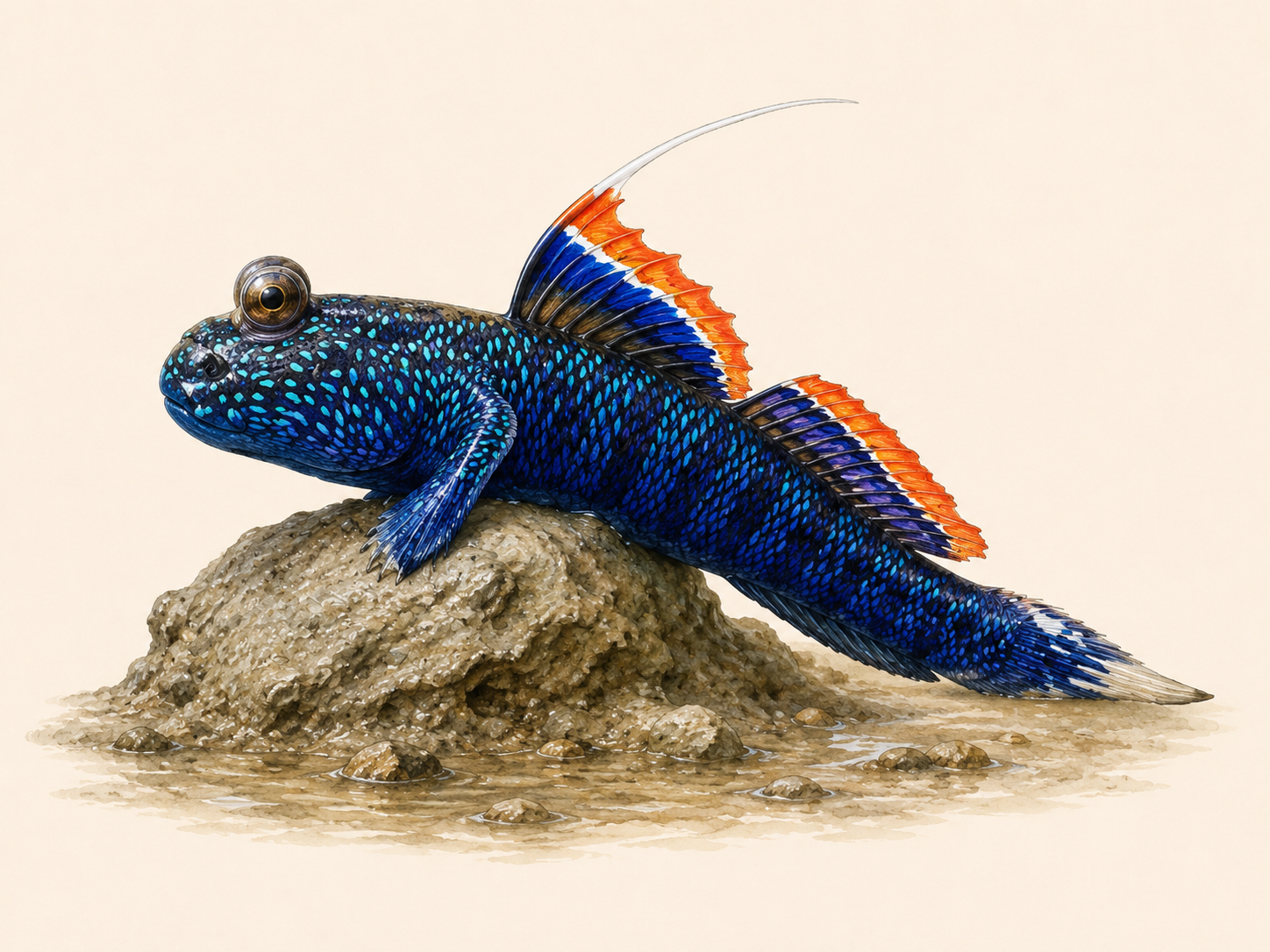
The Rainbow Mudskipper is a compact, muscular fish with the characteristic mudskipper body plan: a blunt, rounded head dominated by two large, protruding eyes set high on the skull, a robust pectoral fin assembly that functions almost like a pair of arms, and a tapering body ending in a rounded caudal fin. Adults typically reach between five and eight centimetres in total length, making this one of the smaller mudskipper species commonly kept in captivity.
What sets P. septemradiatus apart from other mudskippers is its remarkable colouration. The body base colour ranges from olive-brown to greyish-tan, often with a subtle blue or green iridescent sheen visible under good lighting. The real spectacle, however, is reserved for the dorsal fins. The first dorsal fin is tall and sail-like, especially in males, and is adorned with vivid bands of orange, electric blue, and white. The second dorsal fin continues this colour scheme, though usually with somewhat muted tones. During courtship and territorial displays, males will erect this first dorsal fin to its full extent, creating a striking flag-like effect that gives the species its common name.
The pectoral fins are thick and fleshy at the base, serving as the primary means of terrestrial locomotion. The pelvic fins are fused into a sucker-like disc on the underside of the body, which allows the fish to cling to smooth surfaces including aquarium glass. The skin is thick and somewhat leathery compared to fully aquatic fish, an adaptation that helps reduce moisture loss during time spent on land. The eyes are perhaps the most charismatic feature, large, globular, and independently mobile, they give the fish an almost comical, alert expression. Each eye can be retracted into a moist socket for protection and re-moistening, a behaviour that looks remarkably like blinking.
Sexual dimorphism is moderate. Males tend to be slightly larger, more intensely coloured, and possess a taller first dorsal fin than females. During breeding condition, males develop even brighter fin colours and may show a slight orange wash along the lower jaw and throat region. Females are generally plumper when gravid but otherwise more subdued in their patterning.
Natural Habitat
The Rainbow Mudskipper is found primarily in the Mekong Delta region of Vietnam and Cambodia, with populations also reported from parts of Thailand. Unlike many mudskipper species that inhabit strictly marine or high-salinity mangrove environments, P. septemradiatus occupies a somewhat unusual ecological niche. It is predominantly found along the muddy banks of freshwater to mildly brackish rivers, tidal creeks, and the upper reaches of estuaries where salinity levels fluctuate but remain generally low.
The habitat is characterised by soft, silty or muddy substrates exposed at low tide, bordered by dense vegetation including mangrove roots, grasses, and overhanging shrubs. The mudflats and riverbanks where these fish are found experience tidal influence, meaning water levels rise and fall regularly, and the fish have adapted to spend extended periods on exposed mud. Temperatures in these tropical lowland environments are consistently warm, typically ranging from 25 to 30 °C, with high ambient humidity year-round.
In the wild, Rainbow Mudskippers are territorial and each individual maintains a small patch of mud, often centred around a burrow that they excavate and maintain. These burrows serve as refuges from predators, shelter from temperature extremes, and nesting sites during reproduction. The burrows typically extend below the waterline, containing a pocket of air and water that allows the fish to remain moist even during extended low-tide periods. The mudskippers spend their time patrolling their territory, feeding on small invertebrates and algae from the mud surface, and engaging in ritualistic displays with neighbouring individuals.
The water chemistry in their native range tends to be neutral to slightly alkaline, with moderate hardness. While the species is often described as brackish, field observations suggest that many populations thrive in water that is essentially fresh or only very mildly brackish, particularly those found further upstream in the Mekong system. This flexibility makes the Rainbow Mudskipper somewhat more adaptable to aquarium conditions than strictly marine mudskipper species.
Tank Size and Setup
Housing Rainbow Mudskippers successfully requires a fundamental rethinking of what constitutes a fish tank. A standard, fully filled aquarium is entirely inappropriate. Instead, these fish need a paludarium, an enclosure that provides both water and a substantial area of exposed land. The minimum recommended enclosure size is 80 litres for a single specimen or a pair, though larger setups of 120 litres or more are preferable, particularly if keeping a small group. Floor space is far more important than water depth; a long, shallow tank is ideal. Many keepers find that enclosures measuring approximately 80 cm long by 40 cm deep by 40 cm tall work well.
The land-to-water ratio should be approximately 60:40 or even 70:30 in favour of land area. The water section need only be 8 to 15 cm deep. The land area should be built up using a combination of aquarium-safe silicone-sealed barriers, egg crate supports, and a substrate of fine, smooth mud or a sand and soil mixture. Avoid sharp gravel or coarse substrates, as mudskippers drag themselves across the ground and can abrade their sensitive undersides. Many successful keepers use a slope of fine playsand mixed with a small amount of aquarium-safe clay to create a gradual mud bank that transitions from water to land, mimicking the natural tidal mudflat.
Décor should include smooth rocks, driftwood, and mangrove root structures that provide climbing surfaces and visual barriers between territories. Live plants can be incorporated on the land portion, species such as Epipremnum aureum (pothos), various ferns, and mosses do well in the humid environment. Floating plants or marginal aquatic plants can be used in the water section, but the primary focus should be on creating interesting land terrain with hiding spots and elevated basking areas.
Perhaps the single most critical aspect of the setup is a tight-fitting, ventilated lid. Rainbow Mudskippers are exceptional climbers and will readily escape through even small gaps. The lid must also maintain high humidity levels within the enclosure, ideally above 75 per cent, while still allowing some air exchange to prevent stagnation. A glass or acrylic lid with small ventilation holes or mesh panels works well. Some keepers install a small computer fan to provide gentle air circulation without excessively reducing humidity.
Access to the enclosure should be easy for maintenance purposes. Front-opening terrariums or enclosures with removable lids are practical choices. The land area will need regular attention to prevent fouling, as mudskippers defecate on land and uneaten food can decompose quickly in the warm, humid environment.
Water Parameters
One of the most debated aspects of Rainbow Mudskipper care is the question of salinity. While many care guides recommend brackish conditions for all mudskipper species, P. septemradiatus is naturally found in freshwater to low-brackish habitats. Most experienced keepers maintain this species successfully in freshwater with a small addition of marine salt, a specific gravity of 1.000 to 1.005 is generally appropriate, with many thriving populations kept at the lower end of this range or even in pure freshwater. If adding salt, use a marine salt mix rather than aquarium tonic salt, as the former provides the correct balance of trace elements.
Maintaining stable water quality is essential, though the small water volume in a typical mudskipper setup can make this challenging. Regular water changes of 20 to 30 per cent weekly are recommended, and the water section should be kept clean of debris. A reliable thermometer and hydrometer (if using brackish water) should be considered essential equipment.
| Temperature | 24–30 °C |
| pH | 7.0–8.5 |
| General hardness (GH) | 8–20 dGH |
| Carbonate hardness (KH) | 5–15 dKH |
| Ammonia | 0 ppm |
| Nitrite | 0 ppm |
| Nitrate | Below 20 ppm |
Filtration and Equipment
Filtration in a mudskipper paludarium presents unique challenges due to the shallow water level and the need to minimise surface disturbance on the land portion. Small internal filters, sponge filters, or compact hang-on-back filters work well for the water section. Flow rate should be gentle, mudskippers do not appreciate strong currents in their shallow water areas. An air-driven sponge filter is often the simplest and most reliable option, providing both biological filtration and gentle water movement.
Heating the water section is typically accomplished with a small, fully submersible aquarium heater rated for the volume of water present, not the total enclosure volume. Position the heater horizontally in the deepest part of the water section to ensure it remains fully submerged at all times. Some keepers prefer to heat the entire enclosure using an overhead ceramic heat emitter or a low-wattage heat mat placed under one end of the tank, which has the advantage of warming both air and water simultaneously. Whichever method is chosen, the air temperature within the enclosure should be maintained between 25 and 30 °C, closely matching the water temperature.
Lighting serves both aesthetic and functional purposes. A standard LED aquarium light or a low-intensity plant growth light provides good visibility and supports any live plants in the setup. Mudskippers do not require UV lighting in the same way that reptiles do, though some keepers provide a low-output UVB bulb to promote natural behaviour and vitamin D synthesis. A regular photoperiod of 10 to 12 hours of light followed by darkness helps maintain a healthy circadian rhythm.
Humidity management is arguably as important as water quality. A digital hygrometer placed within the enclosure allows monitoring of humidity levels, which should remain above 75 per cent. If humidity drops too low, common in centrally heated homes during winter, a small misting system or regular manual misting with dechlorinated water can be used. The land substrate should remain damp but not waterlogged; a completely dry land area will cause stress and potentially health issues.
Diet and Feeding
Rainbow Mudskippers are primarily carnivorous, with a diet in the wild consisting of small invertebrates, worms, insect larvae, tiny crustaceans, and some algal material scraped from mud surfaces. In captivity, they prove to be enthusiastic and often greedy feeders that quickly learn to associate their keeper with food.
The staple diet should consist of small live or frozen invertebrate foods. Bloodworms, brine shrimp, daphnia, and mosquito larvae are all readily accepted. Small earthworms and whiteworms make excellent supplementary foods. Many keepers find that their mudskippers quickly learn to accept high-quality carnivore pellets or small cichlid pellets, which can form a convenient part of the diet once the fish are settled. However, a varied diet that includes live and frozen foods alongside any dry food is essential for long-term health and colour vibrancy.
Flightless fruit flies (Drosophila) and small crickets (no larger than the mudskipper’s head) make outstanding live food offerings that also stimulate natural hunting behaviour. Watching a Rainbow Mudskipper stalk and pounce on a fruit fly across the land area is one of the great pleasures of keeping this species. Small woodlice (isopods) are another excellent live food option and can even be maintained as a self-sustaining colony within the enclosure if conditions are right.
Feed once or twice daily, offering only as much food as the fish will consume within a few minutes. Remove uneaten food promptly, particularly from the land area, where decomposing food can quickly foul the environment and attract mould. Overfeeding is a common mistake with mudskippers, as their enthusiastic feeding response can tempt keepers into offering too much. A slightly lean feeding regimen is preferable to overfeeding, and one fasting day per week can be beneficial for adult specimens.
Behaviour and Temperament
The Rainbow Mudskipper is one of the most behaviourally complex fish species available in the aquarium trade. These are intelligent, curious animals with a rich repertoire of social behaviours that can keep an observer fascinated for hours. They are predominantly terrestrial, spending the majority of their active time on the land portion of their enclosure, venturing into the water primarily to moisten their skin, cool down, or escape perceived threats.
Territorial behaviour is the defining aspect of mudskipper social life. Males, in particular, are assertive defenders of their chosen patch of mud and will engage in elaborate ritualistic displays to establish dominance. These displays involve raising the vivid first dorsal fin to its maximum height, arching the body, gaping the mouth, and performing rapid press-ups on their pectoral fins. Two rival males will often face off across a territorial boundary, mirroring each other’s displays in a dramatic confrontation that rarely escalates to actual physical contact. Occasionally, however, genuine fights do occur, involving lunging, jaw-locking, and chasing that can result in fin damage or stress if the subordinate individual has no means of escape.
For this reason, keeping multiple Rainbow Mudskippers together requires careful planning. A single specimen or a male-female pair is the safest option for most setups. If keeping a small group, provide a generously sized enclosure with multiple visual barriers, hiding spots, and distinct territories to reduce conflict. Keeping two males in a small enclosure is a recipe for persistent aggression and is best avoided.
Towards their keeper, Rainbow Mudskippers are remarkably personable. They quickly learn to recognise the person who feeds them and will often approach the front of the enclosure in anticipation. Many individuals will accept food from tweezers or even directly from fingers. They are alert, reactive fish that startle easily at sudden movements or vibrations but settle quickly in a calm household. Their large, mobile eyes give them excellent vision both in and out of water, and they are adept at tracking movement around the room.
Activity patterns tend to peak during the morning and late afternoon, with a quieter period during the midday hours. At night, mudskippers typically retreat to a favoured resting spot, often a crevice between rocks, a hollow in the substrate, or even a position clinging to the glass near the waterline, and become largely inactive.
Tank Mates
Selecting tank mates for Rainbow Mudskippers is a nuanced exercise. The semi-terrestrial nature of the enclosure, the shallow water section, and the mudskippers’ territorial behaviour all limit the pool of suitable companions considerably. In many cases, a species-only setup is the simplest and most successful approach. However, there are options for those who wish to create a more diverse paludarium community.
Good tank mates
- Red Claw Crab (Perisesarma bidens), Occupies similar brackish paludarium conditions and generally ignores mudskippers provided there is ample space and hiding spots for both species.
- Nerite Snail (Neritina spp.), Hardy, peaceful algae grazers that tolerate brackish conditions and are generally too large and well-armoured to be bothered by mudskippers.
- Amano Shrimp (Caridina multidentata), Can coexist in the water section of a freshwater mudskipper setup, though very small individuals may occasionally be predated upon.
- Bumblebee Goby (Brachygobius spp.), Small, peaceful bottom-dwelling gobies that thrive in brackish to freshwater conditions and occupy the water section without competing for land space.
- Indian Mudskipper (Periophthalmus novemradiatus), a similarly sized mudskipper species that can sometimes be housed alongside P. septemradiatus in a large enclosure with ample territory for both.
- Ghost Shrimp (Palaemonetes paludosus), Inexpensive, hardy shrimp that can inhabit the water section and serve as both clean-up crew and occasional live food.
- Wrestling Halfbeak (Dermogenys pusilla), a surface-dwelling live-bearer that tolerates mildly brackish water and occupies a completely different ecological niche within the water section.
- Fiddler Crab (Uca spp.), Semi-terrestrial crabs that share similar habitat preferences and can coexist in a sufficiently large paludarium with distinct territories.
Fish to avoid
- Neon Tetra (Paracheirodon innesi), Requires fully aquatic, soft, acidic conditions entirely incompatible with a mudskipper paludarium.
- Betta (Betta splendens), the shallow, warm water section would overheat and stress this species, and territorial conflicts on the surface are likely.
- Common Pleco (Pterygoplichthys pardalis), far too large for the shallow water section and requires fully submerged conditions at all times.
- Axolotl (Ambystoma mexicanum), Requires cold, deep, fully aquatic conditions that are fundamentally incompatible with a warm mudskipper paludarium.
- Oscar (Astronotus ocellatus), a large, aggressive cichlid that would predate on mudskippers and requires an entirely different setup.
- Goldfish (Carassius auratus), Cold-water species requiring deep water and fully aquatic conditions; incompatible in every respect.
- African Dwarf Frog (Hymenochirus boettgeri), Fully aquatic amphibians that would struggle in the shallow, warm, potentially brackish water section.
- Guppy (Poecilia reticulata), while tolerant of brackish water, the extremely shallow water section provides inadequate swimming space and mudskippers may harass them.
Breeding
Breeding the Rainbow Mudskipper in captivity is exceptionally challenging and has been accomplished only rarely by dedicated hobbyists and researchers. The complex reproductive behaviour of mudskippers, which involves burrow construction, air-filled nest chambers, and extended parental care, is difficult to replicate convincingly in a home aquarium setting.
In the wild, the male excavates and maintains a deep burrow in the mud that extends below the waterline. At the bottom of this burrow is an air-filled chamber where the female deposits her eggs on the chamber walls. The male guards the burrow and periodically replenishes the air supply within the nesting chamber by carrying gulps of air from the surface, a behaviour unique to mudskippers and a remarkable adaptation to their amphibious lifestyle. The eggs develop in this humid, air-filled pocket, and the larvae emerge into the water upon hatching.
To attempt breeding in captivity, keepers must provide a deep substrate layer, at least 15 to 20 cm of fine, cohesive mud or sand-clay mix, that allows the male to excavate a proper burrow. The enclosure must be large enough for the male to establish a clear territory, and a compatible pair must be identified and introduced carefully. Conditioning with high-quality live foods over several weeks can help bring the pair into breeding condition.
Spawning triggers in the wild are likely related to tidal cycles, lunar phases, and seasonal rainfall patterns. Simulating these in captivity through gradual water-level changes and temperature fluctuations may help stimulate breeding behaviour. If eggs are successfully laid, the greatest challenge lies in raising the tiny, pelagic larvae, which require microscopic live foods such as infusoria and newly hatched brine shrimp nauplii in their earliest stages. The transition from larval to juvenile form, including the development of terrestrial capabilities, adds a further layer of complexity. Hobbyists interested in breeding this species should be prepared for a long-term project with a significant likelihood of initial failure.
Common Diseases
Rainbow Mudskippers are generally robust animals when maintained in appropriate conditions, but their unique semi-terrestrial lifestyle exposes them to health challenges not typically encountered with fully aquatic fish. The most common health issues are related to environmental problems rather than infectious disease.
Skin desiccation is a frequent concern. If humidity within the enclosure drops too low or the land substrate dries out excessively, mudskippers can develop dry, cracked skin that is vulnerable to secondary bacterial or fungal infections. Maintaining humidity above 75 per cent and ensuring the substrate remains consistently damp prevents this issue. Affected fish will appear dull, may become lethargic, and will spend more time in the water section than usual.
Bacterial infections, often presenting as reddened areas on the skin, fin erosion, or small ulcers, can occur when water quality deteriorates or when the land area becomes fouled with decomposing food. Regular cleaning of both the water and land sections, prompt removal of uneaten food, and maintenance of good water parameters are the best preventive measures. Mild infections may respond to improved conditions alone, while more serious cases may require treatment with a broad-spectrum antibiotic such as a product containing oxytetracycline, administered through the water section.
Fungal infections, visible as white or greyish cotton-like growths on the skin or fins, can develop in response to injuries, poor water quality, or excessively cool temperatures. Maintaining warm, stable temperatures and clean conditions usually prevents these. Treatment with methylene blue or a proprietary antifungal remedy applied to the water can be effective.
Internal parasites are occasionally seen in wild-caught specimens. Signs include weight loss despite good appetite, bloating, or abnormal faeces. A course of anti-parasitic medication may be necessary, though obtaining a proper diagnosis from a veterinarian experienced with fish or exotic species is advisable before treating. Quarantining new arrivals for at least two to four weeks before introducing them to an established setup is strongly recommended.
Stress-related issues, including loss of appetite, colour fading, and excessive hiding, are common in newly acquired mudskippers or those kept in inappropriate conditions. Ensuring the enclosure provides adequate hiding spots, stable environmental conditions, and freedom from persistent harassment by tank mates is essential for long-term wellbeing.
FAQs
Can Rainbow Mudskippers be kept in a standard freshwater aquarium?
No. Rainbow Mudskippers are semi-terrestrial fish that require a paludarium setup with a substantial land area and shallow water section. A fully filled standard aquarium would prevent them from accessing the land they need and could lead to drowning, as these fish are not strong swimmers and spend the majority of their active time out of water. The enclosure must provide both a damp terrestrial area and a shallow water zone, along with high humidity and a secure lid to prevent escape.
Do Rainbow Mudskippers need brackish water?
While many mudskipper species are strongly associated with brackish or marine environments, Periophthalmodon septemradiatus is naturally found in freshwater to low-brackish habitats in the Mekong Delta region. Most keepers maintain this species successfully in freshwater or with only a very slight addition of marine salt, resulting in a specific gravity of around 1.000 to 1.005. Strictly marine conditions are not necessary and may actually be detrimental for this particular species.
How many Rainbow Mudskippers can I keep together?
This depends on the size of your enclosure. A single specimen or a male-female pair is the safest option for most setups of around 80 to 120 litres. If you wish to keep a small group, you will need a significantly larger enclosure, 200 litres or more, with ample visual barriers, multiple hiding spots, and enough land area for each individual to establish a territory. Keeping two males in a confined space will almost certainly result in persistent aggression and should be avoided. Observing the fish carefully after introduction and being prepared to separate individuals if necessary is essential.
Will my Rainbow Mudskipper escape from the tank?
Absolutely, if given the opportunity. Rainbow Mudskippers are powerful climbers capable of scaling wet glass, silicone seams, equipment cords, and any rough surface within the enclosure. A tight-fitting lid with no gaps larger than a few millimetres is essential. Even small openings around filter pipes, heater cords, or airline tubing should be sealed with foam or mesh. Escaped mudskippers can survive for some time outside their enclosure if the environment is humid, but they will rapidly dehydrate in a typical household and can be injured in falls. Prevention is always better than rescue.
How long do Rainbow Mudskippers live in captivity?
With proper care, Rainbow Mudskippers typically live for three to five years in captivity. Some keepers have reported individuals reaching the upper end of this range and occasionally beyond when maintained in well-designed enclosures with stable conditions and a varied diet. Longevity is closely linked to the quality of husbandry, fish kept in suboptimal conditions with poor water quality, inadequate humidity, or an improper diet are unlikely to reach their full potential lifespan.
Related Guides
- Indian Mudskipper (Periophthalmus novemradiatus) Care Guide, a closely related and similarly sized mudskipper species with overlapping care requirements, useful for comparison and community planning.
- Paludarium Setup Guide, a comprehensive overview of how to build and maintain the type of semi-terrestrial enclosure essential for keeping mudskippers successfully.
- Brackish Water Aquarium Guide, Covers the fundamentals of managing water salinity, choosing appropriate salt mixes, and selecting compatible species for brackish setups.
- Fiddler Crab (Uca spp.) Care Guide, another popular semi-terrestrial species often kept in similar paludarium conditions and sometimes housed alongside mudskippers.
- Bumblebee Goby (Brachygobius spp.) Care Guide, a small, peaceful goby suited to brackish conditions that can potentially share the water section of a mudskipper paludarium.