Red Lizard Whiptail Catfish Care Guide – Tank Setup, Feeding and Breeding
Quick summary
The Red Lizard Whiptail Catfish is an easy-to-keep, peaceful bottom dweller well suited to community and planted tanks of 80 litres or more, provided it has a fine sand substrate, plenty of driftwood, and clean, stable water. It’s a great fit for beginners wanting a striking, low-aggression catfish, though breeding requires moderate effort and specific setups like spawning tubes.
🐠 Build a tank around this fish
In this guide:
- Introduction
- Quick Stats
- Appearance
- Natural Habitat
- Tank Size and Setup
- Water Parameters
- Filtration and Equipment
- Diet and Feeding
- Behaviour and Temperament
- Tank Mates
- Breeding
- Common Diseases
- FAQs
Introduction
The Red Lizard Whiptail Catfish is one of the most visually striking members of the whiptail catfish group available in the freshwater aquarium hobby. Traded under the L-number designation L010a, this slender, rust-to-brick-red loricariid has become increasingly popular among aquarists who appreciate unusual bottom-dwellers that combine vivid colouration with peaceful temperament and manageable care requirements. Unlike many of its muted, brown-and-grey relatives, the Red Lizard Whiptail stands out immediately in a planted or naturalistic aquarium, its warm tones contrasting beautifully against driftwood, sandy substrates, and green foliage.
The taxonomic status of this fish is genuinely unresolved. It is generally placed within the genus Rineloricaria, but it has never been formally described as a distinct wild species with a valid binomial name. The red colouration is widely believed to be the product of selective breeding rather than a trait found consistently in wild populations, though some hobbyists and exporters have claimed wild-caught specimens from South American river systems. Whether L010a represents a selectively bred colour morph of an existing Rineloricaria species, a naturally occurring variant, or even a hybrid remains a matter of debate among ichthyologists and experienced hobbyists alike. For the purposes of this guide, the fish is referred to as Rineloricaria sp. L010a, acknowledging that a confirmed Latin binomial does not currently exist for this form.
Despite the taxonomic uncertainty, the care requirements for the Red Lizard Whiptail are well understood, as they align closely with those of other Rineloricaria species that have been kept and bred in aquaria for decades. These are peaceful, nocturnal-to-crepuscular catfish that spend much of their time resting on flat surfaces, tucked against driftwood, or slowly grazing along the substrate. They are well suited to community aquaria, planted tanks, and dedicated biotope setups, and they can be bred in captivity with relative ease once a compatible pair is established. This guide covers everything you need to know to keep and breed Red Lizard Whiptail Catfish successfully in a home aquarium.
Quick Stats
| Scientific name | Rineloricaria sp. L010a (undescribed; taxonomy unresolved) |
| Common names | Red Lizard Whiptail Catfish, Red Lizard Catfish, Red Whiptail Catfish, L010a |
| Family | Loricariidae |
| Origin | South America (precise wild origin uncertain; most specimens are captive-bred) |
| Adult size | 10-12 cm (4-5 inches) |
| Lifespan | 5-8 years |
| Difficulty | Easy |
| Breeding difficulty | Moderate |
| Temperature | 24-28 °C |
| pH range | 6.0-7.5 |
| General hardness (GH) | 2-15 dGH |
| Carbonate hardness (KH) | 2-10 dKH |
| Minimum tank size | 80 litres |
| Conservation status | Not Evaluated |
Appearance
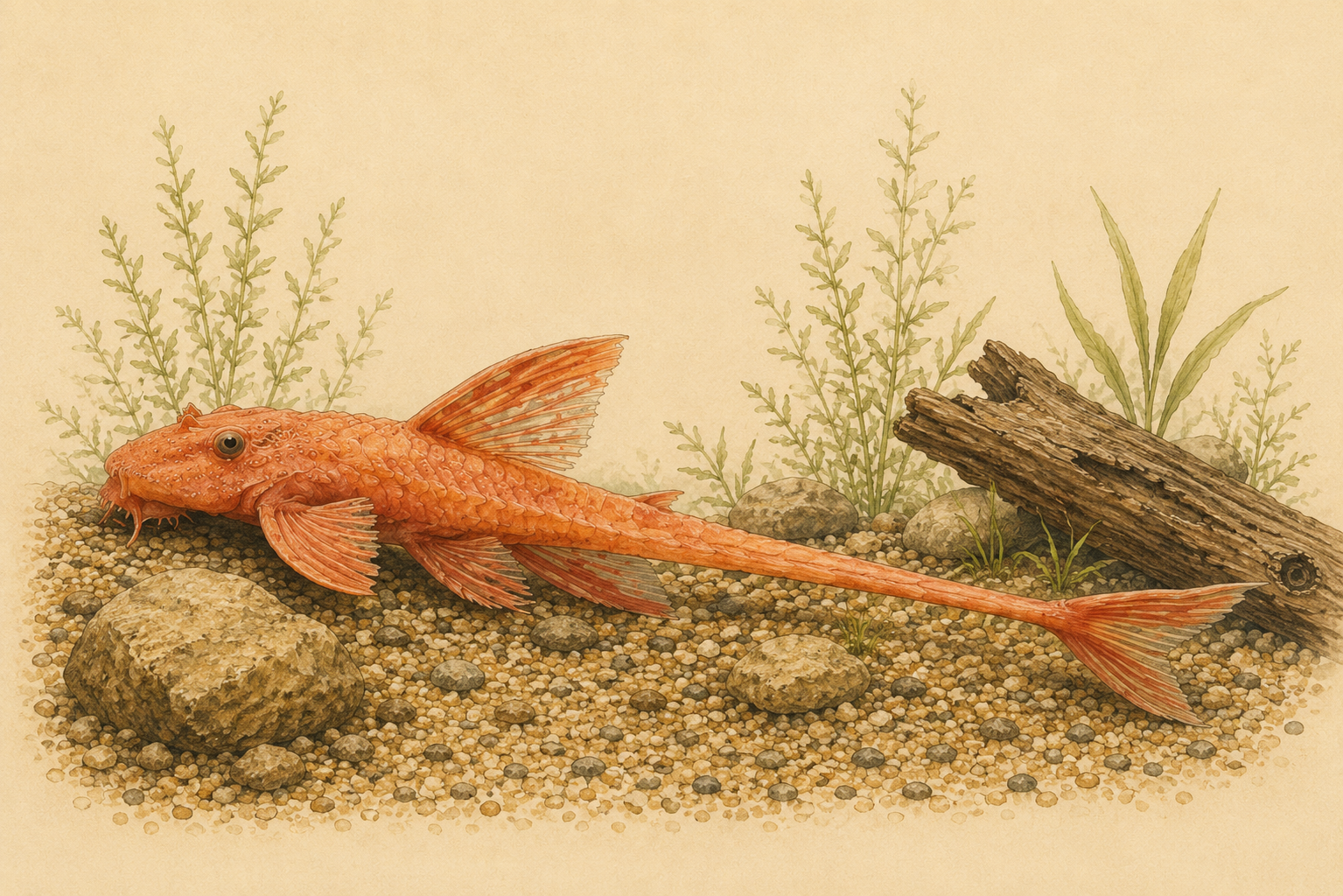
The Red Lizard Whiptail Catfish possesses the classic elongated, dorsoventrally flattened body plan typical of the genus Rineloricaria. The body is slender and somewhat rigid, covered in rows of bony scutes – the armoured plates characteristic of loricariid catfish – that give the fish a slightly rough, textured appearance. The head is broad and flattened, tapering into a pointed snout equipped with a small, underslung suckermouth used for rasping at surfaces and clinging to substrate, rocks, and wood. The caudal peduncle is notably long and thin, tapering to a delicate, filamentous extension that gives the whiptail group its common name.
The defining feature of L010a is, of course, its colour. The base body colour ranges from a warm orange-red to a deep brick red or rusty terracotta, depending on the individual specimen, its lineage, diet, and the conditions under which it is kept. In well-maintained aquaria with appropriate diet and water quality, the red tones can be remarkably vivid. Some specimens display a more uniform, solid colouration, while others may show subtle darker mottling or banding along the flanks and tail, reminiscent of the patterning seen in wild-type Rineloricaria species. The fins are typically translucent to semi-opaque with a reddish or orange wash, and the ventral surface is usually a paler cream or light orange.
The eyes are relatively small and positioned dorsally on the head, suited to a benthic lifestyle. Mature males develop odontodes – small, bristle-like growths – along the pectoral fin rays and sometimes on the sides of the head, particularly during breeding condition. These are less pronounced than the bristles seen in bristlenose catfish but are a reliable indicator of sex in mature specimens. Males also tend to be slightly slimmer when viewed from above, while gravid females appear noticeably broader through the midsection.
Overall, the Red Lizard Whiptail has an elegant, almost prehistoric appearance. Its combination of armoured plating, elongated body shape, and vivid red colouration makes it one of the more distinctive loricariids available to hobbyists. It is a genuinely beautiful fish that rewards close observation, particularly during the evening hours when it becomes most active.
Natural Habitat
The precise wild origin of the Red Lizard Whiptail Catfish is uncertain, and this is directly tied to its unresolved taxonomy. The vast majority of specimens in the aquarium trade are captive-bred, originating from commercial breeding facilities in Southeast Asia, Eastern Europe, and South America. If wild populations of this particular colour form exist, they have not been conclusively documented in the scientific literature as of the time of writing.
However, the genus Rineloricaria as a whole is widely distributed across South America, with species found in river systems in Brazil, Argentina, Paraguay, Uruguay, Colombia, and Venezuela. These catfish typically inhabit slow-to-moderately flowing rivers, streams, and tributaries with sandy or fine-gravel substrates. They are strongly associated with submerged leaf litter, fallen branches, driftwood, and marginal vegetation, where they find shelter during daylight hours and forage for food at dusk and dawn.
The waters in which Rineloricaria species are found are generally soft to moderately hard, slightly acidic to neutral, and well-oxygenated. Many habitats feature tannin-stained water from decomposing plant matter, giving the water a characteristic amber or tea-brown hue. The substrate is typically composed of fine sand, sometimes mixed with clay or silt, and the riverbed is often littered with decaying leaves and organic debris. Understanding these natural conditions is important for replicating a suitable captive environment, even for a form that may itself be a product of selective breeding rather than wild collection.
In the wild, Rineloricaria species are primarily detritivores and aufwuchs grazers, feeding on biofilm, algae, decomposing plant matter, and small invertebrates found within the substrate and on submerged surfaces. Their flattened body shape and suckermouth are perfectly adapted to life on the bottom, allowing them to cling to surfaces in flowing water and to wedge themselves into narrow crevices among roots and wood for protection from predators.
Tank Size and Setup
A single Red Lizard Whiptail Catfish or a pair can be comfortably housed in a tank of at least 80 litres. For a small group of three to five individuals, a tank of 120 litres or more is advisable, particularly if you intend to keep them alongside other community species. Because these are bottom-dwelling fish, the footprint of the tank – specifically the length and width of the base – is more important than overall height. A longer, shallower tank provides more usable floor space than a tall, narrow one.
Substrate choice is critically important for whiptail catfish. Fine, smooth sand is the ideal substrate, as these fish spend virtually all of their time in direct contact with the bottom. Coarse or sharp-edged gravel can damage their delicate ventral surfaces and barbels, potentially leading to abrasion, infection, and stress. A layer of fine play sand or aquarium-grade silica sand in a natural beige or brown tone works excellently and also provides a pleasing contrast to the fish’s red colouration.
The tank should be furnished with plenty of driftwood, which serves multiple purposes: it provides shelter, contributes to the slightly acidic water conditions these fish prefer, and its surfaces become colonised with biofilm that the catfish will graze on. Pieces of bogwood, mopani wood, or Malaysian driftwood arranged to create caves, overhangs, and narrow crevices will be readily used. Smooth river stones and slate can also be added to provide additional resting surfaces and hiding spots.
For breeding purposes, narrow tubes or pipes are highly recommended. PVC pipes, ceramic tubes, or bamboo sections with an internal diameter of approximately 15-25 mm work well, as the male will claim and guard a tube in which the female deposits her eggs. Having several such tubes available reduces competition and increases the likelihood of successful spawning.
Live plants are not essential but are highly beneficial. Species such as Anubias, Java fern, and Cryptocoryne are excellent choices, as they tolerate the same water conditions and provide additional cover and surface area for biofilm growth. Floating plants can be used to diffuse light, which will encourage the fish to be more active and visible during the day. A scattering of dried Indian almond leaves or oak leaves on the substrate adds a naturalistic touch, releases beneficial tannins, and provides additional grazing surfaces as the leaves decompose.
Lighting should be moderate. Red Lizard Whiptails are not fond of intense, bright lighting and will tend to remain hidden if the tank is too brightly lit. Subdued lighting, or lighting softened by floating plants, will result in more natural behaviour and greater visibility of the fish during waking hours.
Water Parameters
| Temperature | 24-28 °C |
| pH | 6.0-7.5 |
| General hardness (GH) | 2-15 dGH |
| Carbonate hardness (KH) | 2-10 dKH |
| Ammonia | 0 ppm |
| Nitrite | 0 ppm |
| Nitrate | Below 20 ppm |
The Red Lizard Whiptail Catfish is reasonably adaptable when it comes to water chemistry, tolerating a fairly broad range of pH and hardness values. That said, it thrives best in soft to moderately hard, slightly acidic to neutral water. A pH between 6.5 and 7.0 represents the sweet spot for most specimens, though they will generally do well anywhere within the broader range listed above. Very hard, alkaline water should be avoided, as it is not reflective of the conditions experienced by Rineloricaria species in the wild.
Water quality is paramount. Like many loricariid catfish, whiptails are sensitive to elevated levels of dissolved organic waste. Ammonia and nitrite must be maintained at zero at all times, and nitrate levels should be kept as low as practically possible – ideally below 20 ppm. Regular partial water changes of 25-30% on a weekly basis are strongly recommended to maintain these conditions. In heavily stocked community tanks, more frequent water changes may be necessary.
Temperature stability is also important. While the fish tolerates a range of 24-28 °C, sudden fluctuations should be avoided. A reliable aquarium heater with an accurate thermostat is essential. A temperature of around 25-26 °C is a good target for general maintenance, with a slight increase to 27-28 °C sometimes used to encourage breeding behaviour.
Adequate oxygenation is beneficial, as Rineloricaria species in the wild are found in well-oxygenated waters. Ensuring good surface agitation through the filter outlet or the addition of an airstone will help maintain dissolved oxygen levels, particularly in warmer water where oxygen solubility is reduced.
Filtration and Equipment
A good-quality filter that provides both efficient mechanical and biological filtration is essential. External canister filters are an excellent choice for tanks of 80 litres and above, as they offer ample media capacity and can be configured to provide gentle-to-moderate flow across the tank floor. Internal power filters and hang-on-back filters can also work well for smaller setups, provided they are appropriately rated for the tank volume.
Flow rate is worth considering carefully. While Rineloricaria species are adapted to cope with some current, the Red Lizard Whiptail does not require strong flow and may find excessively turbulent conditions stressful. A gentle-to-moderate current that creates some movement across the substrate without buffeting the fish around is ideal. Positioning the filter outlet to create a broad, gentle flow rather than a narrow, forceful jet is advisable. A spray bar attachment can help distribute flow evenly.
An aquarium heater rated for the tank’s volume is necessary to maintain a stable temperature within the recommended range. Submersible heaters with adjustable thermostats are the most practical option. In larger tanks or in cooler rooms, two smaller heaters may provide more even heating and offer redundancy in case of failure.
Lighting does not need to be specialised for the catfish themselves, but if live plants are included in the setup, an LED light suitable for plant growth is recommended. A timer set to provide a consistent photoperiod of 8-10 hours per day helps establish a regular day-night cycle, which is beneficial for the fish’s natural behavioural rhythms.
An air pump with a sponge filter or airstone can be a useful addition, particularly in warmer tanks where dissolved oxygen levels may be lower. Sponge filters also serve as excellent supplementary biological filtration and provide surfaces for biofilm growth that whiptails will graze on.
Diet and Feeding
The Red Lizard Whiptail Catfish is an omnivore with a strong leaning towards vegetable matter and detritus. In the wild, Rineloricaria species feed primarily on aufwuchs – the complex community of algae, microorganisms, and organic matter that colonises submerged surfaces – supplemented with small invertebrates and decomposing plant material. In captivity, a varied diet that reflects this natural feeding ecology will keep the fish in optimal health and colour.
A high-quality sinking wafer or pellet designed for bottom-feeding catfish should form the staple of the diet. Products with a high proportion of vegetable ingredients, such as spirulina-based wafers, are particularly suitable. These should be supplemented with blanched vegetables offered two to three times per week. Courgette (zucchini) slices, cucumber, shelled peas, and spinach leaves are all readily accepted. Blanching softens the vegetables and makes them sink, allowing the catfish to rasp at them at their leisure. Remove any uneaten vegetables after 12-24 hours to prevent water quality deterioration.
Protein-rich foods should also be offered regularly, though in smaller quantities than vegetable-based fare. Frozen or live bloodworm, daphnia, brine shrimp, and tubifex worms are all excellent choices and will be eagerly consumed. These foods are particularly valuable for conditioning breeding pairs and for supporting the nutritional needs of growing fry.
Dried Indian almond leaves and other botanicals left to decompose in the tank serve as a continuous supplementary food source. As the leaves break down, they become colonised by biofilm and microorganisms that the whiptails will graze on constantly. This mimics the natural feeding behaviour seen in wild habitats and provides nutritional variety beyond prepared foods.
Feeding should ideally take place in the evening or shortly after lights-out, as these catfish are most active during crepuscular and nocturnal hours. Dropping food in while the tank lights are off (or very dim) helps ensure the whiptails get their share before more assertive daytime-feeding species consume everything. Monitor the fish’s body condition regularly; a healthy Red Lizard Whiptail should appear well-rounded but not bloated, with no visible concavity to the belly.
Behaviour and Temperament
The Red Lizard Whiptail Catfish is a genuinely peaceful and retiring species. It spends the vast majority of the day resting motionless on flat surfaces – the substrate, driftwood, broad leaves, or the aquarium glass – often in sheltered positions beneath overhangs or tucked into crevices. Its flattened body shape and tendency to press itself tightly against surfaces can make it surprisingly difficult to spot at times, despite its vivid colouration.
Activity levels increase significantly during the evening and night. As ambient light levels drop, whiptails emerge from their resting spots and begin foraging across the substrate and along tank surfaces, methodically rasping at biofilm and searching for food particles. This crepuscular-to-nocturnal activity pattern is entirely normal and should not be mistaken for lethargy or illness during daylight hours.
Intraspecific aggression is minimal. Multiple Red Lizard Whiptails can be kept together without significant conflict, though males may display mild territorial behaviour around preferred resting spots or breeding tubes. This rarely escalates beyond posturing and brief chases. Providing ample hiding spots and multiple potential breeding sites largely eliminates any issues. A group of five or more individuals often results in more natural behaviour, with the fish appearing more relaxed and spending more time in the open.
These catfish are not schooling fish in the traditional sense, but they are social to a degree and appear to benefit from the presence of conspecifics. Solitary specimens are often more reclusive than those kept in groups. They are entirely non-aggressive towards other species and will not bother fish, invertebrates, or plants. Their peaceful disposition makes them one of the most community-compatible catfish available.
Tank Mates
The Red Lizard Whiptail Catfish is an excellent community fish that coexists peacefully with a wide range of similarly tempered species. When selecting tank mates, the key considerations are to avoid large, aggressive, or highly boisterous species that might outcompete the whiptails for food or cause them stress, and to choose fish that share compatible water parameter requirements. The whiptail’s peaceful, bottom-dwelling nature means it occupies a niche that rarely conflicts with midwater and surface-dwelling community species.
Good tank mates
- Cardinal Tetra – A peaceful, small schooling fish that occupies the mid-water column and shares a preference for soft, slightly acidic water.
- Rummy-nose Tetra – Another gentle schooling tetra that thrives in similar water conditions and adds movement to the upper levels of the tank.
- Ember Tetra – A tiny, peaceful tetra whose warm orange tones complement the whiptail’s colouration beautifully in planted setups.
- Corydoras sterbai – A compatible bottom-dweller that occupies a similar ecological niche without significant competition or aggression.
- Otocinclus Catfish – A small, peaceful algae-eating catfish that coexists harmoniously and shares similar dietary preferences.
- Kuhli Loach – A docile, nocturnal bottom-dweller that makes an excellent companion in a sand-substrate setup.
- Honey Gourami – A calm, slow-moving surface-to-midwater fish that will not harass or outcompete the whiptails.
- Cherry Shrimp – Peaceful invertebrates that are entirely safe with whiptail catfish and add interest and colour to the lower levels of the tank.
- Bristlenose Pleco – A similarly peaceful loricariid that generally coexists well, provided there are sufficient hiding spots for both species.
Fish to avoid
- Oscar – A large, predatory cichlid that would view a whiptail catfish as potential prey or cause severe stress.
- Jaguar Cichlid – An aggressive, territorial predator entirely incompatible with small, peaceful bottom-dwellers.
- Red-tail Catfish – A massive predatory catfish that would easily consume a whiptail and requires a vastly larger tank.
- Tiger Barb – A nippy, boisterous species that can harass slow-moving fish and outcompete them at feeding time.
- African Cichlids (Mbuna) – Aggressive, territorial fish that require hard, alkaline water incompatible with whiptail preferences.
- Common Pleco – Grows far too large for most community tanks and may bully smaller loricariids in territorial disputes over hiding spots.
- Green Terror – A highly territorial and aggressive cichlid that would dominate and stress peaceful tank mates.
- Flowerhorn – An extremely aggressive hybrid cichlid unsuitable for any community setup with small, docile species.
Breeding
The Red Lizard Whiptail Catfish can be bred in captivity with moderate effort, and successful spawning is a realistic goal for dedicated hobbyists. The breeding behaviour follows the general pattern observed across the genus Rineloricaria, with the male playing the primary parental role in egg guarding and fry care.
Sexing adult specimens is reasonably straightforward once the fish are mature. Males develop small odontodes (bristle-like growths) along the leading rays of the pectoral fins and sometimes on the cheeks. When viewed from above, males tend to appear slimmer and more streamlined, while females carrying eggs are noticeably broader and rounder through the abdominal region. These differences become more apparent as the fish approach breeding condition.
To condition a breeding pair or group, increase the proportion of protein-rich foods in the diet for several weeks prior to a spawning attempt. Frequent water changes with slightly cooler water can help simulate the onset of the rainy season and may trigger spawning behaviour. A slight increase in temperature to 27-28 °C can also be beneficial.
Providing suitable spawning sites is essential. Males will claim narrow tubes – PVC pipes, ceramic caves, or bamboo sections – and attempt to entice females to enter and deposit eggs. The tube should be just wide enough for the fish to enter comfortably; an internal diameter of approximately 15-25 mm is usually appropriate, depending on the size of the individual fish. The snug fit is important, as the male needs to be able to press his body against the eggs to guard and fan them effectively.
When spawning occurs, the female enters the male’s chosen tube and deposits a cluster of relatively large, adhesive eggs – typically 20-50 in number, though clutch sizes can vary. The eggs are usually yellowish to orange in colour. Once the eggs are laid and fertilised, the female departs and the male assumes sole responsibility for guarding and fanning the clutch. The male will remain inside or at the entrance of the tube, using his fins to maintain water flow over the eggs and removing any that become fungused.
Incubation takes approximately 7-10 days at typical breeding temperatures, after which the fry hatch. Newly hatched fry are tiny but relatively well-developed, retaining a yolk sac that sustains them for the first day or two. Once the yolk sac is absorbed, the fry should be offered very fine foods such as powdered spirulina, crushed flake food, microworms, or freshly hatched baby brine shrimp (Artemia nauplii). The fry grow steadily on a varied diet and begin to develop adult colouration within the first few weeks.
Fry survival rates are generally good, provided water quality is maintained and the young fish have access to appropriate food. Rearing the fry in the breeding tank is possible if there are no predatory tank mates, though a dedicated rearing tank offers greater control over feeding and water quality.
Common Diseases
The Red Lizard Whiptail Catfish is a reasonably hardy species when kept in appropriate conditions, but like all aquarium fish, it is susceptible to certain health issues, particularly when water quality deteriorates or the fish is stressed.
Bacterial infections are among the most common problems encountered. These often manifest as reddened or eroded areas on the body, frayed fins, or lethargy. Poor water quality – particularly elevated ammonia, nitrite, or nitrate levels – is the most frequent underlying cause. Treatment involves correcting water quality issues immediately through water changes and, in more advanced cases, the use of a broad-spectrum antibacterial medication suitable for use with scaleless or armoured fish. It is important to note that many common aquarium medications containing copper or certain dyes can be harmful to loricariid catfish, so always check product suitability before dosing.
Fungal infections can affect both adult fish and eggs. On adults, fungal growth typically appears as white, cotton-like patches on the skin or fins and is often secondary to a pre-existing wound or bacterial infection. Maintaining clean water and treating with an appropriate antifungal medication is usually effective. Fungused eggs during breeding should be carefully removed by the attending male, but if fungus spreads to the entire clutch, the spawn may be lost.
Internal parasites can occasionally affect whiptails, particularly wild-caught or poorly quarantined specimens. Symptoms include weight loss despite a healthy appetite, white or stringy faeces, and a generally emaciated appearance. Treatment with an appropriate internal antiparasitic medication, administered via medicated food where possible, is the standard approach.
Stress-related issues, including loss of colour, reduced appetite, and increased hiding behaviour, are common responses to unsuitable tank conditions. Overly bright lighting, aggressive tank mates, sharp substrates, poor water quality, and inadequate hiding spaces are all potential stressors. Addressing the root cause is always more effective than treating symptoms.
Prevention is far more effective than cure. Maintaining excellent water quality through regular water changes, providing a suitable environment with fine sand substrate and ample hiding spots, feeding a varied and nutritious diet, and quarantining new additions before introducing them to an established tank will prevent the vast majority of health issues.
FAQs
Is the Red Lizard Whiptail Catfish a good algae eater?
The Red Lizard Whiptail does graze on biofilm and soft algae to some extent, but it should not be relied upon as a primary algae control solution. Its diet is more broadly omnivorous, focusing on detritus, biofilm, and small organisms rather than heavy algae growth. If you need a dedicated algae eater, species such as Otocinclus catfish or Nerite snails are more effective choices. The whiptail’s value in a tank lies in its beauty, peaceful temperament, and interesting behaviour rather than its utility as a cleaner.
Why does my Red Lizard Whiptail hide all day?
This is entirely normal behaviour. Red Lizard Whiptails are crepuscular to nocturnal, meaning they are naturally most active during the twilight hours of dawn and dusk, and during the night. Spending the day resting motionless in a sheltered spot is typical and not a sign of illness or stress. If you want to observe the fish more during the day, try reducing ambient light levels in the tank by using floating plants, dimming the aquarium light, or using a timer that includes a gradual dimming period. Keeping the fish in a group can also increase daytime confidence.
Can I keep Red Lizard Whiptails on gravel?
Fine, smooth sand is strongly recommended over gravel for this species. Whiptail catfish spend virtually all of their time resting on and moving across the substrate, and coarse or sharp-edged gravel can damage their delicate belly and barbels, leading to abrasion and potential infection. If you must use gravel, choose the smoothest, finest grade available, but sand remains the far superior option for their long-term health and comfort.
How can I tell if my Red Lizard Whiptail is male or female?
Sexing becomes possible once the fish are mature, typically at around 6-8 months of age or when they reach approximately 6-7 cm in length. Males develop small bristle-like growths called odontodes on the pectoral fin rays and sometimes along the sides of the head. When viewed from above, males are generally slimmer, while females appear broader and fuller-bodied, especially when carrying eggs. During breeding condition, these differences become more pronounced.
What is the L-number system, and why does this fish have one?
The L-number system was developed by the German aquarium magazine DATZ in the 1980s as a way to catalogue and identify loricariid catfish species that had not yet been formally described by scientists. Each new, undescribed form imported into the aquarium hobby is assigned an “L” followed by a number, allowing hobbyists and traders to refer to specific types consistently. The Red Lizard Whiptail is designated L010a, indicating that it is a variant associated with the L010 group but distinct enough to warrant a separate sub-designation. The “a” suffix reflects its specific colour form. Because this fish has never been formally described with a scientific binomial name, the L-number remains its primary identifier in the hobby.
Related Guides
- Bristlenose Pleco – Another popular loricariid catfish with similar care requirements and a peaceful temperament, ideal for comparison if you are choosing between bottom-dwelling species.
- Otocinclus Catfish – A small, gentle algae-eating catfish that makes an excellent companion species and shares similar water parameter preferences.
- Corydoras sterbai – A widely kept bottom-dwelling catfish that thrives in the same conditions and complements whiptails well in community setups.
- Royal Whiptail Catfish –