Quick Summary
The Redbreast Acara is one of the most approachable cichlids for community aquariums – peaceful, small, and strikingly colourful, it is an excellent first cichlid for fishkeepers who want cichlid personality without cichlid aggression. If you can maintain stable, slightly soft water and provide a well-planted tank of at least 80 litres, this species will reward you with fascinating behaviour and vivid red-orange colouration.
🐠 Build a tank around this species
In this guide:
- Introduction
- Quick Stats
- Appearance
- Natural Habitat
- Tank Size and Setup
- Water Parameters
- Diet and Feeding
- Behaviour and Temperament
- Tank Mates
- Breeding
Introduction
The Redbreast Acara (Laetacara dorsigera) occupies a sweet spot in the freshwater hobby that surprisingly few species manage to fill. It is undeniably a cichlid – curious, intelligent, and capable of recognising its keeper – yet it carries almost none of the territorial belligerence that makes so many cichlids unsuitable for mixed-species aquariums. For community fishkeepers who have long admired cichlid behaviour from afar but worried about aggression, fin-nipping, or the need for a dedicated species tank, the Redbreast Acara is arguably the best gateway species available.
Native to the Paraguay, Parana and upper Madeira basin systems in Argentina, Bolivia, Brazil and Paraguay, this dwarf cichlid has been available in the hobby for decades but has never achieved the mainstream popularity of species like the German Blue Ram or Apistogramma cacatuoides. This relative obscurity is undeserved. The Redbreast Acara is hardier than the Ram, less demanding about temperature, and considerably more tolerant of minor water quality fluctuations – all of which make it a more forgiving choice for less experienced keepers.
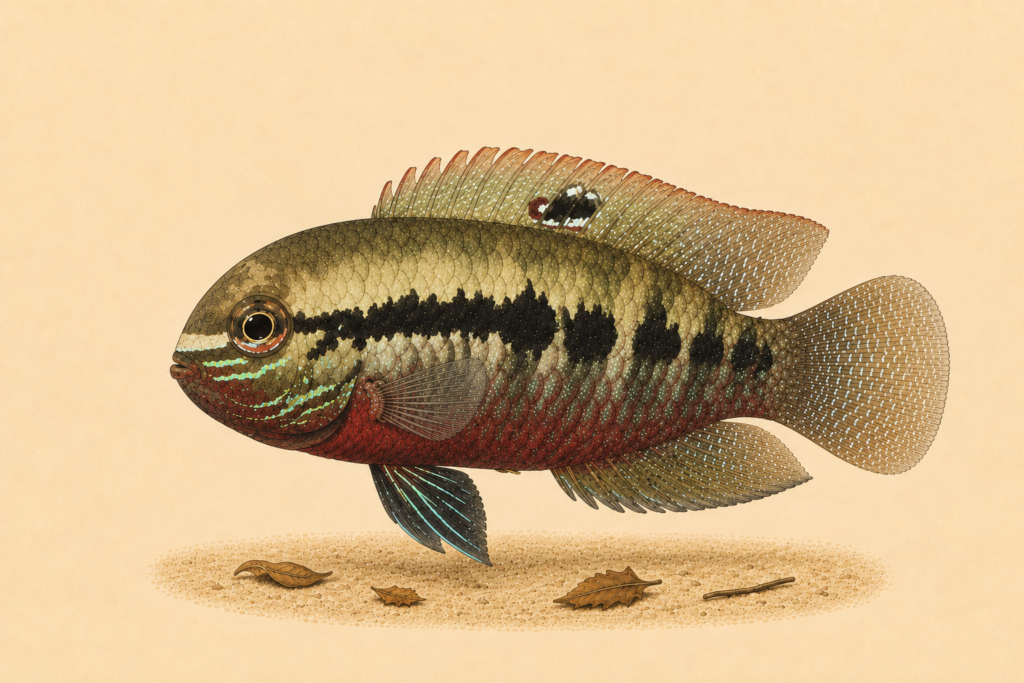
Its common name refers to the warm red to orange flush that develops across the breast and ventral area, particularly vivid in males and intensifying dramatically during breeding. The rest of the body carries subtle olive-green, grey, and iridescent blue tones that shift attractively under aquarium lighting. It is a small fish, rarely exceeding 3.7 cm in standard length, and its calm demeanour means it can be housed alongside a wide range of peaceful community species.
In this guide, we will cover everything you need to know to keep Redbreast Acaras healthy and thriving – from tank setup and water chemistry to diet, breeding, and compatible tank mates. Whether you are considering your first pair or looking to refine an existing setup, the information below should help you provide excellent care for this charming little cichlid.
Quick Stats
| Scientific name | Laetacara dorsigera |
|---|---|
| Common names | Red-breasted Acara, Redbreast Laetacara |
| Family | Cichlidae |
| Origin | Paraguay, Parana and upper Madeira basins: Argentina, Bolivia, Brazil, Paraguay |
| Adult size | 3.7 cm |
| Difficulty | Easy |
| Breeding difficulty | Moderate |
| Temperature | 22–28 °C |
| pH | 5.5–7.5 |
| GH | 2–15 dGH |
| Minimum tank size | 80 L |
| Conservation status | Least Concern (IUCN) |
Appearance
At first glance the Redbreast Acara might appear somewhat subdued compared to the electric blues and yellows of some African cichlids, but closer inspection reveals a subtle and complex beauty. The base body colour is typically olive-grey to pale brownish, overlaid with a faint iridescent sheen that can appear blue, green, or even violet depending on lighting conditions and the fish’s mood. A dark lateral stripe runs from behind the eye towards the caudal peduncle, and the species carries a distinctive dark spot on the middle of the dorsal fin, a key identifying feature. This spot can appear more or less defined depending on the fish’s emotional state, stressed or submissive individuals often display stronger barring.
The feature that gives this species its common name is the vivid red to orange-red colouration that develops across the breast, belly, and lower portions of the gill covers. In dominant males in peak condition, this flush can extend well along the ventral surface and onto the lower portions of the anal fin, creating a striking contrast against the cooler tones of the upper body. Females also display this colouration, but it tends to be less intense and less extensive. During breeding, both sexes intensify noticeably, and the red breast becomes almost luminous.
The fins are generally translucent to pale with subtle red, orange, or blue edging. The dorsal fin is relatively tall and extends the length of the back, and in males it may develop slightly elongated trailing tips. The caudal fin is rounded, which contributes to the fish’s gentle, unhurried swimming style. The eyes are large and expressive, often showing a reddish or orange iris that adds to the overall warm-toned appearance of the head region.
Sexual dimorphism is moderate. Males tend to be slightly larger, with more extended dorsal and anal fin tips and a more pronounced red breast. Females are typically a touch rounder in the body when mature and may show slightly less intense colouration outside of breeding condition. However, sexing can be challenging in juvenile or subdominant fish, and purchasing a small group of four to six individuals and allowing pairs to form naturally is often the most reliable approach.
Natural Habitat
Laetacara dorsigera (Heckel, 1840) is native to the Paraguay, Parana and upper Madeira basin systems in Argentina, Bolivia, Brazil and Paraguay. This species is found in the rio Guapore (Bolivia and western Brazil), the wider Parana drainage (southern Brazil, Paraguay and Argentina), and the rio Uruguay in Rio Grande do Sul state, southern Brazil. Its distribution is wider than many dwarf cichlids, which partly explains its adaptability in captivity – it has evolved to cope with a range of water conditions across different sub-basins and seasonal flooding patterns.
In the wild, this species inhabits slow-moving or still waters such as tributaries, backwaters, floodplain pools, and marshy areas. It is strongly associated with areas of dense aquatic vegetation, submerged roots, and leaf litter. The water in these habitats is often stained with tannins, giving it a tea-brown hue and a slightly acidic pH. The substrate is typically composed of fine sand, mud, and decomposing organic matter. Light levels tend to be low, filtered through overhanging vegetation and floating plants.
Water temperatures in these habitats can vary considerably with the seasons. This species tolerates cooler conditions than many tropical dwarf cichlids, with a tolerance down to 20C, well below what many South American dwarf cichlids can handle. This seasonal temperature range contributes to the Redbreast Acara’s reputation for hardiness – it is not as temperature-sensitive as species like the German Blue Ram, which hails from consistently warm waters.
The fish’s natural diet in these habitats consists primarily of small invertebrates, insect larvae, worms, and organic detritus sifted from the substrate. It forages along the bottom and among plant roots, picking at small prey items with the precision typical of dwarf cichlids. Understanding this natural foraging behaviour is helpful when designing a captive feeding regime.
Recreating elements of this natural environment in the aquarium – soft, slightly acidic water, a sandy substrate, plenty of plants, and some leaf litter or driftwood – is not strictly necessary for survival, but it will bring out the best colouration and encourage the most natural behaviours. Fish kept in bare or brightly lit tanks often appear washed out and spend much of their time hiding.
Tank Size and Setup
A single pair of Redbreast Acaras can be comfortably housed in a tank of 80 litres, though a larger aquarium of 120 litres or more is preferable, especially if you plan to keep them alongside other species in a community setting. If you wish to maintain a small group or multiple pairs, a tank of 150 litres or above will give each pair enough space to establish a territory without constant conflict.
The tank footprint matters more than height for this species. A standard rectangular tank with a decent base area provides ample floor space for territory establishment and foraging. Tall, narrow tanks are less suitable because Redbreast Acaras spend most of their time in the lower half of the water column.
Substrate should be fine sand or smooth gravel. These fish regularly sift through the substrate while foraging, and sharp or coarse substrates can damage their delicate gill rakers and mouths. A layer of fine river sand in a natural tan or brown shade is ideal and will look attractive alongside the decor elements described below.
Planting is highly recommended. Dense plantings of species like Vallisneria, Cryptocoryne, Echinodorus, and Java Fern provide visual barriers that help reduce stress and allow subordinate fish to escape the line of sight of more dominant individuals. Floating plants such as Amazon Frogbit or Salvinia are also beneficial, as they diffuse light and create the shaded conditions this species prefers. Redbreast Acaras are not plant destructive, so even delicate stem plants are generally safe.
Driftwood, bogwood, and smooth rocks should be arranged to create caves, overhangs, and sheltered areas. These serve as spawning sites and retreats. Pieces of driftwood that release tannins into the water are doubly useful, as the tannins replicate natural blackwater conditions, subtly lower pH, and can have mild antifungal properties. Adding a layer of dried Indian Almond leaves (Catappa leaves) to the substrate achieves a similar effect and provides an additional surface for microfauna to colonise, which fry and adults alike will graze on.
Lighting should be moderate to subdued. Intense overhead lighting without the buffering effect of floating plants can make these fish feel exposed, leading to duller colouration and more skittish behaviour. If you prefer stronger lighting for plant growth, ensure there are sufficient shaded retreats and floating plant cover to give the fish the option of dimmer areas.
Water Parameters
One of the great advantages of the Redbreast Acara is its tolerance of a relatively wide range of water conditions. Unlike many South American dwarf cichlids that demand extremely soft, acidic water, Laetacara dorsigera can adapt to moderately hard, neutral water – making it accessible to keepers whose tap water is not naturally soft. That said, the best colouration, most natural behaviour, and highest breeding success will come from keeping them in water that leans towards the softer, more acidic end of their range.
| Temperature | 22 – 28 C |
| pH | 5.5 – 7.5 |
| General hardness (GH) | 2 – 15 dGH |
| Ammonia | 0 ppm |
| Nitrite | 0 ppm |
| Nitrate | Below 20 ppm |
For general community keeping, a temperature of around 24 – 26 C is a comfortable middle ground that suits both the Redbreast Acara and a wide range of common tank mates. If you aim to breed the species, slightly warmer water (26 – 28 C) and softer, more acidic conditions (pH 6.0 – 6.5, GH 2 – 6 dGH) tend to produce the best results.
Consistency is more important than hitting a specific number. Sudden swings in pH or temperature are far more stressful to this species than a stable reading that sits slightly outside the ideal range. Perform regular partial water changes of around 20 – 30% weekly, using dechlorinated water matched as closely as possible to the tank temperature. If your tap water is very hard or alkaline, blending it with reverse osmosis (RO) water is an effective way to bring parameters into a more suitable range without resorting to chemical pH adjusters, which can cause instability.
Ammonia and nitrite must be maintained at zero at all times, as with any tropical fish. Nitrate should be kept below 20 ppm through regular water changes and sensible stocking levels. This species is not exceptionally sensitive to nitrate compared to some dwarf cichlids, but chronically elevated levels will suppress immune function and reduce lifespan.
Filtration and Equipment
Filtration for Redbreast Acaras should prioritise biological capacity and gentle flow. These fish come from slow-moving or still waters and do not appreciate strong currents. A sponge filter is an excellent choice for smaller tanks, particularly breeding setups, as it provides effective biological filtration without creating problematic water movement and poses no risk to fry. For larger community tanks, a hang-on-back filter or a small canister filter is perfectly adequate, but consider positioning the outlet so that it does not create a powerful directional current across the tank. Spray bars or lily pipes can help diffuse flow.
A heater is required to maintain stable temperatures within the recommended range. An adjustable thermostat heater rated appropriately for your tank volume is standard. Place it near the filter outlet to ensure even heat distribution. A separate thermometer – ideally a digital one – is useful for verifying that the heater is functioning correctly, as heater malfunctions are one of the more common causes of sudden fish loss in the hobby.
An air pump is optional but can be beneficial, particularly if your tank is densely planted and you observe signs of low oxygen at night (fish gasping at the surface in the early morning, for example). A gentle airstone positioned at the back of the tank adds surface agitation without creating excessive current.
Lighting should be appropriate for your plants but, as mentioned above, not so intense that it makes the fish uncomfortable. A timer set to provide 8 – 10 hours of light daily is good practice and helps maintain a consistent photoperiod, which supports natural behavioural rhythms and plant health alike.
Diet and Feeding
The Redbreast Acara is an omnivore with a natural preference for small invertebrates, insect larvae, and organic matter. In captivity, it accepts a wide range of foods readily, making feeding one of the easier aspects of its care. A varied diet will keep the fish healthy, support strong colouration, and improve breeding condition.
A high-quality, small-pellet cichlid food should form the staple of the diet. Look for products that list whole fish meal, insect meal, or similar protein sources as the primary ingredient, and avoid those padded with excessive grain or filler. Pellets that sink slowly or settle on the substrate suit this species well, as it naturally feeds in the lower water column.
Supplement the staple pellet with regular offerings of frozen or live foods. Bloodworm, daphnia, brine shrimp, mosquito larvae, and cyclops are all eagerly accepted. Live foods are particularly valuable for conditioning breeding pairs, and the hunting behaviour they stimulate is enriching and entertaining to observe. Freeze-dried foods can be used occasionally but are less nutritionally complete than frozen alternatives.
Vegetable matter should not be overlooked. Blanched spinach, courgette slices, or spirulina-based flakes offered once or twice a week provide fibre and micronutrients that support digestive health. Many keepers find that their Redbreast Acaras also graze on biofilm and algae that develops on driftwood and leaves, supplementing their diet naturally.
Feed once or twice daily, offering only as much food as can be consumed within two to three minutes. Overfeeding is a common mistake with dwarf cichlids – they have small stomachs and excess food quickly degrades water quality. A weekly fast day, where no food is offered, can be beneficial for digestive health, though this is optional rather than essential.
Behaviour and Temperament
The defining characteristic of the Redbreast Acara’s temperament is its peacefulness. By cichlid standards, this species is remarkably tolerant of tank mates and rarely initiates aggression outside of breeding. It does not tear up plants, harass dissimilar species, or stake out vast territories that exclude all other bottom-dwelling fish. This is what makes it such an effective “gateway cichlid” for community fishkeepers.
That said, it is still a cichlid, and it retains the intelligence, awareness, and pair-bonding behaviour that make cichlids so appealing. Redbreast Acaras quickly learn to recognise their keeper and will often approach the front glass at feeding time. They are curious fish that explore their environment methodically, investigating new objects or rearranged decor with evident interest.
Pairs form strong bonds and typically remain close to one another, often occupying the same territory within the tank. They communicate through subtle body language – colour changes, fin displays, and lateral presentations. Watching a bonded pair interact is one of the genuine pleasures of keeping this species. During breeding, both parents become more assertive, defending their chosen spawning site and later their eggs and fry from other tank inhabitants. This defensive behaviour is moderate compared to many cichlids – they will chase intruders away from the nest but rarely inflict injury.
Outside of breeding, Redbreast Acaras are somewhat shy, particularly when newly introduced to a tank or when kept in sparsely decorated environments. They benefit enormously from dense planting, driftwood cover, and the presence of confident, non-threatening dither fish in the upper water column. Small schooling species like tetras or pencilfish serve this role well, their relaxed swimming behaviour signalling to the acaras that the environment is safe.
Aggression between conspecifics is generally limited. A single pair is the easiest configuration to manage. If keeping a group, provide a tank large enough for multiple territories and ensure there are plenty of visual barriers. Subordinate individuals may be chased by the dominant pair, particularly during breeding, but serious injury is rare if the tank is adequately sized and furnished.
Tank Mates
The Redbreast Acara’s peaceful nature makes it compatible with a wide range of community species, provided those species are similarly non-aggressive and do not occupy the exact same niche in the tank. Ideal tank mates are calm, not overly boisterous, and neither large enough to intimidate the acaras nor small enough to be considered prey. Small to medium-sized tetras, rasboras, Corydoras catfish, and other peaceful bottom-dwellers are classic choices. Avoid large, aggressive, or highly territorial cichlids, and be cautious with fin-nipping species that might target the acara’s relatively slow swimming style.
Good tank mates
- Cardinal Tetra – A classic community companion whose soft water preferences align perfectly, and whose mid-water schooling provides excellent dither fish behaviour.
- Rummy-nose Tetra – Peaceful, schooling, and visually striking, these tetras occupy the mid to upper water column and complement the acara’s lower-level activity.
- Ember Tetra – Tiny, peaceful, and warm in colour, Ember Tetras add movement to the upper levels without posing any threat or competition.
- Corydoras sterbai – A bottom-dwelling catfish that tolerates the warmer end of the acara’s temperature range and coexists peacefully on the substrate.
- Bronze Corydoras – Hardy, sociable, and unobtrusive, a group of Bronze Corydoras makes an ideal bottom-dwelling companion.
- Kuhli Loach – Nocturnal and non-competitive, Kuhli Loaches share the lower water column without provoking territorial disputes.
- Harlequin Rasbora – Peaceful schooling fish that prefer soft, slightly acidic water, making them a natural fit for a Redbreast Acara community.
- Bristlenose Pleco – A useful algae-eating addition that generally ignores dwarf cichlids and vice versa, provided there is enough floor space.
- Honey Gourami – Gentle and similarly coloured in warm tones, the Honey Gourami occupies the upper to mid levels and rarely conflicts with bottom-dwelling cichlids.
Fish to avoid
- Convict Cichlid – Far too aggressive and territorial, especially when breeding, and will easily dominate and stress a Redbreast Acara.
- Oscar – Much too large and predatory; an Oscar would view a Redbreast Acara as potential food.
- Tiger Barb – Notorious fin-nippers that would harass the slow-moving acara relentlessly.
- Jack Dempsey – A large, aggressive New World cichlid that would quickly dominate and injure a dwarf species.
- Green Terror – Highly territorial and far too aggressive for cohabitation with any dwarf cichlid.
- Red Devil Cichlid – An extremely aggressive and large cichlid that is incompatible with virtually all community fish.
- Buenos Aires Tetra – Often nippy and boisterous, this tetra can stress and harass smaller, calmer species.
Breeding
Breeding Redbreast Acaras in captivity is achievable for moderately experienced fishkeepers and is one of the most rewarding aspects of keeping this species. Their biparental care – where both the male and female actively guard and tend to eggs and fry – is fascinating to observe and provides a window into the complex social behaviour that makes cichlids so captivating.
The first step is obtaining a compatible pair. While it is possible to purchase a known pair, the most reliable method is to raise a small group of six or more juveniles together and allow pairs to form naturally. As the fish mature, you will notice two individuals spending increasing amounts of time together, occupying the same territory, and displaying intensified colouration. Once a pair has formed, they can be left in the community tank to breed or moved to a dedicated breeding tank of at least 60 litres.
To condition the pair for spawning, increase the proportion of high-quality live and frozen foods in their diet. Bloodworm, daphnia, and brine shrimp are all excellent conditioning foods. Simultaneously, adjust water parameters towards the softer, warmer end of the species’ range – a temperature of 26 – 28 C, pH of 6.0 – 6.5, and GH of 2 – 6 dGH are ideal. A large water change with slightly cooler, softer water can sometimes trigger spawning behaviour, mimicking the onset of the rainy season in their natural habitat.
The pair will select a flat or slightly concave surface on which to spawn – a smooth rock, a piece of driftwood, or even a broad leaf such as an Anubias or Echinodorus leaf. They clean the surface meticulously before the female deposits rows of small, adhesive eggs, which the male then fertilises. Clutch sizes are typically between 100 and 300 eggs, depending on the female’s size and condition.
Both parents guard the eggs fiercely, fanning them to maintain water circulation and removing any that develop fungus. The eggs hatch in approximately 48 to 72 hours, depending on temperature. The parents then move the wriggling larvae to a pre-dug pit in the substrate, where they remain for a further three to four days until they become free-swimming.
Once the fry are free-swimming, they can be fed on infusoria, commercially available liquid fry food, or freshly hatched baby brine shrimp (Artemia nauplii). Baby brine shrimp is the gold-standard first food and will promote the fastest, healthiest growth. Feed small amounts several times daily, and keep the water impeccably clean with gentle sponge filtration and small, frequent water changes.
Parental care continues for several weeks, with both adults herding the fry, leading them to food sources, and defending them from perceived threats. It is genuinely remarkable behaviour. Eventually, the fry become independent, and the parents may begin conditioning for another spawning cycle. In a community tank, fry survival will be lower than in a dedicated breeding setup, as other fish will inevitably pick off some of the young despite the parents’ best efforts.
Common Diseases
White spots, wasting, stringy faeces, skin lesions and head erosion can have several causes and cannot be diagnosed reliably from appearance alone. Isolate the affected fish where practical and check ammonia, nitrite, nitrate, temperature and oxygenation. Seek diagnosis from an aquatic veterinarian or experienced fish health professional when illness persists or is severe. Treat only after identifying the likely cause, using a product licensed for ornamental fish and following its label exactly. Do not automatically raise the temperature, add salt, combine medicines, reduce a labelled dose or deworm fish prophylactically. Maintain strong aeration and complete the full labelled course.
FAQs
How many Redbreast Acaras can I keep together?
A single pair is the most straightforward arrangement and works well in tanks of 80 litres or more. If you want to keep a small group to allow natural pair formation, start with six juveniles in a tank of at least 150 litres. Once pairs form, monitor for aggression towards unpaired individuals and be prepared to rehome any fish that are consistently bullied.
Are Redbreast Acaras suitable for a planted tank?
Absolutely. Unlike many larger cichlids, the Redbreast Acara does not uproot or eat aquarium plants. They may occasionally dig shallow pits in the substrate, particularly around spawning time, but this rarely disturbs well-rooted plants. Dense planting actually benefits these fish by providing cover and reducing stress.
Can I keep Redbreast Acaras with shrimp?
Adult dwarf shrimp such as Cherry Shrimp may be at risk, as Redbreast Acaras will eat any invertebrate small enough to fit in their mouths. Larger shrimp species like Amano Shrimp are generally safer, though there is still some risk, especially with breeding pairs that become more predatory when feeding fry. If you value your shrimp colony, a separate tank is the safest option.
How do I tell males from females?
Males are typically slightly larger, have more extended tips on the dorsal and anal fins, and display a more vivid red-orange breast colouration. Females tend to be slightly rounder in the body when mature. However, these differences are subtle, especially in younger fish, and sexing with certainty often requires observing breeding behaviour or venting the fish.
Do Redbreast Acaras need a heater?
Yes, in most home aquarium situations a heater is necessary to maintain a stable temperature within the species’ preferred range of 22 to 28 C. While this species tolerates cooler temperatures better than many tropical cichlids, allowing the tank to fluctuate with ambient room temperature is risky, as sudden drops – particularly overnight in cooler climates – can stress the fish and increase disease susceptibility.
Related Guides
- Laetacara curviceps (Flag Acara) – A closely related species with similar care requirements, often confused with the Redbreast Acara in the trade.
- German Blue Ram – Another popular South American dwarf cichlid, though more demanding about water temperature and quality.