Quick Summary
The Scarlet Badis is a stunning micro fish best suited to experienced nano keepers who can provide live or frozen foods and a heavily planted, low-traffic tank – it is not a beginner community fish, but rewards patient aquarists with some of the most vivid colour displays in the freshwater hobby.
🐠 Build a tank around this species
In this guide:
- Introduction
- Quick Stats
- Appearance
- Natural Habitat
- Tank Size and Setup
- Water Parameters
- Diet and Feeding
- Behaviour and Temperament
- Tank Mates
- Breeding
Introduction
Dario dario, universally known as the Scarlet Badis, holds the distinction of being one of the smallest freshwater perciform fish available in the aquarium trade. Males rarely exceed 2 cm in total length, yet they pack an extraordinary amount of colour and personality into that tiny frame. First described scientifically by Hamilton in 1822 and later reclassified into the genus Dario by Kullander and Britz in 2002, this species originates from the clear, vegetation-rich tributaries of the Brahmaputra River basin in the Indian states of Assam and West Bengal.
Despite its beauty, the Scarlet Badis is not a fish you can simply drop into any community aquarium and expect to thrive. It has very specific requirements in terms of diet, social structure, and tank environment. Males are fiercely territorial toward one another, and the species as a whole tends to be a reluctant feeder, often refusing flake and pellet foods entirely. For these reasons, it is best considered a species for the dedicated hobbyist who is willing to cultivate live food cultures and maintain a carefully planted nano setup.
When those needs are met, however, few fish can rival the Scarlet Badis for sheer visual impact at such a diminutive scale. A dominant male in full breeding colour, with his flanks blazing in alternating bars of scarlet red and iridescent blue, is genuinely one of the most striking sights in the freshwater hobby. This guide covers everything you need to know to keep and breed Dario dario successfully.
Quick Stats
| Scientific name | Dario dario |
|---|---|
| Common names | Scarlet Dario, Scarlet Gem Badis |
| Family | Badidae |
| Origin | Brahmaputra River basin, Assam and West Bengal, India |
| Adult size | 2 cm |
| Lifespan | 3–5 years |
| Difficulty | Intermediate |
| Breeding difficulty | Moderate |
| Temperature | 18–26 °C |
| pH | 6.5–7.5 |
| GH | 2–10 dGH |
| KH | 1–5 dKH |
| Minimum tank size | 45 L |
| Conservation status | Data Deficient (IUCN, assessed 2010) |
Appearance
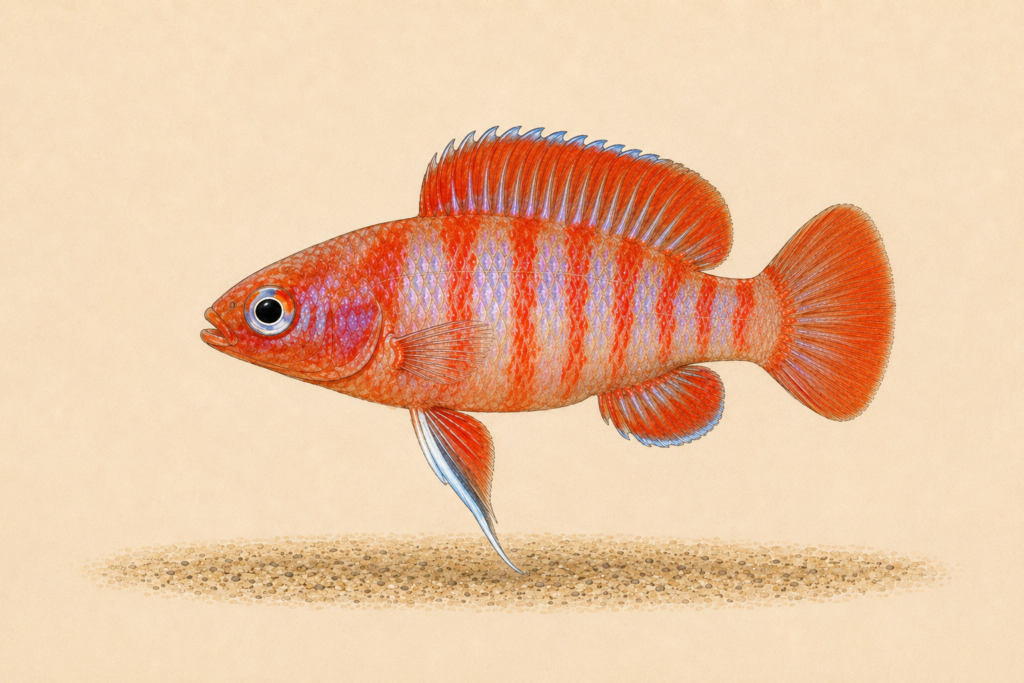
The Scarlet Badis exhibits some of the most dramatic sexual dimorphism of any freshwater aquarium fish. Males are the stars of the show, displaying seven vertical bars of deep scarlet red alternating with shimmering bands of metallic blue that extend from behind the gill cover to the caudal peduncle. The dorsal fin is tall relative to the body, edged in electric blue with red or orange infill, and is frequently flared during territorial and courtship displays. The anal and pelvic fins carry the same red and blue patterning, while the caudal fin is typically rounded and marked with faint red spotting or barring. The overall body shape is elongate and somewhat laterally compressed, resembling a miniature perch.
Females, by contrast, are considerably smaller – often barely reaching 1.3 cm – and are a uniform pale silver-grey, sometimes with the faintest hint of vertical barring. They lack almost all of the vivid colouration that makes the males so desirable. This marked difference in appearance means that females are frequently overlooked in the trade. Many shipments contain almost exclusively males, which can make obtaining a balanced group challenging.
When stressed, unwell, or subordinate, males will lose much of their colour intensity, fading to a washed-out orange or brownish hue. This colour loss is one of the most reliable early indicators of poor health or social stress. A dominant, healthy male in an appropriate environment should display rich, saturated colours almost continuously, intensifying further during feeding and courtship.
Juvenile fish of both sexes look similar to adult females, with colour development in males typically beginning at around 3-4 months of age and reaching full intensity by 6-8 months.
Natural Habitat
Dario dario is found in shallow, clear-water tributaries and marginal streams within the Brahmaputra River drainage in north-eastern India, primarily in the states of Assam and West Bengal. These habitats are characterised by moderate to gentle flow over substrates of sand, gravel, and accumulated leaf litter, with dense marginal and submerged vegetation providing cover and hunting grounds for invertebrate prey.
The water in these streams is typically soft to moderately hard and slightly acidic to neutral. Temperature varies seasonally; the region experiences a pronounced monsoon season, and water temperatures can drop considerably during the cooler months, sometimes falling below 18 C. This tolerance for cooler conditions is worth noting for the aquarist, as it means the Scarlet Badis does not necessarily require a heater in temperate climates where room temperature remains within its comfort range during summer months.
In the wild, Scarlet Badis occupy small, well-defined territories among plant roots, submerged wood, and leaf litter. Males defend tiny patches of habitat from which they court passing females. Population densities can be relatively high in suitable microhabitats, but each individual occupies a very small area. This territorial micro-distribution has important implications for how we set up their aquarium, as discussed in the section below.
The broader Brahmaputra basin supports a rich diversity of small fishes, invertebrates, and aquatic plants. Dario dario shares its habitat with various small cyprinids, loaches, and other micro-predators, and its natural diet consists almost entirely of tiny crustaceans, insect larvae, and other invertebrates small enough to fit in its minuscule mouth.
Tank Size and Setup
A single male Scarlet Badis can technically survive in a well-maintained aquarium as small as 20 litres, but a minimum of 30 litres is recommended for a small group consisting of one male and two to three females. If you wish to keep multiple males, you will need a significantly larger, heavily planted tank – a minimum of 60 litres – with clear visual barriers between territories to reduce aggression. Even then, subordinate males may lose colour and condition.
Dense planting is not optional for this species; it is essential. The Scarlet Badis relies on vegetation for territorial definition, visual cover, stress reduction, and hunting. Aim to plant at least 60-70% of the available floor space, using a mix of stem plants, mosses, and small-leaved species. Java moss (Taxiphyllum barbieri), Christmas moss, Cryptocoryne species, Anubias nana ‘Petite’, and various Bucephalandra species all work well. Floating plants such as Salvinia or Amazon frogbit are also highly beneficial, as they diffuse overhead light and provide a sense of security.
The substrate should ideally be fine sand or smooth gravel in a natural tone. Dario dario will show its best colours against a dark substrate and background. Scattered pieces of small driftwood, seed pods, and dried Indian almond leaves contribute to a naturalistic aesthetic while also releasing beneficial tannins that slightly soften the water and provide surfaces for microfauna to colonise – a useful supplementary food source.
Avoid strong water flow. While the species originates from flowing streams, the individuals themselves tend to occupy sheltered pockets among vegetation and debris rather than the main current. A gentle turnover of 4-6 times the tank volume per hour is sufficient. Position the filter outlet so it does not create a powerful jet across the tank, or use a spray bar to diffuse the flow.
Lighting should be moderate. Bright lighting is fine if attenuated by floating plants, which create the dappled, shaded conditions the fish prefers. Very bright, unshaded tanks can cause stress and colour loss.
Water Parameters
The Scarlet Badis is relatively adaptable within a range of soft to moderately hard, slightly acidic to neutral water conditions. Consistency and cleanliness are more important than hitting a precise number. Regular partial water changes of 20-30% weekly are strongly recommended, as this species is sensitive to the accumulation of dissolved organic waste.
| Temperature | 18-26 C |
| pH | 6.5-7.5 |
| General hardness (GH) | 2-10 dGH |
| Carbonate hardness (KH) | 1-5 dKH |
| Ammonia | 0 ppm |
| Nitrite | 0 ppm |
| Nitrate | Below 20 ppm |
The ideal temperature for long-term keeping is around 22-24 C. At the higher end of its range (25-26 C), metabolism increases and the fish may become more active but also age faster. At the lower end (18-20 C), activity slows and colours may become slightly muted, but the fish remain healthy. Avoid sustained temperatures above 28 C, as this can cause stress and suppress the immune system.
Ammonia and nitrite must always be at zero in a properly cycled tank. Dario dario is a small, delicate fish with a high surface-area-to-mass ratio, making it more susceptible to the toxic effects of dissolved nitrogenous waste than larger species. A fully mature biological filter and consistent maintenance routine are non-negotiable.
Filtration and Equipment
A small sponge filter is the ideal filtration choice for a Scarlet Badis tank. Sponge filters provide gentle, even water circulation without creating the strong currents that stress this species. They are also biologically efficient, harbouring large colonies of nitrifying bacteria, and their surfaces serve as grazing sites for microorganisms that the fish may pick at between meals. For tanks of 30-40 litres, a single small sponge filter rated for the tank volume is perfectly adequate.
If you prefer a hang-on-back or small internal power filter, reduce the flow rate as much as possible and use a pre-filter sponge over the intake to prevent the tiny fish from being drawn against it. Canister filters are generally overkill for nano tanks of this size, but if used on a larger Scarlet Badis community, ensure the outlet is diffused with a spray bar or lily pipe to minimise turbulence.
A heater may or may not be necessary depending on your ambient room temperature. If your home stays consistently within 20-24 C year-round, a heater is not essential. Otherwise, a small adjustable heater rated for the tank size will maintain stability. Temperature fluctuations of more than 2-3 C within a single day can stress the fish, so stability matters more than hitting a specific number.
An LED light suitable for growing live plants is recommended. A timer set for 8-10 hours of light per day will support plant growth without encouraging excessive algae. As mentioned previously, floating plants are highly beneficial for diffusing light and reducing stress.
An air pump connected to the sponge filter serves the dual purpose of driving the filter and providing surface agitation for gas exchange. Additional airstones are not required in most setups.
Diet and Feeding
Diet is the single most common area where new Scarlet Badis keepers struggle. Dario dario is a micro-predator with a strong preference for small, live prey items. Many specimens – particularly wild-caught or recently imported individuals – will flatly refuse dried foods such as flakes, micro pellets, and granules. While some tank-raised specimens can be gradually weaned onto high-quality micro pellets or crushed freeze-dried foods, you should not purchase this species unless you are prepared to provide live or frozen foods as the dietary staple.
The best foods for Scarlet Badis include:
- Live baby brine shrimp (Artemia nauplii) – easily hatched at home and eagerly accepted
- Live micro worms (Panagrellus redivivus) – an excellent staple that is simple to culture
- Live grindal worms – slightly larger than micro worms, ideal for adult specimens
- Live daphnia – a superb food that also helps maintain water quality
- Frozen baby brine shrimp – widely available and accepted by most specimens
- Frozen cyclops – small enough for even juvenile fish
- Frozen daphnia – a good alternative when live cultures are unavailable
- Vinegar eels – useful as a first food for very young fry
Feed small amounts two to three times daily rather than one large meal. The Scarlet Badis has a tiny stomach and processes food quickly. Overfeeding in a single session leads to uneaten food fouling the water, while underfeeding leads to emaciation – a common cause of death in this species. A good rule of thumb is to offer only as much as the fish will consume within 2-3 minutes per feeding session.
One of the benefits of a heavily planted, mature nano tank is the development of a self-sustaining population of microfauna – copepods, ostracods, and other tiny invertebrates that colonise moss, leaf litter, and sponge filter surfaces. These organisms provide a continuous supplementary food source between scheduled feedings and can be the difference between a fish that merely survives and one that truly thrives.
If you wish to try weaning your Scarlet Badis onto dry foods, the best approach is to mix tiny amounts of crushed high-protein micro pellets or freeze-dried daphnia in with live or frozen foods. Over several weeks, some individuals will begin to accept the dry component. However, do not rely on this working, and never withhold live or frozen food in an attempt to force acceptance of dry food – the fish is more likely to starve than capitulate.
Behaviour and Temperament
The Scarlet Badis is a fascinating fish to observe, but its behaviour is frequently misunderstood by those expecting a typical peaceful nano community species. Males are territorial and will aggressively defend a small patch of habitat from other males. Encounters between rival males involve intense colour displays, fin flaring, lateral posturing, and, if neither fish backs down, direct physical confrontation that can result in torn fins and stress-related illness.
In a small tank of 30-40 litres, it is strongly advisable to keep only a single male alongside two to three females. This arrangement allows the male to display his full behavioural repertoire – territory defence, courtship dances, colour intensification – without the stress of constant male-male conflict. If you wish to keep multiple males, a larger tank (60 litres or more) with dense planting and numerous visual barriers is essential so that each male can establish a distinct territory out of direct line-of-sight from rivals.
Females are considerably more retiring than males and spend much of their time hidden among vegetation. They lack the bold, exploratory nature of the males and may be difficult to spot in a well-planted tank. This is normal behaviour and not a cause for concern, provided the females are feeding regularly and maintaining body condition.
Toward other species, the Scarlet Badis is generally shy and non-aggressive. It poses no threat to any fish too large to fit in its tiny mouth, which essentially means everything. The greater concern is the reverse: larger, more boisterous tank mates may outcompete the Scarlet Badis for food, stress it with their activity, or even prey upon it. This is why a species-only or very carefully chosen nano community is the recommended approach.
Dario dario is a diurnal species, most active during daylight hours. Males spend their time patrolling their territory, displaying at rivals or their own reflection, and hunting small invertebrates among plant leaves and moss. They are methodical, stalk-and-pounce predators rather than open-water chasers, and it is a genuine pleasure to watch a male carefully track and strike at a baby brine shrimp.
Tank Mates
Choosing tank mates for the Scarlet Badis requires careful consideration. The overriding principle is that any companion species must be peaceful, small enough not to intimidate the Badis, slow-moving enough not to outcompete it at feeding time, and tolerant of similar water conditions. In many cases, a species-only tank is the most rewarding and least stressful option for both fish and keeper. However, if you wish to add variety, the following species have been successfully kept alongside Dario dario by experienced hobbyists.
Good tank mates
- Celestial Pearl Danio – A similarly sized, peaceful micro fish that occupies the mid-water column, leaving the lower areas to the Badis.
- Ember Tetra – A tiny, non-aggressive tetra that adds colour without competing aggressively for food.
- Chili Rasbora – One of the smallest rasboras, peaceful and unobtrusive enough to coexist well.
- Pygmy Corydoras – A diminutive bottom-dweller that occupies a different niche and poses no competitive threat.
- Otocinclus – A gentle algae grazer that ignores the Badis entirely and helps keep the tank clean.
- Amano Shrimp – Too large for the Badis to prey upon and excellent for algae and detritus control.
- Nerite Snail – A peaceful, effective algae eater that will not reproduce in freshwater.
- Phoenix Rasbora – Another tiny, calm rasbora species well suited to the same planted nano environment.
Fish to avoid
- Betta – Territorial and likely to view the colourful male Badis as a rival, leading to aggression and stress.
- Dwarf Gourami – Too large and too assertive; will dominate feeding time and may bully the Badis.
- Tiger Barb – A notorious fin nipper with a boisterous temperament completely incompatible with this shy species.
- Cherry Shrimp – While adult shrimp are generally safe, baby shrimp will be hunted and eaten, so avoid if you intend to breed the shrimp.
- Angelfish – Far too large and predatory; a Scarlet Badis would be viewed as potential food.
- Convict Cichlid – Highly aggressive and territorial, completely unsuitable for cohabitation.
- Chinese Algae Eater – Becomes aggressive and territorial with age and may harass or injure the Badis.
Breeding
Breeding the Scarlet Badis in captivity is achievable and immensely rewarding, though raising the fry requires dedication and preparation. Spawning behaviour can occur readily in a well-maintained, mature tank with appropriate conditions, but the real challenge lies in feeding the minuscule fry.
To condition a pair for breeding, feed generously with high-quality live foods – baby brine shrimp, daphnia, and micro worms – for two to three weeks. A slight increase in water temperature to around 24-25 C and a modest water change with slightly cooler water can help trigger spawning behaviour.
The male will select a spawning site, typically a sheltered spot among fine-leaved plants, moss, or beneath a broad leaf. He intensifies his colours dramatically and performs a courtship display involving fin flaring, body shimmering, and short, rapid dashes toward the female. A receptive female will approach the male’s territory and follow him to the chosen site.
Spawning occurs with the pair pressing close together as the female deposits a small number of adhesive eggs – typically 30-80 per spawning event – among plant leaves or moss filaments. The male fertilises the eggs immediately. After spawning, the male may become aggressive toward the female, driving her away from the nest site. It is advisable to have sufficient plant cover for the female to retreat safely, or to remove her to a separate tank if aggression is severe.
The male guards the eggs, fanning them with his fins to maintain water circulation and removing any that develop fungus. Eggs typically hatch within 2-3 days at 24-25 C. The fry are extraordinarily small – barely visible to the naked eye – and absorb their yolk sacs over the next 2-3 days before becoming free-swimming.
Feeding fry is the most challenging aspect of breeding this species. Newly free-swimming fry are too small to accept even freshly hatched baby brine shrimp. Initial foods must include infusoria, paramecium cultures, or vinegar eels. After 7-10 days, the fry should be large enough to take freshly hatched brine shrimp nauplii and micro worms. Growth is slow; expect fry to take 4-6 months to reach adult size and full colouration.
In a densely planted species tank, some fry may survive without intervention, feeding on naturally occurring microfauna. However, survival rates are significantly higher if the fry are raised in a dedicated rearing tank with controlled feeding and the absence of adult fish that might prey on them.
Common Diseases
The Scarlet Badis is not especially disease-prone when kept in appropriate conditions, but its small size means that illness can progress rapidly and become fatal before obvious symptoms are noticed. Prevention through excellent water quality, a varied live-food diet, and a low-stress environment is always preferable to treatment.
The most common health issue encountered with Dario dario is emaciation and wasting. This is not a disease per se but rather the result of inadequate feeding – often because the fish refuses dried foods and the keeper does not provide suitable live or frozen alternatives. An emaciated Scarlet Badis has a visibly pinched belly and a bony head profile. If caught early, a return to frequent live food feedings can reverse the condition, but advanced cases are often fatal.
Ich (white spot disease), caused by the parasite Ichthyophthirius multifiliis, can affect this species, particularly after temperature fluctuations or the introduction of new, unquarantined tank mates. The characteristic white spots are visible on the fins and body. Treatment should be approached cautiously, as this small fish is sensitive to medications. Raising the temperature gradually to 28-29 C for a short period, combined with a half-dose of a malachite green-based treatment, is a common approach. Always remove any activated carbon from the filter during treatment.
Fungal infections may appear as white or grey cottony growths on the body or fins, often secondary to a wound or abrasion sustained during territorial scuffles. Mild cases can be treated with antifungal preparations at reduced doses. Maintaining clean water and reducing sources of aggression are the best preventative measures.
Internal parasites, including intestinal worms, can be present in wild-caught specimens. Signs include weight loss despite feeding, pale or stringy faeces, and a general failure to thrive. Medicated foods containing praziquantel or levamisole may be effective, though administering them to such small, picky eaters can be difficult.
Velvet disease (Oodinium) is another parasitic condition that occasionally affects nano fish. It presents as a fine golden or rusty dust-like coating on the skin, often accompanied by clamped fins, lethargy, and rapid gill movement. Darkening the tank (the parasite is partially photosynthetic) and treating with a copper-based remedy at a reduced dose can be effective, but prevention through quarantine of new arrivals is far preferable.
FAQs
Can Scarlet Badis eat flake or pellet food?
Some captive-bred specimens can be slowly weaned onto high-quality micro pellets or crushed freeze-dried foods, but many individuals – especially wild-caught ones – will persistently refuse anything that is not alive or freshly thawed frozen food. You should not purchase this species unless you are willing and able to provide live or frozen foods such as baby brine shrimp, daphnia, micro worms, and frozen cyclops on a regular basis. Relying solely on dry foods is likely to result in emaciation and death.
How many Scarlet Badis can I keep together?
In a 30-litre tank, keep one male with two to three females. If you want multiple males, provide at least 60 litres with extremely dense planting and numerous visual barriers. Even then, subordinate males may lose colour and become stressed. A ratio of one male to two or three females is ideal regardless of tank size.
Do Scarlet Badis need a heater?
Not necessarily. Dario dario tolerates temperatures as low as 18 C and is comfortable at typical UK room temperatures during summer. However, if your home drops below 18 C in winter or experiences significant temperature swings, a small adjustable heater is advisable to maintain stability. Consistency matters more than a specific number.
Why has my Scarlet Badis lost its colour?
Colour loss in a male Scarlet Badis almost always indicates stress, illness, or social subordination. Check your water parameters for ammonia, nitrite, or nitrate spikes. Ensure the fish is eating adequately. If multiple males are present, the paler individual is likely being dominated and may need to be moved to a separate tank. Colour should return once the underlying cause is addressed.
Can I keep Scarlet Badis with shrimp?
Adult Amano shrimp and other larger shrimp species are generally safe with Scarlet Badis. However, Dario dario is a micro-predator and will actively hunt and eat baby shrimp. If you keep Cherry Shrimp or other small breeding shrimp in the same tank, expect the Badis to significantly reduce or eliminate the shrimp colony’s offspring. If maintaining a breeding shrimp colony is a priority, house them separately.
Related Guides
- Celestial Pearl Danio Care Guide – Another jewel-like nano species with similar tank requirements, and one of the best potential companions for a Scarlet Badis setup.
- Chili Rasbora Care Guide – A fellow micro fish that thrives in the same soft, acidic planted nano environments favoured by Dario dario.
- Pygmy Corydoras Care Guide – A peaceful bottom-dwelling nano species that makes an excellent tank mate in a shared micro community.
- Ember Tetra Care Guide – A hardy, colourful nano tetra suitable for the same planted setups and water conditions.
- Cherry Shrimp Care Guide – Useful reading if you are considering mixing invertebrates with your Scarlet Badis, with important caveats about predation on juveniles.