Quick summary
The Silver Distichodus is a peaceful but plant-eating African characin that grows to 20-25 cm, so it needs a 350+ litre tank, hardy plant-free tank mates, and some prior fishkeeping experience rather than suiting a first aquarium. If you can provide the space and pick sturdy companions that won’t fall victim to occasional fin-nipping, it’s a rewarding, low-fuss addition to a Congo biotope setup.
🐠 Build a tank around this species
In this guide:
- Introduction
- Quick Stats
- Appearance
- Natural Habitat
- Tank Size and Setup
- Water Parameters
- Filtration and Equipment
- Diet and Feeding
- Behaviour and Temperament
- Tank Mates
- Breeding
- Common Diseases
- FAQs
Introduction
The Silver Distichodus (Distichodus affinis) is a handsome African characin that has been gaining popularity in the freshwater aquarium hobby over recent years. Originally described by Gunther in 1873, this species hails from the Congo River basin, spanning several Central African nations including Cameroon, the Central African Republic, the Democratic Republic of Congo, and the Republic of Congo. While not as widely known as some of its larger relatives in the Distichodus genus, D. affinis offers a compelling combination of attractive colouration, manageable temperament, and suitability for African biotope aquariums that has drawn the attention of hobbyists seeking something a little different from the usual community fish fare.
As juveniles, Silver Distichodus present a sleek, silvery appearance that belies the subtle beauty they develop with maturity. Adult specimens sport bright red fins and some individuals develop a delicate pink sheen along their underside, making them genuinely eye-catching inhabitants in a well-designed aquarium. Their relatively peaceful disposition – though not without the occasional bout of fin-nipping directed at slow-moving or long-finned tank mates – makes them a workable community fish provided their eventual adult size is carefully considered during planning. They are particularly well suited to African biotope setups alongside Congo Tetras, Synodontis catfish, smaller Polypterus species, and Mormyrids, where they can display natural behaviours in an environment that reflects their wild origins.
This care guide provides comprehensive information on keeping Distichodus affinis in the home aquarium, covering everything from tank setup and water parameters to diet, breeding, and compatible tank mates. Whether you are an experienced keeper of African species or a hobbyist looking to branch out into less commonly kept fish, this guide will help you provide the best possible care for this increasingly available and thoroughly rewarding species.
Quick Stats
| Scientific name | Distichodus affinis |
|---|---|
| Common names | Silver Distichodus, Red-Finned Distichodus |
| Family | Distichodontidae |
| Origin | Congo River basin, Central Africa |
| Adult size | 20 cm |
| Difficulty | Intermediate |
| Breeding difficulty | Advanced |
| Temperature | 23–27 °C |
| pH | 6–8 |
| GH | 5–20 dGH |
| Minimum tank size | 350 L |
| Conservation status | Least Concern |
Appearance
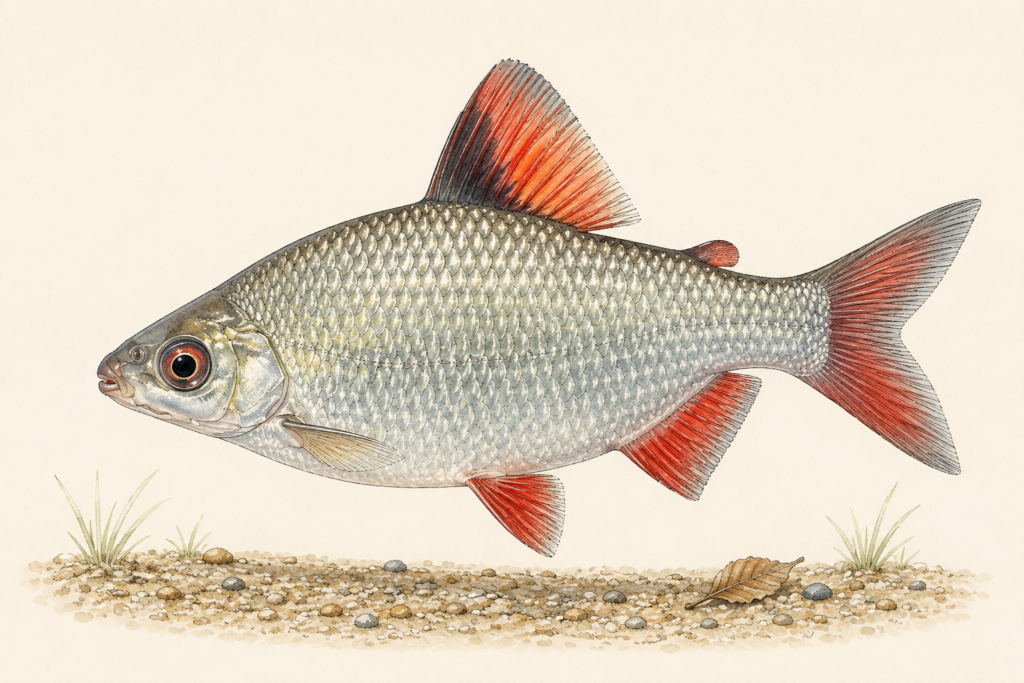
Distichodus affinis is a moderately deep-bodied characin with a laterally compressed profile that is typical of many members of the Distichodontidae family. The body shape is elongated yet robust, tapering to a well-forked caudal fin that reflects the species’ preference for moderately flowing riverine habitats. The mouth is relatively small and subterminal, equipped with flattened, chisel-like teeth that are well adapted for the species’ primarily herbivorous diet – a characteristic feature shared across the Distichodus genus.
Juvenile specimens are predominantly silver, often with a slightly darker dorsal region and lighter ventral surface. The scales are relatively large and well defined, giving the fish a clean, metallic sheen under aquarium lighting. As the fish matures, the fins – particularly the dorsal, caudal, and anal fins – develop a striking bright red colouration that provides a vivid contrast against the silver body. This red fin colouration is one of the species’ most attractive features and tends to intensify with age and optimal care. Some specimens also develop a subtle but appealing pink or rosy flush along the underside of the body, adding further visual interest.
The eyes are moderately large and positioned laterally on the head, giving the fish good peripheral vision. The lateral line is clearly visible, running along the midline of the body from behind the operculum to the caudal peduncle. There is no pronounced sexual dimorphism in terms of colouration, though mature females may appear slightly fuller-bodied when viewed from above, particularly when in breeding condition. Overall, the Silver Distichodus is a subtly beautiful fish that rewards patient keepers who allow it to reach its full adult size and colouration potential.
Natural Habitat
The Silver Distichodus is native to the Congo River basin, one of the most biologically diverse freshwater systems on the planet. Within this vast drainage, D. affinis has been recorded from waterways across Cameroon, the Central African Republic, the Democratic Republic of Congo, and the Republic of Congo. The Congo basin encompasses an enormous range of habitat types, from fast-flowing main channels to slow-moving tributaries, flooded forests, and marshy backwaters, and Distichodus affinis can be found in several of these environments.
In the wild, this species typically inhabits river channels and larger tributary streams with moderate water flow. The substrate in these habitats is often a mix of sand, gravel, and alluvial sediment, with submerged wood, fallen branches, and overhanging riparian vegetation providing cover and shading. Aquatic plants may be present in calmer marginal areas, though the species’ herbivorous tendencies mean that it actively grazes on vegetable matter and algae growing on submerged surfaces. The water in many parts of the Congo basin is soft to moderately hard with a slightly acidic to neutral pH, though conditions can vary considerably depending on the specific location and the season.
The Congo River basin experiences seasonal flooding that alters habitat availability and can influence the behaviour and movements of fish populations. During flood periods, fish may move into inundated forest areas to feed on newly available plant material and other food sources. Understanding these natural conditions is helpful for aquarium keepers, as replicating elements of the wild habitat – such as providing driftwood, moderate flow, and a sand or fine gravel substrate – can help the fish feel secure and display more natural behaviour in captivity.
Tank Size and Setup
Given the adult size of 20-25 cm, the Silver Distichodus requires a reasonably spacious aquarium. A minimum tank size of 350 litres is recommended for a single specimen or a small group. If keeping a group of three or more – which is advisable to spread any occasional fin-nipping behaviour – a tank of 450 litres or larger is preferable. The aquarium should be longer rather than taller, as these fish are active swimmers that appreciate horizontal swimming space. A tank measuring at least 150 cm in length is ideal for adult specimens.
The substrate should ideally be sand or fine rounded gravel, which reflects the species’ natural habitat and allows for natural foraging behaviour. Darker substrates tend to enhance the fish’s colouration and help them feel more secure. Provide plenty of driftwood and bogwood pieces to create visual barriers and hiding spots. Smooth river rocks can also be used to add structural complexity to the aquascape. The inclusion of driftwood serves a dual purpose: it provides shelter and it leaches tannins into the water, which can help maintain slightly acidic conditions and give the water a natural, tea-stained appearance that mimics the species’ wild environment.
Live plants are generally not recommended in a tank housing Distichodus affinis, as the species will readily consume most aquatic plants. If you wish to include greenery, consider robust, unpalatable species such as Anubias or Java Fern attached to hardscape, though even these are not entirely safe from persistent herbivores. Artificial plants or floating plants that can be easily replaced are alternative options if you want a greener look. Some keepers use fast-growing floating plants like Water Lettuce or Salvinia, accepting that they will be nibbled and simply replacing them periodically.
A secure, well-fitting lid or cover glass is essential. Distichodus species can be surprisingly good jumpers, particularly when startled, and an open-top aquarium poses a real risk. Ensure there are no gaps large enough for the fish to escape through, especially around filter inlets and other equipment that passes through the lid.
Lighting should be moderate. The Silver Distichodus does not require intense illumination and may be more comfortable and display better colour under subdued lighting. If you are using driftwood and tannin-stained water, the naturally dimmer conditions will suit the fish well. LED lighting with adjustable intensity is a good choice, as it allows you to find the balance between adequate visibility and the fish’s preference for slightly subdued conditions.
Water Parameters
Maintaining stable, appropriate water parameters is essential for the long-term health of Distichodus affinis. While this species is reasonably adaptable, it does best in conditions that approximate its natural habitat in the Congo basin. Consistency is more important than hitting exact numbers, so aim to keep parameters within the recommended ranges and avoid sudden fluctuations.
| Temperature | 23-27 °C |
| pH | 6.0-8.0 |
| General hardness (GH) | 5-20 dGH |
| Ammonia | 0 ppm |
| Nitrite | 0 ppm |
| Nitrate | Below 30 ppm |
The ideal temperature range for this species is 24-27 °C, which sits comfortably within the broader tolerance range. A slightly acidic to neutral pH of 6.5-7.0 is optimal, though the fish will tolerate somewhat harder, more alkaline conditions provided they are stable. The use of driftwood and the natural tannins it releases can help maintain a slightly acidic pH without the need for chemical buffers.
Regular water changes are important for keeping nitrate levels low and maintaining overall water quality. A weekly water change of 25-30% is recommended for most setups. If the tank is heavily stocked or the filtration is on the lighter side, more frequent or larger water changes may be necessary. Always use a dechlorinator when adding fresh tap water and try to match the temperature of the replacement water to avoid thermal shock.
Filtration and Equipment
The Silver Distichodus is an active, moderately sized fish that produces a reasonable bioload, particularly given its herbivorous diet, which results in a higher volume of waste compared to similarly sized carnivores. Robust filtration is therefore a key consideration when setting up an aquarium for this species.
An external canister filter is the best choice for tanks of this size and stocking level. Choose a filter rated for the tank’s volume or, ideally, one rated slightly above it to ensure adequate biological and mechanical filtration capacity. Canister filters offer the advantage of large media capacity, allowing for multiple stages of filtration including mechanical pre-filtration, biological media such as ceramic rings or sintered glass, and chemical media like activated carbon if desired. A turnover rate of 6-8 times the tank volume per hour is a good target.
Supplementary filtration in the form of an internal powerhead or additional sponge filter can be beneficial, particularly in larger tanks or those housing a group of Distichodus. A powerhead can also be used to create moderate water flow, which the species appreciates. However, avoid creating an overly turbulent environment – the fish should be able to find areas of calmer water within the tank.
A reliable heater is essential to maintain stable tropical temperatures. For tanks of 350 litres or more, it is advisable to use two heaters rather than one, placed at opposite ends of the tank to ensure even heat distribution. This also provides a safety margin if one heater fails. Choose heaters with an adjustable thermostat and consider using an external temperature controller for added reliability.
An air pump with an airstone is a worthwhile addition to ensure good surface agitation and oxygenation, particularly if the tank is heavily stocked or the ambient temperature is at the higher end of the species’ range (warmer water holds less dissolved oxygen). This is especially important during the warmer summer months in homes without air conditioning.
Diet and Feeding
Distichodus affinis is primarily herbivorous in the wild, feeding on algae, plant matter, and detritus found on submerged surfaces. In the aquarium, this dietary preference should be reflected in the food offered, though the species is not strictly vegetarian and will accept a range of food types.
The staple diet should consist of high-quality vegetable-based foods. Spirulina-enriched flakes or pellets are an excellent foundation, as are algae wafers designed for herbivorous fish. Sinking pellets are particularly useful for ensuring the fish receives adequate nutrition, as Distichodus affinis tends to feed at the mid-water and lower levels of the aquarium. Supplement the dry food with fresh vegetables such as blanched spinach, courgette (zucchini) slices, shelled peas, cucumber, and lettuce. These should be lightly blanched to soften them and then cooled before being offered. Remove any uneaten vegetable matter within 12-24 hours to prevent water quality issues.
While primarily herbivorous, this species will also accept and benefit from occasional protein-rich foods. Frozen or live foods such as bloodworm, brine shrimp, and daphnia can be offered once or twice a week as a supplement. These protein-rich treats can help condition the fish and promote overall vitality, but they should not form the bulk of the diet. Overfeeding protein can lead to digestive issues in primarily herbivorous species.
Feed once or twice daily, offering only as much food as the fish can consume within a few minutes. Overfeeding is a common mistake and contributes to poor water quality, which in turn leads to health problems. It is better to feed smaller amounts more frequently than to offer large meals infrequently. Observing the fish during feeding is a good way to gauge the appropriate quantity and to monitor the health and behaviour of all tank inhabitants.
Behaviour and Temperament
The Silver Distichodus is generally a peaceful species that coexists well with a range of similarly sized, robust tank mates. It is an active swimmer that tends to occupy the middle and lower levels of the aquarium, though it will explore all areas of the tank throughout the day. The species is diurnal, being most active during daylight hours and becoming less active as the lights dim in the evening.
While not aggressive in the traditional sense, Distichodus affinis does have a tendency to nip at the fins of slow-moving or long-finned tank mates. This behaviour is not predatory but rather seems to be a natural inclination related to the species’ feeding habits – the same chisel-like teeth used for scraping algae and plant matter can occasionally be directed at trailing fins. This is an important consideration when selecting tank mates, and slow-moving species with elaborate finnage such as fancy goldfish, angelfish, or guppies should be avoided.
Keeping Distichodus affinis in a small group of three or more individuals can help mitigate fin-nipping behaviour directed at other species, as the fish will often focus their attention on conspecifics instead. Within a group, a loose hierarchy may develop, with occasional chasing and mild sparring, but serious aggression is rare. Providing adequate space and plenty of visual barriers in the form of driftwood and rock arrangements helps to break up lines of sight and reduce any tension within the group.
This species can be somewhat skittish, particularly when first introduced to a new aquarium or when kept in tanks with insufficient cover. Sudden movements near the tank, loud noises, or abrupt changes in lighting can cause the fish to dash and potentially injure themselves on hardscape or the tank walls. Providing adequate hiding places and avoiding placing the aquarium in a high-traffic area of the home will help the fish feel more secure. Over time, well-cared-for specimens will become bolder and may even approach the front of the tank at feeding time.
Tank Mates
Selecting appropriate tank mates for the Silver Distichodus requires consideration of its eventual adult size, its occasional fin-nipping tendencies, and its preference for the mid to lower levels of the aquarium. The best companions are robust, active species of a similar size that can hold their own without being overly aggressive. An African biotope setup offers the most natural and visually cohesive approach, pairing D. affinis with other species from the Congo basin and surrounding regions. Avoid small, slow-moving, or long-finned species that may be targeted by the Distichodus or that could be intimidated by its active swimming behaviour.
Good tank mates
- Congo Tetra – A classic Congo basin companion that is active and fast enough to avoid any fin-nipping, creating a stunning biotope display.
- Synodontis eupterus – A robust, bottom-dwelling catfish from Africa that occupies a different niche in the tank and is tough enough to coexist peacefully.
- Synodontis nigriventris – The upside-down catfish is a fascinating and hardy African species that stays out of the Distichodus’ way.
- Polypterus senegalus – A smaller Polypterus species that is armoured, bottom-oriented, and makes an excellent African biotope companion.
- African Butterfly Fish – A surface-dwelling species that occupies a completely different level of the tank, minimising interaction and competition.
- Elephantnose Fish – A distinctive Mormyrid that is active and large enough to hold its own alongside the Silver Distichodus in a Congo-themed tank.
- African Red-Eye Tetra – A robust and fast-swimming tetra that thrives in similar water conditions and adds colour to the middle levels.
- Ctenopoma acutirostre – The Leopard Bush Fish is a sturdy African species that generally coexists well with similarly sized, non-aggressive tank mates.
Fish to avoid
- Angelfish – Their slow, graceful movements and long trailing fins make them a prime target for fin-nipping by the Distichodus.
- Guppy – Far too small and slow, with elaborate finnage that would be irresistible to a fin-nipper of this size.
- Betta – The long fins and relatively sedentary nature of Bettas make them completely unsuitable companions.
- Discus – Discus are slow-moving, sensitive, and would be stressed by the active swimming of the Distichodus, with their fins also at risk.
- Neon Tetra – Far too small to house with a fish that reaches 20-25 cm and could easily be intimidated or accidentally harmed.
- Celestial Pearl Danio – A tiny species that would be at severe risk in a tank with a medium-large characin.
- Flowerhorn – An aggressive, territorial cichlid that would bully and potentially injure the relatively peaceful Distichodus.
Breeding
Breeding Distichodus affinis in the home aquarium is a challenging endeavour and successful captive breeding remains relatively rare. The species is an egg scatterer in the wild, spawning in open water during seasonal conditions that are difficult to replicate fully in captivity. There is limited documented information on the specific breeding behaviours and requirements of D. affinis, and much of what is known is extrapolated from other Distichodus species and related characins.
Sexing adult specimens is difficult, as there is no reliable external sexual dimorphism in terms of colouration or finnage. Mature females may appear slightly rounder in the body when viewed from above, particularly when carrying eggs, but this is not always a definitive indicator. Obtaining a group of at least six or more individuals increases the likelihood of having both sexes represented and may encourage natural pair formation or spawning behaviour.
To attempt breeding, a separate, spacious breeding tank should be set up with soft, slightly acidic water (pH 6.0-6.5, GH below 8 dGH) at a temperature of 26-28 °C. Gentle filtration using a sponge filter is recommended to avoid sucking up eggs or fry. A bare bottom or a thin layer of fine sand can be used as the substrate, and a few large-leaved plants or spawning mops may provide surfaces for egg deposition, though the species is more likely to scatter eggs freely.
Conditioning the potential breeding group with a varied, protein-rich diet in the weeks leading up to the spawning attempt may help bring the fish into breeding condition. Simulating seasonal changes – such as performing large, slightly cooler water changes and varying the photoperiod – may trigger spawning behaviour, as these conditions mimic the onset of the rainy season in the Congo basin, which is typically associated with spawning in many African fish species.
If spawning does occur, the adults should be removed from the breeding tank promptly, as they are likely to consume their own eggs. The eggs, which are small and semi-transparent, typically hatch within 48-72 hours depending on temperature. The resulting fry are tiny and will initially feed on their yolk sacs before requiring very fine foods such as infusoria or commercially available liquid fry food, graduating to newly hatched brine shrimp as they grow.
Common Diseases
Distichodus affinis is a generally hardy species that, when kept in appropriate conditions, is not particularly susceptible to disease. However, like all aquarium fish, it can fall prey to common freshwater diseases, particularly when water quality is poor, the fish is stressed, or new specimens are introduced without proper quarantine.
White Spot Disease (Ichthyophthirius multifiliis), commonly known as ich, is one of the most frequently encountered ailments in freshwater aquariums. It presents as small white spots resembling grains of salt on the body and fins. It is highly contagious and can spread rapidly through a tank. Treatment involves raising the water temperature gradually to 28-30 °C and medicating with a proprietary ich treatment following the manufacturer’s instructions. Note that Distichodus species can be sensitive to some medications, particularly those containing copper or formalin, so always check compatibility before dosing and consider using half-strength treatments initially.
Bacterial infections can occur, particularly in fish with compromised immune systems due to stress or poor water quality. Symptoms may include reddened patches on the body, frayed or eroding fins, lethargy, and loss of appetite. Maintaining excellent water quality through regular water changes and effective filtration is the best preventive measure. If a bacterial infection is suspected, broad-spectrum antibacterial treatments can be used, though a veterinary diagnosis is preferable if available.
Parasitic infections, including skin and gill flukes, can occasionally affect this species. Symptoms may include excessive mucus production, flashing (rubbing against objects), rapid gill movements, and general lethargy. Anti-parasitic treatments are available from aquarium suppliers, and a quarantine period for new fish is the most effective way to prevent the introduction of parasites into an established tank.
Digestive issues can arise if the diet is not appropriately balanced. As a primarily herbivorous species, Distichodus affinis requires a fibre-rich diet. Feeding too much protein or relying exclusively on dry foods without fresh vegetable supplementation can lead to constipation and bloating. Ensuring a varied diet with regular vegetable matter is the simplest prevention.
Quarantining all new fish for a minimum of two to four weeks before adding them to an established tank is one of the most effective disease prevention measures available to the hobbyist. This allows any latent infections to manifest and be treated in isolation, protecting the health of the existing tank inhabitants.
FAQs
How big does the Silver Distichodus get?
Distichodus affinis typically reaches 20-25 cm (8-10 inches) in the home aquarium, though some specimens may grow slightly larger in particularly spacious setups with excellent care. This is considerably smaller than some of its congeners, such as Distichodus sexfasciatus, which can exceed 60 cm. Nevertheless, its adult size means that a tank of at least 350 litres is necessary to house it comfortably.
Will Silver Distichodus eat my aquarium plants?
Almost certainly, yes. Distichodus affinis is a committed herbivore that will readily consume most soft-leaved aquatic plants. Even tougher species like Anubias and Java Fern may be nibbled, though they are more likely to survive than delicate species. If you wish to keep this fish, it is best to design the aquascape around hardscape elements such as driftwood and rocks, and to provide regular fresh vegetable matter as part of the diet to satisfy the fish’s herbivorous appetite.
Can I keep a single Silver Distichodus?
While it is possible to keep a single specimen, Distichodus affinis generally does better in a small group of three or more. Keeping them in a group allows for natural social interactions and can help distribute any fin-nipping behaviour among conspecifics rather than directing it at other tank mates. A solitary individual may be more reclusive and skittish, and in some cases, a lone fish may be more inclined to nip at other species out of boredom or frustration.
Is the Silver Distichodus suitable for beginners?
This species is best suited to aquarists with some prior experience in keeping tropical freshwater fish. While not especially demanding in terms of care, its need for a large tank, its plant-eating habits, and the requirement for careful tank mate selection mean that it is not the ideal choice for a first aquarium. A hobbyist who has successfully maintained a community tank of at least 200 litres and understands the principles of water quality management should find the Silver Distichodus a manageable and rewarding step up.
When do the fins turn red?
The characteristic bright red fin colouration typically begins to develop as the fish matures, usually becoming noticeable once the specimen reaches around 8-10 cm in length. The colour continues to intensify as the fish grows towards its full adult size. Good nutrition, stable water conditions, and low stress levels all contribute to the development of the best fin colouration. Fish kept in cramped conditions or fed a poor diet may show weaker colouration compared to well-maintained specimens.
Related Guides
- Congo Tetra Care Guide – One of the best companion species for Distichodus affinis in an African biotope aquarium, sharing similar water requirements.
- Synodontis eupterus Care Guide – A robust African catfish that makes an excellent bottom-dwelling companion in the same tank setup.
- Polypterus senegalus Care Guide – A fascinating armoured fish from Africa that coexists well with the Silver Distichodus in large community tanks.
- Elephantnose Fish Care Guide – A unique Mormyrid species that pairs well with Distichodus affinis in Congo-themed biotope aquariums.
- Distichodus sexfasciatus Care Guide – A larger relative of D. affinis that requires similar care but a significantly larger aquarium.