
Quick summary
The Paradise Fish is a hardy, colourful, and easy to breed species well suited to beginners, especially since it tolerates cool room temperatures without a heater. However, males are territorial and can be aggressive, so it’s best kept singly or as one male with females, and tank mates must be chosen carefully to avoid fin nipping or fighting.
🐠 Build a tank around this species
In this guide:
- Introduction
- Quick Stats
- Appearance
- Varieties and Morphs
- Natural Habitat
- Tank Size and Setup
- Water Parameters
- Filtration and Equipment
- Diet and Feeding
- Behaviour and Temperament
- Tank Mates
- Breeding
- Common Diseases
- FAQs
Introduction
The Paradise Fish holds a special place in the history of the aquarium hobby. Widely regarded as one of the first tropical fish ever kept in captivity in Europe, specimens were reportedly brought to France as early as the 1860s, long before the advent of modern filtration and heating equipment. Its striking beauty, remarkable hardiness, and fascinating behaviour have ensured its continued popularity for well over a century, even as thousands of newer species have entered the trade.
Macropodus opercularis is a member of the gourami family and, like its relatives, possesses a specialised organ known as the labyrinth that allows it to breathe atmospheric air directly from the surface. This adaptation makes it exceptionally tolerant of low-oxygen environments and helps explain why it was one of the few tropical species that could survive the rudimentary keeping conditions of Victorian-era aquaria. Today, despite the vast range of fish available to hobbyists, the Paradise Fish remains a compelling choice for both beginners and experienced aquarists, offering vibrant colour, personality, and relatively straightforward care requirements, provided its temperament is understood and respected.
Quick Stats
| Scientific name | Macropodus opercularis |
|---|---|
| Common names | Paradise Fish, Paradise Gourami, Blue Paradise Fish, Albino Paradise Fish |
| Family | Osphronemidae |
| Origin | East Asia, China, Taiwan, Vietnam, Laos, Cambodia, Korea, Japan |
| Adult size | 11 cm |
| Lifespan | 6–8 years |
| Difficulty | Easy |
| Breeding difficulty | Easy |
| Temperature | 16–26 °C |
| pH | 6–8 |
| GH | 5–20 dGH |
| KH | 4–10 dKH |
| Minimum tank size | 75 L |
| Conservation status | Least Concern (IUCN) |
Appearance
The Paradise Fish is an undeniably handsome species that rewards close observation. The wild-type form displays a body pattern of bold, alternating vertical bars in vivid blue and orange-red, running from just behind the gill plate to the caudal peduncle. The intensity of these colours varies with mood, health, and social context; a dominant male in breeding condition can be truly spectacular, with colours deepened to an almost iridescent glow. The gill covers, or opercula, are marked with a distinctive dark spot edged in iridescent blue or green, which the fish flares during territorial displays.
Males are generally larger and more intensely coloured than females. Their fins are notably more elongated, particularly the dorsal, anal, and caudal fins, which develop flowing, trailing extensions as the fish matures. The caudal fin is forked, with the upper and lower lobes often extending into filamentous streamers in mature males. Females tend to be somewhat plumper in the body, with shorter, rounder fins and slightly more muted colouration, though they are still attractive fish in their own right. Both sexes have a streamlined, laterally compressed body shape typical of the gourami family, and adults typically reach between 8 and 11 centimetres in total length, with males occasionally exceeding this in well-maintained aquaria.
Varieties and Morphs
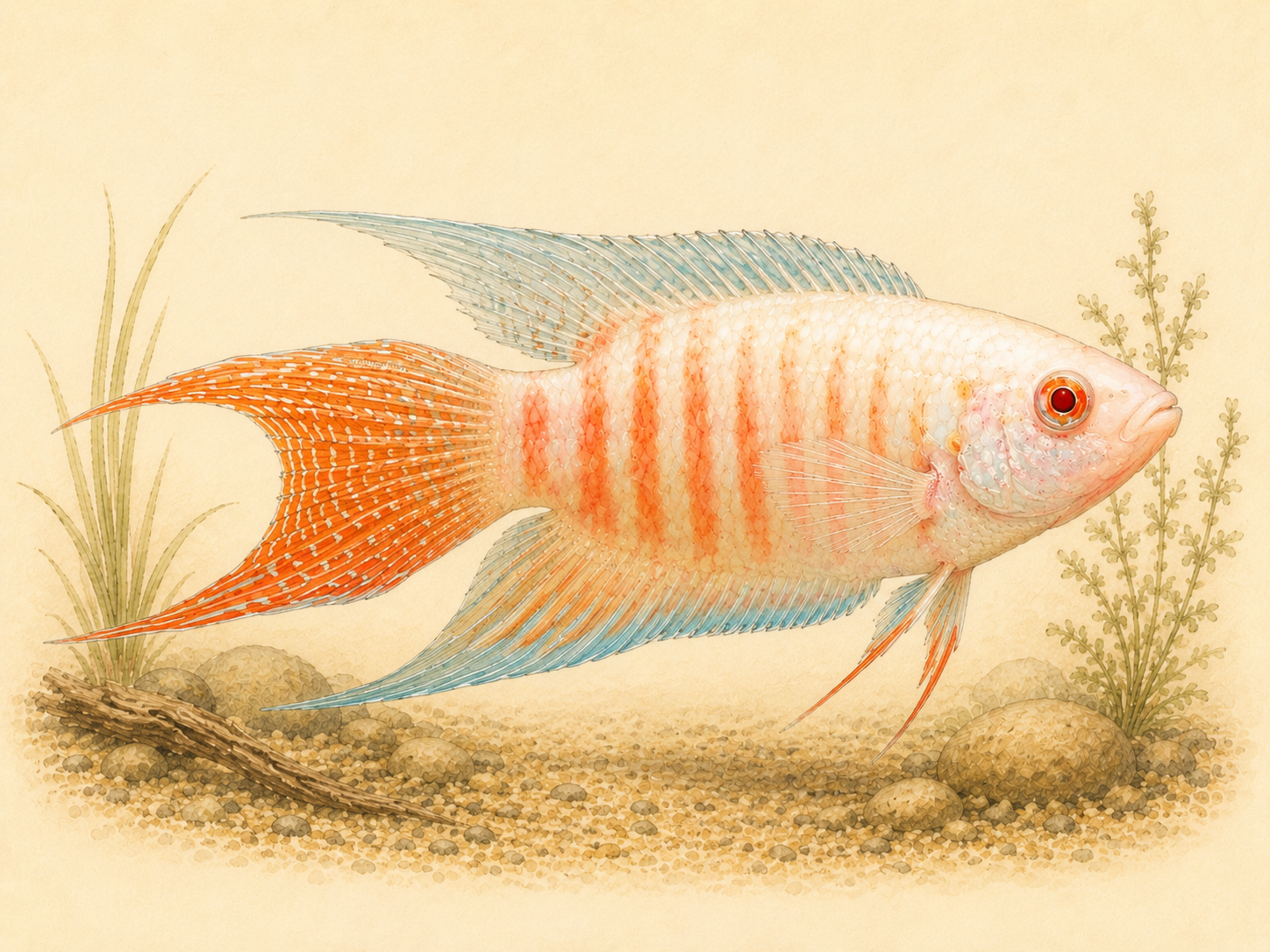
Over decades of captive breeding, several colour morphs and varieties of the Paradise Fish have been established, and most are readily available through specialist retailers and online suppliers. The most commonly encountered variant is the Albino Paradise Fish, which lacks the dark melanin pigmentation of the wild type. Albino specimens display a pale, creamy-white to pinkish body overlaid with the characteristic barred pattern rendered in soft orange and pale gold tones, giving them an ethereal, almost translucent quality. Their eyes are typically red or pink. Albino Paradise Fish are just as hardy as their wild-type counterparts and require identical care, making them an excellent alternative for keepers who prefer a more subtle colour palette.
The Blue Paradise Fish is another popular variant, selectively bred to emphasise the blue pigmentation so that the bars appear a deeper, more saturated steel-blue or cobalt shade, with the red-orange bars reduced or somewhat subdued. Conversely, the Red Paradise Fish or Super Red variant has been developed in the opposite direction, intensifying the red-orange pigmentation to produce a predominantly warm-toned fish with reduced blue banding. Some breeders have also produced a Concolor or Dark variant, which appears almost uniformly dark blue-black, with the barred pattern visible only under certain lighting conditions or during social interactions.
It is worth noting that Macropodus opercularis is sometimes confused in the trade with its close relative Macropodus ocellatus, the Chinese Paradise Fish or Roundtail Paradise Fish, which is a distinct species with a rounded caudal fin and somewhat different temperament. Care should be taken to confirm identification when purchasing, particularly from less specialised sources.
Natural Habitat
Macropodus opercularis is native to a broad swathe of East and Southeast Asia, with populations recorded in China, Taiwan, Vietnam, Laos, Cambodia, Korea, and parts of Japan. Its range also extends to Hong Kong and several smaller islands in the region. The species has additionally been introduced to various locations outside its native range, including Madagascar and parts of the United States, where feral populations have established themselves in suitable waterways.
In the wild, the Paradise Fish inhabits a remarkable variety of lowland freshwater environments. It is most commonly found in slow-moving or still waters such as rice paddies, irrigation ditches, marshes, shallow ponds, and the vegetated margins of streams and rivers. These habitats are frequently characterised by dense aquatic and emergent vegetation, relatively shallow depth, and often turbid or poorly oxygenated water. The species shows a strong preference for environments with abundant plant cover, which provides shelter, hunting grounds, and sites for bubble-nest construction.
One of the most ecologically significant aspects of this species is its exceptional tolerance of a wide range of environmental conditions. Paradise Fish can withstand temperatures as low as 10 °C for brief periods and are found in habitats that experience considerable seasonal temperature fluctuations. They can also tolerate mildly brackish conditions and water with very low dissolved oxygen levels, thanks to their labyrinth organ. This broad environmental tolerance is a key factor in both their historical success as aquarium fish and their ability to establish invasive populations outside their native range.
Tank Size and Setup
A single Paradise Fish or a pair can be comfortably housed in an aquarium of at least 75 litres. If you intend to keep a male with multiple females, or wish to include a community of tank mates, a larger tank of 110 litres or more is strongly recommended. The additional space helps to diffuse territorial aggression, which is one of the primary behavioural considerations with this species. Longer tanks are preferable to taller ones, as the fish primarily occupy the middle and upper water column and benefit from a greater horizontal swimming area.
The aquascape should incorporate plenty of structure and visual barriers. Dense planting is ideal and closely mirrors the species’ natural habitat. Hardy plants such as Vallisneria, Java Fern, Anubias, and Cryptocoryne species work well and can tolerate the range of conditions that suit the Paradise Fish. Floating plants are a particularly valuable addition, as they provide shade, reduce perceived exposure from above, and offer anchoring points for the male’s bubble nest during breeding. Hornwort, Water Sprite, and Amazon Frogbit are all suitable choices.
Driftwood, smooth rocks, and terracotta pots or similar decorations can be used to create additional hiding spots and territorial boundaries. Arranging the décor to break up sightlines across the tank is an effective strategy for managing aggression, particularly if more than one male is present, though keeping multiple males together is generally inadvisable in anything less than a very large, heavily planted aquarium. A dark substrate of fine gravel or sand tends to show off the fish’s colours to best advantage and creates a more natural-looking environment.
A secure, well-fitting lid is essential. Paradise Fish are capable and sometimes enthusiastic jumpers, particularly when startled, during courtship, or when water quality deteriorates. Ensure that there is a small gap between the water surface and the lid to allow the fish access to humid air for labyrinth breathing; a gap of two to three centimetres is usually sufficient.
Water Parameters
The Paradise Fish is one of the most adaptable freshwater species available to hobbyists in terms of water chemistry. It tolerates a remarkably broad range of parameters, which is one of the reasons it has been so successful in captivity for so long. Nevertheless, maintaining stable conditions within its preferred ranges will promote the best health, colouration, and longevity.
| Temperature | 16–26 °C |
| pH | 6.0–8.0 |
| General hardness (GH) | 5–20 dGH |
| Carbonate hardness (KH) | 4–10 dKH |
| Ammonia | 0 ppm |
| Nitrite | 0 ppm |
| Nitrate | Below 30 ppm |
The unusually wide temperature range of the Paradise Fish is worth special attention. Unlike many tropical species that require a consistently warm environment, Macropodus opercularis is genuinely subtropical and can thrive at room temperature in most UK homes without the need for a heater during the warmer months. In fact, the species is sometimes kept in unheated indoor aquaria year-round, provided the ambient temperature does not drop below approximately 16 °C for prolonged periods. For general community keeping, a temperature around 22–24 °C represents a good compromise. If breeding is the goal, a gradual increase to 25–26 °C can help trigger spawning behaviour.
Regular water changes of 20–25 per cent on a weekly basis are recommended to maintain water quality and keep nitrate levels in check. Although the Paradise Fish is more tolerant of suboptimal water conditions than many species, chronic exposure to elevated ammonia, nitrite, or high nitrate levels will compromise its immune system and shorten its lifespan.
Filtration and Equipment
Given the Paradise Fish’s preference for calm or slow-moving water, filtration should be effective but not overly powerful. A strong current can cause stress and make it difficult for males to construct and maintain their bubble nests. A sponge filter is an excellent choice for a dedicated Paradise Fish setup, as it provides gentle biological and mechanical filtration without creating excessive water movement. Sponge filters also have the advantage of being safe for fry, making them ideal if breeding is anticipated.
Hang-on-back filters and small internal canister filters can also be used, but it is advisable to baffle or redirect the outflow to reduce surface agitation. A simple spray bar attachment, or positioning the outflow against the glass, can achieve this effectively. External canister filters are generally unnecessary for a tank dedicated to this species, though they may be appropriate in larger community setups.
Lighting should be moderate. The Paradise Fish does not require intense illumination, and overly bright lighting without adequate plant cover or floating vegetation can make the fish feel exposed and stressed. Standard LED aquarium lights on a timer set for eight to ten hours per day are perfectly adequate and will support healthy plant growth.
As noted, a heater is not strictly necessary in many UK households, but if room temperatures fluctuate significantly or drop below 16 °C in winter, a low-wattage heater set to around 20–22 °C provides a useful safety net. An aquarium thermometer should always be used to monitor conditions, regardless of whether a heater is installed.
Diet and Feeding
The Paradise Fish is an omnivore with a strong carnivorous leaning, and it is generally an enthusiastic and unfussy feeder. In the wild, its diet consists largely of small invertebrates, insect larvae, zooplankton, and occasionally algae and plant matter. In captivity, it will readily accept a wide variety of foods, which makes feeding straightforward.
A high-quality flake or micro-pellet food formulated for tropical or gourami species can serve as the dietary staple. This should be supplemented regularly with protein-rich live or frozen foods such as bloodworm, daphnia, brine shrimp, tubifex, and mosquito larvae. These foods not only provide excellent nutrition but also encourage natural foraging behaviour and help to enhance colouration. The Paradise Fish is an adept surface feeder but will also hunt for food in the mid-water and among plant cover, so varying the placement of food can provide enrichment.
Feed small portions once or twice daily, offering only as much as the fish can consume within two to three minutes. Overfeeding should be avoided, as uneaten food will degrade water quality. One fasting day per week can be beneficial for digestive health, though this is optional and a matter of personal preference. If kept in a planted tank with a healthy micro-ecosystem, the Paradise Fish may also supplement its diet by grazing on small organisms such as hydra, planaria, and detritus worms, a trait that some aquarists actively exploit for pest control purposes.
Behaviour and Temperament
The Paradise Fish is a species of considerable character, and its behaviour is one of its most appealing, and sometimes most challenging, attributes. Males in particular are territorial and can display significant aggression towards conspecifics and other fish of similar size, shape, or colouration. This territorial nature is most pronounced during breeding, but it can be a factor at any time, particularly in confined spaces or sparsely decorated tanks.
Male-on-male aggression is the primary behavioural concern. Two males housed together in a small tank will almost invariably fight, and these encounters can result in serious injury or death. If multiple males are to be kept, the tank must be very large, well over 200 litres, and densely planted to provide adequate visual barriers and retreat spaces. Even then, some individuals are simply too aggressive to coexist peacefully. For most hobbyists, keeping a single male with one or two females is the most practical approach.
Beyond conspecific aggression, the Paradise Fish can also be a fin nipper and a bully towards slow-moving or long-finned tank mates. Its predatory instincts are well developed, and it will readily hunt and consume small invertebrates, fry, and any fish small enough to fit in its mouth. It is not, however, an indiscriminate aggressor; many keepers report that their Paradise Fish coexist peacefully with appropriately chosen community species, particularly in well-structured tanks with ample space.
The species is notably curious and intelligent by fish standards. Paradise Fish quickly learn to recognise their keeper and will often approach the front glass at feeding time. They are active explorers of their environment, investigating new décor and interacting with their surroundings in ways that make them engaging to watch. Males can frequently be observed constructing and tending bubble nests at the surface, a behaviour that occurs even in the absence of females and is a sign of good health and comfort.
Tank Mates
Selecting tank mates for the Paradise Fish requires careful thought. The species’ territorial nature and occasional fin-nipping tendencies mean that compatibility is not universal, and certain categories of fish should be avoided. The best tank mates tend to be robust, moderately active species that occupy different areas of the water column and are neither so small as to be viewed as prey nor so flashy or slow-moving as to provoke aggression. Bottom-dwelling species often work well, as they rarely come into conflict over territory with the Paradise Fish’s preferred mid-to-upper zone. Fast-moving schooling fish that can easily evade any harassment also tend to fare better than solitary, sedentary species.
Good tank mates
- Bristlenose Pleco, a peaceful bottom-dweller that occupies a completely different niche and is well-armoured against any occasional nipping.
- Corydoras Catfish, sociable bottom-feeders that rarely interact with mid-water species and thrive in groups of six or more.
- Zebra Danio, fast, hardy, and active enough to avoid harassment, and tolerant of the cooler temperatures that suit the Paradise Fish.
- White Cloud Mountain Minnow, an excellent subtropical companion that shares similar temperature preferences and is quick enough to evade aggression.
- Cherry Barb, a peaceful, hardy barb that does well in planted tanks and is generally ignored by Paradise Fish.
- Kuhli Loach, a shy, nocturnal bottom-dweller that stays out of the Paradise Fish’s way almost entirely.
- Giant Danio, large and active enough to hold its own, suitable for bigger community setups.
- Swordtail, a robust livebearer that is generally too quick and active to be bothered by a Paradise Fish.
Fish to avoid
- Betta Fish, another labyrinth fish with a similar body shape and territorial disposition; housing them together almost always ends in serious conflict.
- Dwarf Gourami, too closely related in form and behaviour, likely to be bullied or attacked by a dominant Paradise Fish.
- Guppy, their long, flowing fins make them irresistible targets for fin nipping, and they are too slow to escape effectively.
- Angelfish, their slow, deliberate movements and trailing fins invite harassment, and territorial disputes are common.
- Neon Tetra, too small and may be viewed as prey, particularly by larger adult Paradise Fish.
- Endler’s Livebearer, small size and bright colouration make these fish vulnerable to predation and harassment.
- Pearl Gourami, while more peaceful than many gouramis, its similar body shape can provoke territorial aggression from the Paradise Fish.
- Fancy Goldfish, slow-moving and with vulnerable flowing fins; also produces significant waste that can degrade water quality in smaller setups.
Breeding
The Paradise Fish is one of the easiest aquarium species to breed, and witnessing the full courtship, spawning, and parental care sequence is a genuinely rewarding experience. The species is a bubble-nest builder, and breeding can occur in the main aquarium or in a dedicated breeding tank. A separate breeding setup of around 40–60 litres is generally recommended, as it provides a controlled environment and makes rearing the fry considerably easier.
To condition a pair for breeding, provide a varied, protein-rich diet of live and frozen foods for one to two weeks. Gradually raise the water temperature to around 25–26 °C and ensure that the tank includes floating plants or other surface cover. The male will begin constructing a bubble nest at the surface, often amongst floating vegetation. A well-constructed nest can be several centimetres in diameter and is made of air bubbles coated in mucus. The size and elaborateness of the nest are generally indicators of the male’s health and readiness to spawn.
When the female is gravid, her belly will appear noticeably swollen with eggs, and she may display vertical barring on her flanks. The male will intensify his colours and begin to court the female with flared fins, lateral displays, and gentle nudging. If she is receptive, the pair will eventually embrace beneath the bubble nest in a nuptial clasp typical of many anabantoid species. During the embrace, the male wraps his body around the female, and she releases a batch of eggs, which the male immediately fertilises. The eggs are buoyant and float upwards into the nest, where the male collects any that stray and carefully places them amongst the bubbles.
A single spawning session may produce several hundred eggs through multiple embraces. Once spawning is complete, the female should be removed, as the male becomes highly protective of the nest and may attack her. The male takes sole charge of guarding the eggs, repairing the nest, and retrieving any eggs or newly hatched fry that fall from it. This parental care is fascinating to observe; the male is attentive and tireless, often forgoing food during this period.
The eggs typically hatch within 30 to 50 hours, depending on temperature. The fry remain in the nest for a further two to three days while they absorb their yolk sacs. Once they become free-swimming, the male’s parental duties diminish, and he should be removed to prevent him from eating the fry. Free-swimming fry are very small and initially require infusoria or liquid fry food, transitioning to newly hatched brine shrimp (Artemia nauplii) and microworms after approximately one week. Growth is relatively rapid with good nutrition and regular water changes, and the young fish begin to show colour at around six to eight weeks of age.
Common Diseases
The Paradise Fish is a robust species with a strong constitution, and it is generally less susceptible to disease than many popular aquarium fish. However, no species is immune to illness, and poor water quality, stress, or inadequate diet can leave any fish vulnerable to infection.
White Spot Disease, also known as Ich, caused by the protozoan parasite Ichthyophthirius multifiliis, is one of the most common ailments encountered. It presents as small white cysts resembling grains of salt on the fins and body. It is highly treatable if caught early, typically with a gradual temperature increase to around 28–30 °C combined with a proprietary white spot treatment. The Paradise Fish’s tolerance of higher temperatures makes this approach particularly effective.
Fin rot is another condition that may occur, usually as a result of bacterial infection secondary to poor water quality or physical damage from fighting. Affected fins appear ragged, frayed, or discoloured at the edges. Improving water quality through increased water changes is the first line of treatment, and antibacterial medications may be necessary in more advanced cases.
Velvet disease, caused by the parasitic dinoflagellate Piscinoodinium, can also affect labyrinth fish. It appears as a fine, gold or rust-coloured dusting on the skin and fins, and affected fish may clamp their fins, scratch against surfaces, and become lethargic. Treatment involves dimming the lights, raising the temperature slightly, and using a copper-based medication, though care must be taken with dosage in planted tanks as copper can harm invertebrates and some plant species.
Bacterial infections, including columnaris and various internal infections, can occur in stressed or immunocompromised fish. Maintaining excellent water quality, providing a nutritious diet, and minimising stress through appropriate tank setup and stocking are the most effective preventive measures. Quarantining new fish before introducing them to an established aquarium is always advisable.
FAQs
Can Paradise Fish be kept without a heater?
Yes, in many cases. The Paradise Fish is a subtropical species that tolerates temperatures as low as 16 °C, and in most UK homes with central heating, room temperature during the warmer months is perfectly adequate. However, if your home drops below 16 °C in winter, particularly overnight, a low-wattage heater set to around 18–20 °C is a sensible precaution. Monitoring the temperature with a reliable aquarium thermometer is always recommended.
Can I keep two male Paradise Fish together?
This is generally not recommended unless the tank is very large, well over 200 litres, and heavily planted with numerous visual barriers. Male Paradise Fish are territorial and can be extremely aggressive towards one another. In smaller tanks, confrontations are almost inevitable and can result in serious injury or death. Most hobbyists find that keeping a single male, either alone or with one or two females, is the most successful approach.
Are Paradise Fish suitable for a community aquarium?
They can be, provided tank mates are chosen carefully. Avoid slow-moving, long-finned species and very small fish that might be seen as prey. Robust, moderately active fish that occupy different zones of the tank tend to fare best. A well-planted aquarium with plenty of hiding spots significantly reduces the likelihood of aggression. Individual temperament does vary, and some Paradise Fish are considerably more tolerant of tank mates than others.
How can I tell the difference between male and female Paradise Fish?
Males are typically larger, more intensely coloured, and have longer, more elaborate fins, particularly the dorsal, anal, and caudal fins, which develop flowing extensions with age. Females tend to be slightly smaller and plumper, with shorter, rounder fins and somewhat less vivid colouration. During breeding condition, the female’s belly becomes noticeably swollen with eggs, and she may display faint vertical barring on her flanks.
Do Paradise Fish eat snails?
Yes, Paradise Fish are well known for their appetite for small snails and are sometimes deliberately introduced to tanks to control pest snail populations. They will crack open and consume small species such as bladder snails and ramshorn snails with enthusiasm. Larger snails such as Mystery Snails or Nerite Snails are generally safe, as they are too large for the Paradise Fish to attack effectively, though individual results may vary.
Related Guides
- Dwarf Gourami Care Guide, a popular fellow labyrinth fish with similar care requirements, useful for understanding the broader gourami family.
- Betta Fish Care Guide, another anabantoid species with comparable behaviour and bubble-nesting breeding habits.
- White Cloud Mountain Minnow Care Guide, an excellent subtropical tank mate that shares similar temperature preferences with the Paradise Fish.
- Zebra Danio Care Guide, a hardy, active species that makes a compatible community companion in a Paradise Fish setup.
- Bristlenose Pleco Care Guide, a peaceful bottom-dweller frequently recommended as a tank mate for more assertive species like the Paradise Fish.