Quick Summary
The Three-spot Headstander is a peaceful, characterful South American characin that swims at a distinctive head-down angle as it grazes algae and biofilm. It suits intermediate fishkeepers who can provide a spacious, well-planted tank with stable water quality and a varied omnivorous diet.
🐠 Build a tank around this species
In this guide:
- Introduction
- Quick Stats
- Appearance
- Natural Habitat
- Tank Size and Setup
- Water Parameters
- Diet and Feeding
- Behaviour and Temperament
- Tank Mates
- Breeding
Introduction
The Three-spot Headstander (Pseudanos trimaculatus) is one of the more endearing oddities of the freshwater hobby. Belonging to the family Anostomidae – a group whose very name derives from the Greek for “upturned mouth” – this species is immediately recognisable by its habit of hovering at a 30- to 45-degree head-down angle while it picks at surfaces. It uses this posture to methodically graze algae, biofilm and tiny invertebrates from rocks, wood and plant leaves, much as it would along submerged surfaces in its native South American rivers.
Despite being available in the trade for decades, P. trimaculatus has never achieved the mainstream popularity of its relatives the Striped Headstander (Anostomus anostomus) or the Spotted Headstander (Chilodus punctatus). That is a shame, because it is arguably better suited to community life than either of those species. It is notably less aggressive than A. anostomus and a touch hardier than C. punctatus, occupying a comfortable middle ground for aquarists who want the headstander experience without the temperament issues or the extreme softness demands.
In this guide we cover everything you need to know to keep Three-spot Headstanders healthy and thriving: tank dimensions, water chemistry, diet, compatible tank mates, and the admittedly challenging subject of captive breeding. Whether you are considering your first headstander or looking to add another South American characin to a planted biotope, read on for the full picture.
Quick Stats
| Scientific name | Pseudanos trimaculatus |
|---|---|
| Common names | Threespot Headstander, Trimac Headstander |
| Family | Anostomidae |
| Origin | South America (Amazon, Orinoco, Guiana Shield) |
| Adult size | 13.5 cm |
| Lifespan | 8–12 years |
| Difficulty | Intermediate |
| Breeding difficulty | Advanced |
| Temperature | 24–28 °C |
| pH | 5.5–7.5 |
| GH | 2–15 dGH |
| KH | 1–8 dKH |
| Minimum tank size | 200 L |
| Conservation status | Least Concern (IUCN, assessed 2020) |
Appearance
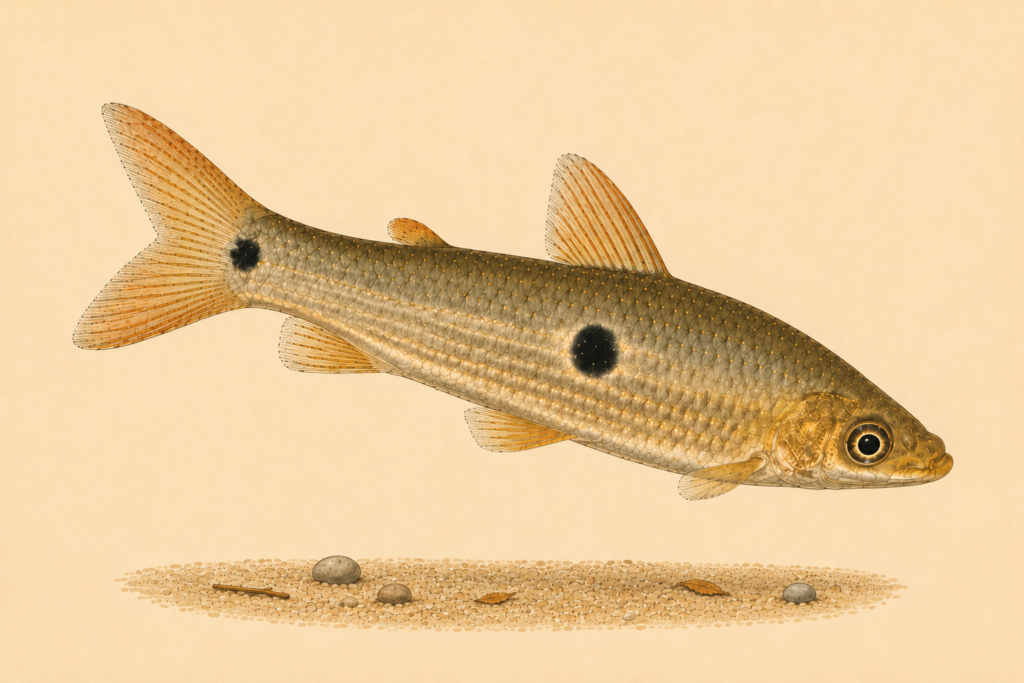
Pseudanos trimaculatus has a moderately elongated, laterally compressed body typical of the anostomid family. The overall base colour is silvery to pale gold, with a slight olive-green sheen across the dorsal surface under aquarium lighting. The most striking feature – and the source of the common name – is a series of three prominent dark spots arranged in a roughly horizontal line along the midlateral region of the body. The first spot sits just behind the gill cover, the second roughly at the midpoint of the flank, and the third near the base of the caudal peduncle. These spots are usually deep black or very dark brown and stand out clearly against the lighter body colour, giving the fish an elegant, punctuated appearance.
A faint dark lateral stripe sometimes connects the spots, varying in intensity between individuals and depending on the fish’s mood and environment. When stressed or kept in very pale, bare tanks, the spots can fade somewhat, so providing a naturalistic setting with tannin-stained water and dark substrates will bring out the best colouration. Some specimens develop a subtle reddish or orange tint to the anal and caudal fins as they mature, particularly when kept in soft, acidic water with a varied diet.
The mouth is small, slightly upturned and positioned terminally – well-adapted for scraping surfaces. The lips are somewhat thickened compared to other characins, a useful adaptation for grazing. The dorsal fin is set relatively far back on the body, and all fins are generally transparent to lightly tinted. Sexual dimorphism is minimal; mature females tend to be slightly fuller-bodied when viewed from above, especially when carrying eggs, but there is no reliable external method to sex juveniles.
At full adult size, most aquarium specimens reach 12 to 15 cm in total length, with well-cared-for individuals occasionally reaching the upper end of that range. Growth is steady but not rapid; expect around 18 months to two years before a juvenile reaches its adult dimensions.
Natural Habitat
Three-spot Headstanders are found across a broad swathe of tropical South America. Their range encompasses tributaries of the Amazon basin in Brazil, the Orinoco drainage in Venezuela, and several river systems in the Guiana Shield region, including rivers in Guyana and Suriname. This wide distribution means they occupy a variety of freshwater habitats, though certain environmental themes are consistent.
In the wild, P. trimaculatus favours slow-moving to moderately flowing stretches of rivers and streams where submerged wood, rocks and aquatic vegetation provide abundant surfaces for biofilm and algal growth. These habitats typically feature sandy or muddy substrates, scattered leaf litter and overhanging riparian vegetation that filters sunlight. Water conditions tend to be warm (25-28 C), soft and mildly acidic, often tinted amber by dissolved tannins from decomposing organic matter. In blackwater tributaries, pH can drop below 5.5, though the species also occurs in clearer, more neutral waters.
Headstanders are generally found in small loose groups rather than tight shoals, drifting among submerged branches and root tangles where they adopt their characteristic head-down posture to graze. They share their habitat with a rich community of other characins, cichlids, catfish and loricariids. Understanding this natural context is the key to replicating a comfortable captive environment: think warm, soft water, plenty of surfaces to graze, moderate current, and dappled or diffused lighting.
Tank Size and Setup
A minimum of 200 litres is recommended for a small group of Three-spot Headstanders. These are active, mid-sized fish that need horizontal swimming space as well as vertical room to adopt their angled grazing posture comfortably. A tank of at least 120 cm in length is ideal. If you plan to keep a group of five or more – which is advisable for their social well-being – aim for 300 litres or above.
Substrate choice should lean towards fine sand or smooth rounded gravel in natural tones. Dark substrates bring out the contrast of the three body spots and encourage more confident behaviour. Avoid sharp or coarse substrates, as headstanders occasionally nose into the bottom when foraging.
Aquascaping should provide a balance between open swimming areas and structured cover. Driftwood and smooth river stones are excellent choices, both aesthetically and functionally – they develop the biofilm and algal coatings that P. trimaculatus loves to graze. Arrange wood and rocks to create distinct visual barriers and retreats without blocking the entire tank length. This gives individual fish the ability to establish loose personal space while still allowing the group to move freely.
Live plants are strongly recommended. Hardy, broad-leaved species such as Anubias, Java Fern (Microsorum pteropus) and Vallisneria are excellent options. These tolerate the grazing attention of headstanders without being consumed outright. Delicate, soft-leaved plants may suffer some nibbling, so choose robust species or accept a degree of cosmetic damage. Floating plants like Amazon Frogbit or Salvinia can provide the dappled light effect that mimics the fish’s natural canopy-shaded habitat, reducing stress and encouraging natural behaviour.
A secure, tight-fitting lid is essential. While Three-spot Headstanders are not prolific jumpers under normal conditions, they can leap when startled, particularly during introduction to a new tank or if water quality deteriorates suddenly. Ensure all gaps around filter intakes, heater cables and airline tubing are minimised.
Water Parameters
Three-spot Headstanders are reasonably adaptable within a range of tropical freshwater conditions, but they do best in soft to moderately hard, slightly acidic to neutral water. Stability matters more than hitting an exact number – avoid sudden swings in pH or hardness, which can cause stress and increase susceptibility to disease.
| Temperature | 24-28 C |
| pH | 5.5-7.5 |
| General hardness (GH) | 2-15 dGH |
| Carbonate hardness (KH) | 1-8 dKH |
| Ammonia | 0 ppm |
| Nitrite | 0 ppm |
| Nitrate | Below 20 ppm |
The ideal sweet spot for this species sits around 26 C, pH 6.0-6.8, and GH 4-10 dGH. If your tap water is moderately hard and neutral, P. trimaculatus will usually acclimatise perfectly well provided parameters are kept consistent. However, if you are aiming for the most vibrant colouration and relaxed behaviour – or if breeding is a goal – softer, more acidic conditions are preferable.
Adding Indian almond leaves, alder cones or peat filtration media can naturally lower pH and tint the water with tannins, recreating blackwater-like conditions. These additions also encourage biofilm growth on surfaces, which the fish will eagerly graze. Perform weekly water changes of 20-30% using dechlorinated water matched as closely as possible to the tank’s existing temperature and chemistry. Consistent maintenance is the single most important factor in keeping this species healthy long-term.
Filtration and Equipment
A good quality external canister filter is the best choice for a tank housing Three-spot Headstanders. It provides the mechanical, biological and chemical filtration capacity needed for a 200-litre-plus setup while allowing you to direct the outlet to create a gentle to moderate current – closely approximating the species’ natural riverine environment. Aim for a turnover rate of roughly four to six times the tank volume per hour.
Headstanders do not require powerheads or wavemakers, but they do appreciate some water movement. Position the filter outlet to create a gentle flow across the length of the tank, with calmer areas behind driftwood or plants where the fish can rest. Stagnant pockets should be avoided, as they can encourage localised build-ups of organic waste.
A reliable, thermostatically controlled heater rated for your tank volume is essential to maintain the tropical temperatures this species requires. In larger tanks, two smaller heaters placed at opposite ends provide more even heat distribution and offer a safety net if one unit fails. Use a separate thermometer to verify the heater’s accuracy regularly.
Lighting should be moderate. Intense, unshaded lighting can make headstanders skittish and encourage them to hide rather than graze openly. If you are growing live plants that demand higher light levels, offset the intensity with floating plant cover to create shaded zones. A timer-controlled photoperiod of 8-10 hours per day supports both plant growth and a natural day-night rhythm for the fish. Some aquarists find that leaving a low-wattage blue or moonlight setting on briefly at dusk and dawn helps reduce startling during light transitions.
Diet and Feeding
In the wild, P. trimaculatus is an omnivorous grazer whose diet consists primarily of aufwuchs – the complex community of algae, biofilm, microorganisms and tiny invertebrates that colonise submerged surfaces. In the aquarium, replicating this varied, plant-heavy diet is key to good health and colour.
The foundation of the captive diet should be high-quality sinking pellets or wafers formulated for herbivorous or omnivorous characins. Spirulina-based wafers and algae tablets are excellent staple foods. Supplement these with blanched vegetables such as courgette (zucchini) slices, cucumber rounds, shelled peas and spinach leaves. Weigh down vegetable pieces with a stainless steel clip or a small stone so they sink to where the fish can graze on them naturally.
Protein should form a smaller but regular component of the diet. Offer frozen or live foods such as bloodworm, daphnia, brine shrimp and mosquito larvae two to three times per week. These items help condition the fish and maintain muscle mass, and they are particularly important if you are attempting to bring adults into breeding condition.
One of the joys of keeping headstanders is watching them graze naturally on surfaces within the tank. Encourage biofilm and soft algal growth by leaving some rocks and driftwood in well-lit positions. You do not need to cultivate a dirty tank – a healthy, lightly planted setup with moderate lighting will develop sufficient natural growth between maintenance sessions to keep your headstanders busy between formal feedings.
Feed small amounts twice daily rather than one large meal. This mirrors the species’ natural continuous grazing behaviour and reduces waste. Remove any uneaten vegetable matter after a few hours to prevent it from decomposing and fouling the water.
Behaviour and Temperament
The Three-spot Headstander is a genuinely peaceful species that integrates well into community setups. Unlike the Striped Headstander (Anostomus anostomus), which can become territorial and nippy as it matures, P. trimaculatus maintains a calm disposition throughout its life. Minor, low-intensity chasing may occur within a group, particularly when establishing a loose hierarchy, but this rarely escalates to fin damage or sustained aggression.
This species is gregarious and should be kept in groups of at least five individuals. Solitary specimens or pairs tend to become reclusive, spending much of their time hiding behind decor and failing to exhibit their characteristic grazing behaviour. In a suitably sized group, the fish will drift through the tank together, heads angled downwards, picking at surfaces in a behaviour that is both fascinating and oddly soothing to watch.
Headstanders occupy primarily the middle and lower regions of the water column, though they will readily move to upper levels to feed if food is present at the surface. Their head-down posture is not a sign of illness or distress – it is their normal resting and foraging orientation, and one of the defining traits that makes them so appealing. When swimming between grazing spots, they adopt a more horizontal posture and move with surprising speed.
P. trimaculatus is somewhat timid, especially when newly introduced or kept with boisterous tank mates. Provide plenty of visual barriers and shaded retreats so the fish feel secure. Once settled, they become increasingly bold and will graze openly during daylight hours. Sudden changes in lighting, loud noises or vibrations near the tank can cause temporary flight responses, so position the aquarium in a relatively calm area of the room.
They are not plant destroyers in the way some larger anostomids can be, but they will nibble soft-leaved plants to some extent. This is natural foraging behaviour rather than destructive herbivory. Choosing robust plant species and ensuring the fish are well-fed will minimise any cosmetic damage to your planting.
Tank Mates
The peaceful nature of the Three-spot Headstander makes it compatible with a wide range of similarly tempered community fish. The ideal companions are species that occupy different niches in the tank, do not compete aggressively for food, and share overlapping water parameter preferences. Avoid very small species that could be intimidated by the headstanders’ size, and steer clear of aggressive or highly territorial fish that would stress this somewhat timid characin.
Good tank mates
- Rummy-nose Tetra – A peaceful, upper-to-mid-water shoaling tetra that thrives in the same soft, warm conditions and occupies different tank zones.
- Cardinal Tetra – Another classic soft-water companion that adds vibrant colour without any aggression concerns.
- Harlequin Rasbora – Calm, adaptable shoaling fish that coexist peacefully and prefer similar temperatures and pH.
- Bristlenose Pleco – A fellow algae grazer that stays small enough to share a tank without territorial issues and occupies the bottom stratum.
- Corydoras sterbai – Warm-water Corydoras that forage the substrate peacefully, well below the headstanders’ preferred grazing zone.
- Pearl Gourami – A gentle, slow-moving labyrinth fish that prefers the upper water column, complementing the headstanders’ mid-level habits.
- Kribensis – A small, generally peaceful dwarf cichlid that can cohabit well provided the tank offers sufficient territory.
- Marbled Hatchetfish – A dedicated surface dweller that shares soft-water preferences and stays well out of the headstanders’ way.
Fish to avoid
- Tiger Barb – Notorious fin nippers that would harass the slower-moving headstanders, causing chronic stress.
- Oscar – A large, predatory cichlid that would view adult headstanders as potential prey or competitors.
- Jack Dempsey – Highly territorial and aggressive, creating an unsafe environment for any peaceful mid-water species.
- Red-bellied Piranha – An obvious predatory risk to any similarly sized or smaller tank mate.
- Convict Cichlid – Extremely territorial when breeding, which they do frequently, and likely to bully headstanders relentlessly.
- African Jewel Cichlid – Aggressive and territorial, with incompatible water chemistry preferences in most cases.
Breeding
Breeding Pseudanos trimaculatus in the home aquarium is considered difficult, and verified reports of successful captive spawning are relatively rare. The species has likely been commercially bred in limited numbers, potentially with the aid of hormonal induction, but hobbyist-level breeding remains an ambitious undertaking.
The first challenge is sexing the fish. As noted, sexual dimorphism is minimal. The most reliable indicator is body shape in mature adults: females tend to be slightly rounder and deeper-bodied when gravid, while males may appear more streamlined. Observing a group of mature fish over time and watching for behavioural cues during the breeding season may help identify potential pairs.
To condition adults for spawning, increase the proportion of live and frozen protein-rich foods in their diet over several weeks. Bloodworm, daphnia and brine shrimp offered daily will help bring females into breeding condition. Simultaneously, gradually soften the water and lower the pH towards the acidic end of the species’ tolerance – a target of pH 5.5-6.0 and GH below 4 dGH is advisable. Raising the temperature slightly to 27-28 C can also act as a trigger.
A separate breeding tank of at least 100 litres is recommended. Furnish it with fine-leaved plants or spawning mops to receive eggs, and keep lighting subdued. Filtration should be gentle – a mature air-driven sponge filter is ideal to avoid sucking up eggs or fry. Some breeders simulate the onset of the rainy season by performing large, slightly cooler water changes over consecutive days, which can prompt spawning behaviour in many South American characins.
If spawning occurs, the eggs are typically scattered among plants or over the substrate. Like many anostomids, the parents show no brood care and may consume the eggs if given the opportunity, so remove the adults promptly after spawning. Eggs are small and may take 24-48 hours to hatch, depending on temperature. The resulting fry are tiny and will initially require infusoria or commercially available liquid fry food before graduating to newly hatched brine shrimp nauplii after a week or so.
It is worth noting that even with meticulous preparation, many attempts at breeding this species do not succeed. If breeding headstanders is a primary goal, patience and a willingness to experiment with water chemistry and conditioning protocols are essential.
Common Diseases
Three-spot Headstanders are not especially disease-prone, but like all freshwater fish they are susceptible to common ailments when water quality lapses or stress levels rise. Prevention through consistent maintenance, stable parameters and a nutritious diet is always the best strategy.
Ich (white spot disease) is perhaps the most frequently encountered illness. It presents as small white cysts on the fins and body, often accompanied by flashing (rubbing against surfaces) and increased respiration. Raising the temperature to 30 C and treating with a proprietary white-spot remedy usually resolves the issue within a week, but address the underlying cause of stress to prevent recurrence.
Skin and gill flukes can affect headstanders, particularly wild-caught specimens or those kept in overcrowded conditions. Symptoms include excessive mucus production, clamped fins and laboured breathing. Antiparasitic medications containing praziquantel are effective against flukes and are generally well tolerated by characins.
Bacterial infections, including fin rot and columnaris, may arise in tanks with poor water quality or where fish have sustained physical injuries. Reddened fin edges, fraying and cotton-wool-like patches on the body are telltale signs. Improving water quality is the critical first step; antibiotic or antibacterial treatments may be necessary in advanced cases.
Internal parasites can be a concern with wild-caught imports. Symptoms include weight loss despite a good appetite, white stringy faeces and a generally emaciated appearance. A course of medicated food containing metronidazole or levamisole is the standard treatment approach.
Quarantine all new arrivals for a minimum of two to four weeks in a separate tank before introducing them to an established community. This simple precaution prevents the vast majority of disease introductions and is especially important with wild-caught or infrequently traded species like P. trimaculatus.
FAQs
Is it normal for my Three-spot Headstander to swim head-down all the time?
Yes, absolutely. The head-down posture at roughly 30-45 degrees from horizontal is the natural resting and foraging position for this species and all headstanders in the family Anostomidae. It is not a sign of illness, swim bladder problems or stress. The fish uses this angle to efficiently graze algae and biofilm from submerged surfaces. You will notice it adopts a more horizontal swimming posture when moving between feeding sites or during active swimming.
How many Three-spot Headstanders should I keep together?
A minimum group of five is recommended. In smaller numbers, individual fish tend to be shy and reclusive, spending most of their time hidden behind decor. A group of five or more provides the social security this species needs to behave naturally, graze openly and display their best colouration. If your tank can accommodate it, groups of eight to ten are even better and result in more engaging, confident behaviour.
Will Three-spot Headstanders eat my aquarium plants?
They may nibble on soft-leaved plants, but they are not destructive plant eaters. Robust species like Anubias, Java Fern, Vallisneria and Amazon Sword are generally left alone or only lightly grazed. Ensure the fish are well-fed with a diet that includes vegetable matter and spirulina-based foods, and any plant nibbling should remain cosmetic rather than damaging. Avoid very delicate or expensive plants if you are concerned about minor grazing.
Can I keep a single Three-spot Headstander in a community tank?
It is not recommended. While a lone specimen will survive physically, it will likely be stressed and reclusive, rarely venturing out to graze or interact with the environment. Headstanders are social fish that rely on the presence of conspecifics for confidence. A single fish may also become more prone to illness due to chronic low-level stress. Always aim for a group of five or more for the best welfare outcomes.
Are Three-spot Headstanders difficult to find in shops?
They are not as commonly stocked as mainstream community fish, but they do appear regularly in specialist aquatic retailers and through online fish suppliers. They are more frequently available as wild-caught imports, which means availability can be seasonal. If your local shop does not carry them, most will be happy to place a special order through their wholesaler. Expect to wait for the right shipment rather than finding them on the shelf every week.
Related Guides
- Spotted Headstander (Chilodus punctatus) – A closely related headstander species with similar care requirements but a different body pattern, useful for comparison.
- Striped Headstander (Anostomus anostomus) – A more commonly seen but more aggressive anostomid, helpful for understanding the temperament differences within the family.
- Cardinal Tetra – An ideal soft-water community companion whose care guide covers overlapping habitat and water chemistry topics.
- Bristlenose Pleco – Another popular algae-grazing species that pairs well with headstanders in planted community setups.
- Corydoras sterbai – A warm-water bottom dweller that complements headstanders in a South American biotope arrangement.