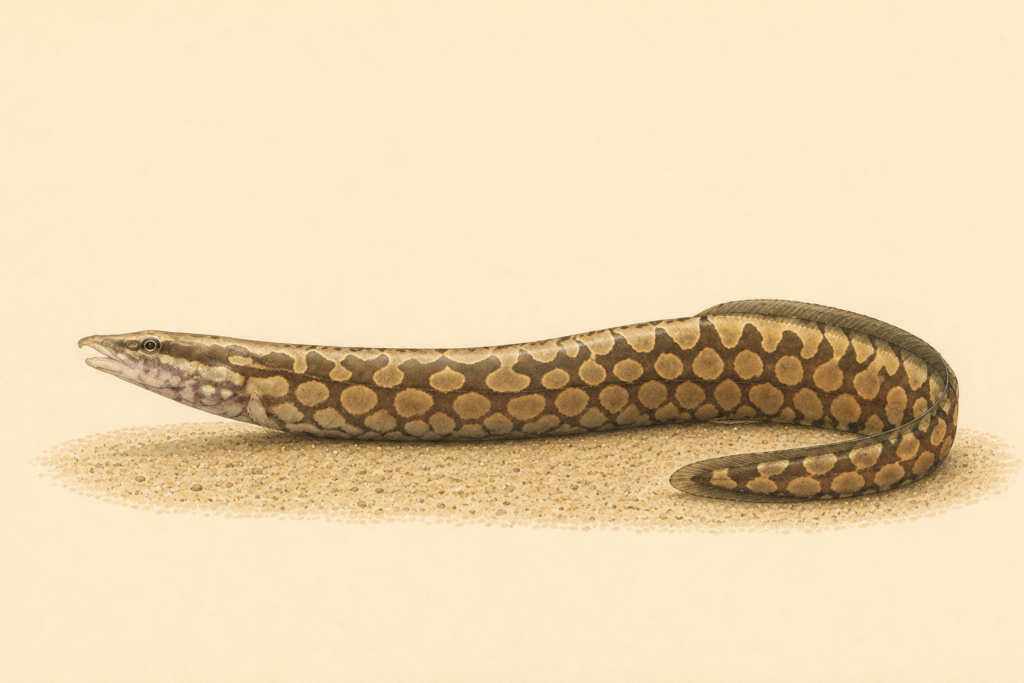
Quick Summary
The Zig-zag Eel is a large, predatory spiny eel that can reach 60-90 cm in captivity and demands a spacious tank of at least 450 litres with soft sand substrate for burrowing – it is suited only to experienced fishkeepers willing to commit to its long-term care and specialised requirements.
🐠 Build a tank around this species
Grows large. Read this before buying. The Zig-zag Eel is usually sold as a small juvenile and is easy to keep at that size, but a healthy adult reaches around 75 cm. A juvenile will be happy in a standard tank for its first year or so. An adult needs a very large tank, six feet long or more, and the water changes to match. Decide now whether you will build for the adult, or have a realistic rehoming plan, because public aquaria and specialist keepers are often full. It is a superb fish for the keeper who plans for it and a sad one for everyone else.
In this guide:
- Introduction
- Quick Stats
- Appearance
- Natural Habitat
- Tank Size and Setup
- Water Parameters
- Diet and Feeding
- Behaviour and Temperament
Introduction
The Zig-zag Eel (Mastacembelus armatus), also known as the Tyre-track Eel or Marbled Spiny Eel, is one of the largest members of the family Mastacembelidae and among the most impressive freshwater fish available in the aquarium trade. With its elongated, serpentine body, striking patterning, and fascinating burrowing behaviour, it captures the imagination of many fishkeepers. However, this is emphatically not a beginner’s fish. Growing to a substantial 60-90 cm in a home aquarium, it requires a very large tank, carefully chosen substrate, and a diet of meaty foods to thrive. Its predatory nature means that any fish small enough to fit in its mouth will eventually become a meal, and its nocturnal habits mean that casual observers may rarely see it during the day.
Despite these challenges, the Zig-zag Eel rewards dedicated keepers with decades of companionship – individuals can live fifteen years or more in captivity – and a personality that is far more engaging than its shy reputation might suggest. Over time, many specimens learn to recognise their keeper and will emerge at feeding time to accept food from forceps or even from the hand. For the advanced aquarist with the space and commitment to provide for this species properly, the Zig-zag Eel is a genuinely rewarding centrepiece fish.
Quick Stats
| Scientific name | Mastacembelus armatus |
|---|---|
| Common names | Tyre-track Eel, Marbled Spiny Eel, White-spotted Spiny Eel |
| Family | Mastacembelidae |
| Origin | South and Southeast Asia |
| Adult size | 75 cm |
| Lifespan | 10–18 years |
| Difficulty | Advanced |
| Breeding difficulty | Advanced |
| Temperature | 23–28 °C |
| pH | 6.5–7.5 |
| GH | 5–15 dGH |
| KH | 3–10 dKH |
| Minimum tank size | 450 L |
| Conservation status | Least Concern (IUCN) |
Appearance
The Zig-zag Eel has a long, compressed, eel-like body that can appear almost snake-like at first glance, though it is a true bony fish rather than an eel in the strict sense. The body is covered in small, embedded scales that give the skin a smooth, slightly slimy texture. The dorsal, caudal, and anal fins are fused into a single continuous fin that runs along the rear portion of the body, providing the undulating locomotion that makes these fish such graceful swimmers. The pectoral fins are small and rounded, and there are no pelvic fins at all.
The most distinctive feature is the elongated, flexible snout that terminates in a pair of tubular nostrils, giving the fish a characteristically pointed face. This proboscis-like snout is highly mobile and is used to probe sand and crevices for food. The eyes are relatively small and set well back on the head. Along the leading edge of the dorsal fin runs a series of short, sharp spines – the hallmark of the spiny eel family – which can prick an unwary handler and are the origin of the common name.
The base colour is typically dark brown to olive, overlaid with a bold pattern of irregular, interconnected pale markings that create the “zig-zag” or “tyre-track” effect. This patterning is highly variable between individuals; some specimens display crisp, well-defined lines that genuinely resemble tyre tracks, whilst others show a more marbled or reticulated pattern. The belly is generally lighter, ranging from cream to pale yellow. Juveniles tend to display sharper contrast, though well-maintained adults retain vivid markings throughout their lives.
Sexing this species externally is extremely difficult. Mature females are sometimes reported to be slightly heavier-bodied than males of the same length, but this is not a reliable indicator. There are no obvious differences in finnage, colour, or patterning between the sexes.
Natural Habitat
Mastacembelus armatus has an exceptionally broad natural range, spanning much of South and Southeast Asia. It is found in river systems across India, Sri Lanka, Pakistan, Bangladesh, Nepal, Myanmar, Thailand, Laos, Cambodia, Vietnam, peninsular Malaysia, and parts of Indonesia. This wide distribution means the species inhabits a considerable variety of freshwater environments, though it shows clear preferences for certain habitat types.
In the wild, Zig-zag Eels are most commonly found in slow to moderately flowing rivers and streams with sandy or muddy substrates. They are strongly associated with submerged cover – fallen trees, root tangles, undercut banks, boulder fields, and dense marginal vegetation all provide the hiding places this species depends upon during daylight hours. They are also encountered in the still waters of floodplain lakes, marshes, and irrigation canals, particularly during the monsoon season when seasonal flooding connects these habitats to the main river channels.
The substrate in their native habitats is typically soft – fine sand, silt, or clay – which allows the eels to burrow and bury themselves partially or completely. This burrowing behaviour is a core part of their biology, serving both as a predation strategy and as protection from larger predators. Water conditions across their range vary, but they generally inhabit slightly acidic to neutral waters with moderate hardness. Temperatures fluctuate seasonally but typically remain within the 23-28 C range.
During the day, Zig-zag Eels remain hidden, emerging at dusk and through the night to forage. Their diet in the wild consists primarily of aquatic invertebrates – insect larvae, worms, crustaceans, and small molluscs – supplemented by small fish. They are opportunistic predators that rely heavily on their excellent sense of smell to locate prey in murky water or within the substrate.
Tank Size and Setup
The single most important consideration for this species is tank size. A fully grown Zig-zag Eel at 60-90 cm requires a substantial aquarium. The absolute minimum for a single adult is 450 litres, and a tank of 600 litres or more is strongly recommended. The tank’s footprint matters more than its height; a long, wide tank is far more appropriate than a tall, narrow one. A minimum footprint of 180 cm x 60 cm is ideal for a single adult specimen. Juveniles can be started in smaller quarters, but growth is reasonably fast in good conditions, and keepers must have an upgrade plan in place before purchasing this species. Keeping a large spiny eel in an undersized tank leads to stress, poor health, and a significantly shortened lifespan.
Soft sand substrate is non-negotiable for this species. Zig-zag Eels are compulsive burrowers that will attempt to dig into whatever substrate is provided. Gravel, crushed coral, or any coarse substrate will abrade and damage their scaleless skin, leading to bacterial and fungal infections that can be fatal. Fine, smooth aquarium sand – either play sand, pool filter sand, or purpose-sold aquarium sand – should be laid to a depth of at least 5-8 cm to allow the eel to burrow comfortably. Some keepers provide even deeper sand beds of 10-15 cm, which the eels clearly appreciate.
Hardscape should include plenty of cover in the form of large pieces of driftwood, smooth rocks, and purpose-made caves or pipe sections. PVC piping of an appropriate diameter makes excellent, inexpensive refuges. Ceramic pipes, coconut shells, and stacked slate caves are also suitable. The key is to provide multiple hiding spots so the eel feels secure; a stressed Zig-zag Eel that cannot find adequate cover will attempt to escape the tank, and this species is a notorious escape artist.
A tightly fitting, weighted lid is essential. Zig-zag Eels are remarkably strong and flexible, and they will find and exploit any gap in the aquarium cover. Every opening – including filter inlet and outlet holes, cable routing gaps, and feeding hatches – must be sealed or blocked. Many experienced keepers use foam or cut acrylic pieces to plug gaps around equipment. A single night of an unsecured lid can result in finding the eel on the floor, often too late.
Planting is possible but can be challenging. The eel’s burrowing will uproot many plants, so sturdy species attached to hardscape – such as Anubias, Java Fern, and Bolbitis – work best. Floating plants like Amazon Frogbit or Water Lettuce help dim the lighting and encourage the eel to emerge earlier in the evening. Subdued lighting is strongly preferred; bright, unshaded lighting will keep the eel hidden and stressed.
Water Parameters
| Temperature | 23-28 C |
| pH | 6.5-7.5 |
| General hardness (GH) | 5-15 dGH |
| Carbonate hardness (KH) | 3-10 dKH |
| Ammonia | 0 ppm |
| Nitrite | 0 ppm |
| Nitrate | Below 20 ppm |
The Zig-zag Eel is reasonably adaptable within the ranges listed above, which is unsurprising given the breadth of its natural distribution. That said, stability is far more important than hitting a specific number. Sudden swings in temperature or pH are poorly tolerated and can trigger stress, appetite loss, and disease. A reliable heater and consistent water change schedule are fundamental.
Water quality is critically important for this species. Like many scaleless or reduced-scale fish, the Zig-zag Eel is more sensitive to dissolved waste products – particularly ammonia and nitrite – than fully scaled species. Ammonia and nitrite must always read zero, and nitrate should be kept below 20 ppm through regular water changes. A mature, well-cycled filter is essential before introducing this species; it should never be used to cycle a new tank.
Weekly water changes of 25-30% are recommended for most setups. Given the large tank volumes involved, some keepers find it practical to install a drip water change system or use a Python-style water changer connected directly to a tap. Dechlorinator must always be used. The species tolerates a moderate current but does not require strong flow; a gentle to moderate turnover rate is ideal.
Filtration and Equipment
Filtration for a tank housing a Zig-zag Eel must be robust. This is a large, carnivorous fish that produces a substantial bioload, and the oversized tank required means that powerful filtration is a necessity rather than a luxury. External canister filters are the most popular choice for tanks of this size, and many keepers run two large canisters to provide adequate biological and mechanical filtration. A total turnover rate of at least six to eight times the tank volume per hour is a reasonable target.
Sump-based filtration is an excellent option for tanks of 600 litres and above, offering greater water volume, easier maintenance access, and the ability to house additional media. If a sump is used, the overflow and return plumbing must be designed to prevent the eel from entering the pipework – Zig-zag Eels will investigate and enter any opening they can fit through, and they can fit through surprisingly small gaps.
Filter inlets should be covered with a fine mesh or sponge pre-filter to prevent the eel from injuring itself on the intake strainer. Coarse intake guards are often insufficient, as juveniles in particular can be drawn against them and injured.
A reliable, appropriately rated aquarium heater is essential. For large tanks, two heaters are often preferable to one, both for redundancy and for even heat distribution. A heater guard or in-line heater is strongly recommended; the eel can wrap around an unguarded glass heater and sustain severe burns. Titanium heaters or externally mounted in-line heaters eliminate this risk entirely.
Lighting should be subdued. The Zig-zag Eel is nocturnal and will be far more active and visible under dim conditions. A timer-controlled light with a gradual dimming function, or the use of floating plants to diffuse light, will help replicate the shaded conditions the species prefers. A separate blue or red “moonlight” LED can allow observation of nocturnal activity without disturbing the eel.
Diet and Feeding
The Zig-zag Eel is an obligate carnivore that requires a diet rich in high-quality protein. In the wild, it feeds on a variety of invertebrates and small fish, and this should be reflected in captivity. Newly acquired specimens are frequently reluctant feeders and may initially accept only live foods. Patience is essential during this acclimatisation period, which can last several weeks.
Excellent staple foods include frozen bloodworm, frozen prawns (chopped to an appropriate size), frozen lancefish, frozen whitebait, earthworms, and frozen or live river shrimp. Earthworms collected from pesticide-free gardens are a particularly nutritious and eagerly accepted food item. Mussels and cockles, either fresh or frozen, provide good variety. Some specimens can be trained to accept high-quality carnivore pellets or sinking wafers, which is beneficial for ensuring balanced nutrition, though this should not be relied upon as the sole diet.
Feeding live feeder fish is not recommended. The practice carries a high risk of introducing parasites and diseases, is nutritionally inferior to most alternatives, and is unnecessary given the range of frozen and prepared foods available. If live foods are desired, cultured invertebrates such as earthworms, blackworms, and river shrimp are far safer options.
Feeding should take place in the evening or after lights-out to align with the eel’s natural activity cycle. Long forceps or feeding tongs are invaluable for target-feeding, allowing the keeper to present food directly to the eel’s hiding spot. Over time, most Zig-zag Eels become confident enough to emerge and take food from tongs at the water’s surface. Feed adult specimens every two to three days; juveniles benefit from daily feeding. It is easy to overfeed a large predatory fish, and obesity is a genuine health concern. A slight concavity to the belly just before a feeding day is normal and healthy.
Behaviour and Temperament
The Zig-zag Eel is primarily nocturnal and, particularly when newly introduced, may spend the entirety of the daylight hours buried in sand or wedged into a crevice. This is completely normal behaviour and should not cause concern. As the eel settles in – a process that can take weeks or even months – it will gradually become bolder, often resting with just its head protruding from a hiding spot during the day and emerging earlier in the evening.
Despite their sometimes serpentine appearance, Zig-zag Eels are not aggressive fish in the conventional sense. They are not territorial towards similarly sized tankmates and do not chase or harass other fish. However, they are unambiguous predators. Any fish, shrimp, or invertebrate small enough to be swallowed will eventually be eaten, usually under cover of darkness. This is not aggression; it is simply predation, and the keeper must plan tankmate choices accordingly.
With conspecifics, behaviour is variable. Some keepers successfully maintain groups, but this requires very large tanks with abundant hiding places. In insufficiently large quarters, Zig-zag Eels may compete aggressively for preferred hiding spots, and dominant individuals can prevent subordinates from feeding. Unless the tank is exceptionally spacious – 800 litres or more for a pair, with many more hiding spots than eels – keeping a single specimen is the safer approach.
One of the most endearing traits of this species is the degree to which individuals can learn to recognise their keeper. Well-established specimens will often emerge from hiding when they detect the vibrations of approaching footsteps or the sound of the tank lid being opened. Some will accept food directly from the keeper’s hand, though caution is warranted – the eel’s small, conical teeth can deliver an unexpected nip that, while not dangerous, is startling.
The burrowing behaviour is a constant feature. The eel will rearrange sand, create tunnels, and occasionally shift lightweight decor. This is healthy, natural behaviour and should be accommodated rather than discouraged. Ensuring that rockwork is securely positioned – ideally resting on the tank base glass rather than on top of the sand – prevents the risk of a collapse caused by burrowing undermining a heavy stone.
Tank Mates
Choosing tankmates for a Zig-zag Eel requires careful thought. The overriding rule is simple: anything small enough to fit in the eel’s mouth will eventually be eaten. For an adult Zig-zag Eel, this includes surprisingly large fish – a 70 cm specimen can swallow a fish of 10-12 cm with ease. Suitable companions are therefore limited to robust, medium-to-large species that are too big to be considered prey and too peaceful to bully the eel. Highly aggressive or territorial species that might harass a slow-moving, nocturnal tankmate should also be avoided.
Good tank mates
- Common Pleco – A sturdy, large-bodied catfish that occupies different areas of the tank and is far too large and armoured to be eaten.
- Sailfin Pleco – Another large plecostomus species whose size and tough skin make it a safe companion.
- Clown Loach – A sociable, good-natured species that reaches a large enough adult size to coexist safely when kept in groups.
- Silver Dollar – A peaceful, deep-bodied schooling fish that grows large enough to avoid predation when kept as adults.
- Bala Shark – An active, mid-water swimmer that reaches a substantial size and is too fast and large to be at risk.
- Giant Gourami – A calm, large cichlid-relative that is peaceful towards non-competing species and far too big to be eaten.
- Featherfin Catfish – A large, peaceful synodontid catfish that is a compatible bottom-dweller in a spacious tank.
- Blood Parrot Cichlid – A robust, moderately sized cichlid that is generally too deep-bodied and peaceful enough to coexist.
Fish to avoid
- Neon Tetra – Far too small; would be eaten within hours of the lights going out.
- Guppy – A bite-sized livebearing fish that would be treated as live food.
- Cherry Shrimp – All dwarf shrimp species are natural prey items for spiny eels.
- Zebra Danio – Too small to survive alongside a large predatory eel.
- Flowerhorn Cichlid – Highly aggressive and territorial; likely to injure or stress the eel.
- Red Devil Cichlid – An extremely aggressive cichlid that would bully a nocturnal, non-confrontational species like the Zig-zag Eel.
- Oscar – Although sometimes suggested, large Oscars can be boisterous and may harass the eel, particularly at feeding time; the risk generally outweighs the benefit.
- Corydoras Catfish – Too small and would be eaten; their defensive spines can also lodge in the eel’s throat, potentially killing both fish.
Breeding
Breeding the Zig-zag Eel in captivity is exceptionally rare and has been achieved only a handful of times by experienced aquarists and commercial breeders. The vast majority of specimens available in the trade are wild-caught. The difficulty arises from multiple factors: sexing adults visually is near-impossible, the species requires an extremely large tank for a breeding pair, and the triggers for spawning are poorly understood.
In the wild, spawning is believed to be linked to the monsoon season, with rising water levels, increased flow, and a drop in water hardness serving as environmental cues. Successful captive breeding reports have generally involved simulating these conditions through large, cool water changes, a period of reduced feeding followed by heavy conditioning with high-quality live foods, and the provision of a very large, well-planted tank with ample cover.
When spawning does occur, eggs are typically deposited among floating plants or fine-leaved vegetation near the water’s surface. The eggs are small, adhesive, and translucent. Parental care is absent; the adults may consume the eggs if they are not removed. Hatching occurs within three to four days at around 26-27 C, and the tiny fry are initially very difficult to feed, requiring infusoria or similarly minute live foods before graduating to newly hatched brine shrimp.
Given the extreme difficulty involved, breeding should not be a primary motivation for keeping this species. Those interested in attempting it should be prepared for a long-term project requiring a dedicated tank of 800 litres or more, multiple specimens to increase the odds of having a compatible pair, and considerable patience.
Common Diseases
The Zig-zag Eel’s reduced scalation and tendency to burrow make it more susceptible to certain health issues than many fully scaled fish. Prevention through excellent water quality and a suitable substrate is always preferable to treatment, particularly because this species is sensitive to many common aquarium medications.
Skin abrasion and secondary infection is the most commonly encountered problem and is almost always caused by inappropriate substrate. Gravel, sharp sand, or rough decor items cause abrasions through which bacteria and fungi readily enter. Affected eels develop reddened patches, white fuzzy growths, or open sores on the body. Treatment involves correcting the substrate, maintaining pristine water quality, and using a broad-spectrum antibacterial or antifungal medication at a reduced dose. Salt baths at 1-2 teaspoons per litre for 10-15 minutes can also be effective for mild cases.
Ich (white spot disease) can affect Zig-zag Eels, and scaleless fish are often among the first in a tank to show symptoms. The characteristic white spots may be less distinct on the eel’s smooth skin but are usually visible on the fins. Standard ich medications containing copper or malachite green must be used at half the recommended dose or avoided entirely, as scaleless fish absorb these chemicals more readily and can be fatally poisoned. Heat treatment – gradually raising the temperature to 30 C for 10-14 days – is a safer first-line approach.
Internal parasites are a common concern with wild-caught specimens. Symptoms include weight loss despite a good appetite, stringy or white faeces, and a gradual decline in condition. Anti-parasitic medications containing praziquantel or levamisole are generally safe for spiny eels and effective against common internal worms. A prophylactic treatment course upon acquisition is considered good practice by many experienced keepers.
Stress-related issues – including appetite loss, colour fading, and increased hiding – are frequently seen in newly acquired specimens or those kept in unsuitable conditions. The most common causes are insufficient hiding places, too-bright lighting, aggressive tankmates, and poor water quality. Addressing the underlying cause is the only effective treatment.
FAQs
How big do Zig-zag Eels actually get in a home aquarium?
In a well-maintained, appropriately sized aquarium, Zig-zag Eels commonly reach 60-75 cm, with exceptional specimens exceeding 80-90 cm. Growth is influenced by diet, tank size, and water quality, but even in modest conditions they will comfortably surpass 50 cm. Do not purchase this species expecting it to stay small – it will not.
Can I keep a Zig-zag Eel in a tank with gravel substrate?
No. Gravel is unsuitable for this species. Zig-zag Eels are compulsive burrowers, and gravel will abrade and damage their delicate skin, leading to infections that can be fatal. Fine, smooth sand is the only appropriate substrate. This is not a matter of preference but of the animal’s basic welfare.
Why does my Zig-zag Eel never come out during the day?
This is completely normal behaviour, especially in newly introduced specimens. Zig-zag Eels are nocturnal by nature and may remain hidden for the entire photoperiod. Over time, as the eel becomes accustomed to its environment and associates your presence with food, it will likely become more visible. Subdued lighting, plenty of cover, and consistent evening feeding all help encourage earlier emergence.
Is the Zig-zag Eel venomous or dangerous to handle?
The Zig-zag Eel is not venomous. However, the series of small, sharp spines along the leading edge of its dorsal fin can prick the skin and cause a painful, stinging sensation. While not dangerous, it is uncomfortable, and the wound can become infected if not cleaned. Use a wet towel or net rather than bare hands when handling is absolutely necessary, and avoid handling altogether whenever possible.
Can I keep two Zig-zag Eels together?
It is possible, but only in a very large tank – 800 litres or more – with an abundance of separate hiding places. In smaller quarters, dominant individuals may monopolise the best refuges and outcompete subordinates for food, leading to chronic stress and health decline in the weaker eel. If you wish to keep more than one, provide at least twice as many hiding spots as eels, and monitor closely for signs of bullying or weight loss in any individual.
Related Guides
- Fire Eel – Another large Mastacembelus species with similar care requirements, often considered alongside the Zig-zag Eel by keepers interested in spiny eels.
- Peacock Eel – A smaller, more manageable spiny eel species suitable for keepers who want the spiny eel experience in a moderately sized tank.
- Clown Loach – A popular large-tank companion for Zig-zag Eels, with complementary care requirements and compatible temperament.
- Common Pleco – A frequently recommended tankmate for large predatory fish, with its own specific care needs worth understanding.
- Giant Gourami – Another large, peaceful species often kept in the same community setups as Zig-zag Eels in very spacious aquariums.