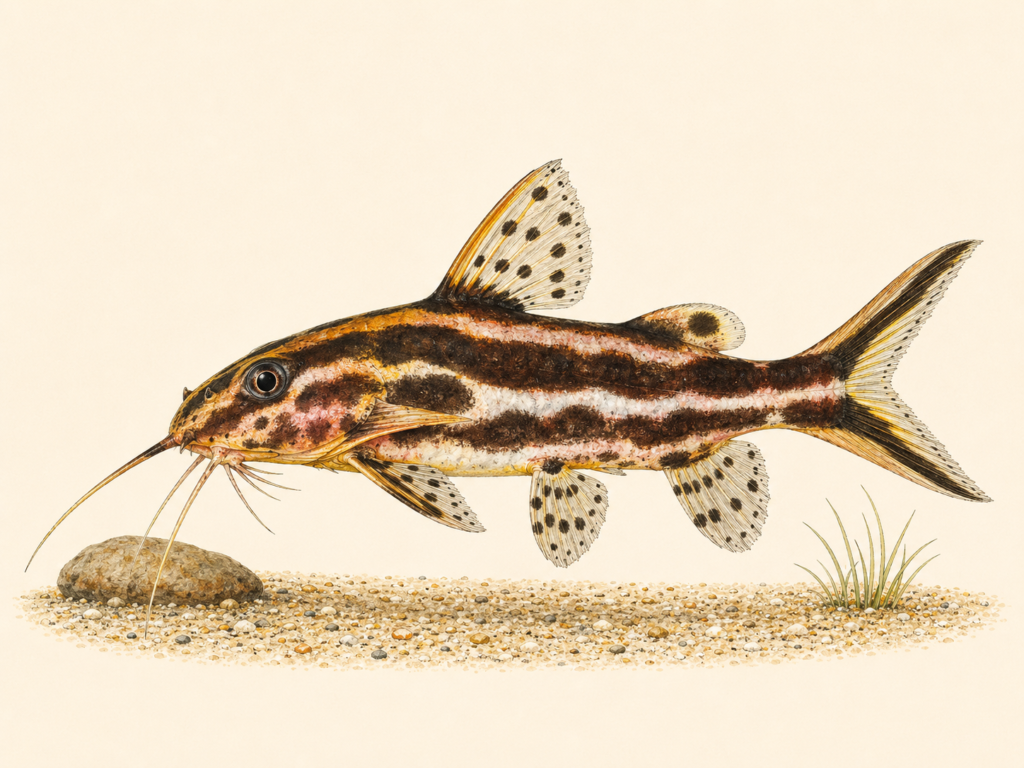
Quick summary
The Orange Striped Squeaker is a striking but moderately difficult Congo River catfish best suited to aquarists with some catfish experience, a large tank of at least 200 litres, and plenty of hiding spots for this nocturnal, cave-dwelling species. It’s peaceful and adaptable to community life, but breeding is very difficult and mostly unaccomplished by hobbyists, so this fish is really for keepers focused on care and display rather than propagation.
🐠 Build a tank around this species
In this guide:
- Introduction
- Quick Stats
- Appearance
- Natural Habitat
- Tank Size and Setup
- Water Parameters
- Filtration and Equipment
- Diet and Feeding
- Behaviour and Temperament
- Tank Mates
- Breeding
- Common Diseases
- FAQs
Introduction
The Orange Striped Squeaker (Synodontis flavitaeniatus) is one of the most visually striking members of the Synodontis catfish genus, a group that has long captivated freshwater aquarists with their unusual behaviours and often remarkable patterning. Native to the Congo River basin in Central Africa, this species stands out from its relatives thanks to its bold orange-yellow stripes set against a dark chocolate-brown to near-black body. The contrast is genuinely eye-catching and gives the fish an almost ornamental quality that few other catfish can rival.
Beyond its appearance, the Orange Striped Squeaker shares a fascinating trait common to many Synodontis species: the ability to produce audible squeaking or croaking sounds. These sounds are generated by the fish locking and rubbing the spines of its pectoral fins against a groove in the pectoral girdle. The squeaking is most commonly heard when the fish is netted, handled, or feels threatened, and it can be surprisingly loud for a fish of its size. This acoustic behaviour gives the entire group their common name of “squeakers” and never fails to intrigue aquarists who encounter it for the first time.
Synodontis flavitaeniatus is a moderately sized catfish that adapts reasonably well to aquarium life, though it does require specific conditions to truly thrive. It is a nocturnal species by nature, spending much of the daylight hours tucked away in caves, crevices, or amongst driftwood, then becoming active at dusk and throughout the night. This shy disposition means that a well-decorated tank with plenty of hiding spots is essential. When kept in appropriate conditions and given the security of a thoughtfully arranged environment, however, this species will often become bolder over time and may even begin to emerge during feeding times while the lights are still on.
This species is not the most commonly available Synodontis in the aquarium trade, and when it does appear it tends to command a higher price than more ubiquitous relatives such as Synodontis eupterus or Synodontis nigriventris. Its relative rarity, combined with its outstanding colouration, makes it a prized addition for keepers who specialise in African catfish or those assembling biotope-style tanks based on the Congo River system. It is generally considered a moderate-difficulty species, suitable for aquarists who have some experience with catfish and are comfortable maintaining stable water conditions.
Quick Stats
| Scientific name | Synodontis flavitaeniatus |
|---|---|
| Common names | Orange Striped Squeaker, Pyjama Synodontis, Orange Striped Synodontis |
| Family | Mochokidae |
| Origin | Congo River basin, DR Congo |
| Adult size | 20 cm |
| Lifespan | 10–15 years |
| Difficulty | Intermediate |
| Breeding difficulty | Advanced |
| Temperature | 23–27 °C |
| pH | 6–7.5 |
| GH | 4–15 dGH |
| KH | 3–10 dKH |
| Minimum tank size | 200 L |
| Conservation status | Least Concern (IUCN) |
Appearance
Synodontis flavitaeniatus is immediately recognisable and rarely confused with other members of its genus once seen in person. The body shape is typical of the Synodontis group: a somewhat flattened ventral profile, a broad head with three pairs of barbels (one pair of maxillary barbels and two pairs of mandibular barbels), a prominent adipose fin, and strong, serrated pectoral and dorsal fin spines. The body is robust and slightly laterally compressed, giving the fish a solid, sturdy appearance.
The defining feature is, of course, the colouration. The base colour is a deep chocolate-brown to near-black, and across this dark canvas run a series of vivid orange to golden-yellow wavy stripes and bands. These stripes run roughly vertically or in slightly irregular, undulating patterns along the flanks. In well-maintained specimens with a good diet, the contrast between the dark base and the bright orange stripes is truly remarkable. The intensity of the orange can vary between individuals and may also be influenced by the fish’s mood, diet, and overall health. Stressed or poorly kept specimens may show muted or faded colouration.
The fins generally follow the body’s colour scheme, with the dorsal, caudal, and anal fins displaying the same orange-on-dark banding pattern, though sometimes as more spotty or blotchy markings rather than clean stripes. The pectoral fin spines are robust and serrated, and care should be taken when netting this species, as the spines can easily become entangled in fine mesh nets and can deliver a painful prick to unwary hands. The adipose fin is well developed and sits prominently on the back, a characteristic feature of the Mochokidae family.
The barbels are relatively long, particularly the maxillary pair, and are used to navigate and forage along the substrate in low-light conditions. The eyes are moderately sized and well adapted for the dim environments the fish prefers. Juveniles tend to display the striped pattern from a young age, though the colouration may intensify and become more defined as the fish matures. There is very little reliable external sexual dimorphism, making it difficult to distinguish males from females by appearance alone, though mature females tend to be slightly fuller-bodied when viewed from above.
Natural Habitat
Synodontis flavitaeniatus is endemic to the Congo River basin in the Democratic Republic of the Congo in Central Africa. The Congo River system is one of the world’s most biodiverse freshwater ecosystems, home to an extraordinary array of fish species, many of which are found nowhere else on Earth. The river and its vast network of tributaries flow through dense tropical rainforest, creating a range of habitats from fast-flowing rapids to slow, murky backwaters.
This species is primarily associated with the middle and lower reaches of the Congo River system. It inhabits areas with rocky substrates, submerged logs, and accumulations of fallen branches and leaf litter. These structures provide the essential hiding places that the species relies on during daylight hours. The water in these habitats is typically warm, slightly acidic to neutral, and relatively soft, though conditions can vary depending on the exact location and the season.
The Congo basin experiences a tropical climate with significant seasonal rainfall, which can influence water levels, flow rates, and water chemistry. During the wet season, flooded forest margins and floodplains provide additional foraging grounds. The substrate in the natural habitat of S. flavitaeniatus tends to be a mixture of sand, gravel, and rocky rubble, with plenty of organic debris. Lighting conditions at the riverbed are generally dim, filtered by the forest canopy above and the tannin-stained water, which suits the nocturnal nature of this species perfectly.
Understanding the natural habitat is invaluable for replicating appropriate conditions in the aquarium. The emphasis should be on providing dim lighting, abundant shelter in the form of caves and wood, a sandy or fine gravel substrate, and water parameters that reflect the warm, soft, slightly acidic conditions of the Congo system.
Tank Size and Setup
A minimum tank size of 200 litres is recommended for a single adult Orange Striped Squeaker, though a larger tank of 300 litres or more is preferable, particularly if keeping more than one individual or housing the fish as part of a community. These catfish are reasonably active at night and appreciate having space to roam and forage. A longer tank footprint is more beneficial than a tall, narrow design, as the fish spends the majority of its time near the bottom of the water column.
The substrate should ideally be fine sand or smooth, rounded gravel. Synodontis catfish use their barbels extensively to sift through the substrate in search of food, and rough or sharp substrates can damage these sensitive sensory organs over time. A natural-looking sand substrate in a tan or brown shade works well and complements the species’ appearance.
Providing ample hiding places is essential for the well-being of this species. Driftwood, bogwood, and branching roots should be arranged to create caves, overhangs, and sheltered nooks. Stacking rocks to form cave-like structures is also highly effective, but ensure all rockwork is stable and cannot collapse, as a curious catfish exploring a poorly secured rock pile could be injured or crushed. PVC pipes or purpose-made ceramic catfish caves can also be used, though natural materials tend to look more appealing and contribute to a more naturalistic setup.
Live plants can be included, though this species is not typically associated with heavily planted environments in the wild. Hardy, low-light species such as Anubias, Java fern, and Bolbitis are good choices, as they tolerate the dim lighting that suits this catfish and can be attached to driftwood rather than rooted in the substrate. Floating plants are an excellent addition, as they help to diffuse overhead lighting and create the shaded conditions the fish prefers.
Lighting should be subdued. Bright overhead lights can cause the fish to remain permanently hidden and may lead to chronic stress. If brighter lighting is needed for plant growth, provide plenty of shaded areas beneath driftwood or floating plants. A moonlight or blue LED night-time setting can be a wonderful way to observe this species during its most active hours without disturbing it.
A secure, tight-fitting lid is recommended. While Synodontis flavitaeniatus is not known as a habitual jumper, startled catfish can leap, and the strong pectoral spines mean that a fish on the floor can be difficult and painful to handle.
Water Parameters
Maintaining stable water parameters within the recommended ranges is important for the long-term health of the Orange Striped Squeaker. As a species from the Congo River basin, it thrives in warm, slightly acidic to neutral water of moderate softness. Sudden fluctuations in temperature, pH, or hardness should be avoided, as these can cause stress and increase susceptibility to disease.
| Temperature | 23-27 °C |
| pH | 6.0-7.5 |
| General hardness (GH) | 4-15 dGH |
| Carbonate hardness (KH) | 3-10 dKH |
| Ammonia | 0 ppm |
| Nitrite | 0 ppm |
| Nitrate | Below 20 ppm |
Regular water changes of 20-30% per week are recommended to keep nitrate levels low and maintain good overall water quality. Use a reliable liquid test kit to monitor parameters regularly, particularly in the weeks following any changes to stocking levels or feeding routines. Dechlorinated or treated tap water that falls within the appropriate ranges is perfectly suitable for this species. Adding Indian almond leaves or alder cones to the tank can help to gently lower pH and release beneficial tannins, mimicking the natural blackwater conditions of the Congo basin.
Filtration and Equipment
Good filtration is essential for keeping Synodontis flavitaeniatus healthy. As a catfish that produces a moderate bioload, an efficient biological and mechanical filtration system is needed to process waste and maintain water clarity. An external canister filter rated for the tank’s volume – or ideally slightly above it – is the best option. Canister filters provide excellent biological filtration capacity, are generally quiet, and allow for flexible media configurations.
Flow rate should be moderate. While the Congo River does contain areas of strong current, this species tends to inhabit sheltered zones amongst rocks and wood. A gentle to moderate flow across the tank, with some calmer areas created by the decor, is ideal. If the filter output is too strong, it can be diffused using a spray bar or directed against the glass to reduce the direct current in the main tank space.
A reliable heater with an accurate thermostat is necessary to maintain stable tropical temperatures. Submersible heaters with external temperature controllers or heaters with built-in digital thermostats are recommended for precision. Always use a separate thermometer to verify the heater’s accuracy, and consider using a heater guard to prevent the catfish from resting against the heater and sustaining burns – a not-uncommon occurrence with bottom-dwelling species.
An air pump with an airstone can be a useful supplementary piece of equipment, helping to ensure good oxygenation, particularly in warmer tanks where dissolved oxygen levels are naturally lower. This species appreciates well-oxygenated water, so surface agitation from the filter return or an airstone is beneficial.
Lighting should be adjustable or naturally dim. LED units with dimming capability or timer-controlled moonlight settings are ideal, allowing the keeper to observe the fish during its active hours without causing stress. If using standard aquarium lighting for plant growth, ensure that the photoperiod is consistent and that shaded retreats are available throughout the tank.
Diet and Feeding
Synodontis flavitaeniatus is an omnivore with a preference for meaty foods, though it will accept a wide variety of foodstuffs in captivity. In the wild, its diet consists of insect larvae, small invertebrates, organic detritus, algae, and plant matter gleaned from submerged surfaces and the substrate. In the aquarium, replicating this varied diet is straightforward and key to maintaining vibrant colouration and good health.
A high-quality sinking pellet or wafer designed for catfish should form the staple of the diet. These pellets sink to the substrate where the fish can find them during its nocturnal foraging. Look for formulations that contain a good balance of protein and vegetable matter. Sinking catfish tablets and algae wafers are readily accepted and provide a convenient base diet.
Supplementary foods should be offered regularly to provide variety and enrichment. Frozen or live bloodworm, brine shrimp, daphnia, mosquito larvae, and tubifex are all eagerly consumed. Blanched vegetables such as courgette (zucchini), cucumber, and shelled peas can also be offered occasionally and contribute to a balanced nutritional profile. Some keepers report that their specimens will also accept small pieces of prawn or mussel.
Feed primarily in the evening or after lights out to align with the species’ natural nocturnal activity pattern. Dropping food into the tank just before or just after the lights go off ensures that the catfish gets its share before diurnal tank mates can consume everything. Overfeeding should be avoided, as uneaten food will decompose and compromise water quality. Offer only as much as the fish can consume within a few hours, and remove any uneaten fresh foods the following morning.
A well-fed Synodontis flavitaeniatus will display richer, more intense colouration. Colour-enhancing foods containing astaxanthin or spirulina may help to bring out the vivid orange tones in the striping, though a varied, nutritious diet is the most important factor in maintaining the fish’s best appearance.
Behaviour and Temperament
The Orange Striped Squeaker is generally a peaceful, somewhat reclusive species. It is primarily nocturnal, spending the daylight hours hidden within caves, under driftwood, or tucked into crevices. As dusk falls, it becomes active, emerging to explore the tank and forage across the substrate. In a well-established tank with ample hiding places, the fish may gradually become more confident and begin to appear during the day, particularly at feeding time.
This species can be kept singly or in small groups. When kept in groups, there may be some territorial behaviour, particularly around favoured hiding spots. Providing more caves and shelters than there are fish helps to reduce competition and minimise aggression. Squabbles are generally brief and rarely result in injury, consisting mainly of chasing and mild fin-flaring. In larger tanks with sufficient cover, groups of three or more can coexist very well, and a small group often results in bolder, more visible fish, as the security of numbers reduces individual shyness.
The squeaking behaviour for which this genus is named is most commonly observed when the fish is stressed, being netted, or handled. The sound is produced mechanically by the pectoral fin spines and can be quite audible even through the water. While fascinating, the squeaking is a stress response, and frequent squeaking may indicate that the fish is being disturbed too often or that tank conditions are not ideal.
Synodontis flavitaeniatus may occasionally swim in an inverted position, a behaviour more commonly associated with its relative Synodontis nigriventris, the Upside-Down Catfish. While not as habitual an inverter as that species, S. flavitaeniatus may feed from the underside of driftwood or rocks while upside down, and this is entirely normal behaviour.
This catfish is not a threat to plants and generally ignores them, though it may occasionally uproot poorly secured stem plants while foraging. Attaching plants to hardscape rather than planting them in the substrate avoids this issue entirely.
Tank Mates
Synodontis flavitaeniatus is a peaceful species that can be housed with a wide range of similarly sized, non-aggressive community fish. The best companions are those that occupy different areas of the water column or are active during different times of the day, reducing competition for food and space. Avoid very small fish that might be mistaken for food by a large adult catfish, and avoid highly aggressive or territorial species that could bully the relatively passive squeaker. An ideal community draws from African species to create a biotope-style setup, though the fish is adaptable enough to live harmoniously with compatible species from other regions.
Good tank mates
- Congo Tetra – An excellent mid-water companion from the same geographic range that adds colour and movement to the upper levels of the tank.
- African Butterfly Fish – A surface-dwelling species that occupies a completely different zone and shares similar water parameter requirements.
- Kribensis – A generally peaceful West African cichlid that coexists well provided both species have adequate hiding spaces.
- Bristlenose Pleco – A hardy, peaceful bottom-dweller that will not compete aggressively with the Synodontis for territory.
- Synodontis eupterus – A related species of similar size and temperament that can work well in a larger tank with ample cover.
- Rainbowfish – Active, colourful mid-water swimmers that are too fast and large to be considered prey and share compatible water parameters.
- Leopard Bush Fish – Another Congo basin native that occupies similar habitats and adds an interesting predatory dynamic to the mid-water zone without threatening the catfish.
- African Red-Eye Tetra – A robust, active schooling fish from the Congo basin that complements the catfish nicely in a biotope setup.
Fish to avoid
- Oscar – Large, aggressive New World cichlids that could bully or injure the catfish and require very different tank dynamics.
- Neon Tetra – Too small and could be eaten by a fully grown Orange Striped Squeaker, particularly at night when the catfish is active.
- Jack Dempsey – A highly territorial and aggressive cichlid that would pose a constant threat of harassment or injury.
- Red-Tail Catfish – Grows enormous and is a voracious predator that would eventually consume any Synodontis kept alongside it.
- Dwarf Shrimp – Far too small and would almost certainly be consumed by the catfish, particularly during nocturnal foraging.
- Flowerhorn – An extremely aggressive hybrid cichlid wholly incompatible with peaceful catfish species.
- African Pike Cichlid – A predatory species that may target the catfish or cause persistent stress through aggression.
- Celestial Pearl Danio – Much too small to be housed safely with a catfish that could reach 20 cm.
Breeding
Breeding Synodontis flavitaeniatus in captivity is considered difficult and is rarely accomplished by hobbyists. There are very few documented cases of successful aquarium spawning, and the vast majority of specimens available in the trade are wild-caught. The primary challenges lie in the difficulty of sexing the fish, the specific conditions likely required to trigger spawning, and the species’ reclusive nature, which makes observing courtship and spawning behaviour extremely challenging.
Sexual dimorphism is minimal. Mature females may appear slightly plumper when viewed from above, particularly when gravid, but this is not a reliable method of sexing. Some experienced keepers report subtle differences in the shape of the genital papilla, with females having a broader, more rounded papilla compared to the more pointed one of males, but this requires close examination and considerable experience to identify with confidence.
In the wild, spawning is likely triggered by seasonal changes in water chemistry, temperature, and water level associated with the onset of the rainy season. Replicating these conditions in the aquarium – through large water changes with slightly cooler, softer water, combined with an increase in high-protein live foods – may encourage spawning behaviour, though success is far from guaranteed.
Some Synodontis species are known to be brood parasites, laying their eggs among those of mouthbrooding cichlids so that the cichlid host incubates them. This behaviour has been well documented in Synodontis multipunctatus, and while it has not been conclusively confirmed in S. flavitaeniatus, the possibility exists that related reproductive strategies may be at play. Providing suitable cichlid hosts in a breeding setup could potentially be worth exploring for dedicated breeders.
If spawning does occur, the eggs are small and adhesive, typically scattered among rocks or within crevices. The parents do not provide parental care and may consume eggs if given the opportunity, so removing the adults or the eggs to a separate rearing tank is advisable. Fry are tiny and will require very fine foods such as infusoria, microworms, or commercially available liquid fry food during their first days, graduating to newly hatched brine shrimp as they grow.
Given the difficulty involved, breeding this species is best approached as a long-term project by experienced aquarists with a thorough understanding of Synodontis biology and the patience to maintain a group of well-conditioned adults over an extended period.
Common Diseases
Synodontis flavitaeniatus is a reasonably hardy species when kept in appropriate conditions, but like all aquarium fish, it can be susceptible to a range of diseases, particularly if water quality is allowed to deteriorate or the fish is subjected to chronic stress.
Ich (white spot disease) is one of the most common ailments affecting freshwater fish, including Synodontis catfish. It presents as small white spots on the body and fins and is caused by the protozoan parasite Ichthyophthirius multifiliis. Treatment involves raising the temperature gradually to 28-30 degrees Celsius and using a suitable medication. However, it is important to note that Synodontis catfish, like many scaleless or reduced-scale species, can be sensitive to certain medications, particularly those containing copper or malachite green. Always use medications at half the recommended dose initially when treating catfish, and monitor the fish closely for adverse reactions.
Bacterial infections can occur, often as secondary infections following physical injury or stress. Symptoms may include reddening of the skin, ulceration, fin erosion, or lethargy. Maintaining excellent water quality is the best prevention, and treatment typically involves antibacterial medications suitable for use with catfish.
Fungal infections, characterised by cotton-like white growths on the body or fins, can also occur, particularly on damaged tissue. These are typically treated with antifungal medications, again used cautiously with scaleless or sensitive species.
Internal parasites may be present in wild-caught specimens. Signs can include weight loss despite a good appetite, white or stringy faeces, and general lethargy. Antiparasitic medications designed for internal parasites should be used under guidance from an experienced aquatic veterinarian or knowledgeable fishkeeper.
Prevention is always preferable to treatment. Maintaining stable water parameters, performing regular water changes, feeding a varied and nutritious diet, quarantining new arrivals before adding them to an established tank, and avoiding overcrowding are all fundamental practices that will significantly reduce the risk of disease. Stress reduction through appropriate tank setup – including plenty of hiding places and subdued lighting – is particularly important for this naturally shy species.
FAQs
Why does my Orange Striped Squeaker hide all day?
This is entirely normal behaviour. Synodontis flavitaeniatus is a nocturnal species that naturally spends daylight hours concealed in caves, under driftwood, or within other sheltered spots. The fish will become active at dusk and forage throughout the night. Over time, and particularly in tanks with subdued lighting and plenty of cover, many individuals become bolder and may emerge during the day, especially around feeding time. Keeping the fish in a small group can also encourage more confident behaviour.
Can I keep more than one Orange Striped Squeaker in the same tank?
Yes, this species can be kept in small groups provided the tank is large enough and there are more hiding spots than fish. A group of three or more in a tank of 300 litres or above generally works well. There may be some minor territorial disputes over preferred caves, but these are rarely serious. Having a group often results in bolder behaviour from each individual, as the security of numbers reduces their natural shyness.
What makes this catfish produce squeaking sounds?
The squeaking sound is produced mechanically when the fish locks and rubs the leading spine of its pectoral fin against a groove in the pectoral girdle, a structure known as the shoulder joint. This creates an audible clicking or squeaking noise. It is primarily a defensive mechanism, used when the fish feels threatened, and is most commonly heard when the fish is being netted or handled. If you hear frequent squeaking from your fish without handling it, consider whether something in the tank environment – such as aggressive tank mates or poor water quality – is causing stress.
Is the Orange Striped Squeaker safe with live plants?
Generally, yes. Synodontis flavitaeniatus does not typically eat or deliberately damage live plants. However, its nocturnal foraging along the substrate can occasionally dislodge poorly rooted stem plants. To avoid this, choose robust species such as Anubias, Java fern, and Bolbitis, which can be attached to rocks or driftwood rather than planted in the substrate. Floating plants are also an excellent choice, as they provide welcome shade and are beyond the catfish’s reach.
How can I tell the difference between male and female specimens?
Sexing Synodontis flavitaeniatus externally is very difficult and not reliably possible for most hobbyists. Mature females may appear slightly plumper than males, particularly when viewed from above, due to the presence of developing eggs. Some experienced keepers can identify subtle differences in the shape of the genital papilla, with females having a broader, more rounded papilla compared to the more pointed one seen in males. Beyond these subtle clues, there is no dependable visual method for determining sex in this species.
Related Guides
- Synodontis eupterus Care Guide – A closely related and widely available featherfin Synodontis that shares many care requirements and is an excellent complementary species.
- Upside-Down Catfish – The famous Upside-Down Catfish, another member of the Synodontis genus with fascinating behavioural traits and similar husbandry needs.
- Congo Tetra Care Guide – A popular and beautiful Congo basin species that makes an ideal mid-water tank mate for the Orange Striped Squeaker.
- Synodontis multipunctatus Care Guide – The well-known cuckoo catfish from Lake Tanganyika, notable for its brood-parasitic breeding behaviour and a fascinating point of comparison within the genus.
- Bristlenose Pleco Care Guide – A widely kept bottom-dwelling catfish that can share tank space peacefully with Synodontis species, useful for comparison of care approaches.