Quick summary
Betta foerschi is not a beginner fish: it demands soft, acidic water (often requiring RO setup) and is genuinely intolerant of typical tap water conditions, so it suits patient, experienced keepers willing to invest in specialist equipment. If you can meet its strict water chemistry needs and want a peaceful, fascinating mouthbrooding species, it can be very rewarding, but casual or first-time fishkeepers should look elsewhere.
🐠 Build a tank around this species
In this guide:
- Introduction
- Quick Stats
- Appearance
- Natural Habitat
- Tank Size and Setup
- Water Parameters
- Filtration and Equipment
- Diet and Feeding
- Behaviour and Temperament
- Tank Mates
- Breeding
- Common Diseases
- FAQs
Introduction
Betta foerschi is a wild-type mouthbrooding betta native to the peat swamp forests of southern Borneo. First described by Vierke in 1979, this species belongs to the foerschi species group – a small cluster of closely related bettas that share remarkably similar morphology. It is a fish that rewards patient, knowledgeable keepers with subtle beauty and fascinating parental behaviour, but it is emphatically not a beginner’s species. Soft, acidic water is not merely preferred but genuinely required, and the species is intolerant of the harder, more alkaline conditions found in most tap water supplies.
One of the most important points any prospective keeper should understand is the genuine difficulty in distinguishing Betta foerschi from its close relatives, Betta mandor and Betta strohi. The morphological differences between these three species are extremely subtle and often unreliable for identification purposes, even for experienced aquarists. Colouration can overlap, fin shape varies between individuals, and preserved specimens have historically caused taxonomic confusion. In practical terms, the most reliable way to confirm the identity of a fish sold as Betta foerschi is to know its collection locality. Reputable specialist importers and breeders will provide locality data with their stock, and this information should be considered essential rather than optional. If a seller cannot tell you where the fish originated, treat the identification with healthy scepticism.
Despite its demanding care requirements, Betta foerschi has a genuine, if niche, presence in the specialist aquarium trade. Dedicated wild betta breeders and specialist importers such as Aquarium Glaser have bred and distributed this species for years. It is not a fish you will find in a typical high-street pet shop, but it is obtainable through specialist channels. In the wild, however, Betta foerschi faces serious threats from habitat destruction – the peat swamp forests of Borneo are under relentless pressure from logging, agriculture, and drainage – and the species is classified as Endangered by the IUCN. Captive breeding efforts therefore carry real conservation value, and responsible husbandry of this species contributes meaningfully to maintaining a viable captive population.
Quick Stats
| Scientific name | Betta foerschi |
|---|---|
| Common names | Foersch's Betta |
| Family | Osphronemidae |
| Origin | Southern Borneo (Kalimantan), Indonesia |
| Adult size | 5 cm |
| Difficulty | Advanced |
| Breeding difficulty | Moderate |
| Temperature | 22–28 °C |
| pH | 4–6 |
| GH | 1–5 dGH |
| Minimum tank size | 54 L |
| Conservation status | Endangered (IUCN, assessed 2018) |
Appearance
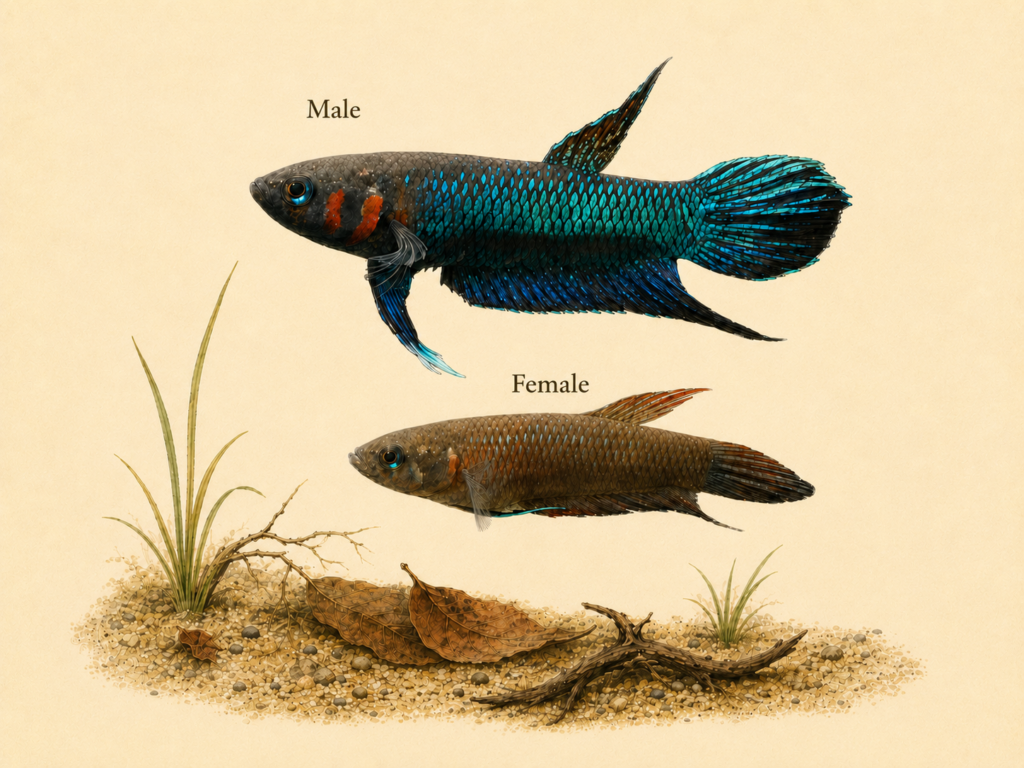
Betta foerschi is a modestly sized, elongated betta with a somewhat compressed body typical of mouthbrooding species. Adults reach approximately 5 to 6 centimetres in total length, making them a relatively small fish even by wild betta standards. The body shape is streamlined and lacks the exaggerated finnage associated with domestic Betta splendens; instead, the fins are short to moderate in length, functional, and proportionate to the body.
The base colouration of Betta foerschi is typically a warm brown to dark brown, sometimes with a reddish or coppery undertone. Males in breeding condition can display considerably more colour intensity, with iridescent green or blue-green scaling visible along the flanks, particularly under good lighting. The opercular (gill cover) region often shows a striking patch of iridescent colour – typically green or turquoise – which becomes especially prominent when the male is displaying. The unpaired fins may show reddish or brownish tones, and the caudal fin is usually rounded to slightly pointed.
Females are generally duller, exhibiting a more uniform brown colouration with less iridescence. They tend to be slightly smaller and less robustly built than males. Sexing can be moderately challenging with young or unstressed fish, but becomes more straightforward once the fish mature and the males begin to display.
It is essential to note that the appearance of Betta foerschi is not reliably distinct from that of Betta mandor and Betta strohi. These three species are part of the foerschi species group and share overlapping colour patterns, body shapes, and fin structures. While some hobbyist literature attempts to delineate them by subtle differences in opercular spot shape, colour hue, or body proportions, these characters are variable within each species and unreliable for definitive identification. The most dependable method of identification remains knowledge of the collection locality. Any fish purchased without locality data should be considered potentially misidentified, regardless of how closely it matches photographs labelled as Betta foerschi.
Natural Habitat
Betta foerschi is found in the peat swamp forests of southern Borneo, specifically in the Indonesian province of Kalimantan. These are extraordinary habitats characterised by waterlogged, heavily forested terrain underlain by thick deposits of peat – partially decomposed organic matter that can accumulate to depths of several metres. The water in these swamps is extremely soft, highly acidic, and stained a deep brown or near-black colour by dissolved tannins and humic acids released from decaying leaf litter and peat.
The water parameters in these habitats are remarkably extreme by typical aquarium standards. The pH frequently drops below 4.0, general hardness is negligible, and the dissolved mineral content is extraordinarily low. Water temperatures tend to be relatively stable and moderate, typically ranging from 22 to 27 degrees Celsius, moderated by the dense forest canopy that shades the water surface. Light penetration is very limited, both because of the dark water colour and the overhead canopy, meaning these are fundamentally dim environments.
The substrate in these habitats consists largely of thick layers of fallen leaves, submerged roots, and decaying wood. Aquatic vegetation may be sparse or absent in the most heavily shaded areas, though marginal plants and emergent vegetation can be found at forest edges. The water is still or extremely slow-moving; these are not riverine habitats but rather pools, ditches, and flooded forest floor areas with virtually no current.
Tragically, the peat swamp forests of Borneo are among the most threatened ecosystems on Earth. Large-scale drainage for palm oil plantations, pulpwood forestry, and agriculture has destroyed vast areas of this habitat. Peat drainage also makes the remaining forest highly susceptible to catastrophic fires, which have become increasingly frequent and devastating. These pressures are directly responsible for the Endangered status of Betta foerschi and many other peat swamp endemics. The loss of these habitats is effectively irreversible on any meaningful human timescale, as peat accumulation occurs over thousands of years.
Tank Size and Setup
An aquarium with a base of 60 x 30 cm or equivalent, around 54 litres, is sufficient for a single pair. For a small group – which is the preferable way to keep this species – a tank of 60 to 80 litres is more appropriate. Larger tanks are always welcome, as they provide greater water volume stability and more space for the fish to establish territories. A long, shallow tank is preferable to a tall, narrow one, as these fish inhabit the lower and middle water column and benefit from horizontal swimming space.
The tank setup should aim to replicate, at least in spirit, the conditions of a Bornean peat swamp. The substrate can be a thin layer of fine sand or bare-bottomed, with a generous covering of dried leaf litter. Indian almond leaves (Terminalia catappa), oak leaves, or beech leaves are all suitable and will release tannins that help to lower pH and stain the water the characteristic brown colour. The leaf litter also serves as a surface for biofilm growth, which provides supplementary grazing for the fish and any fry that may be produced.
Driftwood and bogwood should be included to provide hiding places and visual barriers. Pieces that create caves, overhangs, or narrow gaps are especially valued, as males will often select such spots as retreat sites during mouthbrooding. Coconut shell halves and clay pipes can also serve this purpose. Dense planting is not strictly necessary and may not thrive in the very soft, acidic conditions this species requires, but hardy low-light plants such as Java fern (Microsorum pteropus), Java moss (Taxiphyllum barbieri), and various Cryptocoryne species can do well and provide additional cover.
A tight-fitting lid is essential. Like all bettas, Betta foerschi is a labyrinth fish that breathes atmospheric air and will jump if given the opportunity. Even small gaps around filter inlets or heater cables should be blocked. The humid air layer between the water surface and the lid is also important for the health of the labyrinth organ.
Lighting should be subdued. These are naturally dim-water fish, and bright overhead lighting will cause stress and washed-out colouration. Floating plants such as Salvinia or Riccia can be used to diffuse light, or the tank can simply be lit with a low-intensity LED set on a timer. The tannin-stained water itself will naturally reduce light intensity.
Water Parameters
| Temperature | 22–28 °C |
| pH | 4.0–6.0 |
| General hardness (GH) | 1–5 dGH |
| Ammonia | 0 ppm |
| Nitrite | 0 ppm |
| Nitrate | Below 20 ppm |
The water parameter requirements of Betta foerschi are among the most demanding of any commonly kept aquarium fish, and they should not be underestimated or treated as rough guidelines. This species genuinely requires soft, acidic water. A pH between 4.0 and 6.0 is the acceptable range, with a sweet spot around 5.0 to 6.0 for most captive-bred specimens. Wild-caught fish may prefer the lower end of this range. General hardness should be very low, ideally below 4 dGH, and carbonate hardness should be minimal – 0 to 2 dKH at most.
For most keepers, achieving these parameters will require the use of reverse osmosis (RO) water or a combination of RO water and a very small amount of tap water, depending on local water chemistry. Attempting to keep this species in moderately hard or alkaline water is likely to result in chronic stress, poor colouration, susceptibility to disease, and breeding failure. Peat filtration and the use of botanical materials (leaves, alder cones, driftwood) will help to acidify the water and maintain appropriate conditions, but they are supplements to, not substitutes for, starting with appropriately soft source water.
Temperature should be maintained between 22 and 26 degrees Celsius. This is notably cooler than the tropical temperatures often recommended for domestic bettas, and overheating can be stressful. In many UK homes, a low-wattage heater set to the lower end of this range will suffice, and during summer months, care may need to be taken to prevent the tank from overheating rather than to warm it.
Ammonia and nitrite must be maintained at zero at all times, as with any aquarium fish. Nitrate should be kept below 20 ppm, and lower is better. Regular partial water changes using temperature-matched, appropriately conditioned RO or soft water are essential. When performing water changes, it is important to ensure that the replacement water is of similar pH and hardness to the tank water; a sudden shift from pH 5.0 to pH 7.0, even temporarily, can be deeply stressful or lethal.
Filtration and Equipment
Filtration for Betta foerschi should be gentle and effective. These fish come from still or near-still water, and strong currents will cause stress and exhaustion. A simple air-driven sponge filter is the ideal choice for most setups. It provides adequate biological and mechanical filtration, creates minimal water movement, and is safe for fry if breeding occurs. For larger tanks, a small internal filter or a hang-on-back filter with the flow rate reduced to a trickle can also work, but the output should always be baffled or directed against the glass to minimise current.
A reliable, adjustable heater is necessary to maintain stable temperatures. A heater rated for the tank volume with a thermostat accurate to within one degree is sufficient. Position it near the filter outflow to ensure even heat distribution. A separate thermometer – digital or glass – should be used to verify the heater’s accuracy, as built-in thermostats can drift over time.
Peat filtration can be a valuable addition. Aquarium-grade peat placed in a filter media bag within the filter or in a mesh bag in the tank will release humic acids and tannins, helping to maintain acidic conditions and imparting the brown water colour that these fish find natural. However, peat must be replaced periodically as it exhausts, and its effects on pH should be monitored rather than assumed.
An RO unit or access to RO water is, for most keepers, a practical necessity rather than a luxury. The cost and inconvenience of producing or purchasing RO water is a genuine ongoing commitment and should be factored into the decision to keep this species. Some keepers in naturally soft-water areas may be fortunate enough to have tap water that is close to suitable, but this is the exception rather than the rule in the UK.
Lighting should be low-intensity. A basic LED strip on a timer providing 6 to 8 hours of subdued light per day is more than adequate. If live plants are kept, choose species that thrive in low light, as increasing light intensity to benefit plants will come at the expense of the fish’s comfort.
Diet and Feeding
Betta foerschi is a micropredator that feeds primarily on small invertebrates in the wild. In captivity, it will accept a range of foods, but live and frozen foods should form the core of the diet. Suitable staple foods include frozen or live bloodworm, daphnia, brine shrimp (Artemia), mosquito larvae, and grindal worms. White worms and micro worms can also be offered, particularly for conditioning breeders.
Some captive-bred specimens will learn to accept high-quality micro-pellets or granules designed for small carnivorous fish. However, this should not be assumed, and newly acquired fish may refuse dry foods entirely. It is wise to have a supply of frozen foods on hand when first obtaining this species. Even fish that do accept pellets will benefit from a varied diet that includes regular offerings of live or frozen prey.
Feed small amounts once or twice daily, offering only as much as the fish will consume within a few minutes. Overfeeding is a particular concern in the soft, acidic water this species requires, as uneaten food will decompose rapidly and can cause dangerous spikes in ammonia and a further drop in already low pH. A weekly fast day is acceptable and can help prevent digestive issues.
When a male is holding eggs or fry in his mouth – a process that can last two to three weeks – he will not eat. This is entirely normal and should not prompt the keeper to attempt force-feeding or excessive food offerings that will simply foul the water. The male should be left undisturbed during this period and will resume feeding after releasing the fry.
Behaviour and Temperament
Betta foerschi is a relatively peaceful species by betta standards. It lacks the intense territorial aggression of Betta splendens and can be kept in pairs or small groups, provided the tank is appropriately sized and structured with sufficient hiding places and visual barriers. Males will display to one another and occasional sparring may occur, but serious injury is uncommon in a well-set-up tank with adequate space.
That said, this is not a gregarious, schooling fish. Individuals maintain loose territories centred around favourite hiding spots, and dominant males will assert themselves over subordinates through posturing and flaring rather than outright combat. In very small tanks, a dominant male may harass a subordinate to the point of chronic stress, so providing ample cover and escape routes is important.
Betta foerschi tends to be somewhat shy and retiring, particularly when first introduced to a new tank or when kept in brightly lit conditions. It spends much of its time hovering near cover – among leaf litter, under driftwood overhangs, or within plant thickets. Activity levels increase during feeding and during courtship and breeding displays. Males will flare their opercula and spread their fins when displaying to females or rival males, revealing the iridescent colours that are otherwise subdued.
As a labyrinth fish, Betta foerschi will regularly visit the water surface to gulp atmospheric air. This is normal behaviour and not a sign of oxygen deprivation, though it underscores the importance of maintaining a humid air layer above the water surface with a tight-fitting lid.
This species is not a strong swimmer and does not appreciate rapid water movement. It occupies the lower to middle water column in most situations and will rarely venture into open water if cover is available nearby. A tank that feels barren or exposed will produce a stressed, pale, and inactive fish; one that is densely furnished with botanicals and hiding places will reveal a more confident and colourful animal.
Tank Mates
Betta foerschi is best kept in a species-only setup or with a very carefully chosen selection of small, peaceful companions that share its requirement for soft, acidic water. The extreme water parameters this species needs immediately rule out the vast majority of common community fish. Any potential tank mate must tolerate a pH below 6.0, very low hardness, and subdued conditions. Additionally, tank mates should be small, non-aggressive, and unlikely to outcompete the relatively slow and shy Betta foerschi for food.
Good tank mates
- Chocolate Gourami (Sphaerichthys osphromenoides) – Shares the same soft, acidic water requirements and peaceful temperament, originating from similar peat swamp habitats.
- Harlequin Rasbora (Trigonostigma heteromorpha) – A small, peaceful schooling fish that tolerates soft, acidic conditions and occupies the mid-water column without bothering bottom-dwelling bettas.
- Ember Tetra (Hyphessobrycon amandae) – Tiny, peaceful, and adaptable to soft, acidic water, making it an unobtrusive companion that stays in the mid to upper water column.
- Pygmy Corydoras (Corydoras pygmaeus) – A diminutive, peaceful bottom-dweller that can tolerate mildly acidic conditions, though it prefers slightly higher pH than the extreme low end of Betta foerschi’s range.
- Kuhli Loach (Pangio kuhlii) – A nocturnal, burrowing species that tolerates soft, acidic water and is unlikely to interact with or disturb the bettas.
- Sparkling Gourami (Trichopsis pumila) – Another small labyrinth fish from Southeast Asia that thrives in similar water conditions and is generally peaceful enough to coexist.
- Licorice Gourami (Parosphromenus deissneri) – A specialist blackwater species with near-identical water requirements, though both species are shy and the tank must be large enough to accommodate territories for each.
Fish to avoid
- Betta splendens (Siamese Fighting Fish) – Aggressive, territorial, and likely to harass or attack Betta foerschi; should never be mixed with wild betta species.
- Common Pleco (Hypostomus plecostomus) – Far too large, produces excessive waste, and is entirely unsuitable for the small, soft-water tanks this species requires.
- African Cichlids – Require hard, alkaline water that is the polar opposite of Betta foerschi’s needs, and most species are far too aggressive.
- Tiger Barb (Puntigrus tetrazona) – A boisterous fin-nipper that will stress and harass the slow-moving, shy Betta foerschi.
- Guppy (Poecilia reticulata) – Requires harder, more alkaline water and will not thrive in the acidic conditions Betta foerschi needs.
- Paradise Fish (Macropodus opercularis) – Too aggressive and territorial to coexist safely with this peaceful, retiring species.
Breeding
Betta foerschi is a paternal mouthbrooder, and its breeding behaviour is one of the most compelling reasons to keep the species. Unlike the bubble-nesting Betta splendens, the male Betta foerschi incubates the fertilised eggs in his mouth for approximately 10 to 18 days, during which time he does not eat. This is a remarkable adaptation and fascinating to observe, though it demands patience and careful husbandry from the keeper.
Breeding is most likely to occur when a well-conditioned pair is maintained in appropriately soft, acidic water with plenty of hiding places and a varied diet rich in live and frozen foods. Courtship typically involves the male displaying to the female with flared opercula and spread fins, often near a preferred hiding spot. If the female is receptive, the pair will engage in a nuptial embrace – the typical anabantoid spawning clasp – in which the male wraps his body around the female and eggs and milt are released simultaneously.
After each embrace, the female collects the fertilised eggs from the substrate, often with assistance from the male, and transfers them to the male’s mouth. This process may be repeated several times over the course of an hour or more. Clutch sizes are typically small, ranging from 10 to 40 eggs depending on the female’s size and condition.
Once the male has all the eggs in his mouth, the female’s role is effectively complete. The male will retreat to a quiet area of the tank and remain largely stationary for the duration of the brooding period. His throat will appear visibly distended, and he may occasionally be seen making chewing or rotating motions to turn the eggs. It is critical that the male is not disturbed during brooding, as stress can cause him to swallow or spit out the eggs prematurely. Tank mates that are too active or inquisitive can be problematic during this period, which is another argument for species-only setups.
After approximately two to three weeks, the male will release fully formed, free-swimming fry. The fry are tiny but relatively well-developed and capable of feeding immediately. Suitable first foods include infusoria, vinegar eels, microworms, and newly hatched brine shrimp nauplii. The fry should be kept in soft, acidic water matching the parents’ conditions, and small, frequent water changes using appropriately prepared water are essential to maintain water quality without causing parameter shocks.
Growth is slow compared to domestic bettas, and the fry will require several months to reach a size where they can be clearly sexed and separated if necessary. Keeping the fry in the parents’ tank is often feasible, as adult Betta foerschi rarely prey on their own young, particularly in a well-furnished tank with ample cover.
Common Diseases
Betta foerschi is generally a hardy species when kept in appropriate water conditions, but it is susceptible to the usual range of freshwater fish diseases, particularly when stressed by improper water parameters. The most common health issues are closely linked to husbandry failures rather than inherent fragility.
Bacterial infections are among the most frequent problems encountered. Fin rot, characterised by fraying or disintegrating fin edges, and body ulcers can occur when water quality deteriorates or when the fish is injured through aggression. Treatment involves correcting water quality, performing regular water changes, and if necessary, using antibacterial medications appropriate for soft, acidic water. Note that some medications can be more potent or behave differently in very soft water, so dosing should be cautious.
Velvet disease (Piscinoodinium) is a parasitic infection that can affect labyrinth fish and may present as a fine gold or rust-coloured dusting on the body and fins. It is often associated with stress and poor water quality. Treatment with proprietary anti-parasite medications is effective if caught early, but prevention through good husbandry is always preferable.
White spot disease (Ichthyophthirius multifiliis) can occasionally occur, presenting as small white cysts on the body and fins. Raising the temperature slightly (within the species’ tolerable range) and treating with a suitable medication can resolve this condition, but again, prevention through stable, clean conditions is the best approach.
Fungal infections may appear as cotton-like growths on the body, fins, or mouth, often secondary to an existing wound or bacterial infection. Antifungal treatments are available, but addressing the underlying cause – typically water quality or aggression – is essential for long-term resolution.
One issue somewhat specific to mouthbrooding bettas is premature egg release or egg swallowing by the brooding male. While not a disease per se, it is a common frustration for breeders and is almost always caused by stress – disturbance from tank mates, excessive water changes during brooding, or vibrations from nearby equipment or foot traffic. Providing a calm, undisturbed environment during brooding significantly reduces the likelihood of this occurring.
FAQs
How can I tell Betta foerschi apart from Betta mandor and Betta strohi?
Honestly, visual identification alone is extremely unreliable. The three species in the foerschi group share overlapping colour patterns, body shapes, and fin structures, and the differences described in scientific literature are often too subtle to assess in living fish. The most reliable method of identification is knowing the collection locality of the fish. When purchasing Betta foerschi, always buy from a reputable specialist breeder or importer who can provide locality data. Without this information, you cannot be certain which species you have.
Can I keep Betta foerschi in tap water?
In the vast majority of cases, no. Most UK tap water is too hard and too alkaline for this species. Betta foerschi requires very soft, acidic water with a pH between 4.0 and 6.0 and a general hardness below 4 dGH. Unless you live in an area with exceptionally soft, acidic tap water, you will need to use reverse osmosis (RO) water, remineralised very lightly if at all, to provide suitable conditions. This is a non-negotiable aspect of keeping this species.
Is Betta foerschi aggressive like Betta splendens?
No. Betta foerschi is considerably more peaceful than the domestic Siamese fighting fish. Males may display and spar mildly with one another, but serious aggression is uncommon in a properly sized and furnished tank. Pairs or small groups can be maintained together successfully. However, they are not immune to territorial behaviour, and providing ample hiding places and visual barriers is important to prevent any one individual from being bullied.
How long does the male hold the eggs in his mouth?
The male typically broods the eggs for approximately 10 to 18 days, though the exact duration can vary depending on temperature and individual variation. During this time, the male will not eat, and his throat will appear noticeably swollen. He should not be disturbed during brooding, as stress can cause him to swallow or prematurely release the developing eggs or fry.
Does Betta foerschi need a heater?
In most UK homes, yes. While Betta foerschi tolerates a somewhat cooler temperature range than many tropical fish (22-28 degrees Celsius), room temperatures in the UK can fluctuate significantly, particularly overnight and during colder months. A low-wattage, adjustable heater will provide the stability this species needs. During hot summer periods, you may need to monitor temperatures to ensure the tank does not overheat rather than underheat.
Related Guides
- Betta mandor Care Guide – A closely related species from the foerschi group with near-identical care requirements, useful for understanding the broader species complex.
- Betta strohi Care Guide – The third member of the foerschi species group, sharing similar husbandry needs and the same identification challenges.
- Chocolate Gourami Care Guide – Another demanding soft-water labyrinth fish from Southeast Asian peat swamps, relevant for keepers interested in blackwater biotope setups.
- Licorice Gourami Care Guide – A specialist blackwater species with overlapping habitat requirements and similarly niche care demands.
- Betta albimarginata Care Guide – A more widely available mouthbrooding wild betta species, useful as a comparison for keepers new to wild-type bettas.