Corydoras Catfish Care Guide — Tank Setup, Feeding and Breeding
Introduction
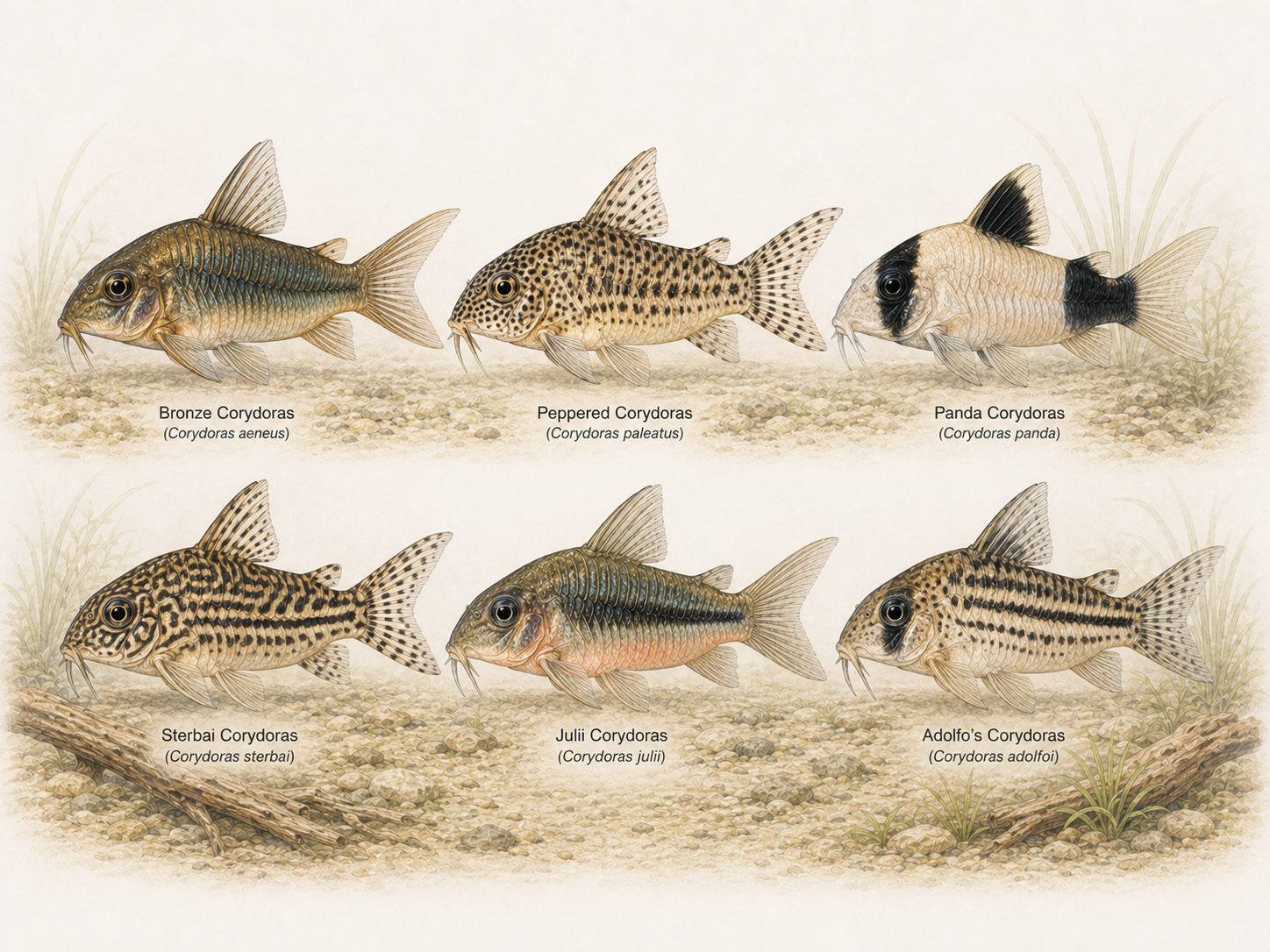
The Corydoras catfish, specifically Corydoras paleatus, is one of the most beloved bottom-dwelling fish in the freshwater hobby. Commonly known as the peppered cory or peppered catfish, this small, armoured catfish has been a staple in community aquariums for well over a century. It was one of the first tropical fish species to be bred in captivity, and its popularity has never waned. There is something deeply endearing about watching a group of corys shuffle across the substrate, their barbels twitching as they sift through sand in search of food. They are charming, social, and genuinely useful members of any community tank.
People love peppered corys for a long list of reasons. They are peaceful to a fault, hardy enough to forgive the occasional beginner mistake, and their constant foraging behaviour adds life and movement to the lower levels of the aquarium, a zone that many other fish simply ignore. They also display fascinating social behaviours when kept in groups, including synchronised swimming, playful chasing, and the remarkable habit of darting to the surface to gulp air. For anyone who has kept a community tank without bottom dwellers, adding a group of corydoras feels like discovering a whole new dimension of the aquarium.
If you are new to fishkeeping, Corydoras paleatus is one of the best species you could choose. They are forgiving of minor water quality fluctuations, they eat a wide variety of foods, and they coexist peacefully with almost anything that will not try to eat them. Experienced keepers love them too, often keeping dedicated cory tanks or breeding them for the rewarding challenge of raising fry. Whether you are setting up your first planted tank or your tenth, the peppered cory deserves a place on your shortlist.
Quick stats
| Scientific name | Corydoras paleatus |
| Family | Callichthyidae |
| Origin | South America, Argentina, Brazil, Paraguay, Uruguay |
| Adult size | 5–7 cm (2–2.75 inches) |
| Lifespan | 5–8 years, occasionally longer |
| Difficulty | Beginner |
| Breeding difficulty | Easy |
| Temperature | 20–26 °C |
| pH range | 6.0–7.5 |
| Minimum tank size | 75 litres (20 US gallons) |
Appearance
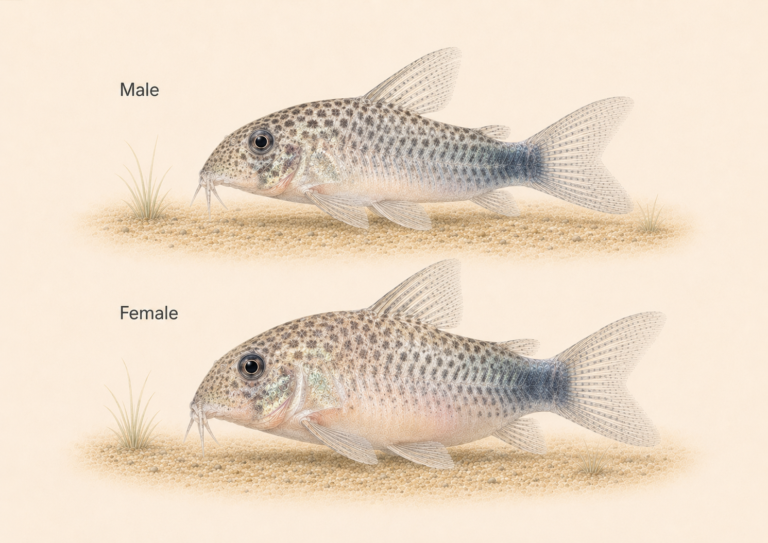
The peppered cory gets its common name from its distinctive patterning, an irregular scattering of dark olive, green, and black blotches across a pale silver or cream body. The pattern is unique to each fish, much like a fingerprint. Their bodies are compact and somewhat flattened on the underside, built for life on the substrate. Two rows of bony plates, called scutes, run along each flank in place of traditional scales, giving them a lightly armoured appearance. The dorsal fin is tall and sometimes tipped with a darker spot, while the pectoral and adipose fins are generally translucent. A pair of sensitive barbels extend from either side of the mouth, which the fish uses to probe the substrate for food. There is also a long-finned variety that has been selectively bred in captivity, featuring flowing, elongated fins that give the fish an almost ethereal quality. An albino form is widely available as well, displaying a pale pinkish-white body with red eyes.
Sexing peppered corys is reasonably straightforward once they reach maturity. Females are noticeably larger and rounder than males, especially when viewed from above. A gravid female will have a distinctly plumper belly compared to the slimmer, more streamlined male. Males also tend to have slightly more pointed pectoral fins and a taller dorsal fin, though these differences are subtle and easiest to spot when you can compare several fish side by side. In terms of colour, both sexes share the same patterning, so body shape is the most reliable indicator.
Natural habitat
Corydoras paleatus is native to the river systems of southeastern South America, with wild populations found across parts of Argentina, southern Brazil, Paraguay, and Uruguay. They inhabit slow-moving rivers, tributaries, streams, and shallow floodplain pools, often in areas with soft, muddy, or sandy bottoms. The waters in these regions are typically warm and slightly acidic to neutral, often stained with tannins from decaying plant matter. Vegetation along the banks provides cover, and fallen branches, leaf litter, and submerged roots create a complex environment where the fish can forage and shelter. These are not fast-flowing mountain streams, corys are adapted to calm, relatively still water with plenty of organic debris on the bottom.
Understanding this natural habitat is important because it directly informs how you should set up your aquarium. Rough or sharp substrates can damage their delicate barbels, so a soft sand or fine gravel substrate is essential. The preference for dimmer, sheltered environments means they appreciate plant cover, driftwood, and shaded areas in the tank. They also come from waters with moderate temperatures, which is worth noting, peppered corys actually prefer slightly cooler water than many tropical fish, and keeping them at the higher end of tropical temperatures for prolonged periods can shorten their lifespan. Replicating even some elements of their wild environment will result in healthier, more active, and more confident fish.
Tank size and setup
A group of six peppered corys needs a minimum of 75 litres (20 US gallons), though 100 litres or more is preferable if you are keeping them in a community setup. Because they are bottom-dwelling fish, floor space matters more than water column height. A longer, shallower tank is better than a tall, narrow one. If you plan to keep a larger group, which they will thank you for, scale up accordingly, a shoal of ten to twelve does beautifully in a 150-litre tank.
Substrate choice is arguably the single most important setup decision for corydoras. Their barbels are sensitive and prone to erosion or infection if kept on sharp gravel. Fine, smooth sand is the best option. Play sand, pool filter sand, or aquarium-specific products like JBL Sansibar or CaribSea Super Naturals are all excellent choices. If you prefer the look of gravel, choose a smooth, rounded variety with a small grain size and avoid anything with jagged edges.
Plants are highly recommended. Corys do not eat or uproot plants, and the cover helps them feel secure. Hardy, low-light species work well, think Anubias barteri, Cryptocoryne wendtii, Java fern (Microsorum pteropus), and Java moss (Taxiphyllum barbieri). Floating plants like Amazon frogbit (Limnobium laevigatum) or Salvinia will diffuse overhead light and create the slightly dimmer conditions that corys prefer. Add some driftwood and a few smooth stones or terracotta caves to provide hiding spots and break up sightlines. These fish are not particularly shy, but they do appreciate having somewhere to retreat.
Lighting should be moderate. If you are running brighter lights for plant growth, floating plants will help tone things down at substrate level. Water flow should be gentle to moderate, corys are not strong swimmers and do not enjoy being buffeted by powerful currents. A sponge filter or a hang-on-back filter with an adjustable flow rate works perfectly.
Water parameters
| Temperature | 20–26 °C (68–79 °F) |
| pH | 6.0–7.5 |
| Hardness (GH) | 2–15 dGH |
| Ammonia | 0 ppm |
| Nitrite | 0 ppm |
| Nitrate | Below 20 ppm |
Peppered corys are more tolerant of cooler water than many tropical species, and in fact they often do better at 22–24 °C than at the upper end of the tropical range. Keeping them consistently above 26 °C can stress them and may reduce their lifespan over time. They handle a broad pH range but do best in slightly acidic to neutral water. Like all fish, they are sensitive to ammonia and nitrite, so make sure your tank is fully cycled before adding them. Regular water changes of 20–30 percent weekly will keep nitrate levels in check. If you are unsure whether your tank is cycled, a liquid test kit such as the API Freshwater Master Test Kit will give you accurate readings.
Filtration and equipment
Because corydoras spend their lives on the substrate, good water quality at the bottom of the tank is critical. A filter rated for your tank volume or slightly above is ideal. Sponge filters are a popular choice for cory tanks because they provide gentle flow, excellent biological filtration, and no risk of trapping small fish or fry. For larger or more heavily stocked tanks, a hang-on-back filter like the Aquaclear series or an internal canister filter works well. If you use a canister filter with a strong output, consider adding a spray bar or lily pipe to diffuse the flow.
A reliable, adjustable heater is worth the investment. The Eheim Jäger or Aquael Ultra Heater are both well-regarded options that hold temperature accurately. Since peppered corys prefer slightly cooler temperatures, you may not even need a heater if your room stays consistently above 20 °C, but in most homes a heater provides valuable stability against overnight temperature drops. A thermometer, either a digital probe or a simple glass stick-on, lets you verify that the heater is doing its job.
As mentioned, a liquid water testing kit is essential, especially during the first few months of a new setup. Test strips can give a rough indication but lack the accuracy and reliability of liquid reagent tests. The API Freshwater Master Test Kit covers ammonia, nitrite, nitrate, and pH, which are the four parameters you will check most often.
Diet and feeding
In the wild, peppered corys are omnivorous scavengers. They sift through substrate and leaf litter feeding on insect larvae, small worms, crustaceans, algae, and decomposing organic matter. They are not picky eaters, and this adaptability carries over into captivity.
A high-quality sinking pellet or wafer should form the foundation of their diet. Hikari Sinking Wafers, Sera Viformo, and JBL NovoCorries are all well-suited options designed to sink quickly and hold their shape long enough for bottom feeders to find and consume them. Supplement these with frozen or live foods such as bloodworm, daphnia, brine shrimp, and tubifex. These protein-rich foods are especially important for conditioning adults prior to breeding and for overall health and colour. Blanched vegetables like courgette (zucchini), cucumber, or shelled peas are appreciated occasionally and add variety.
Feed once or twice daily, offering only as much food as the group can consume in a few minutes. A common mistake is assuming that corys will survive on leftovers from other fish. While they will certainly eat some scraps, relying on this approach will leave them underfed and malnourished. Make sure food reaches the substrate, if mid-water fish are intercepting sinking pellets, try feeding the corys after lights-out or dropping food near their favourite hiding spots.
Behaviour and temperament
Peppered corys are gregarious, peaceful, and endlessly entertaining. They should always be kept in groups of at least six, and larger groups of ten or more really bring out their best behaviour. In a well-stocked group, you will see them shoaling together, resting side by side, and exploring the tank as a loose formation. They are most active during dawn and dusk, though in a well-established tank they will forage throughout the day.
One of their most distinctive behaviours is the surface dash. Corydoras are facultative air breathers, they can gulp atmospheric air at the surface, which is absorbed through their intestinal lining. The occasional trip to the surface is completely normal and nothing to worry about. If they are doing it constantly, however, it may indicate low dissolved oxygen levels or poor water quality, which should be investigated.
Corys are also known for their “winking”, they can independently move their eyes, giving the impression that they are blinking or looking directly at you. It is one of those small details that makes keeping them so rewarding. They are not aggressive in any way and will not bother other fish or invertebrates. Their only defence mechanism is a set of sharp, mildly venomous spines on their pectoral and dorsal fins, which they can lock into place if handled roughly. This is primarily a predator deterrent and is harmless in the context of a community tank, though you should use a container rather than a net when moving them to avoid getting snagged.
Tank mates
Good tank mates
- Neon tetras, peaceful, occupy the mid-water column, and thrive in similar water parameters
- Cardinal tetras, another excellent small tetra that shares the same South American habitat preferences
- Harlequin rasboras, calm, colourful, and stay out of the corys’ territory
- Cherry barbs, peaceful barbs that do well in similar temperatures and water chemistry
- Bristlenose plecos, another peaceful bottom dweller that generally coexists without issue in tanks of 100 litres or more
- Otocinclus catfish, small, gentle algae eaters that complement corys well
- Honey gouramis, one of the most peaceful gourami species, ideal for a calm community
- Amano shrimp, too large to be eaten by corys and helpful algae grazers
- Mystery snails, peaceful, attractive, and completely ignored by corydoras
Fish to avoid
- Oscars, large, predatory cichlids that will eat corydoras
- Jack Dempsey cichlids, aggressive and territorial, a serious threat to small bottom dwellers
- Red-tail catfish, grow enormous and will consume any fish that fits in their mouth
- Common plecos, not aggressive, but grow very large and can outcompete corys for floor space and food in smaller tanks
- Tiger barbs, known fin nippers that can harass slower bottom dwellers
- African cichlids, most species require harder, more alkaline water and are too aggressive for corys
Breeding
Corydoras paleatus is one of the easiest corydoras species to breed in captivity, making it a great starting point for anyone interested in breeding egg-laying fish. Start by establishing a healthy group of at least six adults. More males than females tends to improve success, a ratio of two males to every female works well. Make sure the group is well conditioned with high-protein foods like frozen bloodworm, daphnia, and live brine shrimp for two to three weeks before attempting to trigger spawning.
Spawning is often triggered by a large, cool water change that mimics the onset of the rainy season in their natural habitat. Replace 30–50 percent of the tank water with slightly cooler, dechlorinated water, a drop of two to three degrees Celsius is usually sufficient. Within hours or the following morning, you may observe the classic T-position mating behaviour. The female places her head against the male’s abdomen, forming a T shape, and the pair holds this position while eggs are fertilised. The female then carries a small clutch of sticky eggs in her pelvic fins and carefully deposits them on a hard surface, usually the aquarium glass, broad plant leaves, or the underside of driftwood.
A single spawning event can produce anywhere from 50 to over 200 eggs. The eggs are adhesive and relatively large for a fish this size, about 2 mm in diameter, and are pale white to slightly amber in colour. Fertile eggs will develop a darker centre within a day or two, while infertile eggs turn pure white and should be removed to prevent fungus from spreading. If you want to raise a good number of fry, it is best to gently remove the eggs to a separate hatching container or small tank with an air-powered sponge filter and a few drops of methylene blue to inhibit fungal growth.
Eggs typically hatch in four to six days at around 22–24 °C. The fry are tiny but robust. They will absorb their yolk sac over the first two to three days, after which they need very fine food. Freshly hatched baby brine shrimp (Artemia nauplii) are the gold standard first food. Powdered fry foods or microworms also work well. Keep the water clean with small daily water changes and avoid strong filtration that could trap the fry. Growth is steady, and within six to eight weeks the juveniles will be large enough to join the main tank.
Common diseases and health
Barbel erosion
This is one of the most common issues seen in corydoras and is almost always caused by rough or dirty substrate. Sharp gravel can physically damage the barbels, while a buildup of organic waste in the substrate promotes bacterial infections. Symptoms include shortened, reddened, or completely worn-away barbels. The fix is straightforward: switch to fine sand, increase gravel vacuuming, and improve overall water quality. In most cases the barbels will partially regenerate once conditions improve. Severe bacterial infections may require treatment with a broad-spectrum antibiotic or antibacterial medication.
Ich (white spot disease)
Corydoras can be susceptible to Ichthyophthirius multifiliis, especially after being introduced to a new tank or after a sudden temperature change. Symptoms are the classic white salt-grain spots on the body and fins, along with flashing (rubbing against surfaces) and lethargy. Treat with a temperature increase to 28 °C if the other tank inhabitants can tolerate it, combined with a half-dose of a copper-free ich medication. Corydoras are sensitive to many medications, particularly those containing copper or malachite green at full strength, so always check the product label and dose conservatively.
Red blotch disease
Sometimes called red spot or haemorrhagic septicaemia, this condition presents as red patches or streaks on the belly or around the base of the fins. It is typically caused by bacterial infection, often linked to poor water quality or stress. Improving water conditions is the first and most important step. If symptoms persist, treatment with an antibacterial medication such as eSHa 2000 or API Furan-2 may be necessary.
A note on quarantine: always quarantine new corydoras for at least two to three weeks before adding them to your main tank. These fish are often wild-caught or mass-bred in conditions that can harbour parasites and bacterial infections. A simple quarantine setup, a small tank with a sponge filter, heater, and a hiding spot, can prevent the introduction of disease into an established community. It is a small effort that can save you a great deal of trouble.
Frequently asked questions
How many corydoras should I keep together?
A minimum of six is strongly recommended, and more is always better. Corydoras are shoaling fish that rely on the security of a group to feel confident enough to display natural behaviours. A lone cory or a pair will often be stressed, reclusive, and prone to health problems. In a group of six or more, they become active, social, and genuinely fun to watch.
Can corydoras live with bettas?
Yes, in most cases peppered corys make good companions for a betta. They occupy different zones of the tank and are too armoured and fast-moving for a betta to bother. The main considerations are tank size, at least 75 litres for the group, and temperature. Bettas prefer warmer water around 25–27 °C, which is at the upper end of the peppered cory’s comfort zone. Keeping the tank at 25 °C is a reasonable compromise for both species.
Do corydoras eat algae?
Not in any meaningful way. While corys will occasionally nibble at soft biofilm or algae, they are not algae eaters and should not be purchased for that purpose. They are omnivorous scavengers that need their own dedicated food. If you need algae control, consider otocinclus catfish, amano shrimp, or nerite snails instead.
Why does my corydoras keep swimming to the surface?
Occasional surface dashes are completely normal. Corydoras are facultative air breathers and supplement their oxygen intake by gulping air at the surface, which is then absorbed through the gut lining. If your corys are doing this once every few minutes, there is nothing to worry about. However, if they are constantly at the surface or gasping, check your water parameters, particularly dissolved oxygen, ammonia, and nitrite levels, and increase surface agitation or aeration.
What substrate is best for corydoras?
Fine, smooth sand is the best substrate for any corydoras species. It allows them to perform their natural sifting behaviour without risk of barbel damage. Pool filter sand, play sand, and aquarium sands like JBL Sansibar or CaribSea Super Naturals are all popular choices among cory keepers. Avoid sharp-edged gravel, crushed coral, or any substrate with rough or angular particles.
Related guides
- Corydoras Catfish breeding guide
- Corydoras Catfish tank setup and equipment guide
- Corydoras Catfish diet and feeding guide
- Best tank mates for Corydoras Catfish
- Corydoras Catfish diseases and health guide
- Why is my Corydoras Catfish losing colour?
- Back to the fish species directory
- Beginner’s guide to cycling your tank