Betta mandor Care Guide – Tank Setup, Feeding and Breeding
Quick summary
Betta mandor is not a beginner fish: it demands soft, acidic blackwater conditions (pH 4.0-6.5, near-zero hardness) that rule out standard tap water and community setups, and it needs stable, carefully monitored water quality to thrive. If you have experience keeping wild bettas or other blackwater species and can commit to RO water, botanicals, and a dim, well-covered tank, it’s a rewarding project, but this is a poor choice for a first fish.
🐠 Build a tank around this fish
In this guide:
- Introduction
- Quick Stats
- Appearance
- Natural Habitat
- Tank Size and Setup
- Water Parameters
- Filtration and Equipment
- Diet and Feeding
- Behaviour and Temperament
- Tank Mates
- Breeding
- Common Diseases
- FAQs
Introduction
Betta mandor is a small, striking wild betta species belonging to the foerschi group within the genus Betta. Formally described by Tan and Ng in 2006, it originates from the Kapuas river basin in West Kalimantan, Indonesian Borneo. Before its scientific description, this species circulated in the aquarium hobby under the informal trade names “Betta sp. Ninja” and “Betta sp. Mandor,” and these names are still occasionally encountered today. It is a bubble-nesting species, building its nest at the water surface or beneath floating debris and overhanging leaves, which distinguishes its reproductive strategy from the mouthbrooding species found in other wild betta groups such as the albimarginata complex.
One of the most important points to understand about Betta mandor is that it is genuinely very difficult to distinguish visually from its close relatives Betta foerschi and Betta strohi. All three species share a broadly similar body shape, colouration, and patterning, and the subtle morphological differences cited in the scientific literature – such as a proportionally longer caudal fin and a slightly slimmer body profile in B. mandor compared to B. foerschi – show considerable overlap between individual fish. In practical terms, the most reliable way to confirm identification is through known collection locality. If you are purchasing Betta mandor, sourcing from a reputable breeder or importer who can confirm the geographic origin of the stock is essential. Without locality data, confident identification to species level is extremely challenging even for experienced aquarists and ichthyologists.
Despite the identification challenges, Betta mandor is a rewarding species for the dedicated hobbyist willing to provide the soft, acidic blackwater conditions it requires. It is not a beginner’s fish by any means, but for aquarists with experience maintaining wild bettas or other blackwater species, it offers fascinating behaviour, subtle beauty, and the satisfaction of keeping a rarely seen Bornean endemic. This guide covers everything you need to know to keep and breed Betta mandor successfully in the home aquarium.
Quick Stats
| Scientific name | Betta mandor |
| Common names | Betta mandor, Betta sp. Ninja, Betta sp. Mandor |
| Family | Osphronemidae |
| Origin | Kapuas river basin, West Kalimantan, Borneo, Indonesia |
| Adult size | 5-6 cm |
| Lifespan | 3-5 years |
| Difficulty | Difficult |
| Breeding difficulty | Difficult |
| Temperature | 22-27 °C |
| pH range | 4.0-6.5 |
| General hardness (GH) | 0-4 dGH |
| Carbonate hardness (KH) | 0-2 dKH |
| Minimum tank size | 40 litres |
| Conservation status | Not Evaluated |
Appearance
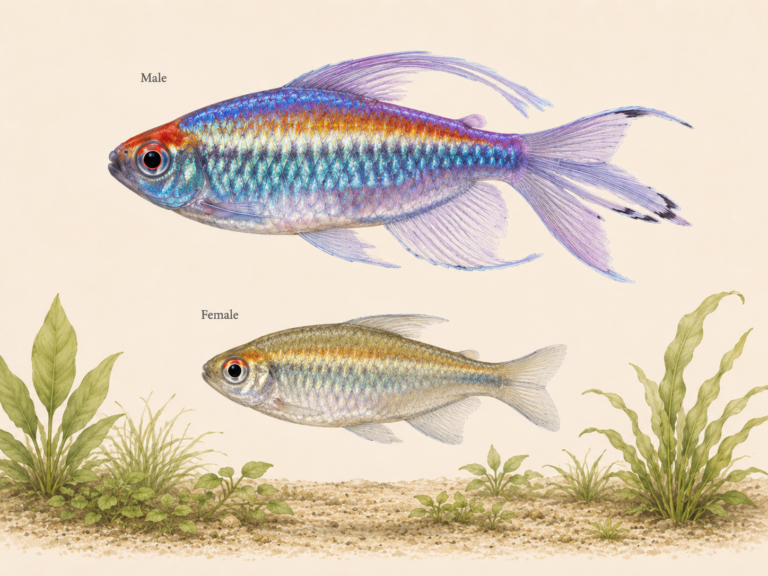
Betta mandor is a compact, laterally compressed fish that typically reaches between 5 and 6 cm in total length. The overall body shape is somewhat elongated and slender, though not dramatically so, with a rounded head and a slightly upturned mouth adapted for surface feeding and air-breathing. The body is dark brown to nearly black as a base colour, overlaid with iridescent scales that can shimmer in shades of green, blue, or teal depending on lighting conditions and the fish’s mood. Males are notably more colourful than females, particularly when displaying or in breeding condition.
Males in full colour display a rich, dark body adorned with rows of iridescent green or blue-green scales along the flanks. The opercular (gill cover) region often shows a distinctive bright marking, typically an iridescent blue or green patch that becomes especially vivid during courtship and territorial displays. The unpaired fins – dorsal, anal, and caudal – are dark with subtle iridescent edging or spotting. The caudal fin is rounded to slightly elongate and, according to the original species description, is proportionally longer in B. mandor than in B. foerschi, though this difference is slight and unreliable as a sole identification criterion. The pelvic fins are typically dark with lighter tips.
Females are generally paler and less iridescent than males. They display a more subdued brown body with less prominent scale iridescence and plainer fins. Females often show two dark lateral bands or a series of dark blotches along the midline of the body, which can also be visible in subdominant males or stressed individuals. Both sexes can change their colour and patterning rapidly in response to mood, social context, or environmental conditions – a trait common to many wild betta species.
As noted in the introduction, Betta mandor is extremely difficult to distinguish from Betta foerschi and Betta strohi based on appearance alone. The differences described in the scientific literature – such as the slightly slimmer body and proportionally longer caudal fin of B. mandor – fall within the range of normal individual variation. Colour and patterning are also broadly similar across the three species. Aquarists should not rely on visual identification alone and should always seek locality information when acquiring fish sold under any of these names.
Natural Habitat
Betta mandor is endemic to the Kapuas river basin in the province of West Kalimantan on the island of Borneo, Indonesia. The Kapuas is the longest river in Kalimantan and drains a vast area of lowland and peat swamp forest. Betta mandor inhabits the smaller tributaries, streams, and associated swamp habitats within this drainage rather than the main river channel itself. These are classic blackwater environments characterised by extremely soft, highly acidic water stained dark brown by dissolved humic substances leached from decomposing leaf litter and peat.
The typical habitat consists of slow-moving or still water beneath a dense forest canopy. The substrate is usually composed of a deep layer of fallen leaves, submerged branches, roots, and other organic debris. Light levels are very low, both because of the dense overhead vegetation and because the dark, tannin-rich water absorbs much of the available light. Aquatic vegetation is generally sparse in these heavily shaded environments, though emergent plants and marginal vegetation may be present along the banks.
Water parameters in these habitats are extreme by typical aquarium standards. The pH frequently falls below 5.0 and can be as low as 3.5 in some peat swamp areas. General and carbonate hardness are negligible, often registering as zero on standard test kits. Water temperature is relatively stable, typically ranging from 23 to 27 degrees Celsius, modulated by the shade provided by the forest canopy. Dissolved oxygen levels are relatively low, which is one reason labyrinth fish such as bettas thrive in these environments – their supplementary air-breathing organ allows them to survive where many other fish species cannot.
These peat swamp and blackwater forest habitats across Borneo are under significant and ongoing threat from deforestation, land conversion for palm oil plantations, logging, and peat drainage. While Betta mandor has not been formally assessed by the IUCN, the broader trend of habitat loss across West Kalimantan raises legitimate conservation concerns for this and many other endemic freshwater species in the region.
Tank Size and Setup
A single pair of Betta mandor can be maintained in a tank of at least 40 litres, though a larger aquarium of 60 litres or more is preferable and makes it easier to maintain stable water parameters. For a small group or a breeding project involving one male and two or three females, a tank of 75 to 100 litres is recommended. These are not open-water swimmers and do not require large horizontal swimming spaces, but they do benefit from a generous amount of structure and cover.
The aquascape should aim to replicate the dim, cluttered blackwater environment of the species’ natural habitat. A dark substrate is ideal – fine sand or a peat-based substrate works well, though some keepers use no substrate at all in breeding setups to make maintenance simpler. The tank should be heavily furnished with driftwood, dried leaf litter, and dense plantings or artificial cover to provide visual barriers and hiding spots. Indian almond leaves (Terminalia catappa), oak leaves, or other suitable botanicals should be added liberally. These serve a dual purpose: they provide cover and foraging opportunities, and as they decompose they release tannins and humic acids that help acidify the water and create the characteristic blackwater conditions this species requires.
Floating plants such as Salvinia, Riccia, or Amazon frogbit are highly recommended. They dim the lighting, provide cover at the surface, and offer anchor points for bubble nests. Low-light tolerant plants such as Java fern, Java moss, and various Cryptocoryne species can be used to add further structure. Avoid bright lighting – Betta mandor is naturally a shade-dwelling species and will be stressed and likely pale-coloured under intense illumination. A dim tank with subdued or filtered lighting will bring out the best colour and the most natural behaviour.
A tight-fitting lid is essential. Like all bettas, Betta mandor is a capable jumper and will escape through any uncovered gap. The lid also helps maintain the warm, humid air layer above the water surface that labyrinth fish need to breathe comfortably. Ensure there is a gap of at least a few centimetres between the water surface and the lid to allow this humid air pocket to form.
Water Parameters
| Temperature | 22-27 °C |
| pH | 4.0-6.5 |
| General hardness (GH) | 0-4 dGH |
| Carbonate hardness (KH) | 0-2 dKH |
| Ammonia | 0 ppm |
| Nitrite | 0 ppm |
| Nitrate | Below 20 ppm |
Betta mandor is a true blackwater species that requires soft, acidic water to thrive. This is not a fish that will adapt well to neutral or hard tap water. Most keepers will need to use reverse osmosis (RO) water or very soft rainwater as a base, remineralising only minimally or not at all depending on the starting mineral content. The pH should ideally be maintained between 4.5 and 6.0, with the lower end of this range more closely mimicking natural conditions. Values above 6.5 are not recommended for long-term health.
General hardness and carbonate hardness should both be kept very low. A GH of 0 to 4 dGH and a KH of 0 to 2 dKH is appropriate. With such low buffering capacity, the pH can fluctuate, so the use of botanicals such as Indian almond leaves, alder cones, and driftwood – combined with a peat filtration medium if desired – helps to naturally buffer the water at an acidic pH through the release of humic and tannic acids.
Temperature should be maintained in the range of 22 to 27 degrees Celsius. The species does not require particularly warm conditions compared to many tropical aquarium fish, and keeping the temperature at the lower to middle end of this range (around 24-25 degrees Celsius) is often a good target. Consistency is more important than hitting an exact number.
Ammonia and nitrite must be maintained at zero at all times. Betta mandor is sensitive to poor water quality. In the very soft, acidic water this species requires, the biological filtration cycle operates differently and can be less efficient than in harder, more alkaline water. Regular testing during the initial setup period is important. Nitrate should be kept below 20 ppm through regular partial water changes. When performing water changes, ensure the replacement water is matched closely in temperature, pH, and hardness to avoid shocking the fish.
Filtration and Equipment
Filtration for a Betta mandor tank should prioritise gentle water flow and effective biological filtration. Sponge filters are the most commonly used and recommended option. They provide adequate biological and mechanical filtration without creating strong currents that would stress this species. An air-driven sponge filter also contributes to gentle surface agitation, which aids gas exchange without disrupting the calm surface conditions preferred for bubble nest construction.
Small internal filters or hang-on-back filters with adjustable flow rates can also be used, provided the output is baffled or directed to avoid creating a strong current. Betta mandor originates from still or very slow-moving water and will be stressed by vigorous water movement. If using a filter with a stronger output, positioning the flow against the glass or through dense plant growth can help diffuse it.
For aquarists aiming to achieve very low pH values, adding peat granules or peat fibre to the filter media can be beneficial. This acts as both a chemical filtration medium and a natural water conditioner, gradually releasing tannins and humic substances. However, peat can lower pH unpredictably, so regular monitoring with a reliable pH meter or test kit is important, especially when first introducing it.
A heater rated for the tank size is necessary in most climates to maintain a stable temperature within the 22-27 degrees Celsius range. An adjustable heater is preferable to a pre-set model, as it allows fine-tuning. In cooler rooms, a thermometer (ideally a digital one for accuracy) should be used to monitor the temperature closely.
Lighting should be subdued. Standard aquarium LED units can be used but should be dimmed or set on a low-intensity programme. Alternatively, the lighting can be softened by the presence of abundant floating plants, which will filter the light naturally and create the dappled, shaded conditions under which this species shows its best colour and most confident behaviour. A timer to maintain a consistent photoperiod of approximately 8 to 10 hours is helpful for routine.
Diet and Feeding
Betta mandor is a micro-predator in the wild, feeding on small invertebrates, insect larvae, and other tiny organisms found among the leaf litter and detritus of its forest stream habitat. In captivity, it can be somewhat finicky, particularly with newly imported or wild-caught specimens that may initially refuse dried or prepared foods.
The ideal diet is based on small live and frozen foods. Daphnia, baby brine shrimp (Artemia nauplii), Moina, grindal worms, micro worms, and small bloodworms are all excellent choices. Live foods are particularly valuable for conditioning breeding pairs and for encouraging feeding in newly acquired or shy individuals. Frozen equivalents of these foods are a convenient staple and are generally accepted readily once the fish have settled in.
High-quality micro pellets or small granules formulated for bettas or small carnivorous fish can sometimes be accepted, particularly by captive-bred specimens, but wild-caught fish may refuse them entirely. If you wish to introduce dry foods, it is best to do so gradually alongside live or frozen offerings. Do not rely solely on dried foods for this species.
Feed small amounts once or twice daily, offering only as much as the fish will consume within a few minutes. Overfeeding is a significant risk in the soft, acidic conditions required by this species, as uneaten food decomposes rapidly and can cause dangerous spikes in ammonia. In the very low pH water preferred by Betta mandor, standard biological filtration may be less effective at processing nitrogenous waste, making careful feeding discipline even more important.
Behaviour and Temperament
Betta mandor is a relatively shy and retiring species compared to the domesticated Betta splendens most aquarists are familiar with. It spends much of its time sheltering among leaf litter, driftwood, and plant cover, emerging to feed or interact with conspecifics. When settled and secure in a well-furnished tank with appropriate water conditions, it becomes bolder and displays more openly, but it is never likely to be a fish that parades constantly at the front of the glass.
Males are territorial towards one another and will display and spar if they encounter a rival. In a sufficiently large, well-structured tank with plenty of visual barriers, it is sometimes possible to keep more than one male, but this requires careful observation and a willingness to separate individuals if aggression becomes excessive. In most situations, keeping a single male with one or more females is the safest approach. Male-female aggression can also occur, especially if the female is not receptive to spawning, so ample hiding places are essential for all tank inhabitants.
Displays between rival males are fascinating to observe. The displaying fish darkens its body colour, flares its gill covers to expose the iridescent opercular patches, and spreads its fins to maximum extent. These ritualised displays usually resolve disputes without physical damage, but in confined spaces, escalation to fin-nipping or more serious aggression is possible.
Betta mandor is generally peaceful towards other species that share its environmental requirements. It will ignore fish that are too large to be prey and too small or non-threatening to be perceived as competitors. However, it can be easily outcompeted for food by more assertive species, and its shy nature means it may hide permanently if kept with boisterous or fast-moving tank mates.
Tank Mates
Selecting tank mates for Betta mandor requires careful consideration of its specific environmental needs and its shy, retiring nature. Any potential companion must be able to tolerate the very soft, acidic blackwater conditions this species requires – this immediately rules out the majority of common community aquarium fish. Tank mates should also be peaceful, small, and not overly active or competitive at feeding time. In many cases, a species-only setup is the most appropriate choice, allowing the keeper to focus entirely on providing optimal conditions for Betta mandor and to observe its natural behaviour without interference.
Good tank mates
- Chocolate Gourami (Sphaerichthys osphromenoides) – A fellow blackwater species from Borneo that thrives in the same soft, acidic conditions and shares a similarly peaceful temperament.
- Harlequin Rasbora (Trigonostigma heteromorpha) – A gentle, small schooling fish that tolerates soft, acidic water and is unlikely to compete aggressively for food.
- Pygmy Corydoras (Corydoras pygmaeus) – A tiny, peaceful bottom-dweller that occupies a different zone in the tank and can tolerate soft water conditions.
- Kuhli Loach (Pangio kuhlii) – A shy, nocturnal bottom-dweller that does well in soft, acidic water and will not bother bettas.
- Ember Tetra (Hyphessobrycon amandae) – A tiny, calm schooling fish that can adapt to soft, acidic conditions and poses no threat or competition.
- Sparkling Gourami (Trichopsis pumila) – A small, peaceful labyrinth fish comfortable in similar blackwater conditions, though males may occasionally interact vocally.
- Lambchop Rasbora (Trigonostigma espei) – A small, undemanding rasbora that does well in soft, acidic water and keeps to the mid-water column.
Fish to avoid
- Betta splendens (Siamese Fighting Fish) – Aggressive, territorial, and may attack or be attacked; should never be mixed with wild betta species.
- Tiger Barb (Puntigrus tetrazona) – A notorious fin-nipper that is far too boisterous and aggressive for a Betta mandor tank.
- African Cichlids – Require hard, alkaline water completely incompatible with Betta mandor’s needs, and are far too aggressive.
- Common Pleco (Hypostomus plecostomus) – Grows far too large, produces excessive waste, and is unsuitable for the small, soft-water tanks Betta mandor requires.
- Guppy (Poecilia reticulata) – Requires harder, more alkaline water and the long fins of male guppies may provoke aggression from the betta.
- Chinese Algae Eater (Gyrinocheilus aymonieri) – Becomes aggressive and territorial with age and may harass or injure slow-moving bettas.
- Convict Cichlid (Amatitlania nigrofasciata) – Far too aggressive and territorial, with incompatible water requirements.
Breeding
Betta mandor is a bubble-nesting species. The male constructs a nest of air bubbles at the water surface, typically beneath a broad leaf, a piece of floating debris, or the underside of a lid or similar structure. Breeding in captivity is achievable but requires patience, excellent water quality, and careful conditioning of the pair.
To condition a pair for breeding, feed generously with high-quality live and frozen foods for several weeks. Females in breeding condition will appear noticeably plumper, and in some cases may display faint vertical bars on their flanks, a signal of readiness. Males will begin to build bubble nests with increasing frequency and intensity when conditions are right.
The breeding tank should be set up with very soft, acidic water – a pH of 4.5 to 5.5 is ideal. The temperature can be raised slightly to around 26-27 degrees Celsius to simulate the warmer conditions that may trigger spawning in the wild. Provide plenty of cover for the female, including dense plantings, leaf litter, and driftwood, so she can retreat from the male’s attentions when needed. Floating plants or a broad leaf positioned near the surface will serve as an anchor point for the bubble nest.
Spawning follows the typical anabantoid embrace. The male wraps his body around the female beneath the bubble nest, and eggs are released and fertilised simultaneously. The eggs float upwards into the nest or are collected by the male and placed there. This embrace is repeated multiple times over a spawning session that can last several hours. Clutch sizes are relatively small, typically ranging from 20 to 60 eggs.
After spawning, the female should be removed, as the male assumes sole responsibility for guarding and tending the nest. He will retrieve any fallen eggs and continue to maintain the bubble nest until the fry hatch, which usually occurs within 24 to 48 hours depending on temperature. The fry become free-swimming approximately two to three days after hatching. At this point, the male can be removed, though some males continue to show parental care without harming the fry.
Free-swimming fry are tiny and require very small first foods such as infusoria, Paramecium cultures, or commercially available liquid fry food. After a week or so, they can graduate to freshly hatched Artemia nauplii and micro worms. Growth is relatively slow, and the fry are sensitive to water quality fluctuations, so small, frequent water changes with carefully matched water are essential during the rearing period. Maintain the same soft, acidic conditions as the adult tank.
Common Diseases
Betta mandor is susceptible to the same diseases that affect other freshwater labyrinth fish, though its requirement for very specific water conditions means that many health problems can be traced back to environmental stress or poor water quality. Prevention through the maintenance of stable, appropriate water parameters is by far the most effective strategy.
Velvet disease (Oodinium) is one of the most common and serious afflictions in wild bettas. It presents as a fine, gold or rust-coloured dusting on the skin, often most visible on the head and gill covers. Affected fish may clamp their fins, scratch against objects, and become lethargic. Velvet thrives in warm, still water, making betta tanks particularly vulnerable. Treatment typically involves raising the temperature slightly, darkening the tank (Oodinium is photosynthetic), and using a copper-based medication, though copper should be used with caution in soft, acidic water as it can be more toxic under these conditions.
Ich (white spot disease, caused by Ichthyophthirius multifiliis) can also occur, presenting as small white spots on the body and fins. Raising the temperature to the upper end of the species’ tolerance range and treating with a suitable medication is the standard approach. Again, dosing should be cautious in very soft water.
Fin rot, caused by bacterial infection, is often a secondary condition triggered by stress, injury, or poor water quality. It appears as fraying, discolouration, or progressive erosion of the fin edges. Improving water quality is the first and most important step; mild cases often resolve with water quality improvements alone. More severe infections may require antibacterial treatment.
Internal parasites can be a concern, particularly in wild-caught specimens. Signs include weight loss despite a good appetite, stringy white faeces, and general lethargy. Prophylactic treatment of newly imported wild-caught fish with an appropriate antiparasitic medication is a sensible precaution, though this should be done in a quarantine tank before introducing fish to the main display.
Stress-related issues are perhaps the most insidious health concern for Betta mandor. Being kept in water that is too hard or too alkaline, in a tank that is too bright or too sparsely furnished, or with incompatible tank mates can all lead to chronic stress. Chronically stressed fish show faded colouration, loss of appetite, clamped fins, and increased susceptibility to opportunistic infections. Addressing the underlying environmental cause is always more important than treating symptoms.
FAQs
How can I tell Betta mandor apart from Betta foerschi and Betta strohi?
In practice, reliable visual identification between these three closely related species is extremely difficult, even for experienced aquarists. The morphological differences cited in the scientific literature, such as a proportionally longer caudal fin and slightly slimmer body in B. mandor, overlap substantially between individuals and species. The most dependable method of identification is through confirmed collection locality data. Betta mandor comes from the Kapuas river basin in West Kalimantan, while Betta foerschi originates from southern and south-eastern Kalimantan and Betta strohi from the Barito drainage. When purchasing, always ask the seller or breeder for locality information.
Can I keep Betta mandor in a standard community aquarium?
No. Betta mandor requires very soft, acidic blackwater conditions with a pH typically between 4.0 and 6.5 and negligible hardness. These parameters are incompatible with the vast majority of common community fish. Additionally, Betta mandor is shy and easily outcompeted for food. A species-only tank or a carefully curated blackwater community with other soft-water-tolerant species is necessary.
Is Betta mandor a mouthbrooder or a bubble-nester?
Betta mandor is a bubble-nester. The male builds a nest of air bubbles at the water surface, typically beneath a leaf or piece of cover, and tends the eggs and newly hatched fry there. This distinguishes it from mouthbrooding betta species found in other groups, such as the albimarginata or channoides complexes, where the male incubates the eggs in his mouth.
What is the best way to lower the pH for Betta mandor?
The most effective and safest approach is to use reverse osmosis (RO) water as a base, which has very low mineral content and minimal buffering capacity, allowing the pH to drop naturally. Adding Indian almond leaves, driftwood, alder cones, and peat to the tank or filter will release tannins and humic acids that gently lower and stabilise the pH at acidic levels. Avoid using chemical pH adjusters, as these can cause sudden and dangerous fluctuations, especially in unbuffered water.
How many Betta mandor can I keep together?
A single pair is the simplest and safest arrangement for most aquarists. In a larger, well-furnished tank of 75 litres or more with abundant visual barriers, one male can be kept with two or three females. Keeping multiple males together is risky and generally only feasible in spacious, heavily planted tanks where territories can be established without constant conflict. Always have a contingency plan to separate individuals if aggression becomes problematic.
Related Guides
- Betta foerschi Care Guide – The closest relative of Betta mandor, sharing nearly identical care requirements and presenting the same identification challenges discussed in this guide.
- Betta strohi Care Guide – Another member of the foerschi group with overlapping appearance and husbandry needs, useful for comparison if you are unsure of your fish’s identity.
- Chocolate Gourami Care Guide – A compatible blackwater species from a similar geographic region, often kept alongside wild bettas in soft, acidic setups.
- Betta channoides Care Guide – A popular mouthbrooding wild betta species from Borneo, offering an interesting comparison in reproductive strategy and care for keepers interested in exploring other wild betta groups.
- Betta albimarginata Care Guide – Another well-known Bornean wild betta, this mouthbrooding species is a common entry point for aquarists moving into wild betta keeping and shares some habitat overlap with foerschi-group species.